Slides
Lesson plan
Energy on the Move
Students learn sound, light, heat, and electric current carry energy. They observe transfers and draw the path energy takes.
Objectives
- Students will observe that sound, light, heat, and current transfer energy place to place.
- Students will use observations as evidence to explain where energy started and ended.
Success criteria
- I can name the four ways energy moves and give an example.
- I can describe what I observed to prove energy moved place to place.
- I can draw arrows to show energy path from source to receiver.
Key words
| Word | Meaning |
|---|---|
| energy | power that can make things move, warm up, or glow |
| transfer | movement of something from one place to another place |
| sound | what ears hear when air shakes and makes things shake |
| light | brightness that lets eyes see and can warm skin |
| heat | warmth that moves from a warmer thing to a cooler thing |
| electric current | moving power in wires that can light a bulb |
Timed plan (60 minutes)
| Time | Stage | What happens |
|---|---|---|
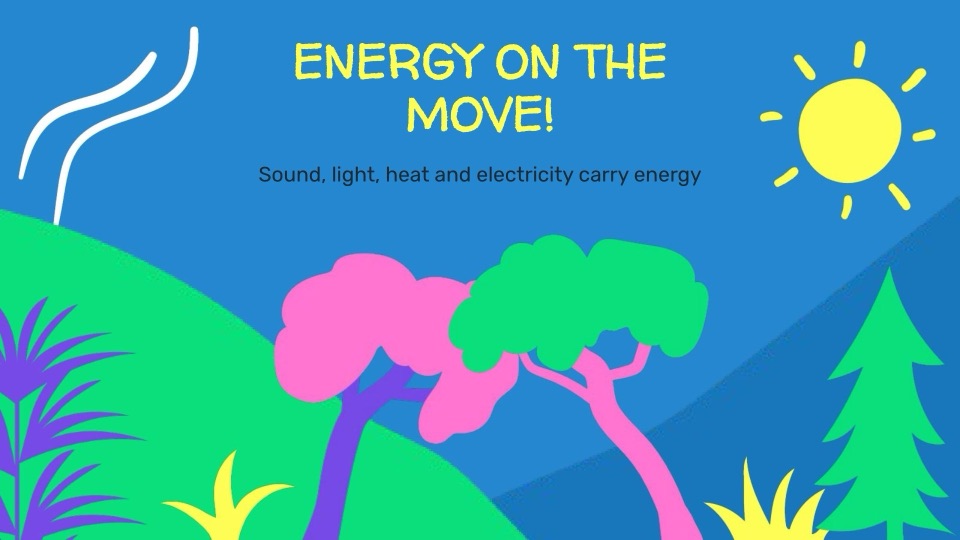
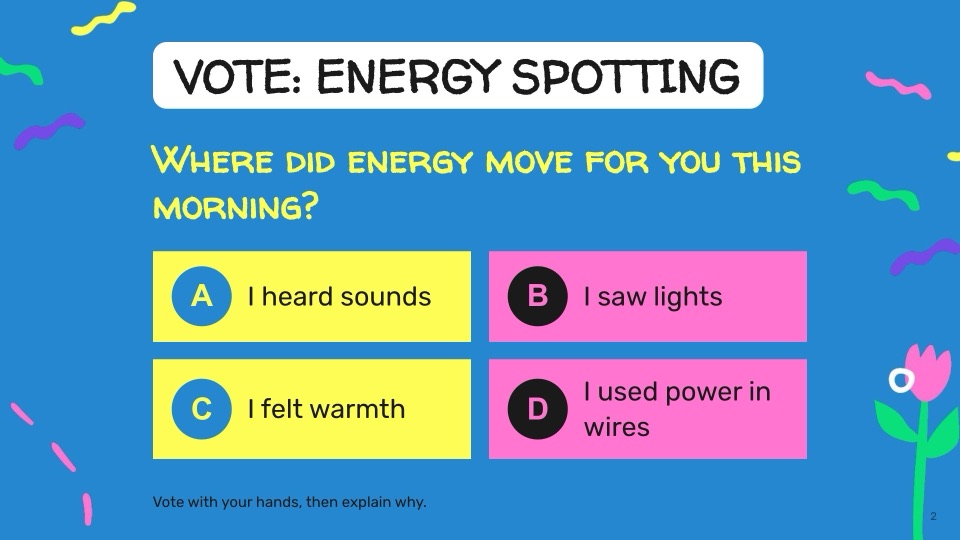
| 8 min | Starter | Activate everyday experiences of energy movement and hook interest in seeing the unseen. Show Slide 1 and read title: Sound, light, heat and electricity carry energy. Use the hook: If you had super glasses that let you see energy moving, what would you see? Take 3 quick ideas. Show Slide 2 and read: Where did energy move for you this morning? Let students vote: I heard sounds, I saw lights, I felt warmth, I used power in wires. Chart 2–3 examples under claim and evidence to model later talk. |
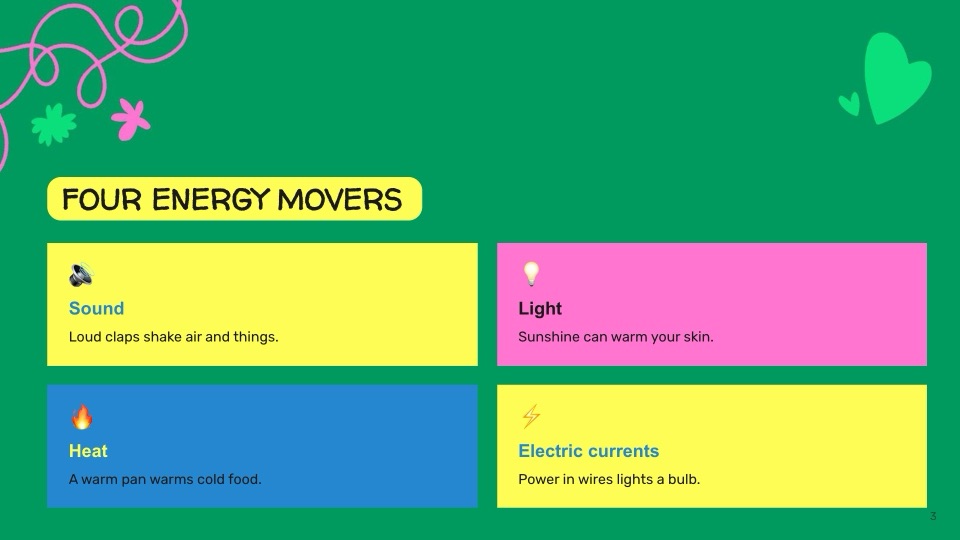
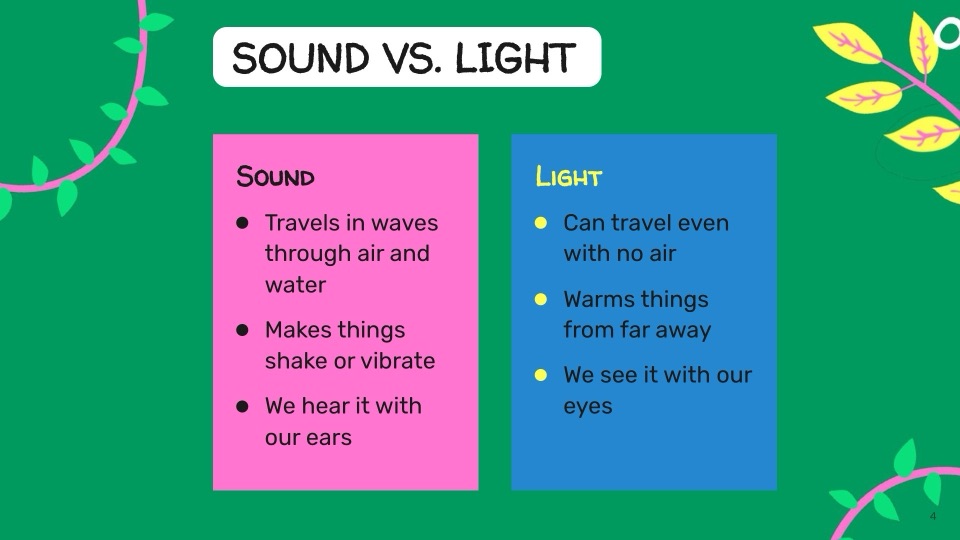
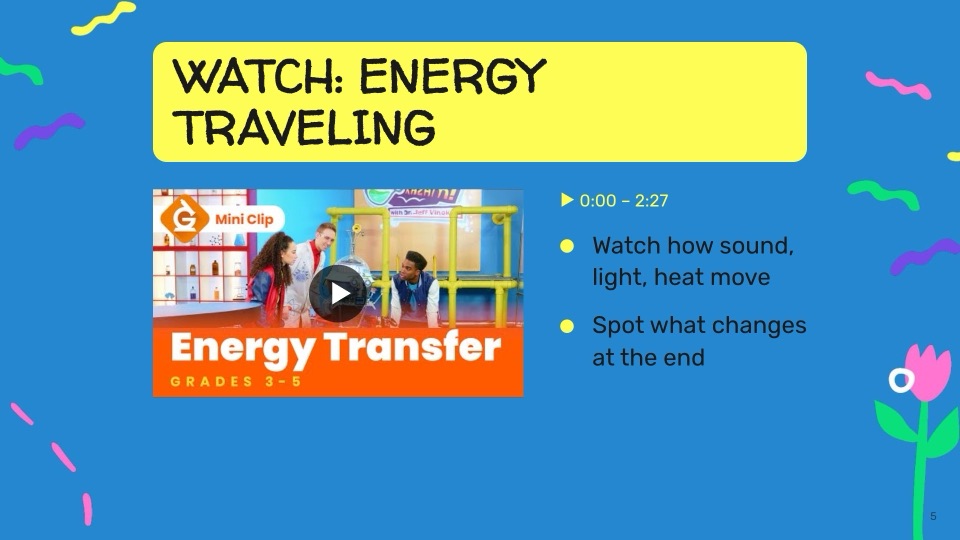
| 12 min | Teaching | Explain the four movers and model how to trace energy from start to end. Show Slide 3 Four energy movers and point to each card: sound shakes, light shines, heat warms, electricity flows. Show Slide 4 Sound vs. Light and read key lines with class. Play Video clip 1 (0:00–2:27) on Slide 5: Watch how sound, light, heat move. Tell students to spot what changes at the end. Model one traced example on board: flashlight to wall with arrow. |
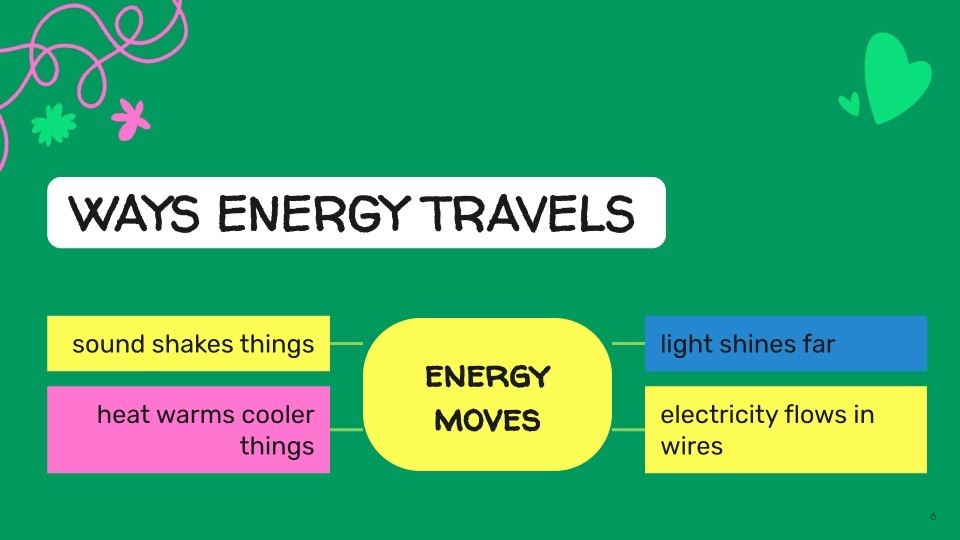
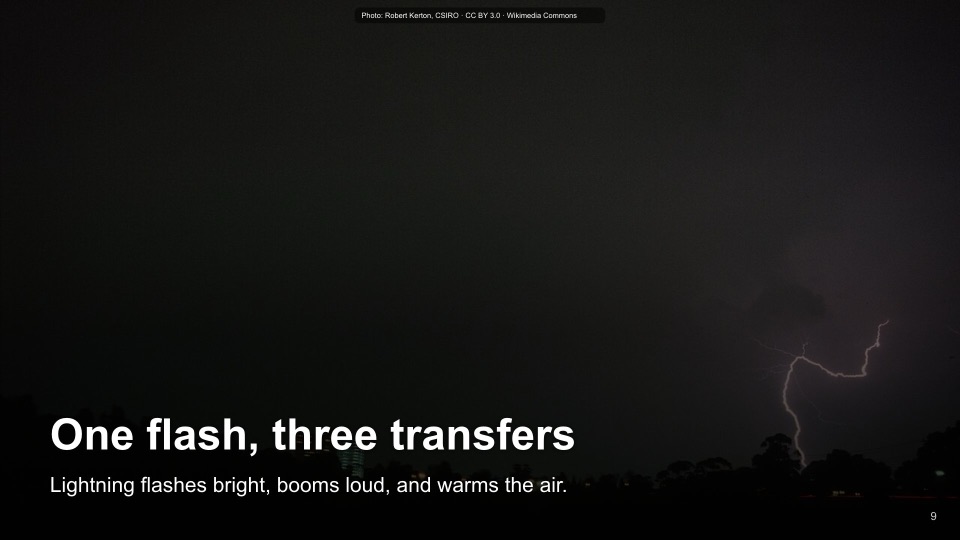
| 15 min | Guided observation | Make shared observations of all four transfers to use as evidence. Show Slide 6 mindmap: energy moves, sound shakes things, light shines far, heat warms cooler things, electricity flows in wires. Demo 1 sound: tap drum near tissue. Demo 2 light: shine flashlight at paper 6 feet away, block then unblock. Narrate start to end. Demo 3 heat: hold warm cup and show metal spoon in warm tap water about 100°F, touch handle after 1 minute. Demo 4 electric current: close battery-bulb loop to light, then open one wire. Show Slide 9 photo and read: Lightning flashes bright, booms loud, and warms the air. Ask which movers are shown. |
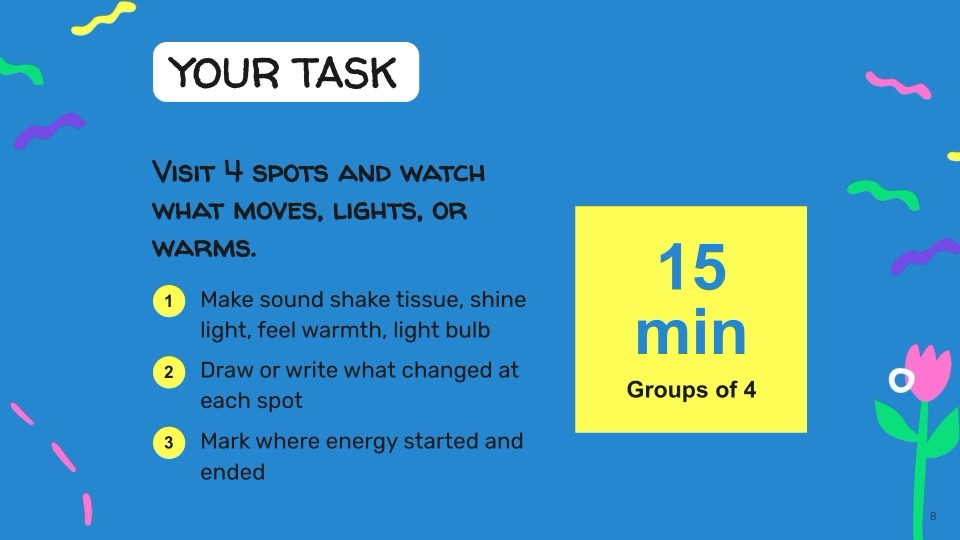
| 17 min | Main activity | Draw and label how energy travels from source to receiver for each mover. Show Slide 8 and read: Visit 4 spots and watch what moves, lights, or warms. Make sound shake tissue, shine light, feel warmth, light bulb. Draw or write what changed. Hand out paper folded into four boxes, crayons, pencils. Model box 1: drum to ear with arrow labeled sound and note tissue shook. Send students to draw boxes 2–4: flashlight to wall, warm pot to hand above it, battery to bulb, with arrows labeled light, heat, electric current and end observation. Collect strips and have 2 students explain start, path, and proof. |
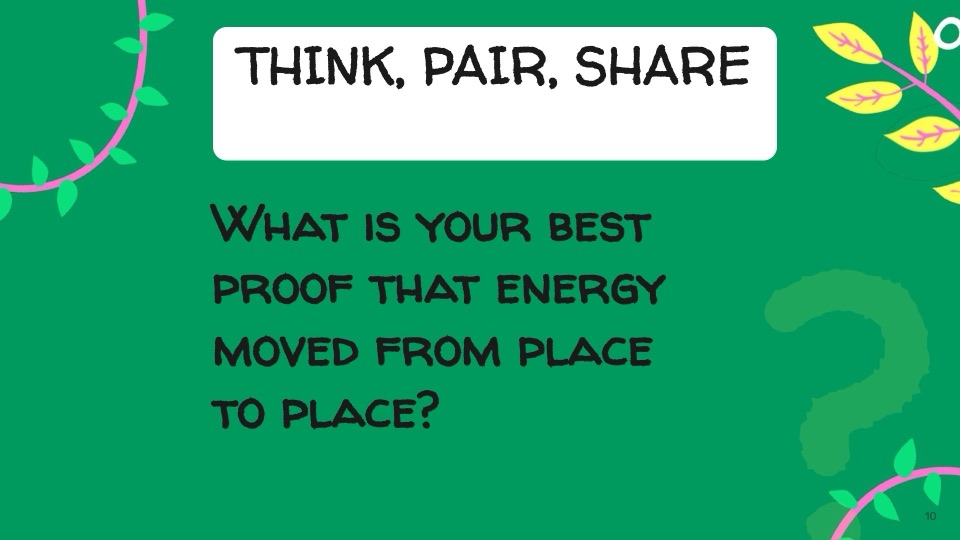
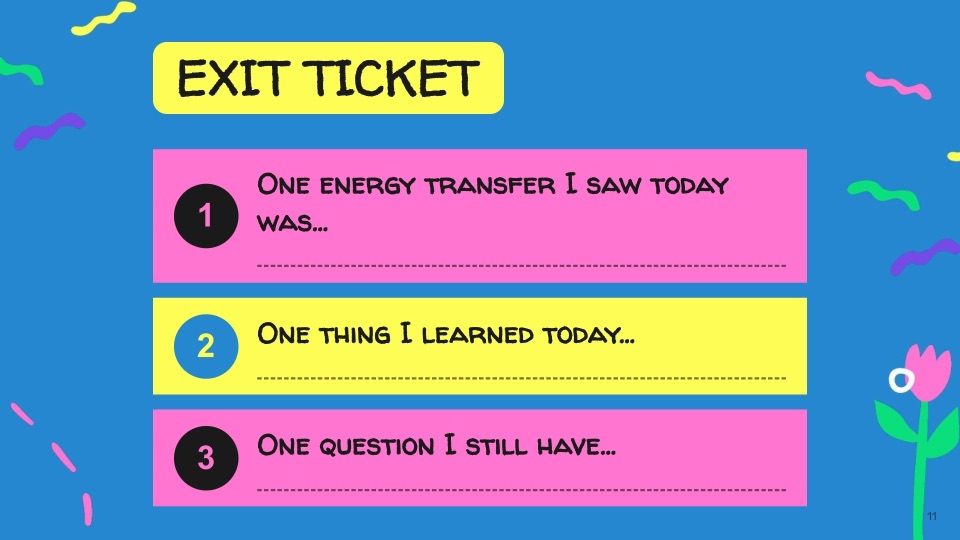
| 8 min | Plenary | Share best evidence and check that all four transfers are understood. Show Slide 10 and ask: What is your best proof that energy moved from place to place? Think, pair, share comic strips. Do Worksheet Task G Matching: match each word to its meaning by writing the number in the circle. Show Slide 11 Exit ticket: One energy transfer I saw today was... One thing I learned today... One question I still have... Collect on slips. |
Common mistakes
- Thinking energy disappears when bulb goes out or sound stops
How to spot it: Says energy is gone when circuit is opened or drum stops
Trace where it went: bulb cools, sound shook air and tissue. Energy transfer is movement from one place to another. - Mixing heat and temperature – cold moves into warm object
How to spot it: Says cold from ice moved into hand
Restate heat is transfer due to difference in temperature and flows hotter to colder; cold feeling is warmth leaving hand. - Thinking light needs air to travel like sound does
How to spot it: Says light stops with no air
Compare: sound travels in waves through air and water, light can travel even with no air and warms from far; sun warmth traveled 93 million miles.
Support
- Use pre-made shaker, drum, and pre-drawn comic panels so focus is on watching rice jump and labeling arrow
- Keep floor marks for standing and aiming flashlight and color-dot sorting hints for sound, light, heat, current
- Give sentence frames: I know energy moved because I observed ___ and My evidence is ___
Stretch
- Compare soft and loud shakes from 3 feet away and test flashlight 3 feet closer and farther to describe spot change
- Add blocked-path panels and explain tricky lamp card where electrical energy becomes both light and heat
- Predict ice-water spoon test and second-bulb brightness change with where energy went
Check questions
- Give one observation that proves sound transferred energy place to place.
Answer: Tissue shook / grains jumped when drum was tapped nearby without touching. - Give one observation that proves light or heat transferred energy.
Answer: Bright spot appeared on wall 6 feet away; spoon handle felt warmer in warm water. - How do you know electric current transferred energy to the bulb?
Answer: Bulb lit when loop was closed and went out when wire was opened.
Curriculum
Make observations to provide evidence that energy can be transferred from place to place by sound, light, heat, and electric currents.
Video clips
Clips on YouTube, from the start and end times we chose. Check each one before you show it.
-
Energy transfer overview from 0:00 to 2:27
GenerationGenius: Energy Transfer for Kids | Science Lesson for Grades 3-5 | Mini-Clip
Made for grades 3-5 so vocabulary and pace are perfect for ages 9-10 and it introduces transfer by sound, light, heat and electric currents.
-
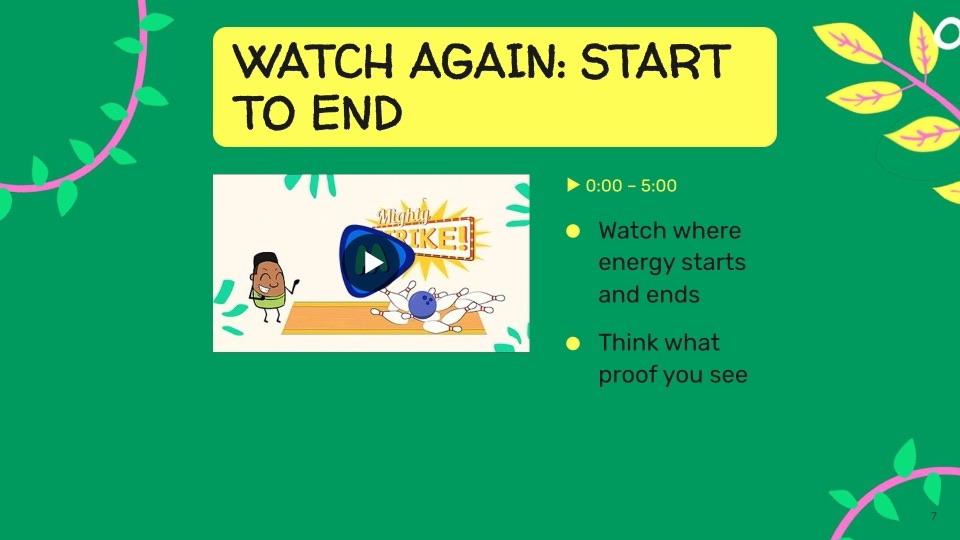
How energy moves from 0:00 to 5:00
MightyOwl: How can we transfer energy? | MightyOwl Science | 4th Grade
Made for 4th grade so ideal for ages 9-10 and shows how sound, light, heat and electric currents carry energy.
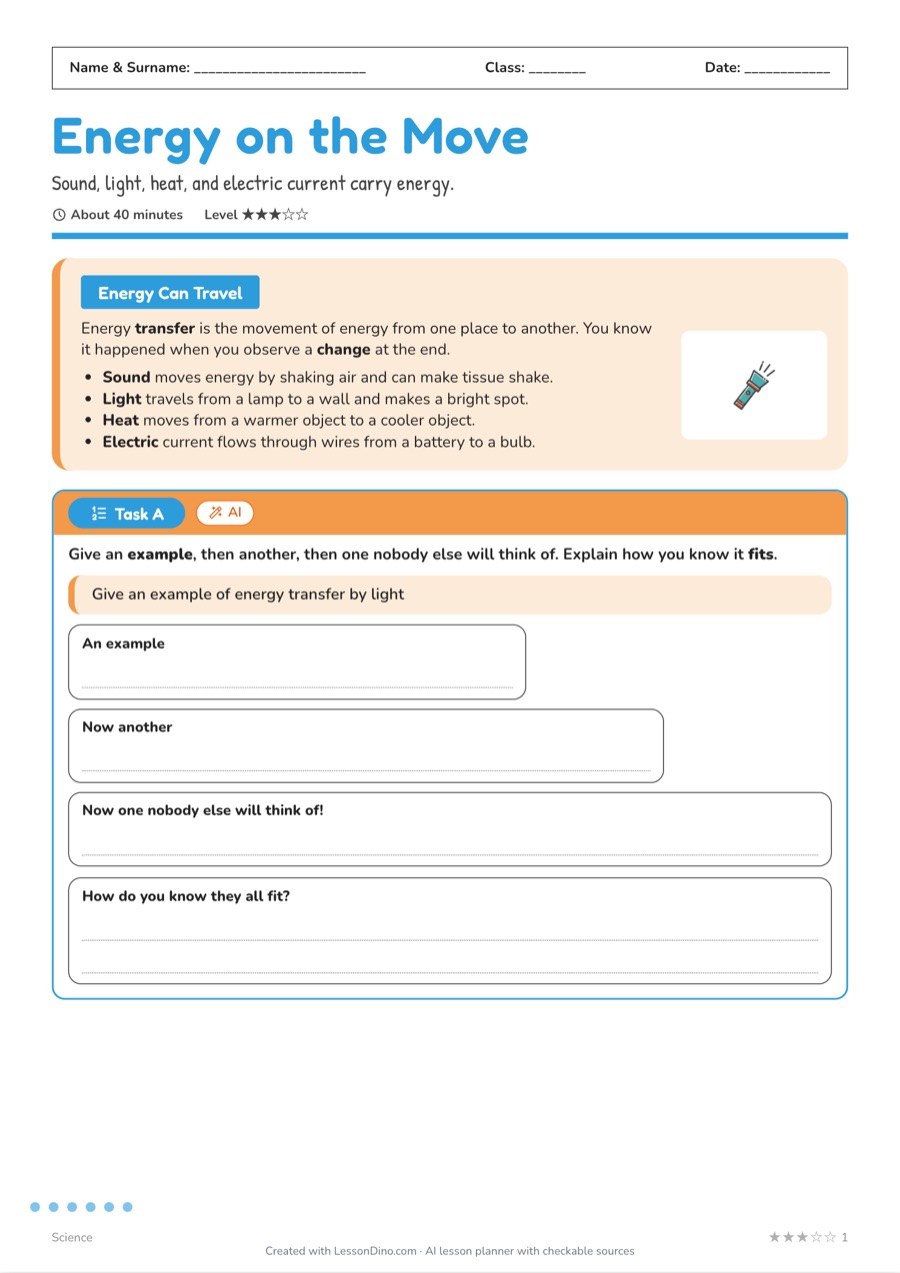
Worksheet
Sources
- 4.Energy | Next Generation Science Standards nextgenscience.org
- 4th Grade Topics Model | Next Generation Science Standards nextgenscience.org
- Energy Transfer energy.gov
- Energy Transfers - Minnesota State Engineering Center of Excellence engineering.mnsu.edu
- Energy Transfer by Heat - Thermodynamics - University of Central ... pressbooks.online.ucf.edu
- Thermal Energy Transfer - NASA nasa.gov
- STEMonstrations: Thermal Energy - NASA nasa.gov
- Energy Transfer - University of Miami chemistry.as.miami.edu
- Energy stores and energy transfers - Forces and movement - KS3 Physics ... bbc.co.uk
- Energy transfers - Transferring energy - Edexcel - GCSE Combined ... - BBC bbc.co.uk
- Energy transfer Facts for Kids kids.kiddle.co
- Energy transfer through bouncing balls - Science for Kids sciencekids.co.nz
- Physics for Kids: Heat Energy - Ducksters ducksters.com
- Energy Transfers and Transformations - Education education.nationalgeographic.org
- [2107.01459] Energy transfer for solutions to the nonlinear Schr… arxiv.org
- Simply explained: Energy Stores and Transfers Explained for ... mumble.nationalgeographic.com
- $100 billion pipeline company Energy Transfer will move stock listing from New York to Dallas kwbu.org
- Energy Transfer Video For Kids | 3rd, 4th & 5th Grade generationgenius.com
- Open-and-go lessons that inspire kids to love science. mysteryscience.com
- Energy Transfer - Definition, Examples, Quiz, FAQ, Trivia workybooks.com
- Simply explained: Energy Stores and Transfers Explained for Kids ... knowunity.co.uk
- Energy Conservation Transfer Exploring Energy Through Technology assistcenter.org
- Energy Transfer tapped as Global Partner of 2026 Presidents Cup - PGA Tour pgatour.com
- Energy Transfer | LinkedIn linkedin.com
- CB Insights cbinsights.com
Picture credits
- Photo: Robert Kerton, CSIRO · CC BY 3.0 · Wikimedia Commons
- Illustration: Memed_Nurrohmad · Pixabay
- Pictograms: Sergio Palao, ARASAAC (arasaac.org) · CC BY-NC-SA
- Microsoft Fluent Emoji (MIT)
Made with Lesson Dino's AI on 17 October 2026. AI can make mistakes, so check facts against the sources before you teach.