Slides
Lesson plan
Linking Words That Join Ideas
Students learn to use relative pronouns and adverbs to add detail. They write and solve partner riddles with who, which, that, where, when and why.
Objectives
- Students will use who, whose, whom, which, and that to tell about people and things.
- Students will use where, when, and why to tell about place, time, and reason.
- Students will join two short sentences into one smooth, complete sentence.
Success criteria
- I can pick the right linking word for a person, thing, place, time, or reason.
- I can write one smooth sentence using a linking word to add detail.
- I can point to the noun my linking word tells more about.
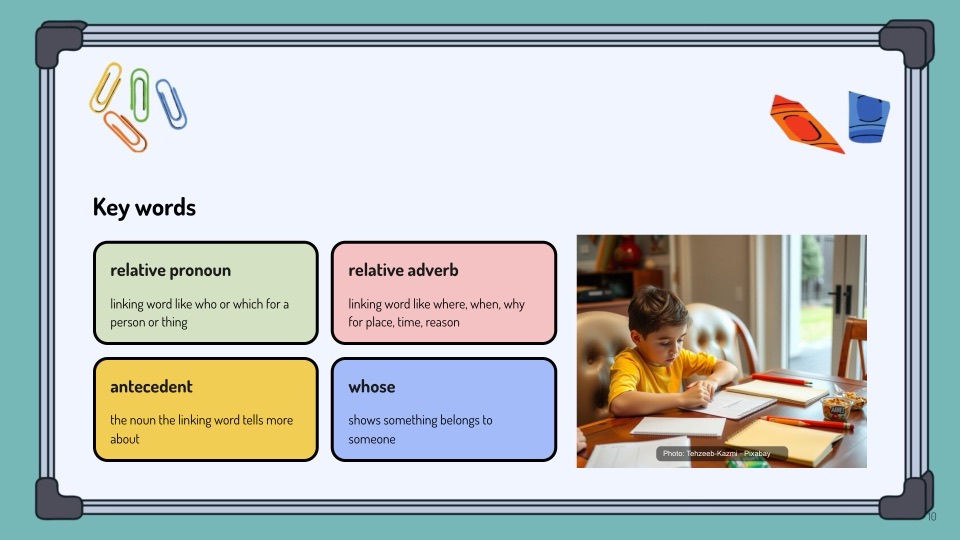
Key words
| Word | Meaning |
|---|---|
| relative pronoun | joining word such as who, which or that that tells more about a person or thing |
| relative adverb | joining word such as where, when or why that tells more about place, time or reason |
| antecedent | the noun that a joining word points back to and replaces |
| join | to clip two short parts together to make one smooth sentence |
Timed plan (60 minutes)
| Time | Stage | What happens |
|---|---|---|
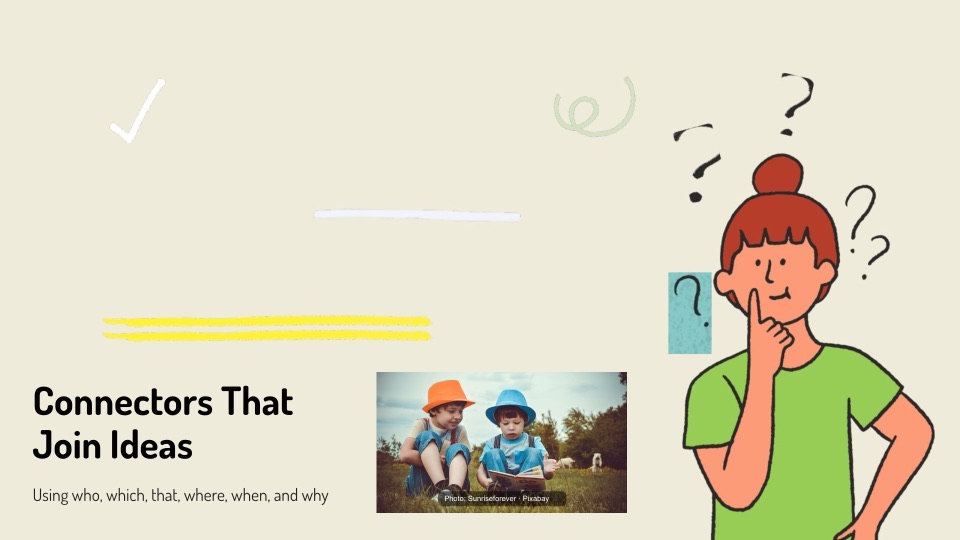
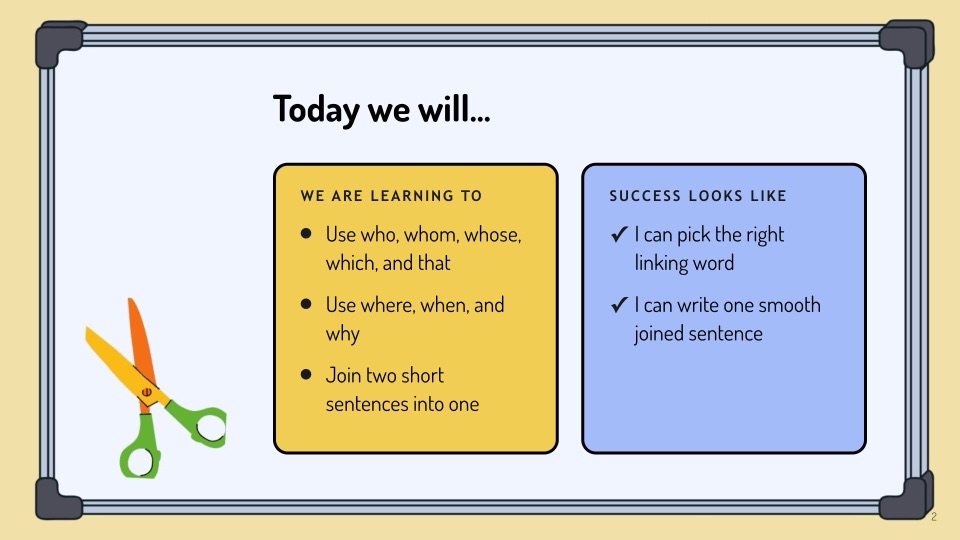
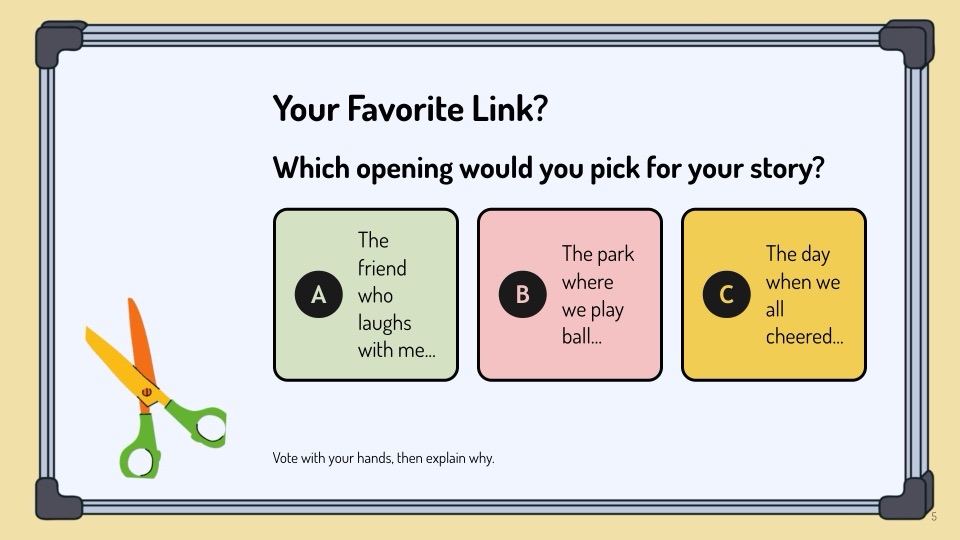
| 5 min | Starter | Hook interest with a riddle and surface what students know about linking words. Show Slides 1-2 to share the title Connectors That Join Ideas and the goals for today. Say the hook riddle: I am thinking of something that you use every day, in a place where we learn. What is it? Now you make one! Show Slide 5 Your Favorite Link and read the three openings for a vote. Take a quick hand vote and repeat the winning sentence aloud. |
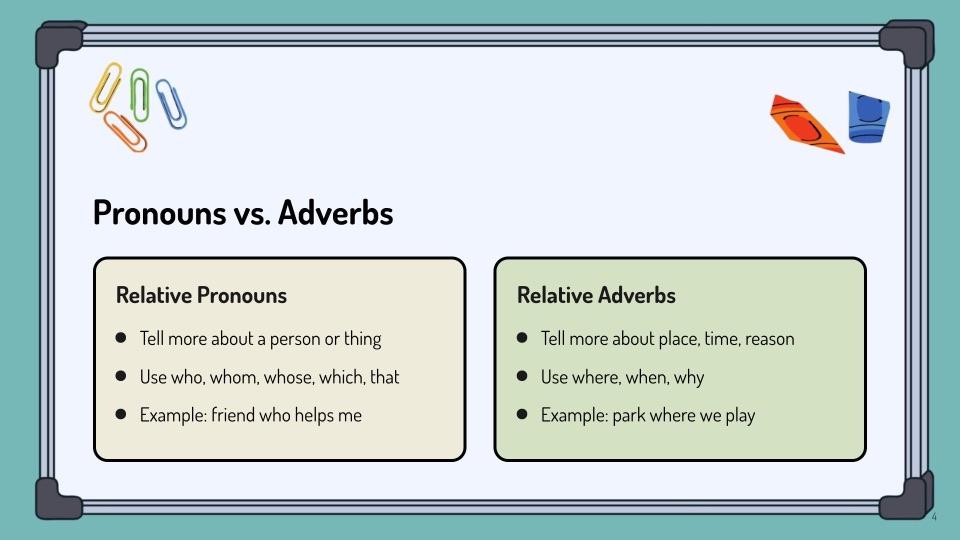
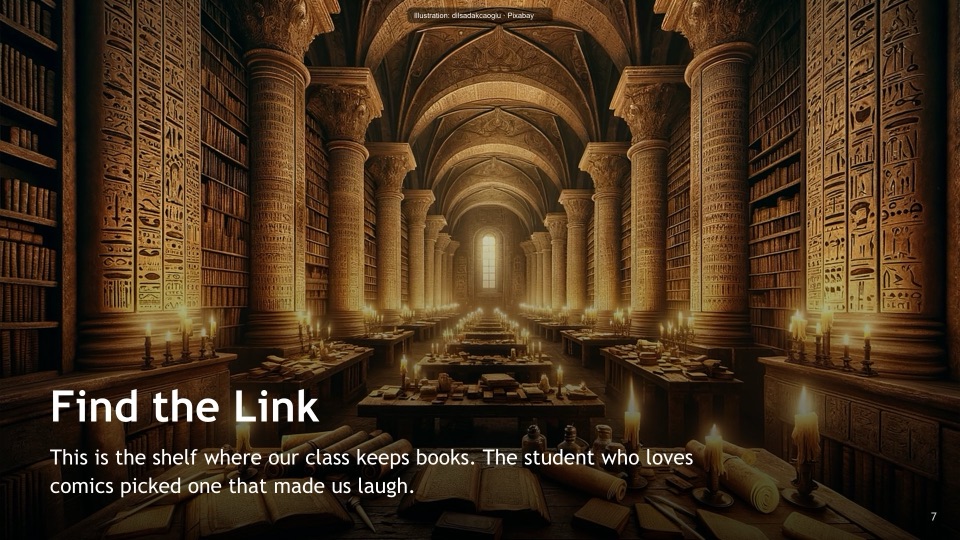
| 10 min | Teaching | Teach the difference between relative pronouns for people and things and relative adverbs for place, time, and reason. Show Slide 3 and read: Small joining words add details and keep writing smooth. Show Slide 4 and chart who, whose, whom, which, that for a person or thing and where, when, why for place, time, or reason. Show Slide 7 and read aloud: This is the shelf where our class keeps books. The student who loves comics picked one that made us laugh. Model underlining each linking word and circling the noun it points back to, which is called its antecedent. |
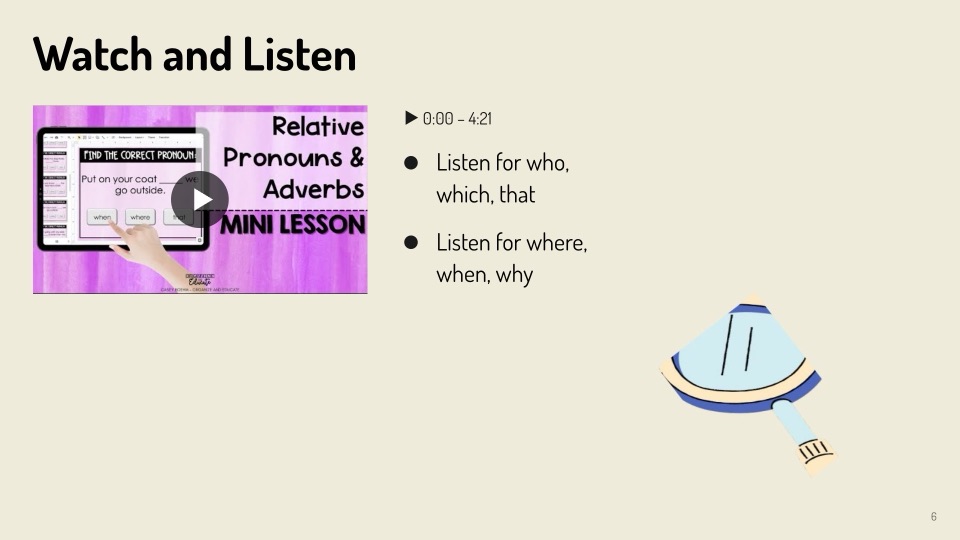
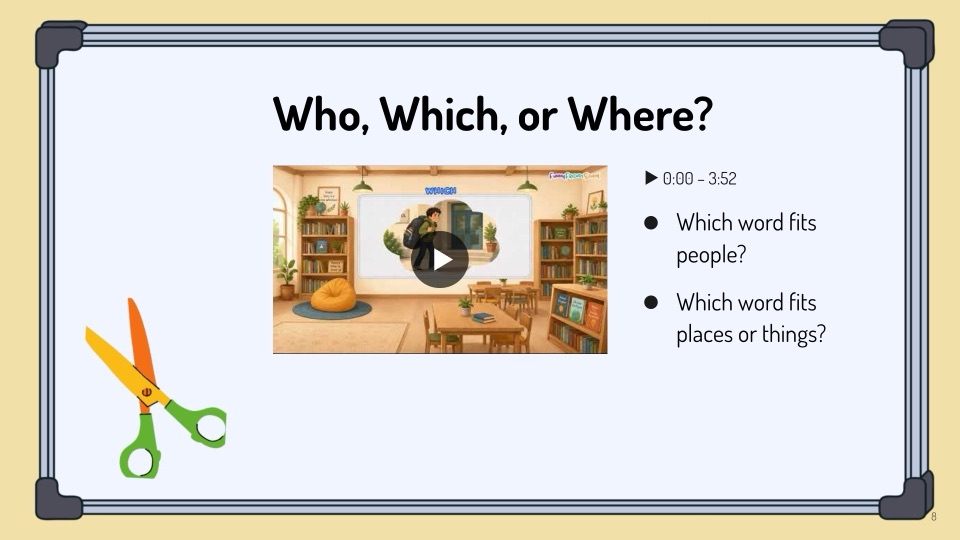
| 10 min | Guided practice | Hear correct models on video and practice choosing the right linker. Show Slide 6 and play Video clip 1 (0:00-4:21). Tell students to listen for who, which, that and for where, when, why. Show Slide 8 and play Video clip 4 (0:00-3:52). Pause to ask which word fits people and which fits places or things. Hand out Worksheet Task D and read the direction to label each picture with one linker from who, whose, which, where, when, why. Do the first two together, thinking aloud about person, thing, place, time, or reason. |
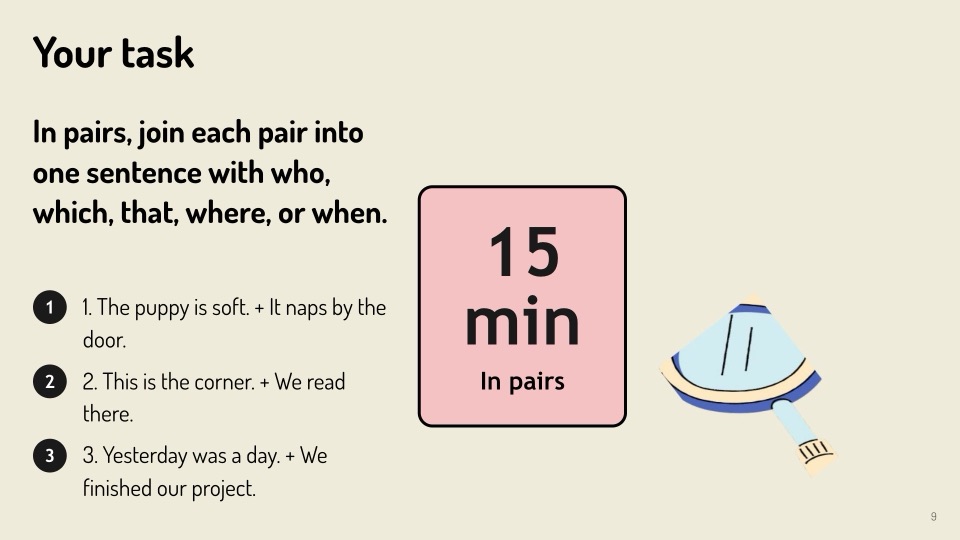
| 20 min | Main activity | Write and solve partner riddles using relative pronouns and adverbs. Show Slide 9 Your task with the three pairs to join and model joining the corner pair with where. Model two riddles on the board: I am a thing which holds pencils. and I am a place where we eat lunch. Underline which and where and circle thing and place. Give each pair index cards and pencils. Tell Student A and Student B to each write two riddles using who, which, that plus where, when, why. Have partners trade cards, guess, and underline the relative word that gave the best clue. |
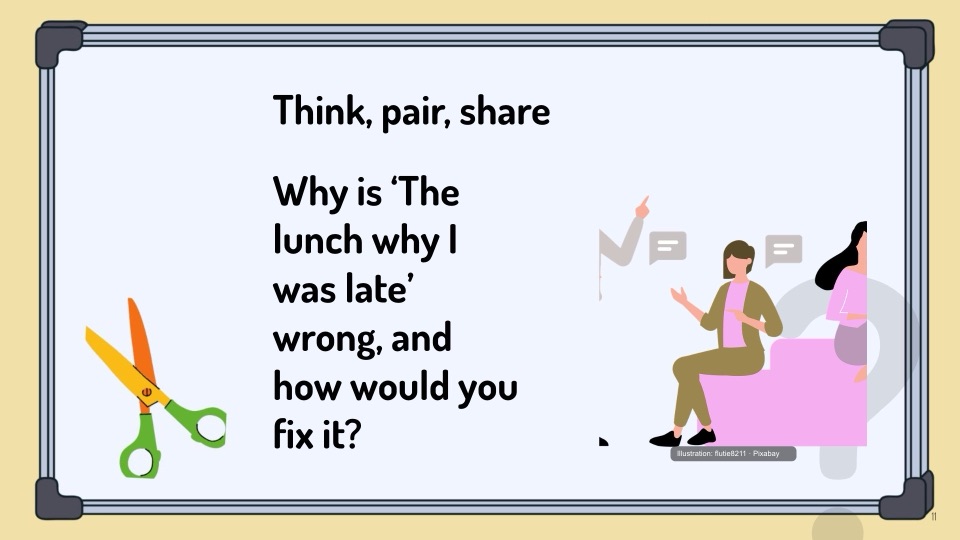
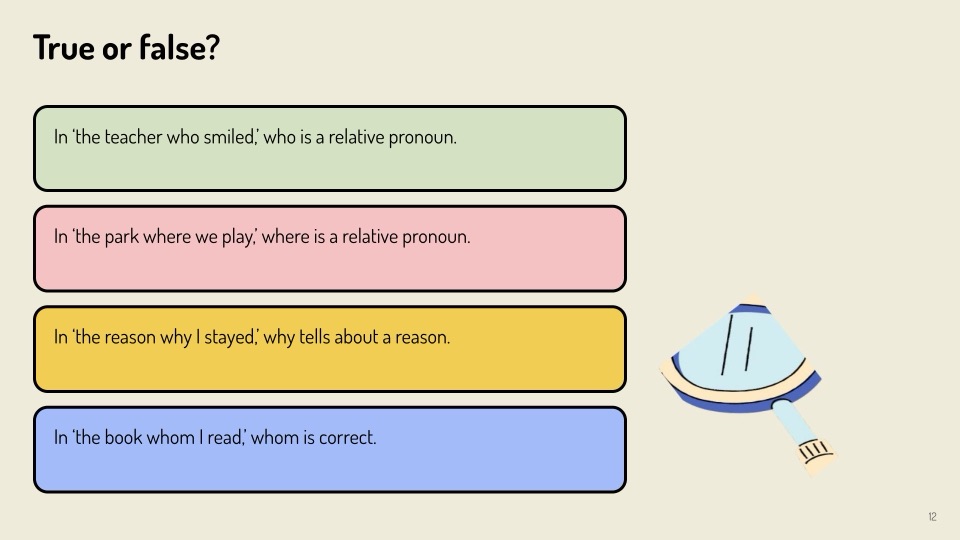
| 15 min | Plenary | Fix common errors and check everyone can pick the right word and explain why. Show Slide 11 and discuss in pairs: Why is The lunch why I was late wrong, and how would you fix it? Show Slide 12 True or false and vote on each line, stressing that where in the park where we play is a relative adverb, not a pronoun. Hand out Worksheet Task F and have students tick each box as they check their riddle for a complete sentence and correct linker. Collect two fixed sentences and restate the pronoun list and adverb list for the exit. |
Common mistakes
- Using who for a thing, like the pencil who broke
How to spot it: Hear who after a thing word in reading aloud or on Task D
Ask person or thing? Use who for a person and which or that for a thing. Fix to the pencil which broke. - Using where for time, like the day where it rained
How to spot it: See where after day, morning, or time in chains and riddles
Ask place, time, or reason? Use where for place, when for time, why for reason. Fix to the day when it rained. - Calling where a relative pronoun in the park where we play
How to spot it: True or false vote says true on Slide 12 third line
Restate that where, when, why are relative adverbs. Point to park as place and label where as adverb.
Support
- Offer riddle frames: I am a person who ___ and It is a time when ___.
- Give a word bank card that shows who for a person and which or that for a thing.
Stretch
- Require a two-clue riddle that uses both a relative pronoun and a relative adverb, like It is a thing that rings when class ends.
Check questions
- Fill it: She is the student ___ helped me. Who or which?
Answer: who, because student is a person. - Fill it: This is the room ___ we read. Where or when?
Answer: where, because room is a place and where is a relative adverb. - Is whose correct here: This is the student whose book fell? Yes or no, why?
Answer: Yes, whose shows ownership and points to student.
Curriculum
Use relative pronouns (who, whose, whom, which, that) and relative adverbs (where, when, why).
Video clips
Clips on YouTube, from the start and end times we chose. Check each one before you show it.
-
4th Grade Pronouns and Adverbs from 0:00 to 4:21
Casey | Teacher Planning & Organization: Relative Pronouns and Adverbs- for 4th Grade
Made specifically for 4th grade and covers both relative pronouns and adverbs with pace and examples right for ages 9-10.
-
Who, Which or Where for Kids from 0:00 to 3:52
Funny friends school.: 📚 WHO, WHICH or WHERE? | Relative Clauses for Kids | Cambridge English Grammar
Made for kids and focuses on choosing who, which, and where, which is perfect practice for ages 9-10.
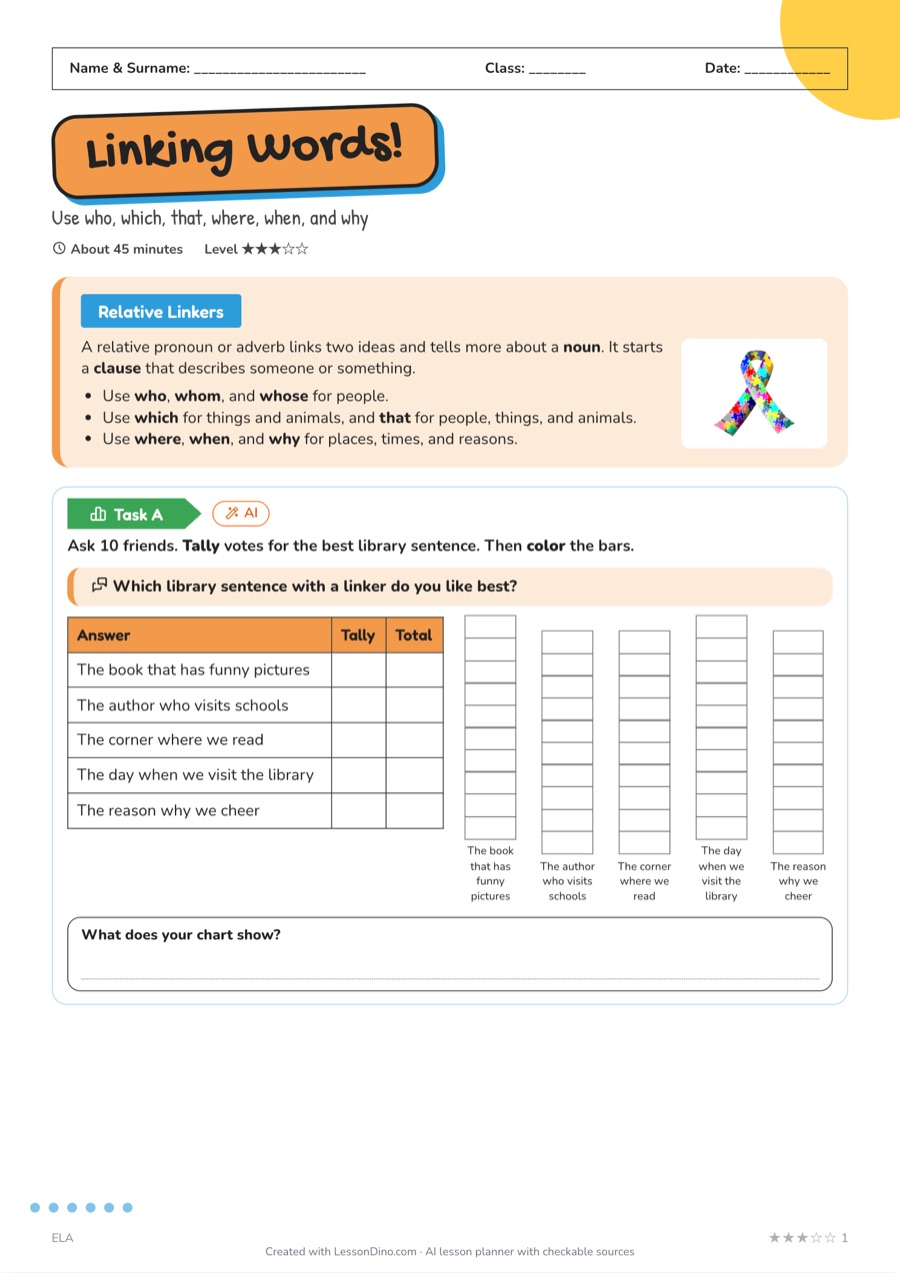
Worksheet
Sources
- English Language Arts Standards » Language » Grade 4 thecorestandards.org
- English Language Arts Standards » Language » Grade 4 » 1 » a thecorestandards.org
- Pronoun Facts for Kids kids.kiddle.co
- Romanian grammar Wikipedia
- Old English grammar Wikipedia
- Reciprocal pronoun Wikipedia
Picture credits
- Photo: Sunriseforever · Pixabay
- Photo: FeeLoona · Pixabay
- Illustration: dilsadakcaoglu · Pixabay
- Photo: Tehzeeb-Kazmi · Pixabay
- Illustration: flutie8211 · Pixabay
- Drawing: J_Alves · CC0 · Wikimedia Commons
- Microsoft Fluent Emoji (MIT)
- Picture: unknown · CC0 · rawpixel via Openverse
- Drawing: Nevit Dilmen · CC0 · Wikimedia Commons
- Pictograms: Sergio Palao, ARASAAC (arasaac.org) · CC BY-NC-SA
- Drawing: CC BY-SA 4.0 · Wikimedia Commons
- Illustration: OpenClipart-Vectors · Pixabay
Made with Lesson Dino's AI on 17 October 2026. AI can make mistakes, so check facts against the sources before you teach.