Slides
Lesson plan
Poem, Drama, or Prose? Spot the Structure
Students learn how poems, drama, and prose look and sound different. They sort three rain texts and prove each form with structure clues.
Objectives
- Students will explain major differences between poems, drama, and prose.
- Students will identify poem parts verse, rhythm, meter and drama parts cast, setting, dialogue, stage directions.
- Students will use structure words to prove a text type in speech and writing.
Success criteria
- I can name poem, drama, or prose and give two structure clues.
- I can point to verse and rhythm in a poem and dialogue and stage directions in drama.
- I can explain how structure changes how a text looks or sounds.
Key words
| Word | Meaning |
|---|---|
| verse | words set in short lines that make up a poem |
| rhythm | a repeated beat you can hear when you read aloud |
| meter | the steady count of beats kept in the lines of a poem |
| stanza | a group of lines with space around it, like a paragraph for a poem |
| dialogue | the words a character says out loud to others |
| stage directions | notes in parentheses that tell actors how to move or speak |
Timed plan (60 minutes)
| Time | Stage | What happens |
|---|---|---|
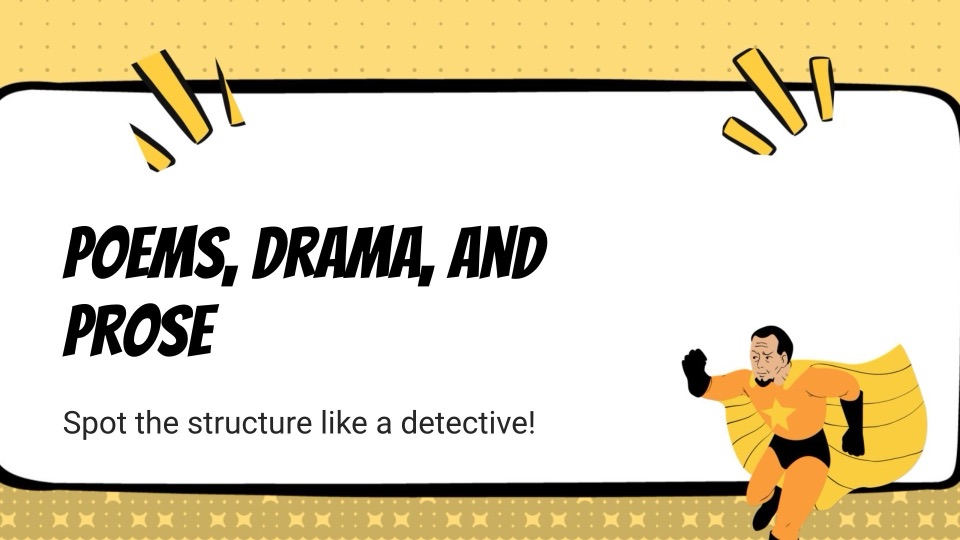
| 5 min | Starter | Hook students with the rain mystery and recall how the three forms look on the page. Show Slide 1 Poems, Drama, and Prose [title]: Spot the structure like a detective! Show Slide 2 and read: Three friends tell about rain as a poem, a play, and a story. Ask: How does each one look on the page? Say the hook: I found three pages all about rain, but they look totally different. Help me figure out which is which. Take 3 quick ideas from turn-and-talk and keep the three texts a mystery for later. |
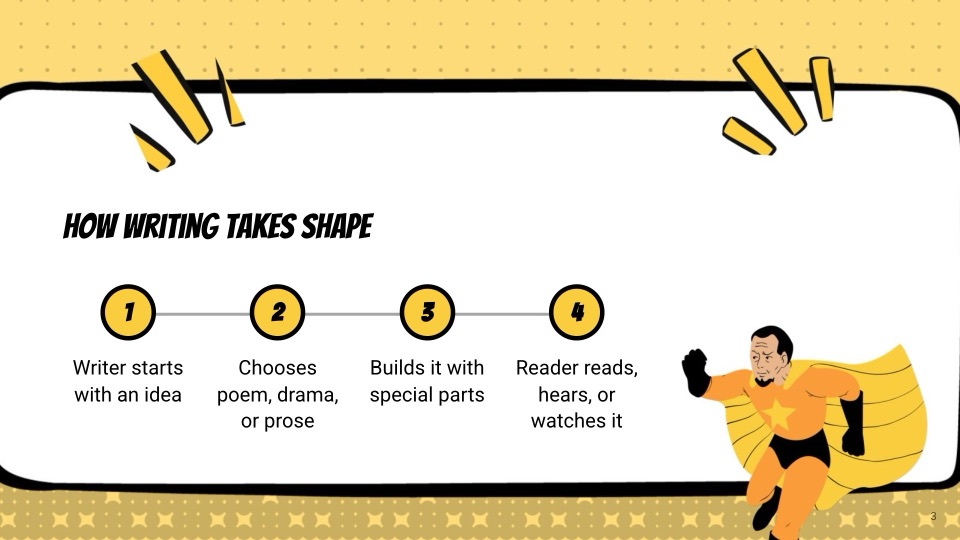
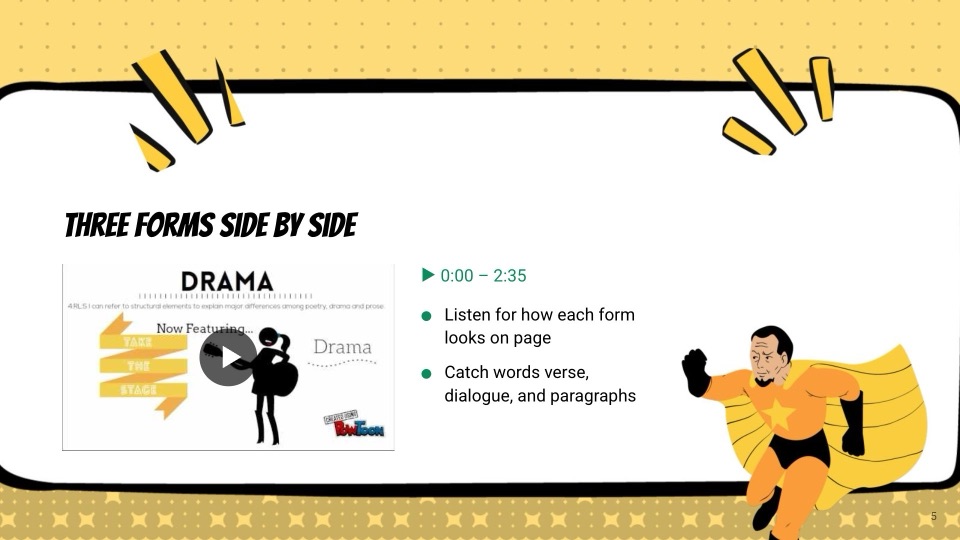
| 12 min | Teaching | Teach major differences between poems, drama, and prose and the words for their parts. Show Slide 3 and walk through: Writer starts with an idea, Chooses poem, drama, or prose, Builds it with special parts. Show Slide 4 and read: Plays are written to be performed, not just read. and Stage directions tell actors where to move and how to speak. Play Video clip 2 (0:00–2:35) on Slide 5 and tell students to listen for verse, dialogue, and paragraphs. Build a 3-column chart live: Poem - verse, rhythm, meter, lines, stanzas; Drama - cast, setting, dialogue, stage directions; Prose - paragraphs, narration. |
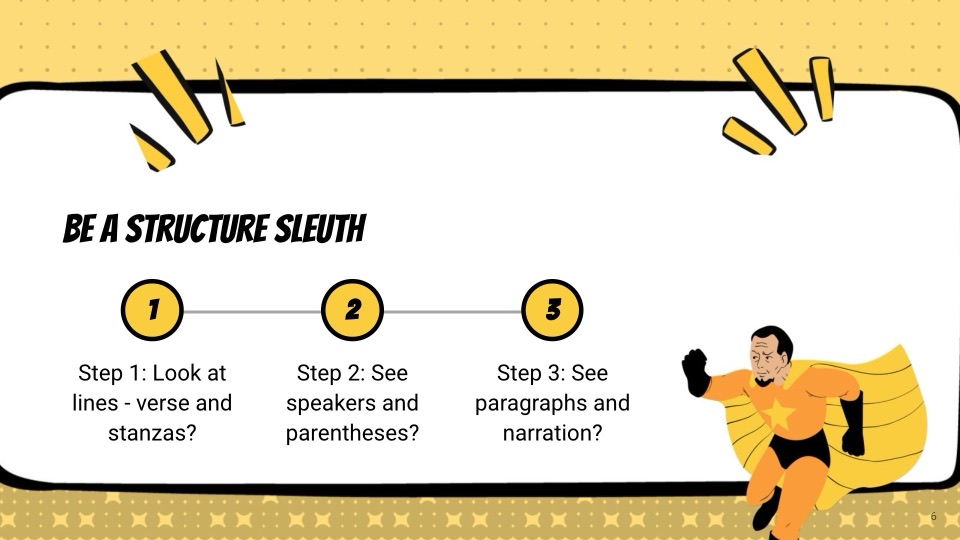
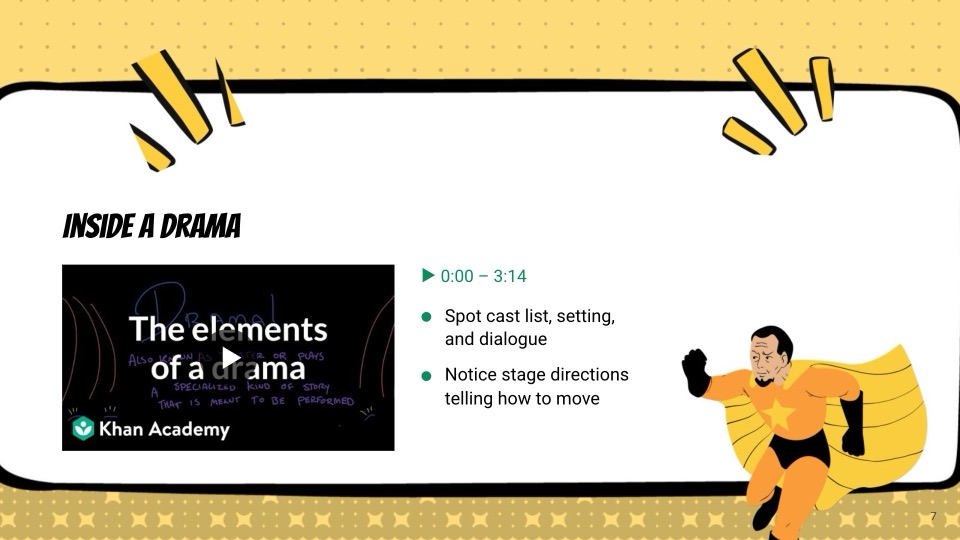
| 13 min | Guided Practice | Model how to use look and sound steps to spot stanza breaks and stage directions. Show Slide 6: Step 1: Look at lines - verse and stanzas? Step 2: See speakers and parentheses? Step 3: See paragraphs and narration? Play Video clip 1 (0:00–3:14) on Slide 7 and stop to name cast list, setting, and dialogue and one stage direction telling how to move. Model with two short texts on the board, thinking aloud through Steps 1 to 3 and marking clues. Have pairs whisper-predict the form before you confirm with two clues. |
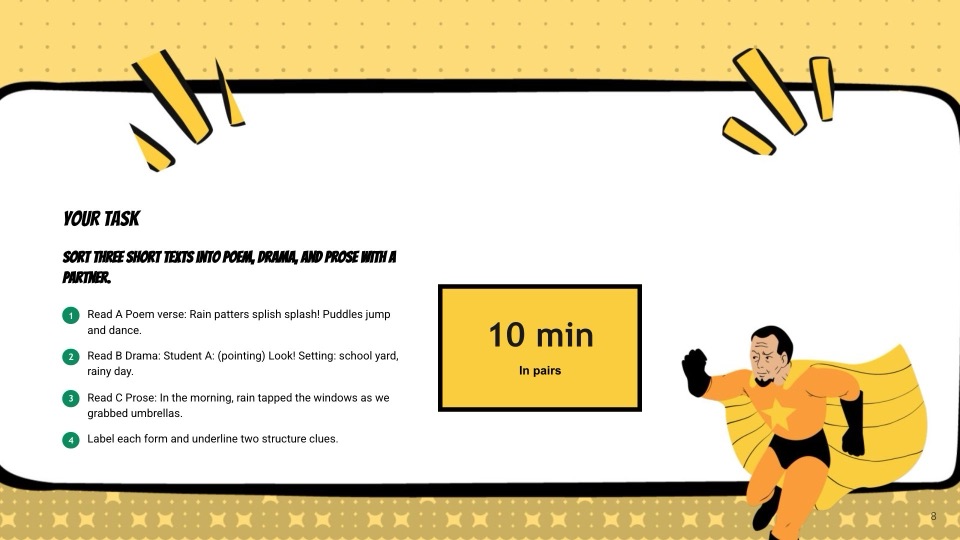
| 20 min | Main Activity | Sort poem, drama, and prose texts in groups and prove each choice with two clues. Show Slide 8 task and hand out mixed Text A poem, Text B drama scene, Text C prose paragraph plus Poem, Drama, Prose label cards and highlighters. Read directions: Lay out the three texts, hunt for shape clues, mark stanzas, verse and rhythm, and mark cast, setting, dialogue, and stage directions. Circulate, prompt groups to point to exact lines and count beats per line together. Stop at 15 minutes for groups to place labels and rehearse saying form plus two clues. |
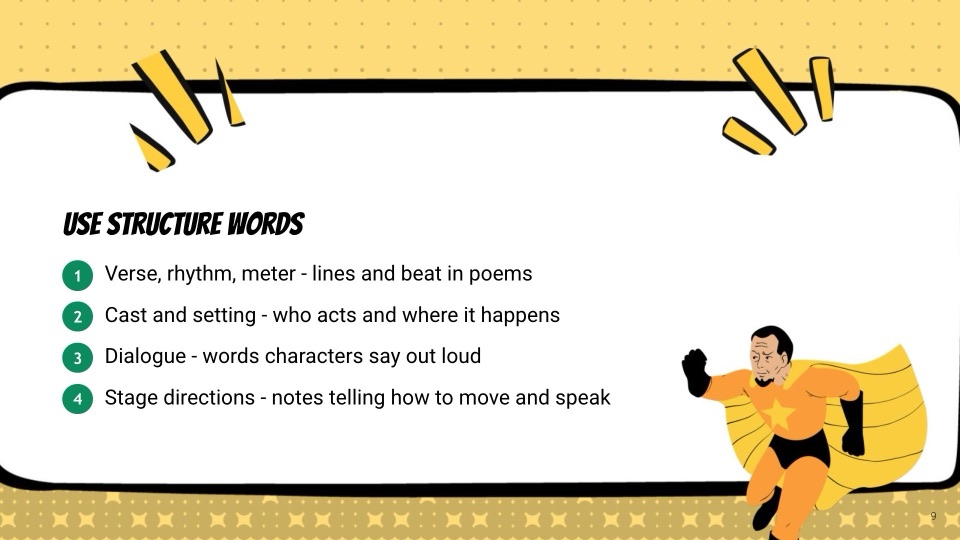
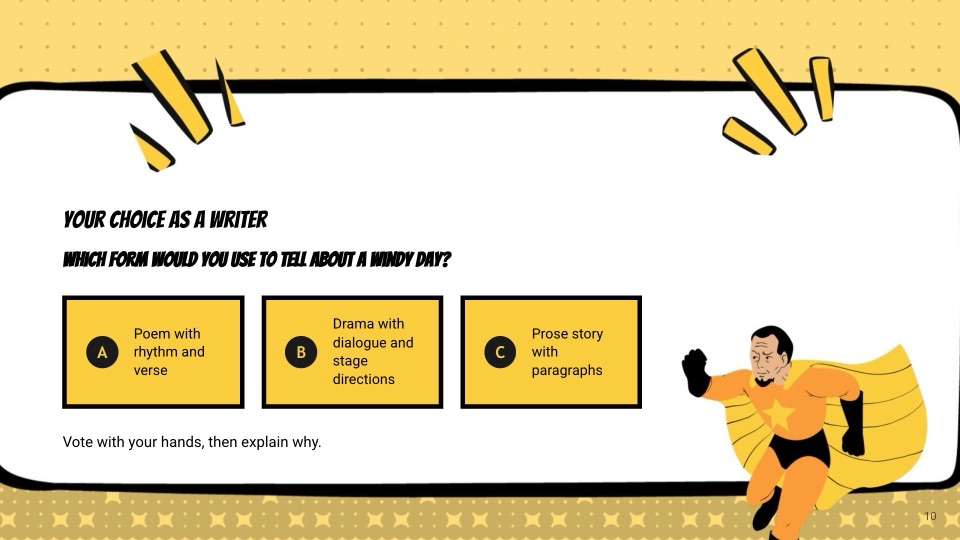
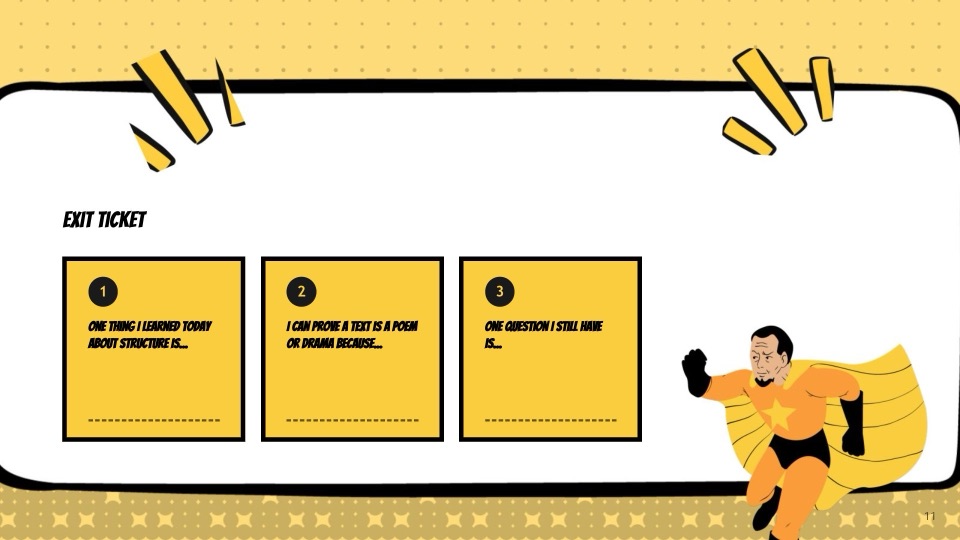
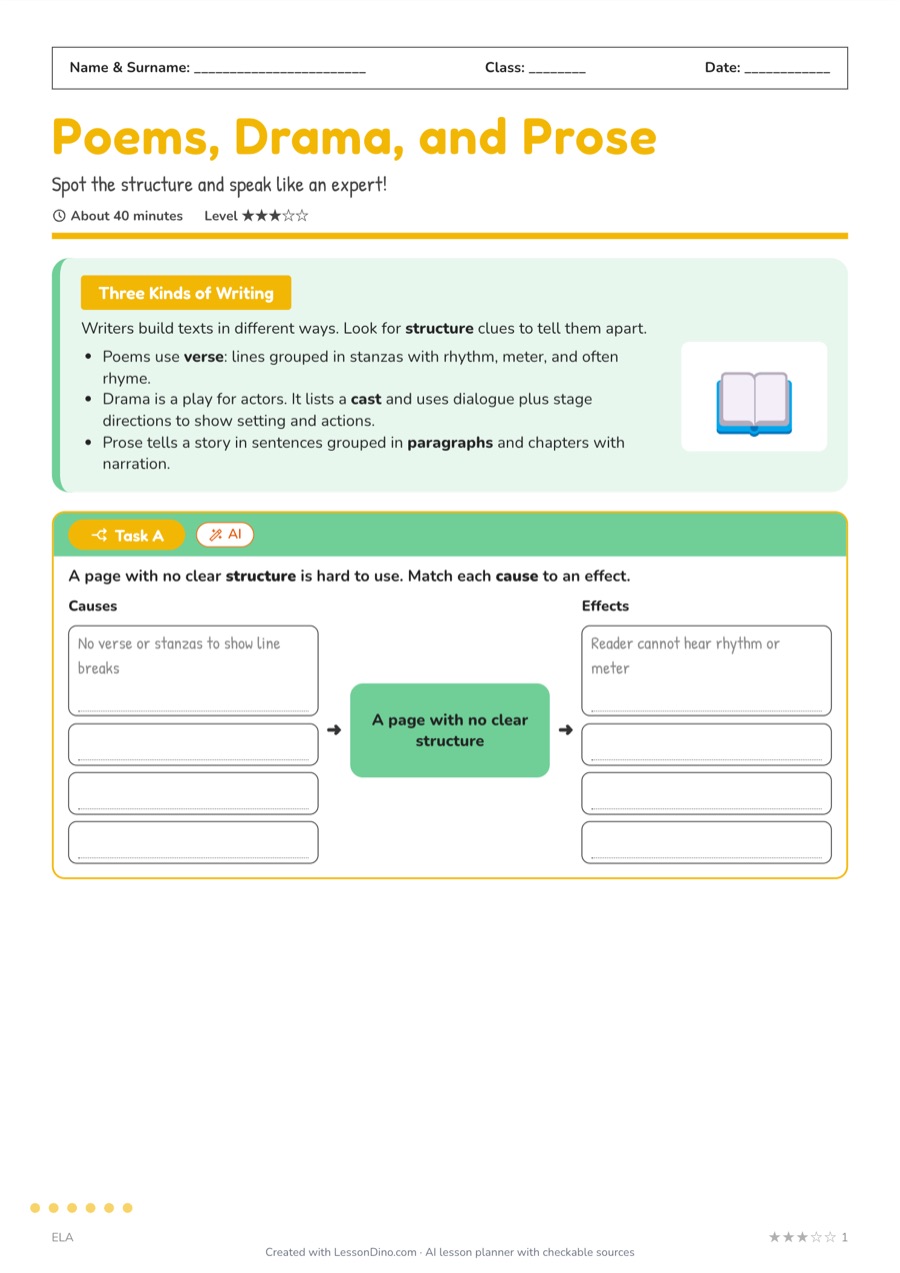
| 10 min | Plenary | Use structure words to choose a form and check learning with an exit ticket. Show Slide 9 and review: Verse, rhythm, meter - lines and beat in poems, Cast and setting - who acts and where it happens, Dialogue - words characters say out loud. Show Slide 10 vote: Which form would you use to tell about a windy day? Take votes for poem with rhythm and verse, drama with dialogue and stage directions, prose story with paragraphs. Hand out Worksheet Task D and have pairs do one writer need: pick the best form and tell why it fits. Show Slide 11 exit ticket and have students write two sentences to hand in. |
Common mistakes
- Thinking any short text or any lines on a page is a poem
How to spot it: Labels poem for drama dialogue or prose paragraph because it is short
Ask for verse and rhythm proof: check for lines and stanzas with beat, not sentences in paragraphs; stanzas separate poems into groups of lines like paragraphs in prose - Mixing up dialogue and stage directions
How to spot it: Points to (pointing) as what the character says
Cover speaker name, read aloud only dialogue, then read parentheses as action notes that tell how to move or speak in drama - Calling prose a drama because people talk
How to spot it: Sees quotation marks in a paragraph and labels it a play
Look for cast list, setting line, speaker names and parentheses for drama versus paragraphs and narration for prose
Support
- Give pre-highlighted set where the stanza breaks, speaker names, and paragraph indent are already marked in color
- Use echo-clap, dots under words for beats, choice bank of stage directions, and sentence starters for proving answers
Stretch
- Ask students to add one sentence explaining how the shape changes how it sounds when read aloud
- Have students make their own two-clue cards or add a new sensible stage direction in parentheses and explain the effect
Check questions
- Name two structural elements that prove a text is a drama.
Answer: Any two: cast of characters, setting, dialogue, stage directions, descriptions - A text has verse in short lines grouped in stanzas with a clear beat. Is it a poem, drama, or prose, and why?
Answer: Poem, because verse, rhythm, meter and stanzas show poem structure - How is a stanza in a poem like a paragraph in prose?
Answer: Both group ideas; stanzas separate poems into groups of lines like paragraphs separate prose
Curriculum
Explain major differences between poems, drama, and prose, and refer to the structural elements of poems (e.g., verse, rhythm, meter) and drama (e.g., casts of characters, settings, descriptions, dialogue, stage directions) when writing or speaking about a text.
Video clips
Clips on YouTube, from the start and end times we chose. Check each one before you show it.
-
Elements of a drama from 0:00 to 3:14
Khan Academy: The elements of a drama | Reading | Khan Academy
Covers cast of characters, setting, dialogue, and stage directions with clear on-page examples at the right pace for ages 9-10.
-
Poems, prose, and drama compared from 0:00 to 2:35
Sara Sawyer: Differences between poetry, prose, and drama?
Directly explains major differences between the three forms using simple vocabulary for Grade 4.
Worksheet
Sources
- English Language Arts Standards » Reading: Literature » Grade 4 thecorestandards.org
- 4th Grade ELA Learning Targets - Beaverton School District beaverton.k12.or.us
- How to study poetry - structure - BBC Bitesize bbc.co.uk
- Form, structure and language - Responding to poetry - AQA ... bbc.co.uk
- Unit Plan 22 (Grade 4 ELA): Poetry, Drama, and Prose Structures teachmaverick.com
Picture credits
- Microsoft Fluent Emoji (MIT)
Made with Lesson Dino's AI on 17 October 2026. AI can make mistakes, so check facts against the sources before you teach.