Slides
Lesson plan
Text Detectives: Prove It With Details
Students learn to tell what the text says straight out from a smart guess. They hunt for proof words and explain one inference with two details.
Objectives
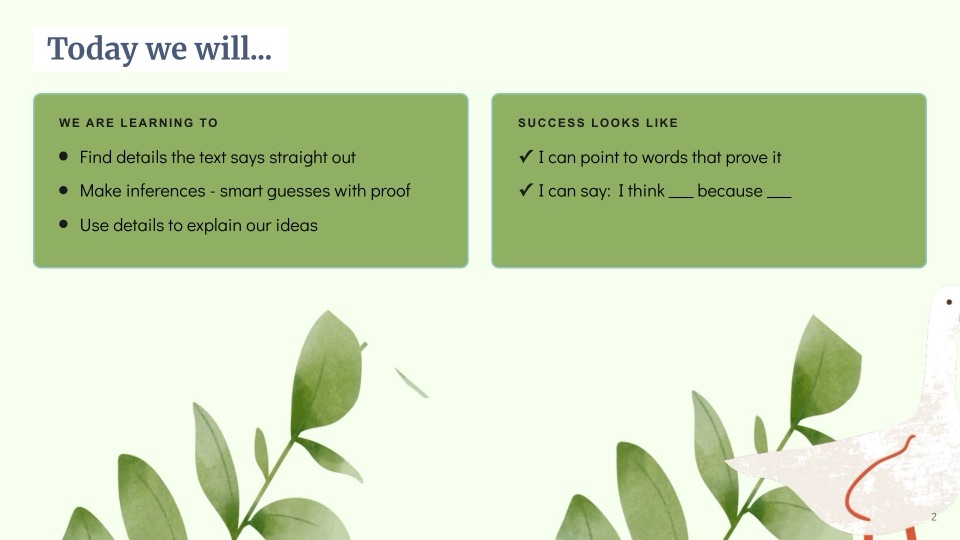
- Students will quote exact details to show what the text says straight out.
- Students will make an inference backed by two details from the text.
Success criteria
- I can point to words that prove what the text says.
- I can say I infer ___ because ___ using two details.
Key words
| Word | Meaning |
|---|---|
| detail | a small piece of information the author puts in the writing |
| explicit | said straight out in words you can point to |
| inference | a smart guess that uses clues plus what you already know |
| evidence | the exact words you copy or point to that prove an answer |
Timed plan (60 minutes)
| Time | Stage | What happens |
|---|---|---|
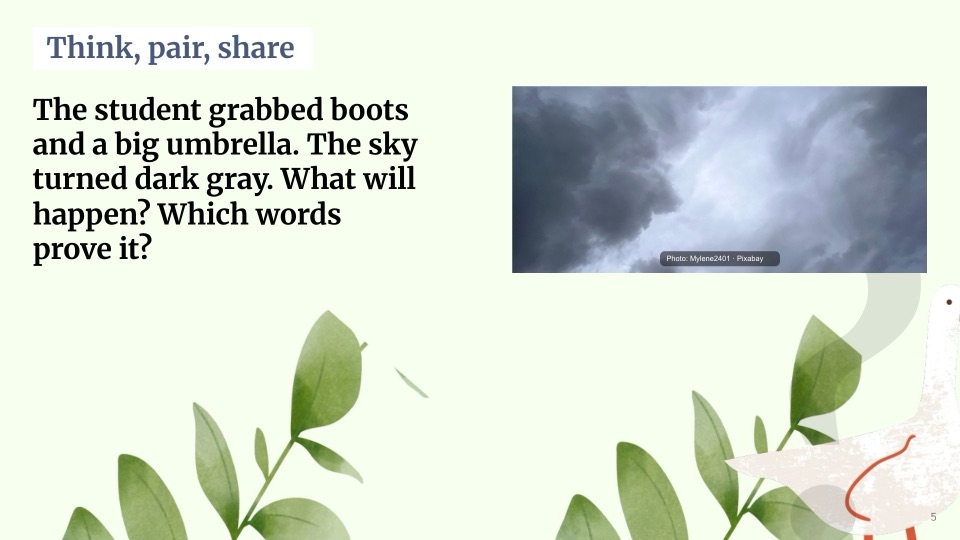
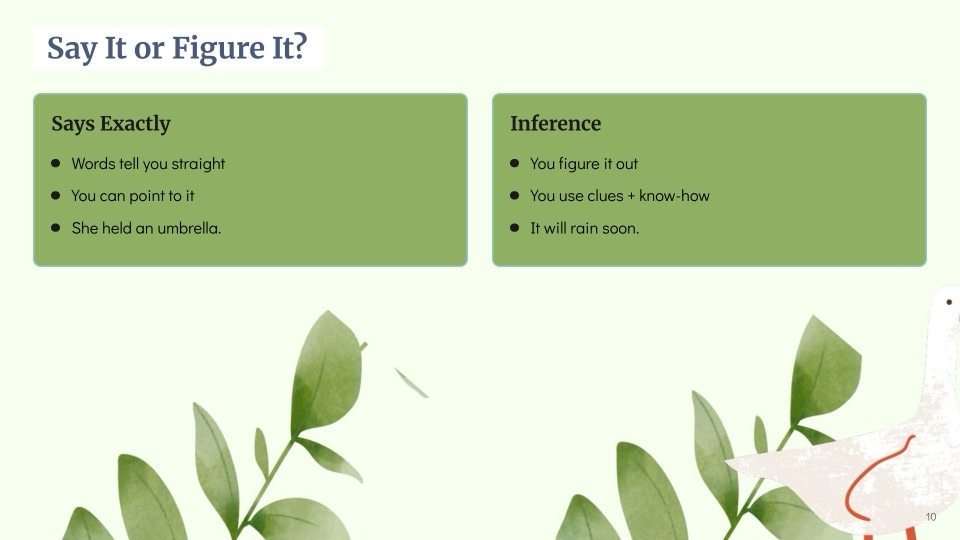
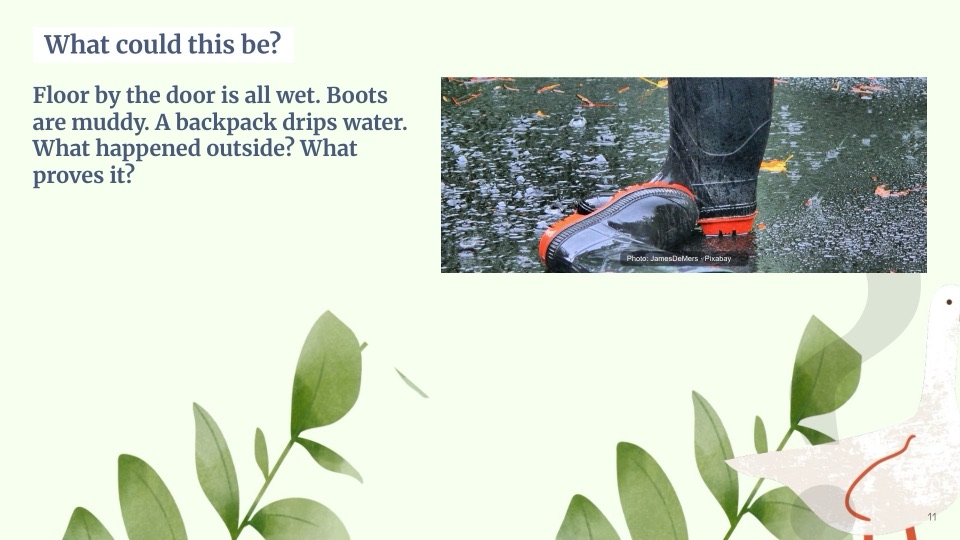
| 5 min | Starter | Hook students as detectives and recall proof words for explicit ideas and guesses. Show Slide 1, welcome class as text detectives hunting for proof. Show Slide 5 question about boots, umbrella, and dark gray sky and read it aloud. Give 30 seconds turn-and-talk: what will happen and which words prove it. Take 2 answers and underline proof words students name. |
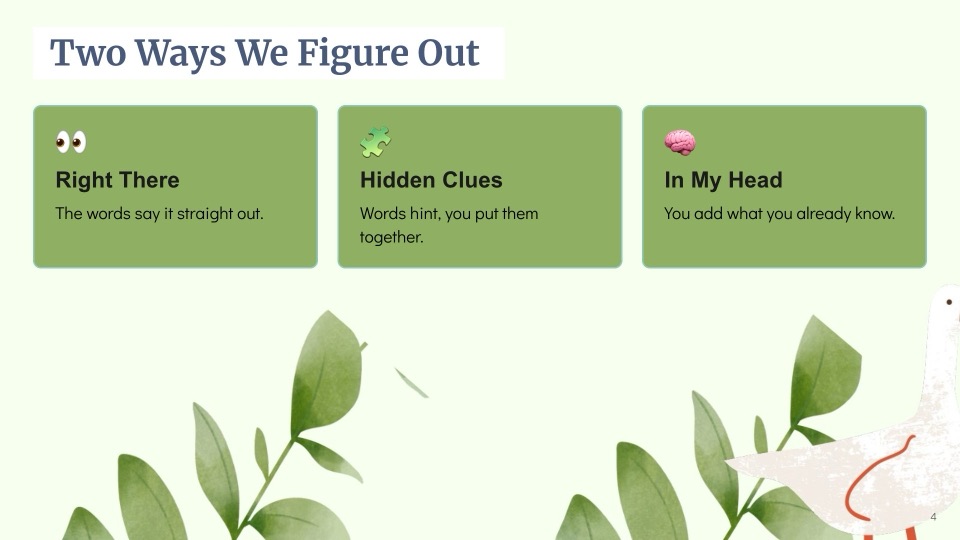
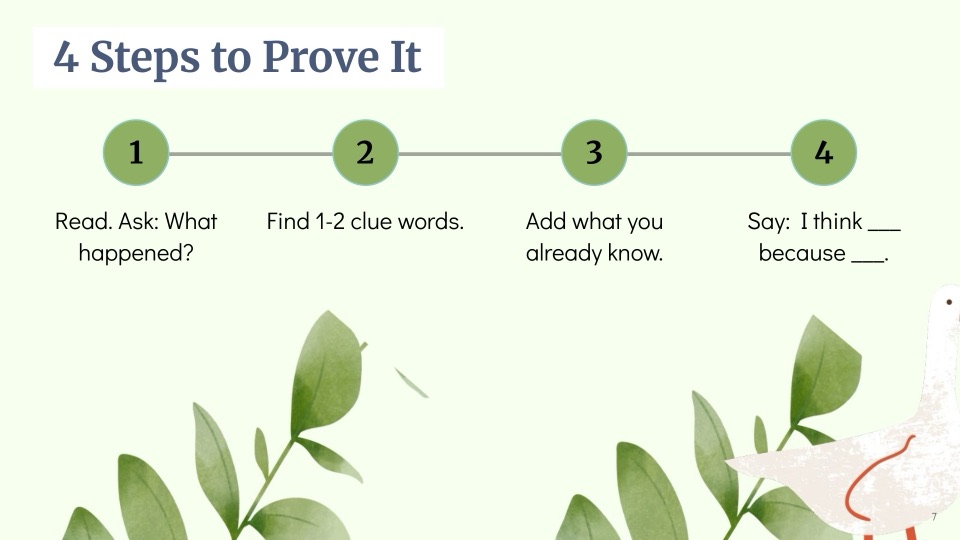
| 10 min | Teaching | Teach explicit meaning versus inference and the 4-step prove-it routine. Show Slides 3-4 and explain Right There clues versus Hidden Clues plus what you know. Show Slide 7 steps: Read, find 1-2 clue words, add what you know, say I think _ because _. Model with paragraph 2 of lighthouse passage on enlarged copy using yellow for explicit. Think aloud an explicit answer, reading the exact words in a clear voice. |
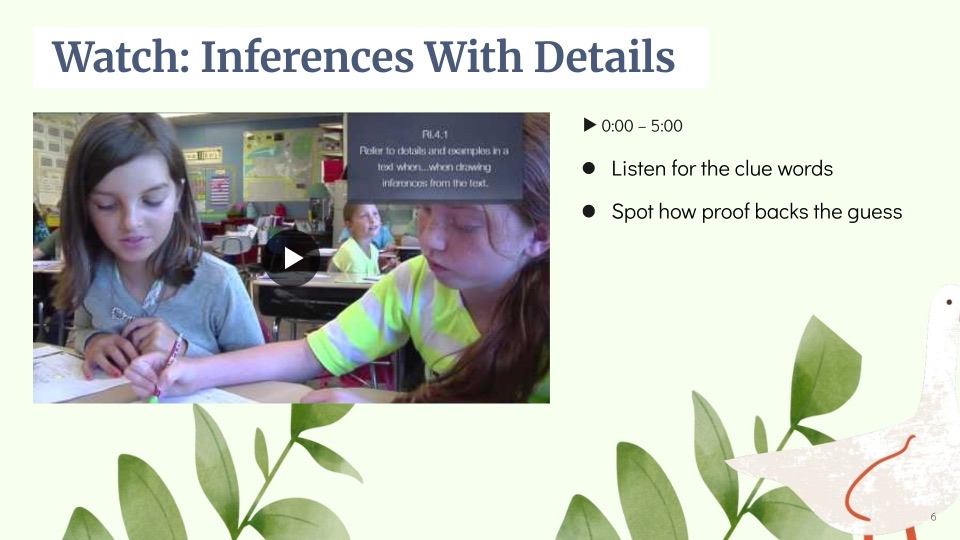
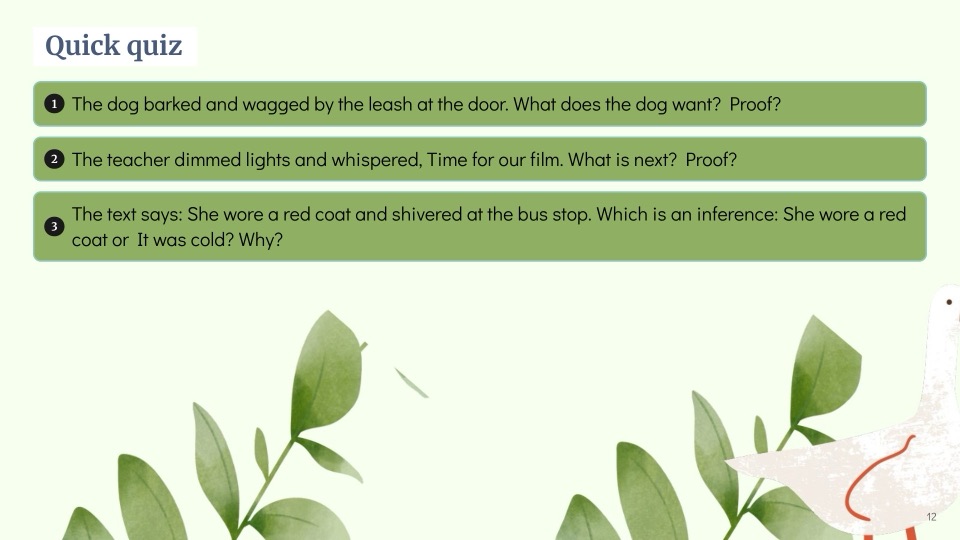
| 15 min | Guided Practice | Watch how readers use proof and practice the because sentence together. Play Video clip 1 (0:00-5:00) on Slide 6; pause twice to name clue words the video points to. Think aloud paragraph 3 inference that a cat took the sandwich, linking two details. Chart on board Author Says quotes on left and I Infer on right for the cat idea. Lead choral practice of frame: The text says _, so I infer _ because _. |
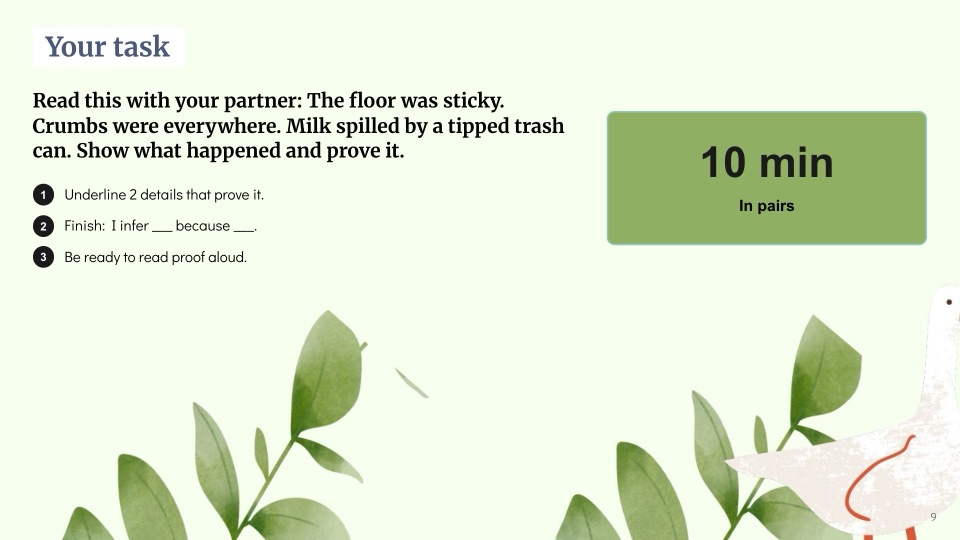
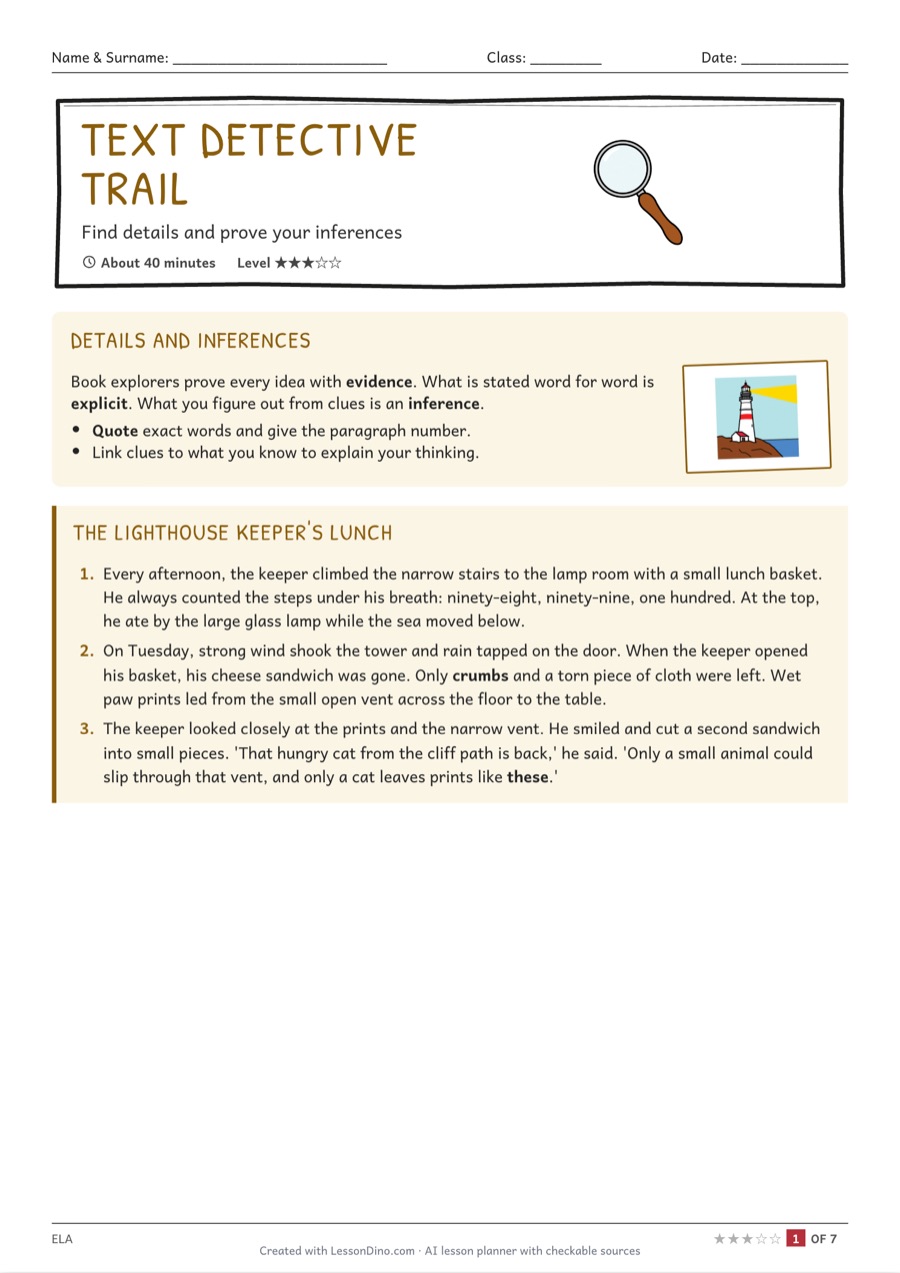
| 20 min | Main Activity | Underline explicit proof in one color and inference clues in a second color to answer Task A. Hand out lighthouse passage, Task A sheet, highlighters, and magnifying glass and demo: yellow for what it says straight out, blue for clues for inference. Set task: with magnifier, underline 2 details that prove it, then finish I infer _ because _ and be ready to read proof aloud. Circulate 12 minutes, asking pairs to read exact words and checking underlines match Task A questions. Stop class at 15 minutes for two pairs to model strongest proof; remind that this joint practice transfers to solo reading and writing. |
| 10 min | Plenary | Fix mistakes, restate what proves explicit and inference, and check who met success criteria. Return to objectives chart and ask students to state success lines in own words. Show two claims, one wrong: It was windy so a dog took the sandwich; ask class to spot mistake and fix with evidence from vent and prints. Take votes for Detail or Inference for two statements and require exact line as proof. Hand out exit slips with lighthouse question and preview homework. |
Common mistakes
- Paraphrasing instead of quoting exact words as proof.
How to spot it: Answer sounds right but words do not match the passage.
Have student reread and copy 4-6 words exactly, then read them aloud to match. - Treating an inference like a wild guess with no clues.
How to spot it: Student says I infer with because I think so and no text words.
Require two blue underlines first, then finish because with those words. - Mixing up explicit detail and inference labels.
How to spot it: Student puts paw prints idea under Says Exactly when it needs putting together.
Ask: Can you point to it in one line? If you had to combine two lines, it is an inference.
Support
- Give a copy with the key sentences already underlined so the student only has to match them to the questions.
- Provide sentence frames: The text says _ and I infer _ because _ with word bank tall, wet, small, narrow.
- Let student use magnifier to track one line at a time with partner reading aloud.
Stretch
- Have students add a second possible inference and explain which details make it weaker or stronger.
- Have students rule out one wrong answer by naming the detail it is missing.
- Have students write a follow-up question that would need another detail from paragraphs 1-3 to answer.
Check questions
- What was in the basket at first, and what exact words prove it?
Answer: Cheese sandwich; When the keeper opened his basket, his cheese sandwich was gone. - What two details prove something small came through the vent?
Answer: Wet paw prints led from the small open vent across the floor to the table and Only a small animal could slip through that vent. - What do you infer took the sandwich, and why with proof?
Answer: A cat; I infer a cat because of paw prints and Only a cat leaves prints like these.
Curriculum
Refer to details and examples in a text when explaining what the text says explicitly and when drawing inferences from the text.
Video clips
Clips on YouTube, from the start and end times we chose. Check each one before you show it.
-
Grade 4 inferences with details from 0:00 to 5:00
EngageNY: Grade 4 ELA: Making Inferences Using Details and the Main Idea RI.4.1
Made for Grade 4 and directly teaches using details to make inferences, perfect for ages 9-10.
-
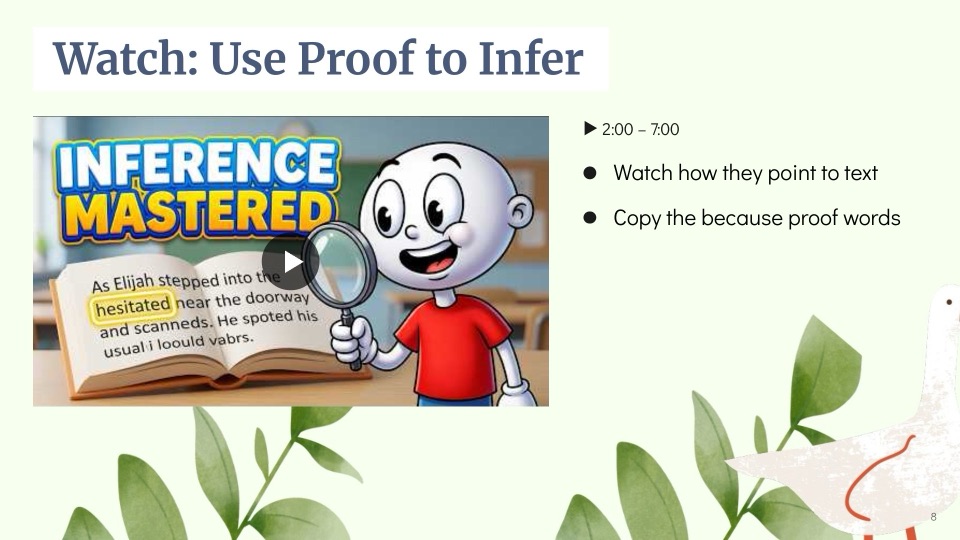
Use text evidence to infer from 2:00 to 7:00
Teacher's Helper Education - Classroom Videos: How to Make Inferences in Reading? Use Text Evidence Like This
Focuses on referring to text evidence when inferring, with clear examples at the right pace for ages 9-10.
Worksheet
Sources
- Foundational Skills (K-5) cps.edu
- Science of reading Wikipedia
Picture credits
- Photo: ParentiPacek · Pixabay
- Photo: Mylene2401 · Pixabay
- Photo: JamesDeMers · Pixabay
- Pictograms: Sergio Palao, ARASAAC (arasaac.org) · CC BY-NC-SA
- Drawing: Equazcion at English Wikipedia · CC BY-SA 3.0 · Wikimedia Commons
- Microsoft Fluent Emoji (MIT)
Made with Lesson Dino's AI on 17 October 2026. AI can make mistakes, so check facts against the sources before you teach.