Slides
Lesson plan
Plan Your Story in Order
Students learn to build real or imagined narratives in clear order with details. They map beginning, middle, and end and start a draft with sensory details.
Objectives
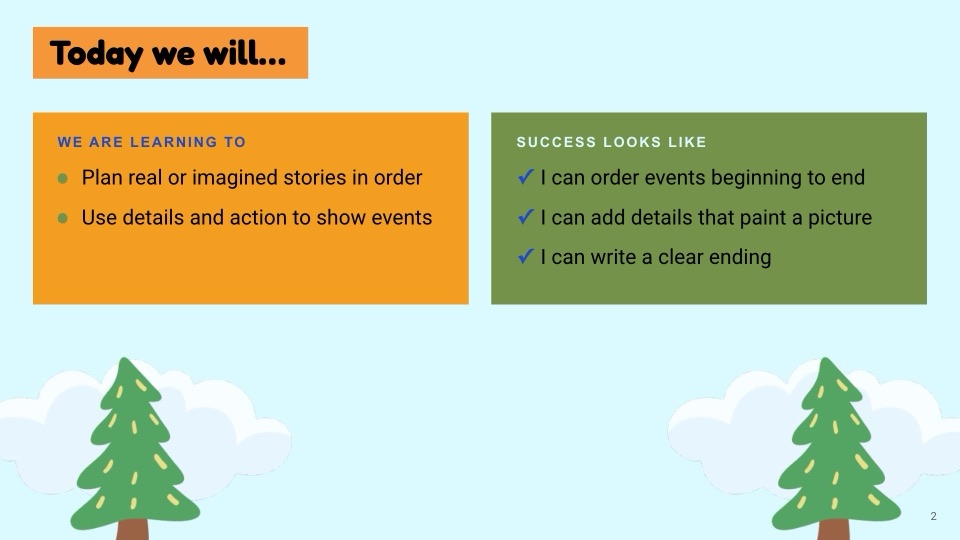
- Students will plan a real or imagined narrative with clear beginning, middle, and end.
- Students will use descriptive details and action to develop events in sequence.
- Students will write a conclusion that fits the narrated events.
Success criteria
- I can order events from beginning to end.
- I can add details that paint a picture.
- I can end my story so it fits the events.
Key words
| Word | Meaning |
|---|---|
| narrative | a story about real or made-up events told in order |
| sequence | the order in which events happen in a story |
| detail | a small bit you see, hear, smell, touch, or taste that paints a picture |
| dialogue | the exact talk between people in a story, with quotation marks |
| conclusion | the last part that fits what happened before |
Timed plan (60 minutes)
| Time | Stage | What happens |
|---|---|---|
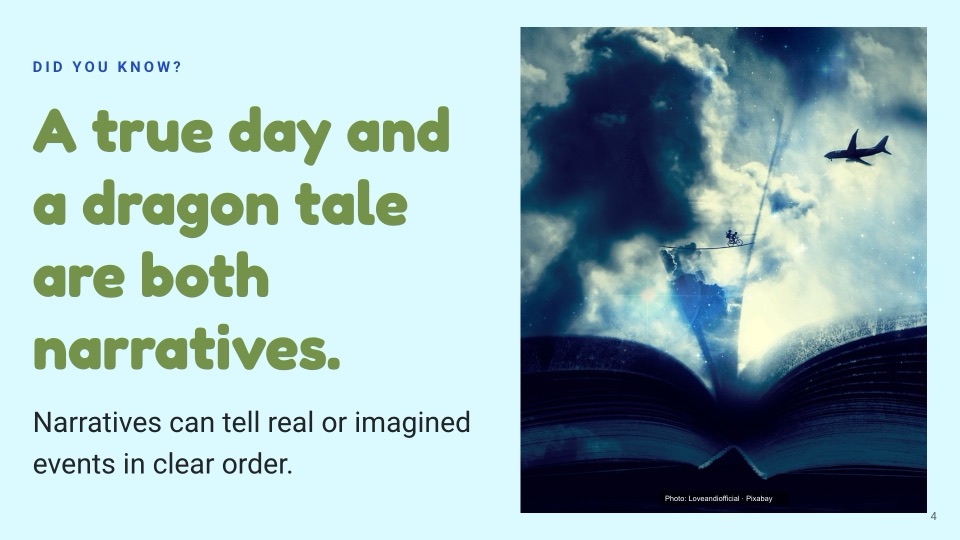
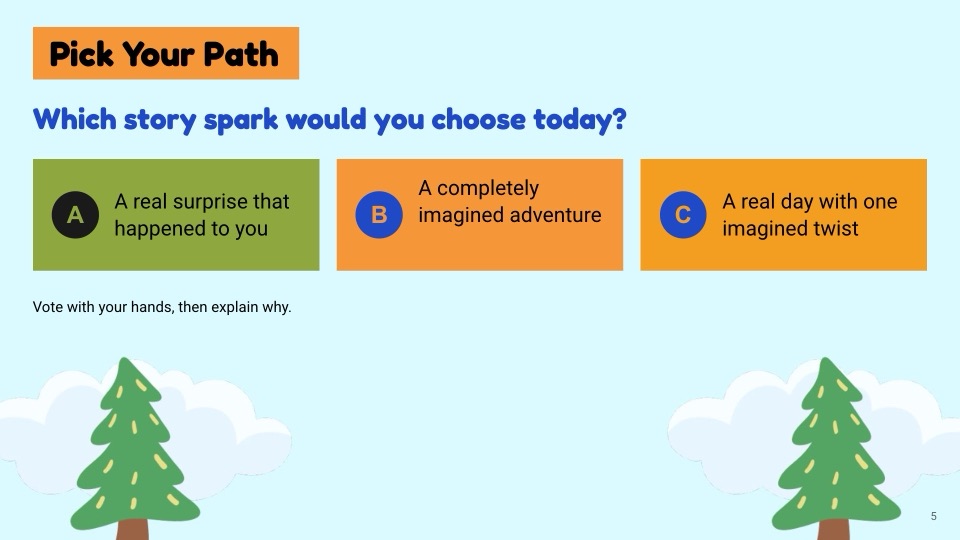
| 5 min | Starter | Hook students and review that narratives can be real or imagined and need order. Say the hook: Writers plan before they write — let's map a story in three boxes. Show Slide 4 and read its fact: A true day and a dragon tale are both narratives. Show Slide 5 and take a quick vote on story spark: real surprise, imagined adventure, or real day with one imagined twist. Connect votes to today: we will plan in order and add details that paint a picture. |
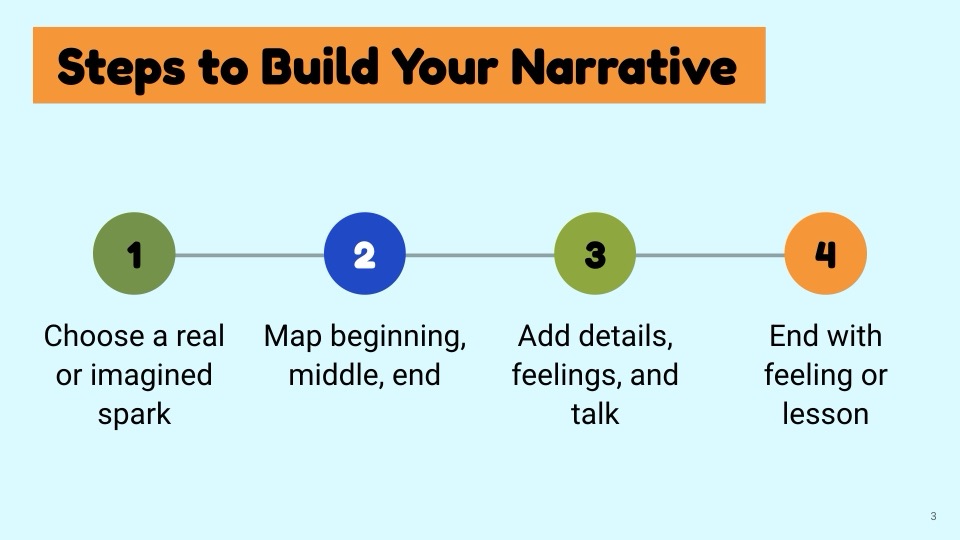
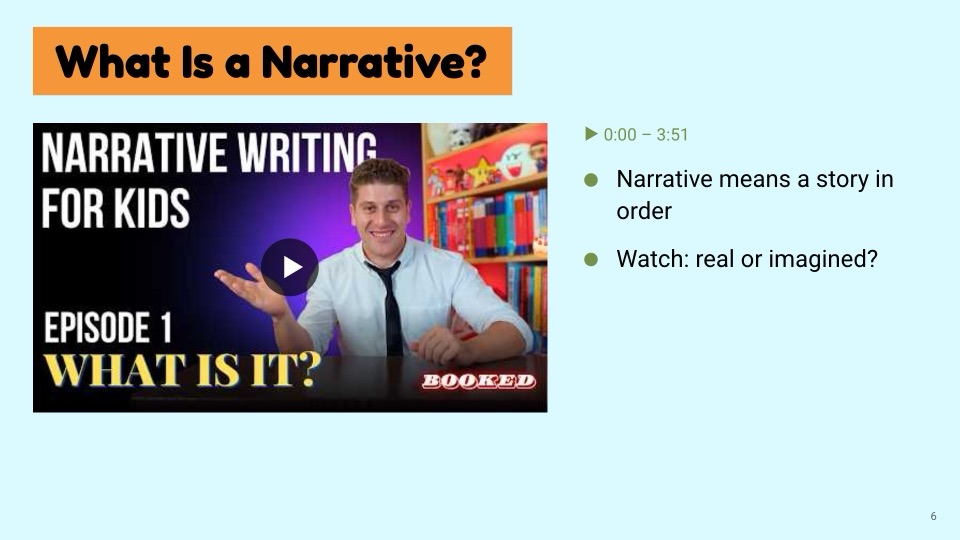
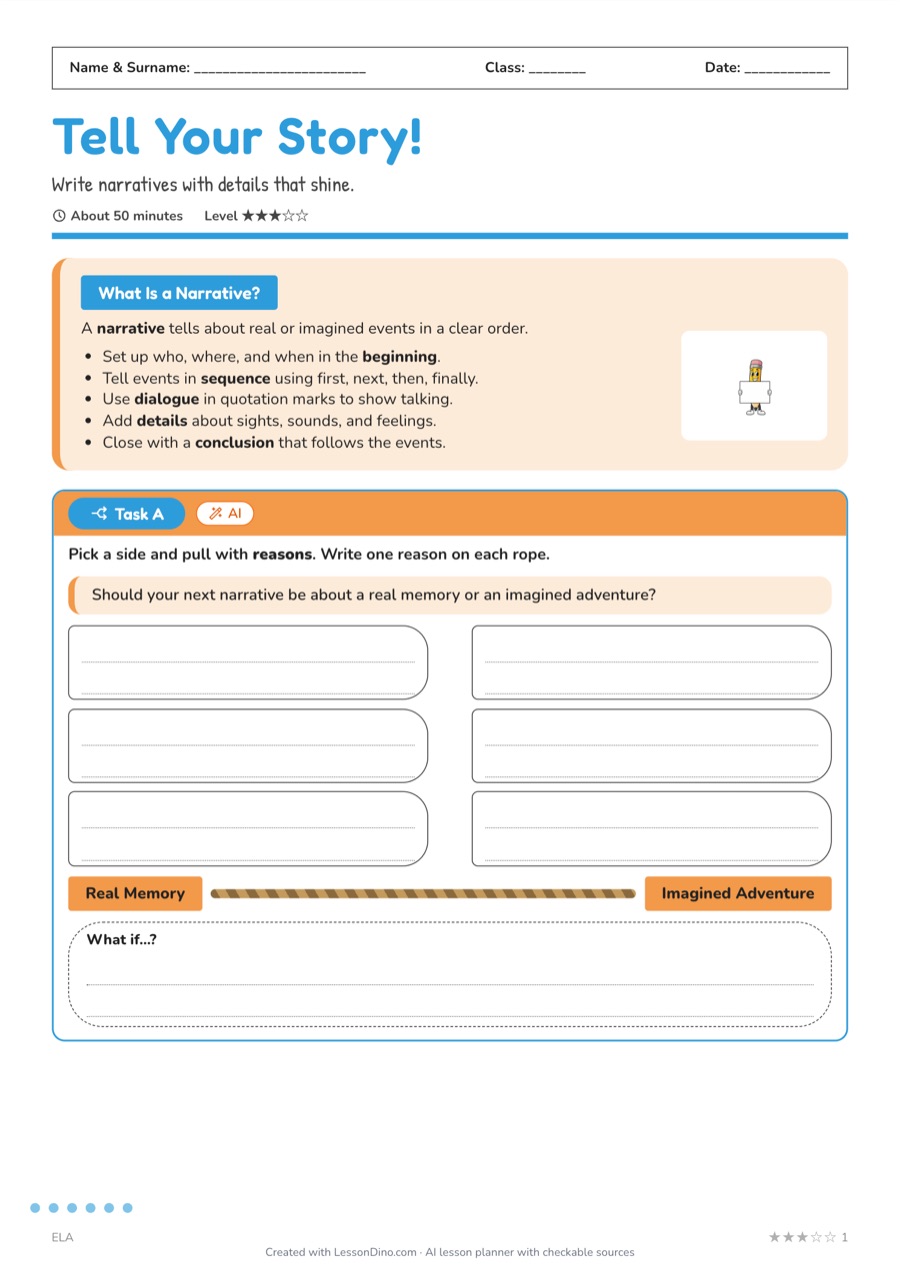
| 12 min | Teaching 1 | Teach that narratives are ordered stories and model beginning, middle, and end. Show Slide 3 steps: Choose a real or imagined spark, map beginning, middle, end, add details and talk, end with feeling or lesson. Show Slide 6 and play Video clip 1 (0:00-3:51) to define narrative as a story in order. Explain that narratives are one of three main writing types alongside arguments and informative/explanatory texts. Guide Worksheet Task B: students sort 4-5 short ideas into Real, Imagined, or Both and share clues. |
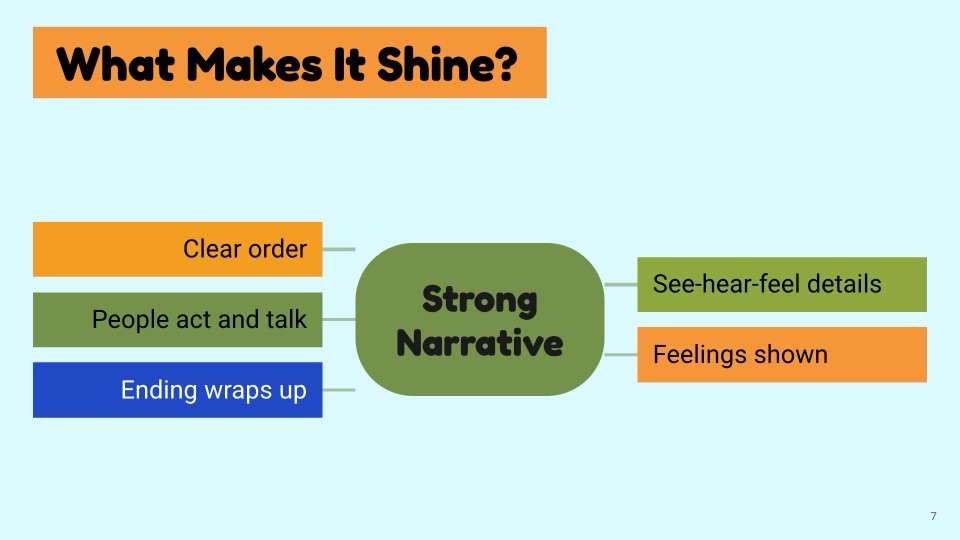
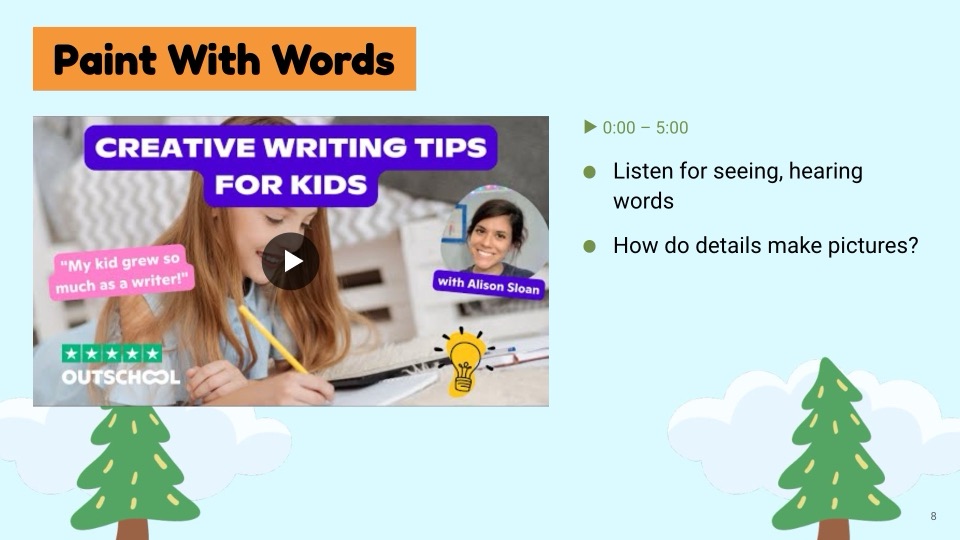
| 10 min | Teaching 2 | Teach how sensory details and action make events clear and vivid. Show Slide 7 mindmap and read parts: clear order, see-hear-feel details, people act and talk, feelings shown, ending wraps up. Play Video clip 2 (0:00-5:00) and ask students to listen for seeing and hearing words. Model turning a weak sentence into a strong one by adding one sense detail and one action. Explain that trying imagery helps writers mold language to their own way of writing. |
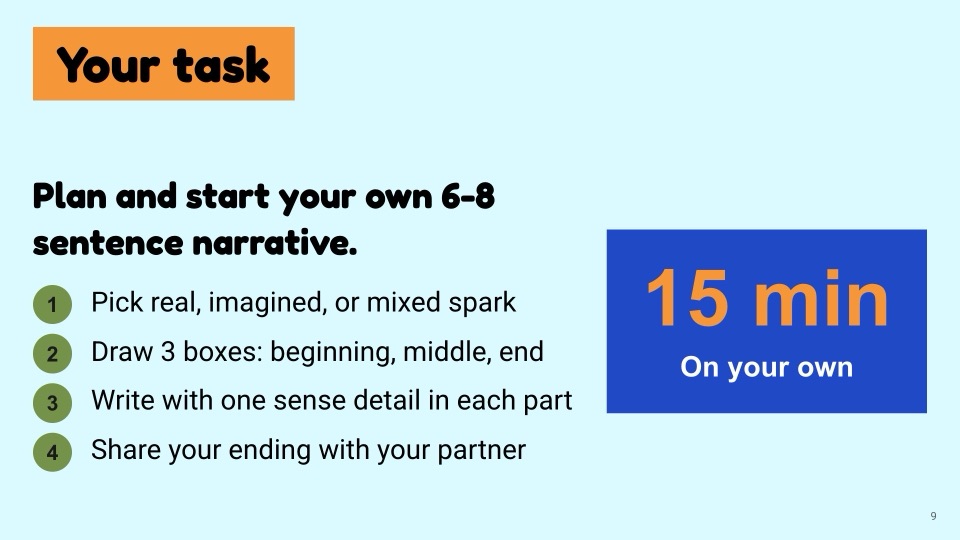
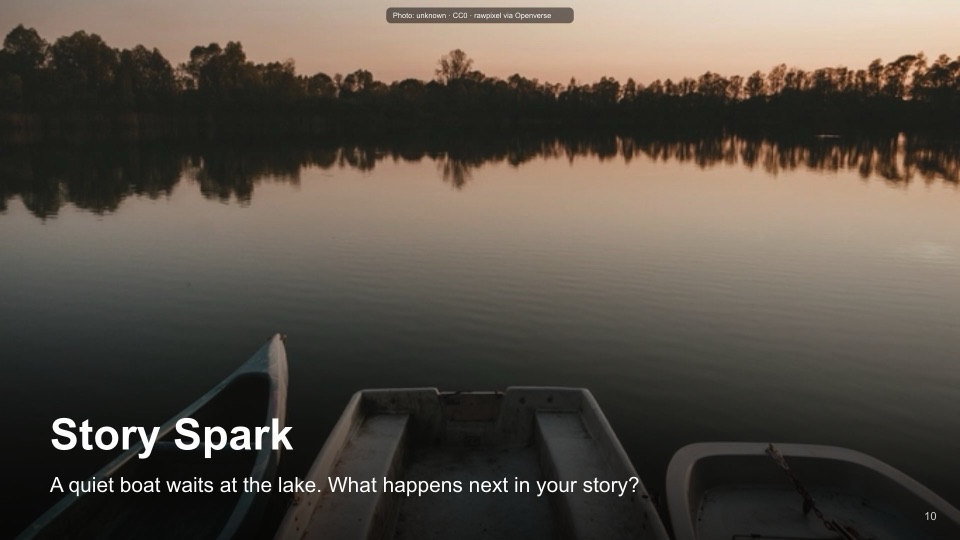
| 23 min | Main activity | Students plan and start a narrative with character, setting, and three ordered events. Show Slide 9 task: pick real, imagined, or mixed spark, draw 3 boxes, write with one sense detail in each part. Show Slide 10 photo prompt: A quiet boat waits at the lake. What happens next in your story? Offer a bike ride choice too. Model a quick 3-box plan on the board with character, setting, and three events in order. Hand out planning sheets and circulate, prompting for First, Next, Finally and one sense detail per box. |
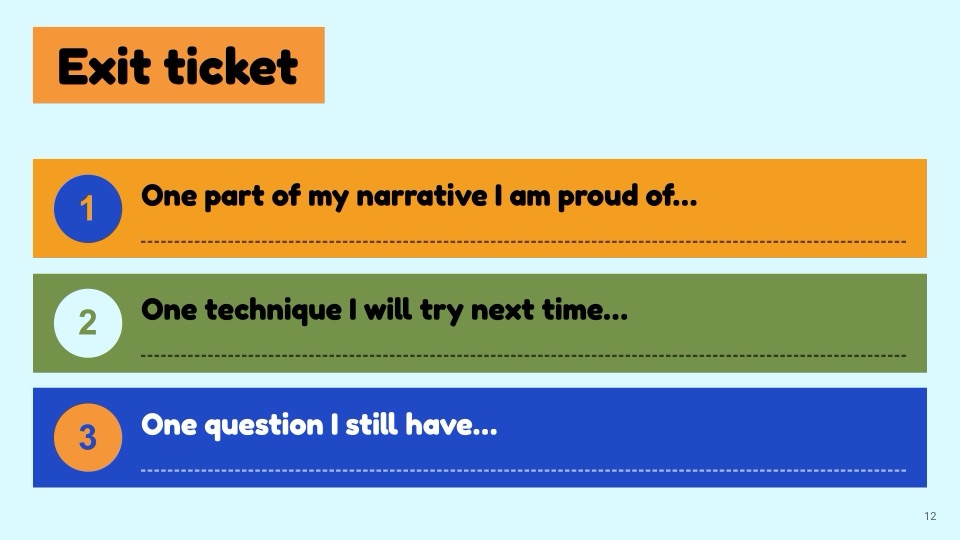
| 10 min | Plenary | Check conclusions fit events and review key techniques. Read two one-sentence endings for the park cleanup story, one that solves the problem and one that does not connect. Explain that Grade 4 writers are expected to provide a conclusion that follows from the narrated experiences or events. Do Worksheet Task D together orally: fill blanks with dialogue, details, finally, sequence, conclusion. Show Slide 12 exit ticket and have students write two lines to complete. |
Common mistakes
- Events out of order or missing order words
How to spot it: Middle happens before beginning or Finally appears first
Number boxes 1-2-3 and add First, Next, Finally to lock sequence - Telling without details, like nice, fun, big
How to spot it: No see, hear, or feel words the reader can picture
Add one sense word per box from the word bank and underline it - Ending that does not connect to the problem
How to spot it: Last sentence introduces a new place or problem with no link
Reread middle problem and rewrite ending to solve it and show feeling
Support
- Provide a half-filled plan with character and setting done so students only add events.
- Offer picture cues and a detail word bank and allow three senses instead of five.
- Give order cards First, Next, Then, Finally and sentence starters like At first.
Stretch
- Students add a problem and solution box under the events.
- Students add one line of dialogue that shows feeling without using said.
- Students replace one weak word like nice or big with a stronger sensory word.
Check questions
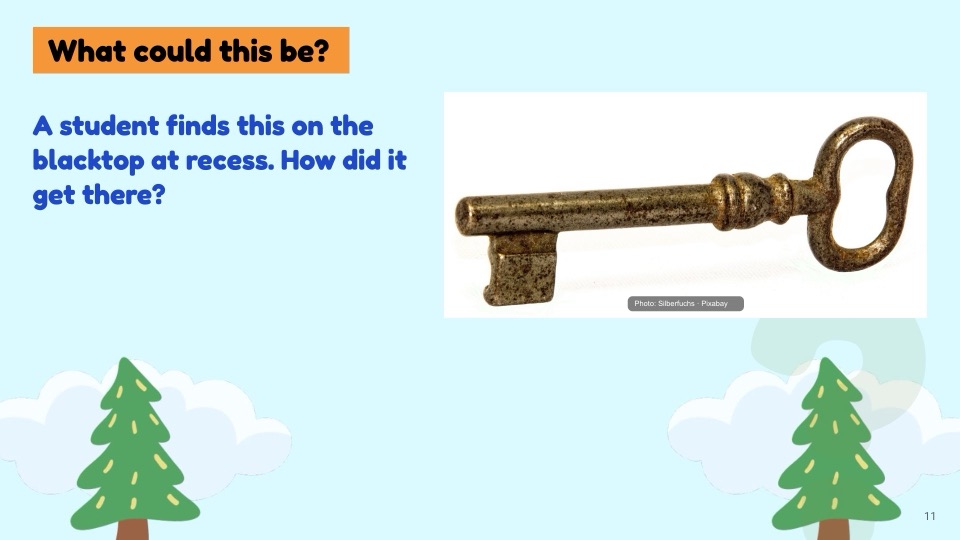
- Put these in order: Finally we went home, First we found a key, Next we asked for help.
Answer: First we found a key, Next we asked for help, Finally we went home. - Which detail paints a clearer picture: The room was nice or The room smelled like fresh paint and buzzed?
Answer: The room smelled like fresh paint and buzzed. - Which ending fits a story about losing and finding a backpack?
Answer: The one where the backpack is found and the student shows relief, not a new unrelated event.
Curriculum
Write narratives to develop real or imagined experiences or events using effective technique, descriptive details, and clear event sequences.
Video clips
Clips on YouTube, from the start and end times we chose. Check each one before you show it.
-
What is a narrative? from 0:00 to 3:51
BOOKED: What Is a Narrative? | Narrative Writing for Kids (Ep 1)
Clear kid-friendly definition of narrative, perfect vocabulary and pace for ages 9-10.
-
Using descriptive detail from 0:00 to 5:00
Outschool - Educational Classes for Kids: ✏️Narrative & Creative Writing for Kids | Introduction & strategies on how to use descriptive detail
Teaches descriptive details for narratives with examples suited to ages 9-10.
Worksheet
Sources
- How to Read the Standards thecorestandards.org
- CCSS for ELA - Content Standards (CA Dept of Education) cde.ca.gov
- Beginning Creative Writing - Harvard Division of Continuing ... coursebrowser.dce.harvard.edu
- Fundamentals in Creative Writing: The Grammar of Narrative creativewriting.uchicago.edu
- THE EFFECTS OF CREATIVE WRITING ACTIVITIES ON NARRATIVE TEXT ... files.eric.ed.gov
- Introduction - Creative Writing - LibGuides at Malone University libraryguides.malone.edu
Picture credits
Made with Lesson Dino's AI on 17 October 2026. AI can make mistakes, so check facts against the sources before you teach.