The worksheet
About this worksheet
Students derive area formulae then use them to find prism volumes. They work in teams round four prism stations to solve volume problems. This Year 8 Maths worksheet gives students (ages 12–13) six pages of practice on volume of prisms, part of the geometry and measures unit. It goes with our free Volume of prisms lesson, which has the slides and a timed lesson plan.
What it covers
By the end, students should be able to:
- Students will derive area formulae for triangles, parallelograms and trapezia.
- Students will solve mixed prism volume problems quickly and accurately in teams.
- Students will calculate cylinder volumes and convert container volumes to litres.
How to use it
- Guided practice (10 minutes): Show Slide 10 traps and set Worksheet Task B: Practice questions: Find each area or perimeter. Include the correct units.
- Support: Give a formula reminder card for triangle, parallelogram and trapezium areas plus a calculator for the multiplication step.
- Stretch: Add a bonus card where the volume and two dimensions are given and students must find the unknown length.
- The answer sheet is the last page, so you can print it on its own or let students check their own work.
Key vocabulary
- prism: a solid with the same flat shape all the way through it
- cross-section: the flat face made by cutting straight through a solid
- volume: the amount of space taken up by a closed solid shape
- area: the amount of flat surface inside a 2D shape
- perimeter: the total distance all the way round the edge of a shape
- cylinder: a solid with a circle at each end and the same circle all through
Mistakes to watch for
- Using the wrong face as the cross-section, especially when prism lies on its side. Mark the two identical ends and redraw the cross-section separately, then do area times length.
- Forgetting to halve for triangular cross-section. Insist on 1/2 × base × height first, then times length, and check against half a cuboid.
- Stopping after cross-section area or using diameter instead of radius for cylinders. Require two lines: area in cm² then volume in cm³; halve diameter to get radius for pi × radius² × height.
What's on the worksheet
Prisms Made Simple
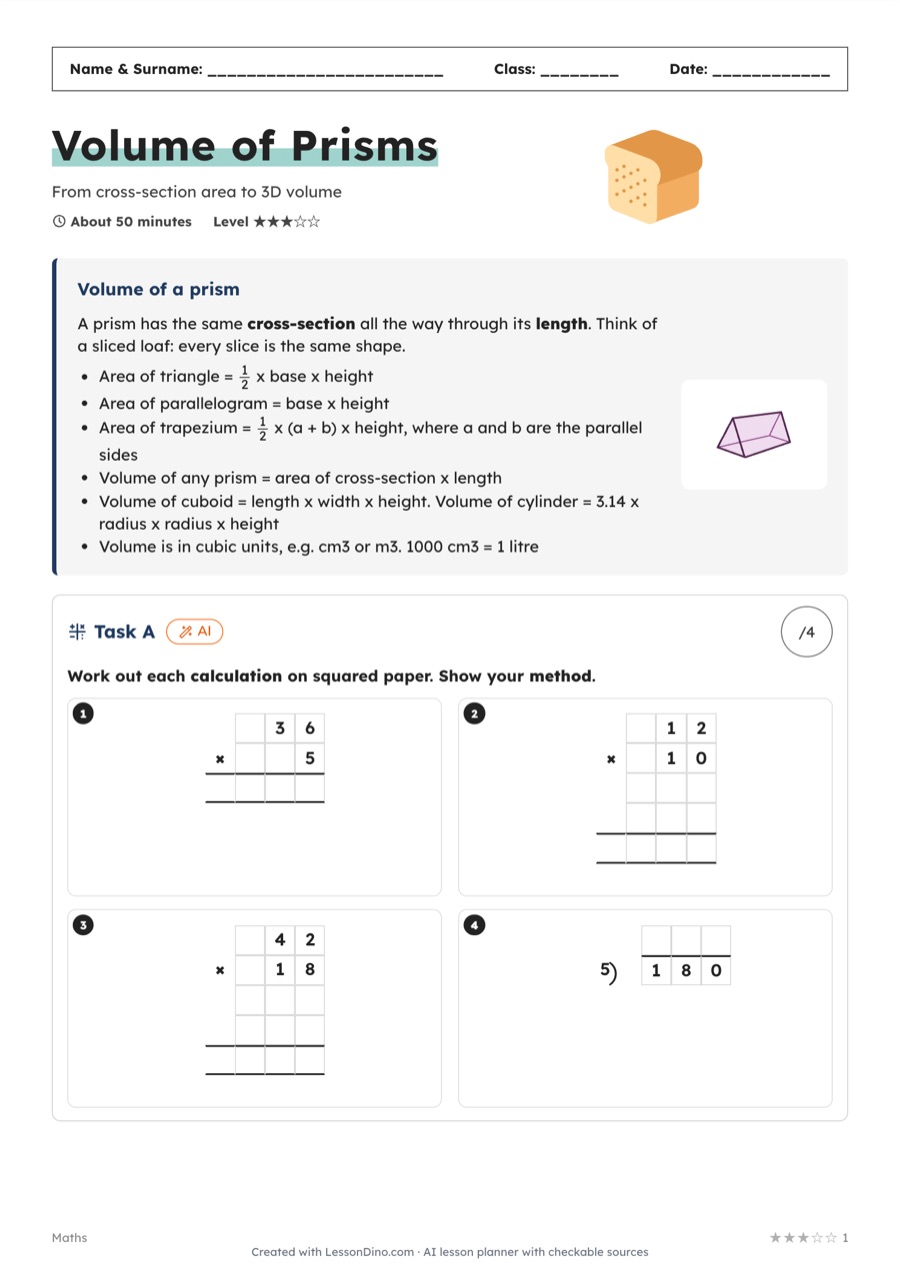
Learn the volume rule, then warm up written methods.
Volume of a prism
- A prism has the same cross-section all the way through its length. Think of a sliced loaf: every slice is the same shape.
- Area of triangle = 1/2 x base x height
- Area of parallelogram = base x height
- Area of trapezium = 1/2 x (a + b) x height, where a and b are the parallel sides
- Volume of any prism = area of cross-section x length
- Volume of cuboid = length x width x height. Volume of cylinder = 3.14 x radius x radius x height
- Volume is in cubic units, e.g. cm3 or m3. 1000 cm3 = 1 litre
Work out each calculation on squared paper. Show your method.
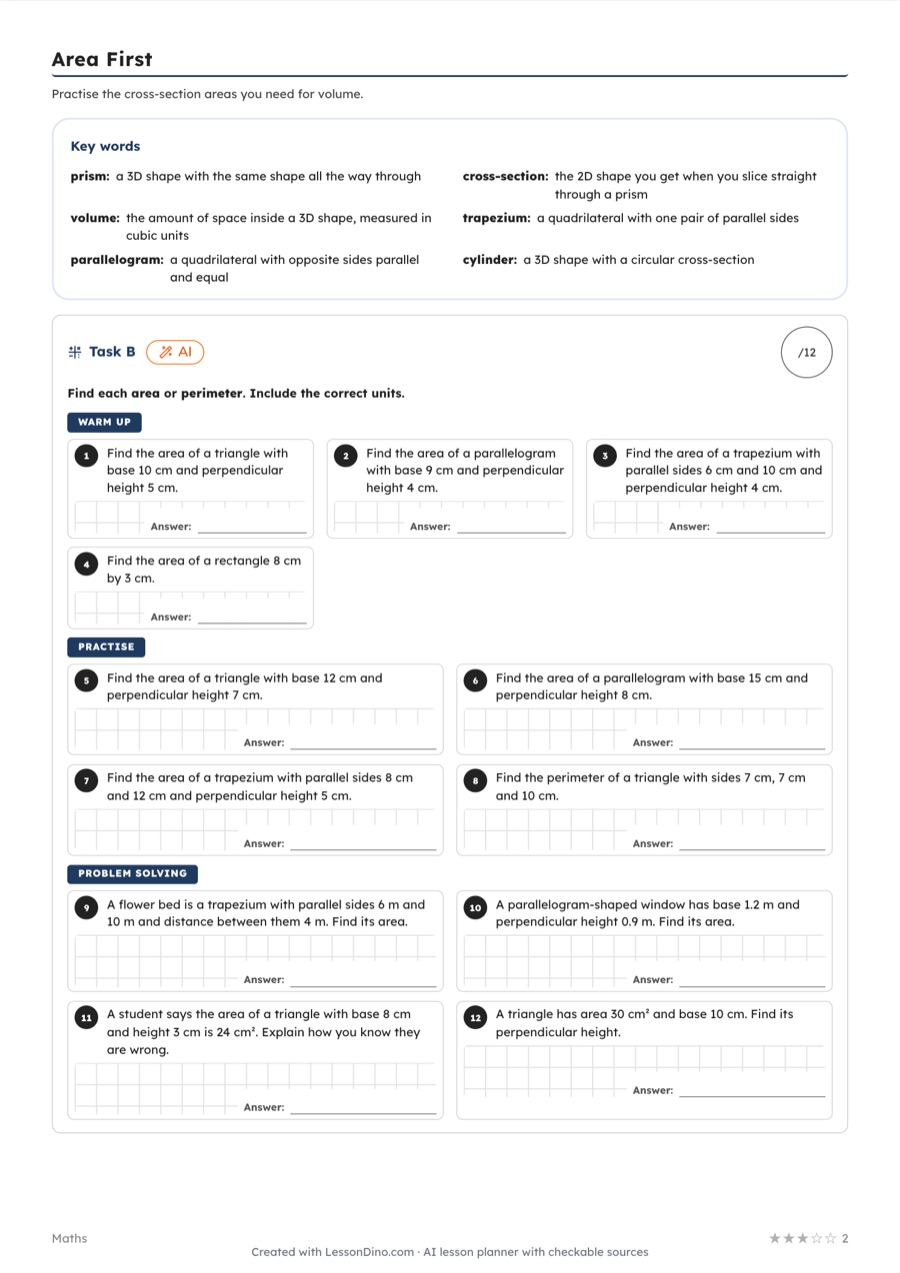
Area First
Practise the cross-section areas you need for volume.
| Word | Meaning |
|---|---|
| prism | a 3D shape with the same shape all the way through |
| cross-section | the 2D shape you get when you slice straight through a prism |
| volume | the amount of space inside a 3D shape, measured in cubic units |
| trapezium | a quadrilateral with one pair of parallel sides |
| parallelogram | a quadrilateral with opposite sides parallel and equal |
| cylinder | a 3D shape with a circular cross-section |
Find each area or perimeter. Include the correct units.
Warm up
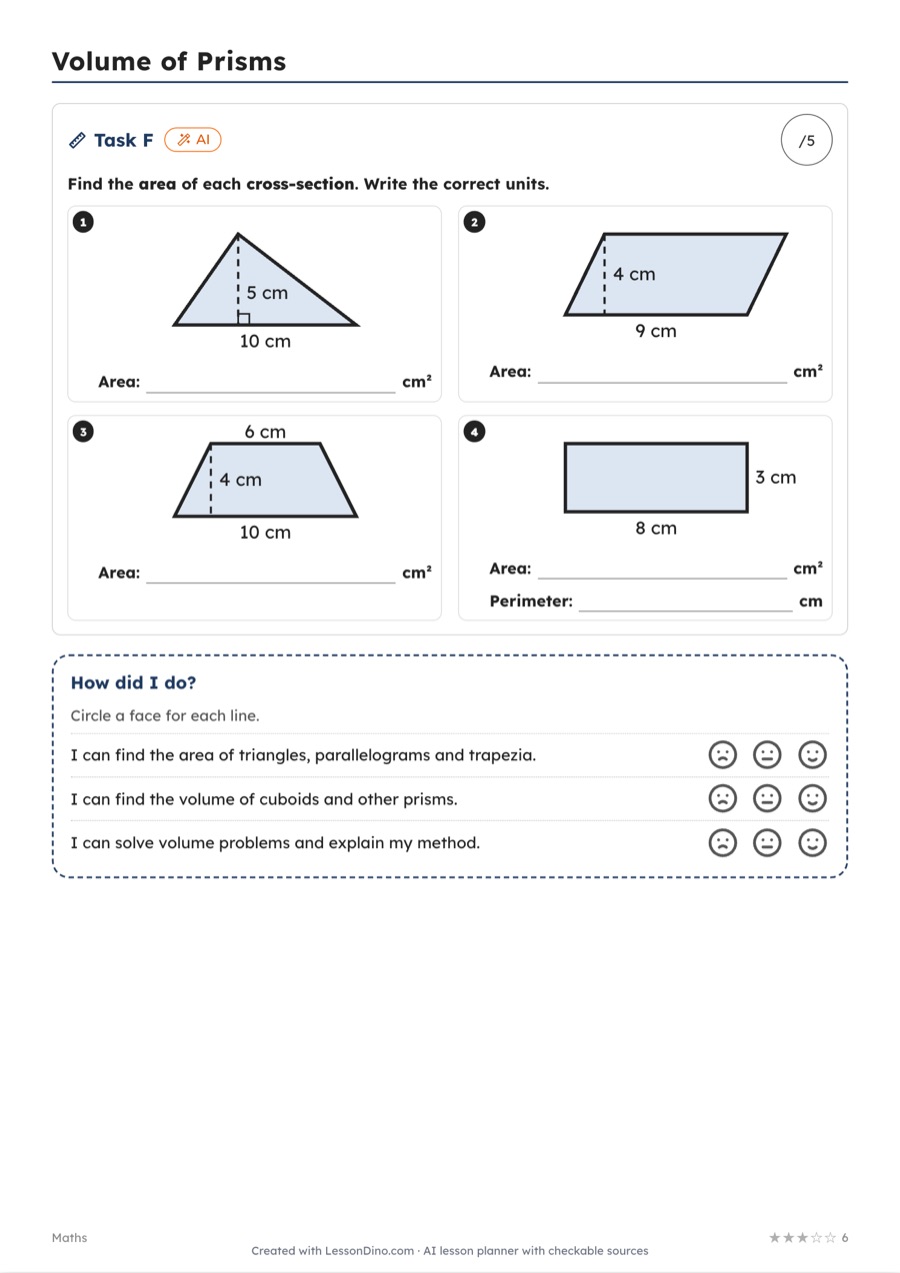
- Find the area of a triangle with base 10 cm and perpendicular height 5 cm.
- Find the area of a parallelogram with base 9 cm and perpendicular height 4 cm.
- Find the area of a trapezium with parallel sides 6 cm and 10 cm and perpendicular height 4 cm.
- Find the area of a rectangle 8 cm by 3 cm.
Practise
- Find the area of a triangle with base 12 cm and perpendicular height 7 cm.
- Find the area of a parallelogram with base 15 cm and perpendicular height 8 cm.
- Find the area of a trapezium with parallel sides 8 cm and 12 cm and perpendicular height 5 cm.
- Find the perimeter of a triangle with sides 7 cm, 7 cm and 10 cm.
Problem solving
- A flower bed is a trapezium with parallel sides 6 m and 10 m and distance between them 4 m. Find its area.
- A parallelogram-shaped window has base 1.2 m and perpendicular height 0.9 m. Find its area.
- A student says the area of a triangle with base 8 cm and height 3 cm is 24 cm². Explain how you know they are wrong.
- A triangle has area 30 cm² and base 10 cm. Find its perpendicular height.
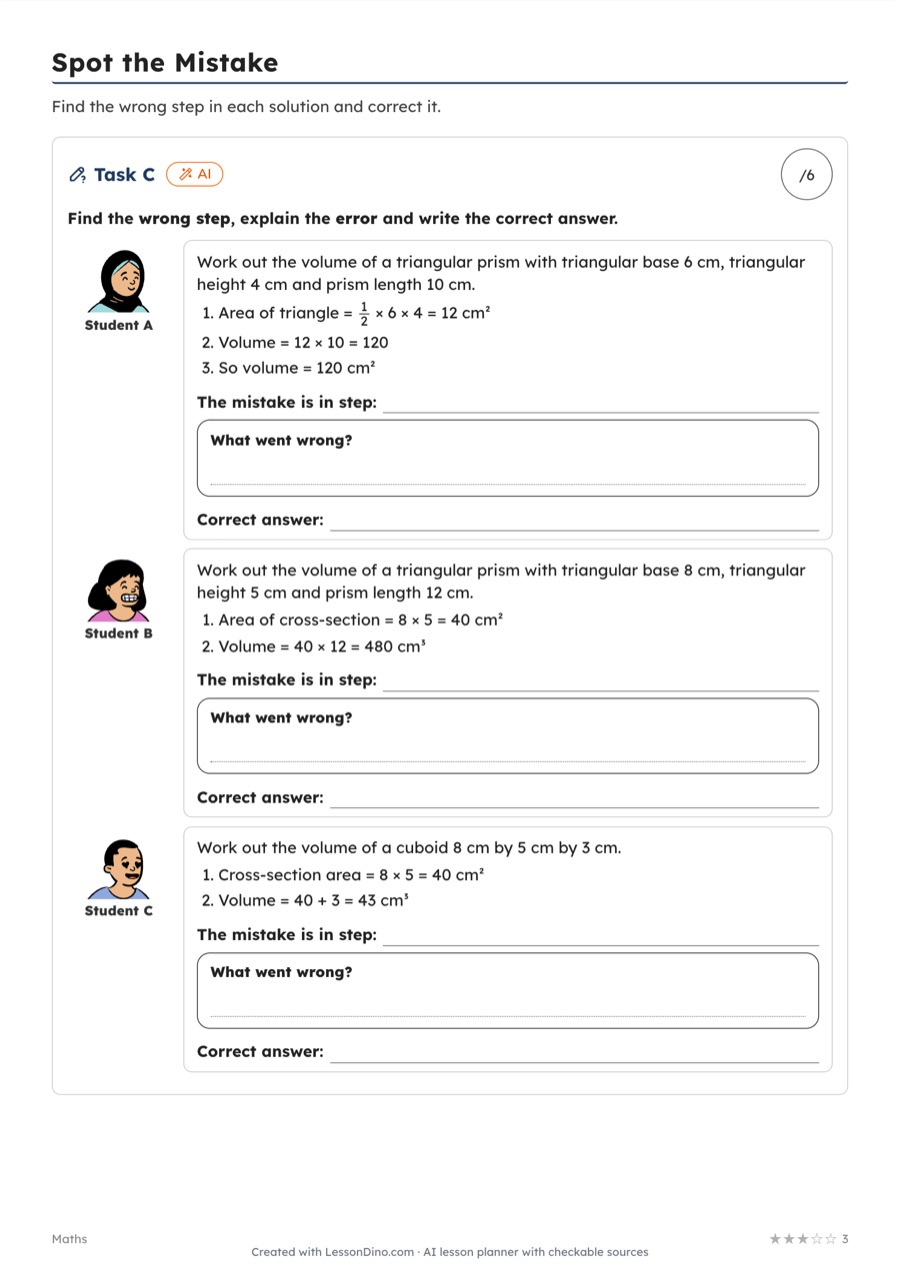
Spot the Mistake
Find the wrong step in each solution and correct it.
Find the wrong step, explain the error and write the correct answer.
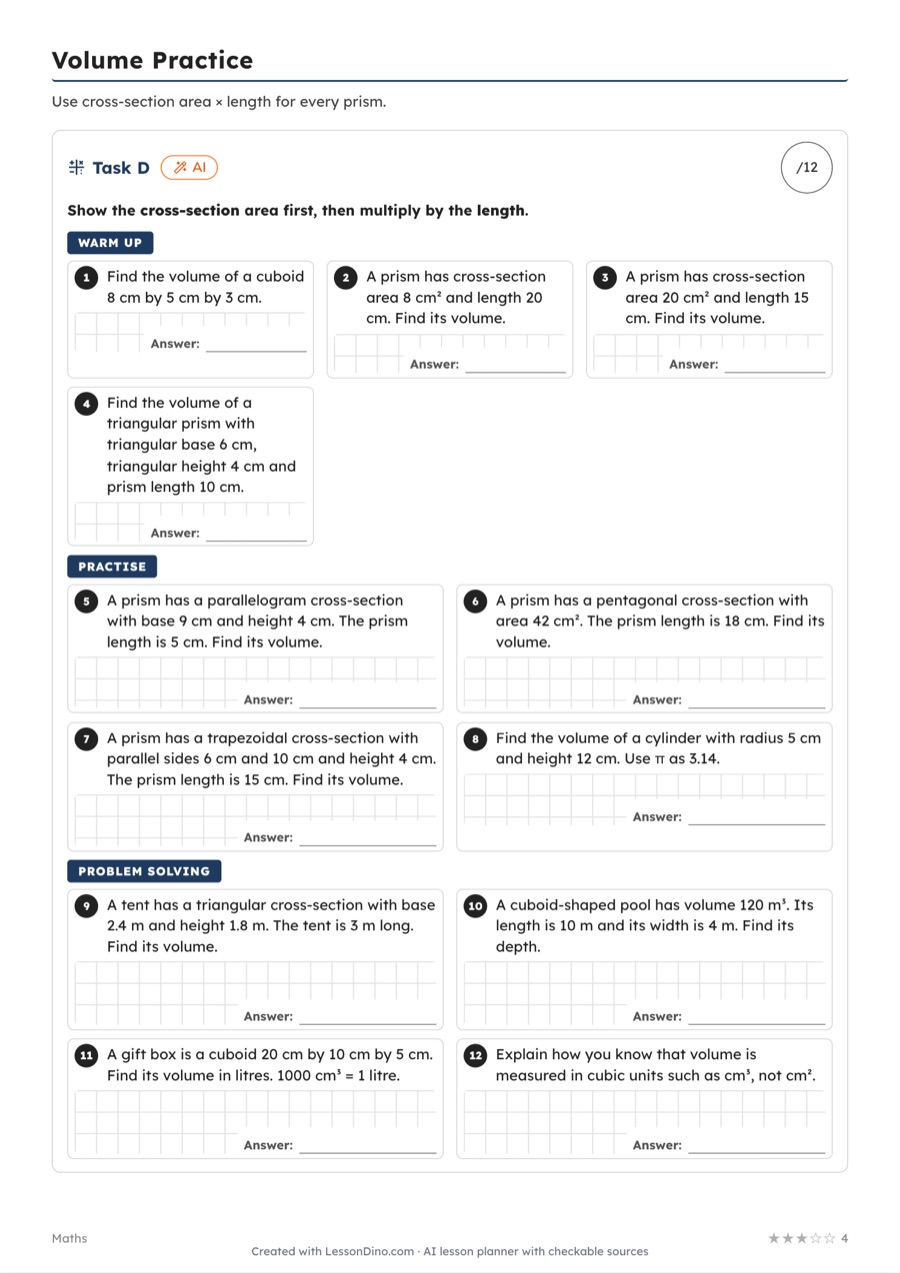
Volume Practice
Use cross-section area × length for every prism.
Show the cross-section area first, then multiply by the length.
Warm up
- Find the volume of a cuboid 8 cm by 5 cm by 3 cm.
- A prism has cross-section area 8 cm² and length 20 cm. Find its volume.
- A prism has cross-section area 20 cm² and length 15 cm. Find its volume.
- Find the volume of a triangular prism with triangular base 6 cm, triangular height 4 cm and prism length 10 cm.
Practise
- A prism has a parallelogram cross-section with base 9 cm and height 4 cm. The prism length is 5 cm. Find its volume.
- A prism has a pentagonal cross-section with area 42 cm². The prism length is 18 cm. Find its volume.
- A prism has a trapezoidal cross-section with parallel sides 6 cm and 10 cm and height 4 cm. The prism length is 15 cm. Find its volume.
- Find the volume of a cylinder with radius 5 cm and height 12 cm. Use π as 3.14.
Problem solving
- A tent has a triangular cross-section with base 2.4 m and height 1.8 m. The tent is 3 m long. Find its volume.
- A cuboid-shaped pool has volume 120 m³. Its length is 10 m and its width is 4 m. Find its depth.
- A gift box is a cuboid 20 cm by 10 cm by 5 cm. Find its volume in litres. 1000 cm³ = 1 litre.
- Explain how you know that volume is measured in cubic units such as cm³, not cm².
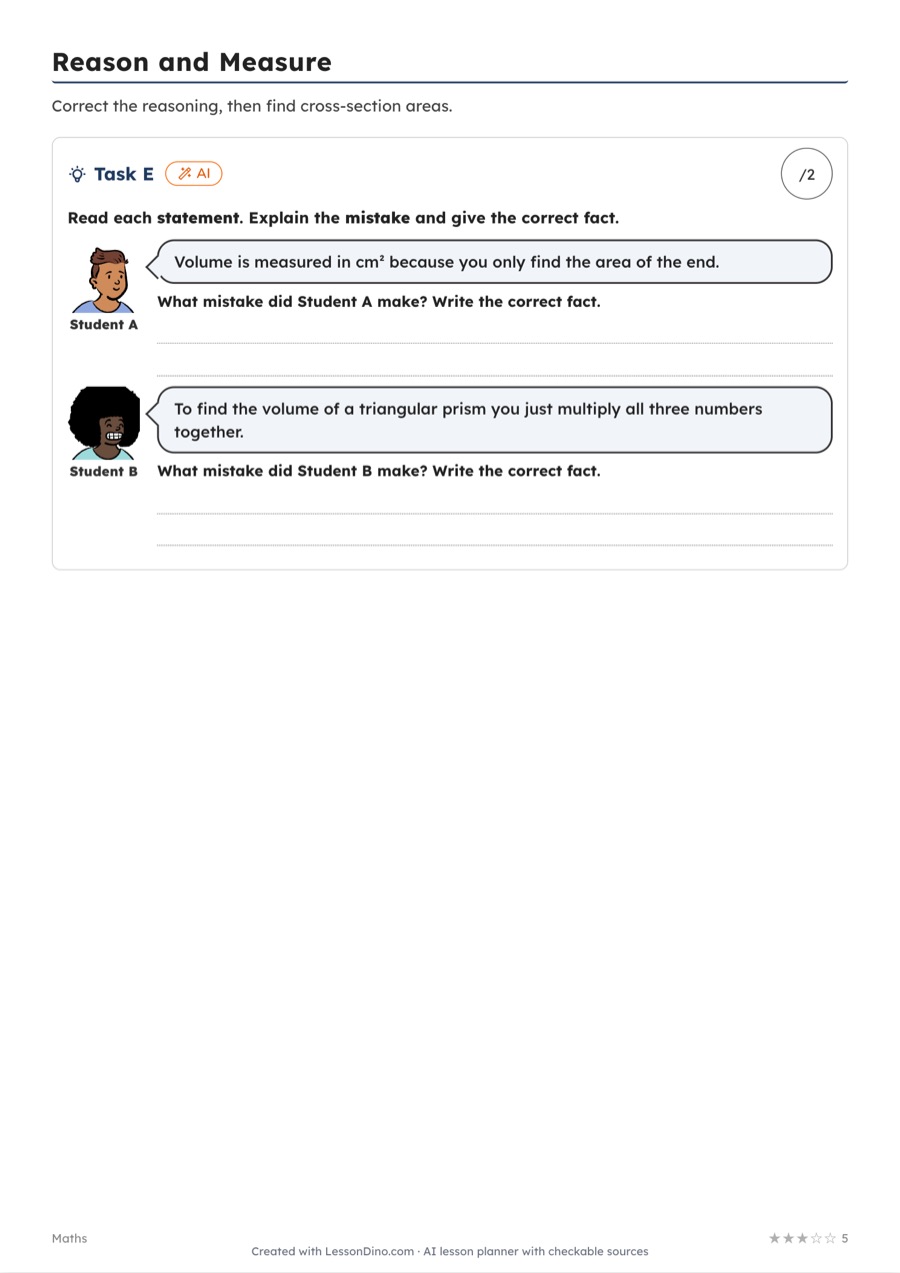
Reason and Measure
Correct the reasoning, then find cross-section areas.
Read each statement. Explain the mistake and give the correct fact.
Page 6
Find the area of each cross-section. Write the correct units.
Answers
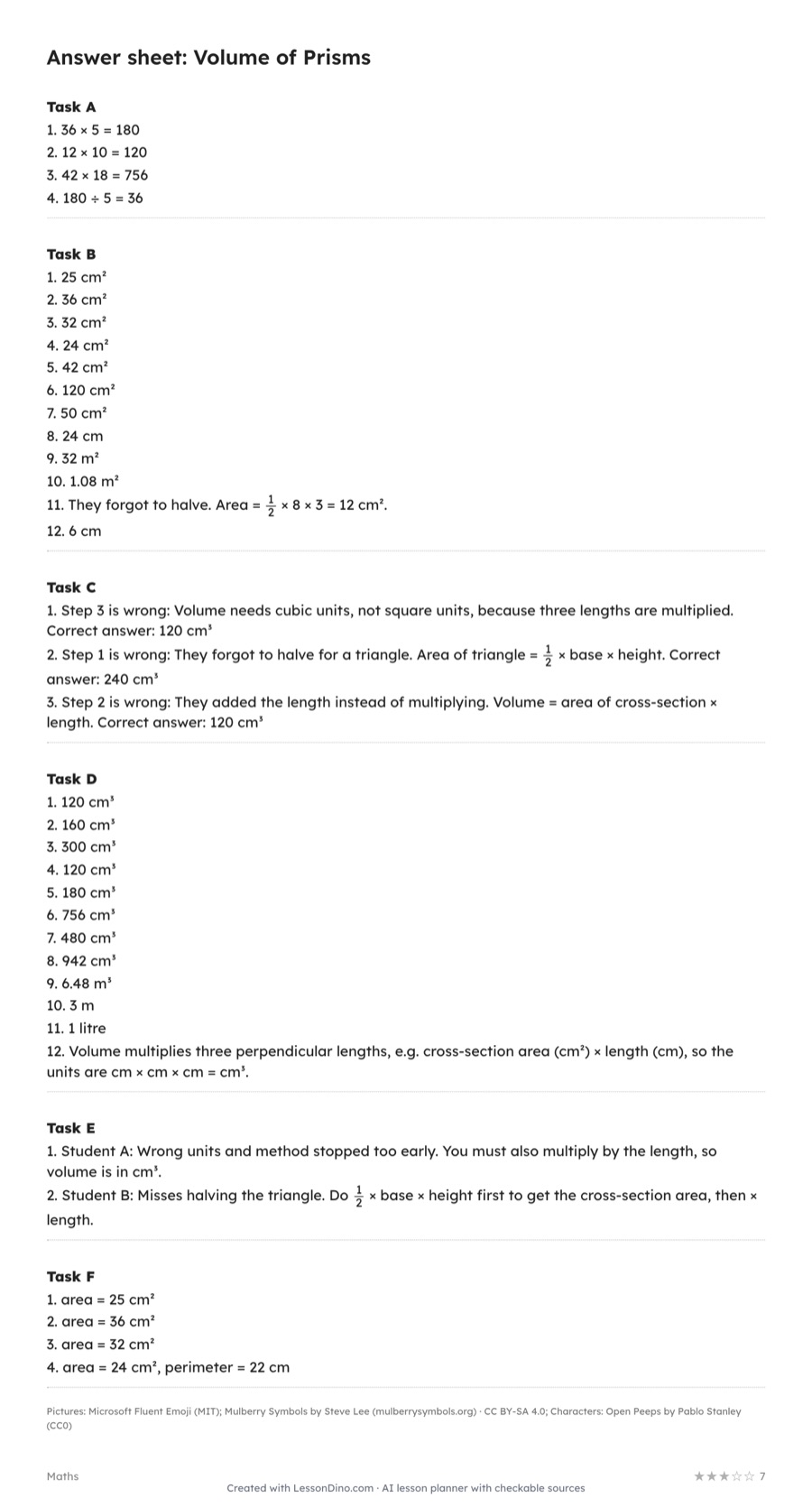
Show the answers
- Find the area of a triangle with base 10 cm and perpendicular height 5 cm. 25 cm²
- Find the area of a parallelogram with base 9 cm and perpendicular height 4 cm. 36 cm²
- Find the area of a trapezium with parallel sides 6 cm and 10 cm and perpendicular height 4 cm. 32 cm²
- Find the area of a rectangle 8 cm by 3 cm. 24 cm²
- Find the area of a triangle with base 12 cm and perpendicular height 7 cm. 42 cm²
- Find the area of a parallelogram with base 15 cm and perpendicular height 8 cm. 120 cm²
- Find the area of a trapezium with parallel sides 8 cm and 12 cm and perpendicular height 5 cm. 50 cm²
- Find the perimeter of a triangle with sides 7 cm, 7 cm and 10 cm. 24 cm
- A flower bed is a trapezium with parallel sides 6 m and 10 m and distance between them 4 m. Find its area. 32 m²
- A parallelogram-shaped window has base 1.2 m and perpendicular height 0.9 m. Find its area. 1.08 m²
- A student says the area of a triangle with base 8 cm and height 3 cm is 24 cm². Explain how you know they are wrong. They forgot to halve. Area = 1/2 × 8 × 3 = 12 cm².
- A triangle has area 30 cm² and base 10 cm. Find its perpendicular height. 6 cm
- Find the volume of a cuboid 8 cm by 5 cm by 3 cm. 120 cm³
- A prism has cross-section area 8 cm² and length 20 cm. Find its volume. 160 cm³
- A prism has cross-section area 20 cm² and length 15 cm. Find its volume. 300 cm³
- Find the volume of a triangular prism with triangular base 6 cm, triangular height 4 cm and prism length 10 cm. 120 cm³
- A prism has a parallelogram cross-section with base 9 cm and height 4 cm. The prism length is 5 cm. Find its volume. 180 cm³
- A prism has a pentagonal cross-section with area 42 cm². The prism length is 18 cm. Find its volume. 756 cm³
- A prism has a trapezoidal cross-section with parallel sides 6 cm and 10 cm and height 4 cm. The prism length is 15 cm. Find its volume. 480 cm³
- Find the volume of a cylinder with radius 5 cm and height 12 cm. Use π as 3.14. 942 cm³
- A tent has a triangular cross-section with base 2.4 m and height 1.8 m. The tent is 3 m long. Find its volume. 6.48 m³
- A cuboid-shaped pool has volume 120 m³. Its length is 10 m and its width is 4 m. Find its depth. 3 m
- A gift box is a cuboid 20 cm by 10 cm by 5 cm. Find its volume in litres. 1000 cm³ = 1 litre. 1 litre
- Explain how you know that volume is measured in cubic units such as cm³, not cm². Volume multiplies three perpendicular lengths, e.g. cross-section area (cm²) × length (cm), so the units are cm × cm × cm = cm³.
The answer sheet is the last picture above.
Curriculum
derive and apply formulae to calculate and solve problems involving: perimeter and area of triangles, parallelograms, trapezia, volume of cuboids (including cubes) and other prisms (including cylinders)
From National curriculum in England, Key Stage 3 mathematics.
Made with Lesson Dino's AI on 19 October 2026. AI can make mistakes, so check the answers and facts against the sources before you teach.