Slides
Lesson plan
Fence It, Paint It: Circles and Composite Shapes
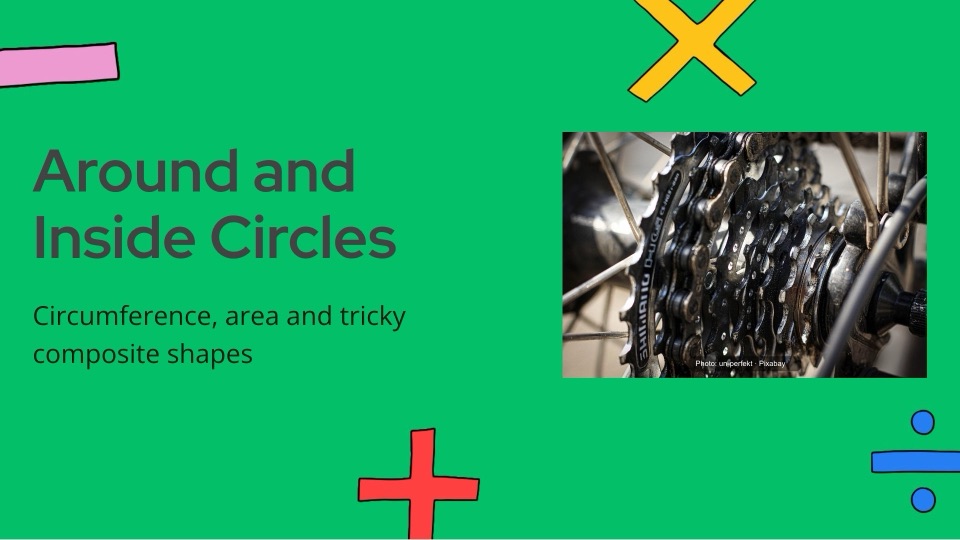
Students learn to find circumference and area of circles and composites. They dissect a running-track shape to solve perimeter and area problems.
Objectives
- Students will find circumference of circles from radius or diameter using pi accurately.
- Students will find areas of circles and semicircles using pi times radius squared.
- Students will solve perimeter and area problems for composite shapes with semicircles.
Success criteria
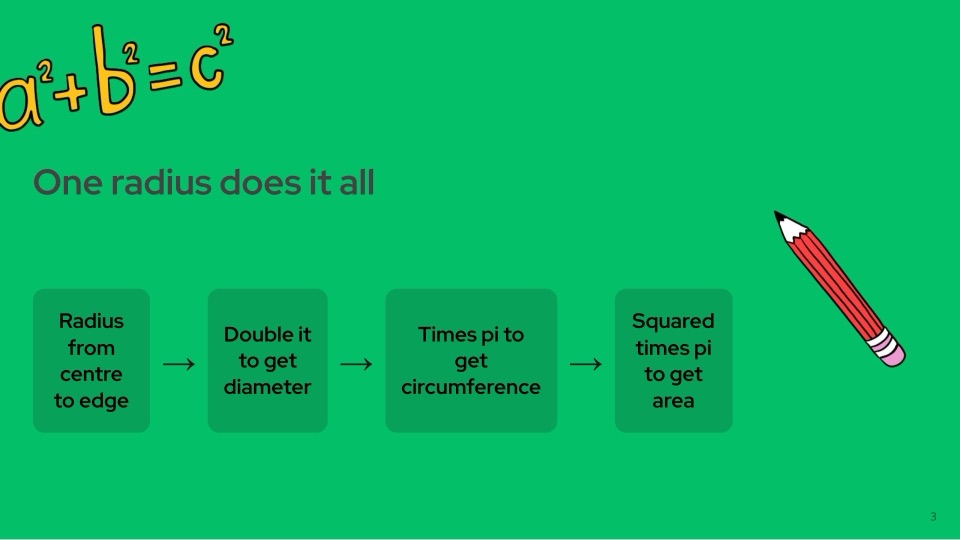
- I can work out circumference with C equals pi times diameter.
- I can work out area with A equals pi times radius squared.
- I can find perimeter and area of a rectangle with semicircles.
Key words
| Word | Meaning |
|---|---|
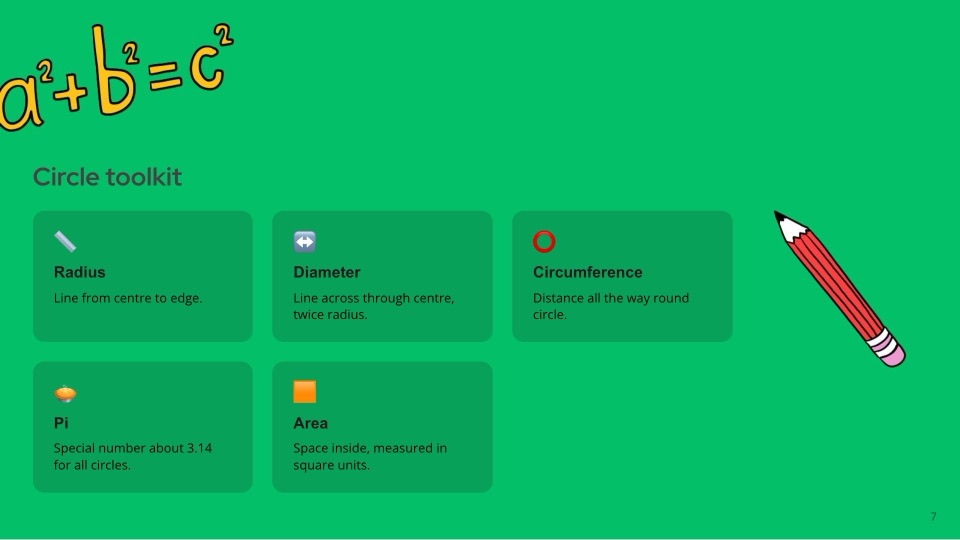
| circumference | distance all the way round a round shape, like a fence |
| radius | length from the middle dot to the edge of a circle |
| diameter | length straight across through the middle, double the radius |
| area | amount of flat space inside a shape, counted in squares |
| semicircle | half of a round shape cut straight through its middle |
| pi | special number about 3.14 linking width across to distance round |
Timed plan (60 minutes)
| Time | Stage | What happens |
|---|---|---|
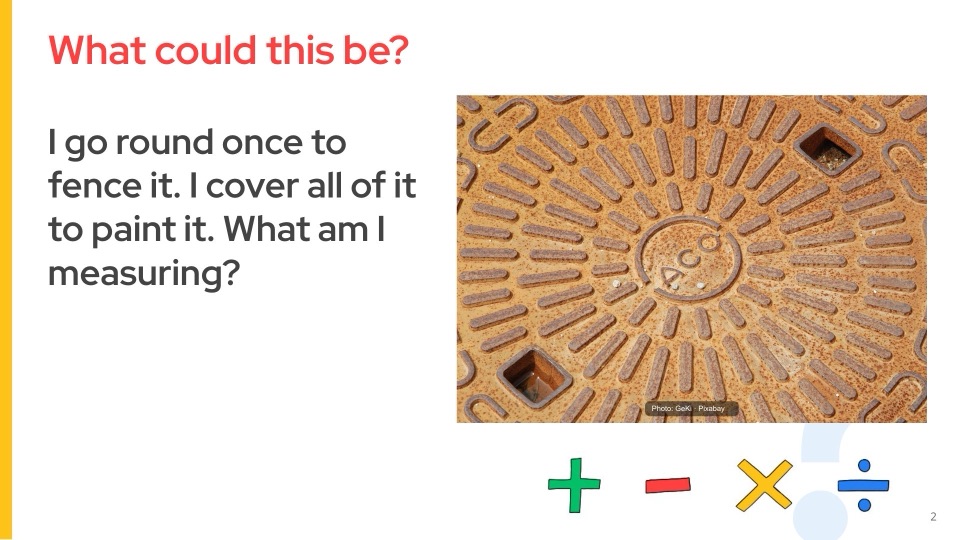
| 10 min | Starter | To recall fence means perimeter and paint means area and hook the track problem. Show Slide 1 title and read the running-track hook to the class. Show Slide 2 mystery and ask pairs to decide fence or paint for two quick jobs. Take answers on mini whiteboards and confirm circumference for fence, area for paint. Link answers to today's goal of perimeter and area with semicircles. |
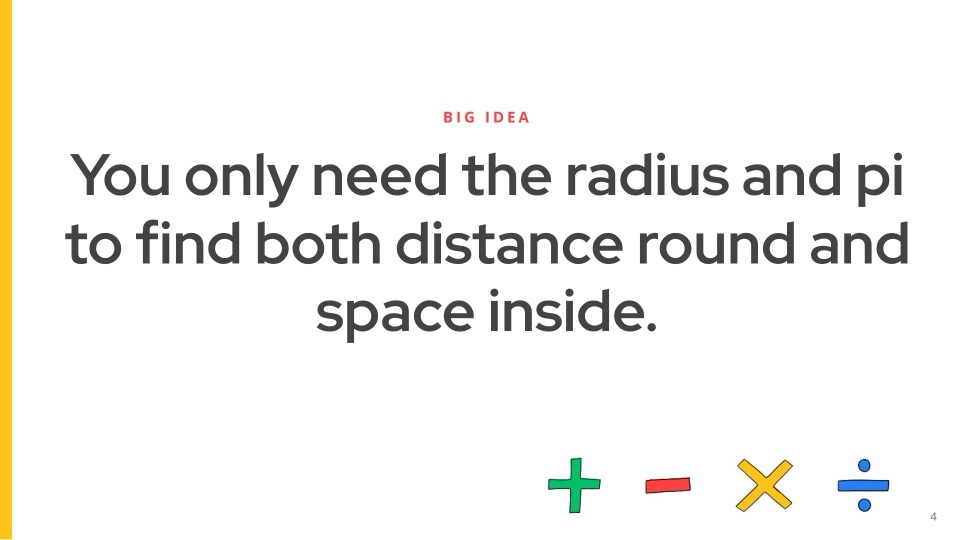
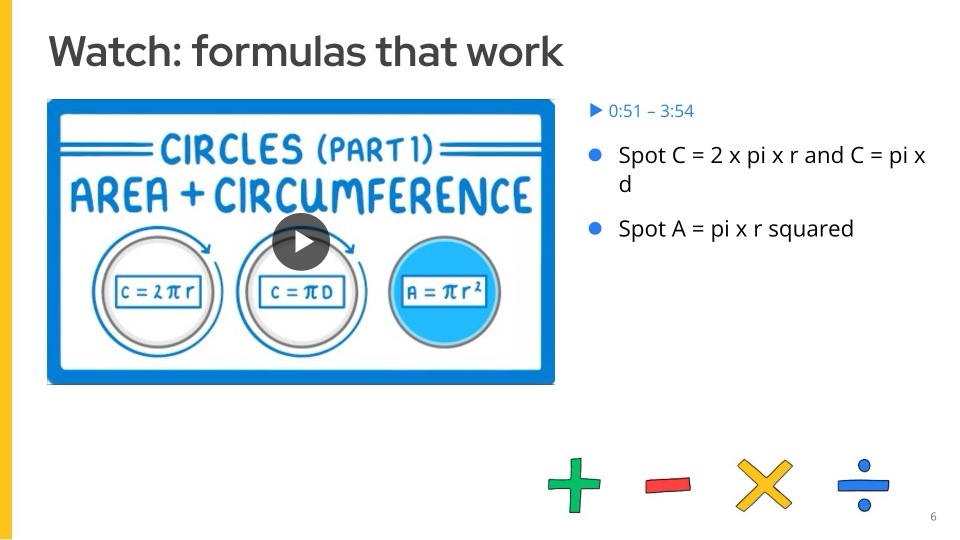
| 12 min | Teaching | To teach circumference and area formulas from radius and diameter. Talk through Slide 3 chain and Slide 4 big idea using a drawn circle. Play Video clip 1 and ask students to spot the two circumference forms and the area form. Model one full-circle example on the board with pi = 3.14. Use Slide 7 cards to check radius, diameter, circumference and area meanings. |
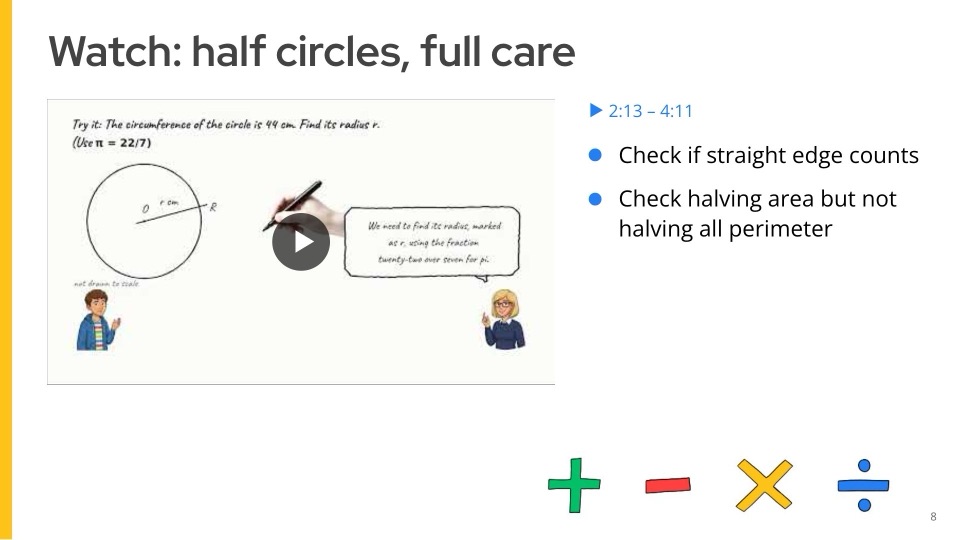
| 20 min | Main activity | To find perimeter and area of composite shapes made with semicircles. Show Slide 8 and play Video clip 2, stressing when the straight edge counts. Model the running track with highlighter round only the outside edge. Hand out printed running-track and window shapes, highlighters and calculators. Circulate, prompting pairs to make a full circle from two ends for C = pi x d and A = pi x r squared. |
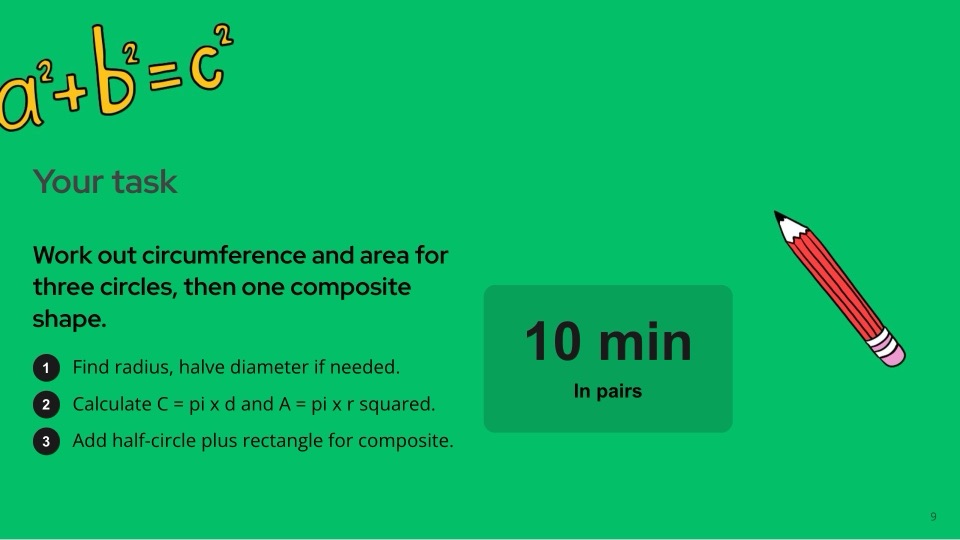
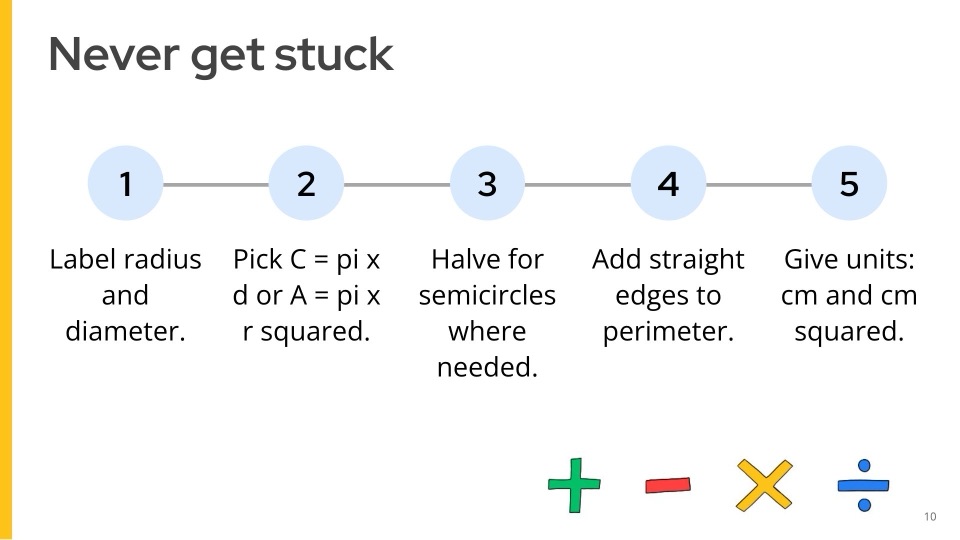
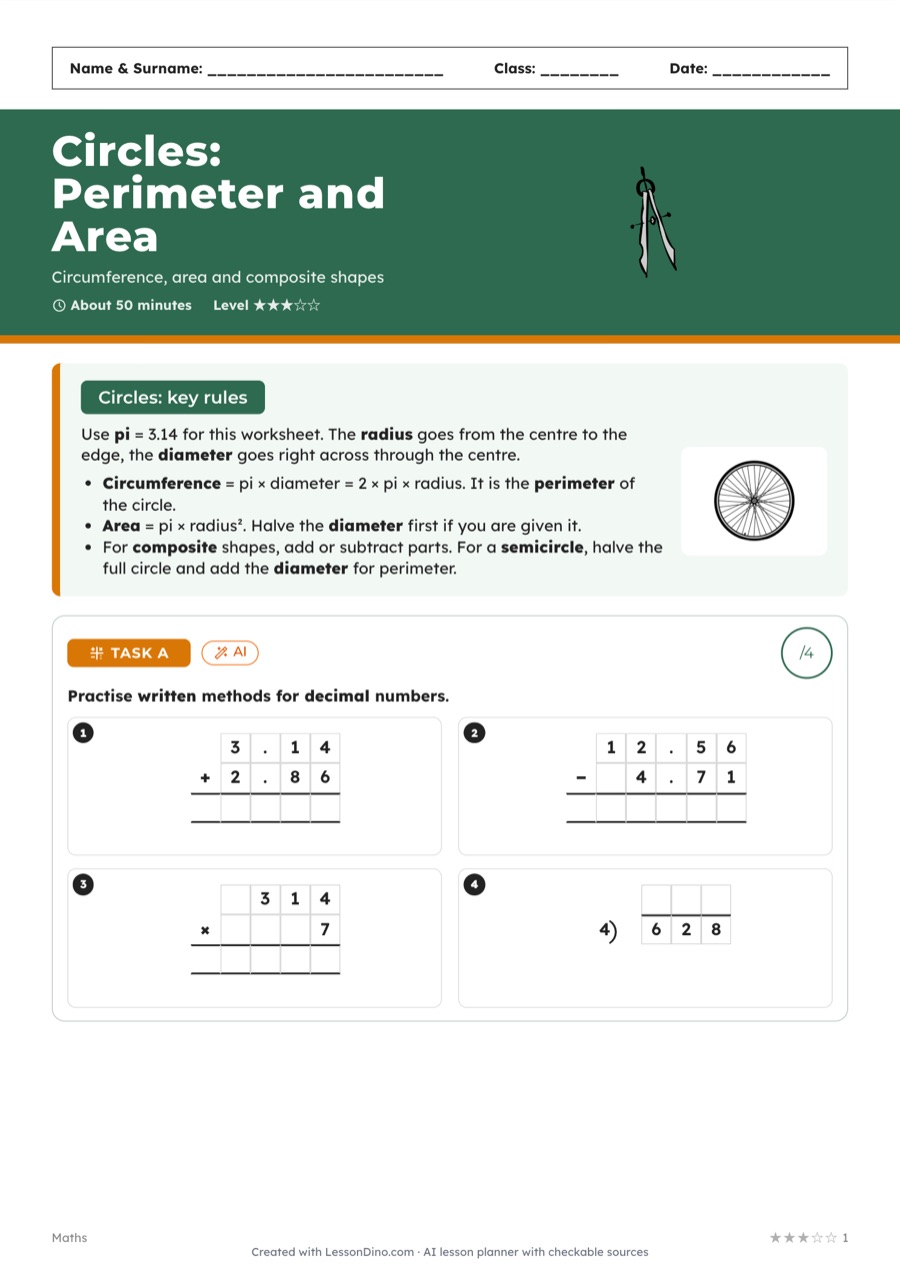
| 8 min | Independent practice | To practise choosing and using area, perimeter or circumference alone. Hand out Worksheet Task D (Work out the area, perimeter or circumference of each shape) and read the first shape instruction together. Remind students of Slide 10 steps: label, pick formula, halve if needed, add straights. Set 8 minutes for three shapes with pi = 3.14 and calculators. Stop at 6 minutes to give a one-minute hint on units. |
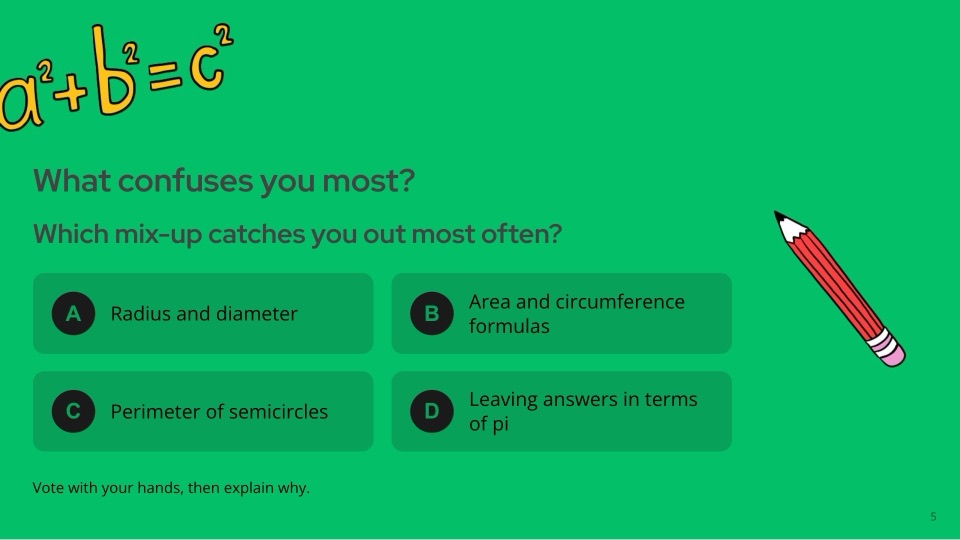
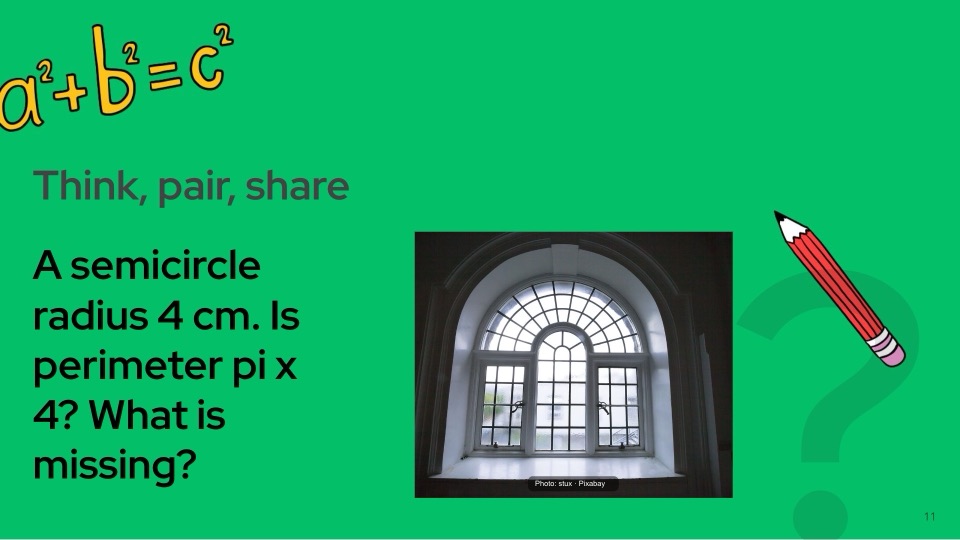
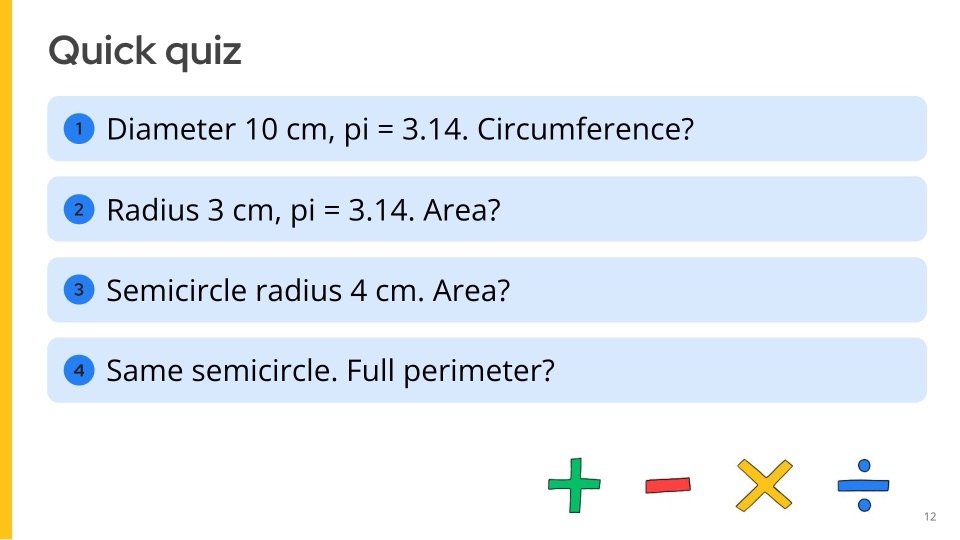
| 10 min | Plenary | To fix semicircle perimeter errors and check all three objectives. Show Slide 11 question and ask pairs to discuss the trap in one minute. Model the semicircle radius 4 cm perimeter fully on the board. Run Slide 12 quick quiz with whiteboards using pi = 3.14. Close by matching answers back to the three success criteria. |
Common mistakes
- Using diameter in A = pi x r squared instead of radius
How to spot it: Area far too big, about four times expected, no halving step seen
Underline radius or diameter, write r = d / 2 first, then use A = pi x r squared - Giving semicircle perimeter as half circumference only
How to spot it: Answer equals pi x r only, straight edge missing from sketch
Highlight the outside including the diameter, add half C = pi x d plus diameter - Mixing area and circumference formulas or units
How to spot it: cm squared for distance round or cm for covering, or C = pi x r squared
Ask fence or paint: fence is circumference in length units like metres, paint is area in square units
Support
- Colour the diameter line where the semicircle joins the rectangle to show it is inside and not counted in the perimeter.
- Provide multiplication grid and table for radius, radius squared and times pi with whole-number radii.
Stretch
- Give a shape with a semicircular hole removed and ask students to subtract and to adjust the perimeter to include the inside curve.
- Ask students to design where inner circle and outer ring have equal areas and explain with pi x r squared.
Check questions
- Diameter 10 cm, pi = 3.14. Circumference?
Answer: 31.4 cm, because C = pi x d. - Radius 3 cm, pi = 3.14. Area?
Answer: 28.26 cm squared, because A = pi x 9. - Rectangle 20 m by 10 m with a semicircle radius 5 m on each end. Perimeter and area?
Answer: Perimeter 71.4 m; area 278.5 m squared.
Curriculum
calculate and solve problems involving: perimeters of 2-D shapes (including circles), areas of circles and composite shapes
From National curriculum in England, Key Stage 3 mathematics.
Video clips
Clips on YouTube, from the start and end times we chose. Check each one before you show it.
-
Area and circumference formulas with radius from 0:51 to 3:54
Cognito: GCSE Maths - How to find the Area and Circumference of a Circle (Circles Part 1) (2026/27 exams)
Clear UK explanations with clean visuals at a pace that suits 12–13-year-olds in Year 8.
-
Semicircle perimeter and shape check from 2:13 to 4:11
Sketchcast-AI: Circumference and Area of a Circle Explained | Circumference | Cambridge Stage 9 Mathematics
Made for Cambridge Stage 9 at about age 13 so the language fits Year 8 and it directly covers composite perimeters.
Worksheet
Sources
- How do you work out the circumference and area of a circle? | MyTutor mytutor.co.uk
- Flexi answers - How to find circumference and area of circle? | CK-12 Foundation ck12.org
- Circumference and Area of a Circle Calculator omnicalculator.com
- Area and Circumference of a Circle (Video) mometrix.com
- Section 2.5: Circles – MAT112 Mathematical Concepts & Applications open.maricopa.edu
Picture credits
- Photo: un-perfekt · Pixabay
- Photo: GeKi · Pixabay
- Photo: stux · Pixabay
- Pictograms: Sergio Palao, ARASAAC (arasaac.org) · CC BY-NC-SA
- Drawing: Editor B · CC BY 4.0 · Wikimedia Commons
Made with Lesson Dino's AI on 19 October 2026. AI can make mistakes, so check facts against the sources before you teach.