Slides


Lesson plan
Find the nth Term by Matching the Rule
Pupils learn to recognise arithmetic sequences and find the nth term. They match sequences, pictures and rules, then test them.
Objectives
- Students will recognise arithmetic sequences by checking for a constant difference.
- Students will find the nth term of linear sequences using difference and adjustment.
Success criteria
- I can tell if a sequence is arithmetic and give the common difference.
- I can write the nth term and use it to find any term.
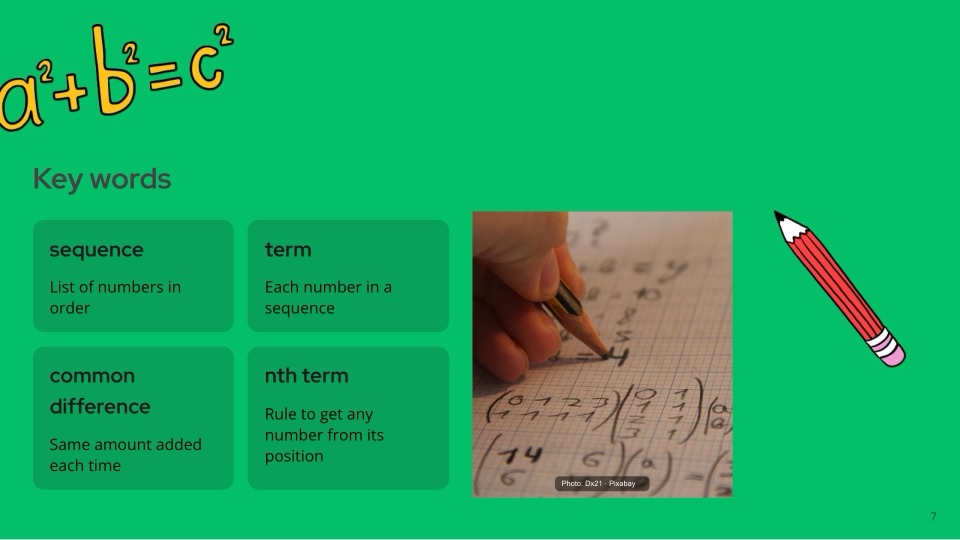
Key words
| Word | Meaning |
|---|---|
| sequence | a list of numbers in order |
| term | each separate number in a list |
| common difference | the same amount added each time to get the next number |
| nth term | a rule that gives any number from its place in the list, so each place maps to exactly one value |
Timed plan (60 minutes)
| Time | Stage | What happens |
|---|---|---|
| 8 min | Starter | To recall equal steps and create curiosity about matching sequences to rules. Show Slide 1 title and keep four sealed envelopes on the desk to build suspense. Say the hook and show Slide 2 photo of cups stacking by the same number each time. Ask pairs where they have seen this kind of steady growth and take two quick answers. Do a 2-minute prior check by counting up in 4s and back in 5s round the class. |
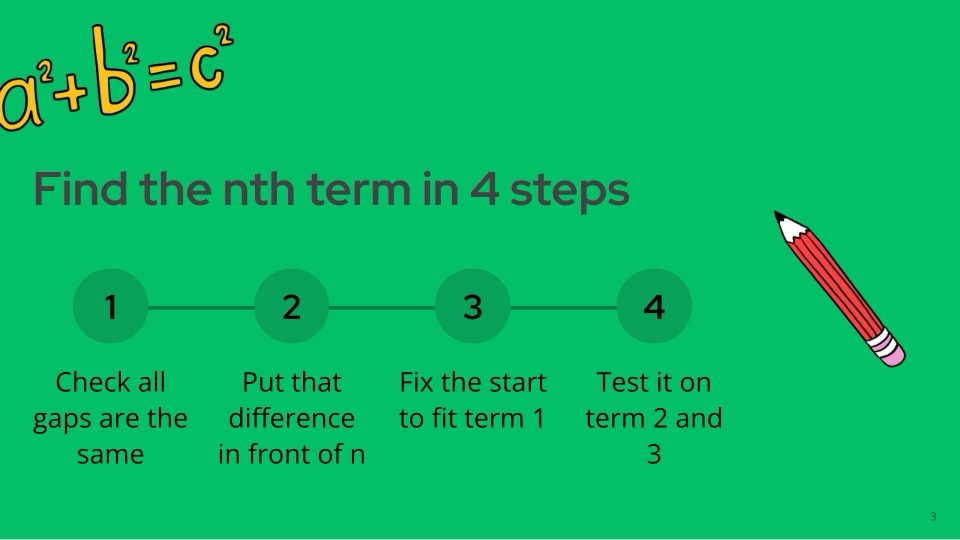
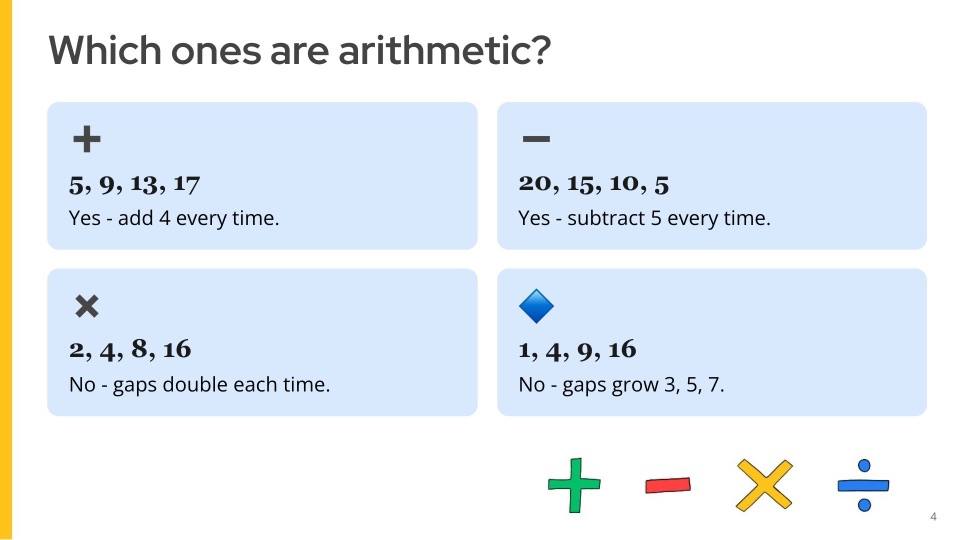
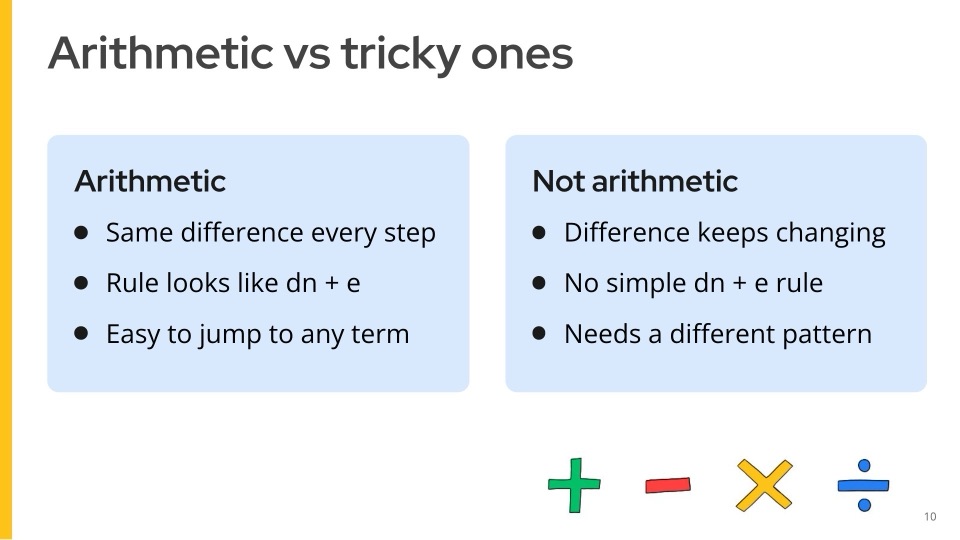
| 12 min | Teaching | To model how to recognise arithmetic sequences and build the nth term. Show Slide 4 cards with 5, 9, 13, 17 and 20, 15, 10, 5 and 2, 4, 8, 16. Model writing gaps under each sequence to show same gap means arithmetic. Show Slide 3 four steps and model them for 4, 7, 10, 13 on the board. Stress each position maps to exactly one term value, so the rule must fit n = 1, 2, 3. |
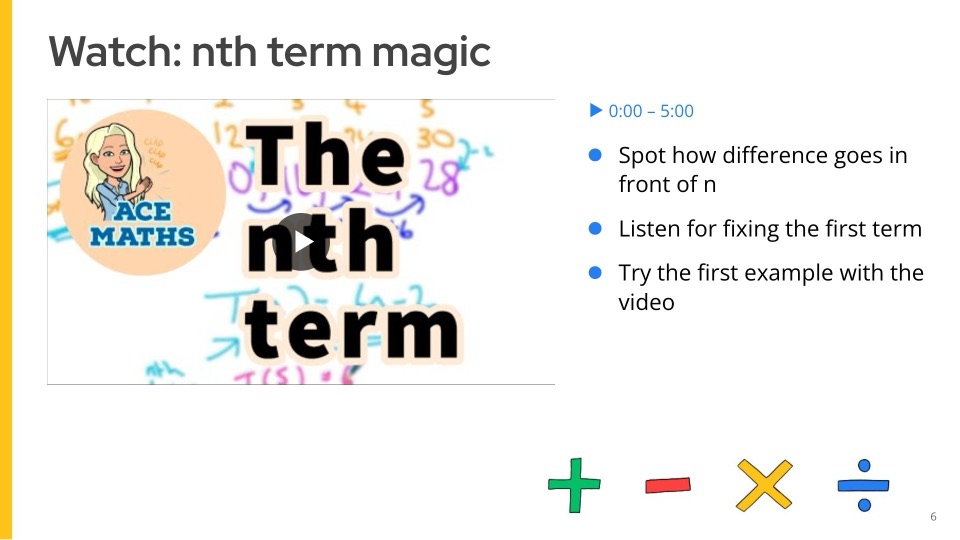
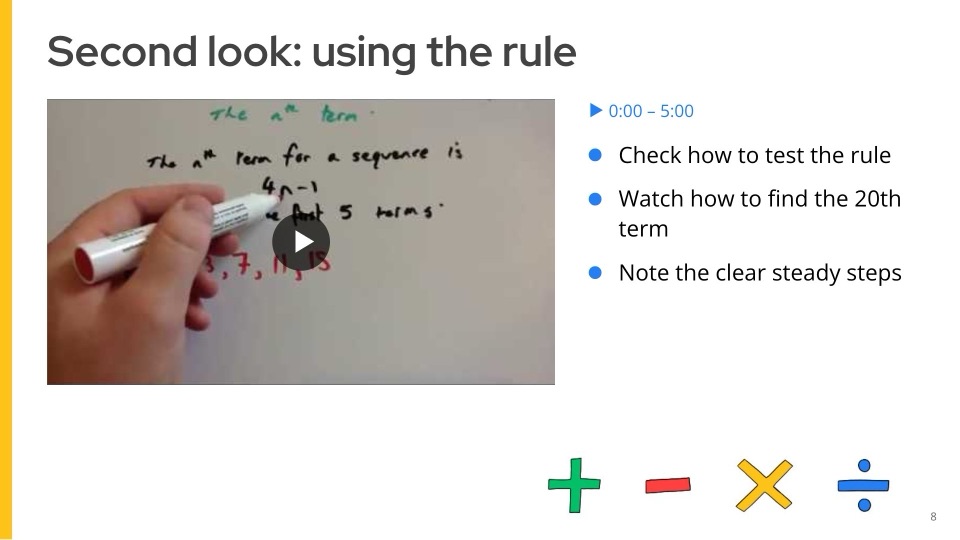
| 12 min | Guided practice | To practise the method together and secure key vocabulary. Show Slide 6 and play Video clip 1 (0:00-5:00), pausing after the first example. Ask pupils to try the first video example on whiteboards before the answer is shown. Show Slide 7 key words and link sequence, term, common difference and nth term to the example. Model function evaluation for the 20th term with clear substitution. |
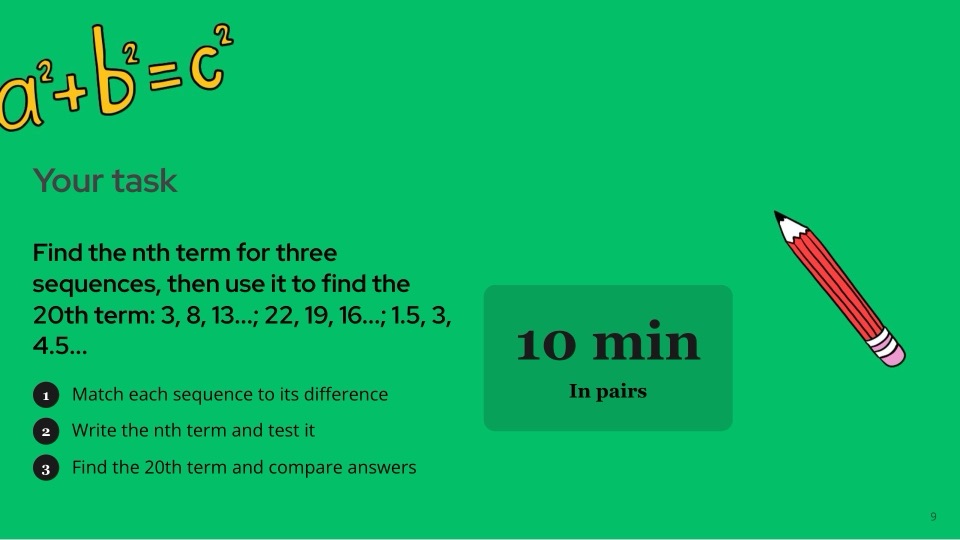
| 18 min | Main activity | To match sequences, diagrams and nth terms that describe the same pattern. Show Slide 9 task and hand each group an envelope, sugar paper and glue. Explain they must fit sequence, growing bar diagram and rule together, such as 4, 7, 10, 13 with a bar growing by 3 and 3n + 1. Remind them that addition belongs to arithmetic, so keep adding the difference to test each match before gluing. Circulate, ask for checks with n = 4, and stop the class once for a good check. |
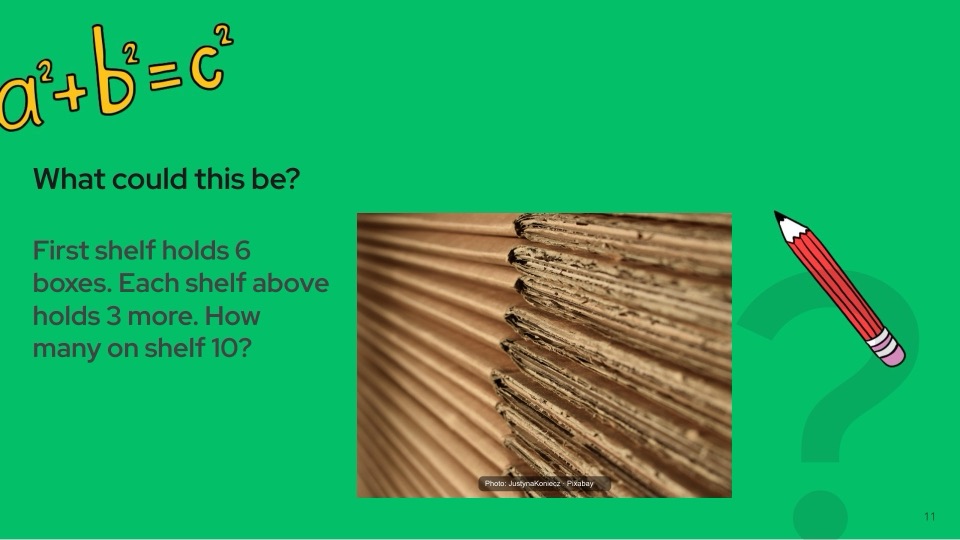
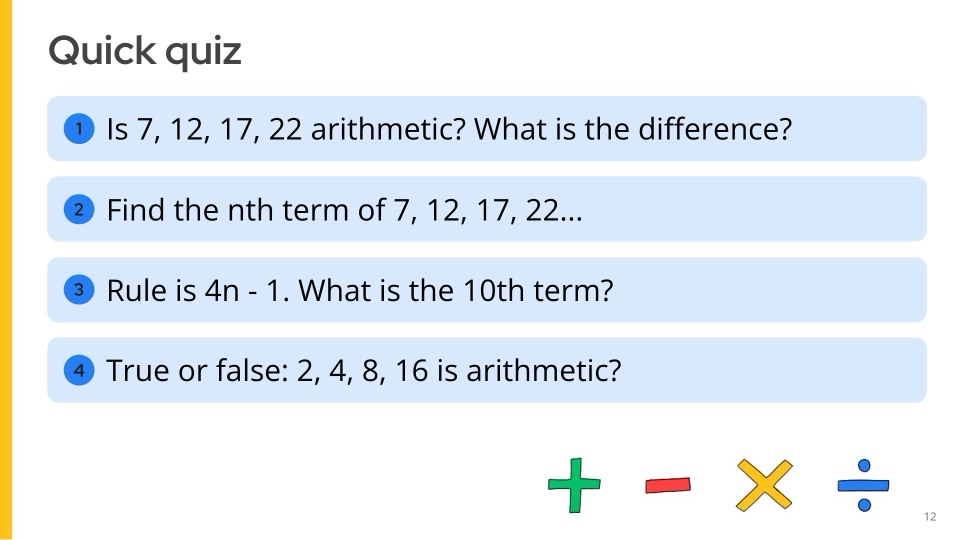
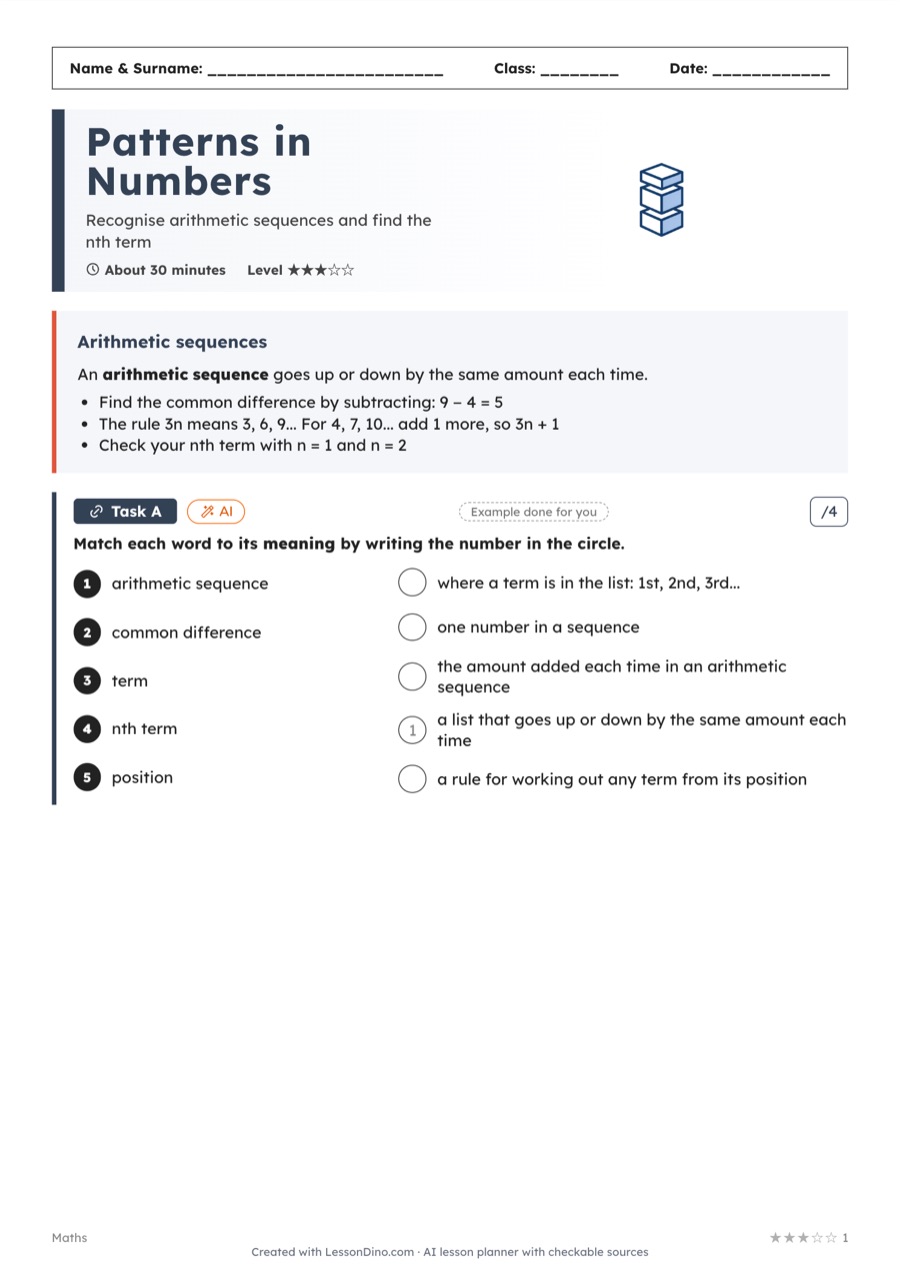
| 10 min | Plenary | To apply the nth term to a problem and correct common mistakes. Show Slide 11 mystery about shelves: 6, 9, 12... and solve for shelf 10 together. Show Slide 12 quiz for 7, 12, 17, 22 and take answers on whiteboards. Hand out Worksheet Task G and tick true or false together in 4 minutes, watching for common mistakes. |
Common mistakes
- Calling 2, 4, 8, 16 arithmetic because numbers go up.
How to spot it: Gaps written as 2, 4, 8 are not equal.
Always write all gaps first and keep only the ones with the same gap every time. - Writing n + 3 for 4, 7, 10, 13 instead of 3n + 1.
How to spot it: Test with n = 2 gives 5 not 7.
Multiply the difference by n first, then adjust to fit term 1 and test n = 1, 2, 3. - Saying a constant list like 12, 12, 12 cannot be arithmetic.
How to spot it: Pupil says difference must be positive.
Show difference is 0 and addition of 0 does not change a number, so it is arithmetic.
Support
- Use colour-coded borders so sequence cards, picture cards and rule cards are easy to tell apart.
- Provide gap templates, substitution frames and a word bank with difference, position, term and nth term.
Stretch
- Ask groups to make one extra false match that looks close and challenge another group to explain the error.
- Ask whether a given number such as 150 or 200 can belong to a rule and prove it by solving.
Check questions
- Is 6, 10, 14, 18 arithmetic? What is the common difference?
Answer: Yes, common difference +4. - Find the nth term of 6, 10, 14, 18.
Answer: 4n + 2. Check n = 1 gives 6. - Use the rule to find the 20th term.
Answer: 4 x 20 + 2 = 82.
Curriculum
recognise arithmetic sequences and find the nth term
From National curriculum in England, Key Stage 3 mathematics.
Video clips
Clips on YouTube, from the start and end times we chose. Check each one before you show it.
-
KS3 nth term worked examples from 0:00 to 5:00
Ace Maths: KS3 Maths - Sequences and the nth term
Made for KS3 so vocabulary and pace are perfect for Year 8 learning arithmetic nth terms.
-
Corbettmaths - finding and using nth term from 0:00 to 5:00
corbettmaths: The nth Term - Corbettmaths
Trusted UK classroom channel with clear steady explanation ideal for 12-13 year olds on linear sequences.
Worksheet
Sources
- Function (mathematics) Wikipedia
- On-Line Encyclopedia of Integer Sequences Wikipedia
- Addition Wikipedia
Picture credits
- Photo: debbiedeboo · Pixabay
- Photo: kaboompics · Pixabay
- Photo: Dx21 · Pixabay
- Photo: JustynaKoniecz · Pixabay
- AI illustration · Cloudflare
Made with Lesson Dino's AI on 19 October 2026. AI can make mistakes, so check facts against the sources before you teach.