The worksheet
About this worksheet
Students learn to find circumference and area of circles and composites. They dissect a running-track shape to solve perimeter and area problems. This Year 8 Maths worksheet gives students (ages 12–13) six pages of practice on area and circumference of circles, part of the geometry and measures unit. It goes with our free Area and circumference of circles lesson, which has the slides and a timed lesson plan.
What it covers
By the end, students should be able to:
- Students will find circumference of circles from radius or diameter using pi accurately.
- Students will find areas of circles and semicircles using pi times radius squared.
- Students will solve perimeter and area problems for composite shapes with semicircles.
How to use it
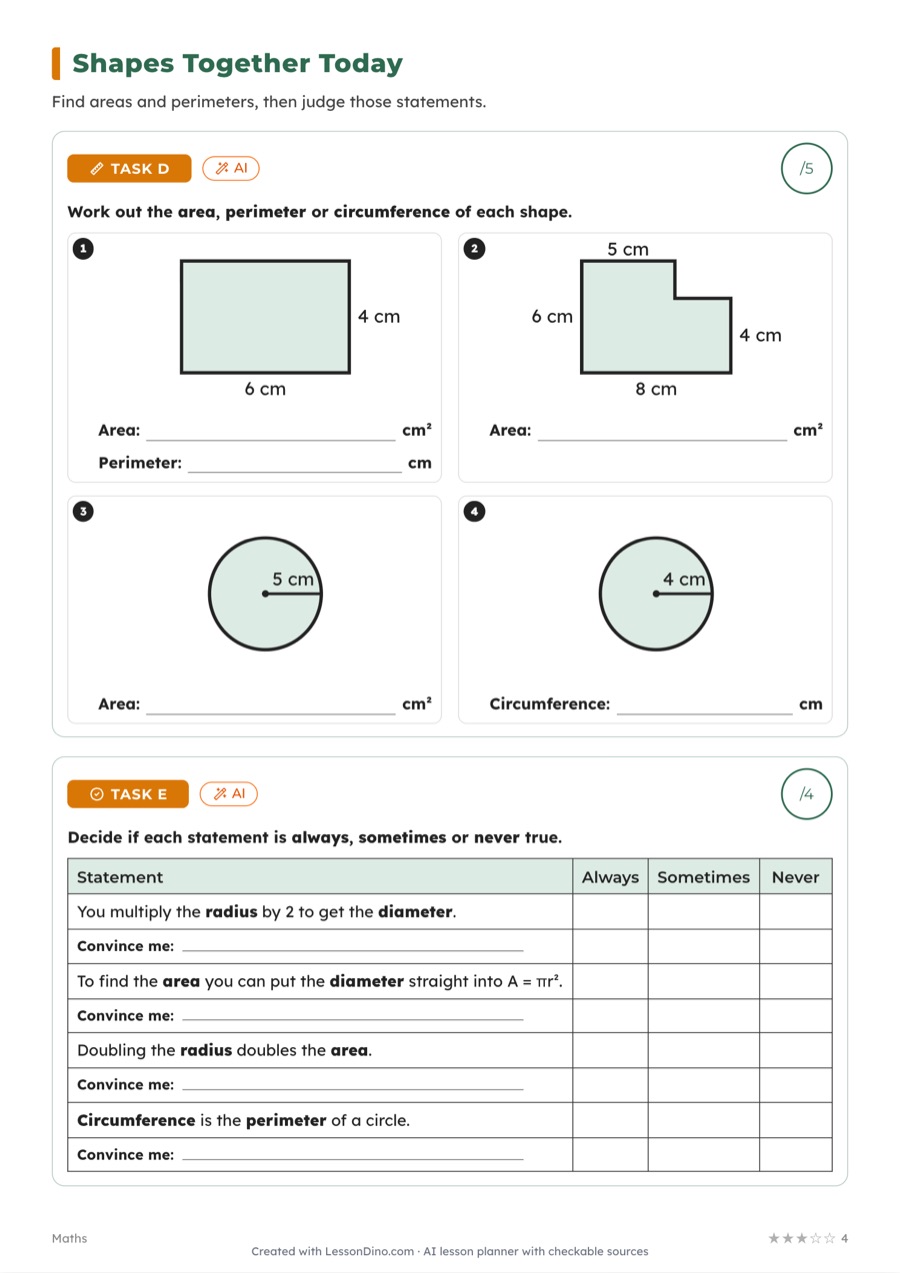
- Independent practice (8 minutes): Hand out Worksheet Task D (Work out the area, perimeter or circumference of each shape) and read the first shape instruction together.
- Support: Colour the diameter line where the semicircle joins the rectangle to show it is inside and not counted in the perimeter.
- Stretch: Give a shape with a semicircular hole removed and ask students to subtract and to adjust the perimeter to include the inside curve.
- The answer sheet is the last page, so you can print it on its own or let students check their own work.
Key vocabulary
- circumference: distance all the way round a round shape, like a fence
- radius: length from the middle dot to the edge of a circle
- diameter: length straight across through the middle, double the radius
- area: amount of flat space inside a shape, counted in squares
- semicircle: half of a round shape cut straight through its middle
- pi: special number about 3.14 linking width across to distance round
Mistakes to watch for
- Using diameter in A = pi x r squared instead of radius. Underline radius or diameter, write r = d / 2 first, then use A = pi x r squared.
- Giving semicircle perimeter as half circumference only. Highlight the outside including the diameter, add half C = pi x d plus diameter.
- Mixing area and circumference formulas or units. Ask fence or paint: fence is circumference in length units like metres, paint is area in square units.
What's on the worksheet
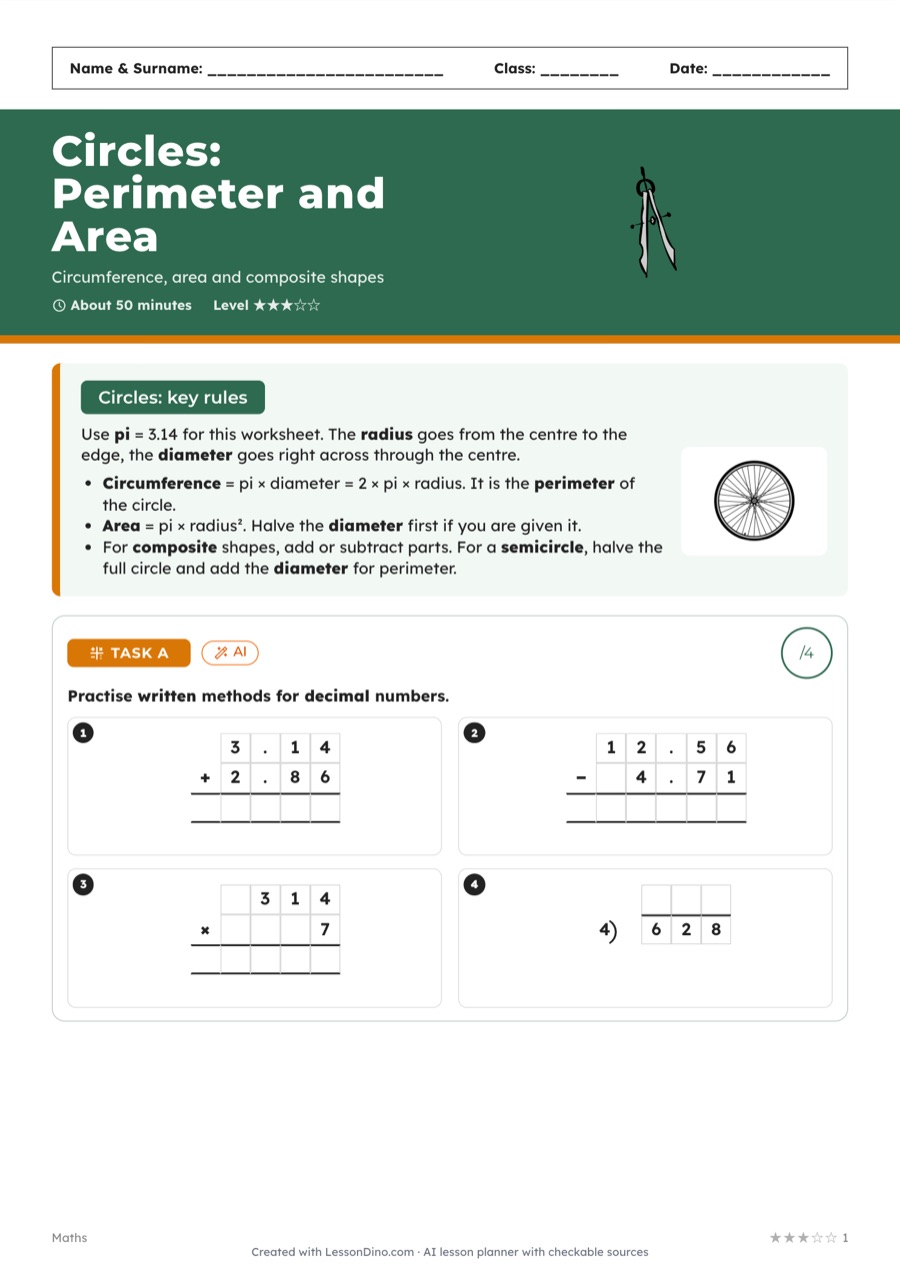
Circle Rules First
Remember the circle formulas, then warm up your number work.
Circles: key rules
- Use pi = 3.14 for this worksheet. The radius goes from the centre to the edge, the diameter goes right across through the centre.
- Circumference = pi × diameter = 2 × pi × radius. It is the perimeter of the circle.
- Area = pi × radius². Halve the diameter first if you are given it.
- For composite shapes, add or subtract parts. For a semicircle, halve the full circle and add the diameter for perimeter.
Practise written methods for decimal numbers.
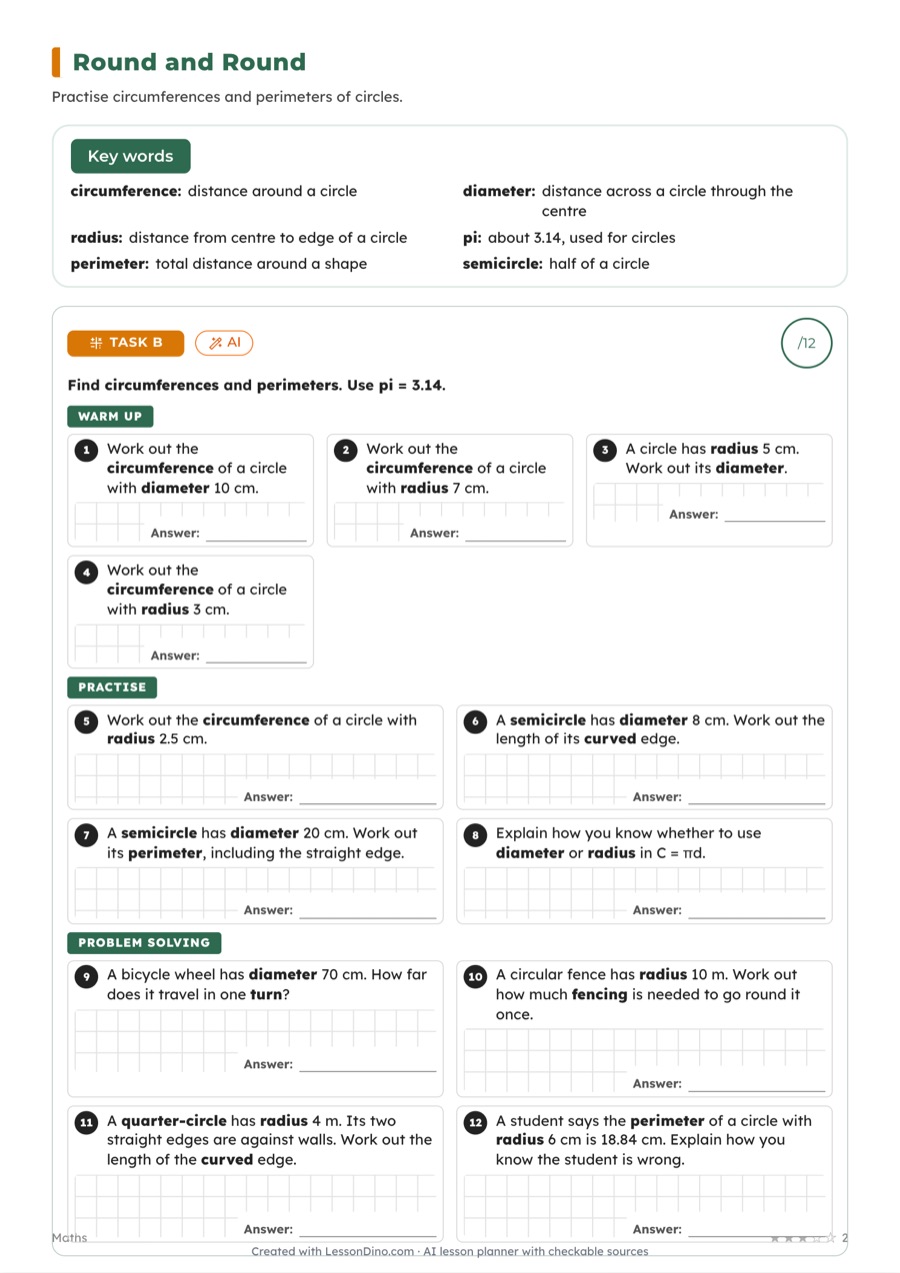
Round and Round
Practise circumferences and perimeters of circles.
| Word | Meaning |
|---|---|
| circumference | distance around a circle |
| diameter | distance across a circle through the centre |
| radius | distance from centre to edge of a circle |
| pi | about 3.14, used for circles |
| perimeter | total distance around a shape |
| semicircle | half of a circle |
Find circumferences and perimeters. Use pi = 3.14.
Warm up
- Work out the circumference of a circle with diameter 10 cm.
- Work out the circumference of a circle with radius 7 cm.
- A circle has radius 5 cm. Work out its diameter.
- Work out the circumference of a circle with radius 3 cm.
Practise
- Work out the circumference of a circle with radius 2.5 cm.
- A semicircle has diameter 8 cm. Work out the length of its curved edge.
- A semicircle has diameter 20 cm. Work out its perimeter, including the straight edge.
- Explain how you know whether to use diameter or radius in C = πd.
Problem solving
- A bicycle wheel has diameter 70 cm. How far does it travel in one turn?
- A circular fence has radius 10 m. Work out how much fencing is needed to go round it once.
- A quarter-circle has radius 4 m. Its two straight edges are against walls. Work out the length of the curved edge.
- A student says the perimeter of a circle with radius 6 cm is 18.84 cm. Explain how you know the student is wrong.
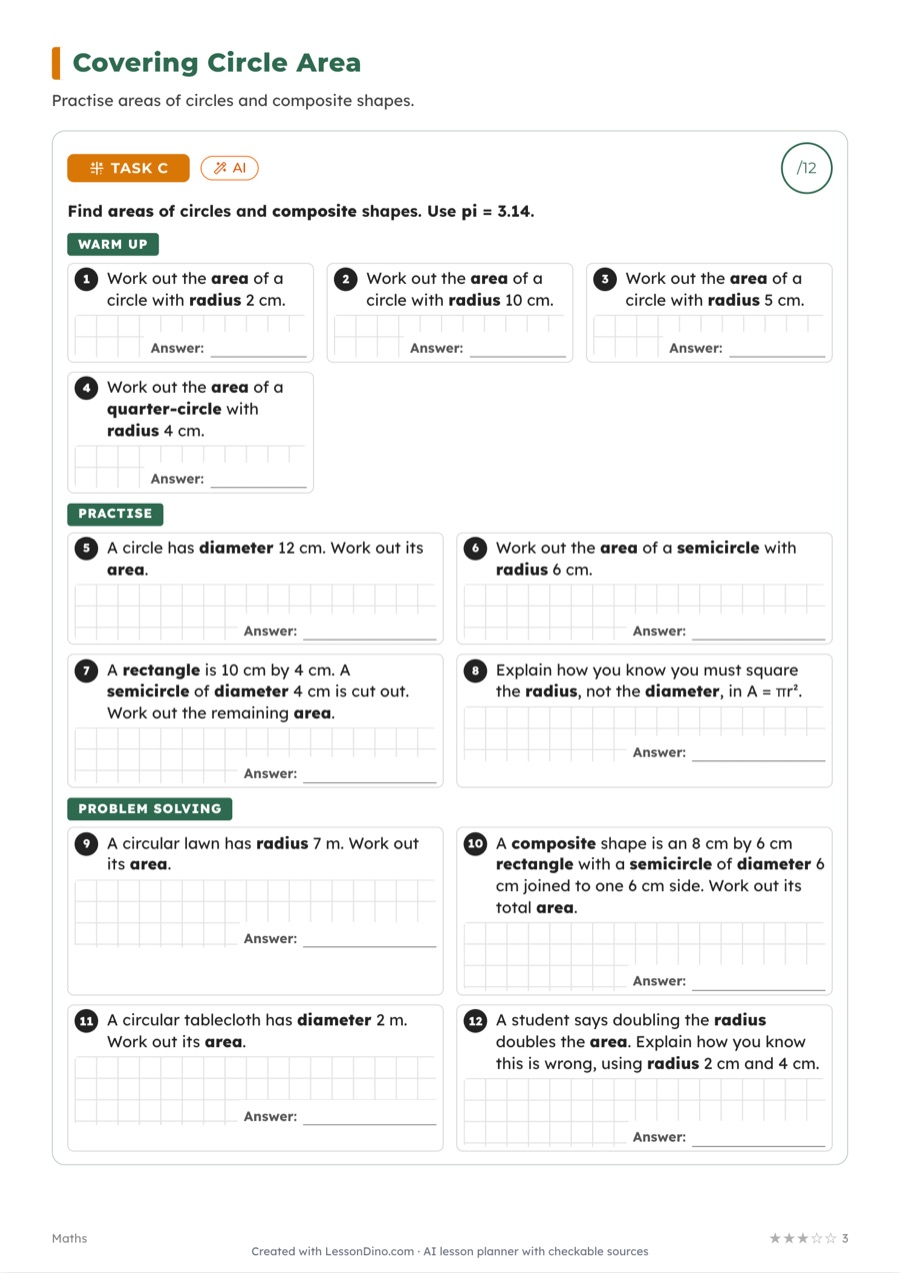
Covering Circle Area
Practise areas of circles and composite shapes.
Find areas of circles and composite shapes. Use pi = 3.14.
Warm up
- Work out the area of a circle with radius 2 cm.
- Work out the area of a circle with radius 10 cm.
- Work out the area of a circle with radius 5 cm.
- Work out the area of a quarter-circle with radius 4 cm.
Practise
- A circle has diameter 12 cm. Work out its area.
- Work out the area of a semicircle with radius 6 cm.
- A rectangle is 10 cm by 4 cm. A semicircle of diameter 4 cm is cut out. Work out the remaining area.
- Explain how you know you must square the radius, not the diameter, in A = πr².
Problem solving
- A circular lawn has radius 7 m. Work out its area.
- A composite shape is an 8 cm by 6 cm rectangle with a semicircle of diameter 6 cm joined to one 6 cm side. Work out its total area.
- A circular tablecloth has diameter 2 m. Work out its area.
- A student says doubling the radius doubles the area. Explain how you know this is wrong, using radius 2 cm and 4 cm.
Shapes Together Today
Find areas and perimeters, then judge those statements.
Work out the area, perimeter or circumference of each shape.
Decide if each statement is always, sometimes or never true.
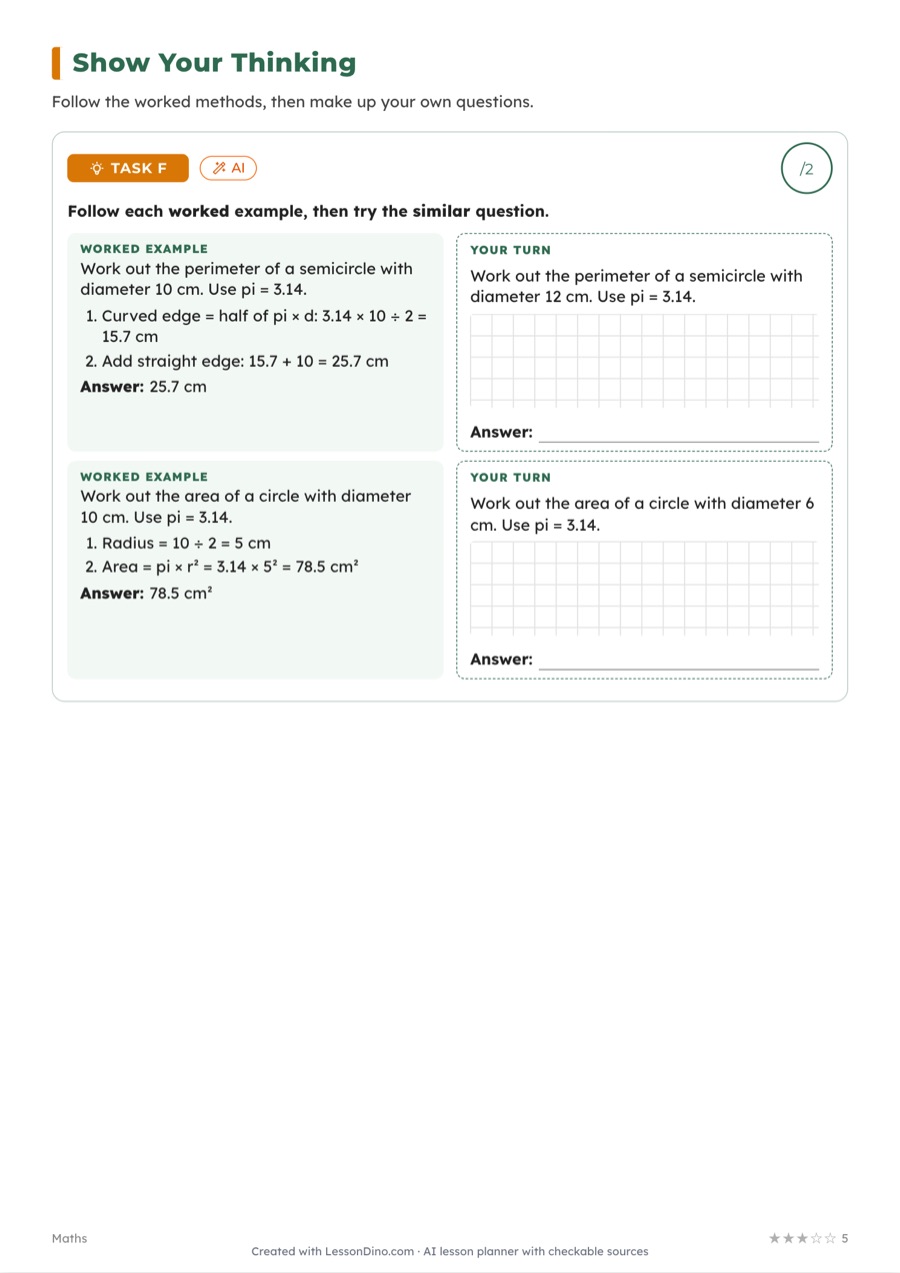
Show Your Thinking
Follow the worked methods, then make up your own questions.
Follow each worked example, then try the similar question.
Page 6
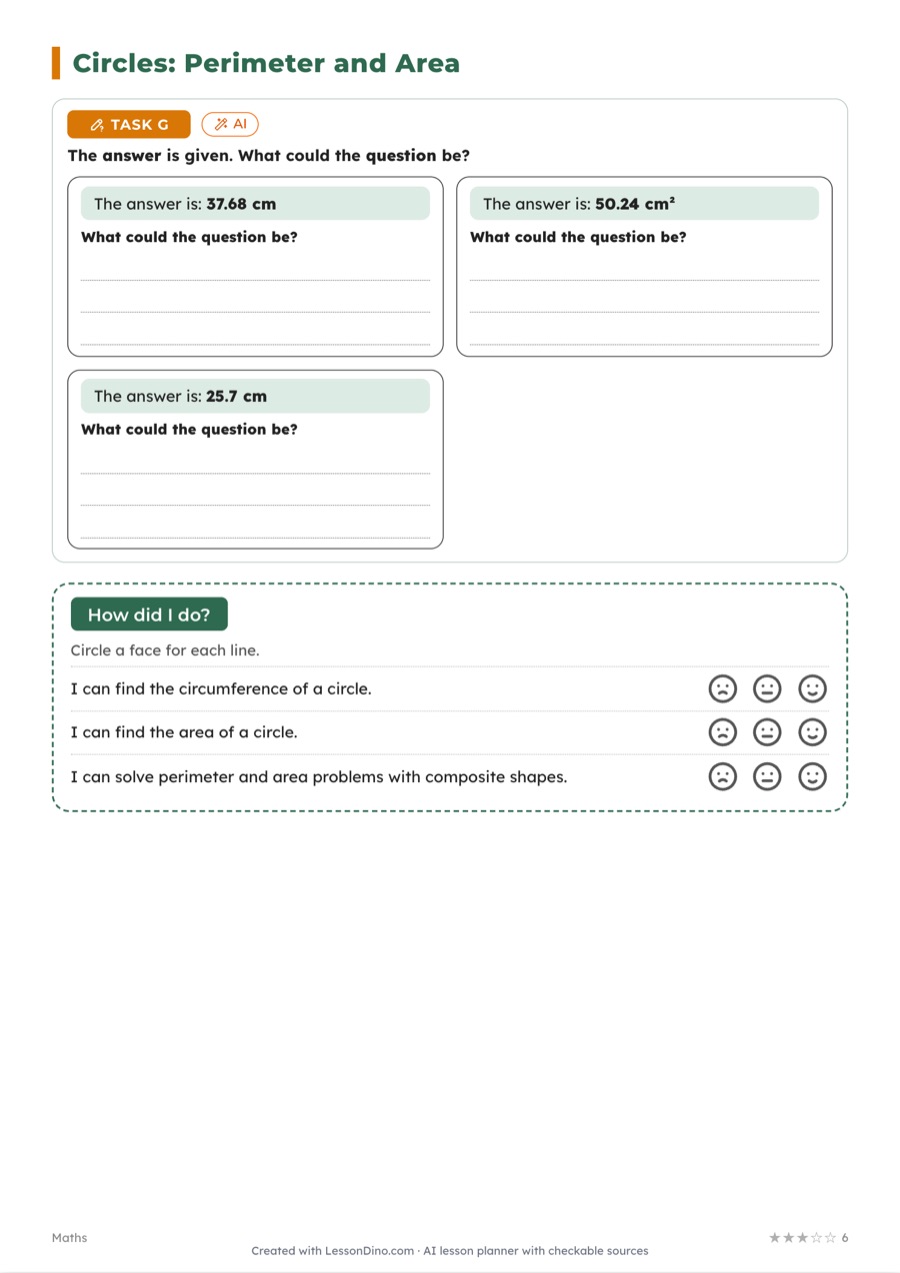
The answer is given. What could the question be?
Answers
Show the answers
- Work out the circumference of a circle with diameter 10 cm. 31.4 cm
- Work out the circumference of a circle with radius 7 cm. 43.96 cm
- A circle has radius 5 cm. Work out its diameter. 10 cm
- Work out the circumference of a circle with radius 3 cm. 18.84 cm
- Work out the circumference of a circle with radius 2.5 cm. 15.7 cm
- A semicircle has diameter 8 cm. Work out the length of its curved edge. 12.56 cm
- A semicircle has diameter 20 cm. Work out its perimeter, including the straight edge. 51.4 cm
- Explain how you know whether to use diameter or radius in C = πd. C = πd uses the diameter, so if you are given the radius you must double it first.
- A bicycle wheel has diameter 70 cm. How far does it travel in one turn? 219.8 cm
- A circular fence has radius 10 m. Work out how much fencing is needed to go round it once. 62.8 m
- A quarter-circle has radius 4 m. Its two straight edges are against walls. Work out the length of the curved edge. 6.28 m
- A student says the perimeter of a circle with radius 6 cm is 18.84 cm. Explain how you know the student is wrong. The student has used 6 cm as the diameter. The diameter is 12 cm, so the circumference is 3.14 × 12 = 37.68 cm.
- Work out the area of a circle with radius 2 cm. 12.56 cm²
- Work out the area of a circle with radius 10 cm. 314 cm²
- Work out the area of a circle with radius 5 cm. 78.5 cm²
- Work out the area of a quarter-circle with radius 4 cm. 12.56 cm²
- A circle has diameter 12 cm. Work out its area. 113.04 cm²
- Work out the area of a semicircle with radius 6 cm. 56.52 cm²
- A rectangle is 10 cm by 4 cm. A semicircle of diameter 4 cm is cut out. Work out the remaining area. 33.72 cm²
- Explain how you know you must square the radius, not the diameter, in A = πr². The formula uses radius, so you must halve the diameter first, otherwise the area will be 4 times too big.
- A circular lawn has radius 7 m. Work out its area. 153.86 m²
- A composite shape is an 8 cm by 6 cm rectangle with a semicircle of diameter 6 cm joined to one 6 cm side. Work out its total area. 62.13 cm²
- A circular tablecloth has diameter 2 m. Work out its area. 3.14 m²
- A student says doubling the radius doubles the area. Explain how you know this is wrong, using radius 2 cm and 4 cm. Radius 2 cm gives 12.56 cm² and radius 4 cm gives 50.24 cm², which is 4 times bigger, not double, because the radius is squared.
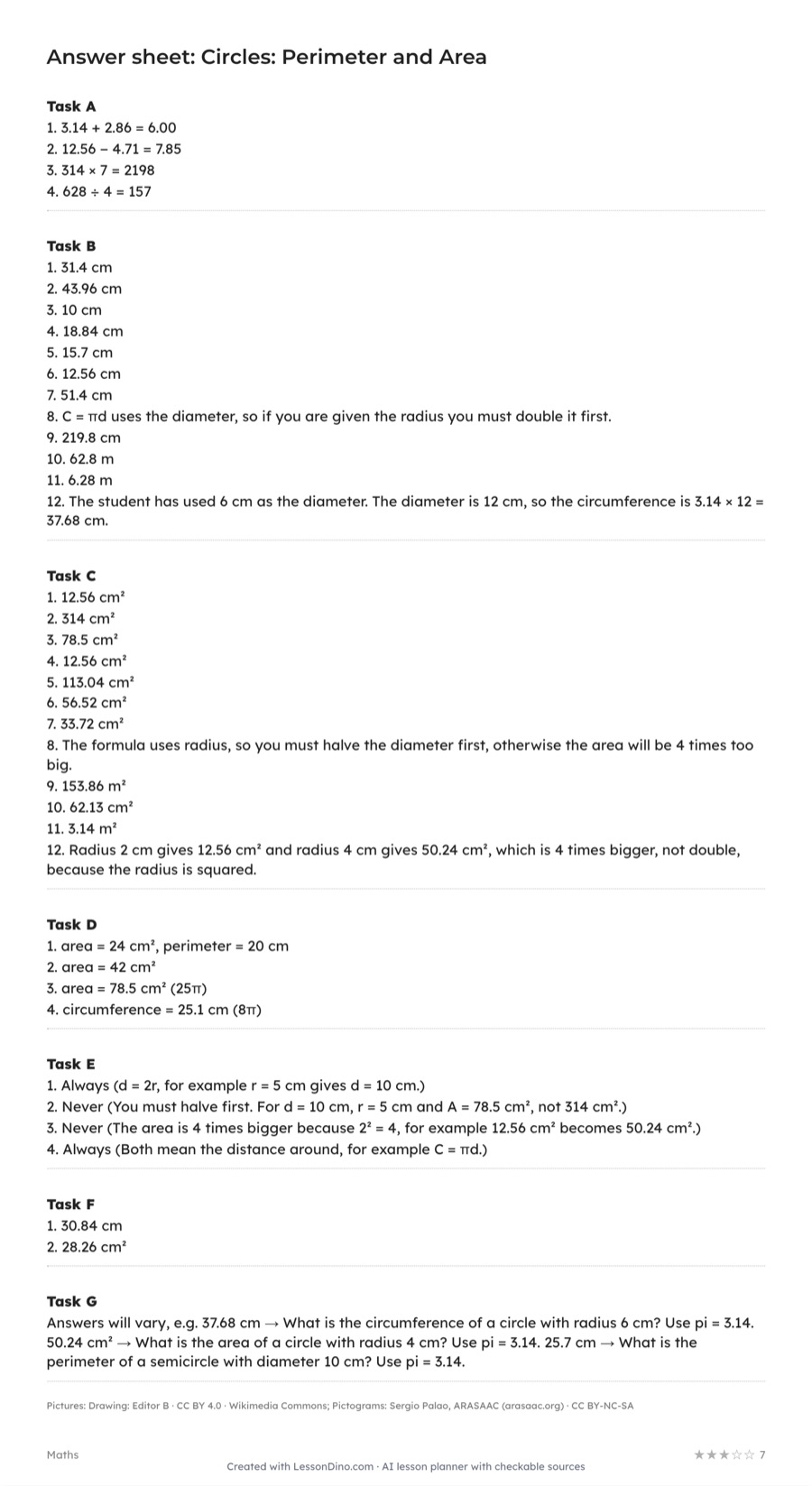
The answer sheet is the last picture above.
Curriculum
calculate and solve problems involving: perimeters of 2-D shapes (including circles), areas of circles and composite shapes
From National curriculum in England, Key Stage 3 mathematics.
Made with Lesson Dino's AI on 19 October 2026. AI can make mistakes, so check the answers and facts against the sources before you teach.