The worksheet
About this worksheet
Pupils learn to use multipliers for increase, decrease, original values and simple interest. They move, calculate and practise with sale prices and savings in pounds. This Year 8 Maths worksheet gives students (ages 12–13) six pages of practice on percentage change, part of the ratio, proportion and rates of change unit. It goes with our free Percentage change lesson, which has the slides and a timed lesson plan.
What it covers
By the end, students should be able to:
- Students will use multipliers to calculate new amounts after percentage increase and decrease.
- Students will divide by multipliers to find original values before percentage change.
- Students will calculate simple interest and total savings over time in pounds.
How to use it
- Practice (15 minutes): Set Slide 9 task: Find new price after 15% rise on £60 · Find sale price after 25% off £48 · Find original when £63 is price after 5% rise, then Worksheet Tasks B and C in pairs.
- Support: Multiplier reminder cards and bars split into 10% steps for finding 10% first.
- Stretch: Model two increases over 100% and order final amounts, and test 20% up then 20% down.
- The answer sheet is the last page, so you can print it on its own or let students check their own work.
Key vocabulary
- multiplier: a decimal number used to find a new amount in one step
- percentage increase: when an amount gets bigger, shown as parts out of a hundred
- percentage decrease: when an amount gets smaller, shown as parts out of a hundred
- original value: the starting amount before it goes up or down
- simple interest: extra money for saving, worked out only on the starting amount
Mistakes to watch for
- Using the new amount as the base for percentage change. Stress difference divided by original times 100; label old and new before dividing.
- Multiplying instead of dividing to find the original. Show £96 is 80%, so divide by 0.8 and check forwards; recall up then down needs different percentages to return.
- Adding sequential percentages or mixing interest with balance. Work in two steps from the new start each time, since changes are measured from different values; record yearly interest, total interest and balance separately.
What's on the worksheet
Recall and Review
Recap earlier maths and learn the percentage change method.
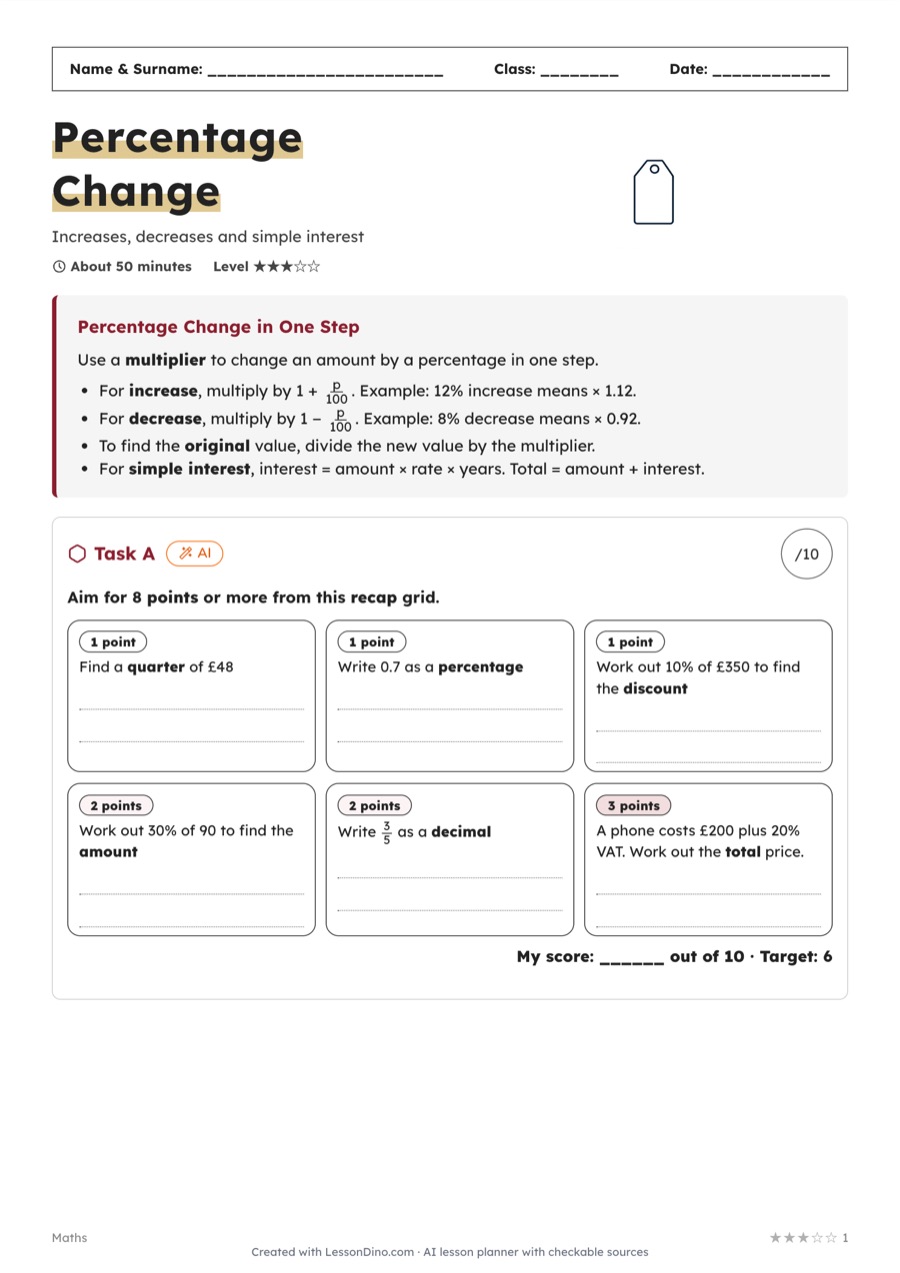
Percentage Change in One Step
- Use a multiplier to change an amount by a percentage in one step.
- For increase, multiply by 1 + p/100. Example: 12% increase means × 1.12.
- For decrease, multiply by 1 − p/100. Example: 8% decrease means × 0.92.
- To find the original value, divide the new value by the multiplier.
- For simple interest, interest = amount × rate × years. Total = amount + interest.
Aim for 8 points or more from this recap grid.
- Find a quarter of £48
- Write 0.7 as a percentage
- Work out 10% of £350 to find the discount
- Work out 30% of 90 to find the amount
- Write 3/5 as a decimal
- A phone costs £200 plus 20% VAT. Work out the total price.
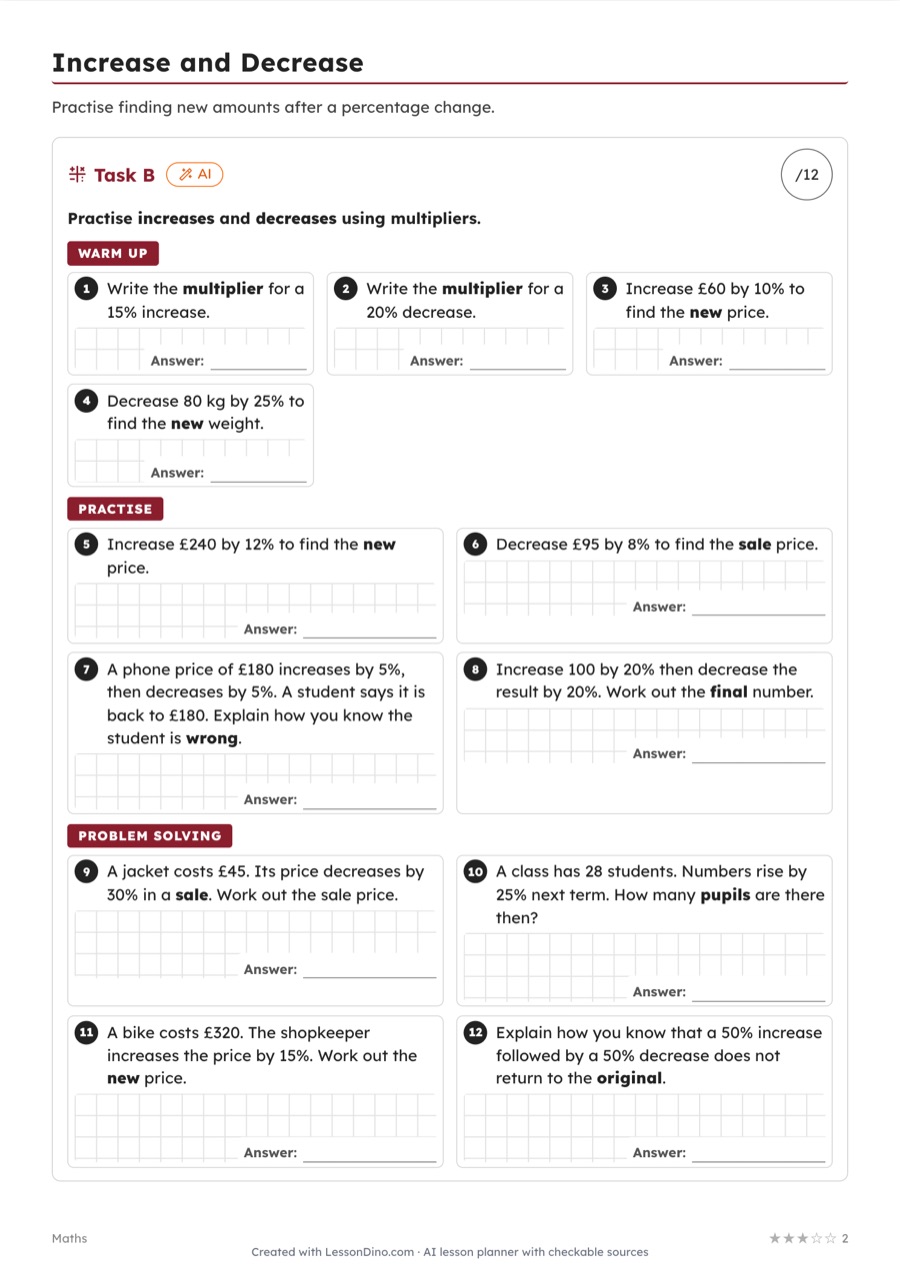
Increase and Decrease
Practise finding new amounts after a percentage change.
Practise increases and decreases using multipliers.
Warm up
- Write the multiplier for a 15% increase.
- Write the multiplier for a 20% decrease.
- Increase £60 by 10% to find the new price.
- Decrease 80 kg by 25% to find the new weight.
Practise
- Increase £240 by 12% to find the new price.
- Decrease £95 by 8% to find the sale price.
- A phone price of £180 increases by 5%, then decreases by 5%. A student says it is back to £180. Explain how you know the student is wrong.
- Increase 100 by 20% then decrease the result by 20%. Work out the final number.
Problem solving
- A jacket costs £45. Its price decreases by 30% in a sale. Work out the sale price.
- A class has 28 students. Numbers rise by 25% next term. How many pupils are there then?
- A bike costs £320. The shopkeeper increases the price by 15%. Work out the new price.
- Explain how you know that a 50% increase followed by a 50% decrease does not return to the original.
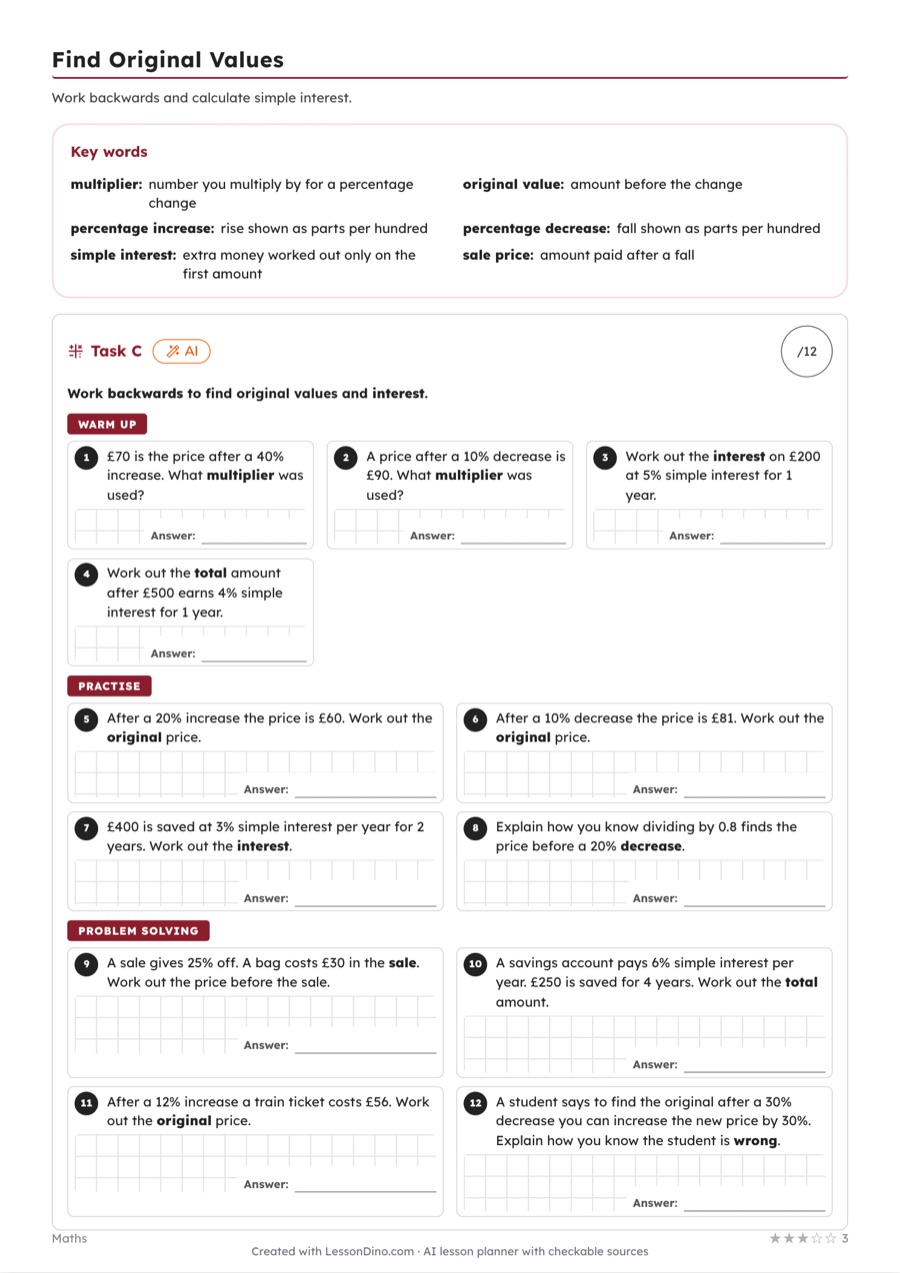
Find Original Values
Work backwards and calculate simple interest.
| Word | Meaning |
|---|---|
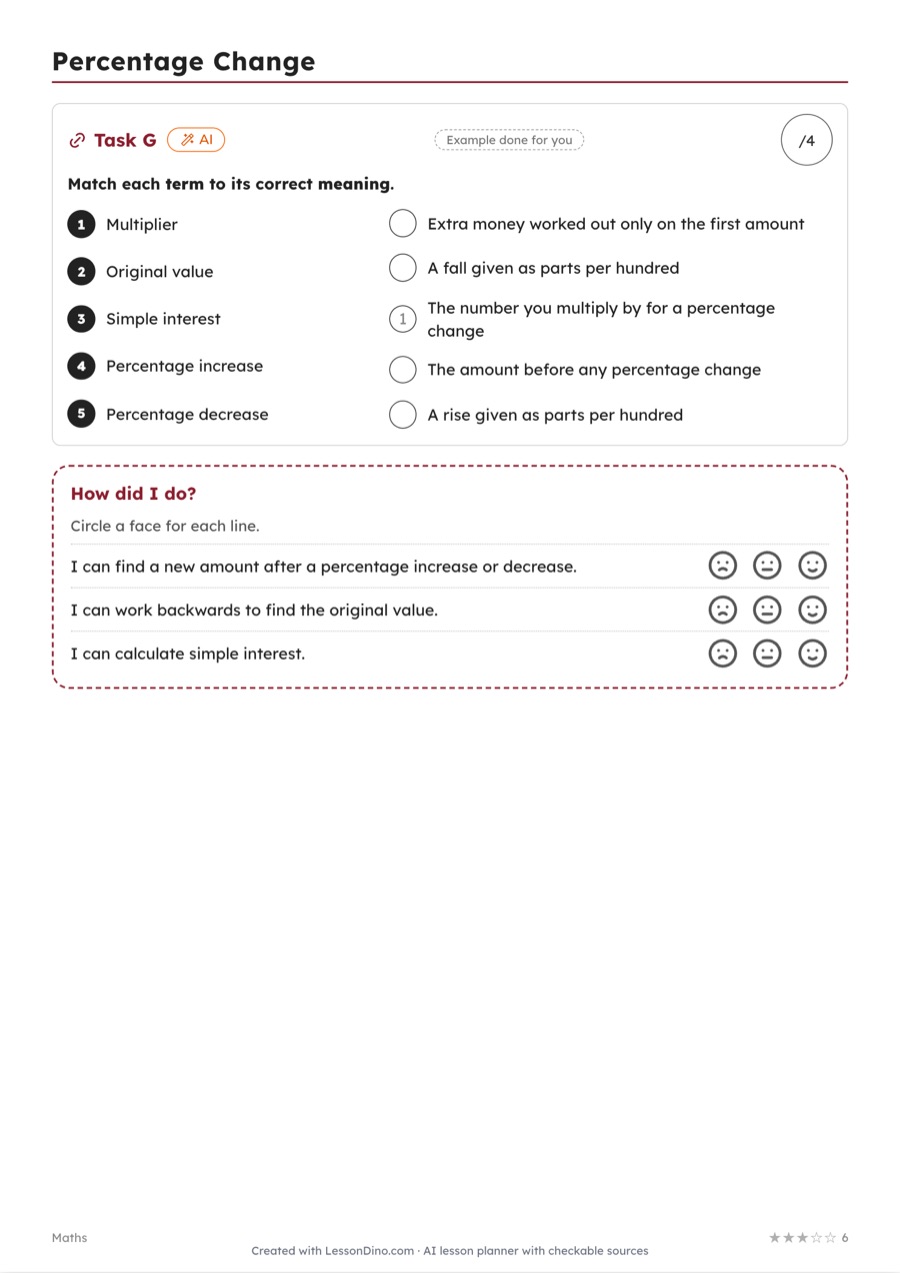
| multiplier | number you multiply by for a percentage change |
| original value | amount before the change |
| percentage increase | rise shown as parts per hundred |
| percentage decrease | fall shown as parts per hundred |
| simple interest | extra money worked out only on the first amount |
| sale price | amount paid after a fall |
Work backwards to find original values and interest.
Warm up
- £70 is the price after a 40% increase. What multiplier was used?
- A price after a 10% decrease is £90. What multiplier was used?
- Work out the interest on £200 at 5% simple interest for 1 year.
- Work out the total amount after £500 earns 4% simple interest for 1 year.
Practise
- After a 20% increase the price is £60. Work out the original price.
- After a 10% decrease the price is £81. Work out the original price.
- £400 is saved at 3% simple interest per year for 2 years. Work out the interest.
- Explain how you know dividing by 0.8 finds the price before a 20% decrease.
Problem solving
- A sale gives 25% off. A bag costs £30 in the sale. Work out the price before the sale.
- A savings account pays 6% simple interest per year. £250 is saved for 4 years. Work out the total amount.
- After a 12% increase a train ticket costs £56. Work out the original price.
- A student says to find the original after a 30% decrease you can increase the new price by 30%. Explain how you know the student is wrong.
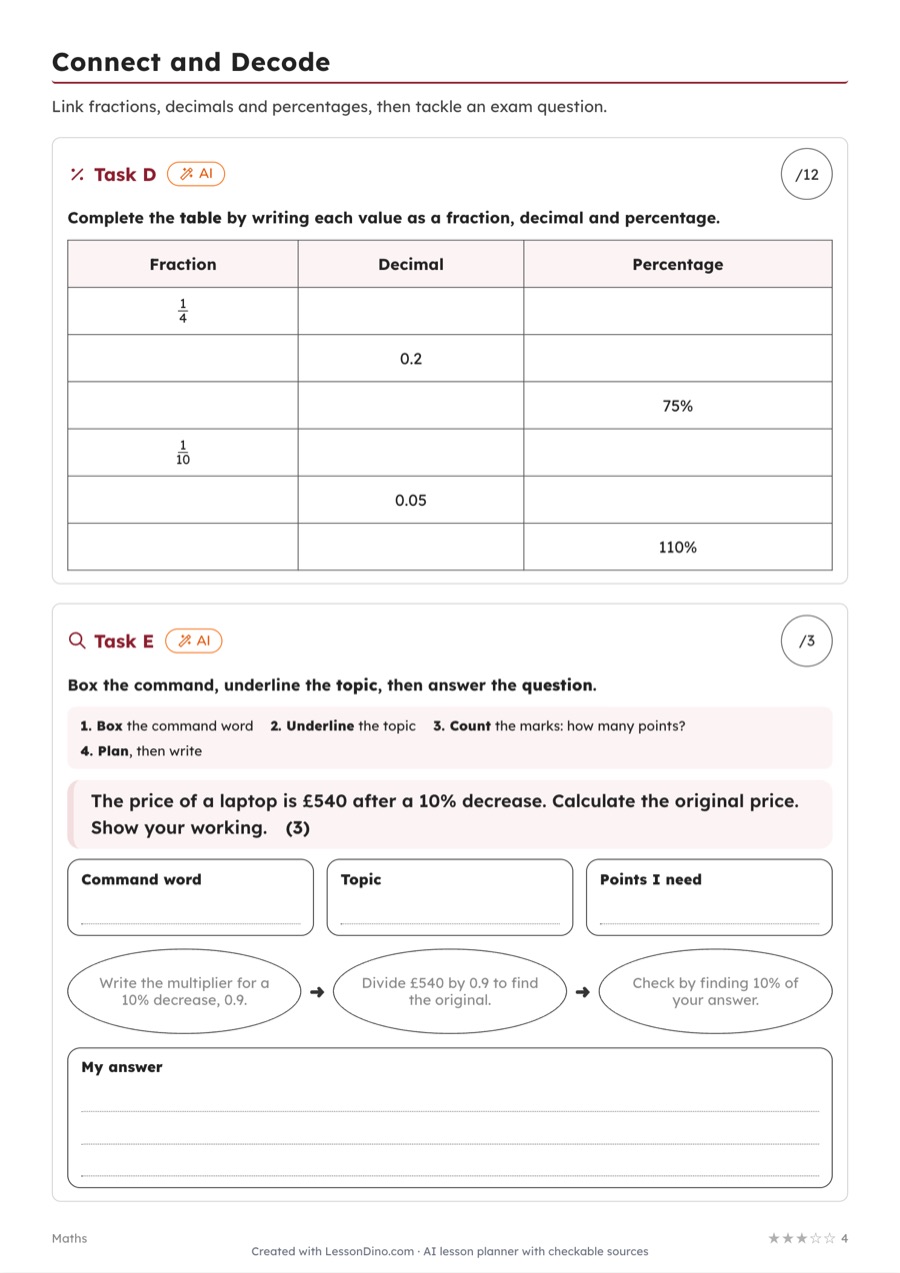
Connect and Decode
Link fractions, decimals and percentages, then tackle an exam question.
Complete the table by writing each value as a fraction, decimal and percentage.
Box the command, underline the topic, then answer the question.
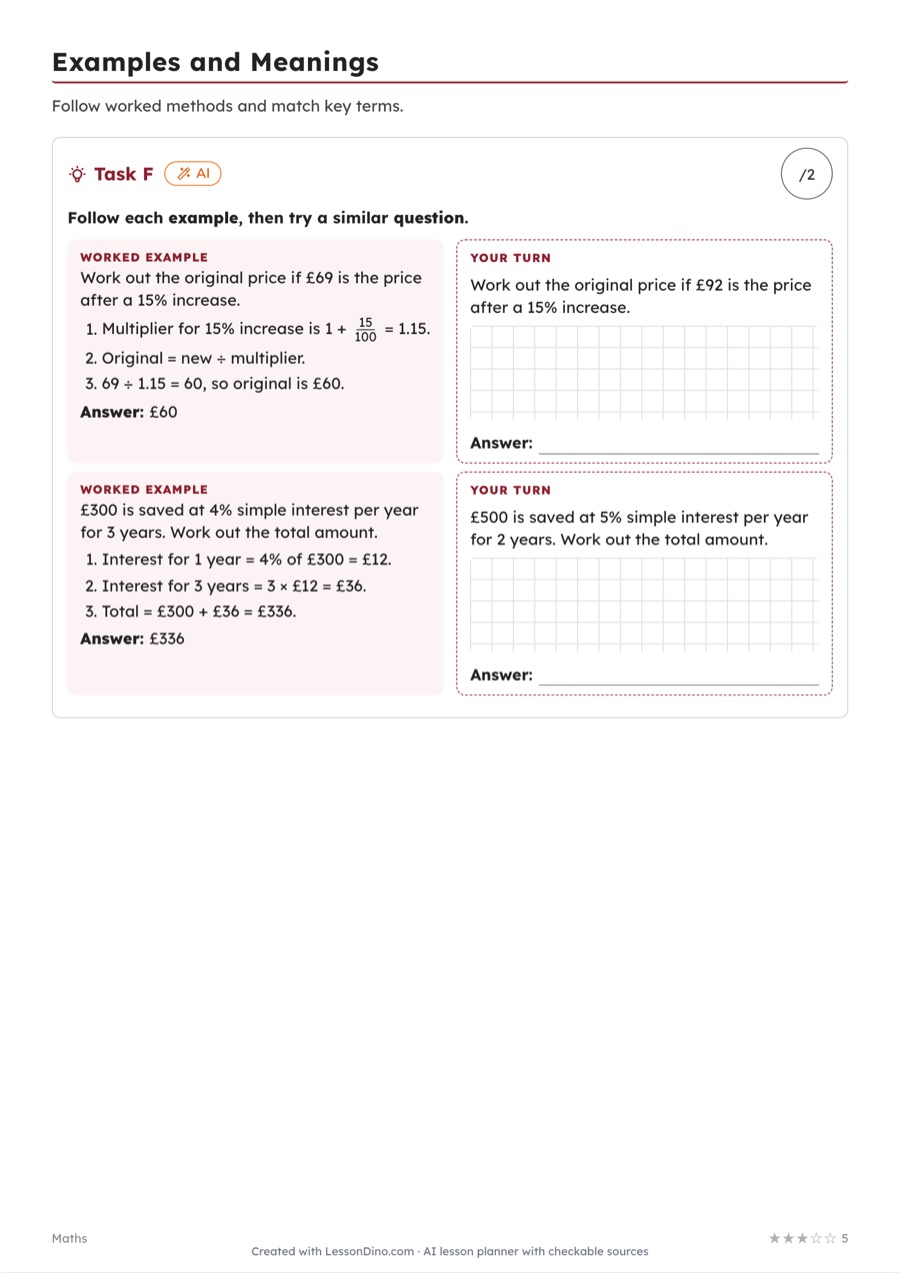
Examples and Meanings
Follow worked methods and match key terms.
Follow each example, then try a similar question.
Page 6
Match each term to its correct meaning.
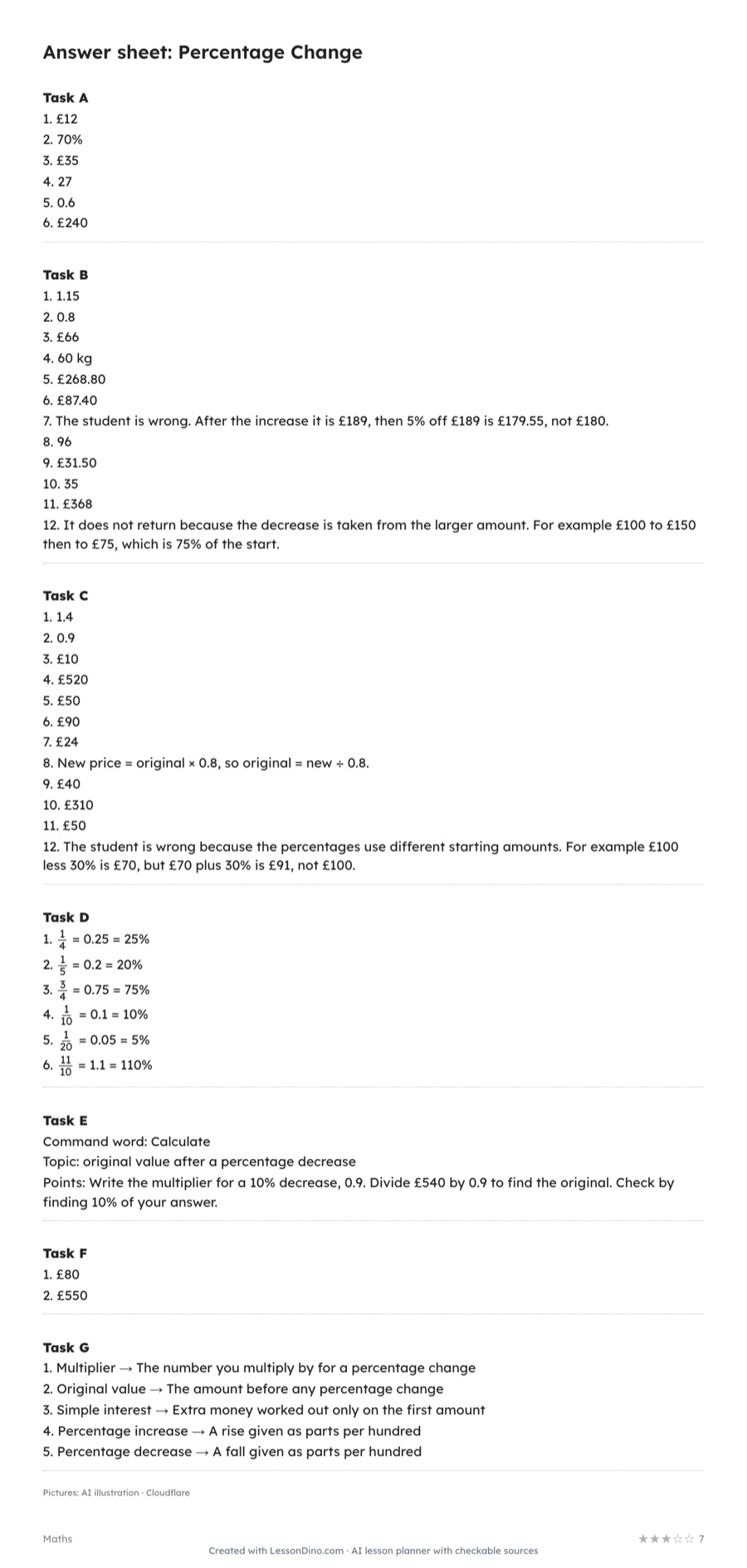
Answers
Show the answers
- Find a quarter of £48 £12
- Write 0.7 as a percentage 70%
- Work out 10% of £350 to find the discount £35
- Work out 30% of 90 to find the amount 27
- Write 3/5 as a decimal 0.6
- A phone costs £200 plus 20% VAT. Work out the total price. £240
- Write the multiplier for a 15% increase. 1.15
- Write the multiplier for a 20% decrease. 0.8
- Increase £60 by 10% to find the new price. £66
- Decrease 80 kg by 25% to find the new weight. 60 kg
- Increase £240 by 12% to find the new price. £268.80
- Decrease £95 by 8% to find the sale price. £87.40
- A phone price of £180 increases by 5%, then decreases by 5%. A student says it is back to £180. Explain how you know the student is wrong. The student is wrong. After the increase it is £189, then 5% off £189 is £179.55, not £180.
- Increase 100 by 20% then decrease the result by 20%. Work out the final number. 96
- A jacket costs £45. Its price decreases by 30% in a sale. Work out the sale price. £31.50
- A class has 28 students. Numbers rise by 25% next term. How many pupils are there then? 35
- A bike costs £320. The shopkeeper increases the price by 15%. Work out the new price. £368
- Explain how you know that a 50% increase followed by a 50% decrease does not return to the original. It does not return because the decrease is taken from the larger amount. For example £100 to £150 then to £75, which is 75% of the start.
- £70 is the price after a 40% increase. What multiplier was used? 1.4
- A price after a 10% decrease is £90. What multiplier was used? 0.9
- Work out the interest on £200 at 5% simple interest for 1 year. £10
- Work out the total amount after £500 earns 4% simple interest for 1 year. £520
- After a 20% increase the price is £60. Work out the original price. £50
- After a 10% decrease the price is £81. Work out the original price. £90
- £400 is saved at 3% simple interest per year for 2 years. Work out the interest. £24
- Explain how you know dividing by 0.8 finds the price before a 20% decrease. New price = original × 0.8, so original = new ÷ 0.8.
- A sale gives 25% off. A bag costs £30 in the sale. Work out the price before the sale. £40
- A savings account pays 6% simple interest per year. £250 is saved for 4 years. Work out the total amount. £310
- After a 12% increase a train ticket costs £56. Work out the original price. £50
- A student says to find the original after a 30% decrease you can increase the new price by 30%. Explain how you know the student is wrong. The student is wrong because the percentages use different starting amounts. For example £100 less 30% is £70, but £70 plus 30% is £91, not £100.
The answer sheet is the last picture above.
Curriculum
solve problems involving percentage change, including: percentage increase, decrease and original value problems and simple interest in financial mathematics
From National curriculum in England, Key Stage 3 mathematics.
Made with Lesson Dino's AI on 19 October 2026. AI can make mistakes, so check the answers and facts against the sources before you teach.