Slides
Lesson plan
Up, Down and Back Again with Multipliers
Pupils learn to use multipliers for increase, decrease, original values and simple interest. They move, calculate and practise with sale prices and savings in pounds.
Objectives
- Students will use multipliers to calculate new amounts after percentage increase and decrease.
- Students will divide by multipliers to find original values before percentage change.
- Students will calculate simple interest and total savings over time in pounds.
Success criteria
- I can choose multipliers like 1.15 and 0.75 to find new prices.
- I can divide the new amount by the multiplier to find the original.
- I can work out yearly interest and the final savings balance.
Key words
| Word | Meaning |
|---|---|
| multiplier | a decimal number used to find a new amount in one step |
| percentage increase | when an amount gets bigger, shown as parts out of a hundred |
| percentage decrease | when an amount gets smaller, shown as parts out of a hundred |
| original value | the starting amount before it goes up or down |
| simple interest | extra money for saving, worked out only on the starting amount |
Timed plan (60 minutes)
| Time | Stage | What happens |
|---|---|---|
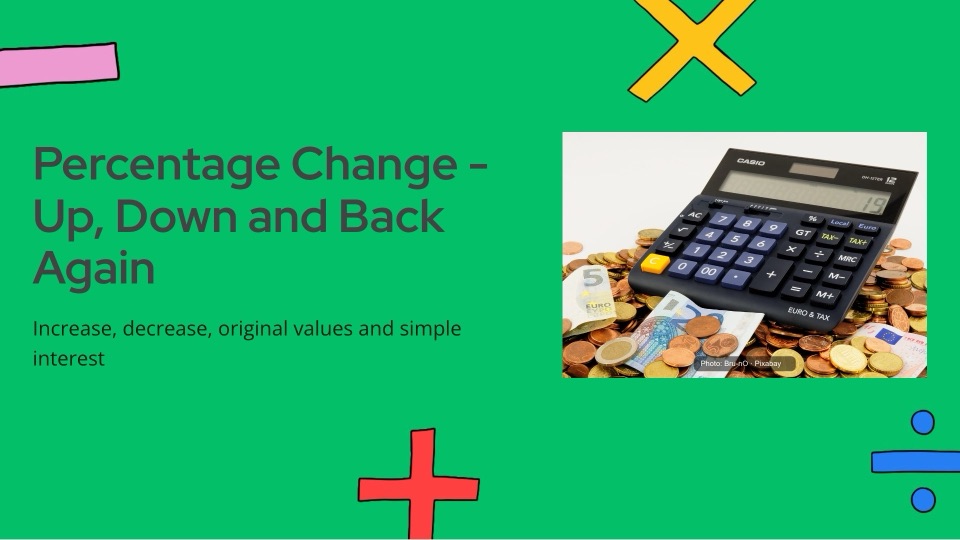
| 8 min | Starter | Recall per cent basics and spark curiosity about percentage change up and down. Show Slide 1 title with Increase, decrease, original values and simple interest and Slide 2: Shops put prices up and bring them down in sales. Today we calculate exactly how much they change. Show Slide 3: Work out percentage increase with multipliers · Work out percentage decrease with multipliers · Find the original value by reversing · Calculate simple interest. Show Slide 4: Up 10% then down 10% does not get you back! · £200 up 10% is £220, then down 10% is £198. Ask for yes/no vote on returning to £200. Introduce three corners and say the hook, then try one teaser card to model moving. |
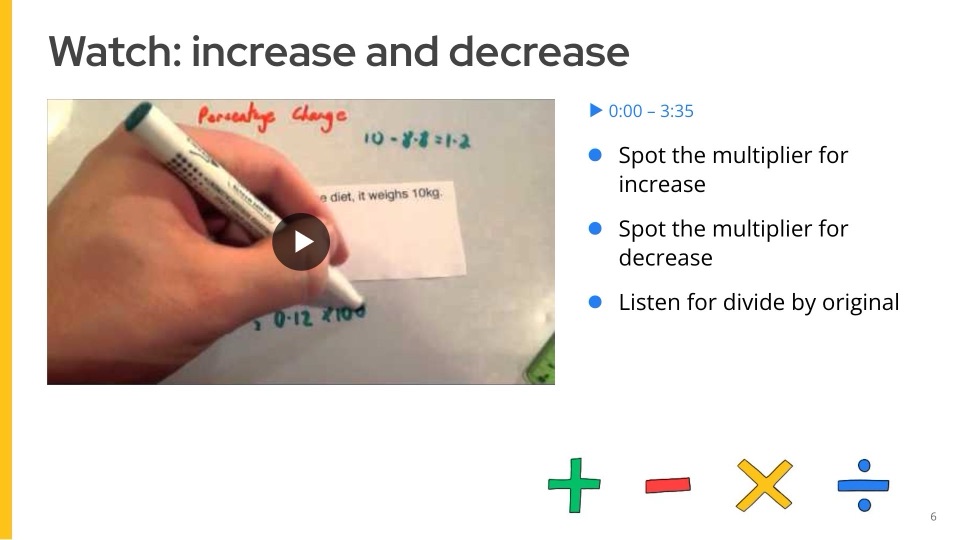
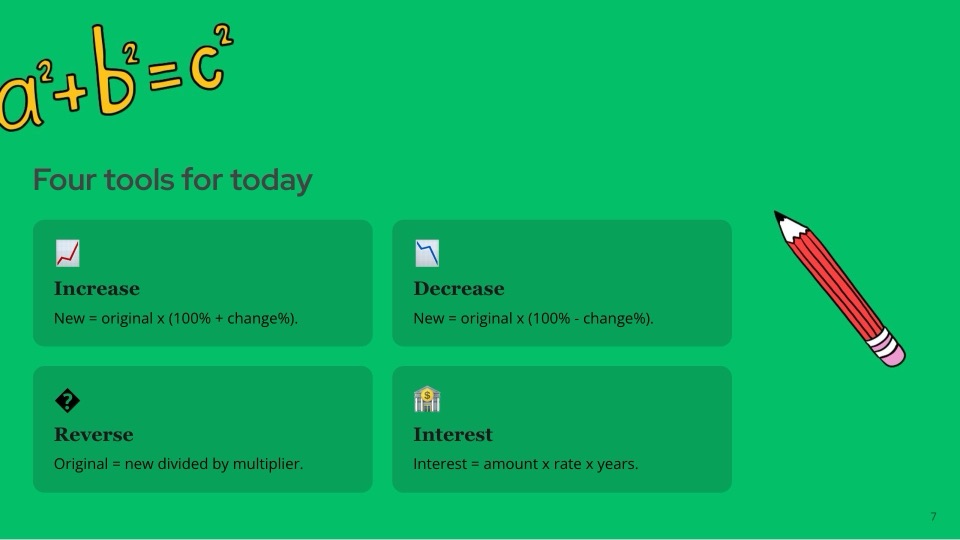
| 12 min | Teaching | Teach how to choose and use multipliers for percentage increase and decrease. Play Video clip 2 and ask pupils to spot the multiplier for increase, spot the multiplier for decrease and listen for divide by original. Show Slide 7 cards: Increase · New = original x (100% + change%). · 📈 · Decrease · New = original x (100% - change%). · 📉 · Reverse · Original = new divided by multiplier. Model £60 with 15% rise as £60 x 1.15 = £69 and £48 with 25% off as £48 x 0.75 = £36, noting a change of x per cent gives 100 + x per cent of the original. Ask class to call out multipliers for 20% off and 5% rise and write them on the board. |
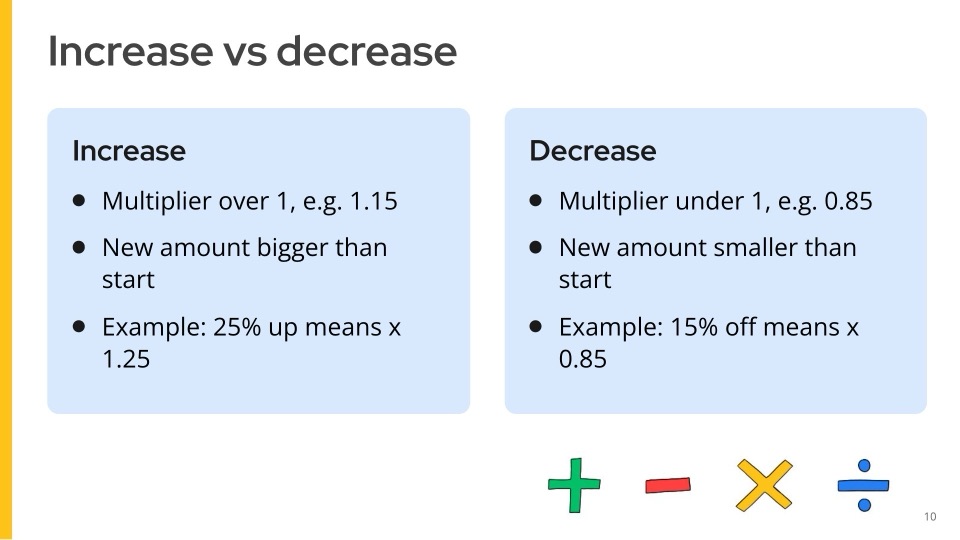
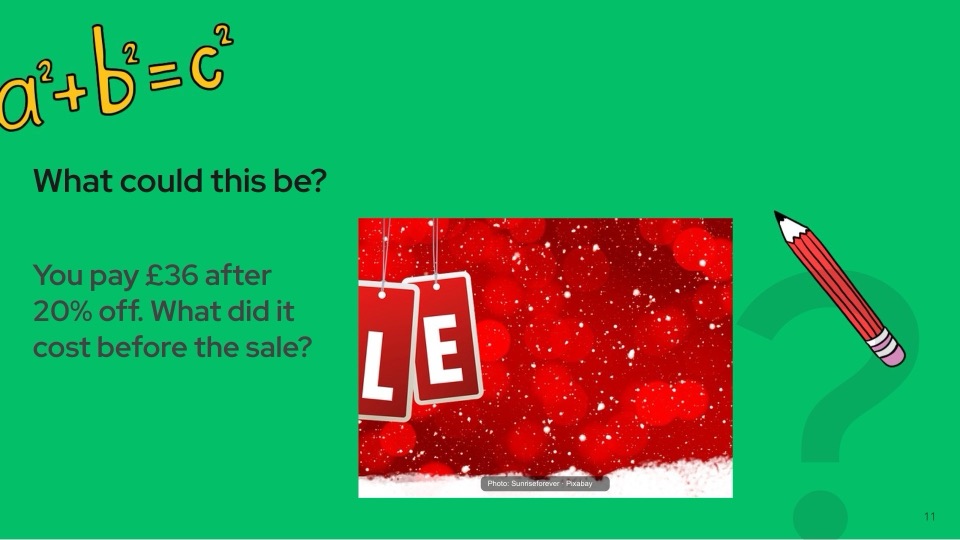
| 15 min | Main activity | Practise choosing the correct multiplier for increase, decrease and original value problems. Label corners Increase, Decrease and Find the Original and hand out multiplier reminder cards. Read the six problem cards in turn: 1) Find new price after 15% rise on £60. 2) Find sale price after 25% off £48. 3) You pay £36 after 20% off. What did it cost before the sale? 4) Find original when £63 is price after 5% rise. 5) £200 savings with 5% simple interest for 1 year. How much interest? 6) A £40 game rises to £46. How would you find the percentage increase? On a signal, pupils walk to the matching corner, then write the multiplier and answer on whiteboards. Remind them the multiplier is 1 plus or minus the percentage as a decimal: a 20% increase means x1.2 and 20% off means x0.8. Check each corner together, using Slide 10: Increase · Multiplier over 1, e.g. 1.15 · New amount bigger than start · Example: 25% up means x 1.25 and Slide 11: You pay £36 after 20% off. What did it cost before the sale? · £45, because £36 is 80%, so 10% is £4.50. |
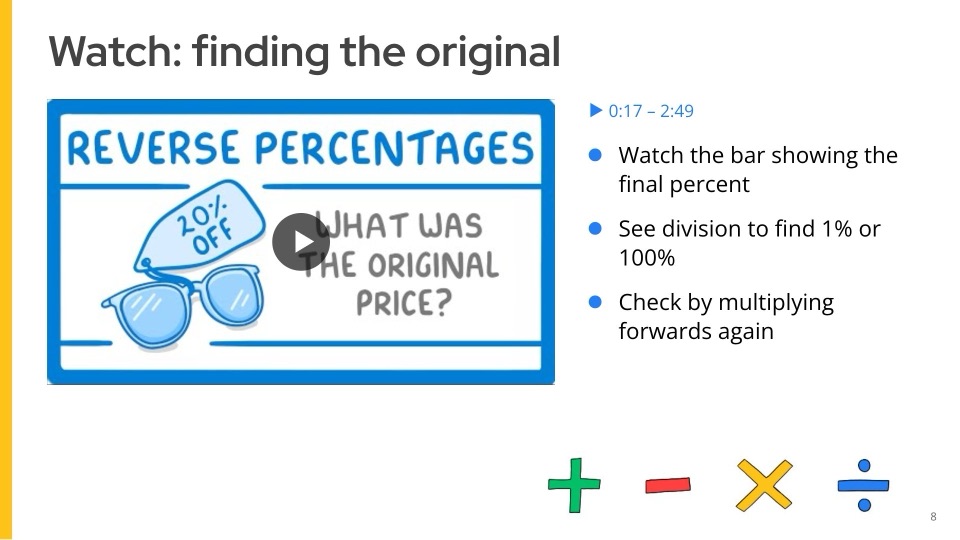
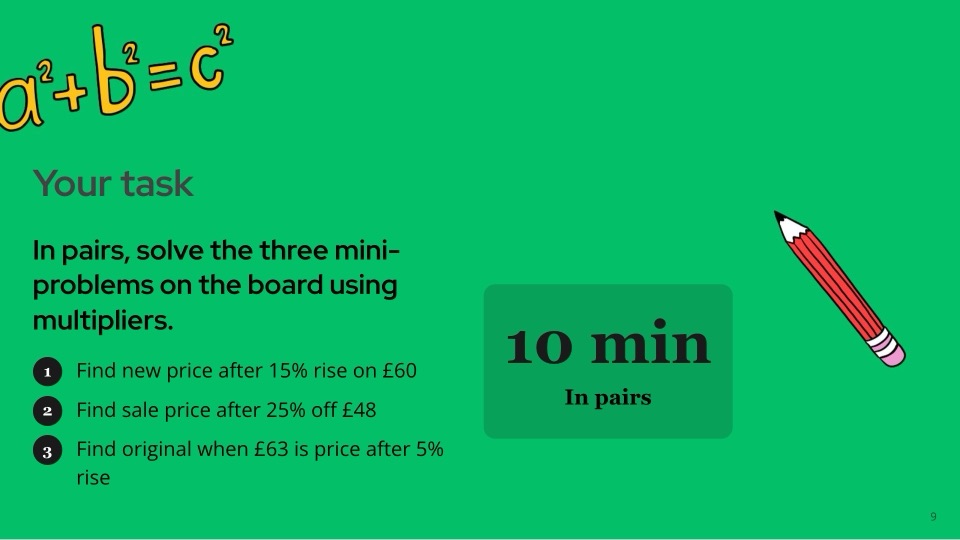
| 15 min | Practice | Apply reversing to find original values and calculate simple interest in pairs. Show Slide 8 and play Video clip 4, asking pupils to watch the bar showing the final percent and see division to find 1% or 100%. Model reversing with £96 after 20% off: £96 is 80% or 0.8, so £96 divided by 0.8 = £120, then check £120 x 0.8 = £96. Note a 25% rise from £100 to £125 needs a 20% fall to return. Model simple interest: 5% of £200 is £10 each year, so 3 years gives £30 interest and £230 balance, since per cent means per hundred. Set Slide 9 task: Find new price after 15% rise on £60 · Find sale price after 25% off £48 · Find original when £63 is price after 5% rise, then Worksheet Tasks B and C in pairs. |
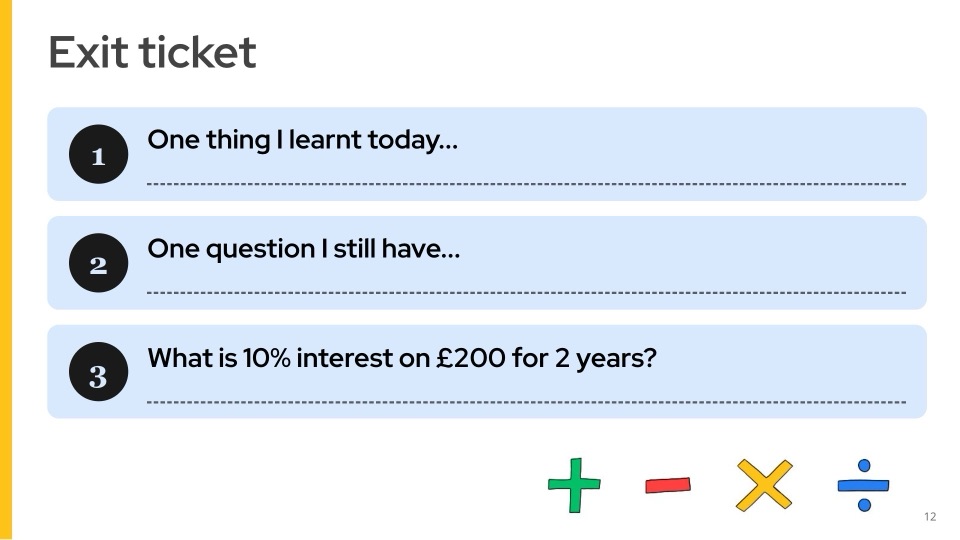
| 10 min | Plenary | Review multipliers, reversing and interest and check what pupils can do now. Revisit Slide 3 objectives and ask pupils to point to Increase, Decrease or Find the Original for two quick problems. Re-show Slide 4 fact and take one-sentence explanations of the £2 difference from pairs. Show Slide 12 exit: One thing I learnt today... · One question I still have... · What is 10% interest on £200 for 2 years? and collect answers. |
Common mistakes
- Using the new amount as the base for percentage change
How to spot it: Divides difference by new price, e.g. £6 divided by £46 not £40
Stress difference divided by original times 100; label old and new before dividing. - Multiplying instead of dividing to find the original
How to spot it: Does £96 x 0.8 to rewind a 20% discount
Show £96 is 80%, so divide by 0.8 and check forwards; recall up then down needs different percentages to return. - Adding sequential percentages or mixing interest with balance
How to spot it: Says up 10% then down 10% cancels, or gives £30 as balance not interest
Work in two steps from the new start each time, since changes are measured from different values; record yearly interest, total interest and balance separately.
Support
- Multiplier reminder cards and bars split into 10% steps for finding 10% first
- Writing frames for difference divided by original and for divide-then-check-forwards
Stretch
- Model two increases over 100% and order final amounts, and test 20% up then 20% down
- Compare two savings offers and solve original-value problems with 12% and 18% changes
Check questions
- Find the sale price after 25% off £48.
Answer: x0.75, £36. - Find the original when £63 is the price after a 5% rise.
Answer: £63 divided by 1.05 = £60. - What is 10% interest on £200 for 2 years?
Answer: £40 interest, £240 balance.
Curriculum
solve problems involving percentage change, including: percentage increase, decrease and original value problems and simple interest in financial mathematics
From National curriculum in England, Key Stage 3 mathematics.
Video clips
Clips on YouTube, from the start and end times we chose. Check each one before you show it.
-
Percentage change - Corbettmaths from 0:00 to 3:35
corbettmaths: Percentage Change - Corbettmaths
Trusted UK classroom style covering increase and decrease clearly for 12-13-year-olds.
-
Reverse percentages - original value from 0:17 to 2:49
Cognito: GCSE Maths - Reverse Percentages - Calculating The Cost Before The Discount (2026/27 exams)
Excellent for original value problems with clear bar method suited to Year 8 aged 12-13.
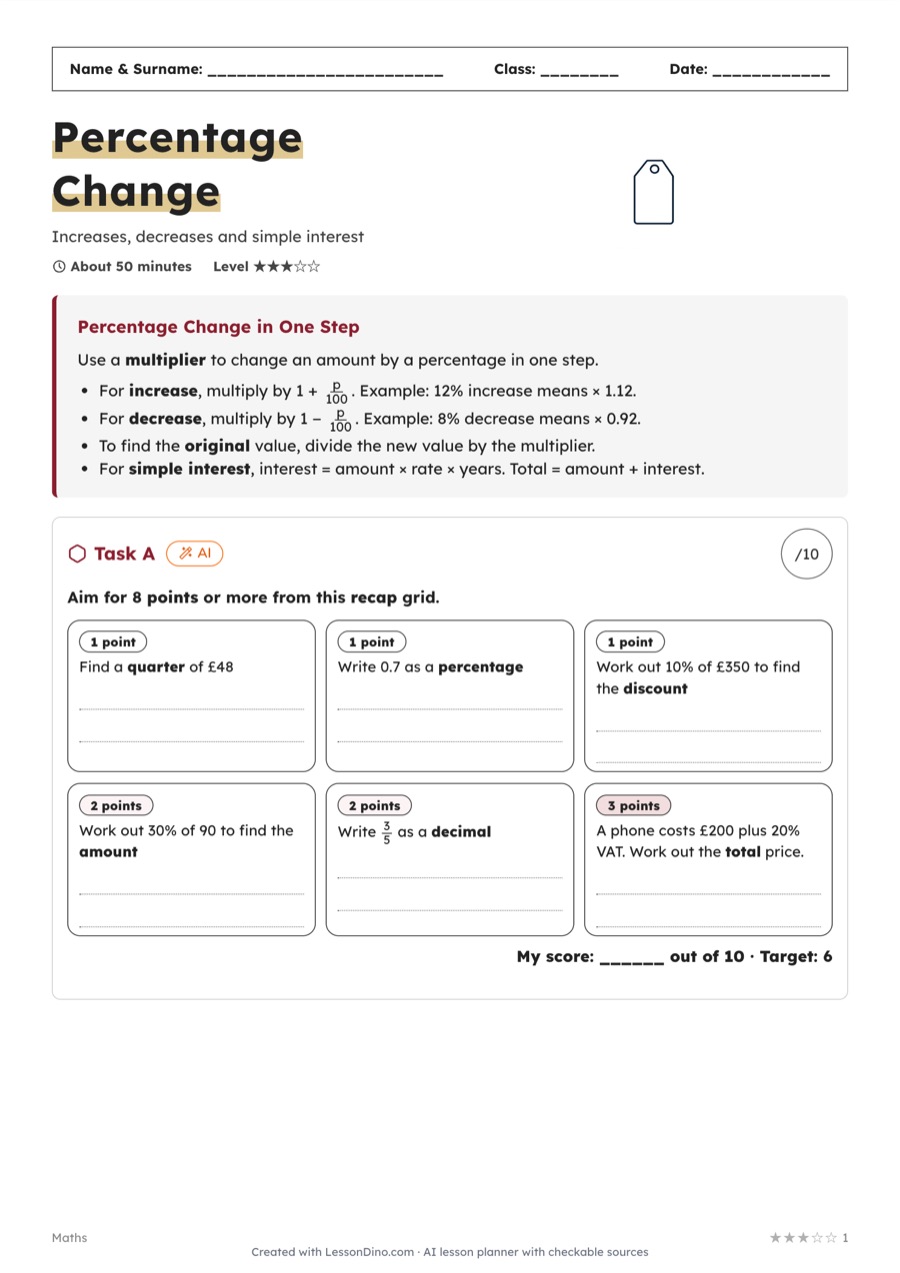
Worksheet
Sources
- QuickStats: Percentage Change in Death Rates for the Leading Cau… cdc.gov
- Percentage Change Estimation (whole class activity) – GeoGebra geogebra.org
- [Video] After the change process, which course among E1 to E6 had the largest change in its enrollment as a percentage of its original enrollment? - There were seven elective courses - E1 to E7 - runn cracku.in
- Percentage Wikipedia
- Grading systems by country Wikipedia
- Dyscalculia Wikipedia
Picture credits
Made with Lesson Dino's AI on 19 October 2026. AI can make mistakes, so check facts against the sources before you teach.