The worksheet
About this worksheet
Pupils learn to recognise arithmetic sequences and find the nth term. They match sequences, pictures and rules, then test them. This Year 8 Maths worksheet gives students (ages 12–13) five pages of practice on sequences and the nth term, part of the algebra unit. It goes with our free Sequences and the nth term lesson, which has the slides and a timed lesson plan.
What it covers
By the end, students should be able to:
- Students will recognise arithmetic sequences by checking for a constant difference.
- Students will find the nth term of linear sequences using difference and adjustment.
How to use it
- Plenary (10 minutes): Hand out Worksheet Task G and tick true or false together in 4 minutes, watching for common mistakes.
- Support: Use colour-coded borders so sequence cards, picture cards and rule cards are easy to tell apart.
- Stretch: Ask groups to make one extra false match that looks close and challenge another group to explain the error.
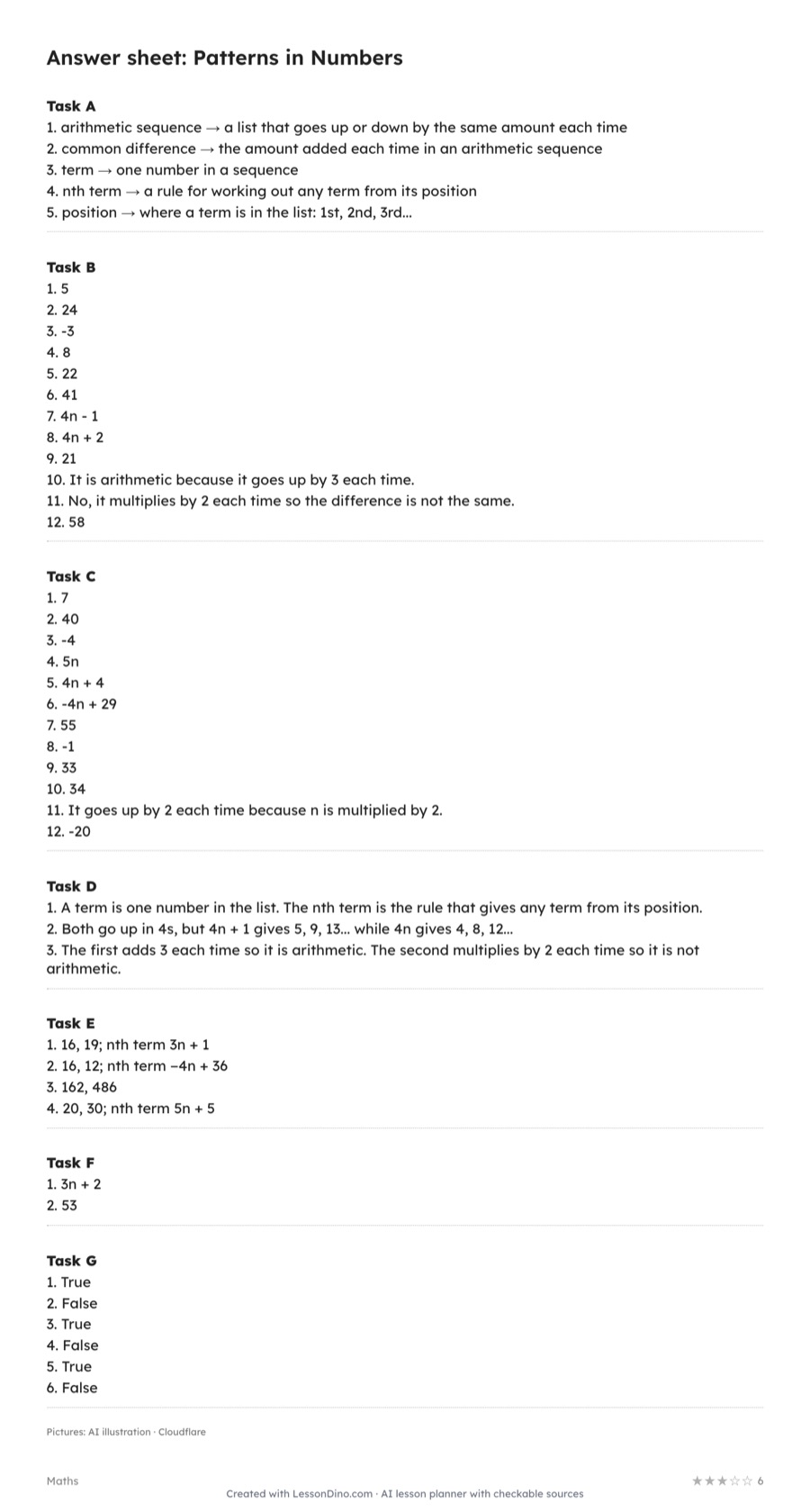
- The answer sheet is the last page, so you can print it on its own or let students check their own work.
Key vocabulary
- sequence: a list of numbers in order
- term: each separate number in a list
- common difference: the same amount added each time to get the next number
- nth term: a rule that gives any number from its place in the list, so each place maps to exactly one value
Mistakes to watch for
- Calling 2, 4, 8, 16 arithmetic because numbers go up. Always write all gaps first and keep only the ones with the same gap every time.
- Writing n + 3 for 4, 7, 10, 13 instead of 3n + 1. Multiply the difference by n first, then adjust to fit term 1 and test n = 1, 2, 3.
- Saying a constant list like 12, 12, 12 cannot be arithmetic. Show difference is 0 and addition of 0 does not change a number, so it is arithmetic.
What's on the worksheet
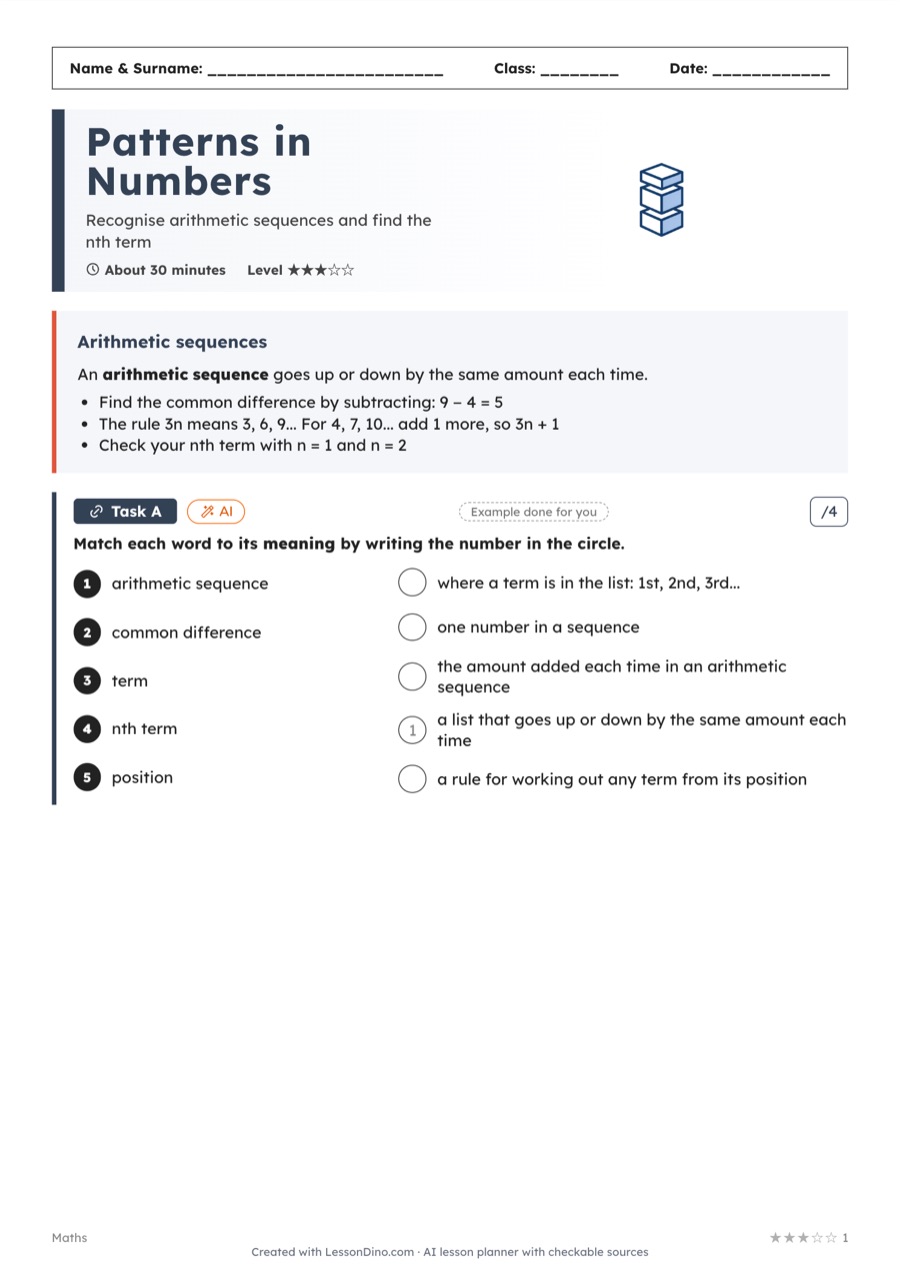
Spot the Pattern
Learn what makes a sequence arithmetic and match the key words.
Arithmetic sequences
- An arithmetic sequence goes up or down by the same amount each time.
- Find the common difference by subtracting: 9 − 4 = 5
- The rule 3n means 3, 6, 9... For 4, 7, 10... add 1 more, so 3n + 1
- Check your nth term with n = 1 and n = 2
Match each word to its meaning by writing the number in the circle.
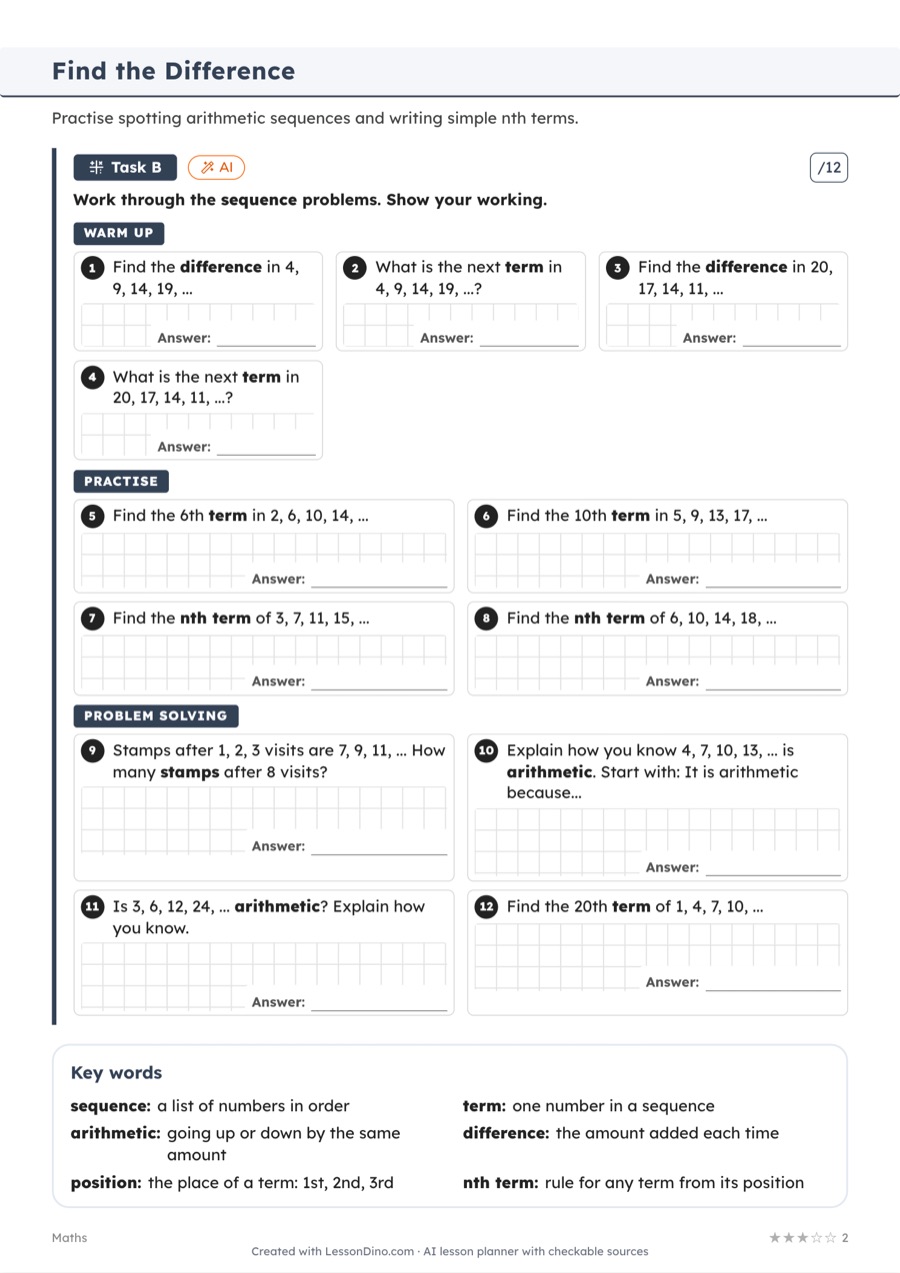
Find the Difference
Practise spotting arithmetic sequences and writing simple nth terms.
Work through the sequence problems. Show your working.
Warm up
- Find the difference in 4, 9, 14, 19, ...
- What is the next term in 4, 9, 14, 19, ...?
- Find the difference in 20, 17, 14, 11, ...
- What is the next term in 20, 17, 14, 11, ...?
Practise
- Find the 6th term in 2, 6, 10, 14, ...
- Find the 10th term in 5, 9, 13, 17, ...
- Find the nth term of 3, 7, 11, 15, ...
- Find the nth term of 6, 10, 14, 18, ...
Problem solving
- Stamps after 1, 2, 3 visits are 7, 9, 11, ... How many stamps after 8 visits?
- Explain how you know 4, 7, 10, 13, ... is arithmetic. Start with: It is arithmetic because...
- Is 3, 6, 12, 24, ... arithmetic? Explain how you know.
- Find the 20th term of 1, 4, 7, 10, ...
| Word | Meaning |
|---|---|
| sequence | a list of numbers in order |
| term | one number in a sequence |
| arithmetic | going up or down by the same amount |
| difference | the amount added each time |
| position | the place of a term: 1st, 2nd, 3rd |
| nth term | rule for any term from its position |
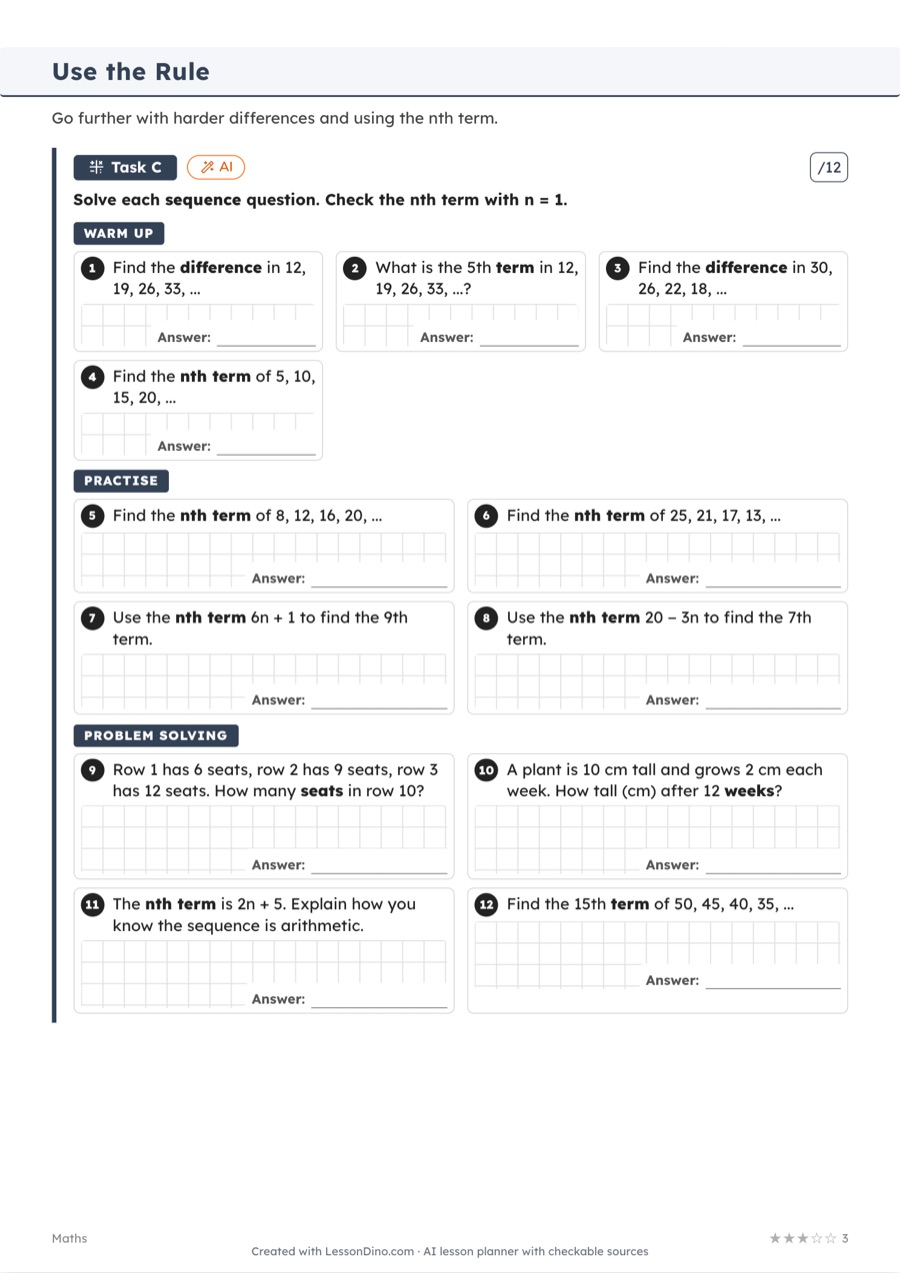
Use the Rule
Go further with harder differences and using the nth term.
Solve each sequence question. Check the nth term with n = 1.
Warm up
- Find the difference in 12, 19, 26, 33, ...
- What is the 5th term in 12, 19, 26, 33, ...?
- Find the difference in 30, 26, 22, 18, ...
- Find the nth term of 5, 10, 15, 20, ...
Practise
- Find the nth term of 8, 12, 16, 20, ...
- Find the nth term of 25, 21, 17, 13, ...
- Use the nth term 6n + 1 to find the 9th term.
- Use the nth term 20 − 3n to find the 7th term.
Problem solving
- Row 1 has 6 seats, row 2 has 9 seats, row 3 has 12 seats. How many seats in row 10?
- A plant is 10 cm tall and grows 2 cm each week. How tall (cm) after 12 weeks?
- The nth term is 2n + 5. Explain how you know the sequence is arithmetic.
- Find the 15th term of 50, 45, 40, 35, ...
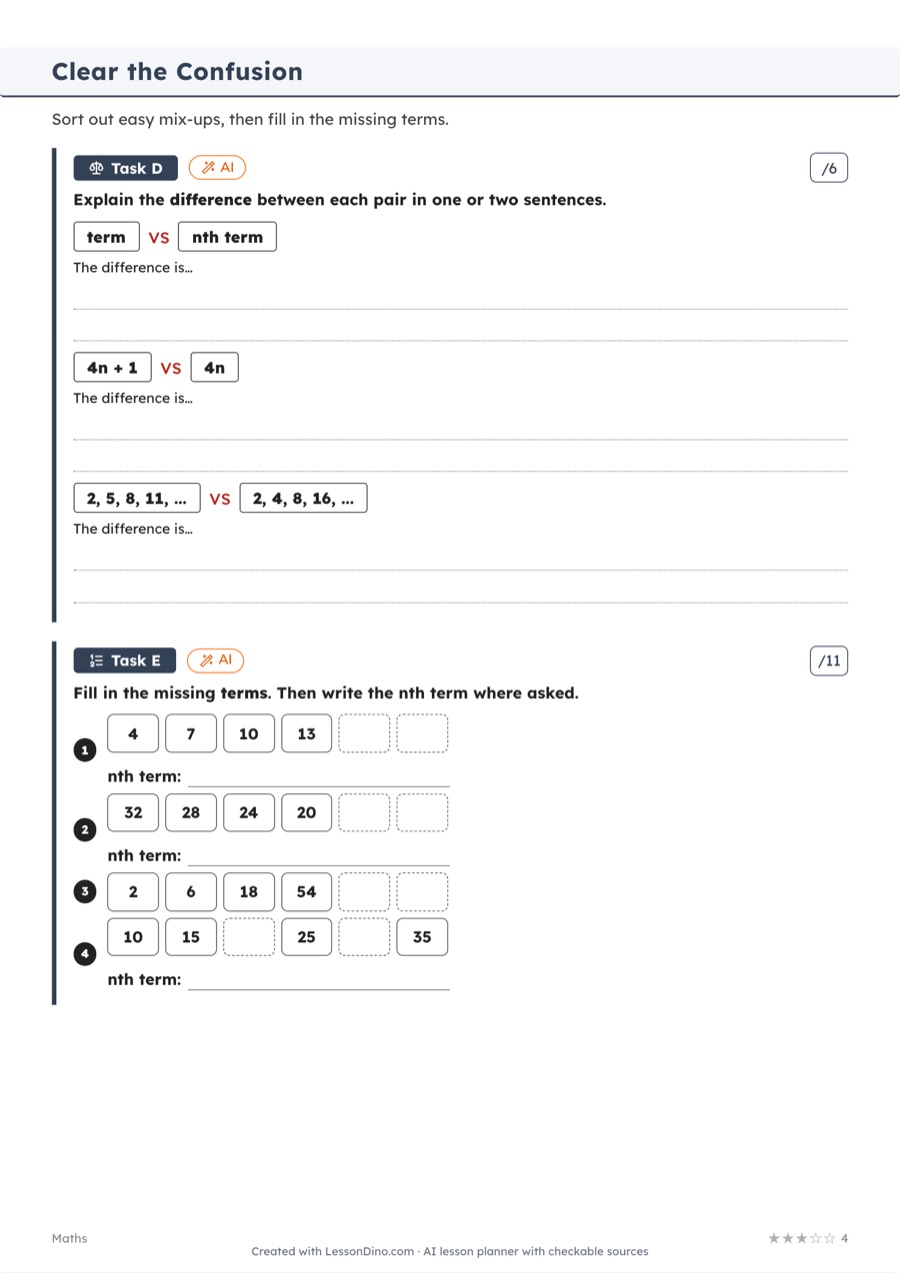
Clear the Confusion
Sort out easy mix-ups, then fill in the missing terms.
Explain the difference between each pair in one or two sentences.
Fill in the missing terms. Then write the nth term where asked.
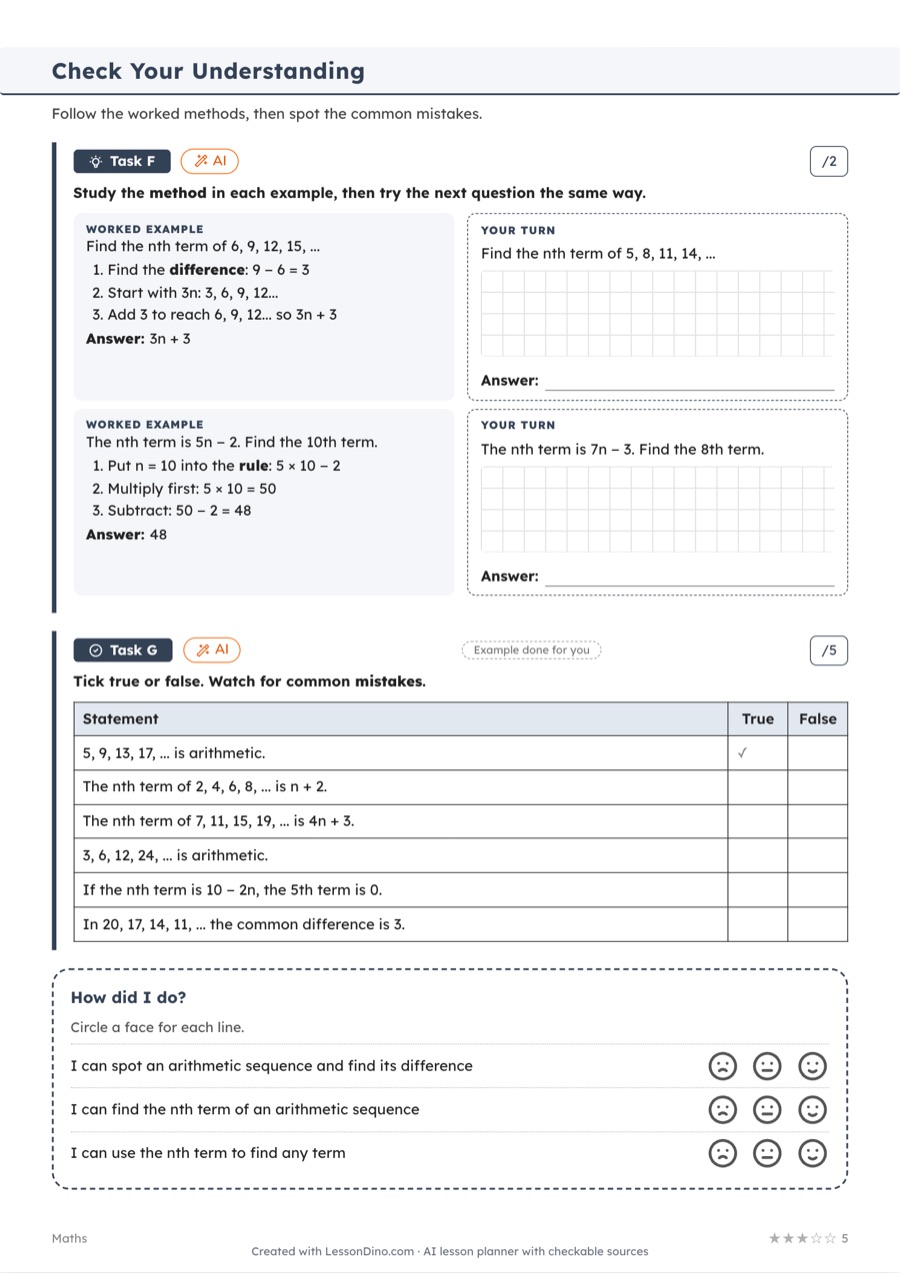
Check Your Understanding
Follow the worked methods, then spot the common mistakes.
Study the method in each example, then try the next question the same way.
Tick true or false. Watch for common mistakes.
Answers
Show the answers
- Find the difference in 4, 9, 14, 19, ... 5
- What is the next term in 4, 9, 14, 19, ...? 24
- Find the difference in 20, 17, 14, 11, ... -3
- What is the next term in 20, 17, 14, 11, ...? 8
- Find the 6th term in 2, 6, 10, 14, ... 22
- Find the 10th term in 5, 9, 13, 17, ... 41
- Find the nth term of 3, 7, 11, 15, ... 4n - 1
- Find the nth term of 6, 10, 14, 18, ... 4n + 2
- Stamps after 1, 2, 3 visits are 7, 9, 11, ... How many stamps after 8 visits? 21
- Explain how you know 4, 7, 10, 13, ... is arithmetic. Start with: It is arithmetic because... It is arithmetic because it goes up by 3 each time.
- Is 3, 6, 12, 24, ... arithmetic? Explain how you know. No, it multiplies by 2 each time so the difference is not the same.
- Find the 20th term of 1, 4, 7, 10, ... 58
- Find the difference in 12, 19, 26, 33, ... 7
- What is the 5th term in 12, 19, 26, 33, ...? 40
- Find the difference in 30, 26, 22, 18, ... -4
- Find the nth term of 5, 10, 15, 20, ... 5n
- Find the nth term of 8, 12, 16, 20, ... 4n + 4
- Find the nth term of 25, 21, 17, 13, ... -4n + 29
- Use the nth term 6n + 1 to find the 9th term. 55
- Use the nth term 20 − 3n to find the 7th term. -1
- Row 1 has 6 seats, row 2 has 9 seats, row 3 has 12 seats. How many seats in row 10? 33
- A plant is 10 cm tall and grows 2 cm each week. How tall (cm) after 12 weeks? 34
- The nth term is 2n + 5. Explain how you know the sequence is arithmetic. It goes up by 2 each time because n is multiplied by 2.
- Find the 15th term of 50, 45, 40, 35, ... -20
The answer sheet is the last picture above.
Curriculum
recognise arithmetic sequences and find the nth term
From National curriculum in England, Key Stage 3 mathematics.
Made with Lesson Dino's AI on 19 October 2026. AI can make mistakes, so check the answers and facts against the sources before you teach.