The worksheet
About this worksheet
Students learn to expand products of two and three binomials. They practise four multiplications, collect like terms and build to a cubic. This Year 8 Maths worksheet gives students (ages 12–13) six pages of practice on expanding brackets, part of the algebra unit. It goes with our free Expanding brackets lesson, which has the slides and a timed lesson plan.
What it covers
By the end, students should be able to:
- Students will expand products of two binomials correctly and simplify answers.
- Students will expand products of three binomials in two clear stages with simplification.
- Students will collect like terms to give each answer in simplest form.
How to use it
- Practise double brackets (12 minutes): Hand out Worksheet Task B and explain to expand each pair and collect like terms.
- Triple Bracket Tower (18 minutes): Set Worksheet Task C and the Slide 9 challenge (x+1)(x+2)(x+3) in stages.
- Support: Give the expanded quadratic from the first two brackets so students only have to do the final single-bracket style multiplication of each term.
- Stretch: Try changing the order and check you still get the same final answer, expanding a different pair first.
- The answer sheet is the last page, so you can print it on its own or let students check their own work.
Key vocabulary
- expand: multiply out to remove brackets
- binomial: expression with two parts joined by + or -
- like terms: parts with same letters and powers that can be added
- simplify: collect together to make shorter and tidier
Mistakes to watch for
- Squaring each term: (x + 3)² = x² + 9. Always expand as (x + 3)(x + 3) to get x² + 6x + 9.
- Only making two products: (x + 2)(x + 5) = x² + 10. Multiply every term in first bracket by every term in second to get x² + 7x + 10.
- Sign slip with negatives, e.g. -2(x - 5) = -2x - 10. Remember negative times negative is positive, so -2(x - 5) = -2x + 10.
What's on the worksheet
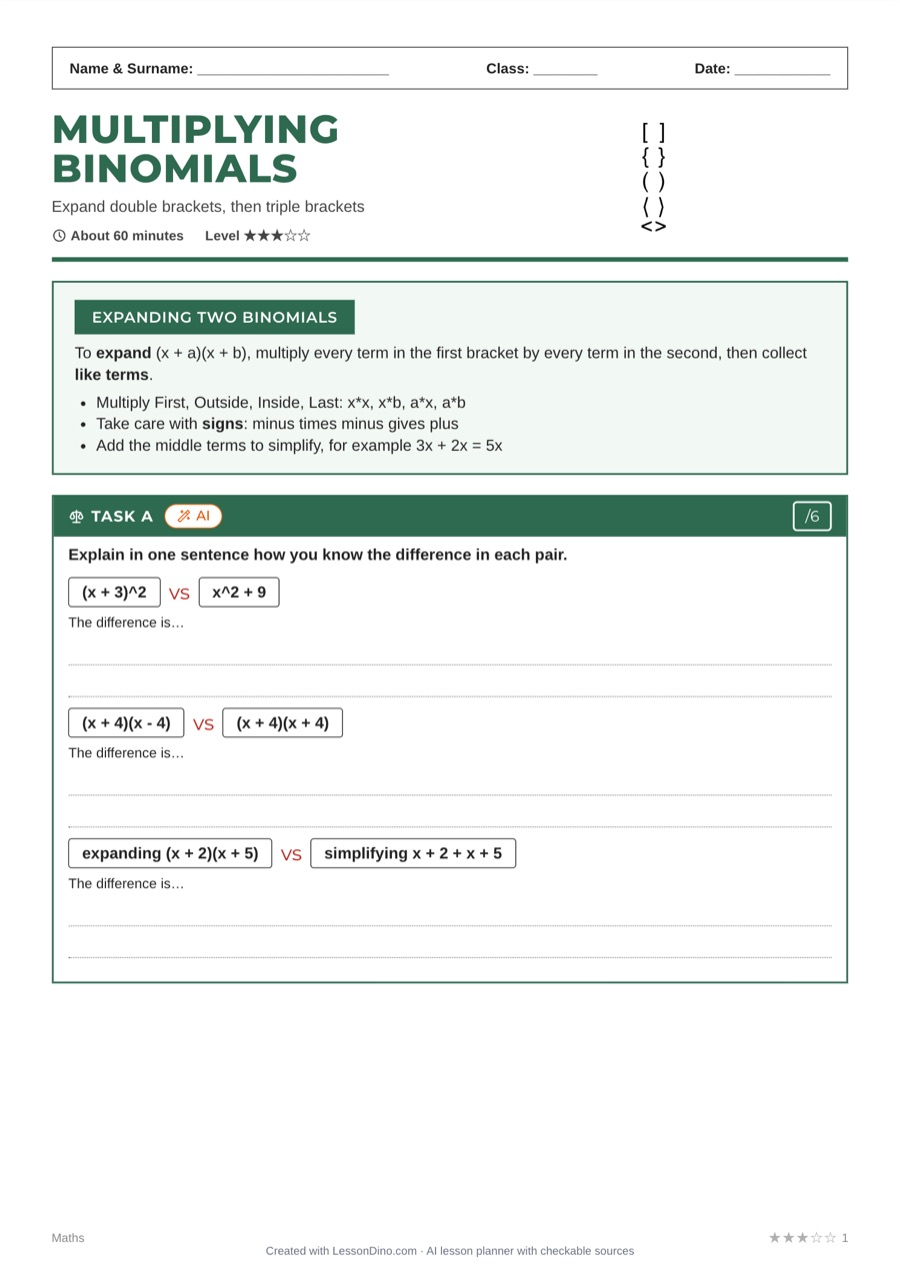
Expand Two Brackets
How to multiply every term by every term.
Expanding two binomials
- To expand (x + a)(x + b), multiply every term in the first bracket by every term in the second, then collect like terms.
- Multiply First, Outside, Inside, Last: xx, xb, ax, ab
- Take care with signs: minus times minus gives plus
- Add the middle terms to simplify, for example 3x + 2x = 5x
Explain in one sentence how you know the difference in each pair.
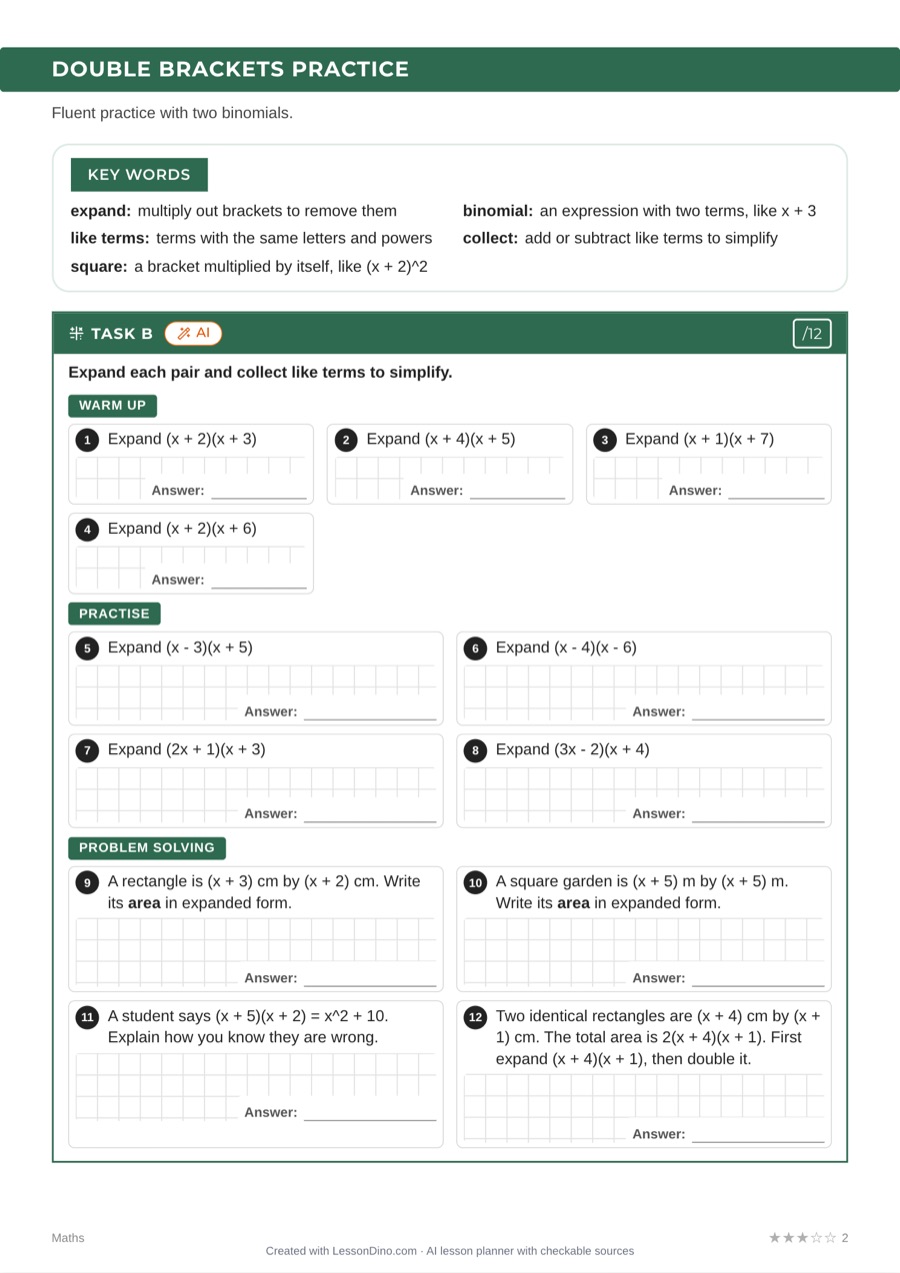
Double Brackets Practice
Fluent practice with two binomials.
| Word | Meaning |
|---|---|
| expand | multiply out brackets to remove them |
| binomial | an expression with two terms, like x + 3 |
| like terms | terms with the same letters and powers |
| collect | add or subtract like terms to simplify |
| square | a bracket multiplied by itself, like (x + 2)^2 |
Expand each pair and collect like terms to simplify.
Warm up
- Expand (x + 2)(x + 3)
- Expand (x + 4)(x + 5)
- Expand (x + 1)(x + 7)
- Expand (x + 2)(x + 6)
Practise
- Expand (x - 3)(x + 5)
- Expand (x - 4)(x - 6)
- Expand (2x + 1)(x + 3)
- Expand (3x - 2)(x + 4)
Problem solving
- A rectangle is (x + 3) cm by (x + 2) cm. Write its area in expanded form.
- A square garden is (x + 5) m by (x + 5) m. Write its area in expanded form.
- A student says (x + 5)(x + 2) = x^2 + 10. Explain how you know they are wrong.
- Two identical rectangles are (x + 4) cm by (x + 1) cm. The total area is 2(x + 4)(x + 1). First expand (x + 4)(x + 1), then double it.
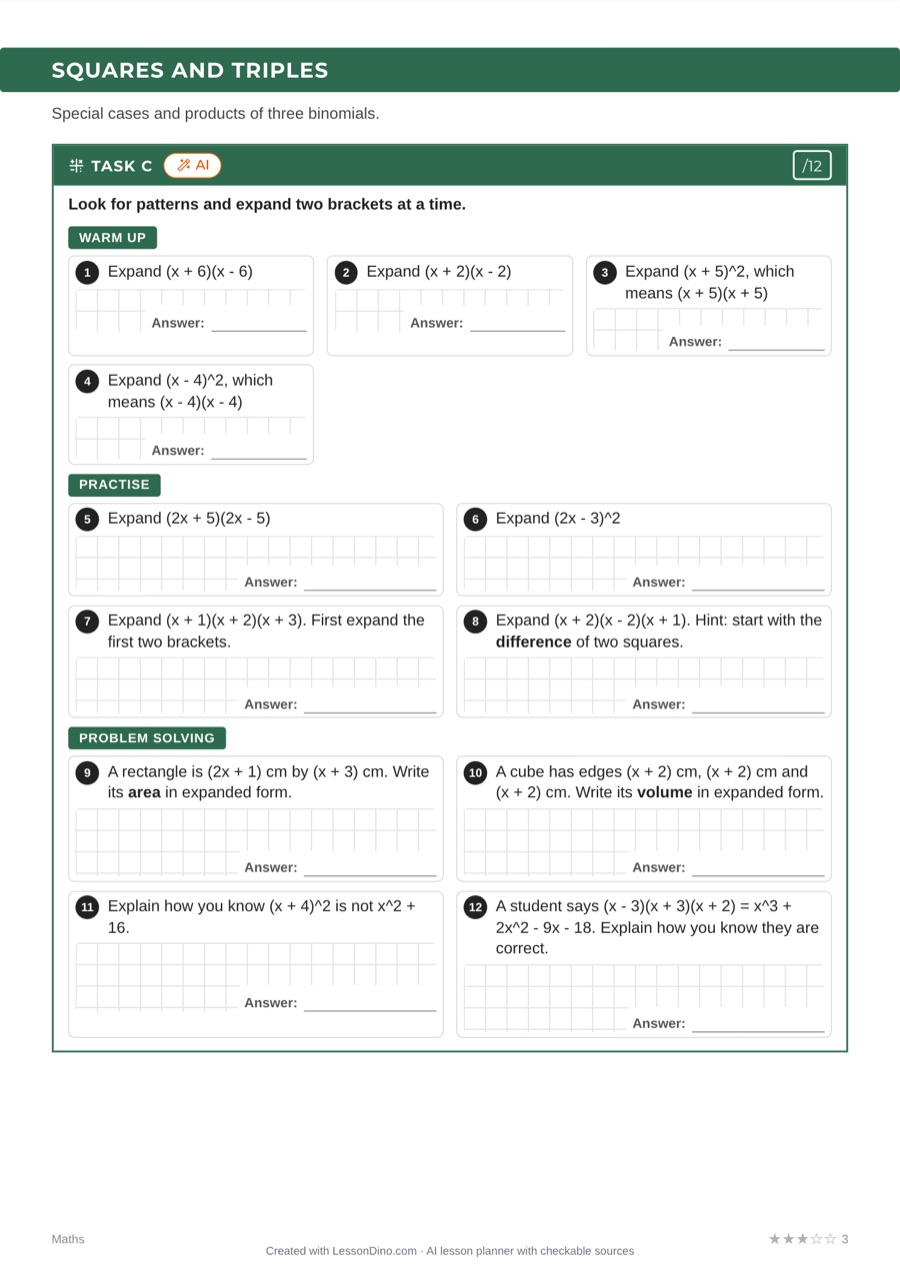
Squares And Triples
Special cases and products of three binomials.
Look for patterns and expand two brackets at a time.
Warm up
- Expand (x + 6)(x - 6)
- Expand (x + 2)(x - 2)
- Expand (x + 5)^2, which means (x + 5)(x + 5)
- Expand (x - 4)^2, which means (x - 4)(x - 4)
Practise
- Expand (2x + 5)(2x - 5)
- Expand (2x - 3)^2
- Expand (x + 1)(x + 2)(x + 3). First expand the first two brackets.
- Expand (x + 2)(x - 2)(x + 1). Hint: start with the difference of two squares.
Problem solving
- A rectangle is (2x + 1) cm by (x + 3) cm. Write its area in expanded form.
- A cube has edges (x + 2) cm, (x + 2) cm and (x + 2) cm. Write its volume in expanded form.
- Explain how you know (x + 4)^2 is not x^2 + 16.
- A student says (x - 3)(x + 3)(x + 2) = x^3 + 2x^2 - 9x - 18. Explain how you know they are correct.
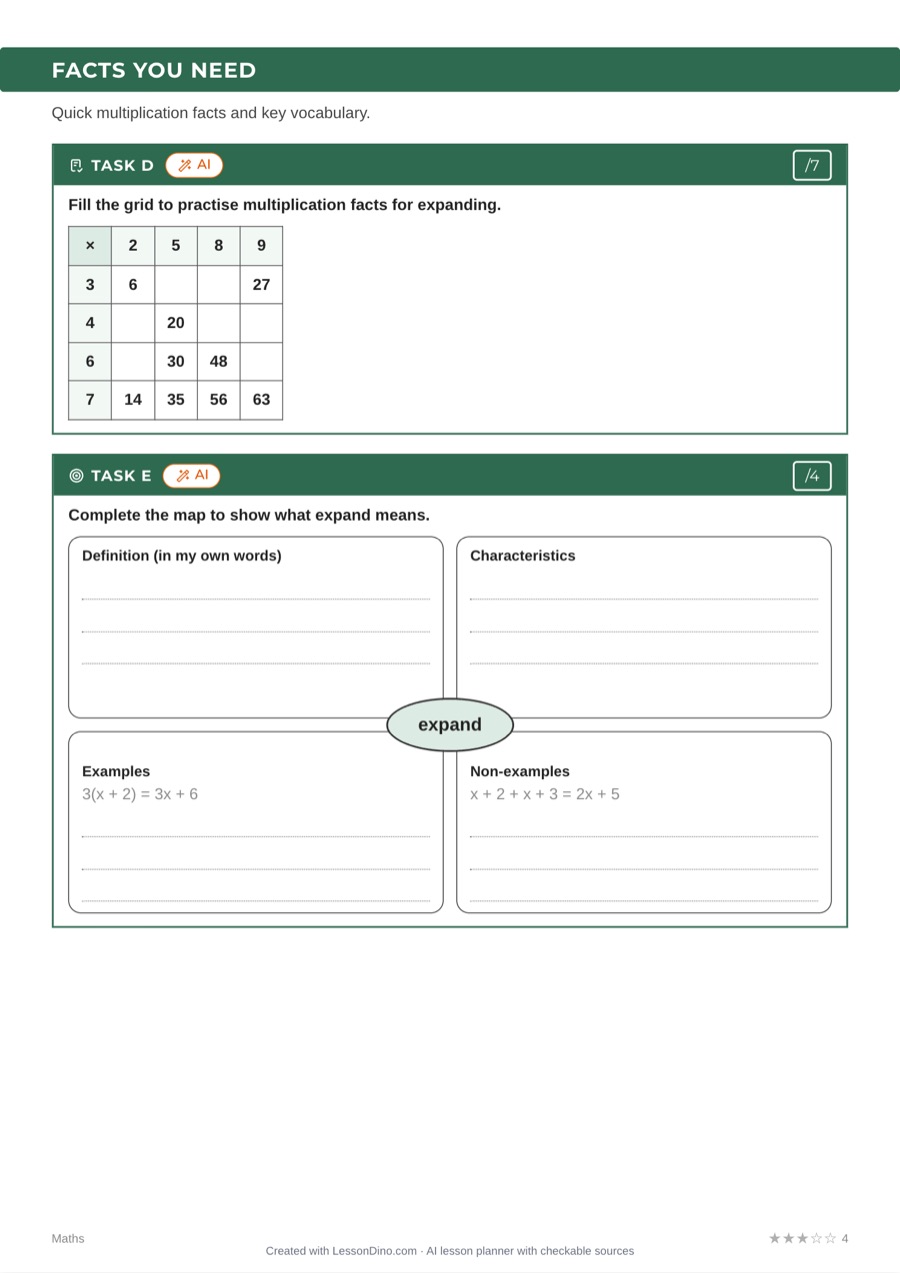
Facts You Need
Quick multiplication facts and key vocabulary.
Fill the grid to practise multiplication facts for expanding.
Complete the map to show what expand means.
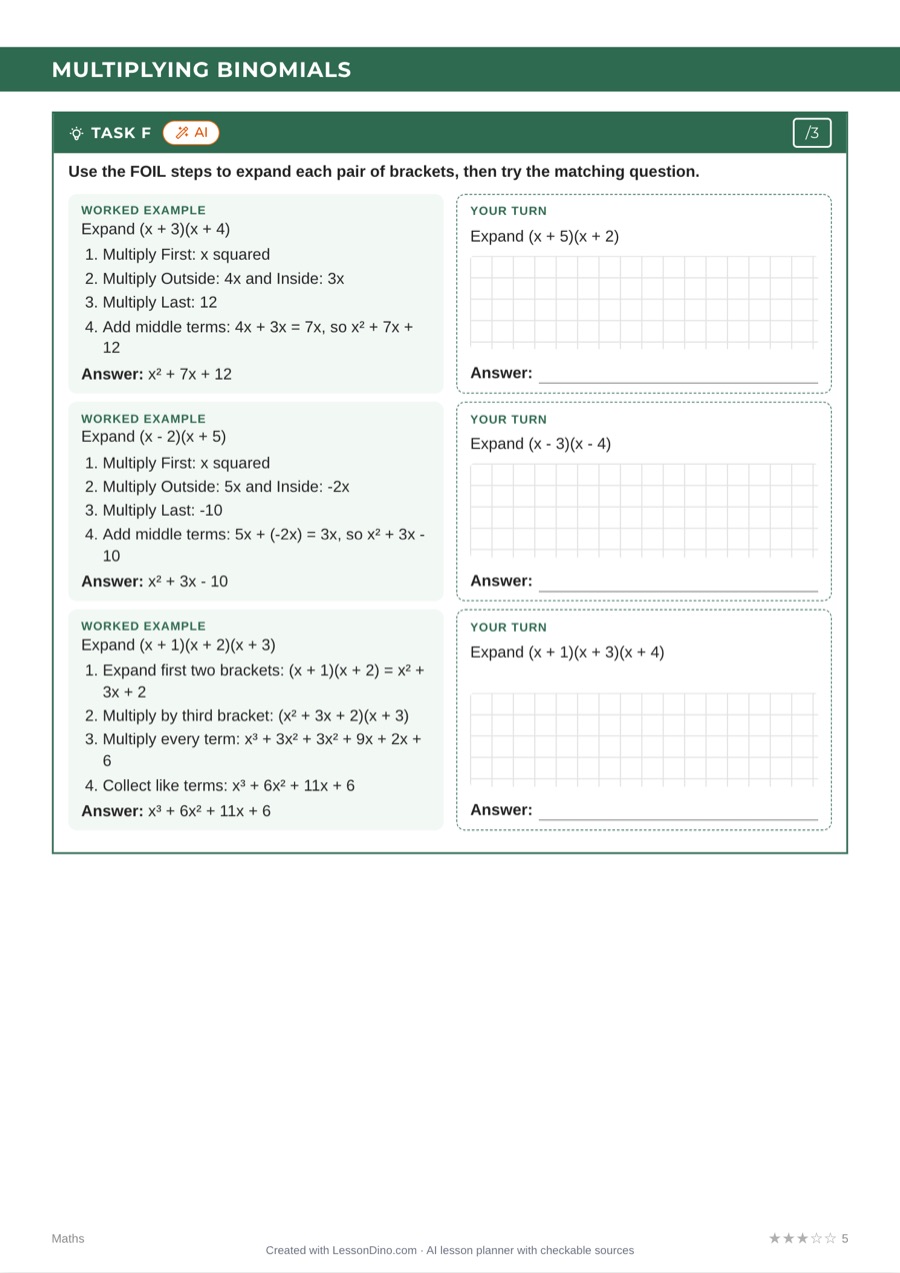
Page 5
Use the FOIL steps to expand each pair of brackets, then try the matching question.
Page 6
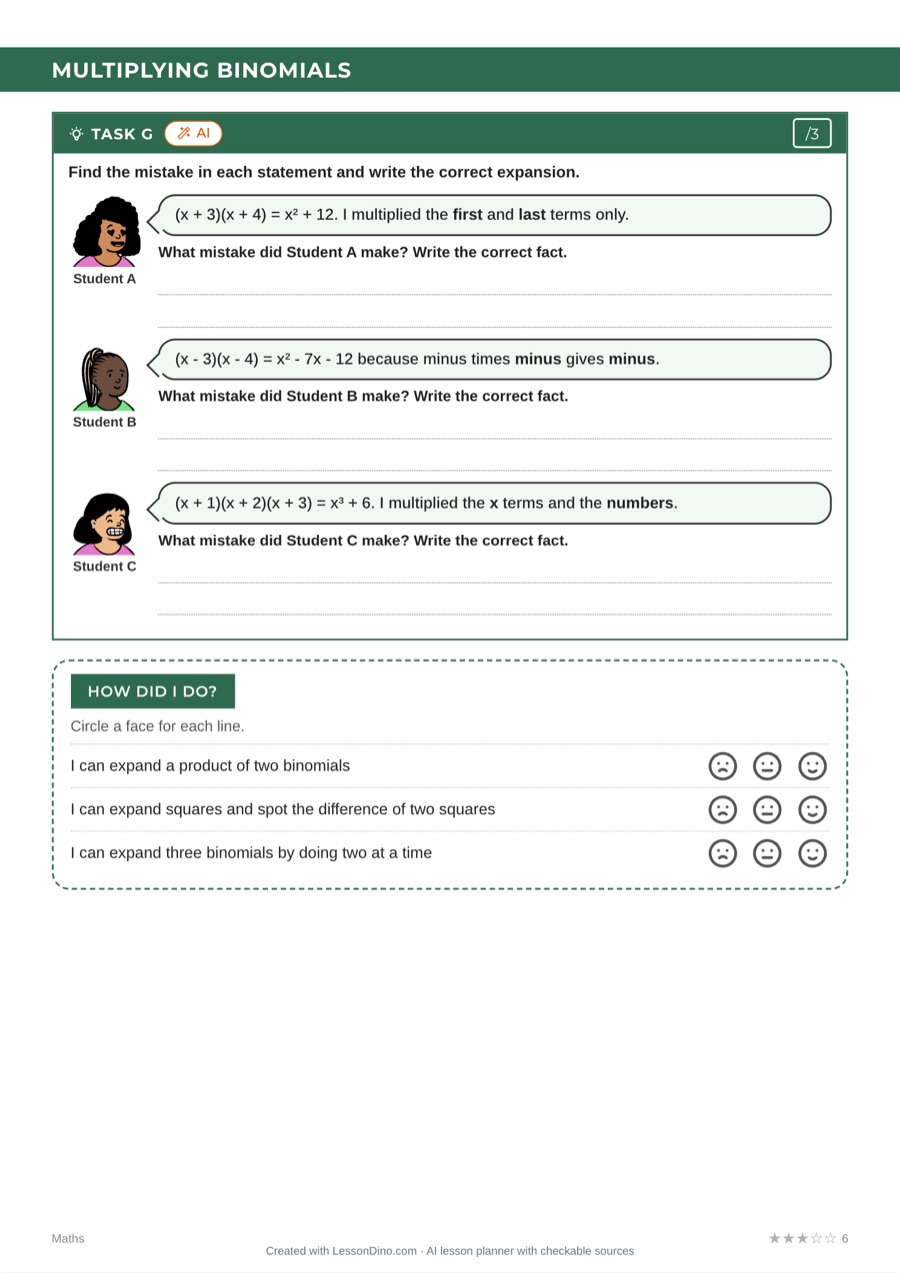
Find the mistake in each statement and write the correct expansion.
Answers
Show the answers
- Expand (x + 2)(x + 3) x^2 + 5x + 6
- Expand (x + 4)(x + 5) x^2 + 9x + 20
- Expand (x + 1)(x + 7) x^2 + 8x + 7
- Expand (x + 2)(x + 6) x^2 + 8x + 12
- Expand (x - 3)(x + 5) x^2 + 2x - 15
- Expand (x - 4)(x - 6) x^2 - 10x + 24
- Expand (2x + 1)(x + 3) 2x^2 + 7x + 3
- Expand (3x - 2)(x + 4) 3x^2 + 10x - 8
- A rectangle is (x + 3) cm by (x + 2) cm. Write its area in expanded form. x^2 + 5x + 6 cm^2
- A square garden is (x + 5) m by (x + 5) m. Write its area in expanded form. x^2 + 10x + 25 m^2
- A student says (x + 5)(x + 2) = x^2 + 10. Explain how you know they are wrong. They only multiplied First and Last. The full expansion is x^2 + 7x + 10, the middle terms 5x + 2x are missing.
- Two identical rectangles are (x + 4) cm by (x + 1) cm. The total area is 2(x + 4)(x + 1). First expand (x + 4)(x + 1), then double it. 2x^2 + 10x + 8 cm^2
- Expand (x + 6)(x - 6) x^2 - 36
- Expand (x + 2)(x - 2) x^2 - 4
- Expand (x + 5)^2, which means (x + 5)(x + 5) x^2 + 10x + 25
- Expand (x - 4)^2, which means (x - 4)(x - 4) x^2 - 8x + 16
- Expand (2x + 5)(2x - 5) 4x^2 - 25
- Expand (2x - 3)^2 4x^2 - 12x + 9
- Expand (x + 1)(x + 2)(x + 3). First expand the first two brackets. x^3 + 6x^2 + 11x + 6
- Expand (x + 2)(x - 2)(x + 1). Hint: start with the difference of two squares. x^3 + x^2 - 4x - 4
- A rectangle is (2x + 1) cm by (x + 3) cm. Write its area in expanded form. 2x^2 + 7x + 3 cm^2
- A cube has edges (x + 2) cm, (x + 2) cm and (x + 2) cm. Write its volume in expanded form. x^3 + 6x^2 + 12x + 8 cm^3
- Explain how you know (x + 4)^2 is not x^2 + 16. You must multiply (x + 4)(x + 4), which gives x^2 + 8x + 16. Squaring each term misses the two middle terms.
- A student says (x - 3)(x + 3)(x + 2) = x^3 + 2x^2 - 9x - 18. Explain how you know they are correct. First (x - 3)(x + 3) = x^2 - 9, then (x^2 - 9)(x + 2) = x^3 + 2x^2 - 9x - 18, so it matches.
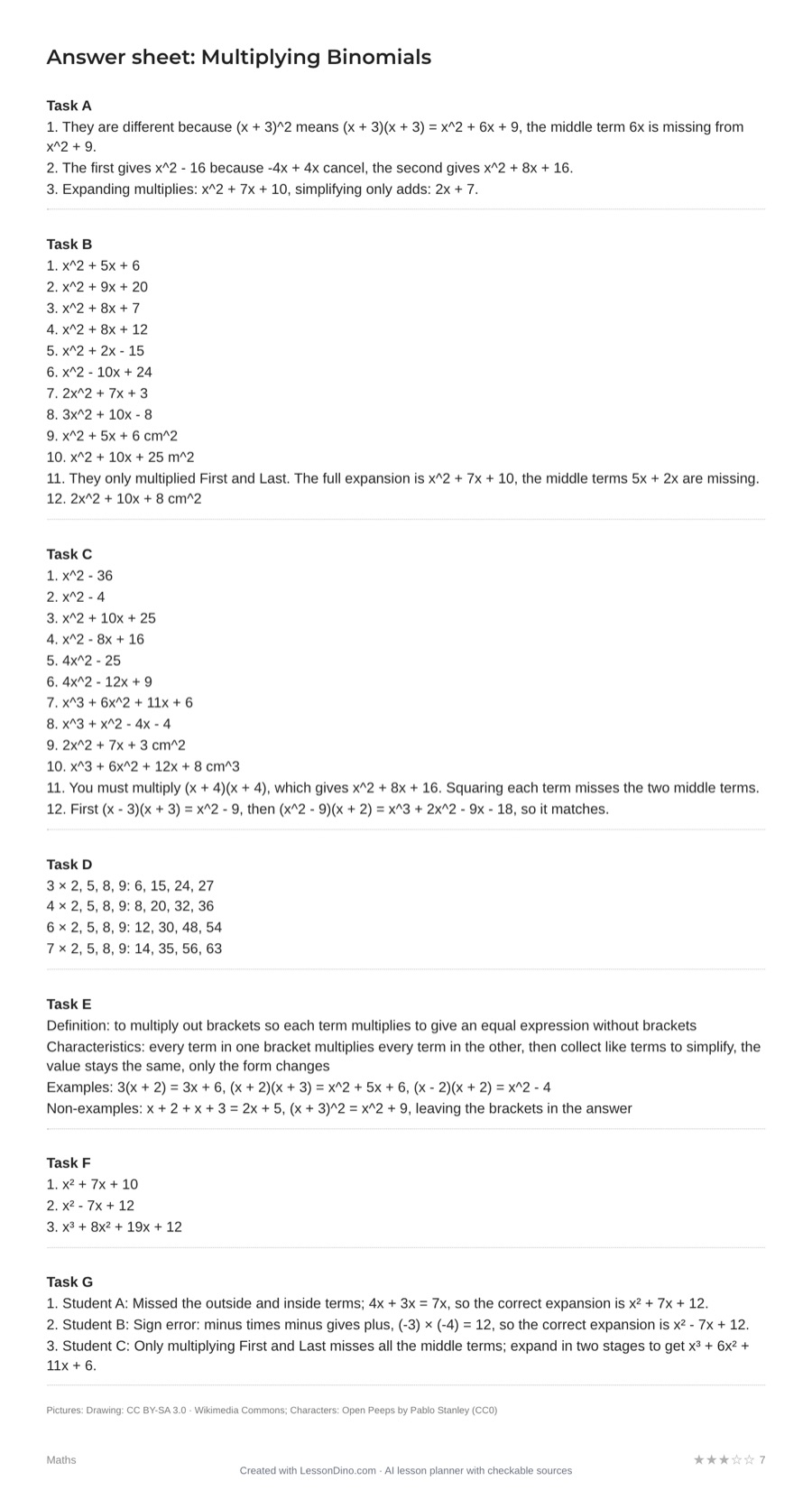
The answer sheet is the last picture above.
Curriculum
expanding products of 2 or more binomials
From National curriculum in England, Key Stage 3 mathematics.
Made with Lesson Dino's AI on 19 October 2026. AI can make mistakes, so check the answers and facts against the sources before you teach.