Slides
Lesson plan
Volume Relay: From Cross-Section to Prisms
Students derive area formulae then use them to find prism volumes. They work in teams round four prism stations to solve volume problems.
Objectives
- Students will derive area formulae for triangles, parallelograms and trapezia.
- Students will solve mixed prism volume problems quickly and accurately in teams.
- Students will calculate cylinder volumes and convert container volumes to litres.
Success criteria
- I can find perimeter and area of triangles, parallelograms and trapezia.
- I can find prism volume from cross-section area times length.
- I can find cylinder volume and use 1000 cm³ = 1 litre.
Key words
| Word | Meaning |
|---|---|
| prism | a solid with the same flat shape all the way through it |
| cross-section | the flat face made by cutting straight through a solid |
| volume | the amount of space taken up by a closed solid shape |
| area | the amount of flat surface inside a 2D shape |
| perimeter | the total distance all the way round the edge of a shape |
| cylinder | a solid with a circle at each end and the same circle all through |
Timed plan (60 minutes)
| Time | Stage | What happens |
|---|---|---|
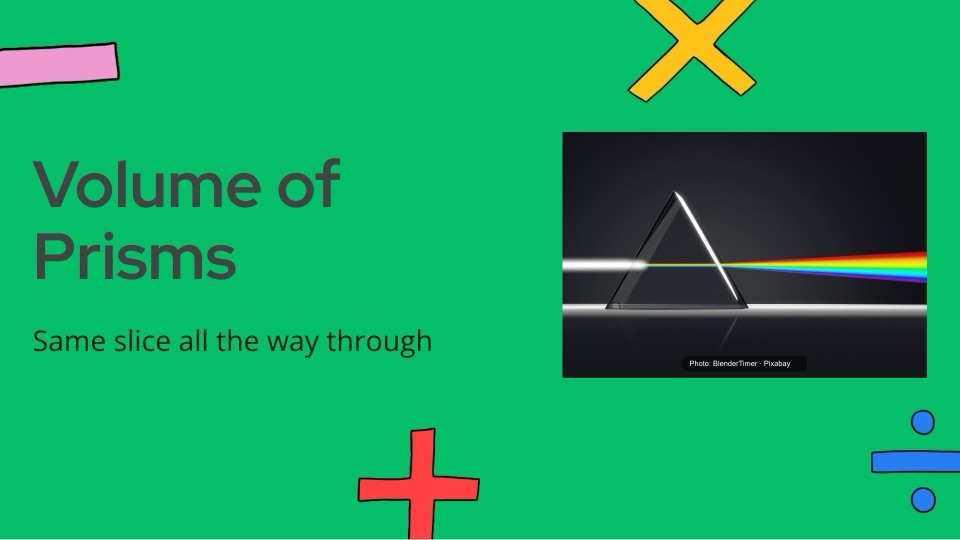
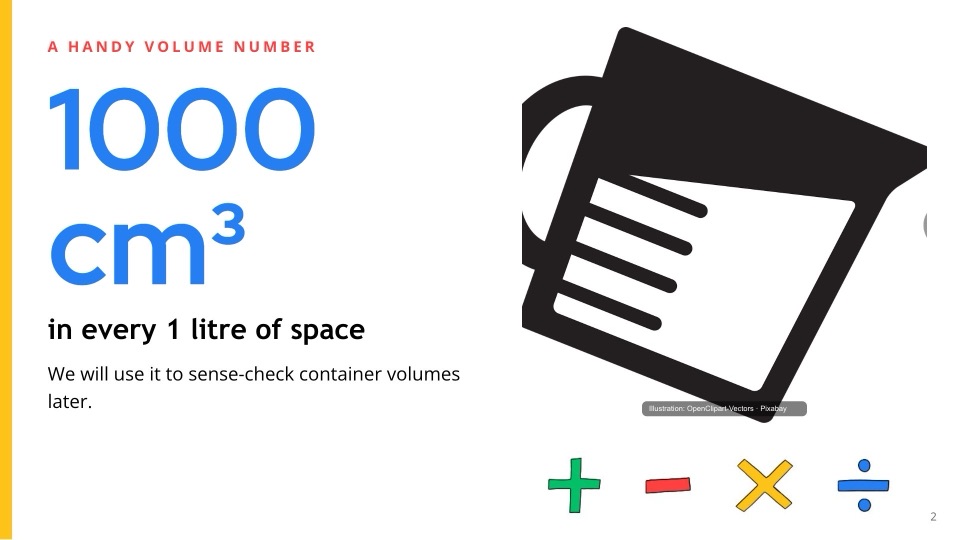
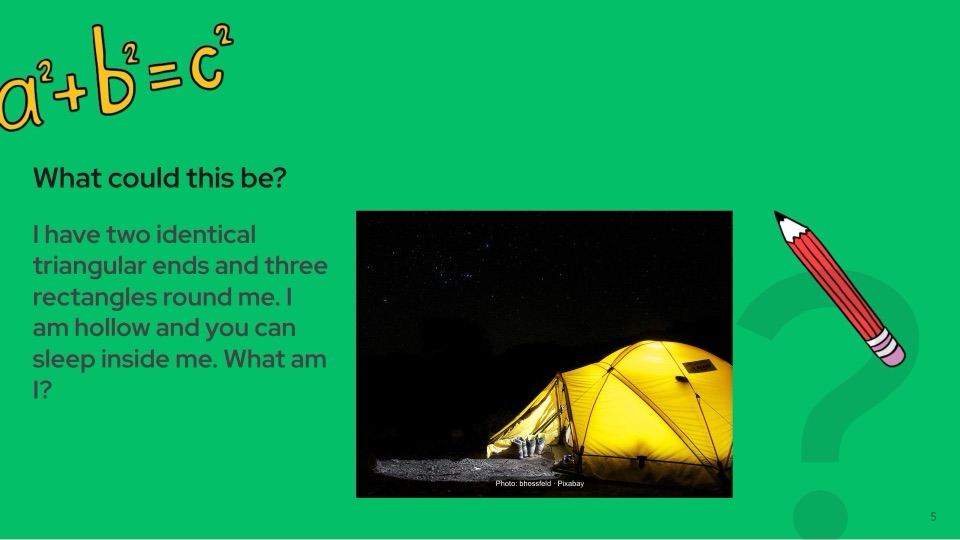
| 7 min | Starter | Recall area facts and set up the team relay challenge for the lesson. Show Slide 1 and give the hook: Four stations, four prisms, one winning team. No skipping the working. Show Slide 2 and explain we will use 1000 cm³ in every 1 litre of space to sense-check container volumes later. Show Slide 5 mystery and read the riddle about two identical triangular ends and three rectangles. Ask what students already know about rectangle area and perimeter to link to new formulae. |
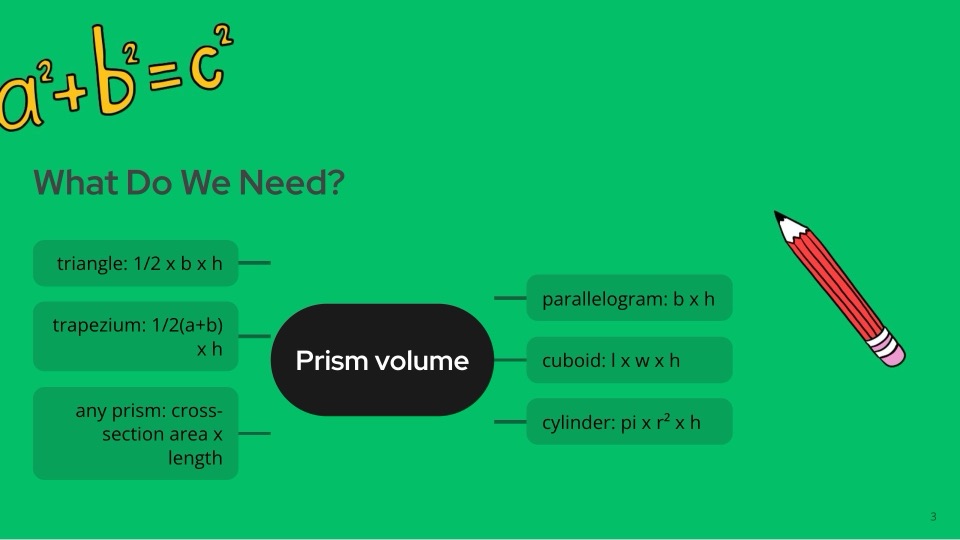
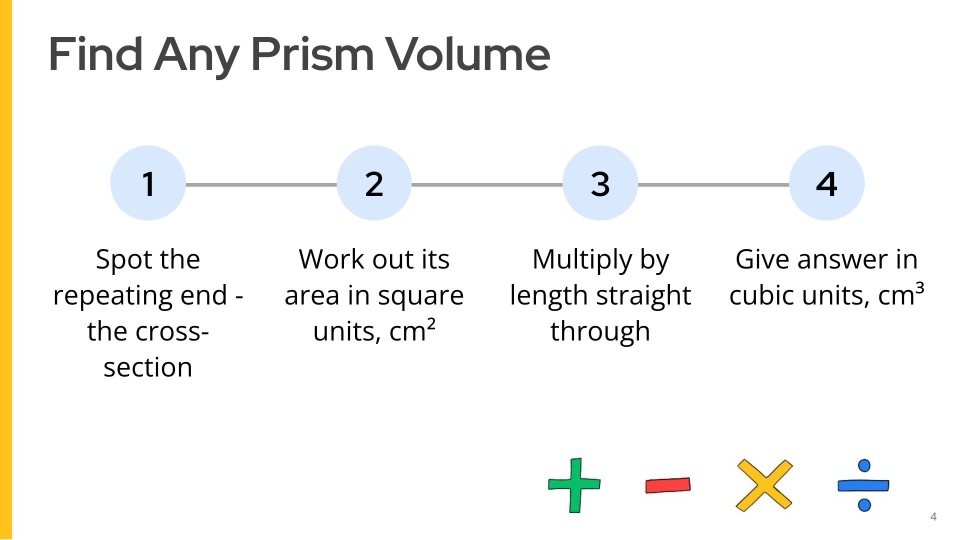
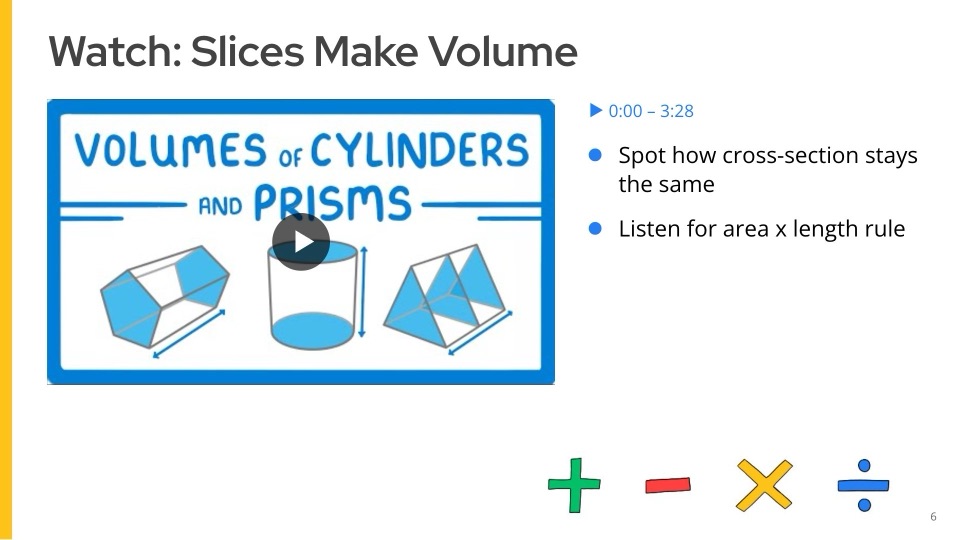
| 13 min | Teaching | Derive 2D area formulae and link them to volume as cross-section area times length. Show Slide 3 mindmap and model cutting a paper parallelogram into a rectangle to show area is base times perpendicular height. Show cutting that parallelogram along a diagonal to give triangle area as half times base times height, then joining two identical trapezia to give half times sum of parallel sides times height, as in half × (6 + 10) × 4. Show Slide 4 steps: spot the repeating end, work out its area in cm², multiply straight through, give cm³. Play Slide 6 Video clip 1 and ask students to spot how the cross-section stays the same all through the prism. |
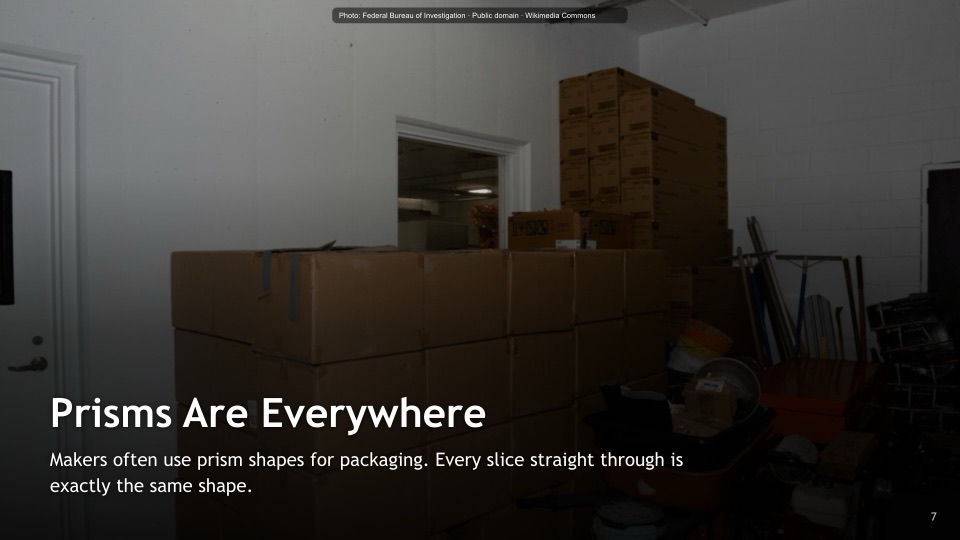
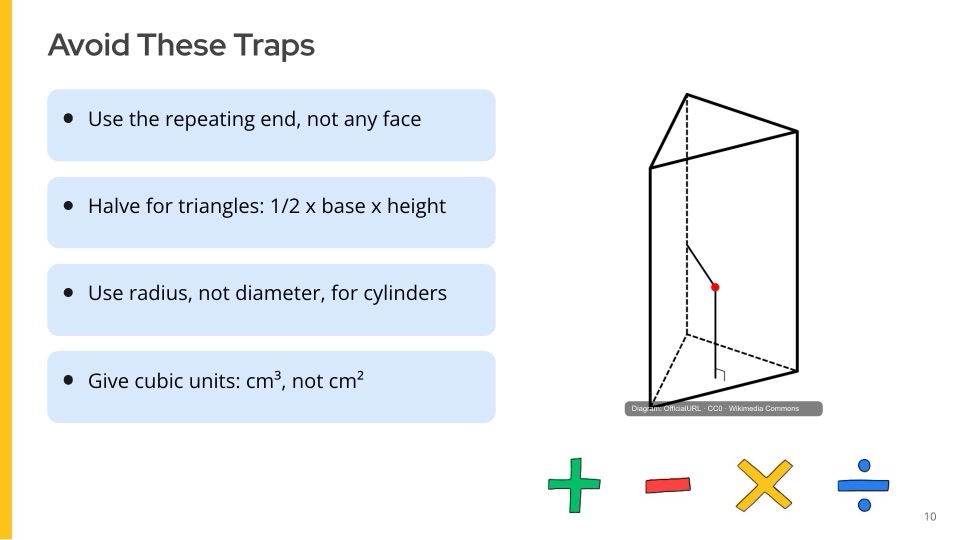
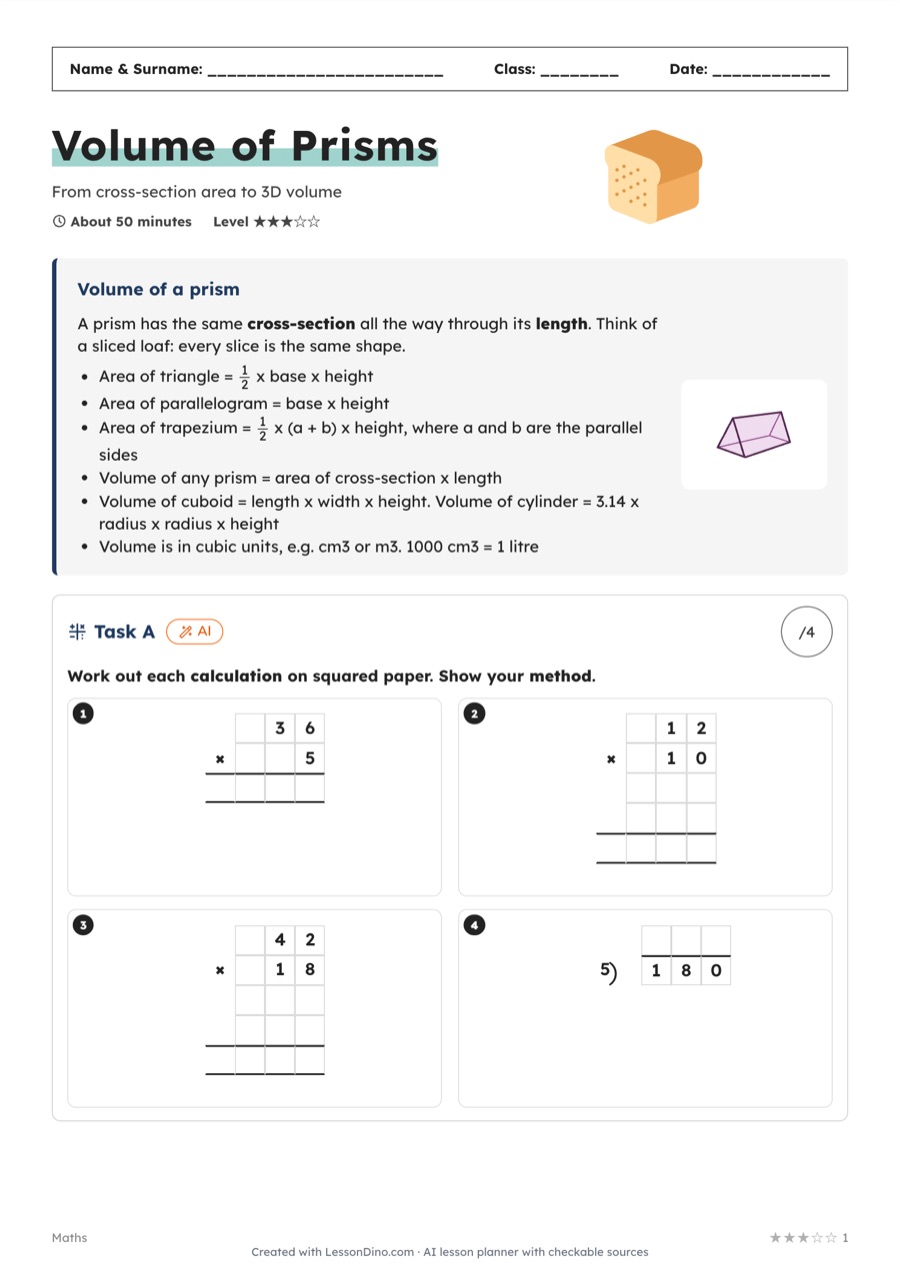
| 10 min | Guided practice | Model correct two-step working and avoid common traps with units and faces. Show Slide 7 photo and stress makers often use prism shapes for packaging where every slice straight through is exactly the same shape. Model cuboid 9 cm by 4 cm by 5 cm: cross-section 9 × 4 = 36 cm², volume 36 × 5 = 180 cm³. Model triangular prism base 6 cm, height 4 cm, length 10 cm: triangle 1/2 × 6 × 4 = 12 cm², volume 12 × 10 = 120 cm³. Show Slide 10 traps and set Worksheet Task B: Practice questions: Find each area or perimeter. Include the correct units. |
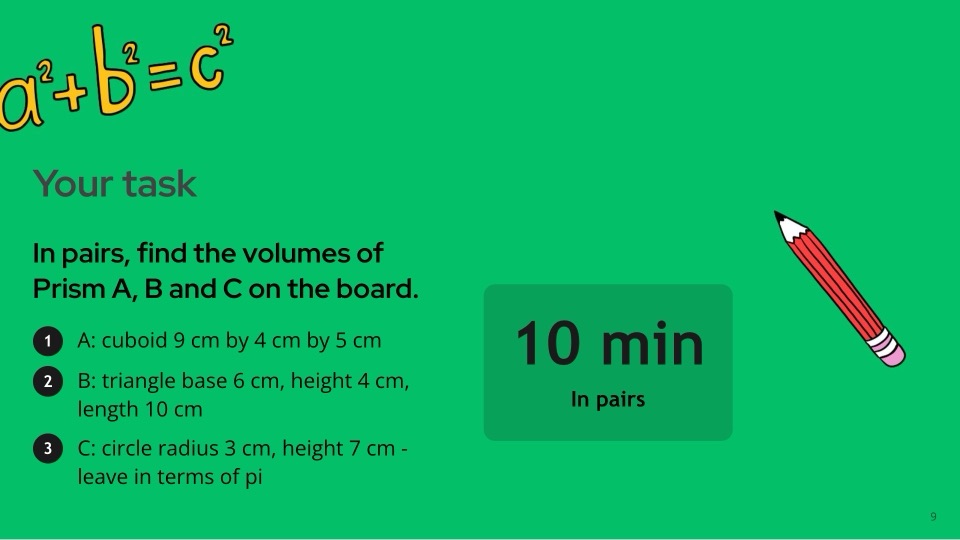
| 22 min | Main activity | Students solve mixed prism volume problems quickly and accurately in teams. Set out four stations with task cards, answer sheets and timers. Station A: cuboid 9 cm by 4 cm by 5 cm. Station B: triangle base 6 cm, height 4 cm, length 10 cm. Station C: pentagonal cross-section area 20 cm², length 15 cm, so 20 × 15 = 300 cm³. Station D: cuboid container 10 cm by 10 cm by 10 cm = 1000 cm³ = 1 litre. Show Slide 9 task and explain teams rotate, find cross-section area first then multiply by length, recording both with cubic units. Remind of safety: walk quickly between stations, keep bags under desks and keep walkways clear to avoid trips. Start timers, circulate to check choice of repeating end and correct use of half and radius. |
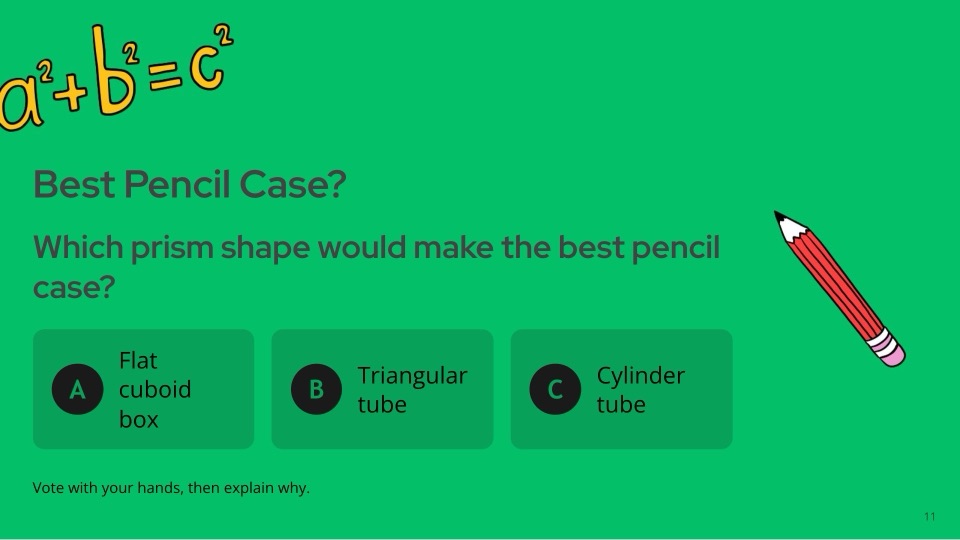
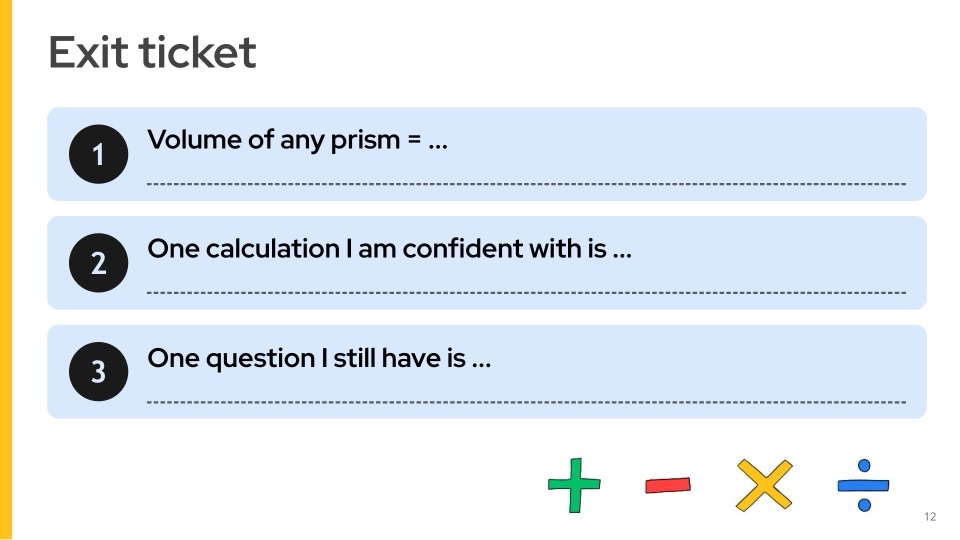
| 8 min | Plenary | Check objectives, fix traps and confirm litre link and vote. Show Slide 11 vote: Which prism shape would make the best pencil case? Flat cuboid box, triangular tube or cylinder tube. Revisit Slide 2: use 1000 cm³ in every 1 litre to sense-check Station D container. Show Slide 12 exit ticket and collect three answers from all students. Summarise rule and name next lesson link to surface area. |
Common mistakes
- Using the wrong face as the cross-section, especially when prism lies on its side
How to spot it: Volume far too big or small and working starts with a face that does not repeat
Mark the two identical ends and redraw the cross-section separately, then do area times length. - Forgetting to halve for triangular cross-section
How to spot it: Answer exactly double the correct volume, e.g. 240 cm³ not 120 cm³
Insist on 1/2 × base × height first, then times length, and check against half a cuboid. - Stopping after cross-section area or using diameter instead of radius for cylinders
How to spot it: Answer in cm², or cylinder volume four times too big
Require two lines: area in cm² then volume in cm³; halve diameter to get radius for pi × radius² × height.
Support
- Give a formula reminder card for triangle, parallelogram and trapezium areas plus a calculator for the multiplication step.
- Give pre-drawn shapes on squared paper and prompt cards for cm, cm² and cm³.
Stretch
- Add a bonus card where the volume and two dimensions are given and students must find the unknown length.
- Ask students to redesign with double radius or double length and explain the effect on volume.
Check questions
- Triangular prism, base 6 cm, height 4 cm, length 10 cm. Volume?
Answer: 1/2 × 6 × 4 = 12 cm², 12 × 10 = 120 cm³ - Pentagonal prism, cross-section 20 cm², length 15 cm. Volume?
Answer: 20 × 15 = 300 cm³ - Cuboid container 10 cm × 10 cm × 10 cm. Volume in cm³ and litres?
Answer: 1000 cm³ = 1 litre
Curriculum
derive and apply formulae to calculate and solve problems involving: perimeter and area of triangles, parallelograms, trapezia, volume of cuboids (including cubes) and other prisms (including cylinders)
From National curriculum in England, Key Stage 3 mathematics.
Video clips
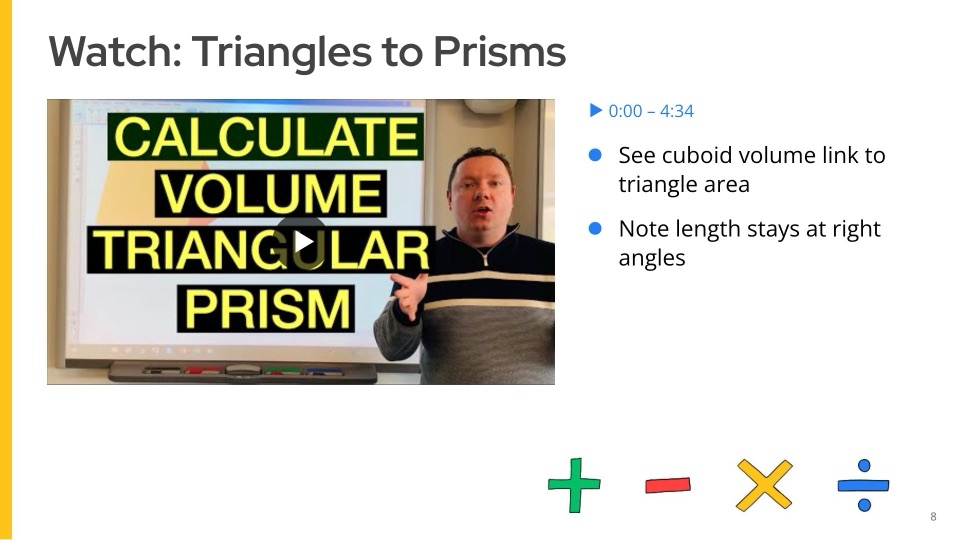
Clips on YouTube, from the start and end times we chose. Check each one before you show it.
-
cylinders and prisms overview from 0:00 to 3:28
Cognito: How to Find the Volume of Cylinders & Prisms
Perfect for 12-13-year-olds with clear UK-style explanations that link area of cross-section to volume of triangular prisms and cylinders.
-
triangular prism method from 0:00 to 4:34
Clelland Maths: How to find the volume of a triangular prism - Easy Maths Volume Of Prisms.
Suits 12-13-year-olds well with simple steps linking cuboid volume to 1/2 x base x height x length for triangular prisms.
Worksheet
Sources
- Surface area and volume of prisms - KS3 Maths - BBC Bitesize bbc.co.uk
- Volume of a Prism - GCSE Maths Questions & Mark Scheme | Virtus Academy virtusacademy.co.uk
- Volume of a Prism - GCSE Maths Revision Guide | GCSEMaths gcsemathsai.co.uk
- Volume of prisms — Revision Notes & Key Facts | GCSEMathsAI gcsemathsai.co.uk
- Volume of Prisms - Tutorful tutorful.co.uk
- Lesson: Volume of prisms | Oak National Academy thenational.academy
- Checking and securing understanding of volume of prisms thenational.academy
- Volume of a prism - Volume - National 4 Applications of Maths Revision ... bbc.co.uk
- Finding the volume of a prism with a polygon base on a grid en.khanacademy.org
- Flexi answers - How to find the volume of a prism? | CK-12 Foundation ck12.org
- Volume of rectangular prisms review - Khan Academy en.khanacademy.org
- Volume and surface area | Geometry (all content) | Math - Khan Academy khanacademy.org
- Volume of Prisms Worksheets (printable, online, answers, example… onlinemathlearning.com
- Volume formulas review (article) | Khan Academy khanacademy.org
- Volume en.wikipedia.org
Picture credits
- Photo: BlenderTimer · Pixabay
- Illustration: OpenClipart-Vectors · Pixabay
- Photo: bhossfeld · Pixabay
- Photo: Federal Bureau of Investigation · Public domain · Wikimedia Commons
- Diagram: OfficialURL · CC0 · Wikimedia Commons
- Microsoft Fluent Emoji (MIT)
- Mulberry Symbols by Steve Lee (mulberrysymbols.org) · CC BY-SA 4.0
Made with Lesson Dino's AI on 19 October 2026. AI can make mistakes, so check facts against the sources before you teach.