The worksheet
About this worksheet
Pupils learn to write ratios in the correct order and reduce them to simplest form. They crack money puzzles by changing to the same units first. This Year 7 Maths worksheet gives students (ages 11–12) six pages of practice on ratio, part of the ratio, proportion and rates of change unit. It goes with our free Ratio lesson, which has the slides and a timed lesson plan.
What it covers
By the end, students should be able to:
- Students will write two quantities as a:b in the correct order without units.
- Students will change quantities to the same units before writing a ratio.
- Students will reduce ratios to simplest form using the highest common factor.
How to use it
- Main: Pence to Pounds Puzzle (18 minutes): Hand out Worksheet Tasks B-C and replica money, reminding pupils the same units must be used or the comparison will be wrong.
- Support: Use dot pictures, coin strips and sentence starters for ___ to ___ is ___ : ___.
- Stretch: Design a stronger squash mix with same total volume and explain the ratio change.
- The answer sheet is the last page, so you can print it on its own or let students check their own work.
Key vocabulary
- ratio: a way of showing how much of one thing there is compared with another
- order: which quantity is written first and which is written second
- units: what you measure in, such as pence, pounds or millilitres
- equivalent: different pairs of numbers that show the same comparison
- highest common factor: the biggest number that divides exactly into both numbers
- simplest form: the smallest whole numbers that still keep the same comparison
Mistakes to watch for
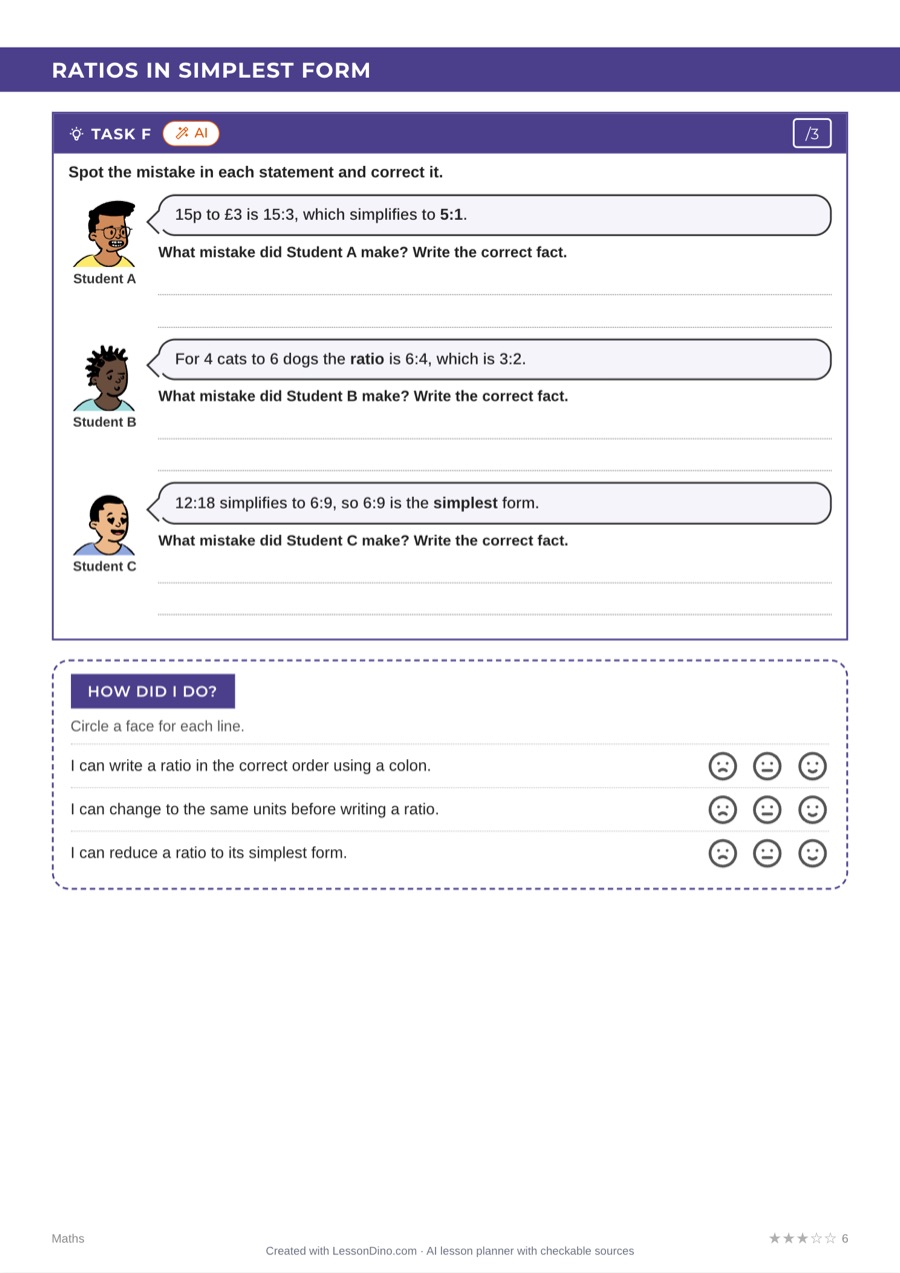
- Writing 15p to £3 as 15:3 without converting units. Change to same units first, £3 to 300p, then 15:300 simplifies to 1:20.
- Swapping the order, writing 4:1 for orange to water 1:4. Underline first-named quantity and write it first, because changing order changes proportions.
- Dividing only one side, for example 12:18 to 6:18. Divide both sides by the same number to keep an equivalent ratio, then check by scaling up.
What's on the worksheet
Know Your Ratio
How to write a ratio and reduce it to simplest form.
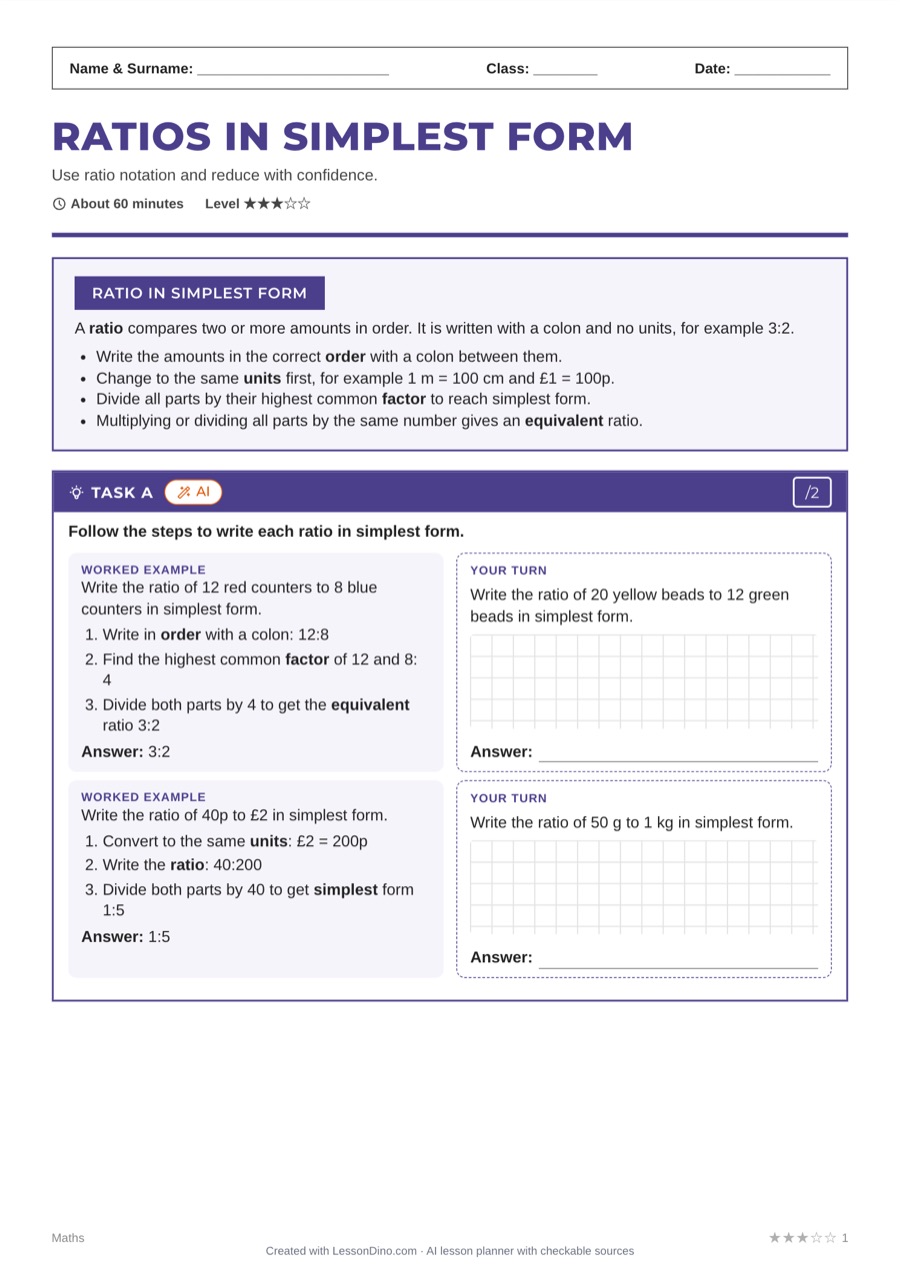
Ratio in simplest form
- A ratio compares two or more amounts in order. It is written with a colon and no units, for example 3:2.
- Write the amounts in the correct order with a colon between them.
- Change to the same units first, for example 1 m = 100 cm and £1 = 100p.
- Divide all parts by their highest common factor to reach simplest form.
- Multiplying or dividing all parts by the same number gives an equivalent ratio.
Follow the steps to write each ratio in simplest form.
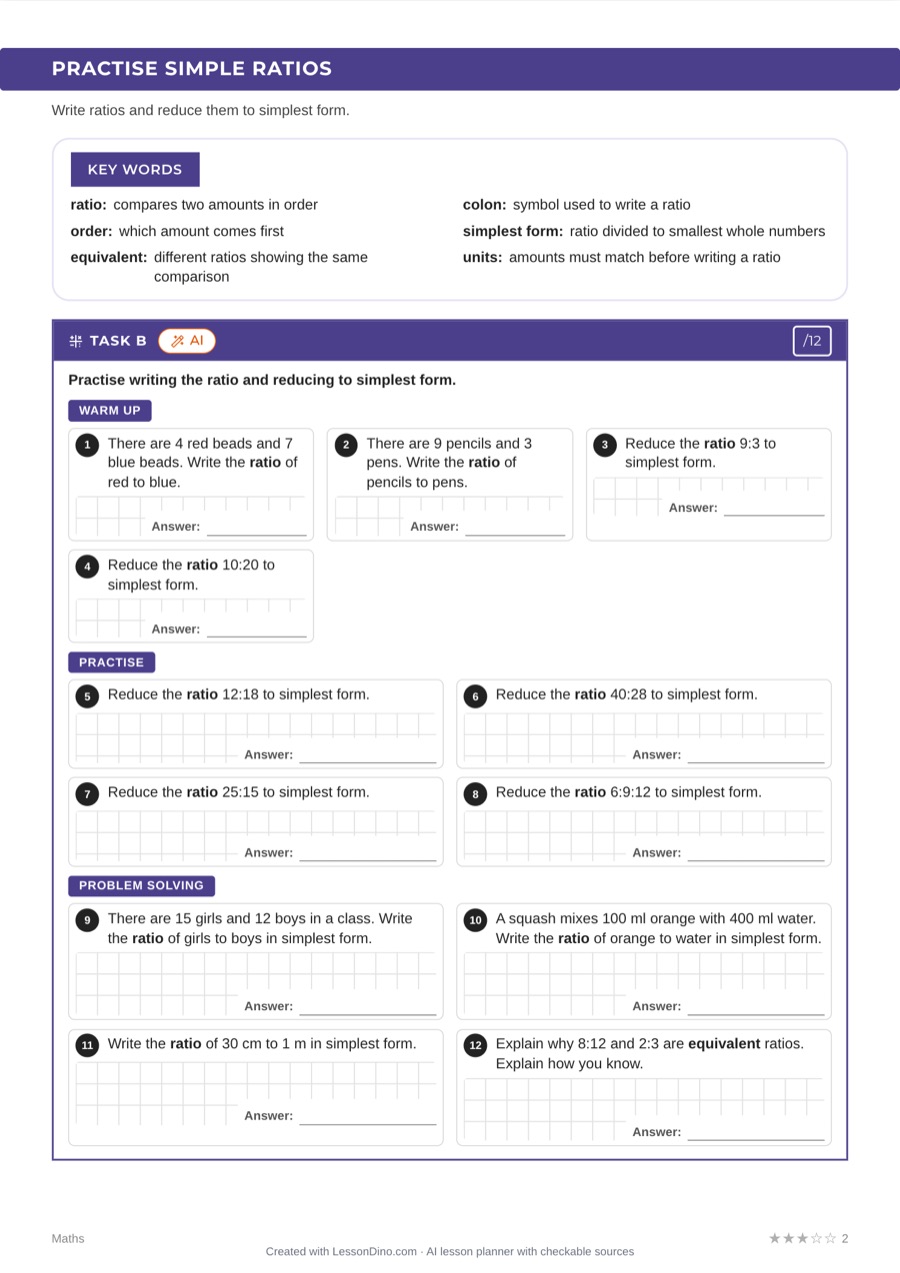
Practise Simple Ratios
Write ratios and reduce them to simplest form.
| Word | Meaning |
|---|---|
| ratio | compares two amounts in order |
| colon | symbol used to write a ratio |
| order | which amount comes first |
| simplest form | ratio divided to smallest whole numbers |
| equivalent | different ratios showing the same comparison |
| units | amounts must match before writing a ratio |
Practise writing the ratio and reducing to simplest form.
Warm up
- There are 4 red beads and 7 blue beads. Write the ratio of red to blue.
- There are 9 pencils and 3 pens. Write the ratio of pencils to pens.
- Reduce the ratio 9:3 to simplest form.
- Reduce the ratio 10:20 to simplest form.
Practise
- Reduce the ratio 12:18 to simplest form.
- Reduce the ratio 40:28 to simplest form.
- Reduce the ratio 25:15 to simplest form.
- Reduce the ratio 6:9:12 to simplest form.
Problem solving
- There are 15 girls and 12 boys in a class. Write the ratio of girls to boys in simplest form.
- A squash mixes 100 ml orange with 400 ml water. Write the ratio of orange to water in simplest form.
- Write the ratio of 30 cm to 1 m in simplest form.
- Explain why 8:12 and 2:3 are equivalent ratios. Explain how you know.
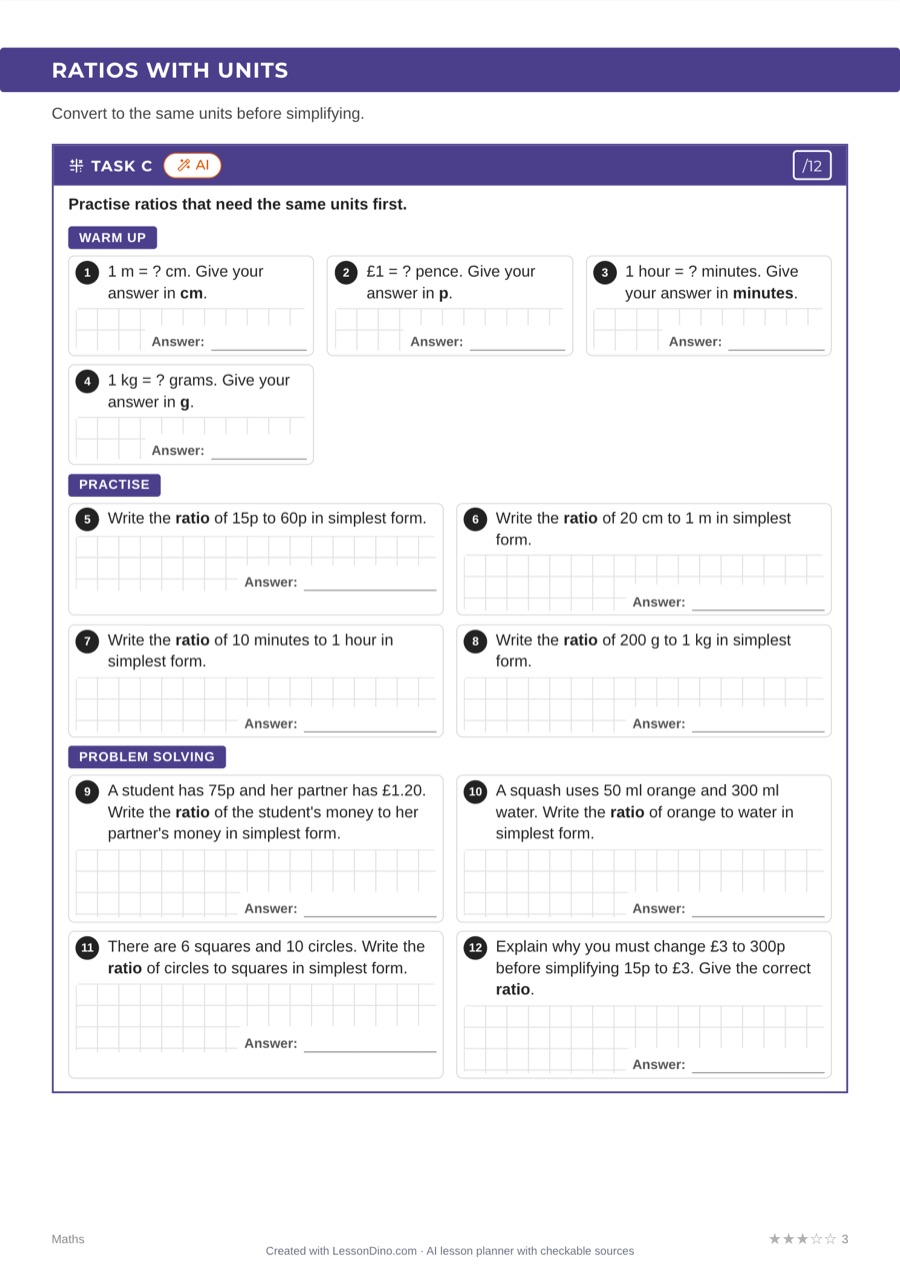
Ratios With Units
Convert to the same units before simplifying.
Practise ratios that need the same units first.
Warm up
- 1 m = ? cm. Give your answer in cm.
- £1 = ? pence. Give your answer in p.
- 1 hour = ? minutes. Give your answer in minutes.
- 1 kg = ? grams. Give your answer in g.
Practise
- Write the ratio of 15p to 60p in simplest form.
- Write the ratio of 20 cm to 1 m in simplest form.
- Write the ratio of 10 minutes to 1 hour in simplest form.
- Write the ratio of 200 g to 1 kg in simplest form.
Problem solving
- A student has 75p and her partner has £1.20. Write the ratio of the student's money to her partner's money in simplest form.
- A squash uses 50 ml orange and 300 ml water. Write the ratio of orange to water in simplest form.
- There are 6 squares and 10 circles. Write the ratio of circles to squares in simplest form.
- Explain why you must change £3 to 300p before simplifying 15p to £3. Give the correct ratio.
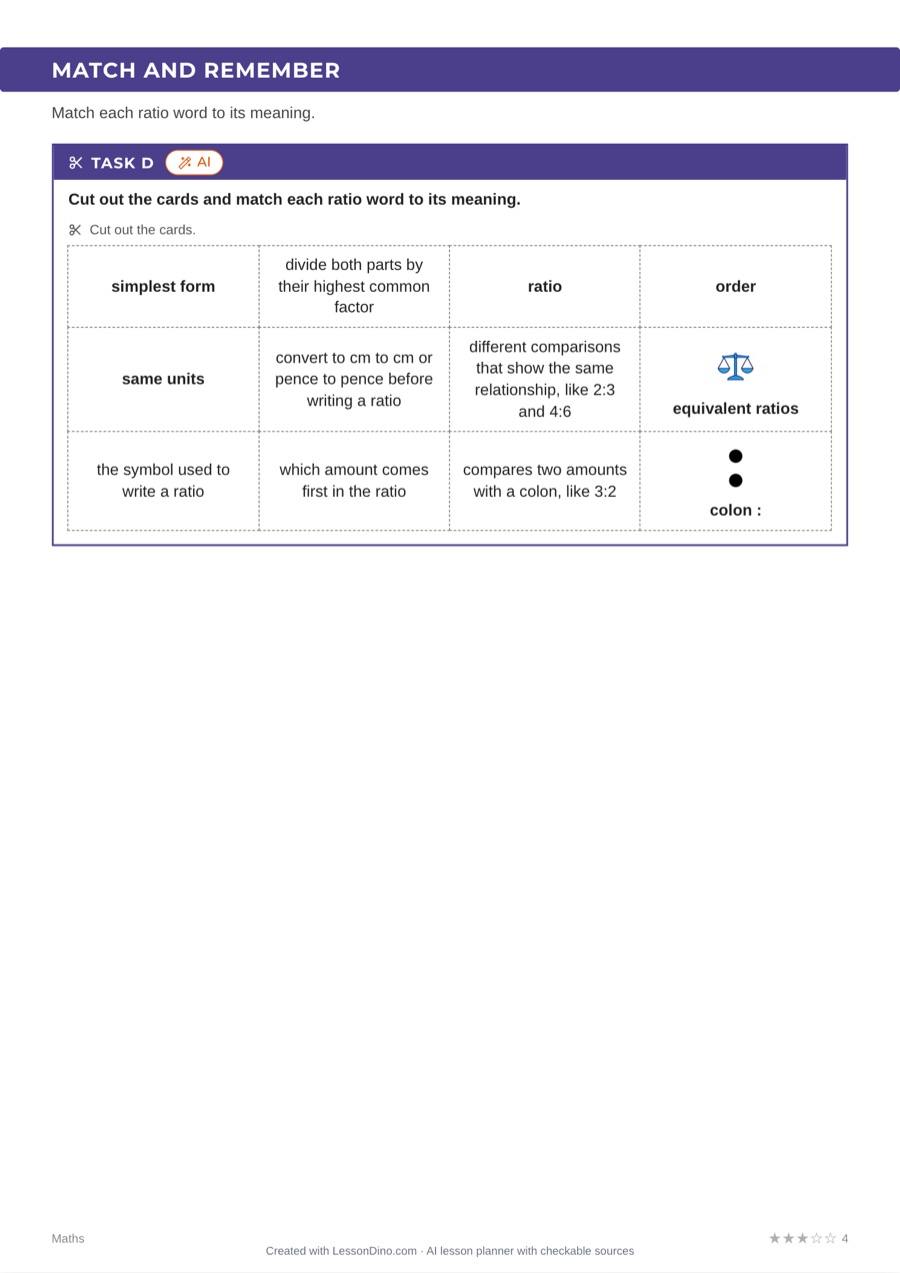
Match and Remember
Match each ratio word to its meaning.
Cut out the cards and match each ratio word to its meaning.
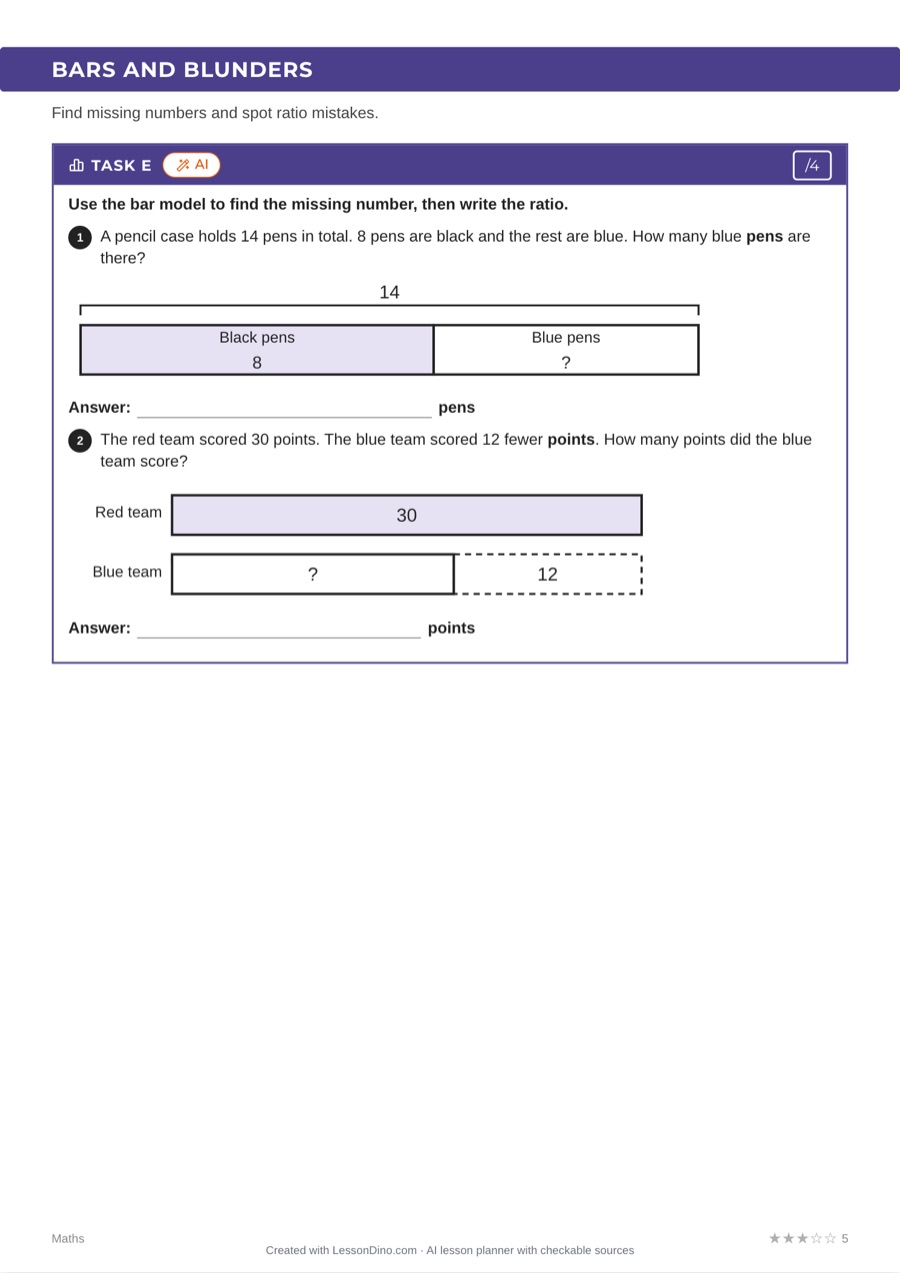
Bars and Blunders
Find missing numbers and spot ratio mistakes.
Use the bar model to find the missing number, then write the ratio.
Page 6
Spot the mistake in each statement and correct it.
Answers
Show the answers
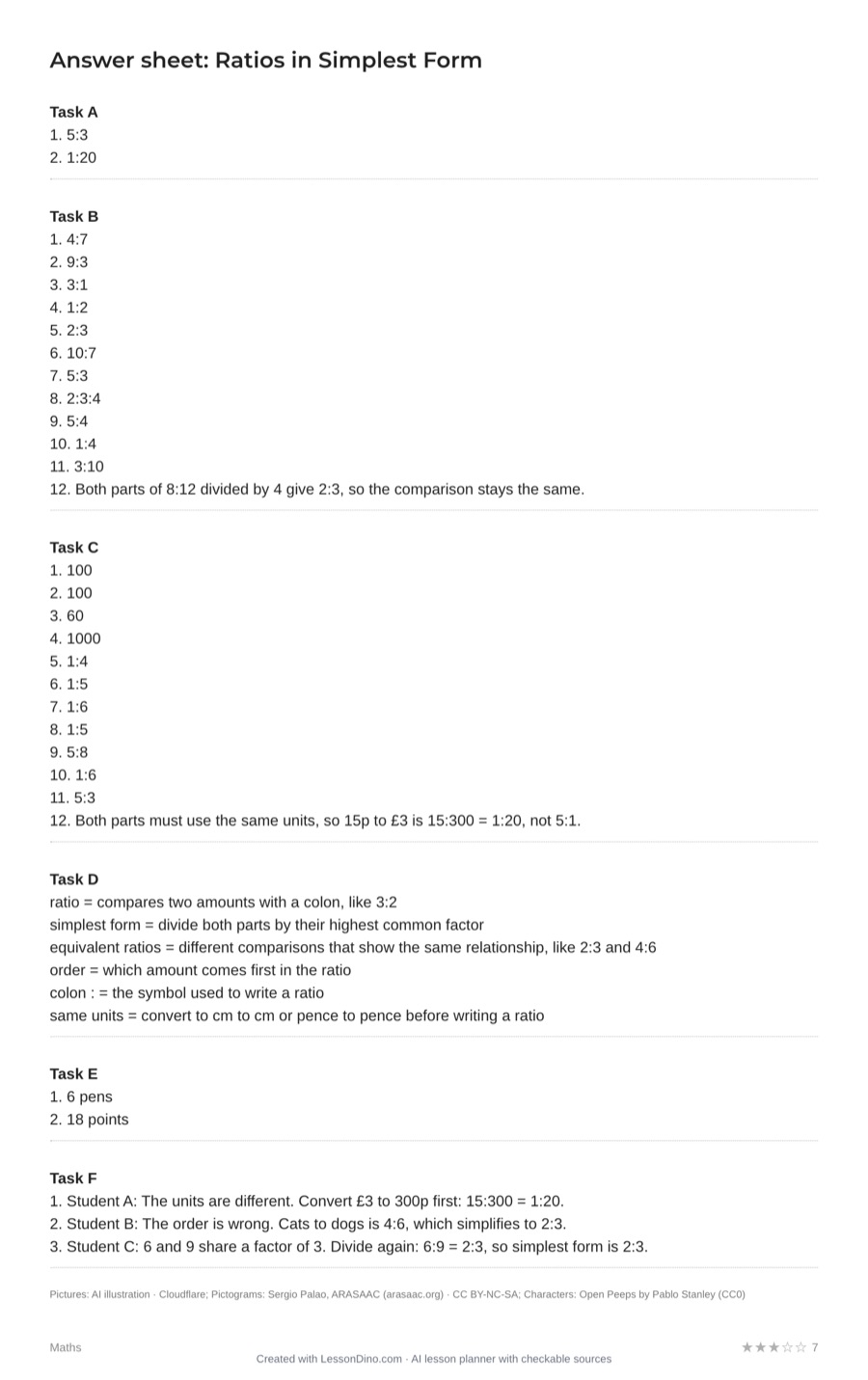
- There are 4 red beads and 7 blue beads. Write the ratio of red to blue. 4:7
- There are 9 pencils and 3 pens. Write the ratio of pencils to pens. 9:3
- Reduce the ratio 9:3 to simplest form. 3:1
- Reduce the ratio 10:20 to simplest form. 1:2
- Reduce the ratio 12:18 to simplest form. 2:3
- Reduce the ratio 40:28 to simplest form. 10:7
- Reduce the ratio 25:15 to simplest form. 5:3
- Reduce the ratio 6:9:12 to simplest form. 2:3:4
- There are 15 girls and 12 boys in a class. Write the ratio of girls to boys in simplest form. 5:4
- A squash mixes 100 ml orange with 400 ml water. Write the ratio of orange to water in simplest form. 1:4
- Write the ratio of 30 cm to 1 m in simplest form. 3:10
- Explain why 8:12 and 2:3 are equivalent ratios. Explain how you know. Both parts of 8:12 divided by 4 give 2:3, so the comparison stays the same.
- 1 m = ? cm. Give your answer in cm. 100
- £1 = ? pence. Give your answer in p. 100
- 1 hour = ? minutes. Give your answer in minutes. 60
- 1 kg = ? grams. Give your answer in g. 1000
- Write the ratio of 15p to 60p in simplest form. 1:4
- Write the ratio of 20 cm to 1 m in simplest form. 1:5
- Write the ratio of 10 minutes to 1 hour in simplest form. 1:6
- Write the ratio of 200 g to 1 kg in simplest form. 1:5
- A student has 75p and her partner has £1.20. Write the ratio of the student's money to her partner's money in simplest form. 5:8
- A squash uses 50 ml orange and 300 ml water. Write the ratio of orange to water in simplest form. 1:6
- There are 6 squares and 10 circles. Write the ratio of circles to squares in simplest form. 5:3
- Explain why you must change £3 to 300p before simplifying 15p to £3. Give the correct ratio. Both parts must use the same units, so 15p to £3 is 15:300 = 1:20, not 5:1.
The answer sheet is the last picture above.
Curriculum
use ratio notation, including reduction to simplest form
From National curriculum in England, Key Stage 3 mathematics.
Made with Lesson Dino's AI on 19 October 2026. AI can make mistakes, so check the answers and facts against the sources before you teach.