The worksheet
About this worksheet
Pupils learn that light travels in straight lines into the eye. They model and draw how luminous and non-luminous objects are seen. This Year 6 Science worksheet gives students (ages 10–11) six pages of practice on how we see things, part of the light unit. It goes with our free How we see things lesson, which has the slides and a timed lesson plan.
What it covers
By the end, students should be able to:
- Students will explain seeing as light travelling straight from source into eye.
- Students will compare luminous sources and non-luminous objects that reflect light to eye.
How to use it
- Plenary (15 minutes): Hand out Worksheet Task F and read the word bank aloud: straight, luminous, non-luminous, reflect, eyes, pupil; pairs fill gaps and say each sentence aloud.
- Support: Give a frame with the start drawn: torch to book to eye, so students only add straight lines with a ruler and the words reflects and enters, because light must enter our eyes for us to see it.
- Stretch: Add a mirror as the object and show how the straight path changes direction at the shiny surface but stays straight on each side.
- The answer sheet is the last page, so you can print it on its own or let students check their own work.
Key vocabulary
- luminous: makes and sends out its own light
- non-luminous: does not make its own light and is seen by bouncing back other light
- reflect: when light bounces off a surface
- pupil: hole at the front of the eye that lets light in
- retina: back surface inside the eye that senses light
Mistakes to watch for
- Thinking the Moon is luminous like a bulb. Remind that the Moon does not make its own light; draw Sun to Moon to eye because sunlight reflects off it.
- Drawing rays leaving the eye to the object. Rehearse that light must enter our eyes to see; flip arrows to enter the pupil to the retina.
- Drawing curved or zig-zag rays or thinking only mirrors reflect. Insist on ruler-straight lines and that all surfaces reflect light, dull ones by scattering.
What's on the worksheet
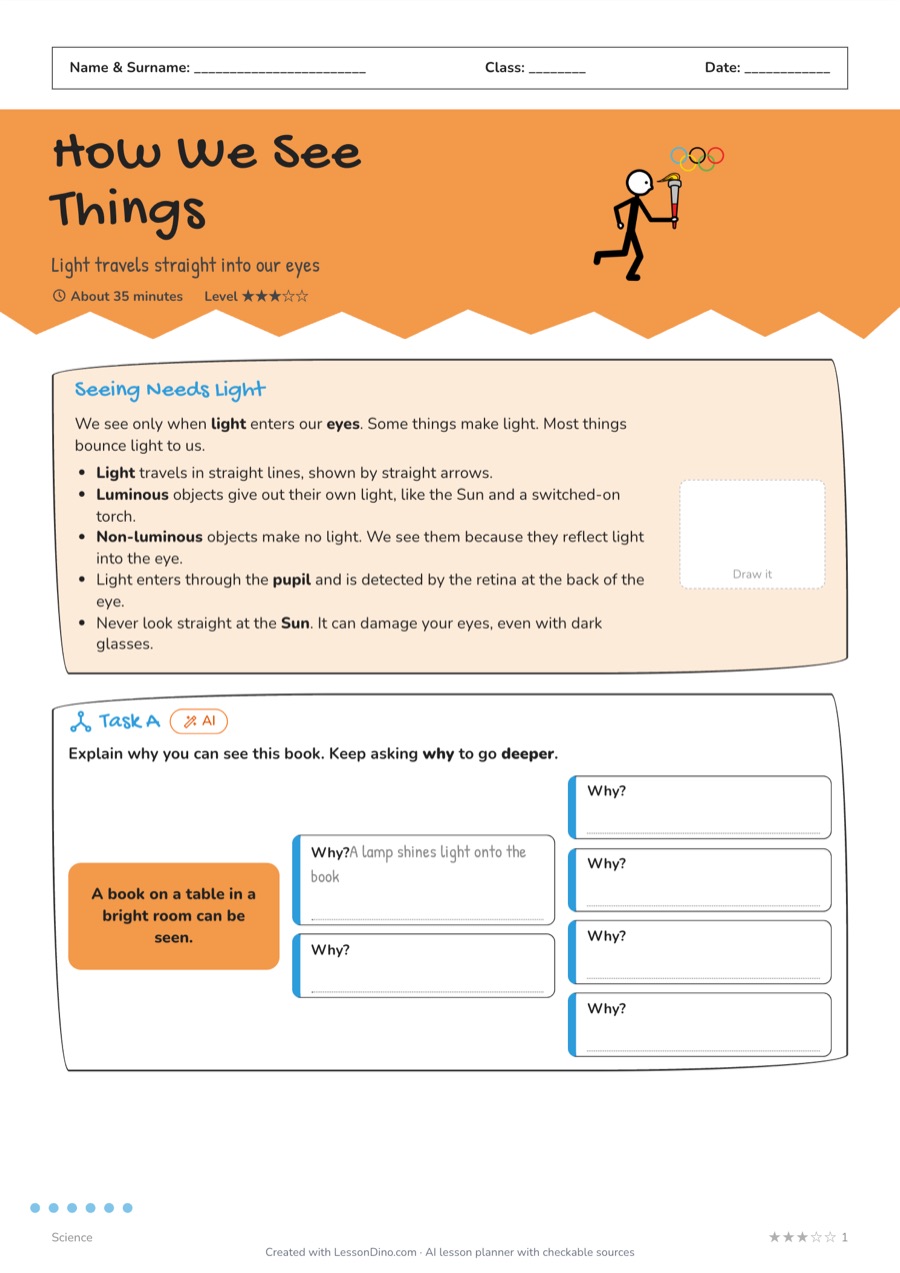
Light Into Eyes
Learn the two ways light gets into our eyes.
Seeing Needs Light
- We see only when light enters our eyes. Some things make light. Most things bounce light to us.
- Light travels in straight lines, shown by straight arrows.
- Luminous objects give out their own light, like the Sun and a switched-on torch.
- Non-luminous objects make no light. We see them because they reflect light into the eye.
- Light enters through the pupil and is detected by the retina at the back of the eye.
- Never look straight at the Sun. It can damage your eyes, even with dark glasses.
Explain why you can see this book. Keep asking why to go deeper.
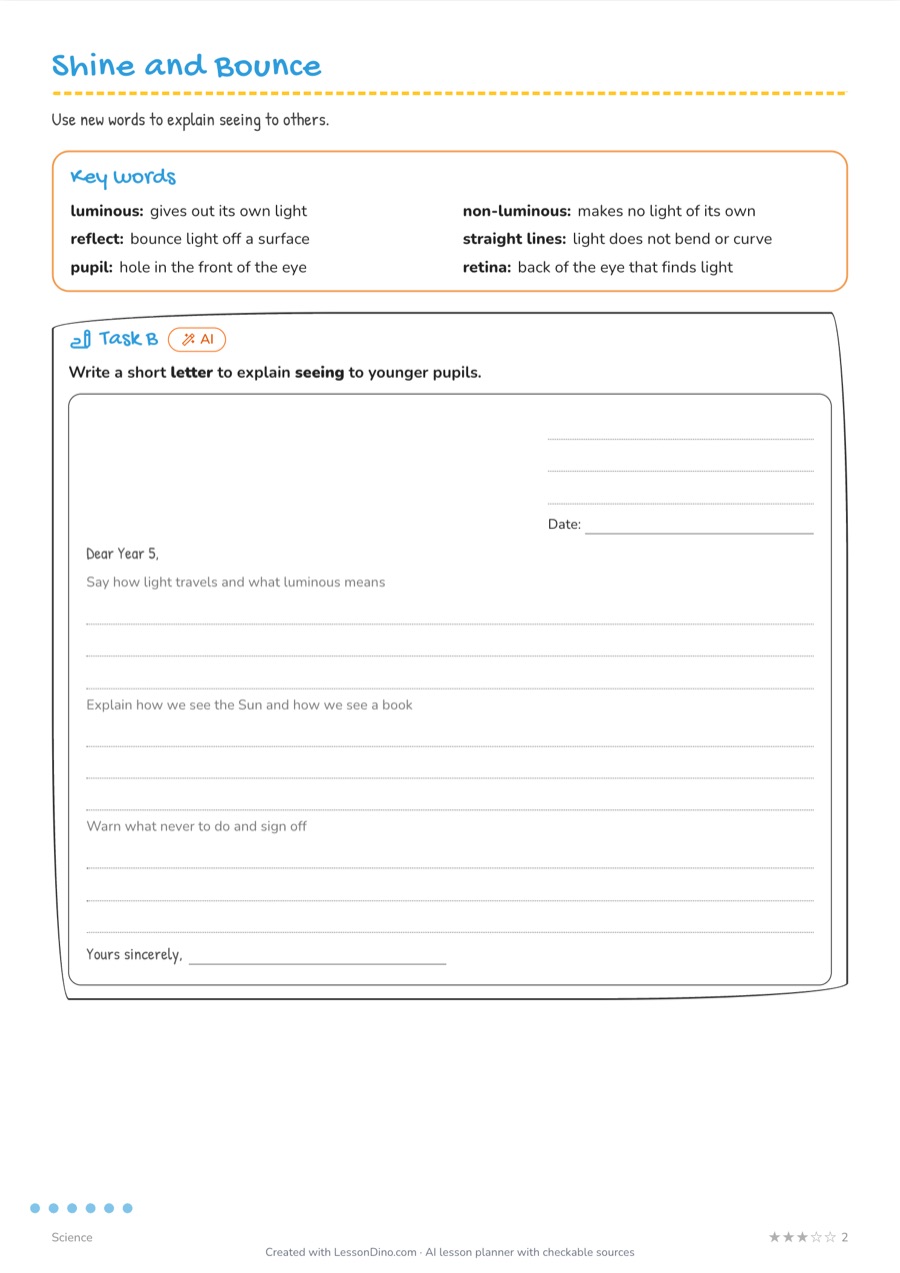
Shine and Bounce
Use new words to explain seeing to others.
| Word | Meaning |
|---|---|
| luminous | gives out its own light |
| non-luminous | makes no light of its own |
| reflect | bounce light off a surface |
| straight lines | light does not bend or curve |
| pupil | hole in the front of the eye |
| retina | back of the eye that finds light |
Write a short letter to explain seeing to younger pupils.
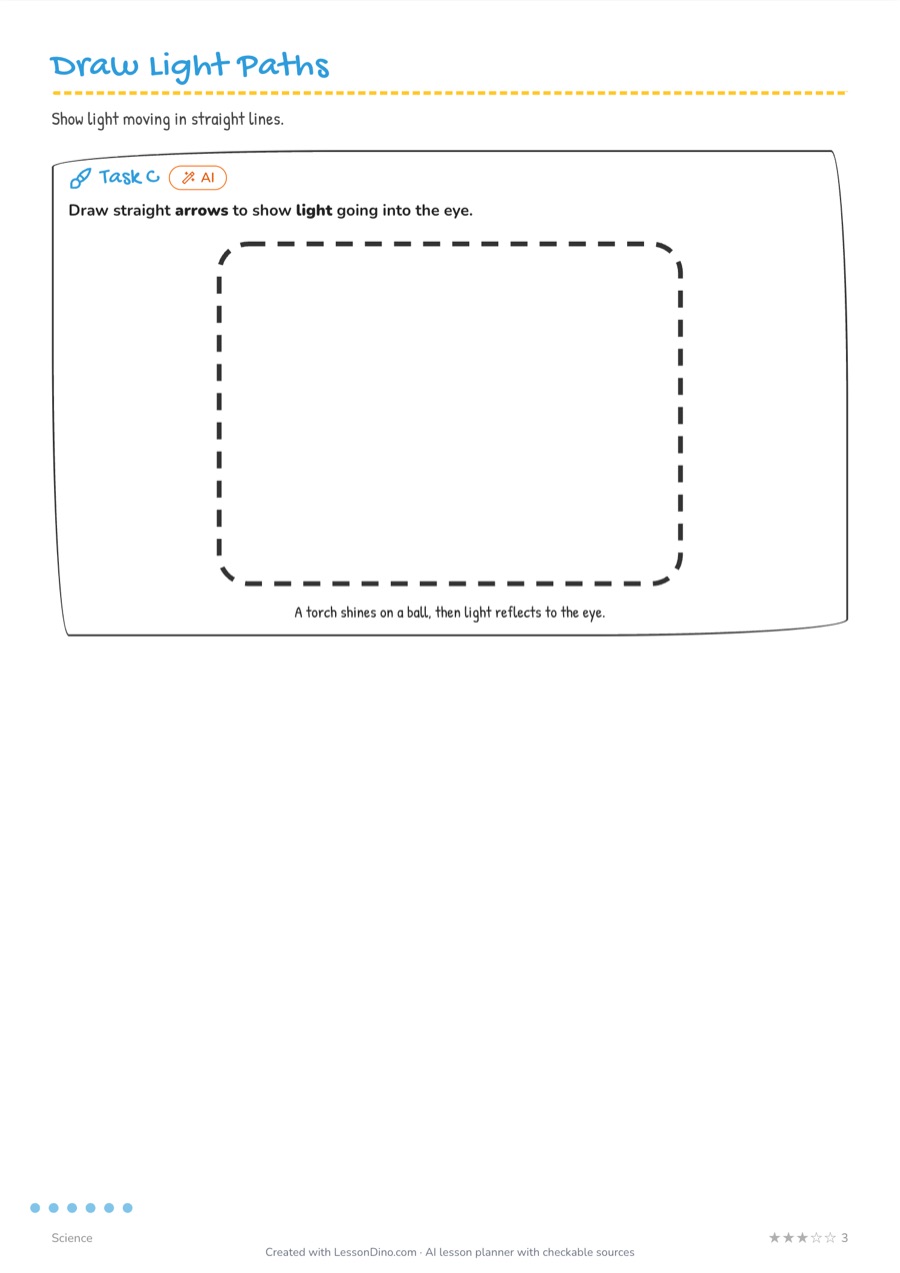
Draw Light Paths
Show light moving in straight lines.
Draw straight arrows to show light going into the eye.
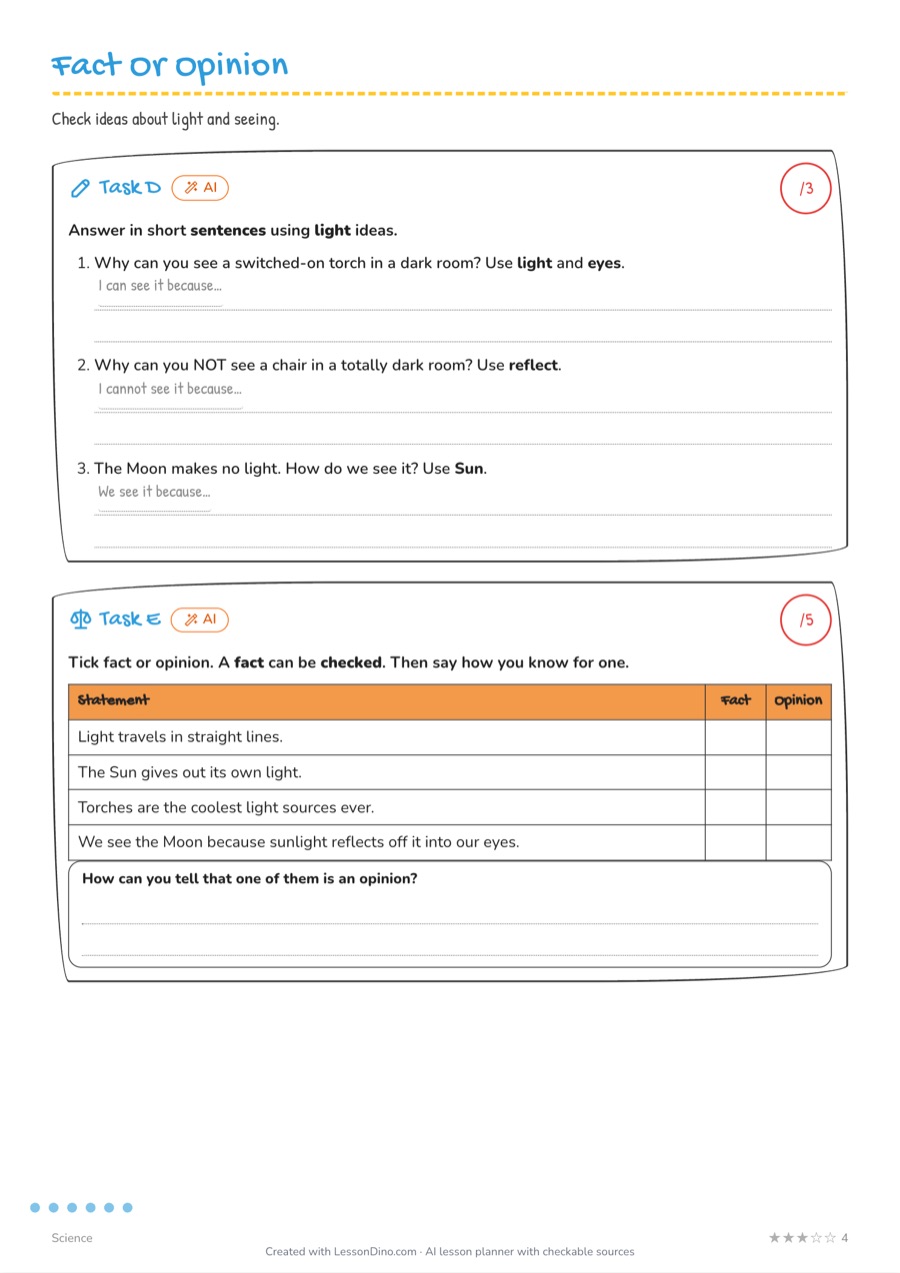
Fact Or Opinion
Check ideas about light and seeing.
Answer in short sentences using light ideas.
- Why can you see a switched-on torch in a dark room? Use light and eyes.
- Why can you NOT see a chair in a totally dark room? Use reflect.
- The Moon makes no light. How do we see it? Use Sun.
Tick fact or opinion. A fact can be checked. Then say how you know for one.
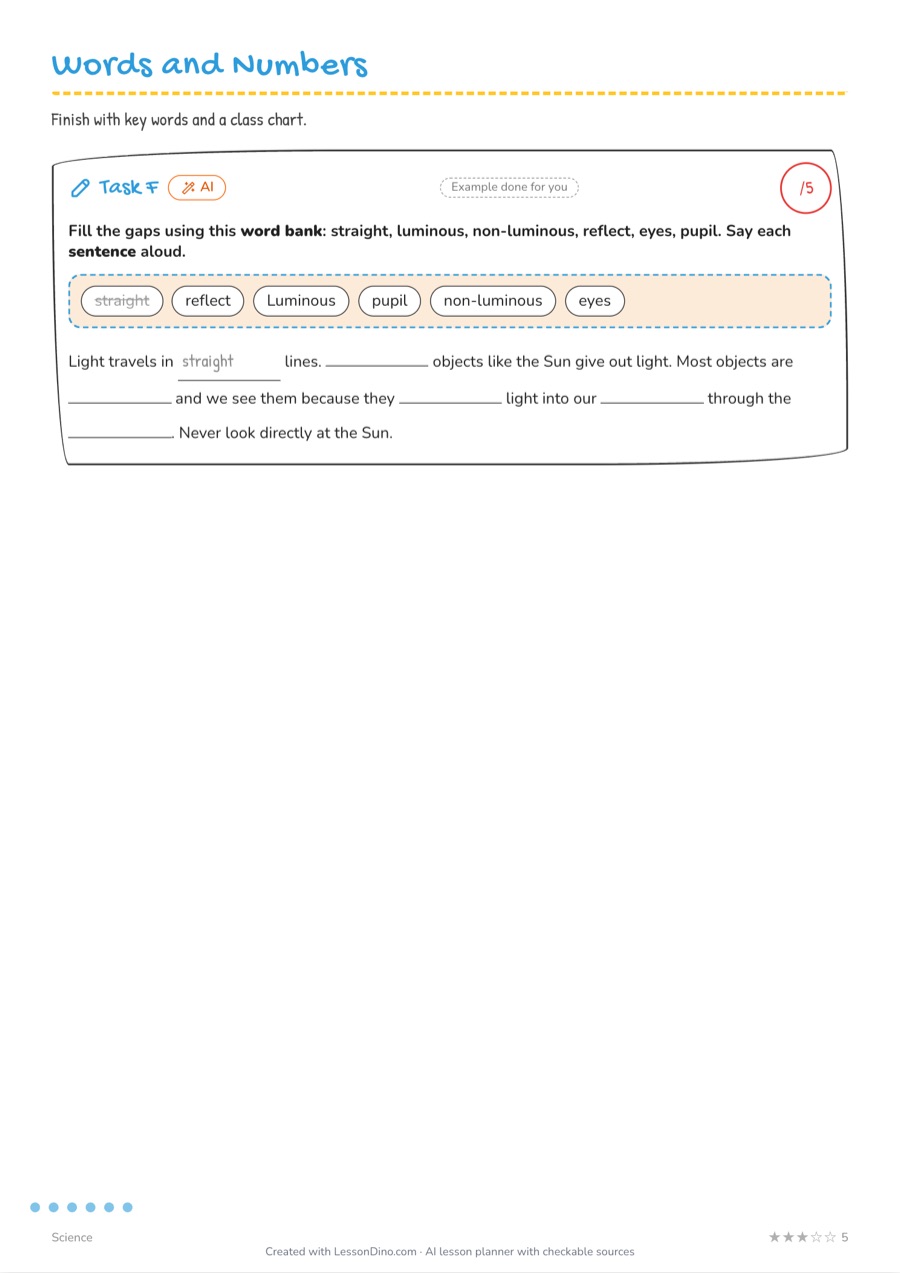
Words and Numbers
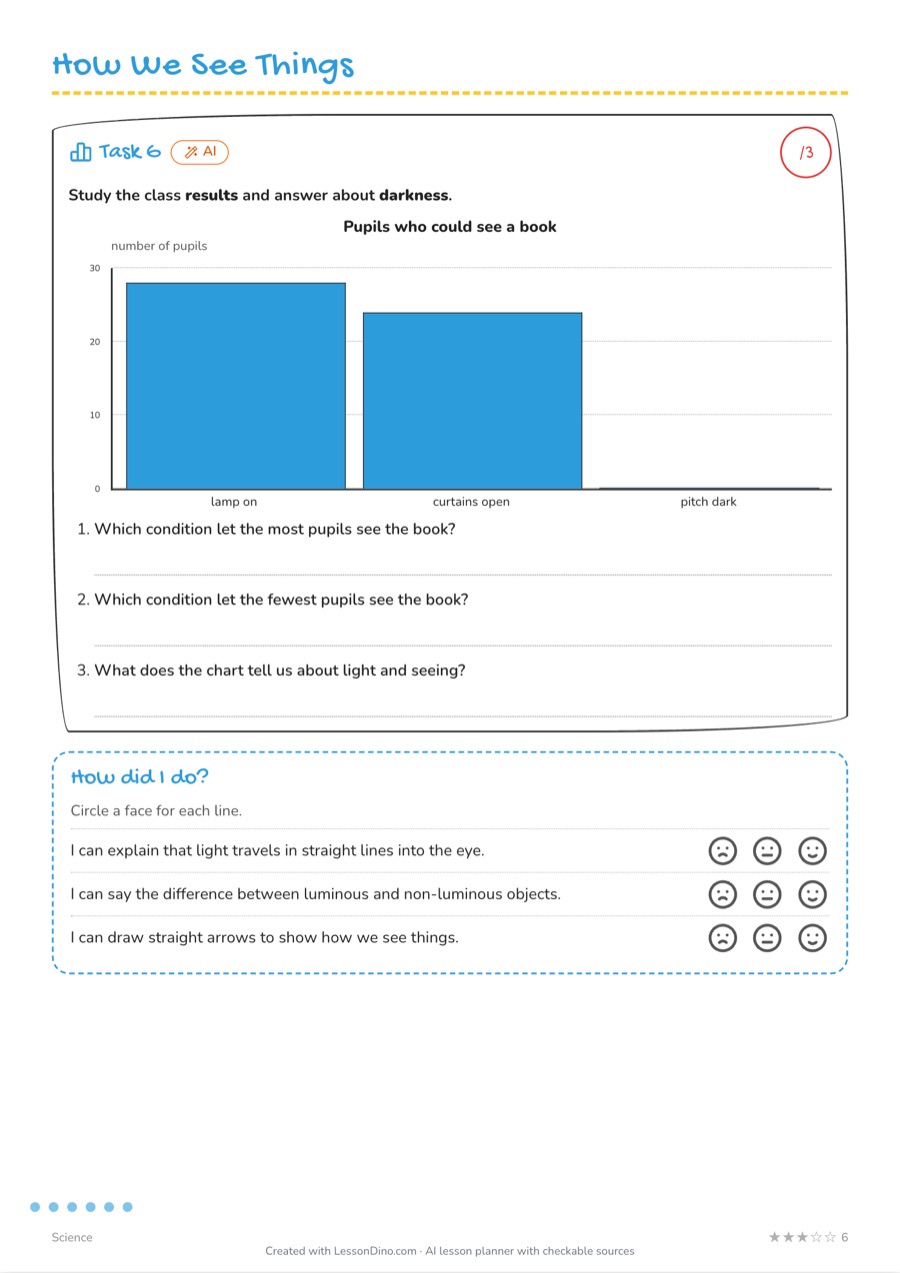
Finish with key words and a class chart.
Fill the gaps using this word bank: straight, luminous, non-luminous, reflect, eyes, pupil. Say each sentence aloud.
- Light travels in [[straight]] lines. [[Luminous]] objects like the Sun give out light. Most objects are [[non-luminous]] and we see them because they [[reflect]] light into our [[eyes]] through the [[pupil]]. Never look directly at the Sun.
Page 6
Study the class results and answer about darkness.
- Which condition let the most pupils see the book?
- Which condition let the fewest pupils see the book?
- What does the chart tell us about light and seeing?
Answers
Show the answers
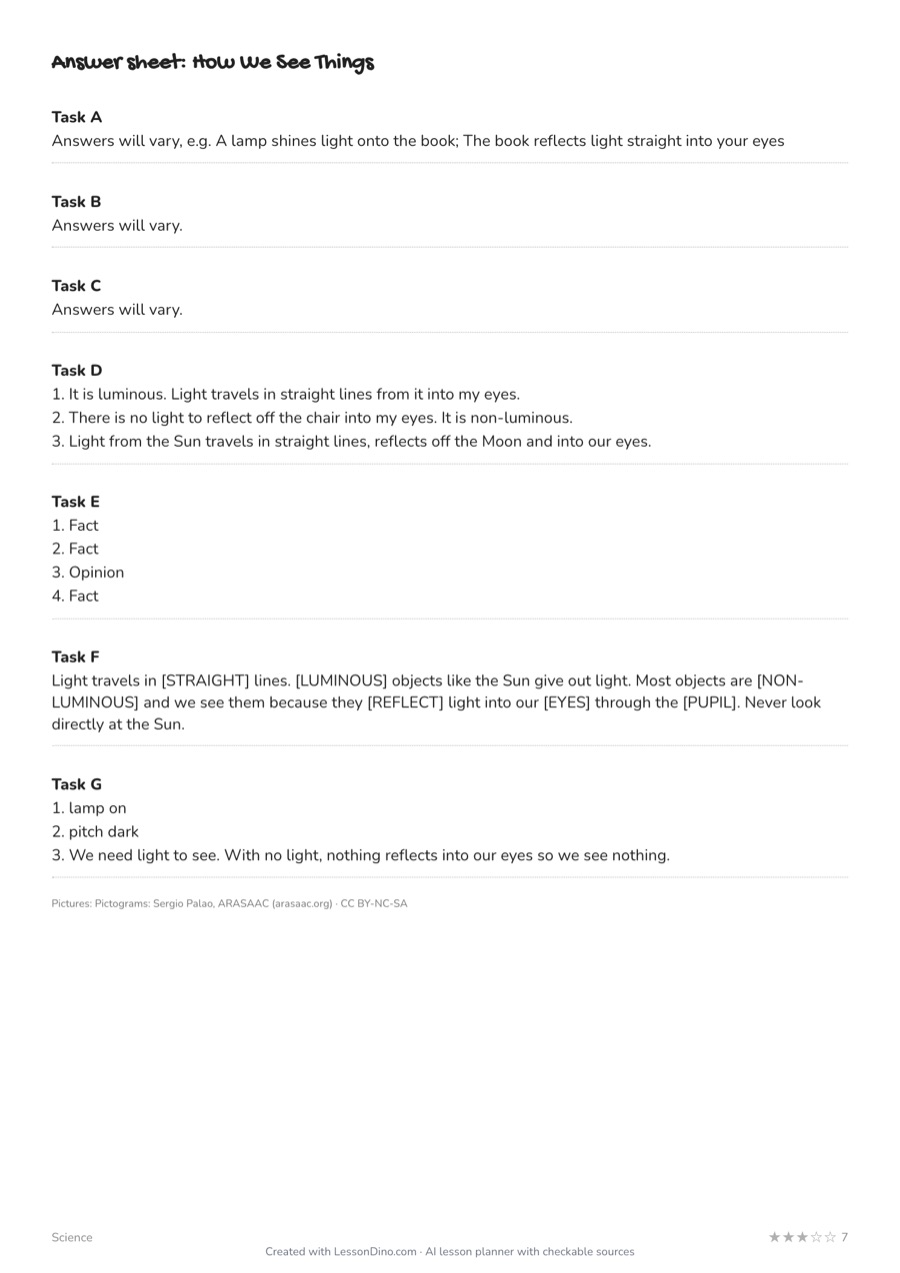
- Why can you see a switched-on torch in a dark room? Use light and eyes. It is luminous. Light travels in straight lines from it into my eyes.
- Why can you NOT see a chair in a totally dark room? Use reflect. There is no light to reflect off the chair into my eyes. It is non-luminous.
- The Moon makes no light. How do we see it? Use Sun. Light from the Sun travels in straight lines, reflects off the Moon and into our eyes.
- Which condition let the most pupils see the book? lamp on
- Which condition let the fewest pupils see the book? pitch dark
- What does the chart tell us about light and seeing? We need light to see. With no light, nothing reflects into our eyes so we see nothing.
The answer sheet is the last picture above.
Curriculum
use the idea that light travels in straight lines to explain that objects are seen because they give out or reflect light into the eye
Made with Lesson Dino's AI on 17 October 2026. AI can make mistakes, so check the answers and facts against the sources before you teach.