The worksheet
About this worksheet
Students learn how scientists group living things by what can be observed. They sort picture cards into five kingdoms and explain their choices. This Year 6 Science worksheet gives students (ages 10–11) five pages of practice on classifying living things, part of the living things and their habitats unit. It goes with our free Classifying living things lesson, which has the slides and a timed lesson plan.
What it covers
By the end, students should be able to:
- Students will sort living things into broad groups using observable characteristics.
- Students will give reasons for plant and animal groups using specific characteristics.
- Students will describe micro-organisms as tiny living things seen with a microscope.
How to use it
- Use it for practice after the teaching part of the lesson, once students have seen the worked examples on the slides.
- Support: Give a pre-sorted example tray with a mushroom labelled as fungi, not a plant, because fungi cannot make their own food.
- Stretch: Students add a sub-label, such as vertebrate or flowering plant, to two cards they are sure about.
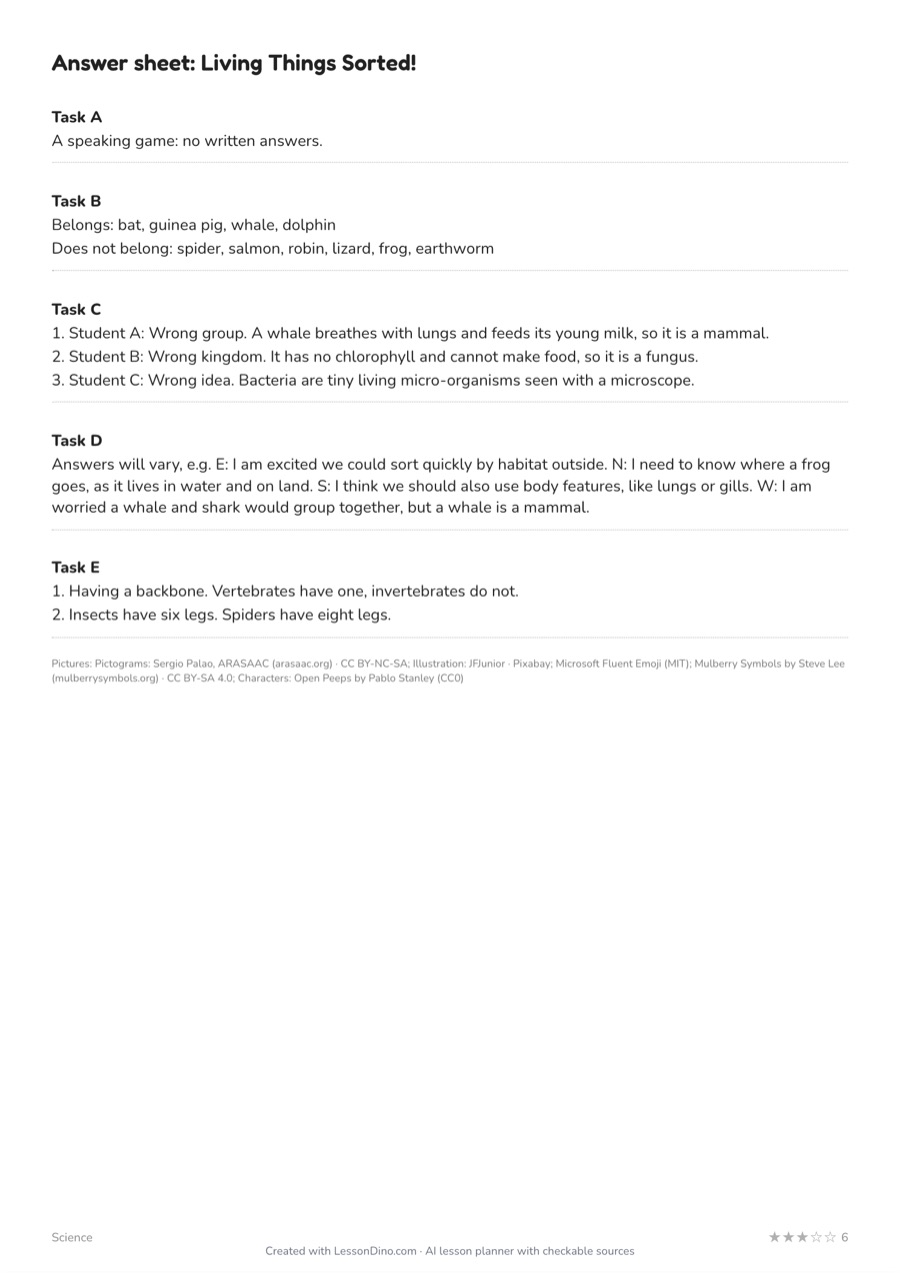
- The answer sheet is the last page, so you can print it on its own or let students check their own work.
Key vocabulary
- classify: to put things into groups by what you can see
- characteristic: something you can notice about a living thing, like leaves or legs
- vertebrate: an animal with a backbone inside its body
- invertebrate: an animal without a backbone inside its body
- micro-organism: a very tiny living thing that can only be seen using a microscope
- fungi: living things like mushrooms and mould that cannot make their own food
Mistakes to watch for
- Thinking a mushroom or mould is a plant because it grows in soil. Test for green chlorophyll and food making: fungi cannot make their own food and reproduce from microscopic spores. Move to fungi.
- Thinking a whale is a fish because it lives in the sea. Compare breathing and young: whale uses lungs and milk for mammals, fish use gills underwater.
- Thinking spiders are insects because they are small with legs. Count legs: insects have six legs, spiders have eight and are not insects. Both are invertebrates.
What's on the worksheet
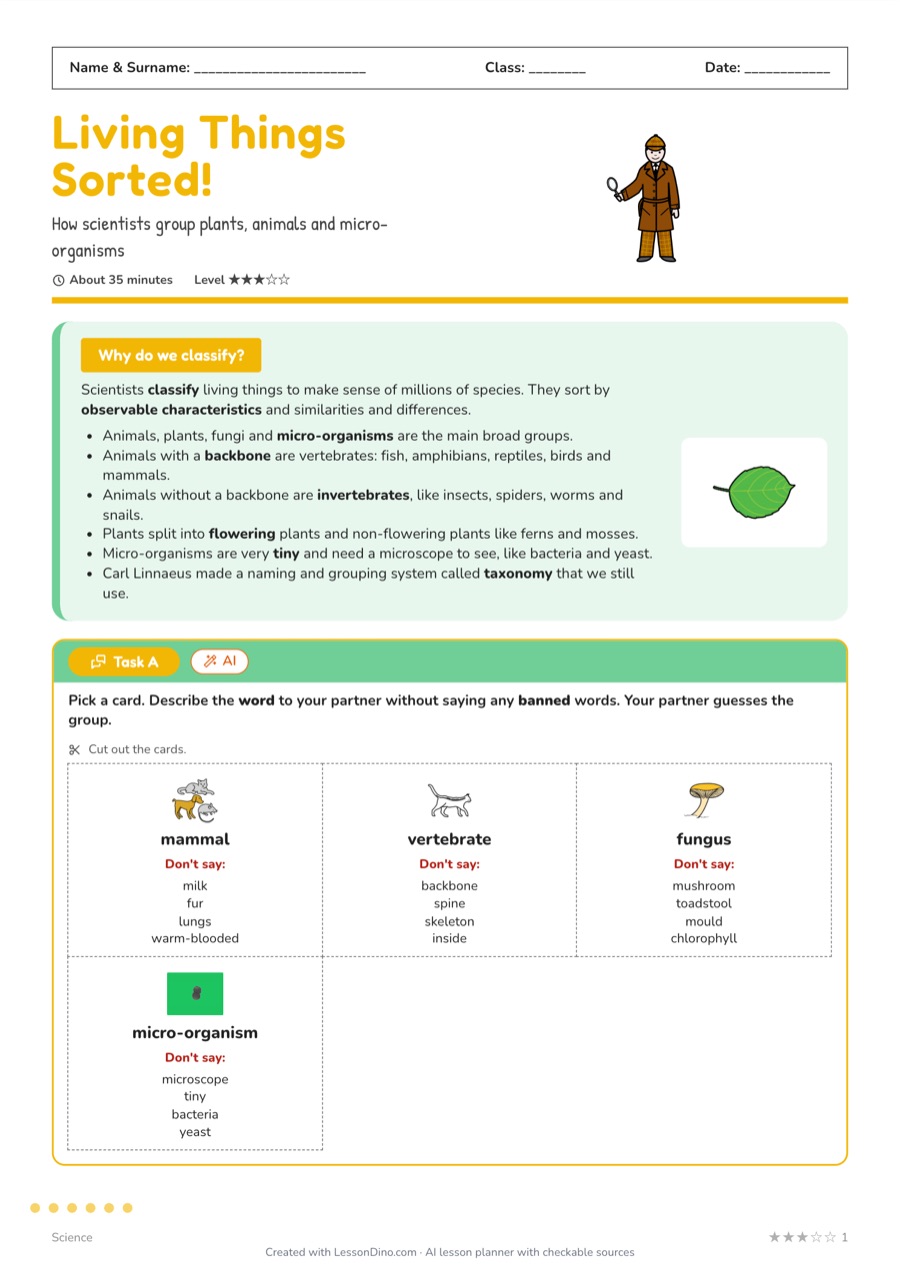
Sorting Living Things
Learn how scientists group living things.
Why do we classify?
- Scientists classify living things to make sense of millions of species. They sort by observable characteristics and similarities and differences.
- Animals, plants, fungi and micro-organisms are the main broad groups.
- Animals with a backbone are vertebrates: fish, amphibians, reptiles, birds and mammals.
- Animals without a backbone are invertebrates, like insects, spiders, worms and snails.
- Plants split into flowering plants and non-flowering plants like ferns and mosses.
- Micro-organisms are very tiny and need a microscope to see, like bacteria and yeast.
- Carl Linnaeus made a naming and grouping system called taxonomy that we still use.
Pick a card. Describe the word to your partner without saying any banned words. Your partner guesses the group.
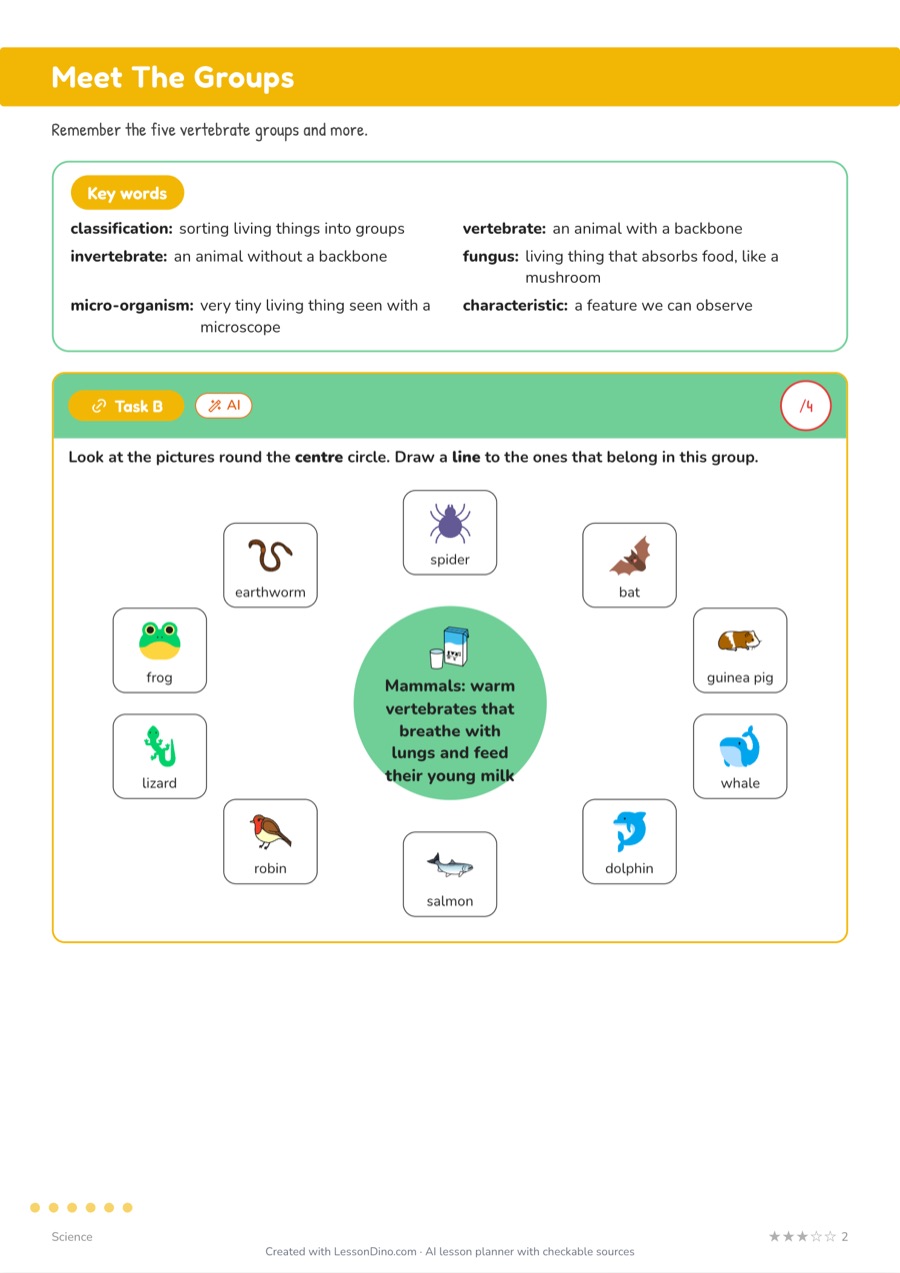
Meet The Groups
Remember the five vertebrate groups and more.
| Word | Meaning |
|---|---|
| classification | sorting living things into groups |
| vertebrate | an animal with a backbone |
| invertebrate | an animal without a backbone |
| fungus | living thing that absorbs food, like a mushroom |
| micro-organism | very tiny living thing seen with a microscope |
| characteristic | a feature we can observe |
Look at the pictures round the centre circle. Draw a line to the ones that belong in this group.
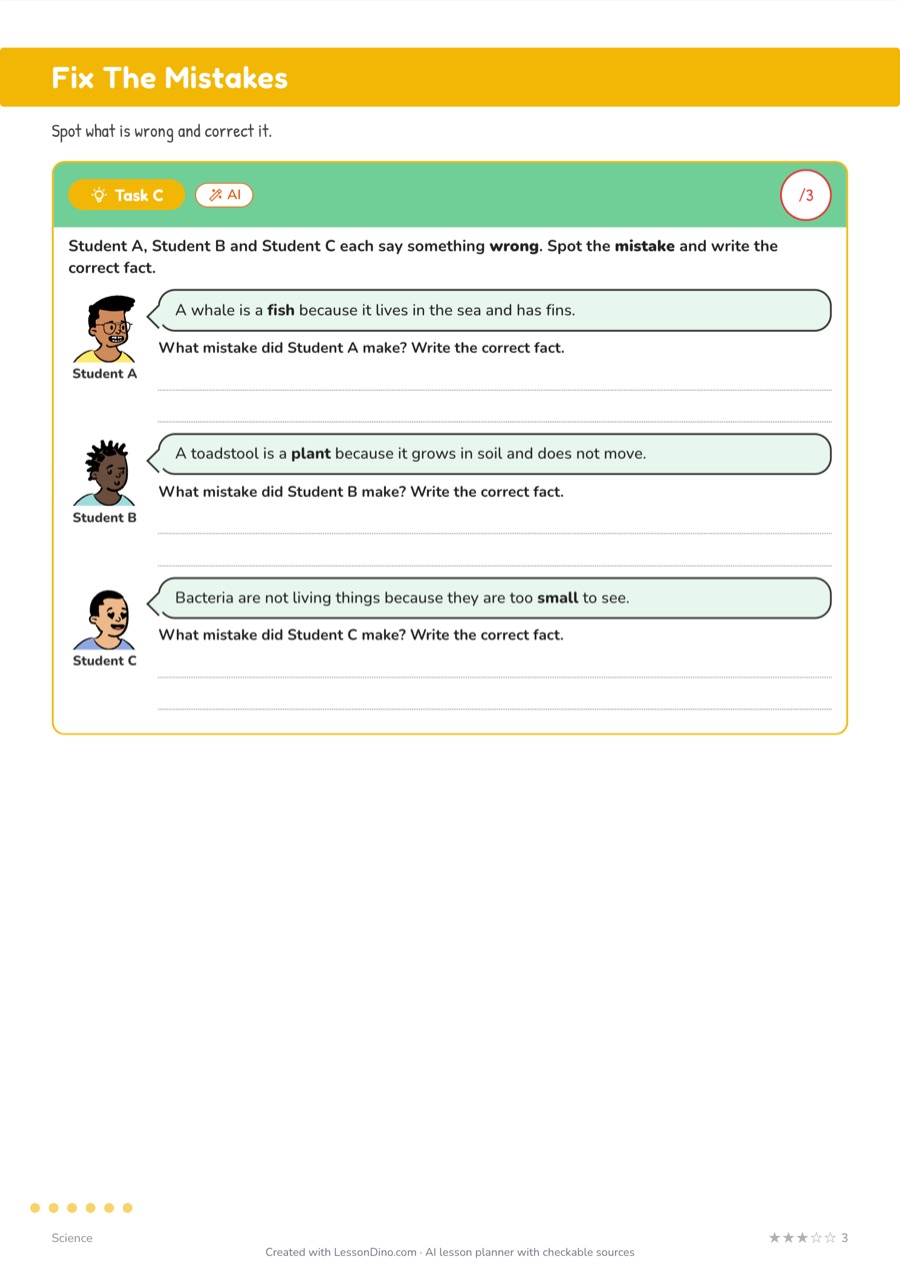
Fix The Mistakes
Spot what is wrong and correct it.
Student A, Student B and Student C each say something wrong. Spot the mistake and write the correct fact.
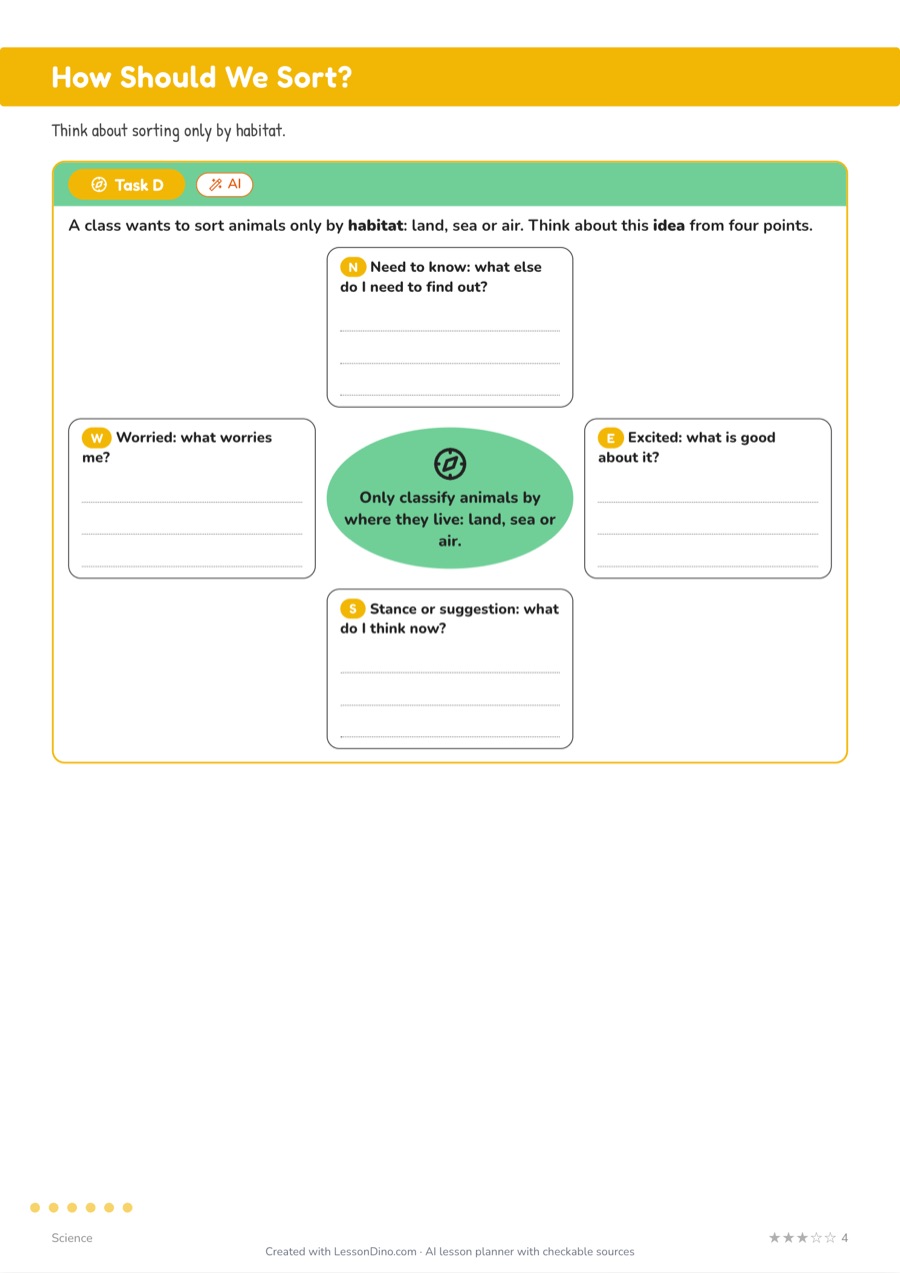
How Should We Sort?
Think about sorting only by habitat.
A class wants to sort animals only by habitat: land, sea or air. Think about this idea from four points.
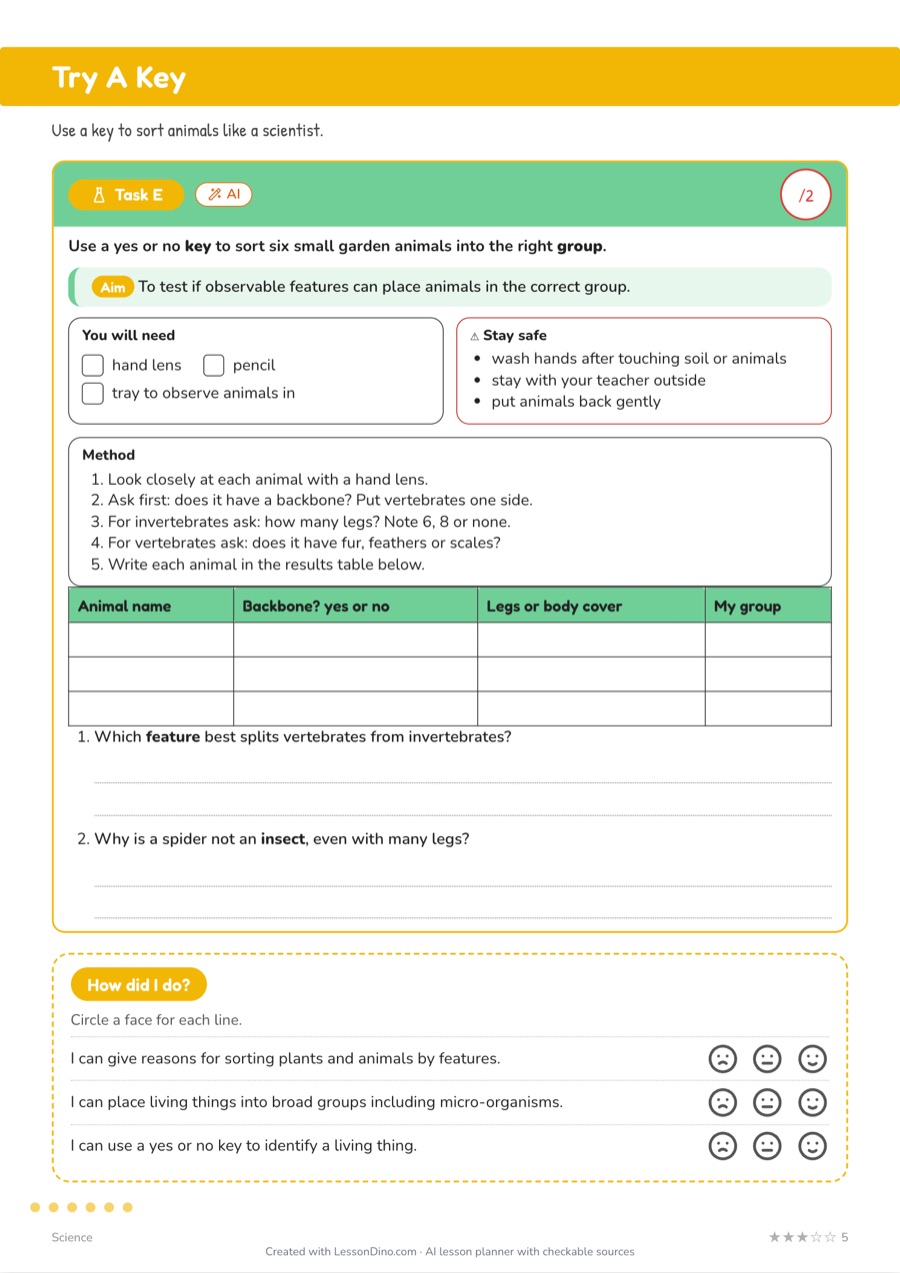
Try A Key
Use a key to sort animals like a scientist.
Use a yes or no key to sort six small garden animals into the right group.
- Which feature best splits vertebrates from invertebrates?
- Why is a spider not an insect, even with many legs?
Answers
Show the answers
- Which feature best splits vertebrates from invertebrates? Having a backbone. Vertebrates have one, invertebrates do not.
- Why is a spider not an insect, even with many legs? Insects have six legs. Spiders have eight legs.
The answer sheet is the last picture above.
Curriculum
describe how living things are classified into broad groups according to common observable characteristics and based on similarities and differences, including micro-organisms, plants and animals
Made with Lesson Dino's AI on 17 October 2026. AI can make mistakes, so check the answers and facts against the sources before you teach.