Slides
Lesson plan
Sorting the Living World
Students learn how scientists group living things by what can be observed. They sort picture cards into five kingdoms and explain their choices.
Objectives
- Students will sort living things into broad groups using observable characteristics.
- Students will give reasons for plant and animal groups using specific characteristics.
- Students will describe micro-organisms as tiny living things seen with a microscope.
Success criteria
- I can place living things into five kingdoms by similarities and differences.
- I can explain why an animal or plant belongs in its group.
- I can describe what micro-organisms are and where they are found.
Key words
| Word | Meaning |
|---|---|
| classify | to put things into groups by what you can see |
| characteristic | something you can notice about a living thing, like leaves or legs |
| vertebrate | an animal with a backbone inside its body |
| invertebrate | an animal without a backbone inside its body |
| micro-organism | a very tiny living thing that can only be seen using a microscope |
| fungi | living things like mushrooms and mould that cannot make their own food |
Timed plan (60 minutes)
| Time | Stage | What happens |
|---|---|---|
| 8 min | Starter | To hook students and recall that living things can be grouped in different ways. Show Slide 1 Sorting the Living World and read the title. Say the hook and place one mixed pile of picture cards on each table but tell students not to touch yet. Show Slide 2 Think, pair, share and give 2 minutes for pairs to discuss how they would sort 30 new living things. Take three quick ideas and link them to sorting by similarities and differences. |
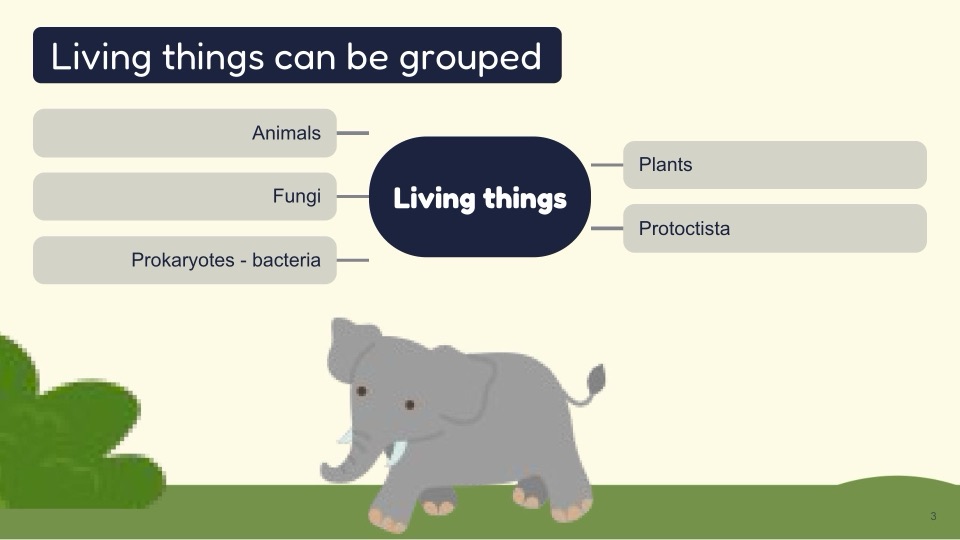
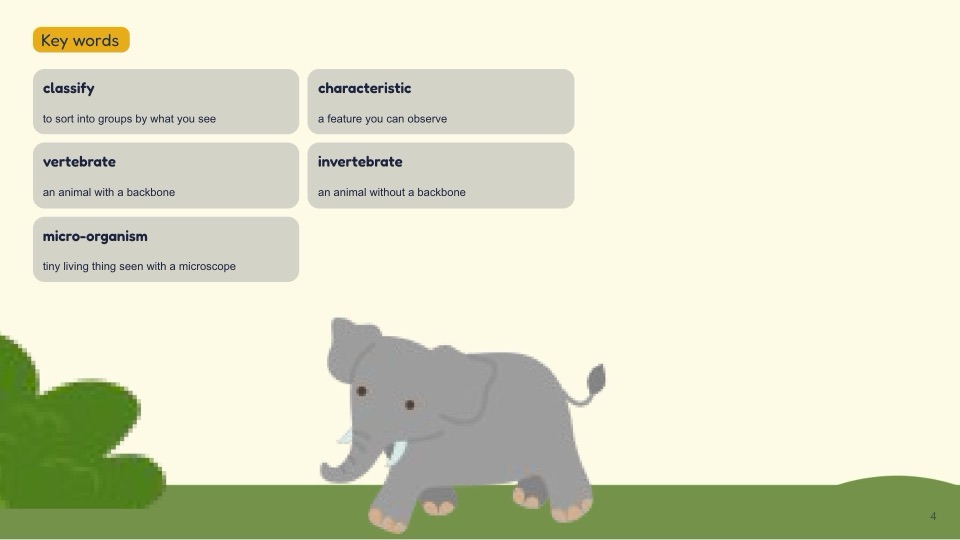
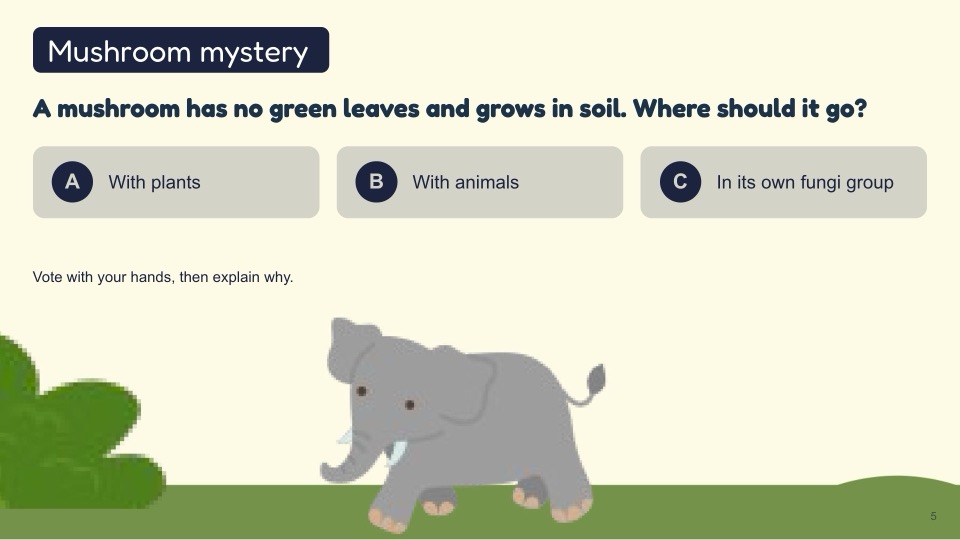
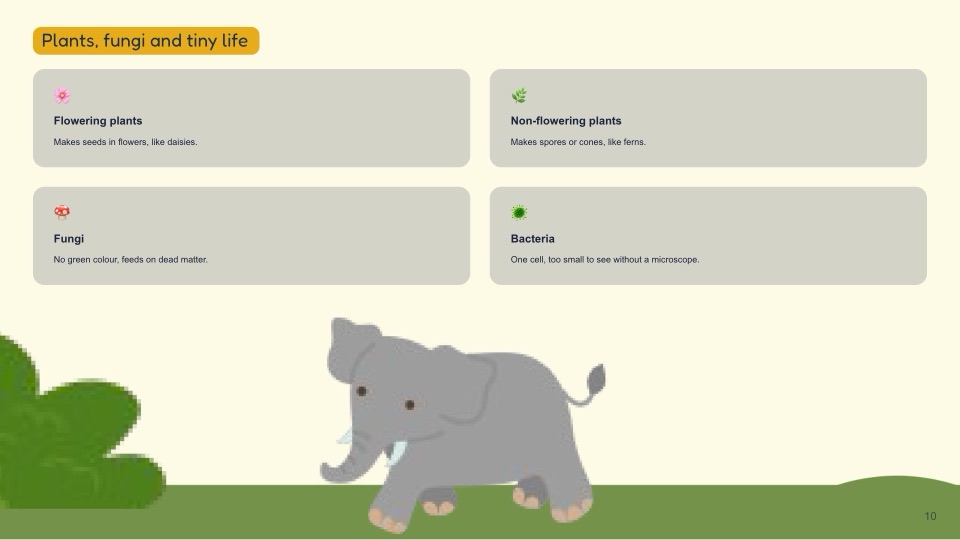
| 12 min | Teaching | To teach the five kingdoms and how observable features place a living thing. Show Slide 4 Key words and teach classify, characteristic, vertebrate and invertebrate. Show Slide 3 mindmap with Living things, Animals, Plants, Fungi, Protoctista, Prokaryotes - bacteria and explain UK scientists use five kingdoms: Animals, Plants, Fungi, Protoctista, and Prokaryota/Monera. Show Slide 5 Mushroom mystery vote and take a class vote for With plants, With animals or In its own fungi group. Model the answer using green colour and food clues, then note that many living things in the last three kingdoms are micro-organisms (tiny, seen with a microscope), though fungi such as mushrooms are not. |
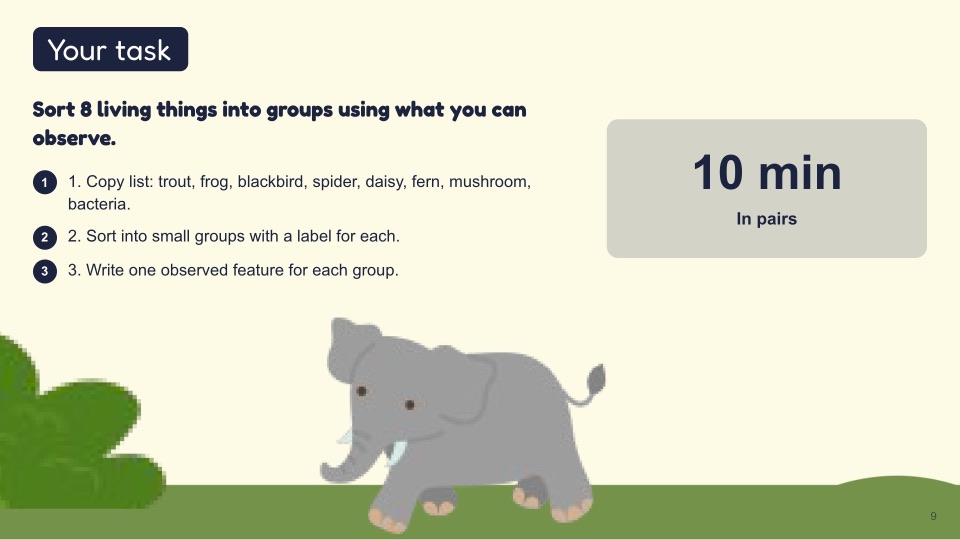
| 25 min | Main activity | To sort eight living things into broad groups using observable characteristics. Show Slide 9 Your task and read the list: trout, frog, blackbird, spider, daisy, fern, mushroom, bacteria. Give each group trays labelled for the five kingdoms and a set of picture cards, with one pre-sorted example tray showing mushroom as fungi. Model sorting trout: animal, has backbone so vertebrate, lives in water and breathes with gills so fish. Time 15 minutes for sorting, then hear one card per tray from each group with the similarity that put it there. |
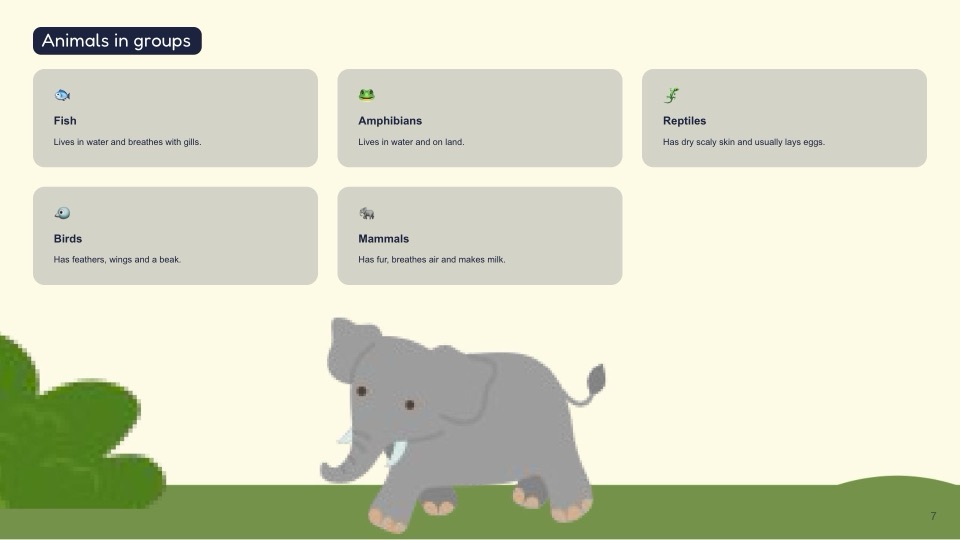
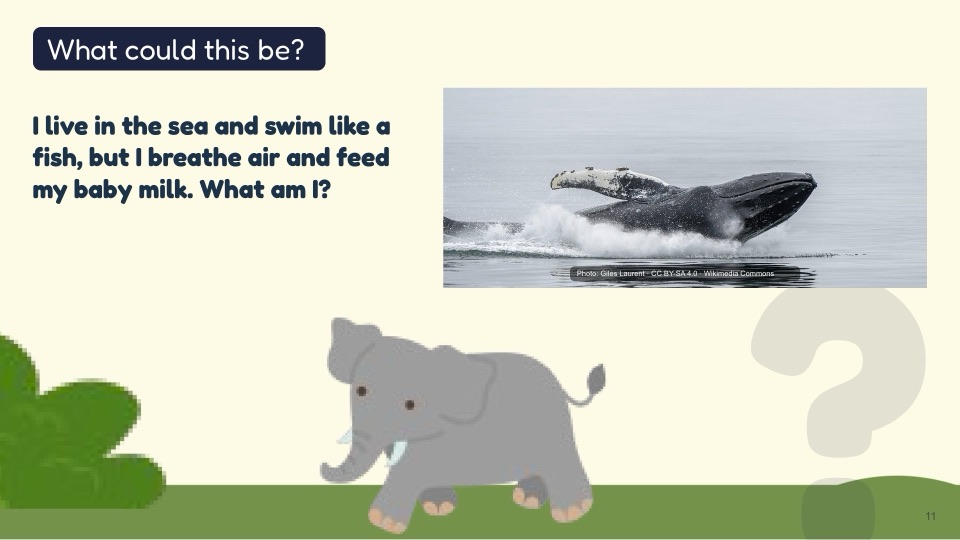
| 8 min | Teaching | To give reasons for groups using characteristics, not where an animal lives. Show Slide 11 What could this be? and read: I live in the sea and swim like a fish, but I breathe air and feed my baby milk. What am I? Show Slide 7 Animals in groups cards and compare fish that breathe underwater with gills with mammals. Explain grouping by water, air and land would wrongly put birds, bees and bats in the same group. |
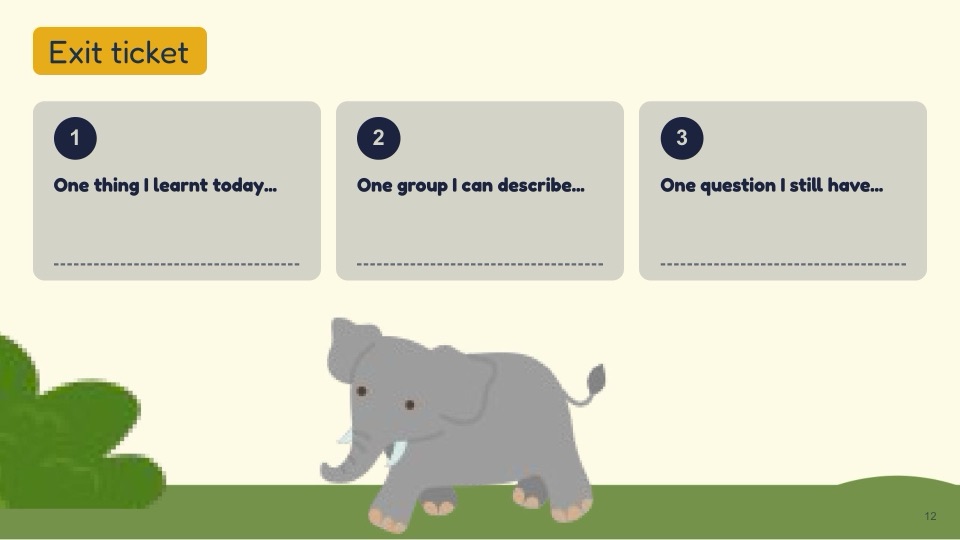
| 7 min | Plenary | To check what students can now describe and what is still unclear. Return to the five trays and ask each table to state one similarity for one kingdom. Show Slide 12 Exit ticket with One thing I learnt today, One group I can describe, One question I still have. Collect answers and praise use of observable characteristics and similarities and differences. |
Common mistakes
- Thinking a mushroom or mould is a plant because it grows in soil.
How to spot it: Plants tray contains mushroom card.
Test for green chlorophyll and food making: fungi cannot make their own food and reproduce from microscopic spores. Move to fungi. - Thinking a whale is a fish because it lives in the sea.
How to spot it: Whale placed with fish or reason says lives in water.
Compare breathing and young: whale uses lungs and milk for mammals, fish use gills underwater. - Thinking spiders are insects because they are small with legs.
How to spot it: Spider sorted as insect without counting legs.
Count legs: insects have six legs, spiders have eight and are not insects. Both are invertebrates.
Support
- Give a pre-sorted example tray with a mushroom labelled as fungi, not a plant, because fungi cannot make their own food.
Stretch
- Students add a sub-label, such as vertebrate or flowering plant, to two cards they are sure about.
Check questions
- Name the five kingdoms and one example in each.
Answer: Animals, plants, fungi, Protoctista and Prokaryota/Monera; e.g. blackbird, daisy, mushroom, pond microbe, bacteria. - A whale lives in the sea. Why is it a mammal not a fish?
Answer: Because it breathes air with lungs and feeds its young milk; fish breathe with gills. - What is a micro-organism and how do we see one?
Answer: A very tiny living thing such as bacteria and yeast that can only be seen using a microscope.
Curriculum
describe how living things are classified into broad groups according to common observable characteristics and based on similarities and differences, including micro-organisms, plants and animals
Video clips
Clips on YouTube, from the start and end times we chose. Check each one before you show it.
-
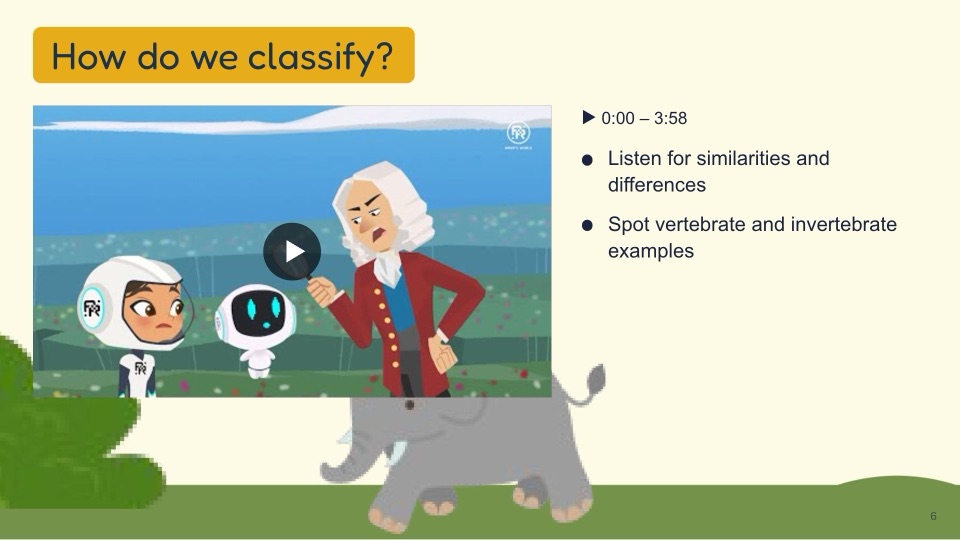
How to classify living things from 0:00 to 3:58
Argo's World - Official Channel: How to CLASSIFY Living Things? - Argo's World | Diversity | STEM for Kids and Teens (Science)
Directly teaches grouping by observable similarities and differences with clear vocabulary and pace perfect for 10-11.
-
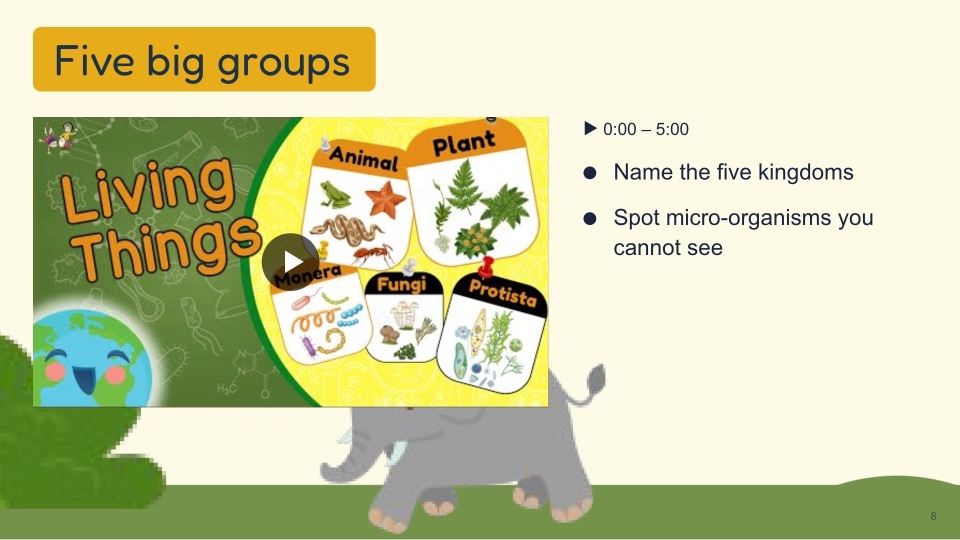
Five kingdoms of living things from 0:00 to 5:00
Fun World For Kids: Living Things and their Classification - 5 Kingdoms of Living Things (Educational Video for Kids)
Covers the broad groups including micro-organisms, plants and animals in simple language that is spot-on for 10-11.
Worksheet
Sources
- Living things and their habitats Year 6 National Curriculum Objectives ... dinting.derbyshire.sch.uk
- National curriculum in England: science programmes of study gov.uk
- How do scientists classify living things? | The Learning Zone learningzone.oumnh.ox.ac.uk
- How to classify animals and plants - KS2 Science curriculum - BBC bbc.co.uk
- Classifying Living Things: Yr 5/6—Cycle B belmontprimarybolton.co.uk
- Classifying Living Things (KS2 Science) | MindBlaze mindblaze.uk
- How to classify animals and plants – KS2 Science curriculum ... bbc.co.uk
- Carl Linnaeus and classification - Oak National Academy thenational.academy
- Classifying Living Things | Science Explained for Kids kidsworldfun.com
- Classifying Living Things - NG Science ngscience.com
- Lesson plan Classifying living things cdn-media.tigtagworld.com
- y6 science classify living things primarysite-prod-sorted.s3.amazonaws.com
Picture credits
- Diagram: CC BY-SA 3.0 · Wikimedia Commons
- Photo: Giles Laurent · CC BY-SA 4.0 · Wikimedia Commons
- Pictograms: Sergio Palao, ARASAAC (arasaac.org) · CC BY-NC-SA
- Illustration: JFJunior · Pixabay
- Microsoft Fluent Emoji (MIT)
- Mulberry Symbols by Steve Lee (mulberrysymbols.org) · CC BY-SA 4.0
Made with Lesson Dino's AI on 17 October 2026. AI can make mistakes, so check facts against the sources before you teach.