Slides
Lesson plan
Weather Reporters Spot Patterns
Students learn to observe local weather and spot what repeats over time. They look, draw, and share as weather reporters.
Objectives
- Students will describe today's local weather using simple words like sunny and rainy.
- Students will record weather observations together on a class picture chart.
- Students will share past observations to name a weather pattern.
Success criteria
- I can say what the weather is like today.
- I can put my weather picture on our chart.
- I can point to the chart and name what repeats.
Key words
| Word | Meaning |
|---|---|
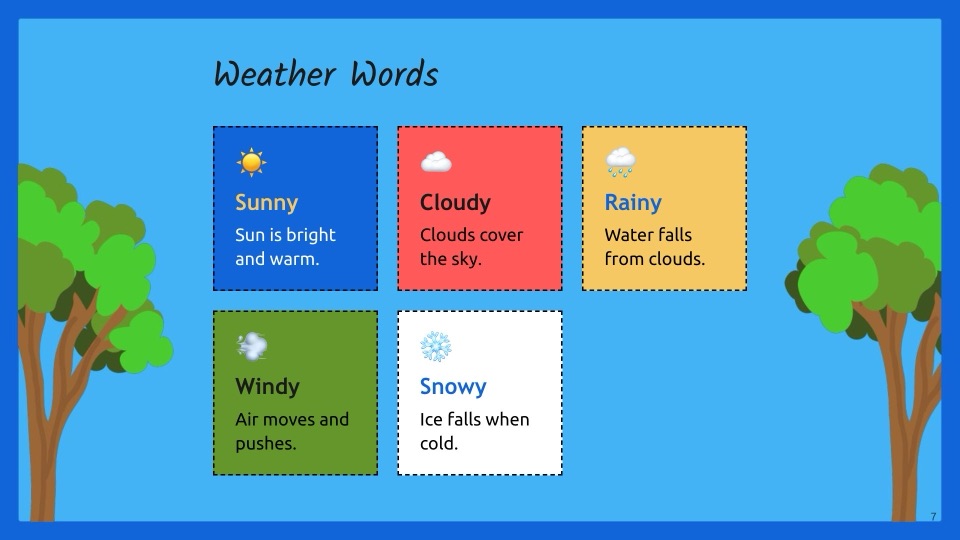
| weather | what the sky and air outside are like right now |
| sunny | when the light in the sky is bright and feels warm |
| cloudy | when soft gray shapes fill the sky and hide the light |
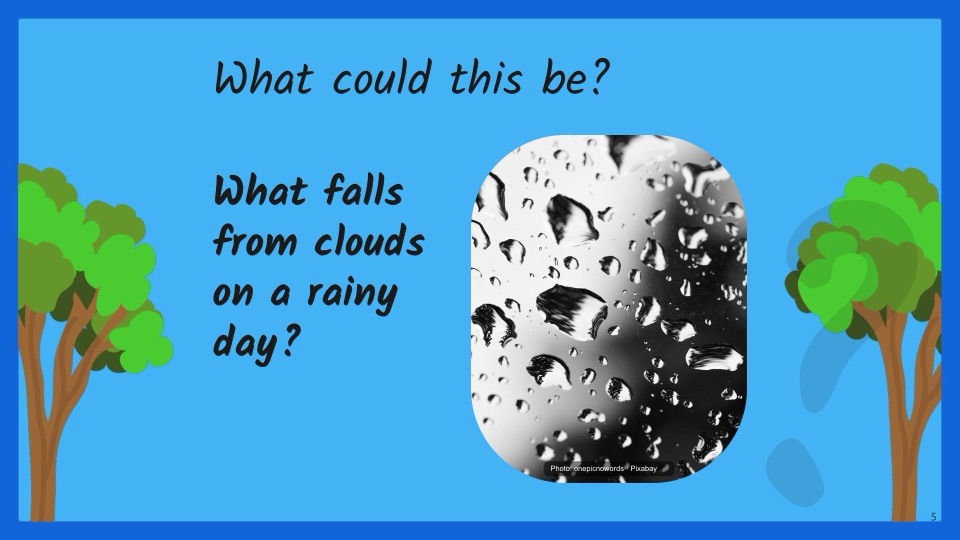
| rainy | when drops of water fall down from the sky |
| pattern | something that happens again and again in the same way |
Timed plan (60 minutes)
| Time | Stage | What happens |
|---|---|---|
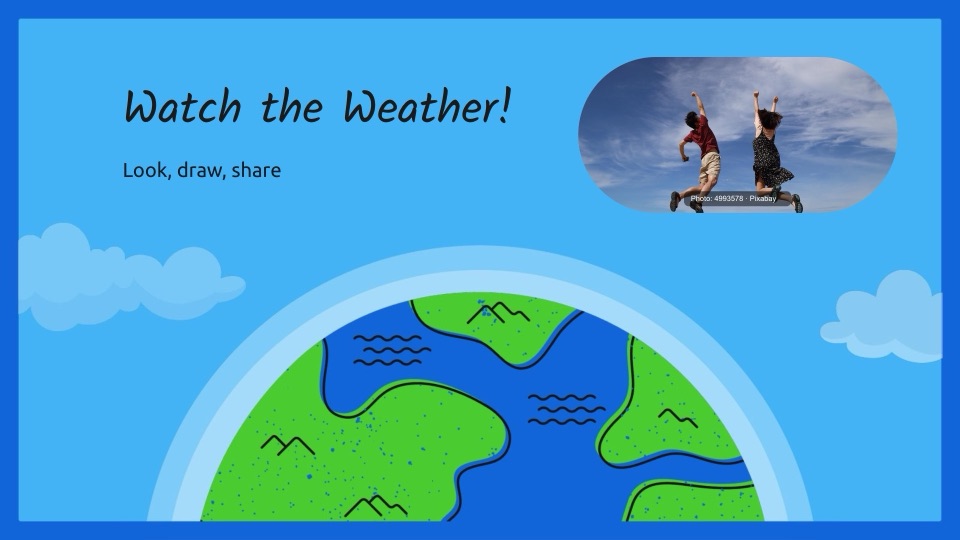
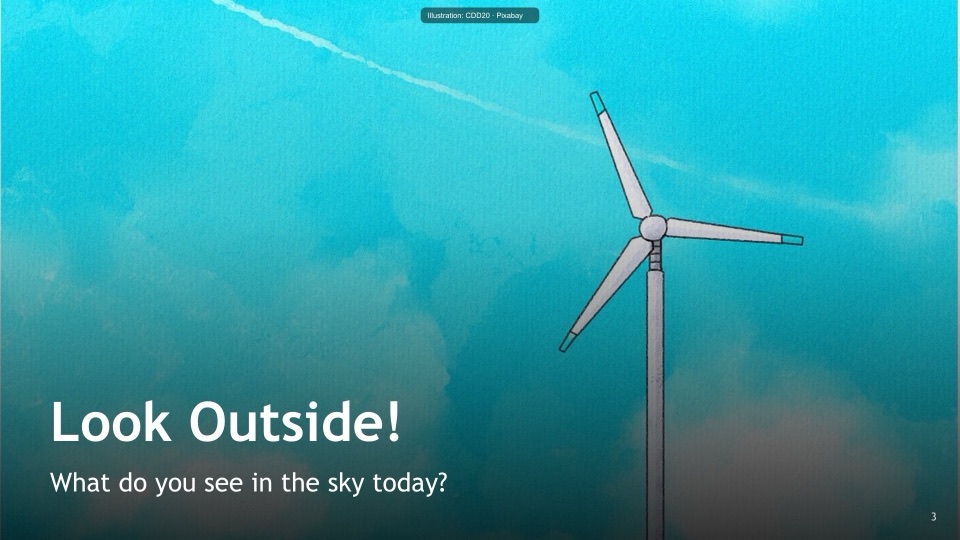
| 10 min | Starter | Hook students and practice describing today's weather in simple words. Welcome class and show Slide 1: Watch the Weather! Look, draw, share. Say the hook: Who wants to be the weather reporter? What pattern did you spot? Show Slide 3 photo and lead all students to look out the window together. Model pointing to one picture card that matches the sky and saying the word. |
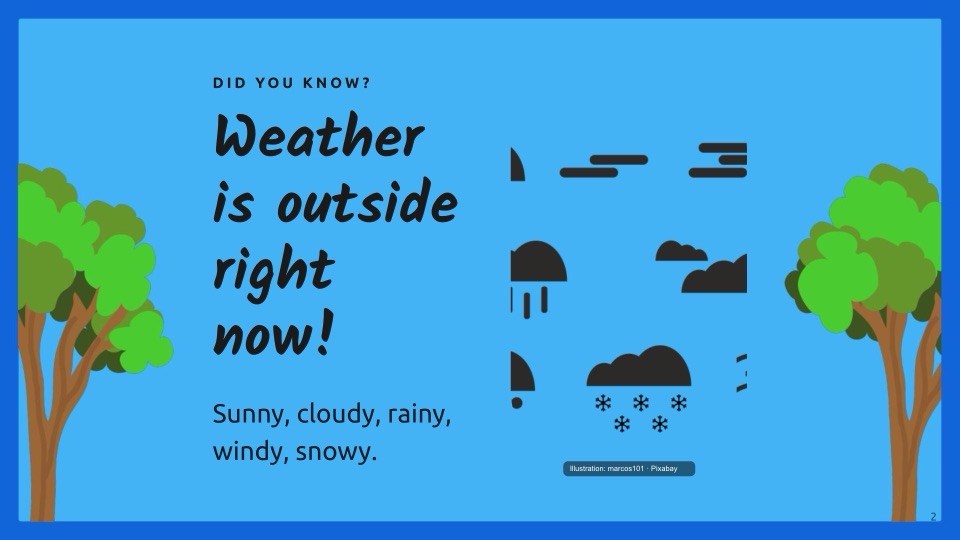
| 10 min | Teaching | Teach weather words and that weather can change and repeat. Show Slide 2 and read: Weather is outside right now! Sunny, cloudy, rainy, windy, snowy. Show Slide 7 cards and teach each word with motion: Sunny - Sun is bright and warm, Cloudy - Clouds cover the sky, Rainy - Water falls from clouds, Windy - Air moves and pushes. Show Slide 4 and explain morning sun can change to rain later. Model today's weather in a full sentence and stick today's picture on the class chart. |
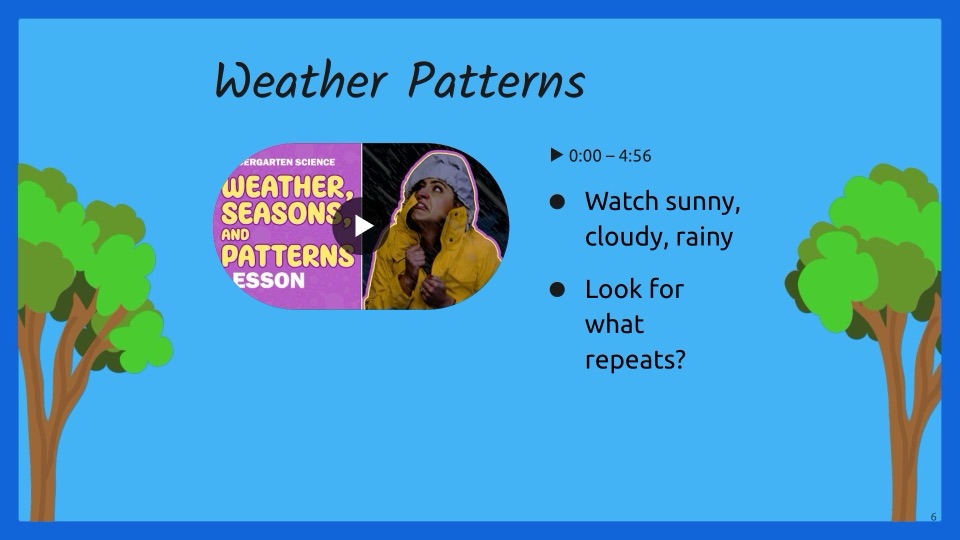
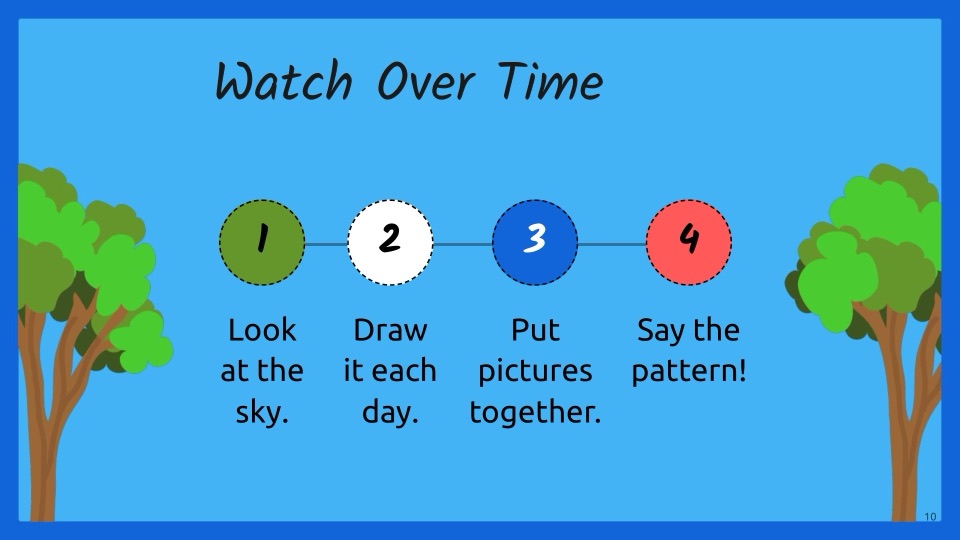
| 10 min | Watch over time | Show how putting daily pictures together helps us see a pattern. Show Slide 10 steps: Look at the sky. Draw it each day. Put pictures together. Say the pattern! Play Slide 6 Video clip 1 (0:00–4:56) to watch sunny, cloudy, rainy and look for what repeats. Point across the completed 5-day chart day by day and count sunny pictures together. Think aloud to name the pattern from repeats, like three sunny mornings in a row. |
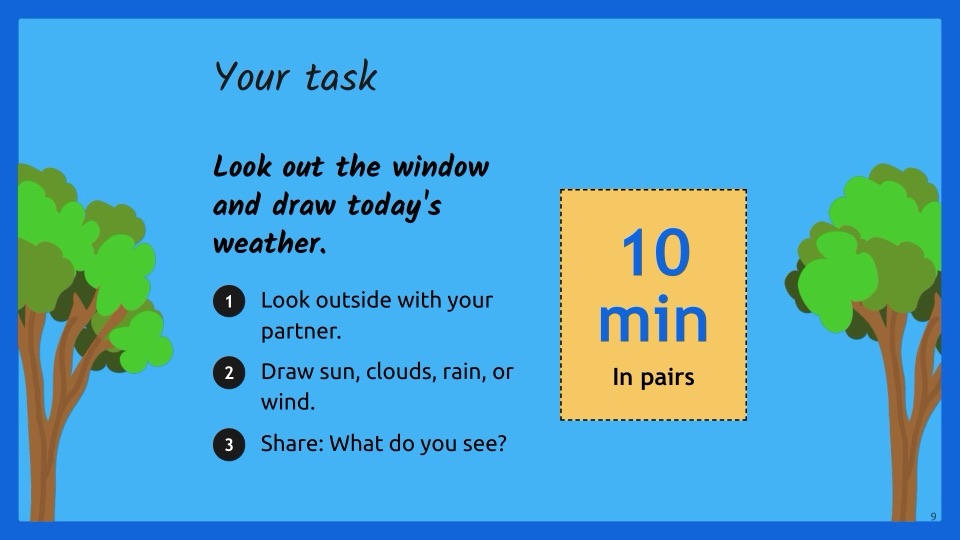
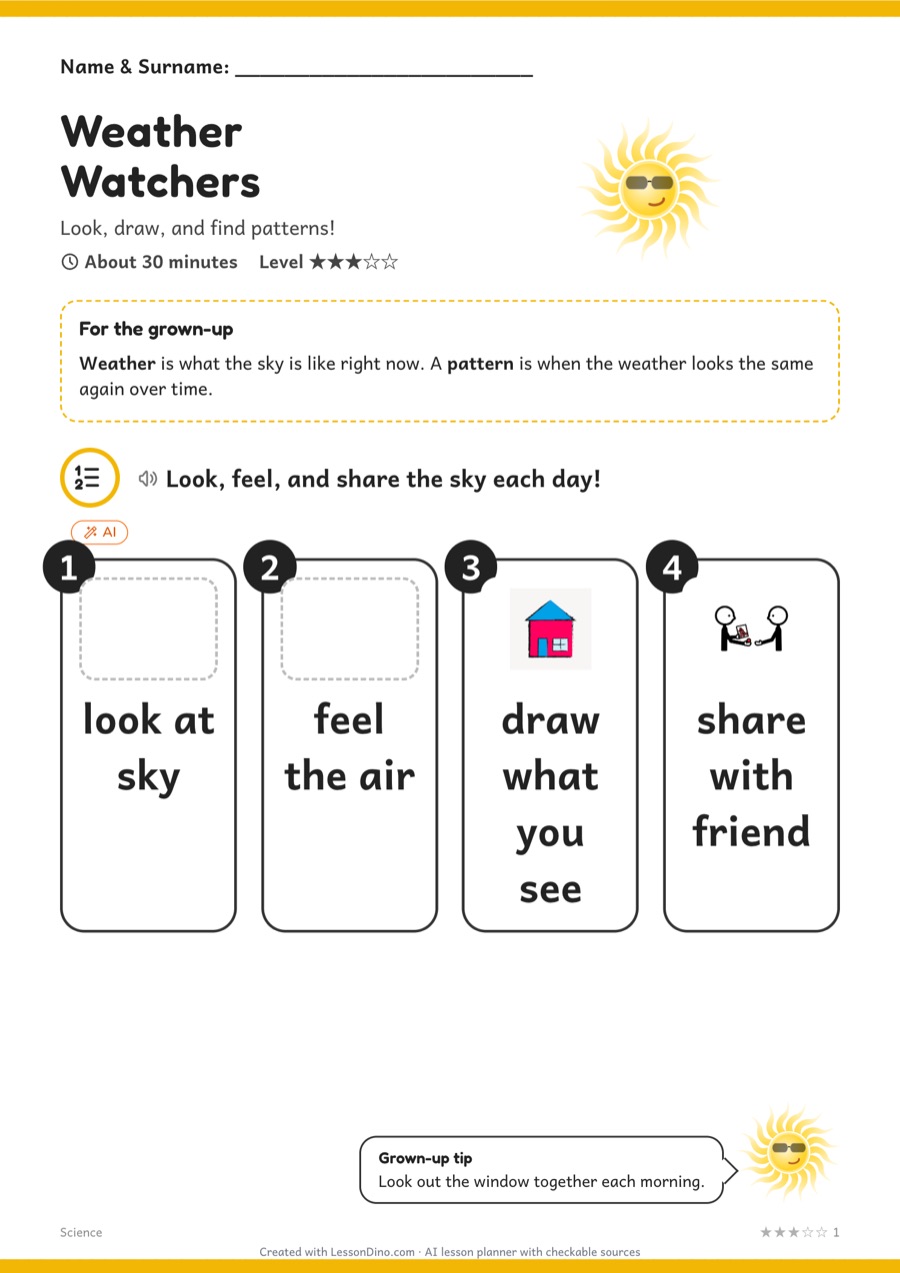
| 20 min | Weather Reporters Share Out | Students observe, record, and share observations to name the class weather pattern. Show Slide 9 task: Look outside with your partner. Draw sun, clouds, rain, or wind. Share: What do you see? Give out Worksheet The page 3 activity and have pairs look out the window and draw today's sky. Invite pairs to add today's drawing to the class chart and take the toy microphone as reporter. Guide reporters to point to the chart pictures that show the repeat and say one pattern sentence. |
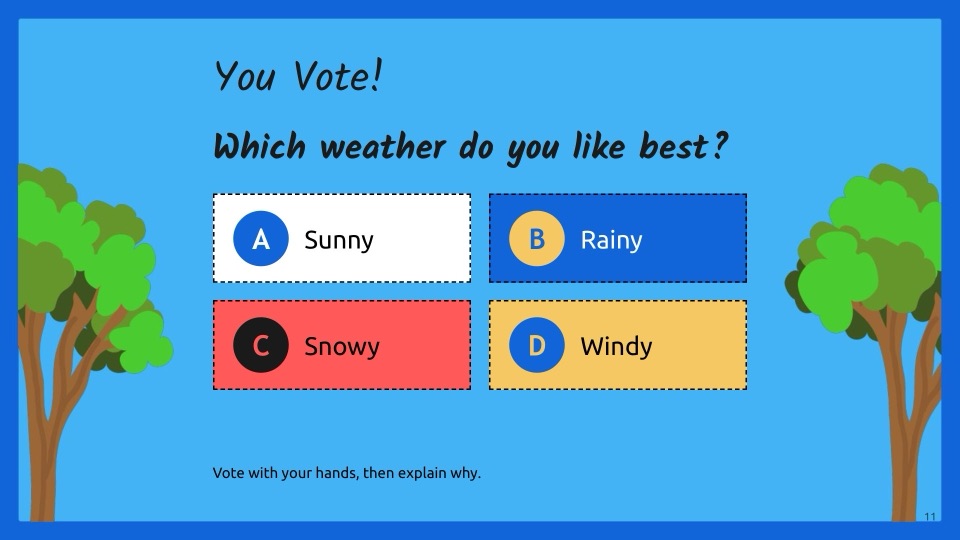
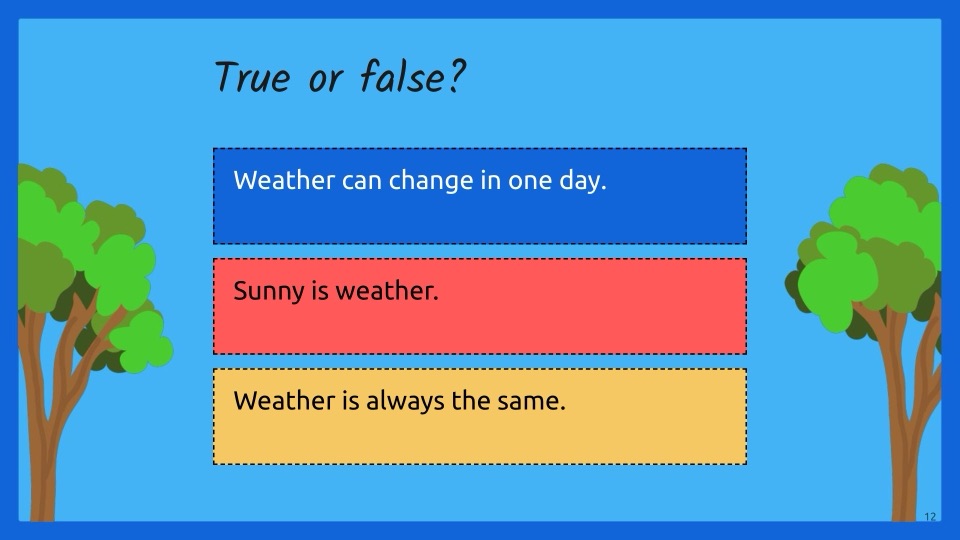
| 10 min | Plenary | Check that students can describe today's weather and the week pattern. Show Slide 11 vote: Which weather do you like best? Sunny, Rainy, Snowy, Windy, and take a quick class vote. Show Slide 12 true or false and read each line: Weather can change in one day. Sunny is weather. Weather is always the same. Have students show thumbs up for true and thumbs down for false and fix the last one together. Close by repeating today's weather and the week pattern from the chart. |
Common mistakes
- Thinking weather is always the same.
How to spot it: Student says tomorrow must be sunny because today is sunny.
Point to chart change from sun to rain. Weather can change from day to day and at different times of the day. - Mixing up cloudy and rainy.
How to spot it: Student calls gray sky with no falling water rainy.
Ask: Is water falling from clouds? If no, it is cloudy. Clouds are tiny drops of water in the air that float. - Naming one day as a pattern.
How to spot it: Student points to one sun and says pattern.
Count together across days. A pattern needs repeats, like three sunny days in a row.
Support
- Use large picture cards and sentence starter: This morning it was ___, now it is ___.
- Give pre-made sun, cloud, and rain pictures to stick instead of drawing.
Stretch
- Count how many sunny days and cloudy days and say which had more.
- Use the pattern to predict tomorrow and check it next morning at 9 a.m.
Check questions
- What is today's weather in simple words?
Answer: Sunny / cloudy / rainy / windy to match outside. - What pattern did our chart show this week?
Answer: It was sunny a lot this week. - How do we find a weather pattern?
Answer: Look each day, put pictures together, say what repeats.
Curriculum
Use and share observations of local weather conditions to describe patterns over time.
Video clips
Clips on YouTube, from the start and end times we chose. Check each one before you show it.
-
Weather, seasons, and patterns from 0:00 to 4:56
Ms Shelley's Science Show: Weather, Seasons, & Patterns 📅 Fun Science with Ms. Shelley | Kindergarten Grade NGSS
Made for kindergarten and directly teaches weather types and patterns over time at the right pace for age 5-6.
-
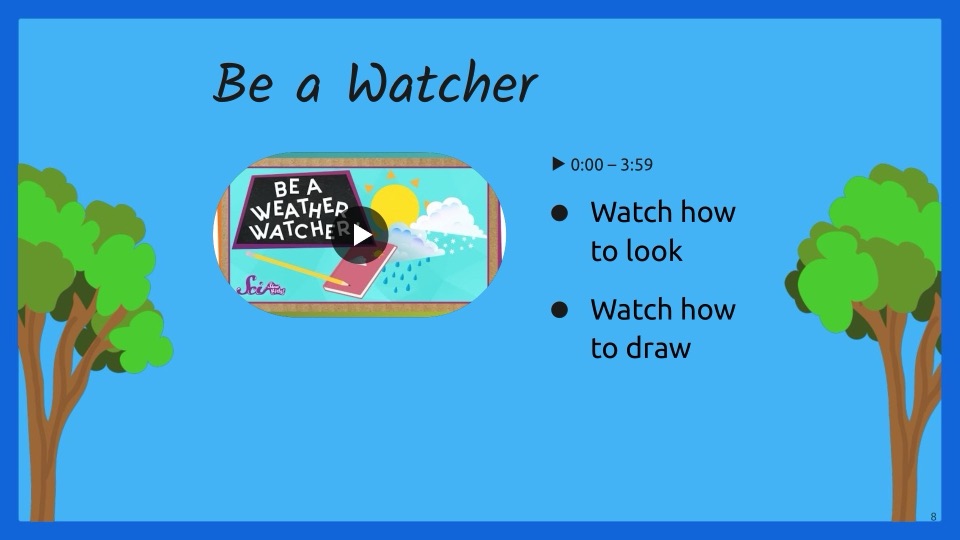
Be a weather watcher from 0:00 to 3:59
SciShow Kids: Be a Weather Watcher | Weather Science | SciShow Kids
Made for young kids by SciShow Kids and models how to observe and record weather, perfect for age 5-6.
Worksheet
Sources
- Grade 3 Science Curriculum What is taught in grade 3 Science? fcps.edu
- Science Kindergarten - Chicago Public Schools cps.edu
- Weather systems and patterns - National Oceanic and ... noaa.gov
- NSF-driven research finding shifts in typical weather patterns nsf.gov
- Weather & Climate | Precipitation Education gpm.nasa.gov
- US: Weather Patterns and Climate Change - Climate Scorecard climatescorecard.org
- Kids science: Weather - Ducksters ducksters.com
- Explore weather and climate - BBC Bitesize bbc.co.uk
- Earth Science for Kids: Weather Forecasting and Meteorology ducksters.com
- Weather Trends and Patterns - Early Science Matters earlysciencematters.org
Picture credits
- Photo: 4993578 · Pixabay
- Illustration: marcos101 · Pixabay
- Illustration: CDD20 · Pixabay
- Photo: onepicnowords · Pixabay
- Drawing: Editor at Large · CC BY-SA 3.0 · Wikimedia Commons
- Picture: unknown · CC0 · rawpixel via Openverse
- Pictograms: Sergio Palao, ARASAAC (arasaac.org) · CC BY-NC-SA
- Microsoft Fluent Emoji (MIT)
Made with Lesson Dino's AI on 17 October 2026. AI can make mistakes, so check facts against the sources before you teach.