Slides
Lesson plan
Alike But Not the Same
Students learn young animals and plants are like parents but not exactly the same. They match parents to babies and name one same and one different part.
Objectives
- Students will match four animal parents to their young using observations.
- Students will explain young plants and animals are like but not exactly like parents.
Success criteria
- I can match each baby to its parent.
- I can name one same and one different part.
- I can tell babies are like parents but not exactly the same.
Key words
| Word | Meaning |
|---|---|
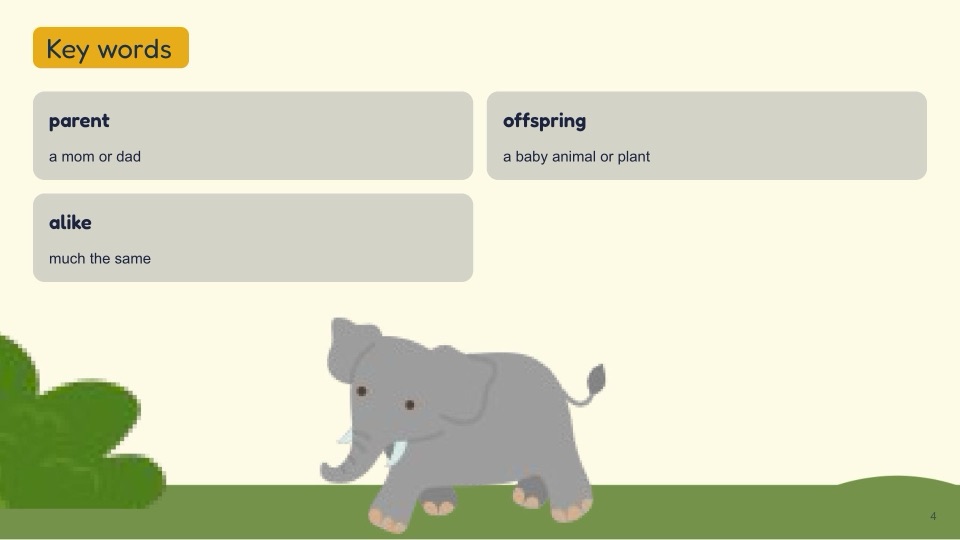
| parent | a mom or dad that feeds, shelters, and teaches a baby |
| offspring | a baby animal or plant |
| alike | much the same as something else |
| different | not the same in how it looks or works |
Timed plan (60 minutes)
| Time | Stage | What happens |
|---|---|---|
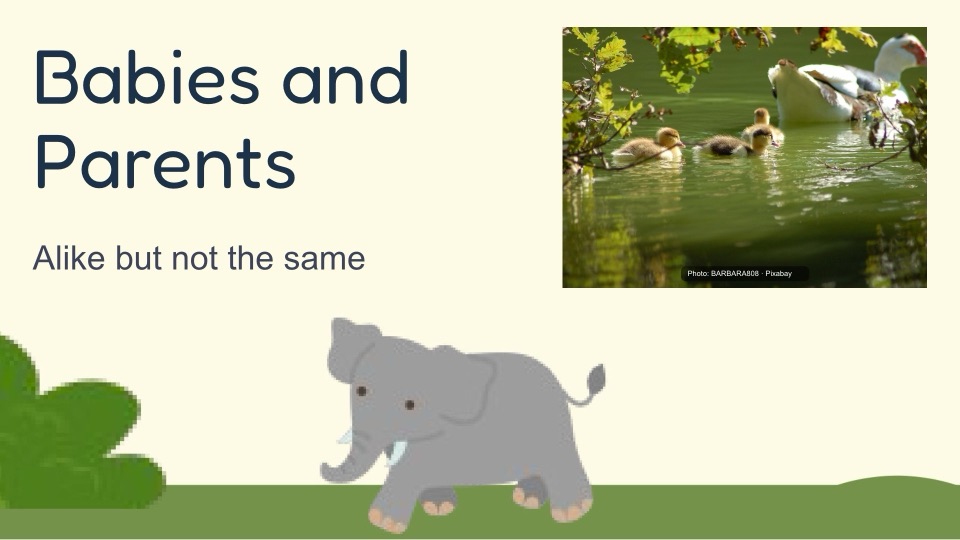
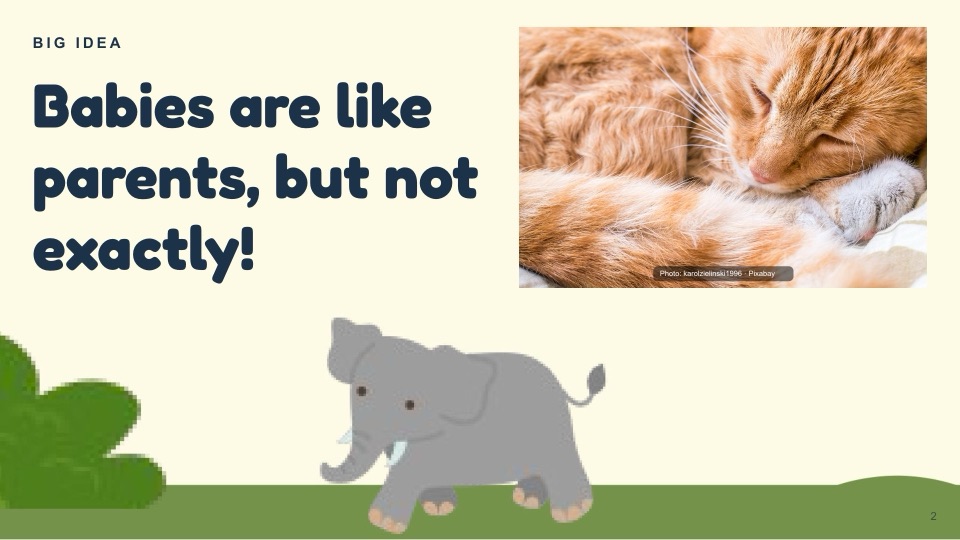
| 5 min | Starter | Hook interest and recall what alike means in families. Show Slide 1 and read the title: Babies and Parents: Alike but not the same. Show Slide 2 and read the big idea: Babies are like parents, but not exactly! Show mixed-up parent and baby cards on the board to set up the problem. Show Slide 5 and ask partners to share how they are like their family. |
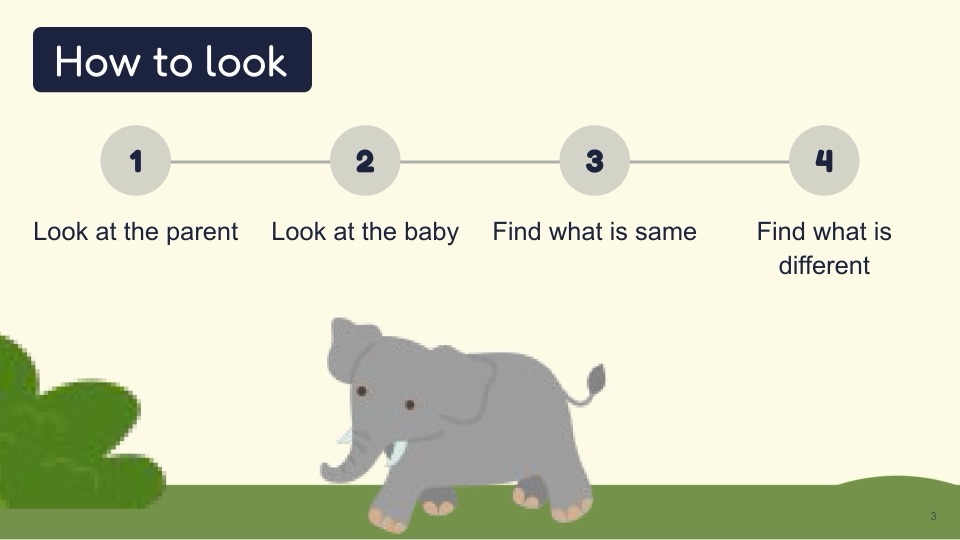
| 10 min | Teach: How to Look | Teach key words and model how to compare a parent and baby. Show Slide 4 and teach parent as a mom or dad, offspring as a baby animal or plant, and alike as much the same. Show Slide 3 and read the steps: Look at the parent, look at the baby, find what is same, find what is different. Model with duck and duckling cards on the pocket chart, thinking aloud about feathers and size. Have the class repeat the same and different sentence frame with you. |
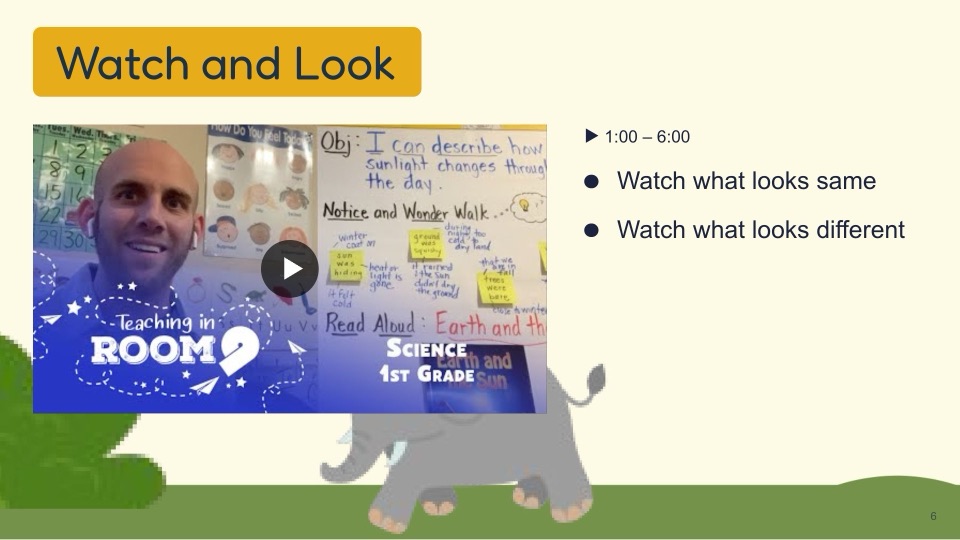
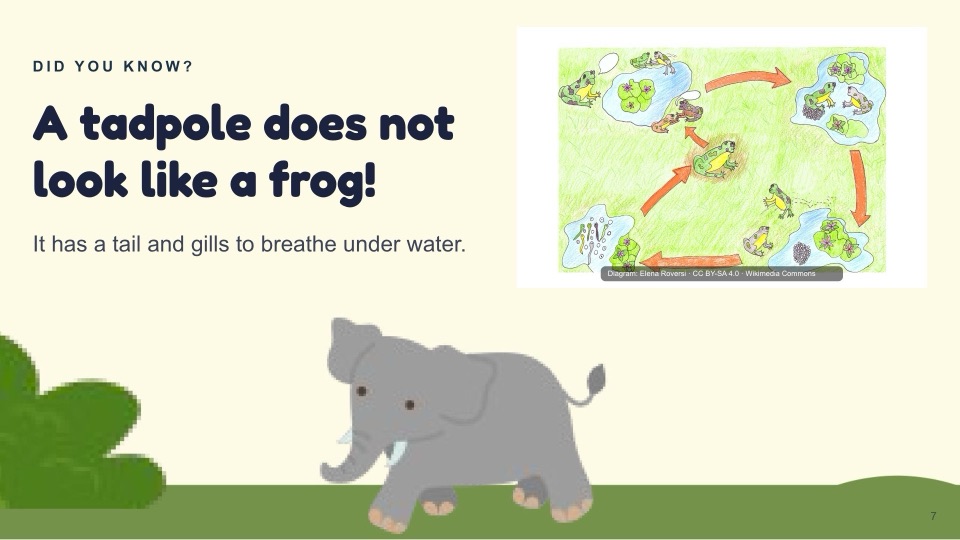
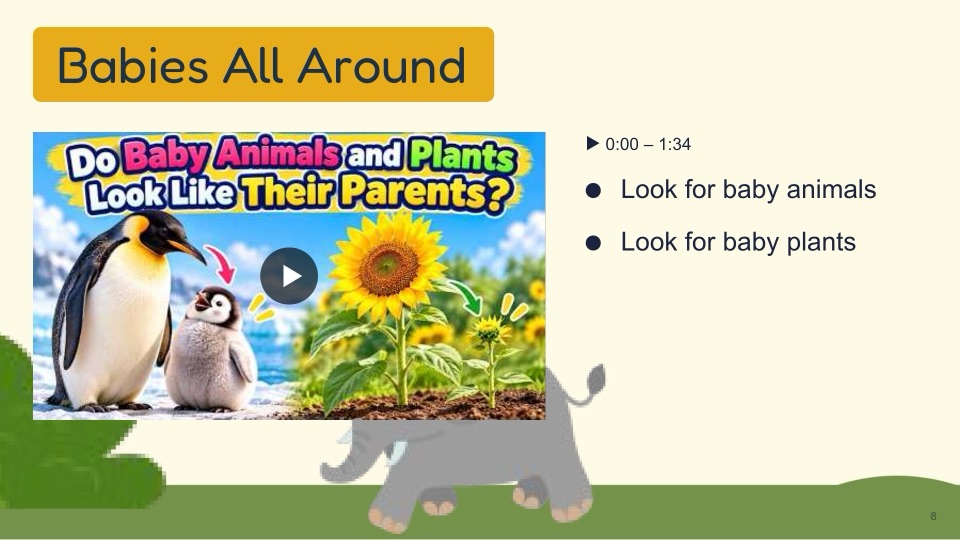
| 15 min | Watch and Talk | Observe babies that look similar and babies that look very different. Show Slide 6 and play Video clip 1 (1:00-6:00), pausing to name one same and one different each time. Show Slide 7 and explain the tadpole fact with the frog life cycle picture. Show Slide 8 and play Video clip 4 (0:00-1:34) to look for baby animals and baby plants. Lead a short talk comparing a seedling to a grown plant and a furry baby to its parent. |
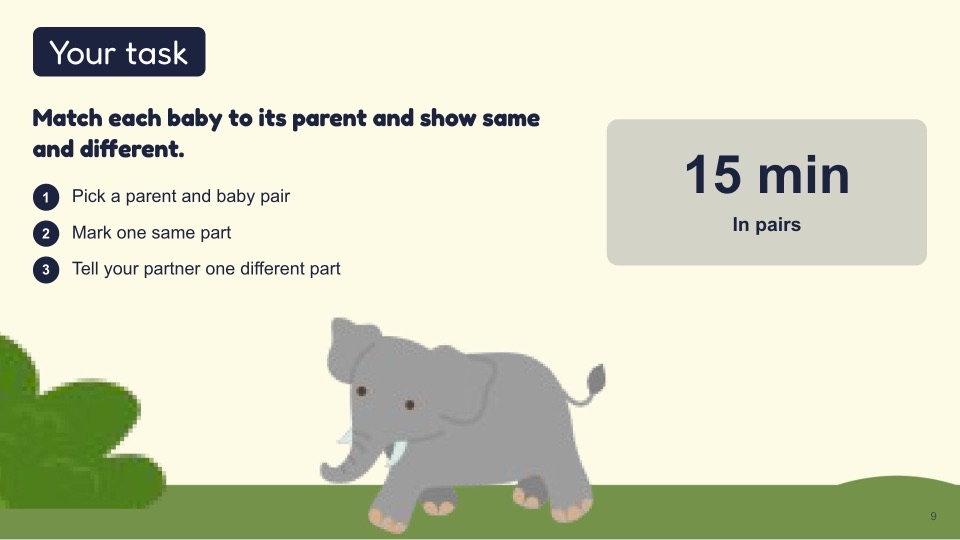
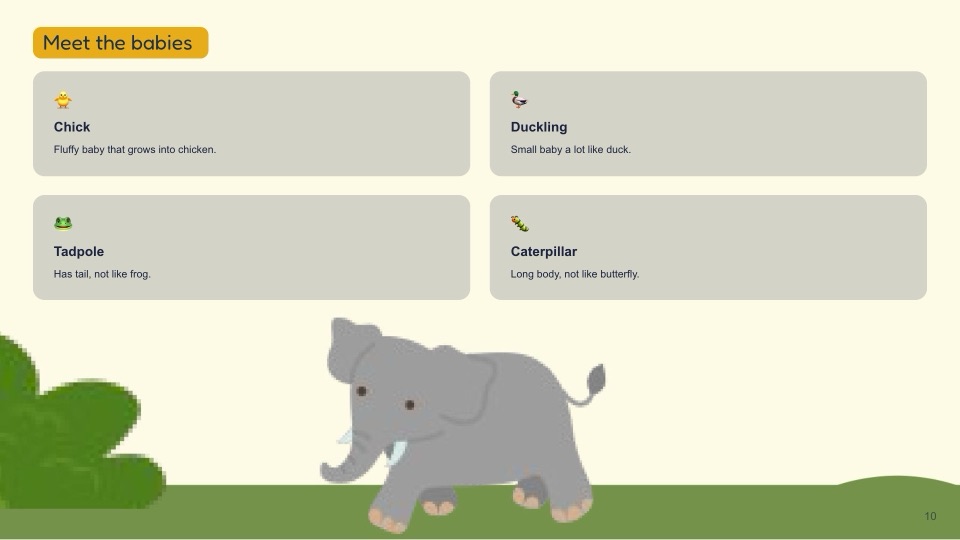
| 15 min | Main Activity: Match the Baby | Match parents to young and name one same and one different. Show Slide 9 task and Slide 10 Meet the babies cards: chick, duckling, tadpole, caterpillar. Model matching goose to gosling, then duck to duckling, naming one same and one different to show how to differentiate between geese/goslings and ducks/ducklings. Hand out picture cards and Worksheet page 2 activity and remind pairs to mark one same part. Circulate, confirm matches, and ask what clues they used such as size and shape. |
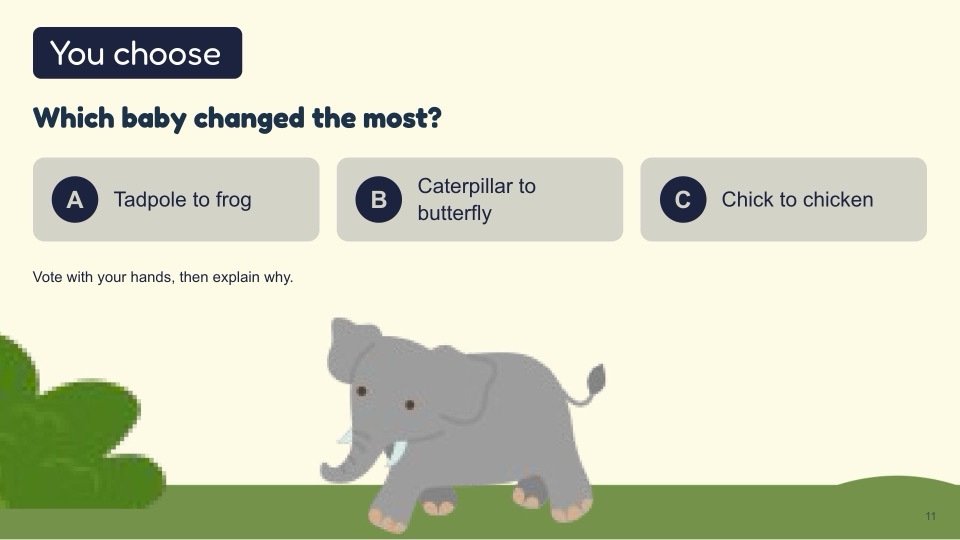
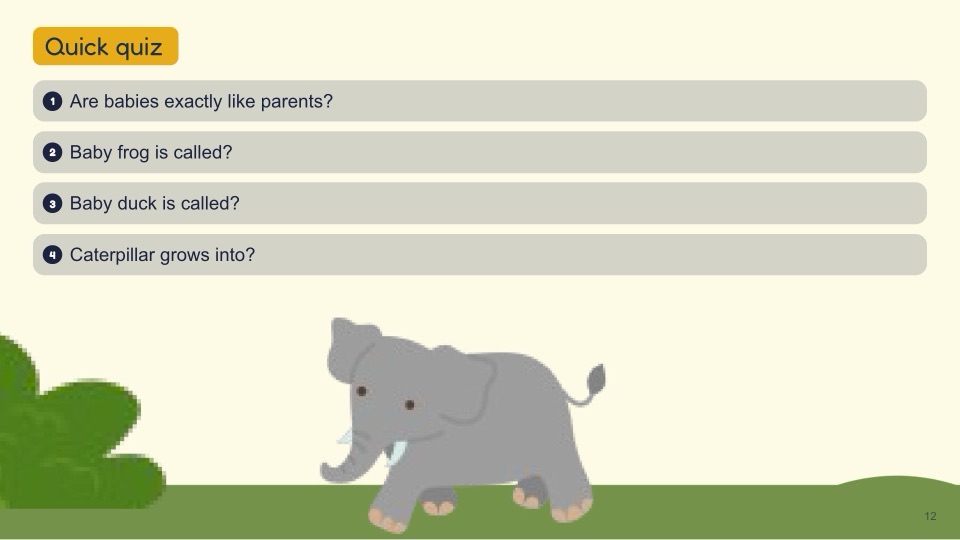
| 15 min | Plenary: Vote and Quiz | Check learning and agree our evidence about parents and young. Show Slide 11 and take a vote: Which baby changed the most, tadpole to frog, caterpillar to butterfly, or chick to chicken that hatches from an egg and grows from chick into adult? Show Slide 12 and run the quick quiz on exactly alike, tadpole, duckling, and butterfly. Build the class evidence sentence together: Babies are like parents, but not exactly. Hand out Worksheet page 5 activity for students to circle the face that shows how they feel. |
Common mistakes
- Students think babies are exactly the same as parents, only in a different place.
How to spot it: They say same size or same everything and cannot name a difference.
Put parent and baby side by side and compare size and one part, to prove young are like but not exactly like parents. - Students think a tadpole is a different animal, not a baby frog.
How to spot it: They match tadpole to fish or say it will stay with a tail forever.
Retell that tadpoles hatch from jelly-covered eggs and then lose tails and gills and grow legs to become frogs. - Students mix up ducklings and goslings.
How to spot it: They place a small baby with the goose or a larger baby with the duck.
Match slowly to differentiate between geese/goslings and ducks/ducklings by checking size and which parent shape it copies.
Support
- Give one pair already matched as a model and let students match only two families first.
- Let students point to the same body part on parent and baby to show what is alike before they say the words.
Stretch
- Ask students to sort the pairs into looks a lot like parent and looks very different from parent.
- Have students list another parent and baby that look similar and another that look different from each other.
Check questions
- Are babies exactly like their parents?
Answer: No - A baby frog is called what?
Answer: Tadpole - A caterpillar grows into what?
Answer: Butterfly
Curriculum
Make observations to construct an evidence-based account that young plants and animals are like, but not exactly like, their parents.
Video clips
Clips on YouTube, from the start and end times we chose. Check each one before you show it.
-
Similarities and differences from 1:00 to 6:00
Nine PBS: Similarities and Differences of Parents and their Offspring | 1st Grade Science | Teaching In Room 9
Made for 1st grade and directly about how offspring are similar and different from parents, perfect for ages 6-7.
-
Babies and parents alike from 0:00 to 1:34
Science Wonderscope: Do Baby Animals and Plants Look Like Their Parents?
Short, simple video asks exactly our lesson question about baby animals and plants for ages 6-7.
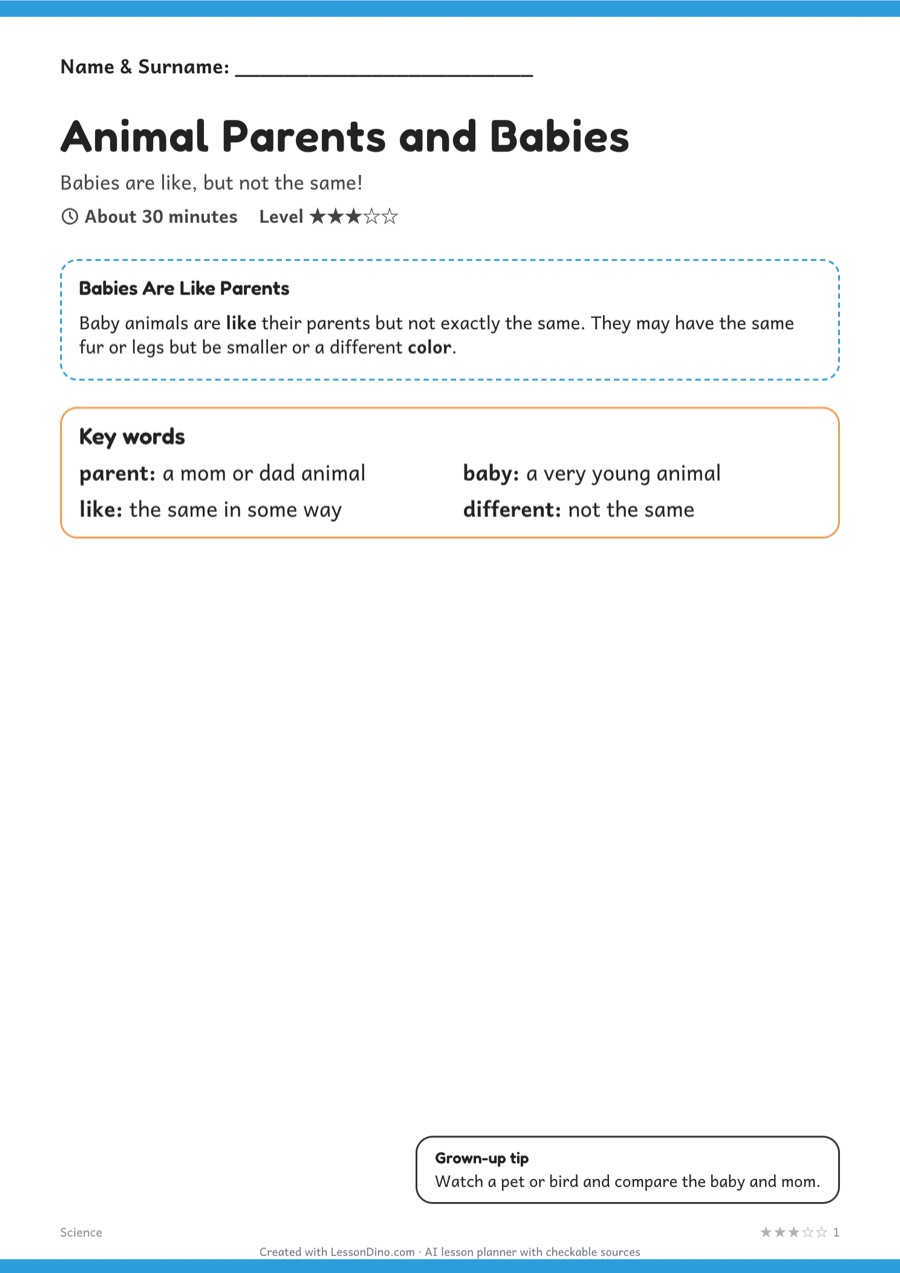
Worksheet
Sources
- Grade 1 Science science.edu
- Download the Lesson List science.edu
- Animal Families - U.S. Fish and Wildlife Service fws.gov
- Animal Families and Homes - U.S. Fish and Wildlife Service fws.gov
- Do baby animals look like their parents? - Living things ... bbc.co.uk
- How do animals grow? - KS1 Science curriculum - BBC Bitesize bbc.co.uk
- Meet the animal kingdom's fiercely protective mothers | National Geographic nationalgeographic.com
Picture credits
- Photo: BARBARA808 · Pixabay
- Photo: karolzielinski1996 · Pixabay
- Illustration: garten-gg · Pixabay
- Diagram: Elena Roversi · CC BY-SA 4.0 · Wikimedia Commons
- Pictograms: Sergio Palao, ARASAAC (arasaac.org) · CC BY-NC-SA
- Illustration: dandelion_tea · Pixabay
- Microsoft Fluent Emoji (MIT)
- Illustration: Loaivat · Pixabay
- Illustration: olenchic · Pixabay
Made with Lesson Dino's AI on 17 October 2026. AI can make mistakes, so check facts against the sources before you teach.