The worksheet
About this worksheet
Pupils learn how to add prefixes and suffixes to root words. They build new words and use them in silly sentences. This Year 4 English worksheet gives students (ages 8–9) five pages of practice on prefixes and suffixes, part of the writing - transcription unit. It goes with our free Prefixes and suffixes lesson, which has the slides and a timed lesson plan.
What it covers
By the end, students should be able to:
- Students will build new words with un-, dis-, mis-, -ful, -less and -ness.
- Students will explain the spelling rules for joining prefixes and suffixes.
- Students will use new prefix and suffix words correctly in sentences.
How to use it
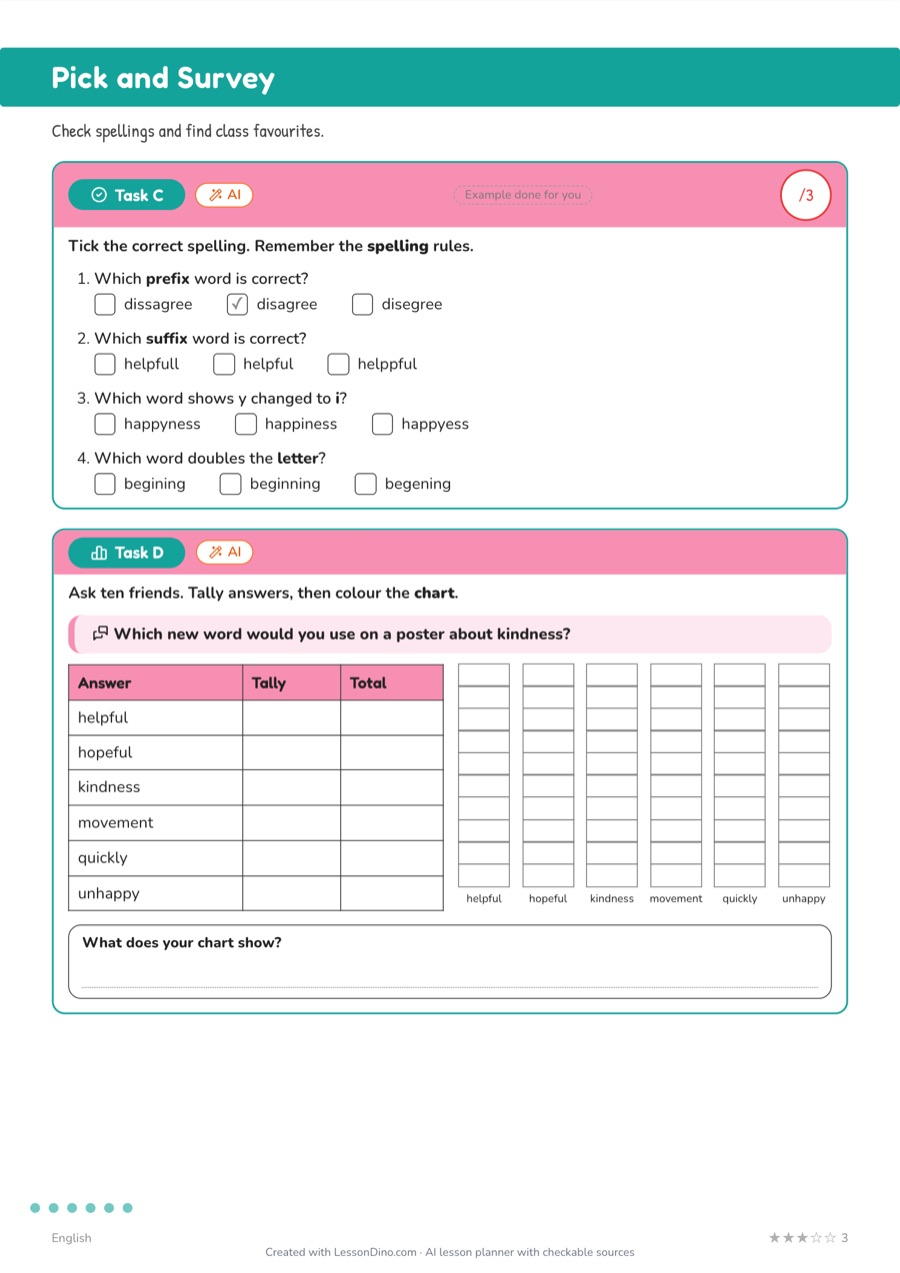
- Plenary (15 minutes): Do Worksheet Task C together: tick the correct spelling, remembering the rules.
- Support: Give only un- and dis- with spoken roots first to build unhappy, unfair, disagree and dislike.
- Stretch: Challenge pupils to build two words from same root, such as behave, misbehave and behaviour, and explain both.
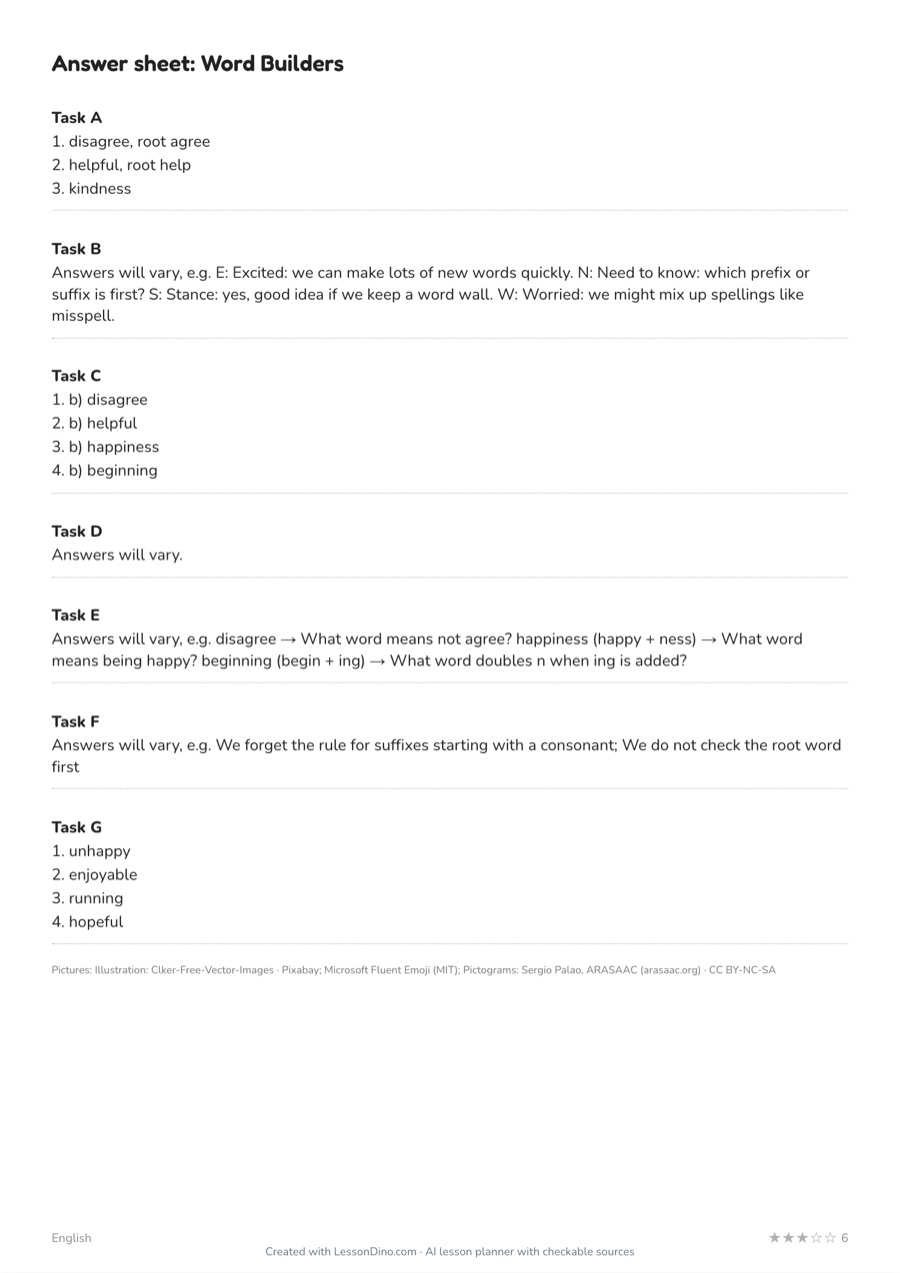
- The answer sheet is the last page, so you can print it on its own or let students check their own work.
Key vocabulary
- prefix: small bit joined to the front of a word to change what it means
- suffix: small bit joined to the end of a word to change how it is used
- root word: main part of a word that carries the basic meaning
- spelling rule: agreed way to join bits to a main word without mistakes
Mistakes to watch for
- Writing misspell with one s. Split to mis + spell and keep both s letters because prefixes join straight.
- Adding -ness or -ful without changing y to i, e.g. happyness. Check consonant before y and syllables: happy > happi + ness = happiness.
- Mixing up -ful and -less meanings. Teach as opposites from same root: -ful means full of, -less means without.
What's on the worksheet
Meet Word Parts
Learn how small parts build big new words.
Prefixes and Suffixes
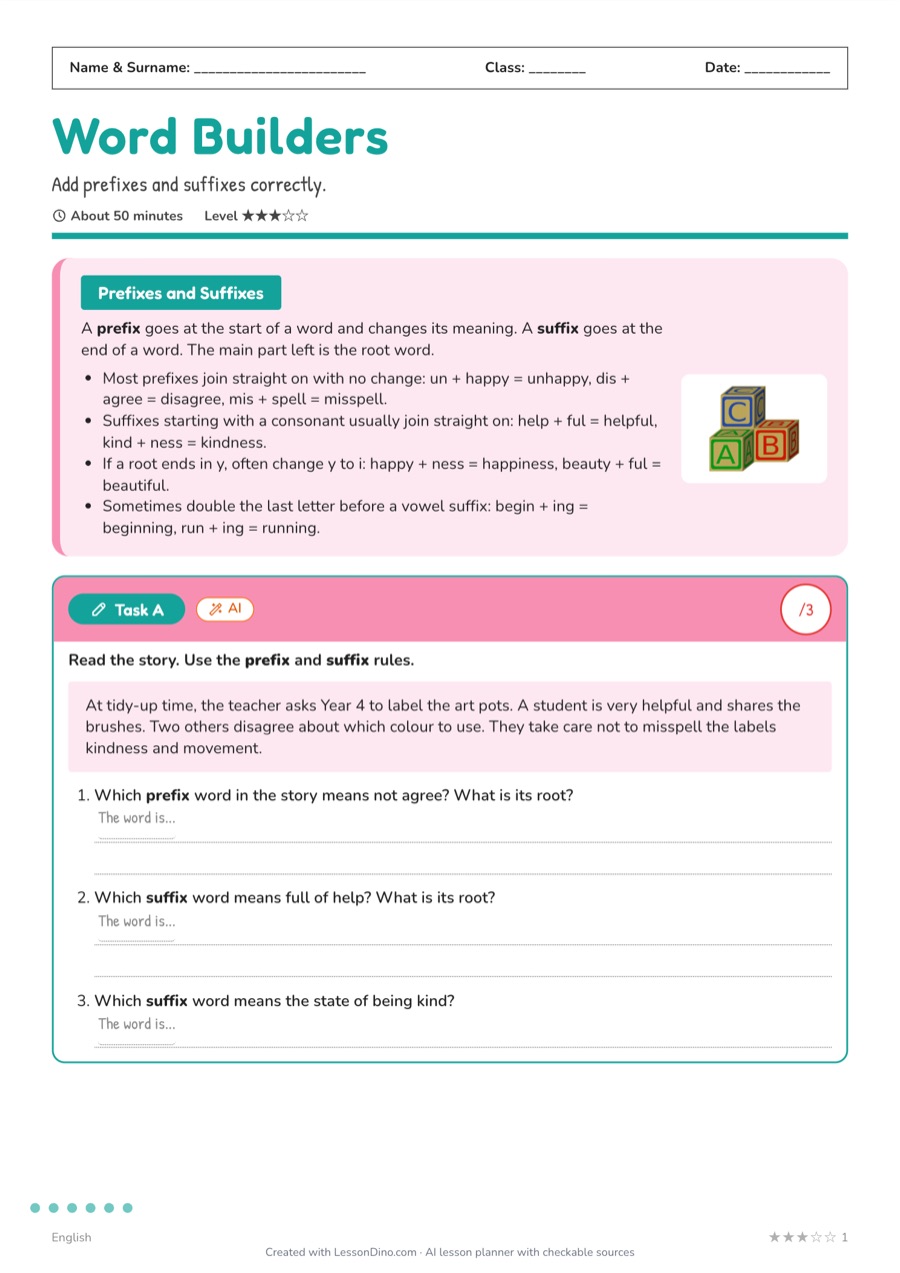
- A prefix goes at the start of a word and changes its meaning. A suffix goes at the end of a word. The main part left is the root word.
- Most prefixes join straight on with no change: un + happy = unhappy, dis + agree = disagree, mis + spell = misspell.
- Suffixes starting with a consonant usually join straight on: help + ful = helpful, kind + ness = kindness.
- If a root ends in y, often change y to i: happy + ness = happiness, beauty + ful = beautiful.
- Sometimes double the last letter before a vowel suffix: begin + ing = beginning, run + ing = running.
Read the story. Use the prefix and suffix rules.
- Which prefix word in the story means not agree? What is its root?
- Which suffix word means full of help? What is its root?
- Which suffix word means the state of being kind?
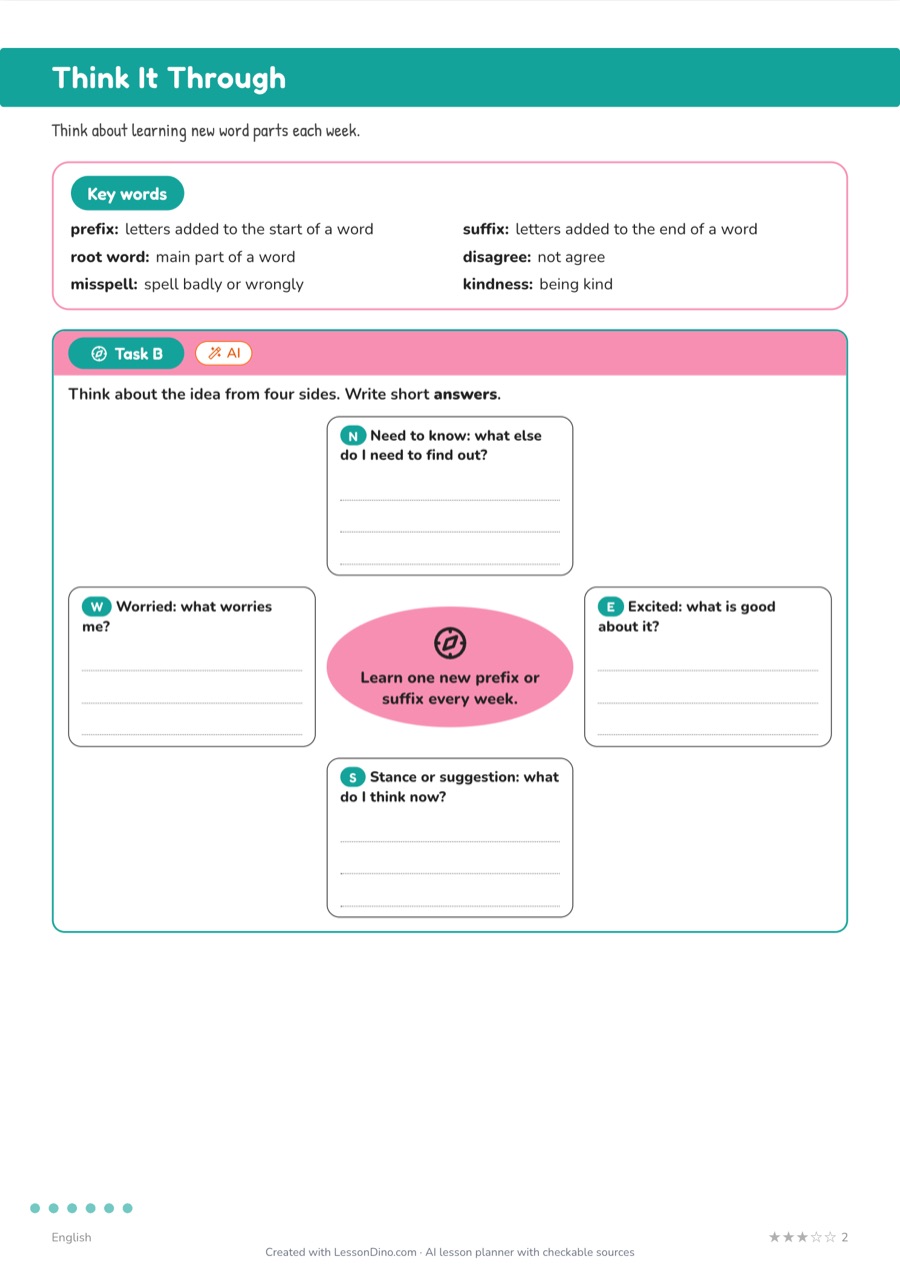
Think It Through
Think about learning new word parts each week.
| Word | Meaning |
|---|---|
| prefix | letters added to the start of a word |
| suffix | letters added to the end of a word |
| root word | main part of a word |
| disagree | not agree |
| misspell | spell badly or wrongly |
| kindness | being kind |
Think about the idea from four sides. Write short answers.
Pick and Survey
Check spellings and find class favourites.
Tick the correct spelling. Remember the spelling rules.
- Which prefix word is correct?
- Which suffix word is correct?
- Which word shows y changed to i?
- Which word doubles the letter?
Ask ten friends. Tally answers, then colour the chart.
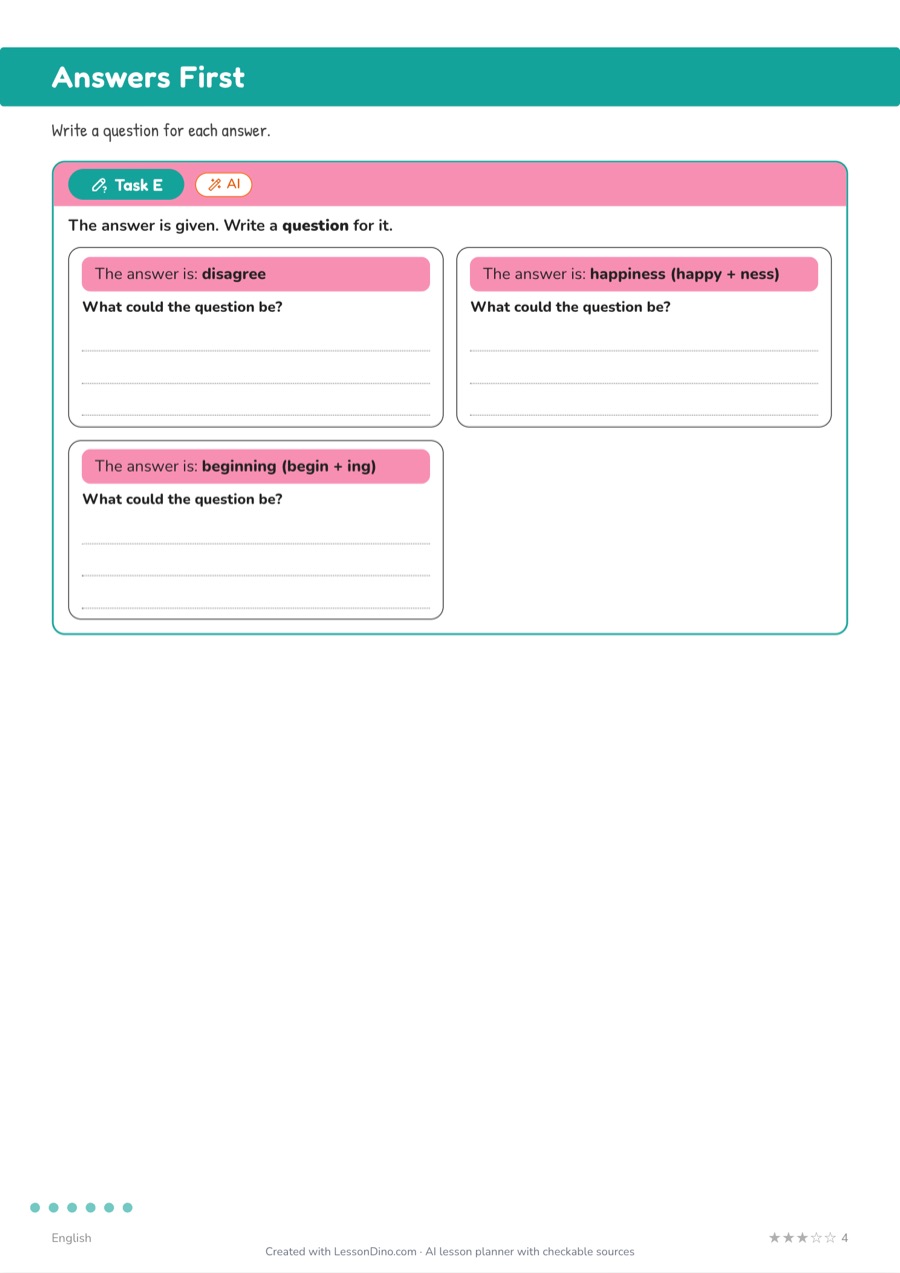
Answers First
Write a question for each answer.
The answer is given. Write a question for it.
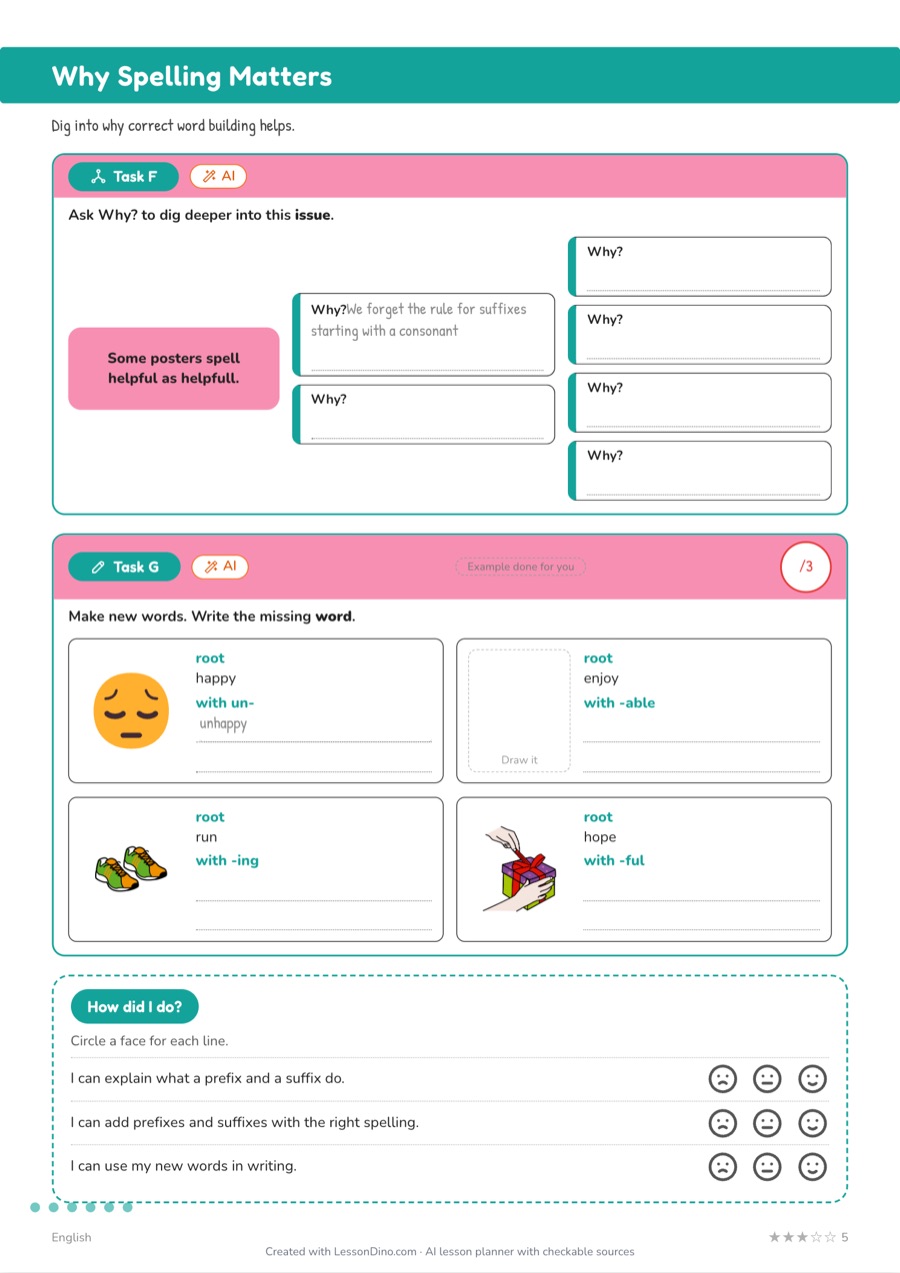
Why Spelling Matters
Dig into why correct word building helps.
Ask Why? to dig deeper into this issue.
Make new words. Write the missing word.
Answers
Show the answers
- Which prefix word in the story means not agree? What is its root? disagree, root agree
- Which suffix word means full of help? What is its root? helpful, root help
- Which suffix word means the state of being kind? kindness
The answer sheet is the last picture above.
Curriculum
use further prefixes and suffixes and understand how to add them
Made with Lesson Dino's AI on 17 October 2026. AI can make mistakes, so check the answers and facts against the sources before you teach.