Slides
Lesson plan
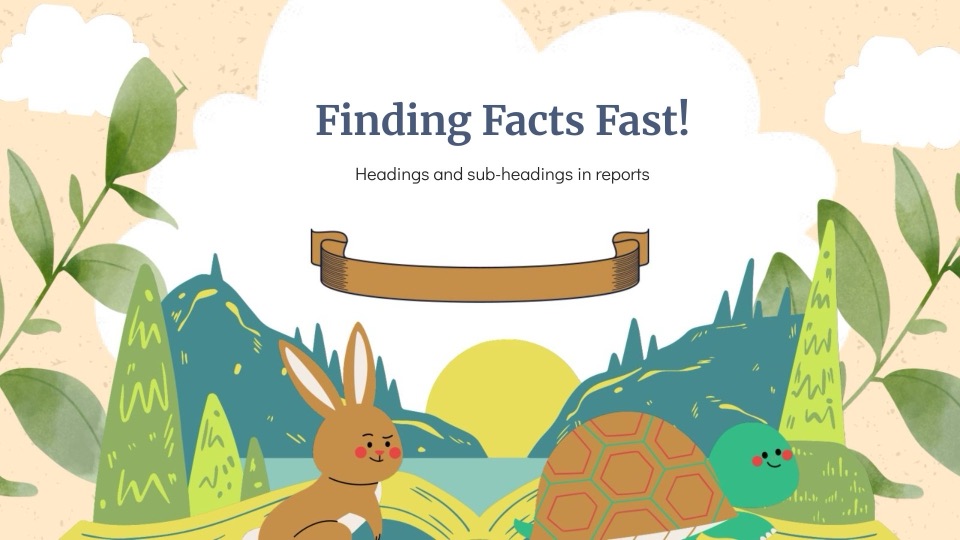
Finding Facts Fast with Headings
Pupils learn how headings and sub-headings organise facts. They rebuild a jumbled bicycle report.
Objectives
- Students will explain how headings and sub-headings help readers find facts fast.
- Students will match paragraphs of facts to the correct headings and sub-headings.
Success criteria
- I can say why headings and sub-headings help the reader.
- I can match each paragraph to the correct sub-heading.
- I can lay out a report with title, introduction and sections.
Key words
| Word | Meaning |
|---|---|
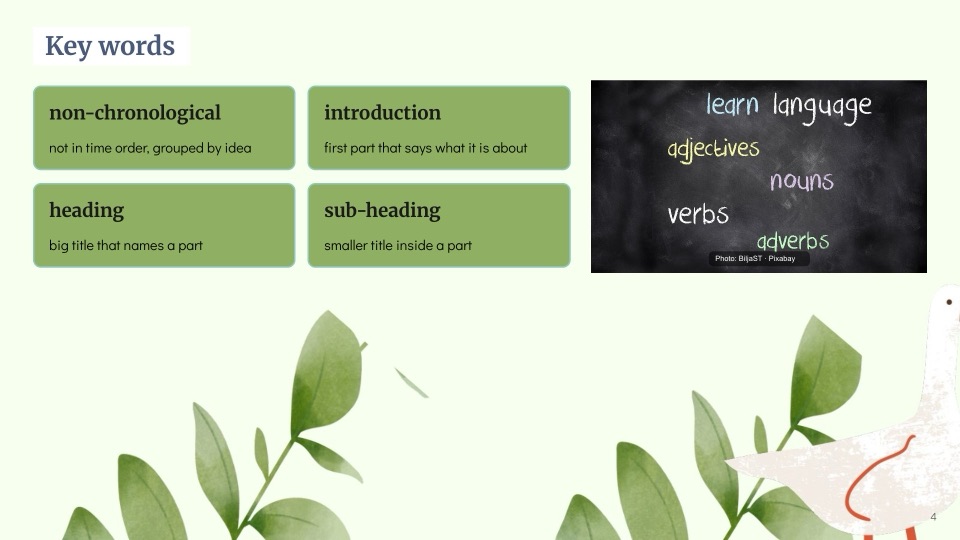
| non-chronological | not in time order, grouped by idea instead |
| introduction | starting part that says in a general way what the topic is about |
| heading | big title that names the topic or a part |
| sub-heading | smaller title over a part that shows what those facts are about |
| paragraph | group of sentences about one small idea |
Timed plan (60 minutes)
| Time | Stage | What happens |
|---|---|---|
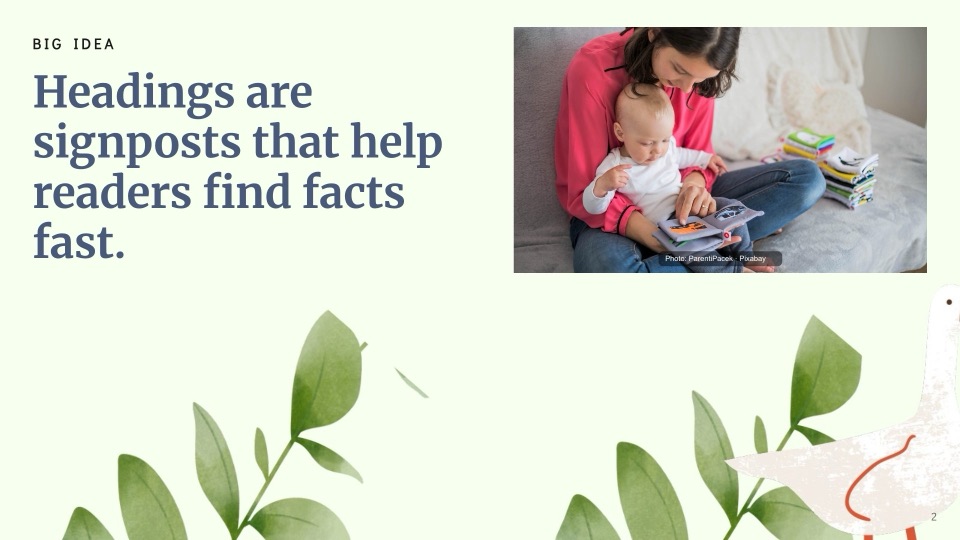
| 8 min | Starter | To hook pupils and recall that reports group facts to help readers find information. Hold up a messy bag with an envelope spilling strips and say the hook about the bicycle report falling apart. Show Slide 1 Finding Facts Fast and Slide 2 big idea that headings are signposts that help readers find facts fast. Ask pairs to say where they have seen titles over parts in books or on web pages. Link answers to learning goal that pupils will match sub-headings to the right paragraph of facts. |
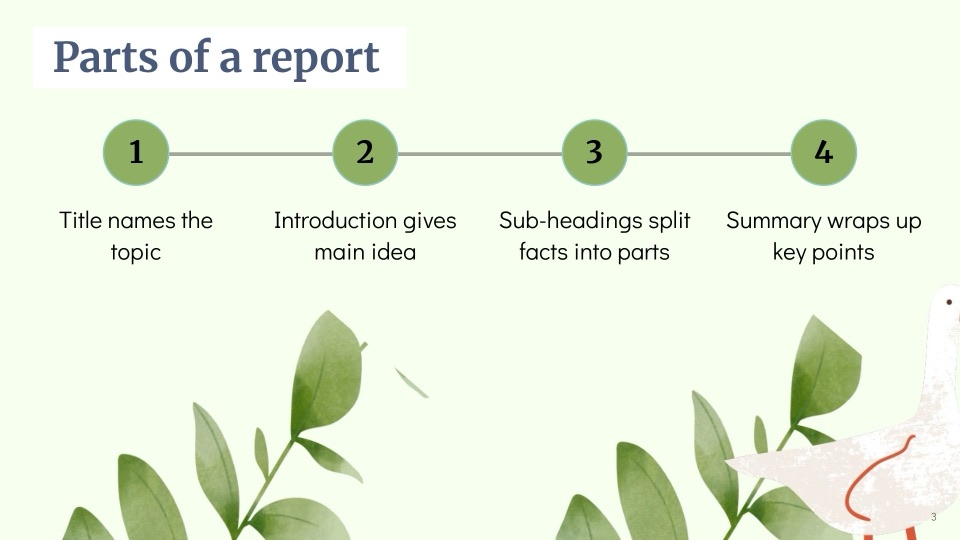
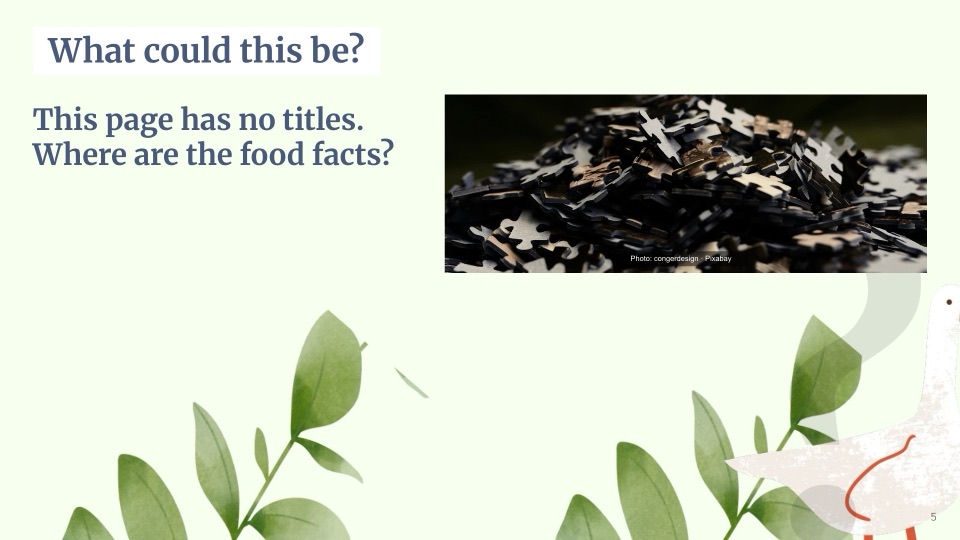
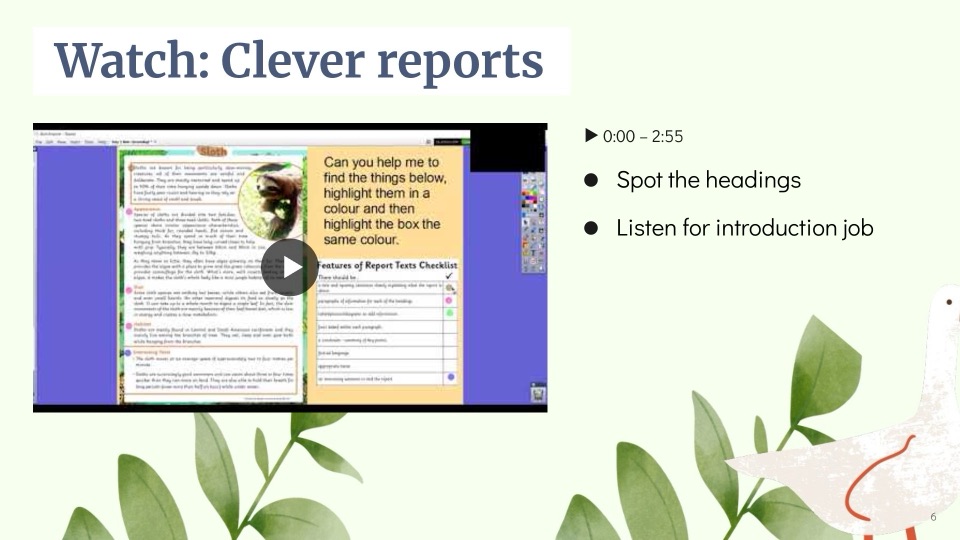
| 12 min | Teaching | To teach the parts of a report and the job of headings and sub-headings. Show Slide 3 Parts of a report and read the steps: title names the topic, introduction gives main idea, sub-headings split facts into parts, summary wraps up key points. Show Slide 4 Key words and explain non-chronological as not in time order, grouped by idea. Show Slide 5 mystery page with no titles and ask where the food facts are, to prove we need to split facts and find them fast. Play Video clip 1 on Slide 6 and ask pupils to spot the headings and listen for the introduction job. |
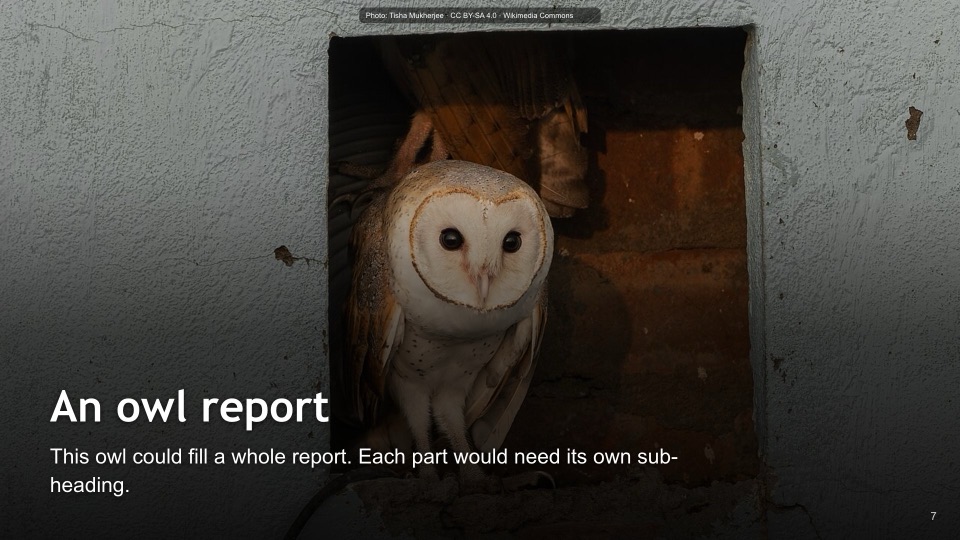
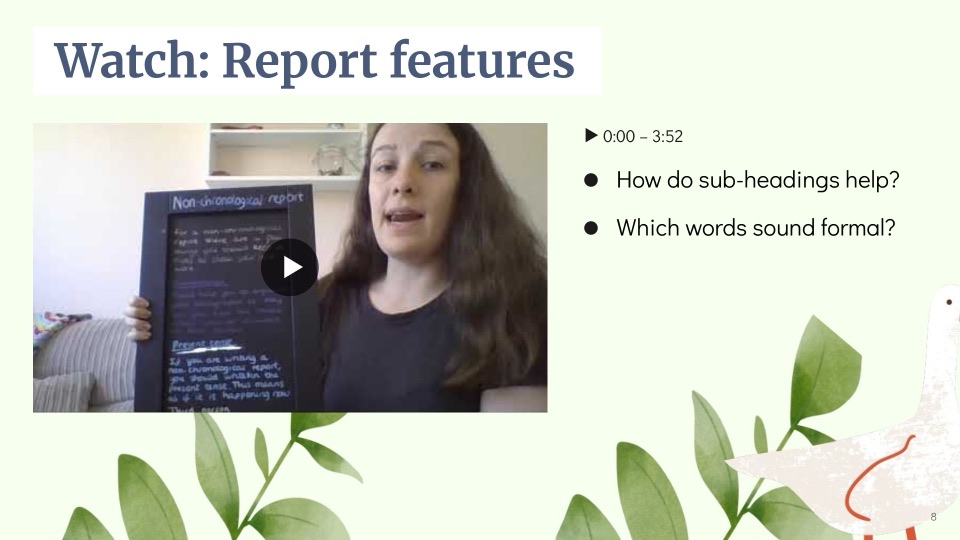
| 15 min | Guided practice | To practise together deciding which paragraph fits which sub-heading. Show Slide 7 owl photo and explain each part would need its own sub-heading. Play Video clip 6 on Slide 8 and ask how sub-headings help and which words sound formal. Model matching one bicycle paragraph to What It Looks Like by underlining clues about wheels and brakes. Ask class to vote for the next match with thumbs and justify with because. |
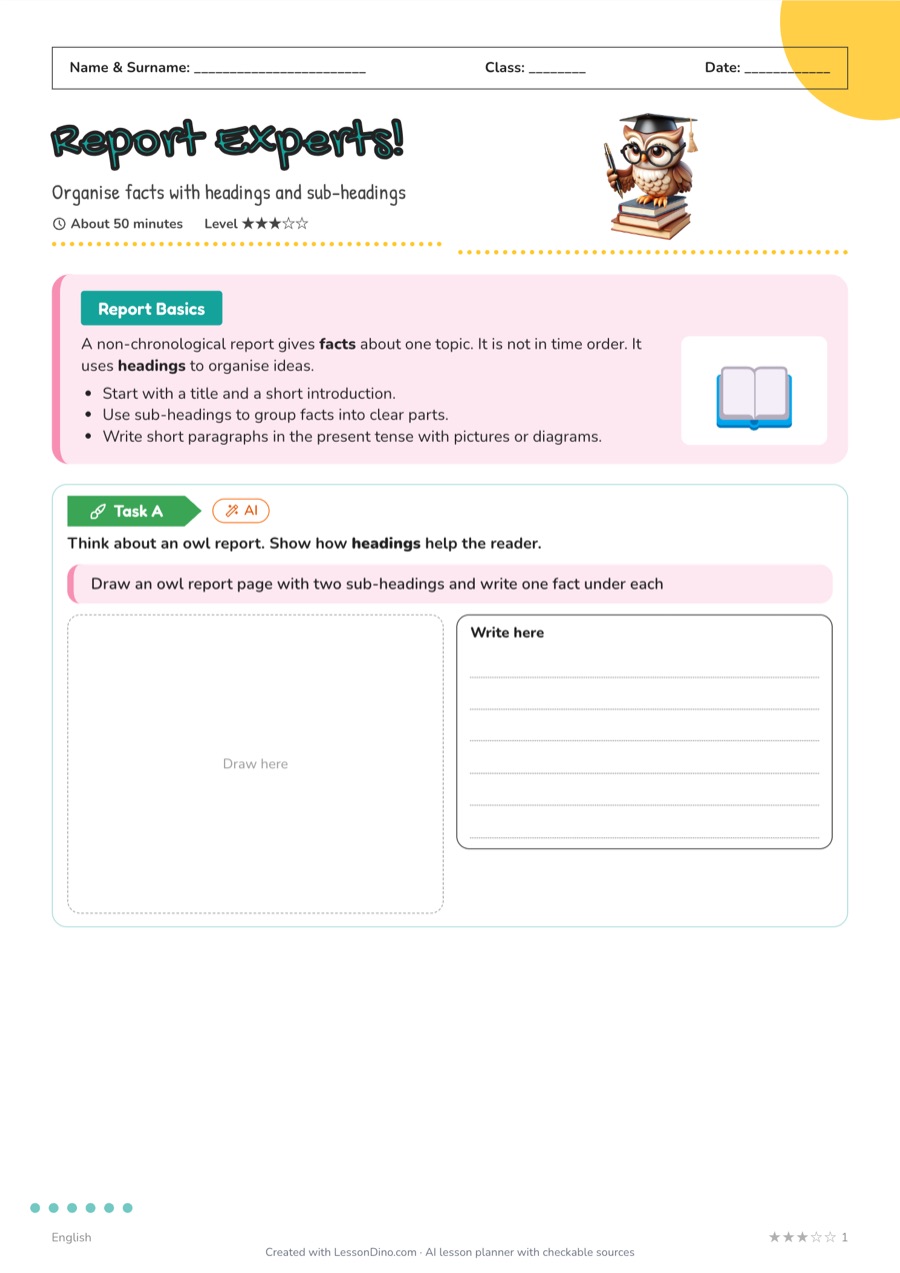
| 15 min | Main activity | To organise a jumbled report by matching paragraphs to sub-headings and laying it out clearly. Give each pair an envelope, large paper, glue sticks and scissors and remind of scissor safety. Ask pairs to tip out three jumbled paragraphs and three sub-heading strips: What It Looks Like, How It Works, Looking After It. Remind them to read each paragraph, discuss which facts belong together, then organise the page with title at top and each paragraph under its sub-heading. Stop class halfway to check one match, then let them stick down the rescued report. |
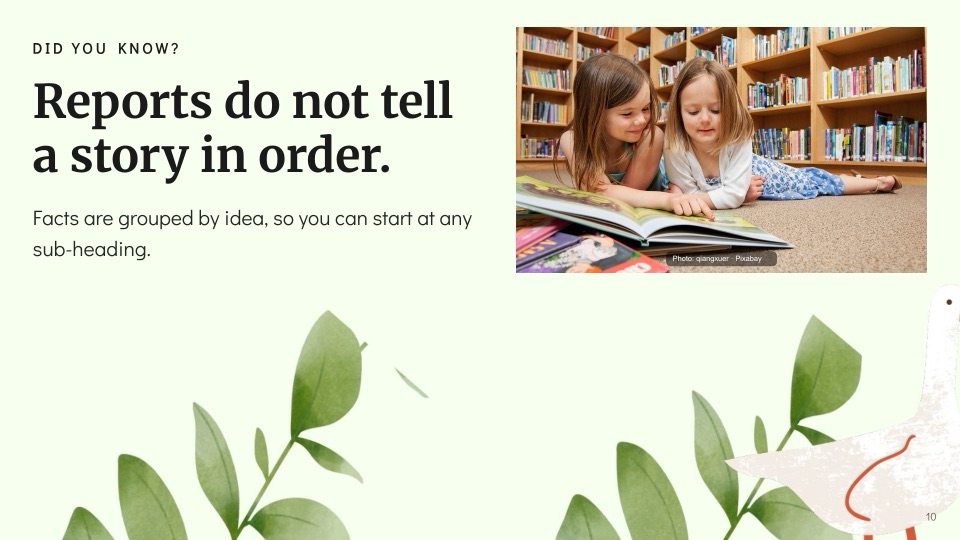
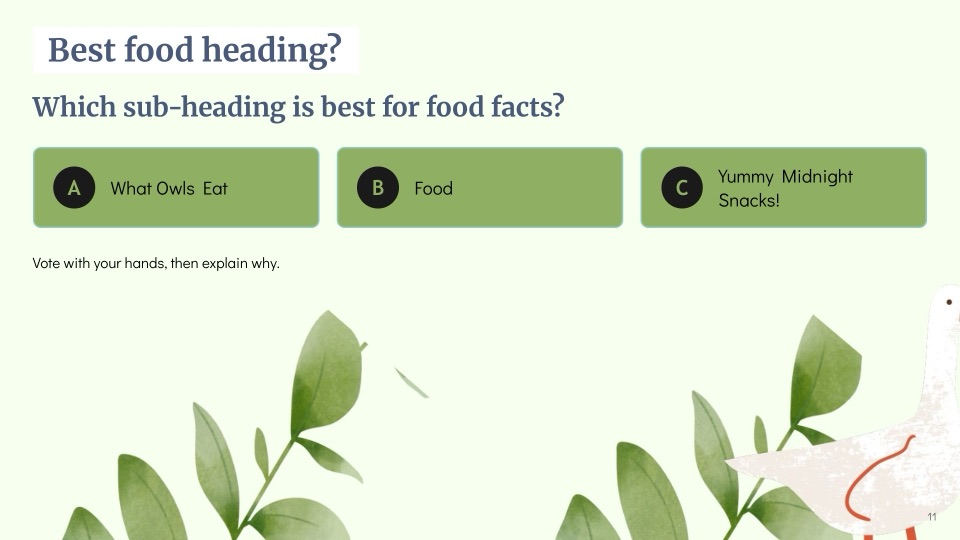
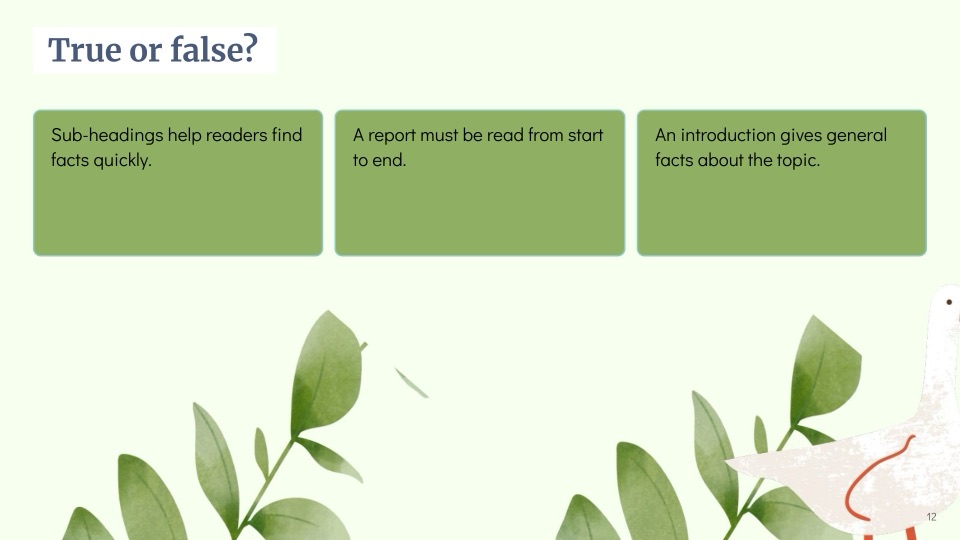
| 10 min | Plenary | To check that pupils can explain how headings help readers find facts quickly. Show Slide 10 fact that reports do not tell a story in order and facts are grouped by idea. Show Slide 11 vote and ask which sub-heading is best for food facts, sorting helpful and unhelpful piles. Show Slide 12 True or false statements and take class vote on each. Link answers back to success criteria and praise rescued layouts. |
Common mistakes
- Thinking a report must be read from start to end like a story
How to spot it: Pupil insists on numbering sections in time order
Show Slide 10: facts are grouped by idea, so you can start at any sub-heading - Putting a paragraph under the wrong sub-heading after reading one sentence only
How to spot it: Match is based on one word, other sentences do not fit
Reread all sentences and underline all clues, then ask which title tells the truth about all of them - Treating headings as decoration rather than signposts
How to spot it: Layout is random, title at bottom or sections with no titles
Remind that reports must be set out clearly with title, introduction, paragraphs and subheadings to help find facts
Support
- Give a colour-coded set where each sub-heading and its matching paragraph have the same small coloured dot in the corner.
Stretch
- Ask pupils to improve one dull sub-heading so it tells the reader more clearly what that section is about.
Check questions
- What job does a sub-heading do?
Answer: It splits text into clear parts so readers find facts quickly. - Where do general facts go and where do specific facts go?
Answer: General facts in the introduction, specific facts in sections under sub-headings. - Which layout order is correct?
Answer: Title first, introduction next, then sections under sub-headings.
Curriculum
in non-narrative material, using simple organisational devices [for example, headings and sub-headings]
Video clips
Clips on YouTube, from the start and end times we chose. Check each one before you show it.
-
Features of non-chronological reports from 0:00 to 2:55
SWECET: Week Five Year 4 Day 1 Literacy Features of non chronological reports
Made for Year 4 Day 1 Literacy so age, vocabulary and pace are perfect for 8-9-year-olds learning headings.
-
Report features with examples from 0:00 to 3:52
SDSA: Features of non-chronological reports
Clear primary-school explanation of report features that suits 8-9-year-olds learning non-narrative layout.
Worksheet
Sources
- National curriculum in England: English programmes of study assets.publishing.service.gov.uk
- English appendix 1 gov.uk
- Y4 Non-chronological report - Grammarsaurus grammarsaurus.co.uk
- KS1 / KS2 English: How to write a non-chronological report - BBC bbc.co.uk
- Non-Chronological Report ecclesallprimary.co.uk
- Non-Chronological Reports | St Thomas C of E Primary School stthomaswernethprimary.co.uk
- Features of Non-chronological Reports (Years 3-4) cgpplus.co.uk
- Structural features of a non-chronological report KS2 | Y3 ... thenational.academy
- Writing a non- chronological report - English - Learning with ... bbc.co.uk
- Non-chronological report – Best KS1/KS2 examples & resources teachwire.net
- Writing Non-Chronological Reports for KS1 and KS2 | Lesson ... teachingcave.com
- Non-fiction Lesson - Features of a Non-chronological report - Teaching ... tes.com
- Exclusive Content Ready - Bats ks1 non chronological reports staging.canadagamescentre.ca
- How to research and write a report - BBC Bitesize bbc.co.uk
- How to write an animal report - National Geographic Kids kids.nationalgeographic.com
- Non-chronological reports - Pencombe CofE School pencombe.hmfa.org.uk
- How to Write Non-chronological Reports Anchor Charts classroomstars.co.uk
Picture credits
Made with Lesson Dino's AI on 19 October 2026. AI can make mistakes, so check facts against the sources before you teach.