Slides
Lesson plan
Join It Up! Super Sentences
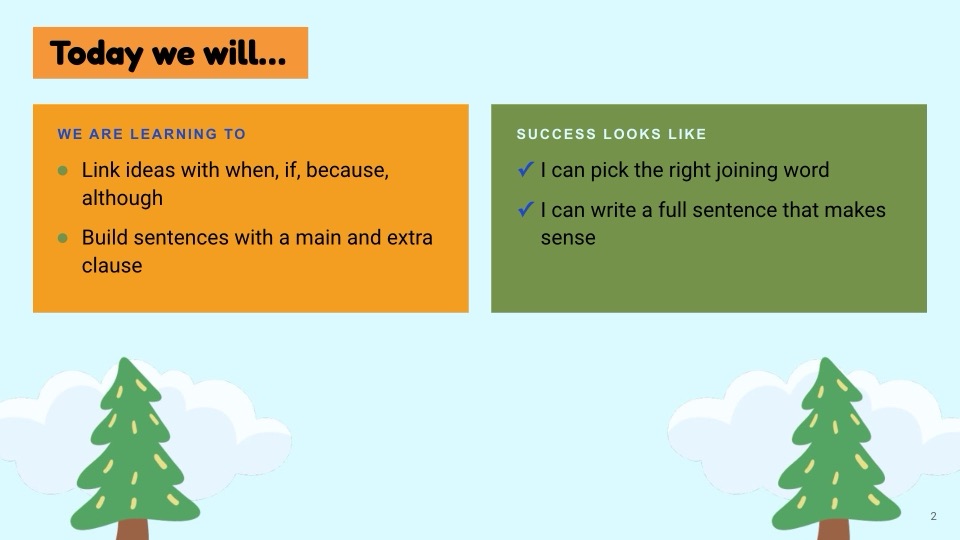
Pupils learn to link ideas with when, if, because and although. They repair short ideas into super sentences and write their own.
Objectives
- Students will join two short ideas into one sentence using when, if, because or although.
- Students will choose the best joiner to show time, condition, reason or contrast.
- Students will write super sentences with the extra part in the middle or at the start.
Success criteria
- I can pick when, if, because or although to fit the link between ideas.
- I can write a full sentence with a main part and an extra part.
- I can start a sentence with the extra part and use a comma.
Key words
| Word | Meaning |
|---|---|
| conjunction | a joining word that links two parts of a sentence |
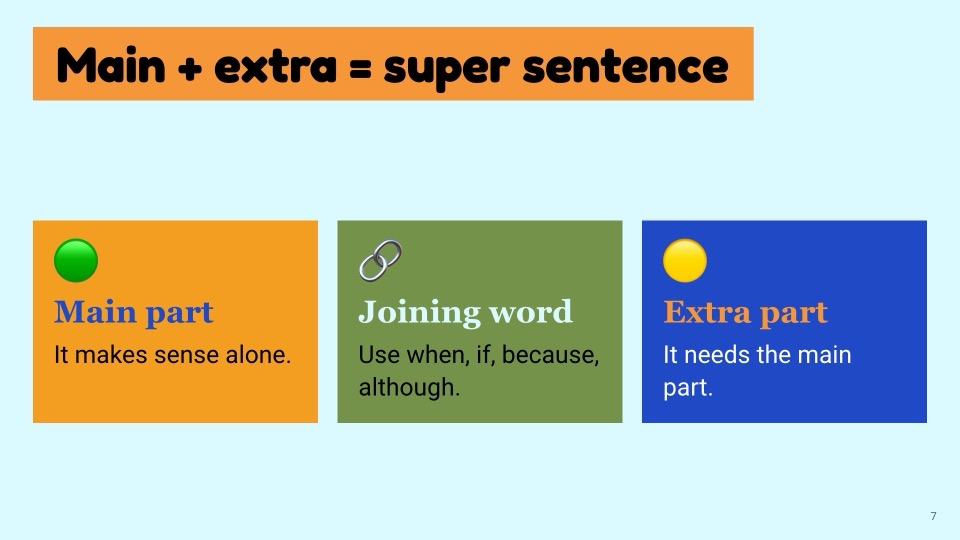
| main clause | a short idea that makes sense on its own as a sentence |
| subordinate clause | an extra idea that needs another part to make complete sense |
| although | a joining word that shows a surprise or contrast between ideas |
Timed plan (60 minutes)
| Time | Stage | What happens |
|---|---|---|
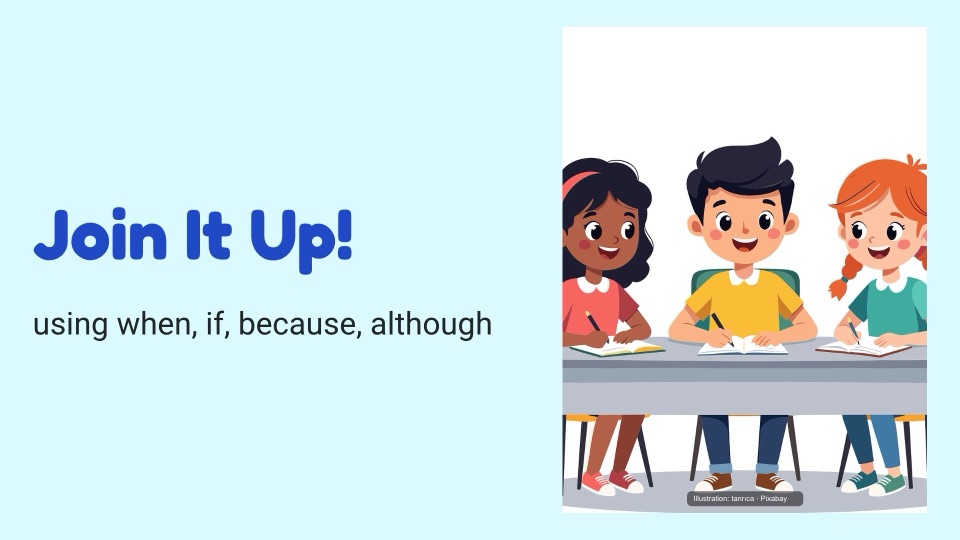
| 5 min | Starter | Hook pupils and recall that some short ideas make sense alone. Welcome the class with the hook: Nurse, we have two short sentences that need joining together! Show Slide 1 Join It Up! and Slide 2 objectives for the lesson. Do the prior check: invite three pupils to say a short idea that makes sense alone and lead a clap. Explain that today they will become sentence doctors who turn two short ideas into one strong sentence. |
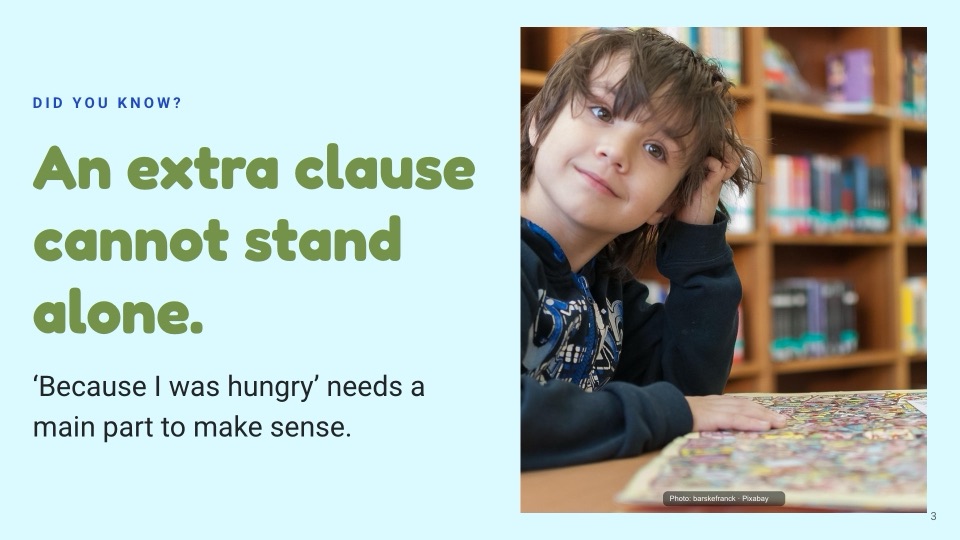
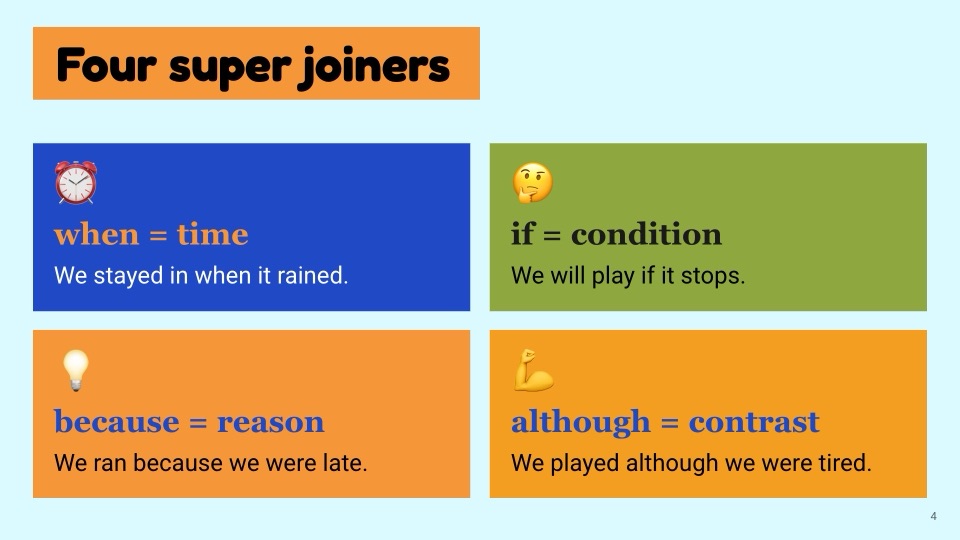
| 10 min | Teaching | Teach the four joiners and the main plus extra parts. Show Slide 3 and explain that an extra clause cannot stand alone and needs a main part to make sense. Show Slide 4 and teach the four jobs: because for reason, when for time, if for condition and although for contrast. Show Slide 7 and explain that a subordinating conjunction joins a main clause and a subordinate clause. Model as doctor with strips: The window was closed and It was raining joined with because, which introduces the subordinate clause, then underline because. |
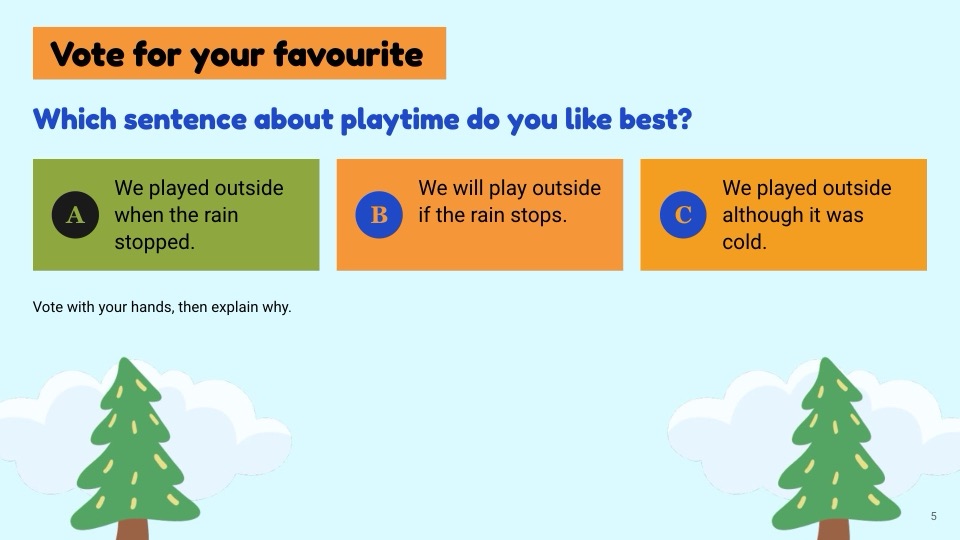
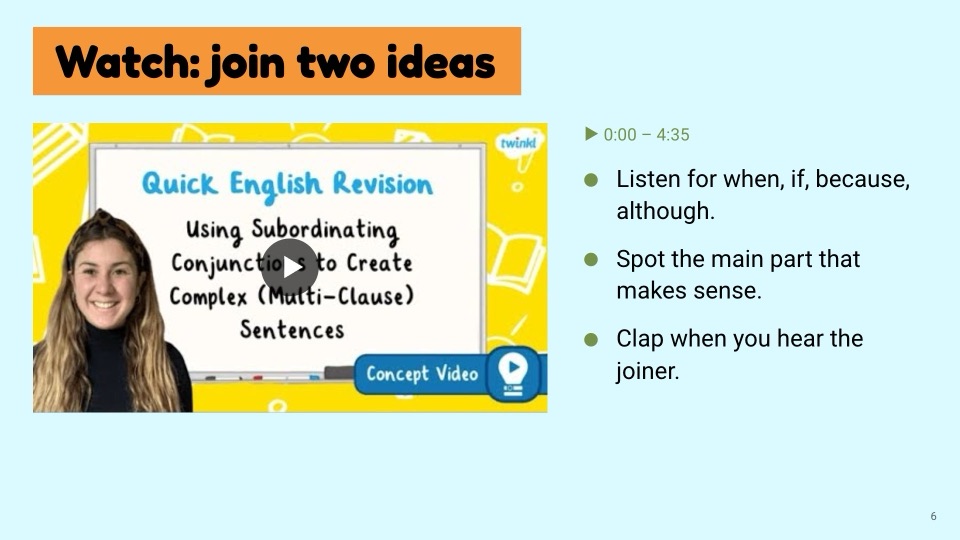
| 12 min | Guided practice | Hear joiners in sentences and practise both word orders together. Play Slide 6 Video clip 1 (0:00–4:35) and ask pupils to clap when they hear the joiner and spot the main part that makes sense. Pause to note that a subordinating conjunction can appear in the middle or at the beginning of a sentence. Model the flip: We played outside when the rain stopped becomes When the rain stopped, we played outside, pointing to the comma after the starting part. Use Slide 5 vote sentences about playtime for choral reading in both orders. |
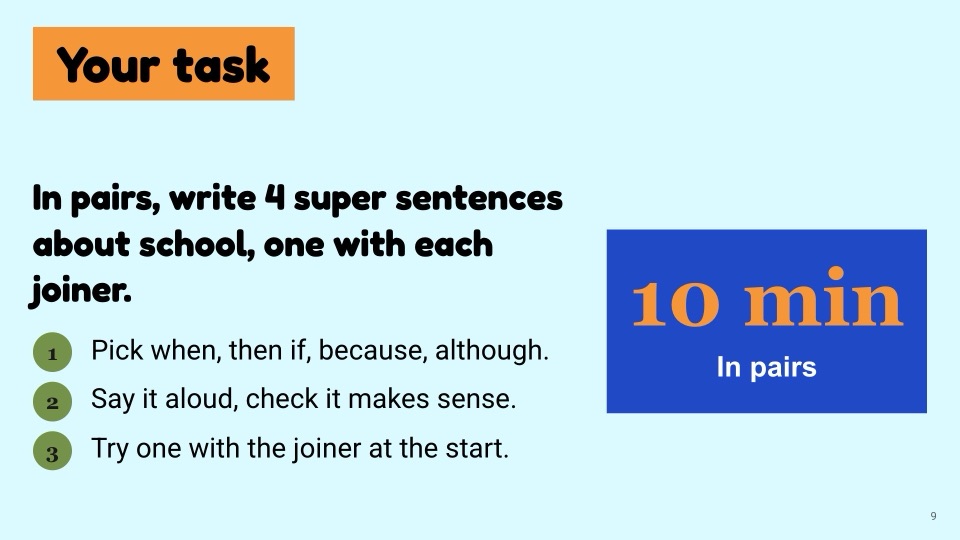
| 20 min | Main activity | Join pairs of short ideas into super sentences with the correct joiner. Set out hospital tables with these strip sets: We stayed inside / it rained; We will play outside / the rain stops; We put on coats / it was cold; We played outside / it was windy. Remind pupils that common subordinating conjunctions include because, although, if, when and while and they must pick the link that makes sense. Model picking two matching strips, choosing the joiner, gluing the longer sentence and underlining the conjunction. Show Slide 9 task: pick when, then if, because, although, say it aloud to check it makes sense, and try one with the joiner at the start. |
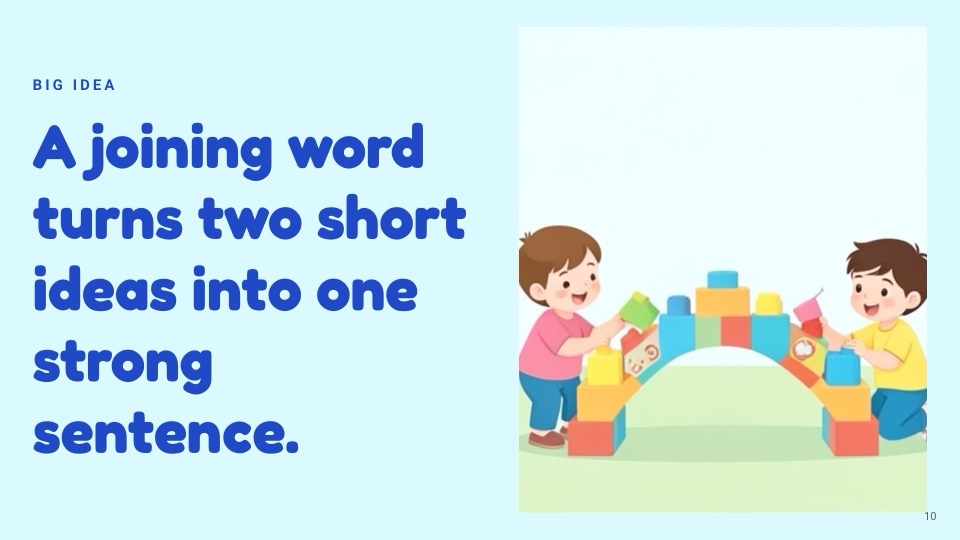
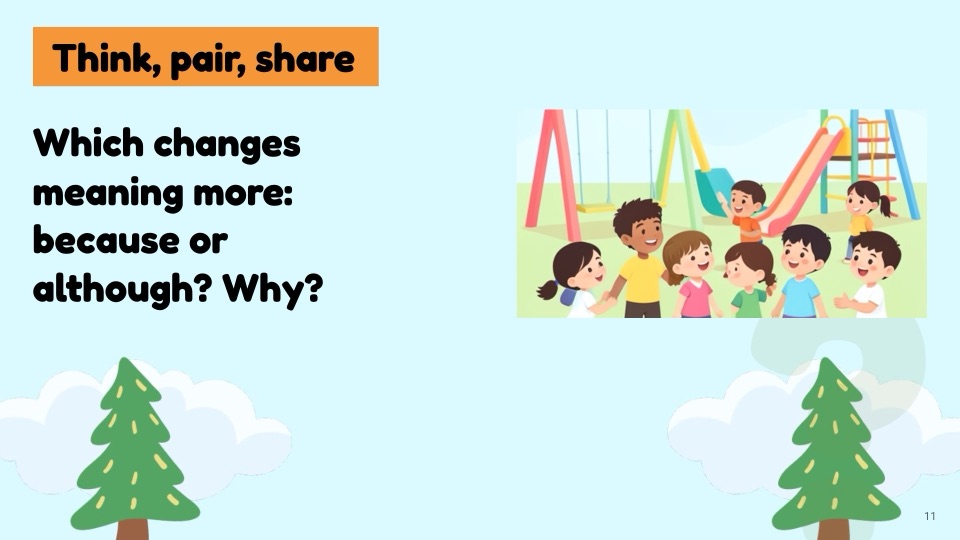
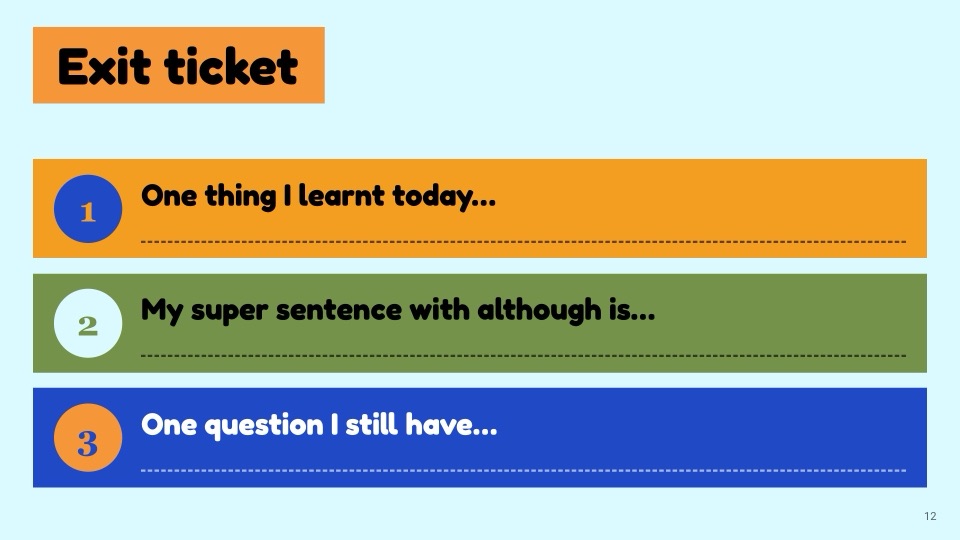
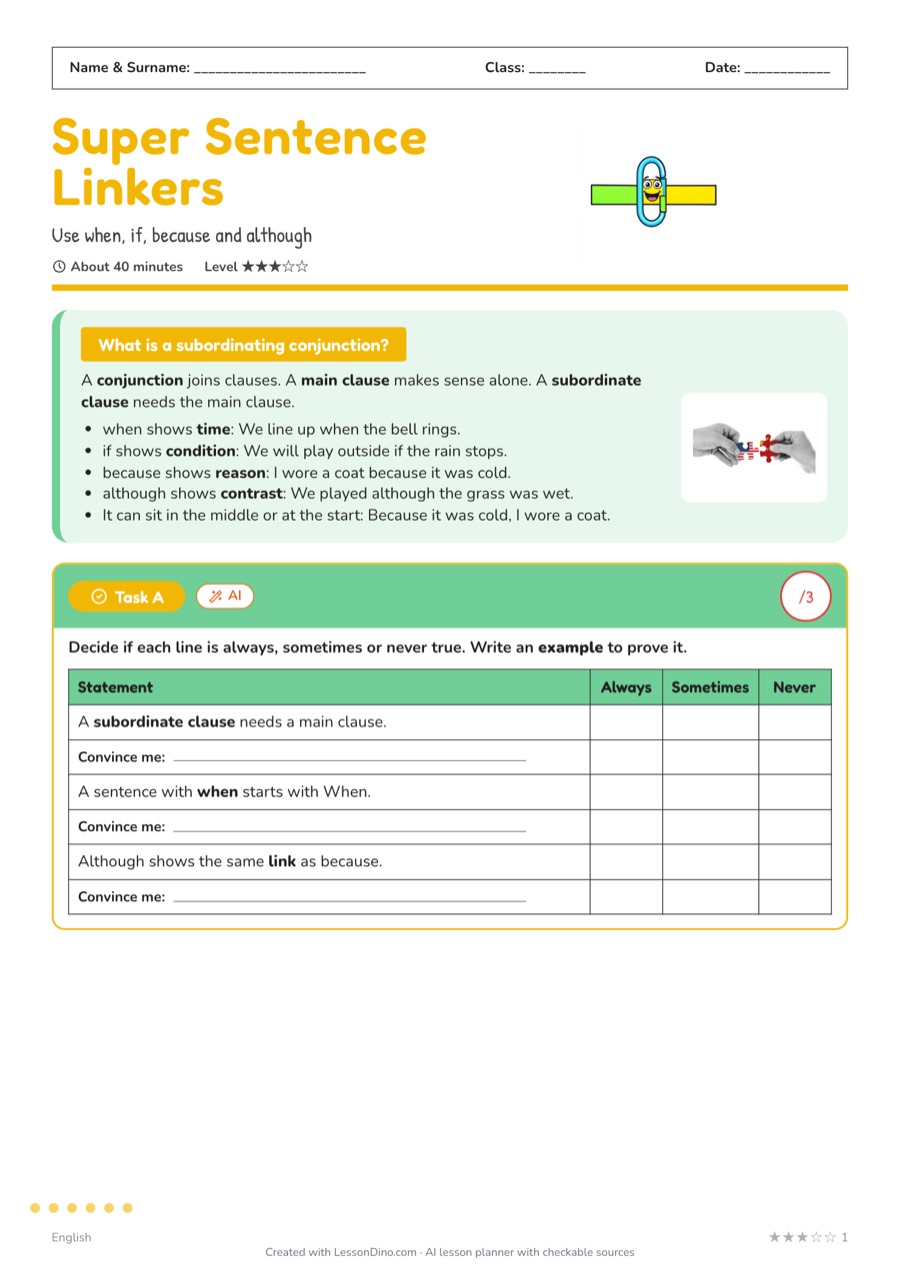
| 13 min | Plenary | Compare because and although and check all can build super sentences. Show Slide 10: a joining word turns two short ideas into one strong sentence, and remind pupils that the conjunction shows the link between the two clauses. Lead Slide 11 Think, pair, share: compare We wore coats because it was cold with We wore coats although it was cold and ask which changes meaning more. Hand out Worksheet Task E and ask pupils to number the steps in order to build a sentence with two clauses. Use Slide 12 exit ticket to collect one super sentence with although and one question. |
Common mistakes
- Writing the extra part alone as a sentence, e.g. Because I was hungry.
How to spot it: Pupil reads Because I was hungry and stops, thinking it is complete.
Show it does not make sense on its own and must be added to a main clause to complete the idea; clap the main part only. - Using because for every sentence.
How to spot it: All glued sentences use because even for time or surprise links.
Ask what the link is: time, condition, reason or contrast, and push when, if and although as well as because. - Mixing up although and but and trying to swap them.
How to spot it: Pupil writes Although she was tired but she kept reading or puts although where but should go.
Explain but links two clauses as an equal pair, while although introduces a subordinate clause; practise Although she was tired, she kept reading with a comma.
Support
- Provide sentence frames with the conjunction already printed in the middle, so pupils only add the endings.
- Give pre-cut clause strips, word banks and talk stems for choosing and justifying the joiner.
Stretch
- Ask pupils to rewrite the same repaired sentence starting with the subordinate clause and add the comma.
- Challenge pupils to change one caption to although to create a surprise ending and explain the new meaning.
Check questions
- We stayed inside ___ it rained. Which joiner shows reason?
Answer: because, because it answers why. - Is If the rain stops a complete sentence on its own?
Answer: No, the extra part needs the main part to make sense. - Write a super sentence with although about playing outside.
Answer: e.g. We played outside although it was windy, or Although it was windy, we played outside.
Curriculum
extending the range of sentences with more than one clause by using a wider range of conjunctions, including: when, if, because, although
Video clips
Clips on YouTube, from the start and end times we chose. Check each one before you show it.
-
using conjunctions in multi-clause sentences from 0:00 to 4:35
Twinkl Educational Publishing: How Do You Use Subordinating Conjunctions? | KS2 English Concept for Kids
Made for KS2 pupils aged 7-11 so pace and language suit Year 4 age 8-9, and it directly teaches main and subordinate clauses with when, if, because, although.
-
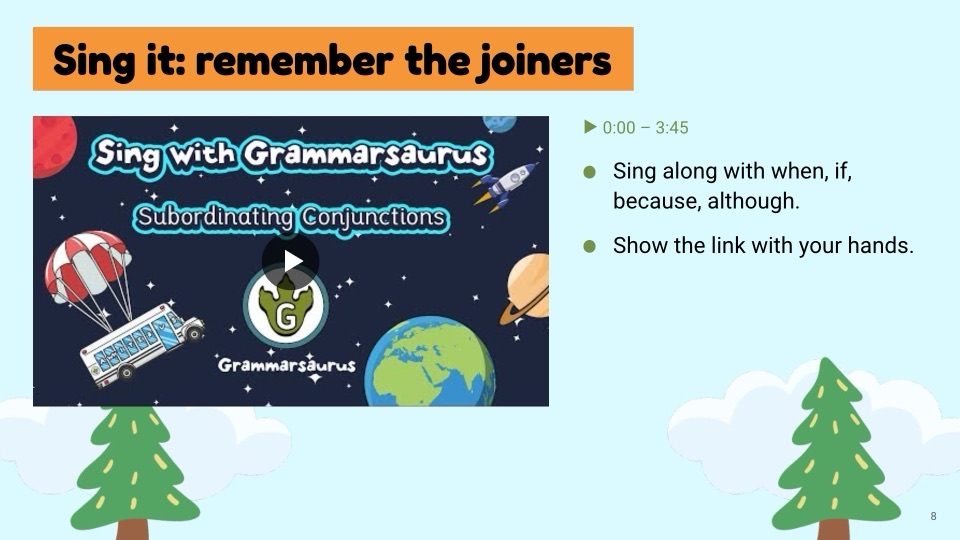
A WHITE BUS song from 0:00 to 3:45
Grammarsaurus: Sing with Grammarsaurus - Subordinating Conjunctions (A WHITE BUS)
Catchy UK Grammarsaurus song made for KS2 age 7-11 so perfect for Year 4 age 8-9 to remember subordinating conjunctions including when, if, because, although.
Worksheet
Sources
- English programmes of study: key stages 1 and 2 - GOV.UK assets.publishing.service.gov.uk
- glossary gov.uk
- What are subordinating conjunctions? - KS2 English - BBC Bitesize bbc.co.uk
- What are subordinating conjunctions? - BBC Bitesize bbc.co.uk
- Subordinating conjunctions | British Council - TeachingEnglish africa.teachingenglish.org.uk
- Subordinating Conjunctions: KS2 List and Teaching Tips resourcefully.co.uk
- What are subordinating conjunctions? - KS2 English - BBC bbc.co.uk
- Conjunctions for Kids | Learn about coordinating, correlative ... classx.org
- Subordinating Conjunctions | Learn about how to use ... kidvideo.org
- Subordinating Conjunctions – Definition and Examples for Kids planetspark.in
- Subordinating Conjunction - smartboardingschool.com smartboardingschool.com
- Subordinating Conjunctions Video - Turtle Diary turtlediary.com
- Subordinating Conjunctions - Complete Lesson with Activities tes.com
- Coordinating vs Subordinating Conjunctions: Easy Beginner ... lingoharvest.com
- BYJU'S Online learning Programs For K3, K10, K12, NEET, JEE ... byjus.com
- What is a Subordinating Conjunction? | English | Teaching Wiki twinkl.co.uk
Picture credits
- Illustration: tanrıca · Pixabay
- Photo: barskefranck · Pixabay
- AI illustration · Cloudflare
- Illustration: Henrix_photos · Pixabay
Made with Lesson Dino's AI on 19 October 2026. AI can make mistakes, so check facts against the sources before you teach.