Slides
Lesson plan
Silly Sentences with Prefixes and Suffixes
Pupils learn how to add prefixes and suffixes to root words. They build new words and use them in silly sentences.
Objectives
- Students will build new words with un-, dis-, mis-, -ful, -less and -ness.
- Students will explain the spelling rules for joining prefixes and suffixes.
- Students will use new prefix and suffix words correctly in sentences.
Success criteria
- I can build four new words from a root word.
- I can join prefixes and suffixes with correct spelling.
- I can use two new words correctly in a sentence.
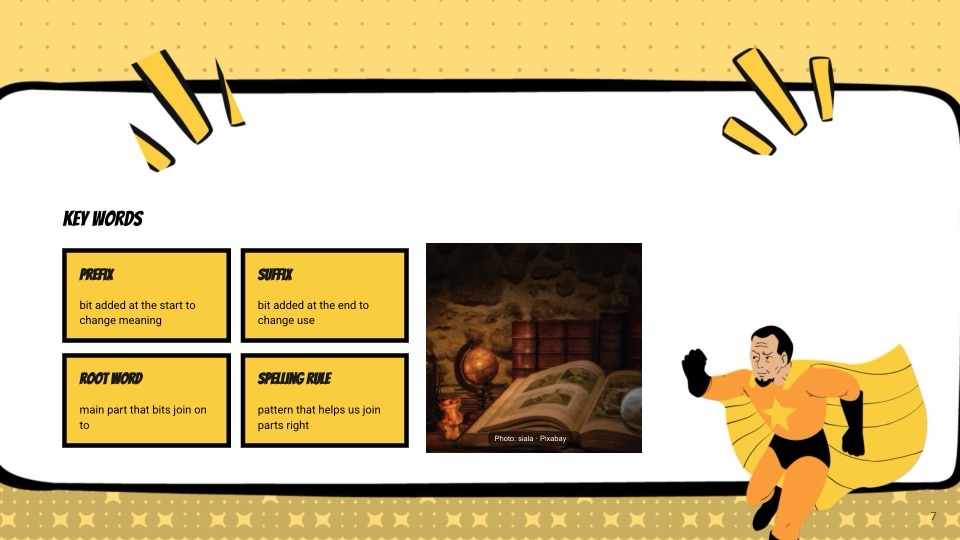
Key words
| Word | Meaning |
|---|---|
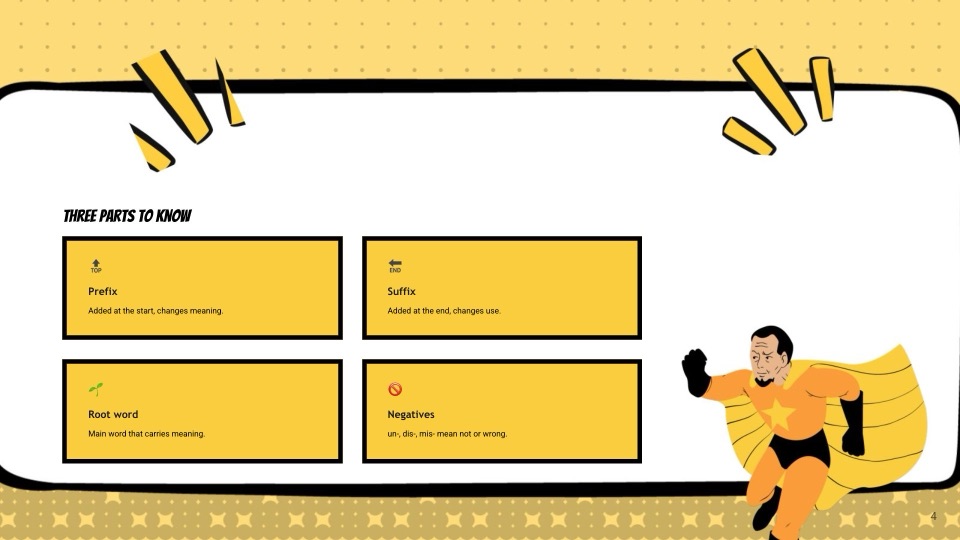
| prefix | small bit joined to the front of a word to change what it means |
| suffix | small bit joined to the end of a word to change how it is used |
| root word | main part of a word that carries the basic meaning |
| spelling rule | agreed way to join bits to a main word without mistakes |
Timed plan (60 minutes)
| Time | Stage | What happens |
|---|---|---|
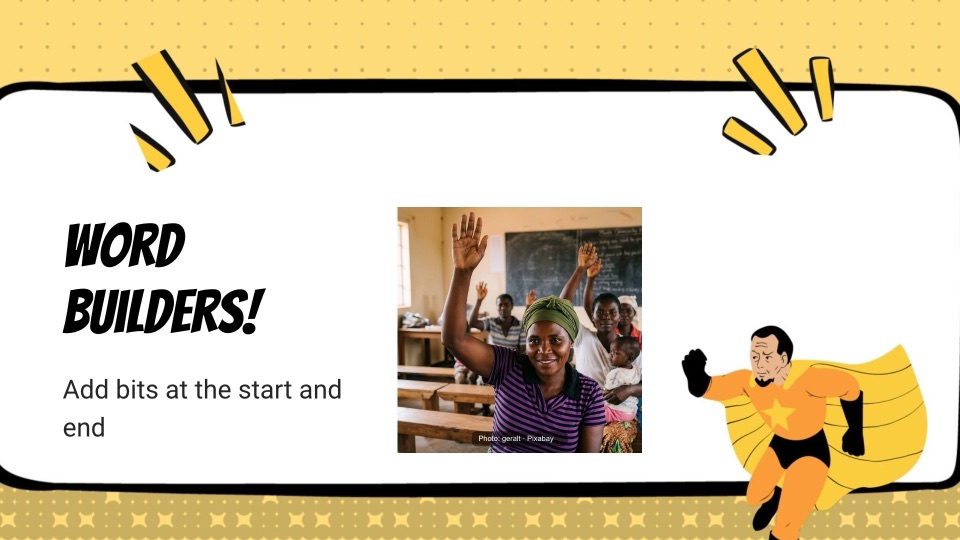
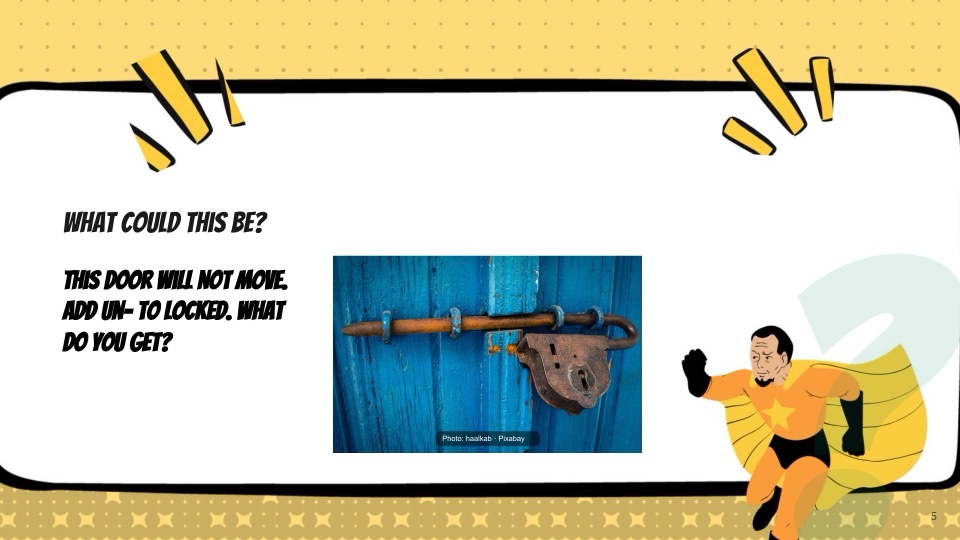
| 10 min | Starter | To recall prefix, suffix and root word and hook pupils into word building. Show Slide 1 Word Builders! Add bits at the start and end and give the hook: Let's make the silliest sentence in Year 4 - but every silly word still has to be spelt perfectly. Show Slide 4 cards for prefix, suffix and root word and ask pupils to point to head for start, toes for end, tummy for main part. Show Slide 5 mystery: This door will not move. Add un- to locked. What do you get? Model splitting unlocked into un + locked. Take answers and fix meaning: un- means not, so unlocked means not locked. |
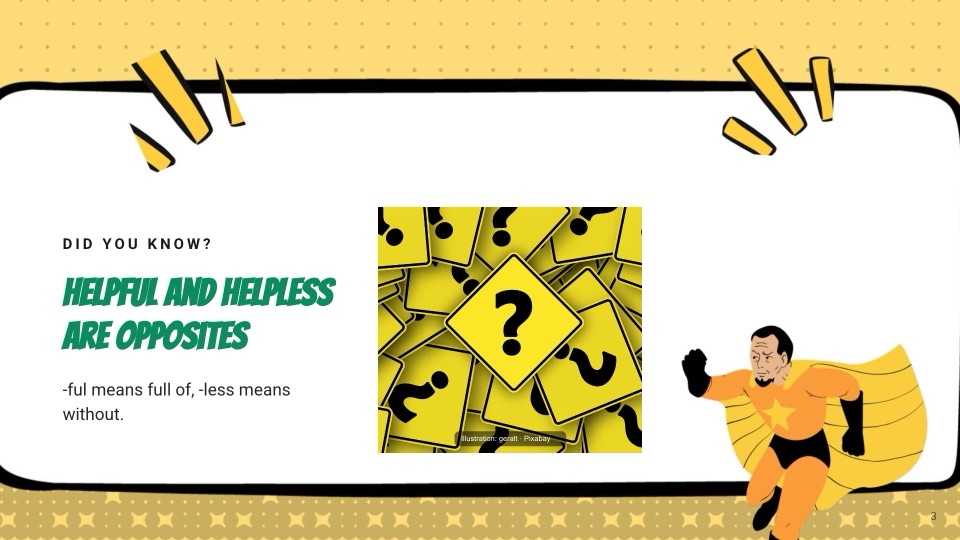
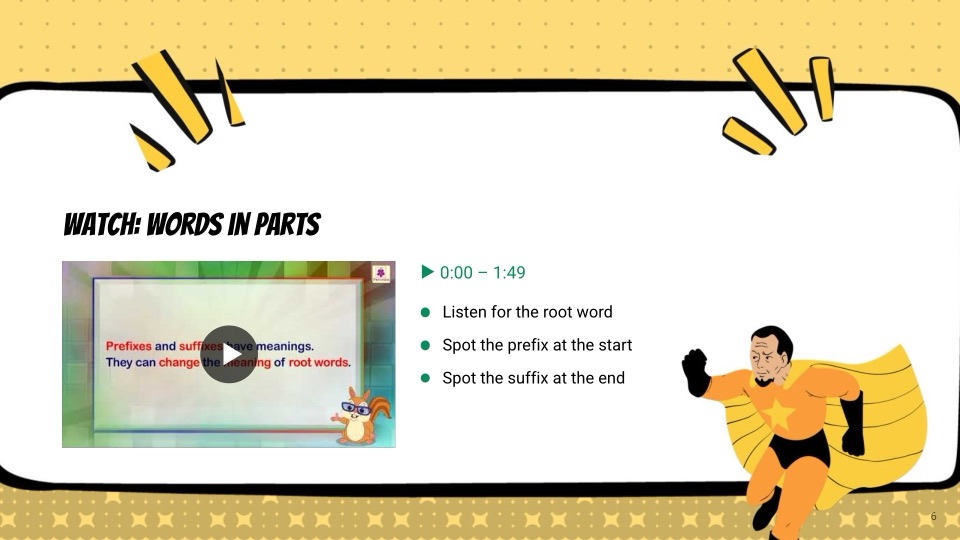
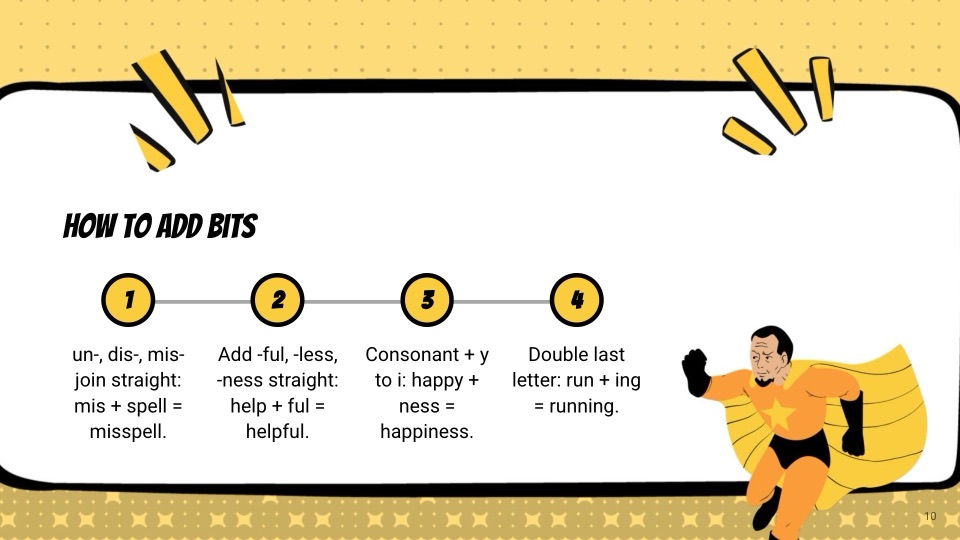
| 15 min | Teaching | To model how to add prefixes and suffixes with correct spelling. Play Video clip 1 and ask pupils to listen for the root word and spot the bit at the start and the bit at the end. Show Slide 10 steps and model three joins on the board, underlining the join. Show Slide 2 and Slide 3 to fix two key facts with examples. Think aloud the y to i check: look at letter before y, count syllables, then change or keep. |
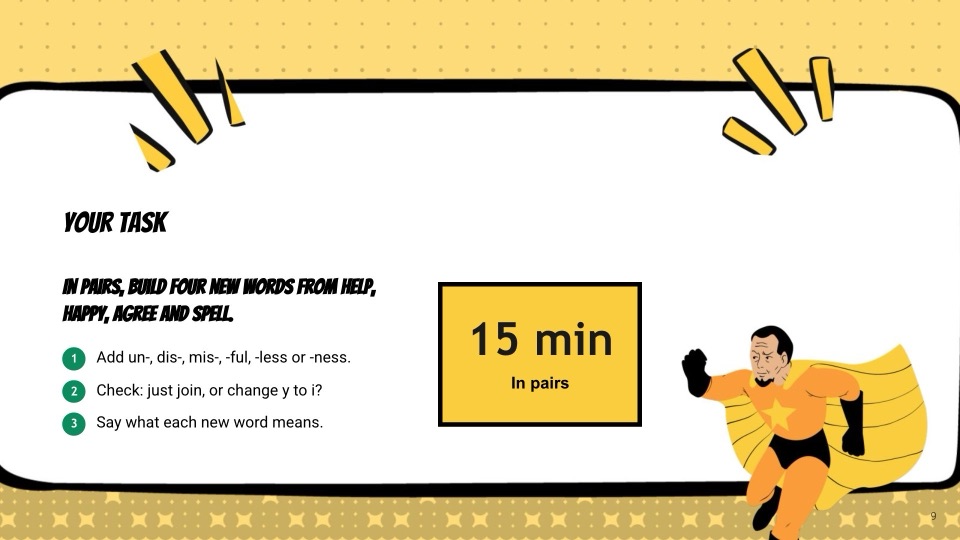
| 20 min | Main activity | To build prefix and suffix words and use them correctly in a silly sentence. Show Slide 9 task: Add un-, dis-, mis-, -ful, -less or -ness. Check: just join, or change y to i? Say what each new word means. Give each pair prefix cards, suffix cards and a sentence frame sheet; remind them most prefixes are added without changes in spelling. Circulate, ask pairs to prove spelling by pointing to the root inside each long word. Choose two pairs to read aloud for the plenary vote. |
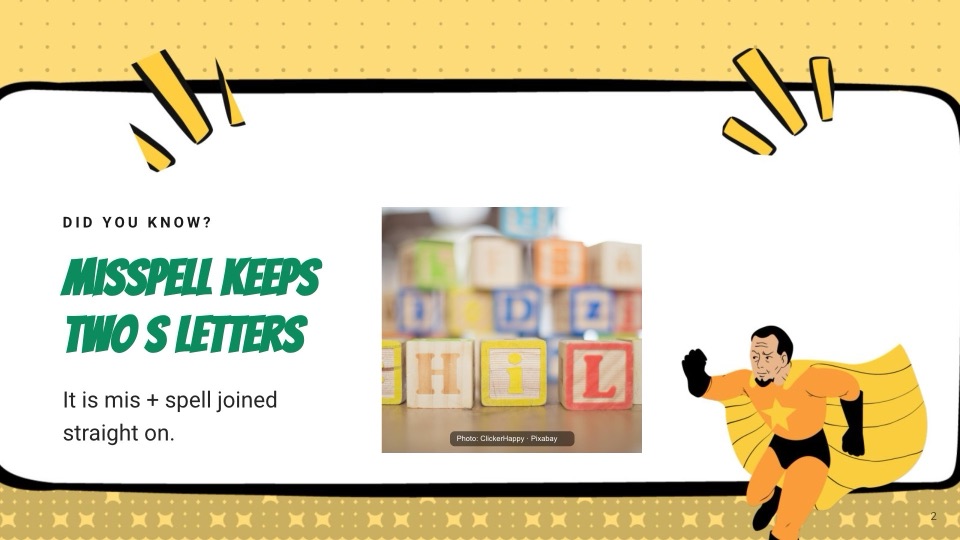
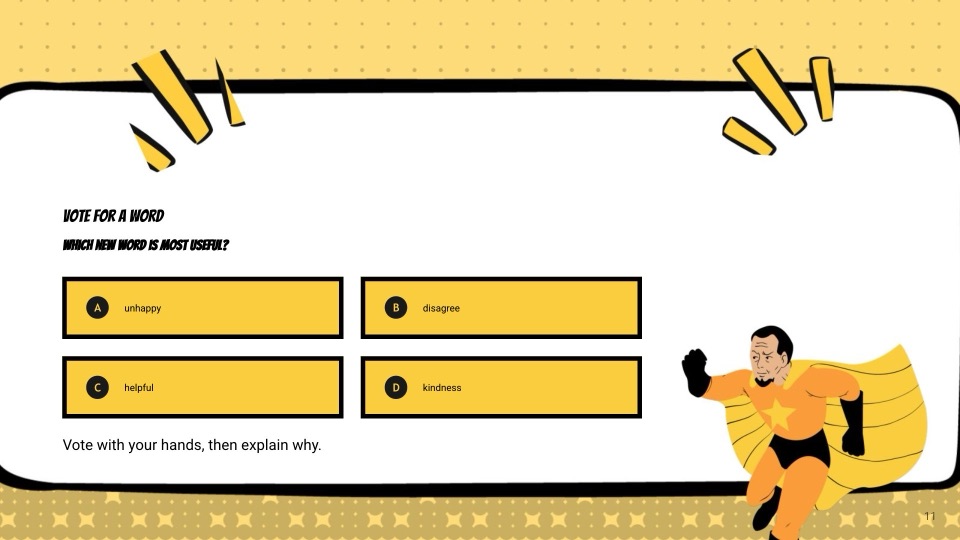
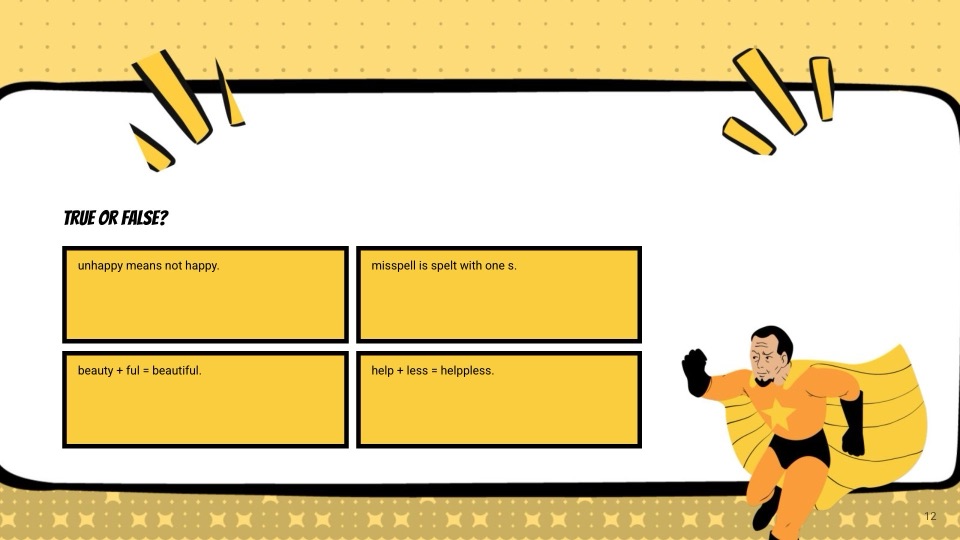
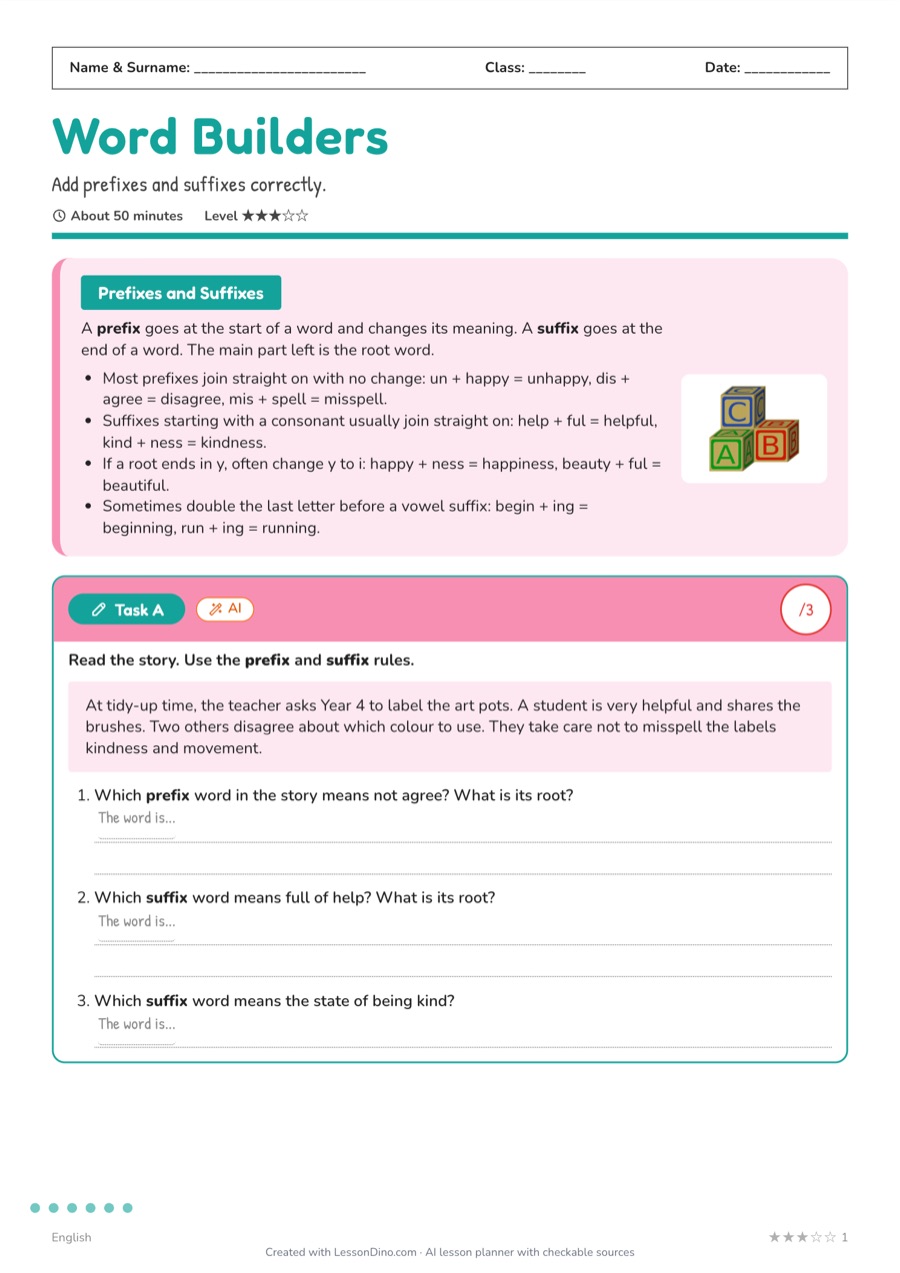
| 15 min | Plenary | To check spelling rules and meanings and celebrate useful new words. Hear two silly sentences; class points to roots and checks joins. Show Slide 11 vote: Which new word is most useful? unhappy, disagree, helpful, kindness. Tally and ask why. Do Worksheet Task C together: tick the correct spelling, remembering the rules. Show Slide 12 true or false to close: unhappy means not happy, mis + spell keeps both s letters. |
Common mistakes
- Writing misspell with one s
How to spot it: Spelling shows mispell in books or on boards
Split to mis + spell and keep both s letters because prefixes join straight. - Adding -ness or -ful without changing y to i, e.g. happyness
How to spot it: y still in longer word with consonant before it
Check consonant before y and syllables: happy > happi + ness = happiness. - Mixing up -ful and -less meanings
How to spot it: Says helpless means full of help
Teach as opposites from same root: -ful means full of, -less means without.
Support
- Give only un- and dis- with spoken roots first to build unhappy, unfair, disagree and dislike.
- Limit suffix choice to help, care and hope with frames: Someone helpful will... and Without help...
Stretch
- Challenge pupils to build two words from same root, such as behave, misbehave and behaviour, and explain both.
- Challenge pupils to add a sentence using -ly or -ness with same root, such as helpfully or helplessness.
Check questions
- Add dis- to agree. Spell it and say what it means.
Answer: disagree, means not agree. - Add -ness to happy. Spell it and explain the change.
Answer: happiness, happy > happi + ness, y to i. - What is the root in helpless and what does helpless mean?
Answer: help, means without help.
Curriculum
use further prefixes and suffixes and understand how to add them
Video clips
Clips on YouTube, from the start and end times we chose. Check each one before you show it.
-
Roots, Prefixes and Suffixes from 0:00 to 1:49
Periwinkle: Roots - Prefixes and Suffixes | English Grammar & Composition Grade 4 | Periwinkle
Made for Grade 4 so vocabulary, pace and examples are perfect for Year 4 ages 8-9 and it covers prefixes, suffixes and root words together.
-
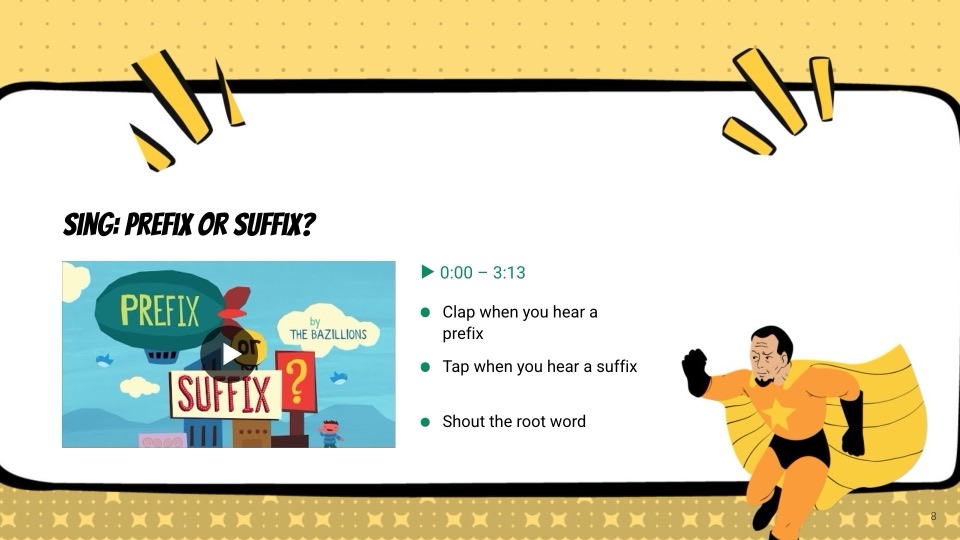
Prefix or Suffix song from 0:00 to 3:13
TheBazillions: "Prefix or Suffix?" by The Bazillions
Catchy song clearly shows the difference between a prefix and a suffix with pace and humour that suit ages 8-9.
Worksheet
Sources
- English appendix 1 gov.uk
- Year 4 Curriculum – Woolmore Primary School woolmore.towerhamlets.sch.uk
- What are prefixes and suffixes? - BBC Teach bbc.co.uk
- Word Formation in English — Prefixes & Suffixes | ELS elitelanguage.co.uk
- Prefixes and Suffixes Teaching Resources and Printables for ... sparklebox.co.uk
- Prefixes and Suffixes Introduction - How to Spell howtospell.co.uk
- Prefixes and suffixes - KS2 English - BBC Bitesize bbc.co.uk
- Prefixes and suffixes - KS1 English - BBC Bitesize bbc.co.uk
- Prefixes and Suffixes: A Complete Grammar Guide for Kids planetspark.in
- What Are Prefixes and Suffixes? – Explained for Kids smartonlinegames.com
- Prefixes and Suffixes List: Meanings and Examples (K-5) whatihavelearnedteaching.com
- The Complete Guide to Teaching Prefixes and Suffixes teachingwithamountainview.com
- Identify Prefixes, Suffixes, and Base Words - Kids Academy kidsacademy.mobi
- Prefixes And Suffixes Worksheets With Answers (Free Printable ... atozworksheet.com
- Prefixes and suffixes: Definition, List and Examples englishan.com
Picture credits
- Photo: geralt · Pixabay
- Photo: ClickerHappy · Pixabay
- Illustration: geralt · Pixabay
- Photo: haalkab · Pixabay
- Photo: siala · Pixabay
- Illustration: Clker-Free-Vector-Images · Pixabay
- Microsoft Fluent Emoji (MIT)
- Pictograms: Sergio Palao, ARASAAC (arasaac.org) · CC BY-NC-SA
Made with Lesson Dino's AI on 17 October 2026. AI can make mistakes, so check facts against the sources before you teach.