The worksheet
About this worksheet
Pupils learn how headings and sub-headings organise facts. They rebuild a jumbled bicycle report. This Year 4 English worksheet gives students (ages 8–9) five pages of practice on non-chronological reports, part of the writing unit. It goes with our free Non-chronological reports lesson, which has the slides and a timed lesson plan.
What it covers
By the end, students should be able to:
- Students will explain how headings and sub-headings help readers find facts fast.
- Students will match paragraphs of facts to the correct headings and sub-headings.
How to use it
- Use it for practice after the teaching part of the lesson, once students have seen the worked examples on the slides.
- Support: Give a colour-coded set where each sub-heading and its matching paragraph have the same small coloured dot in the corner.
- Stretch: Ask pupils to improve one dull sub-heading so it tells the reader more clearly what that section is about.
- The answer sheet is the last page, so you can print it on its own or let students check their own work.
Key vocabulary
- non-chronological: not in time order, grouped by idea instead
- introduction: starting part that says in a general way what the topic is about
- heading: big title that names the topic or a part
- sub-heading: smaller title over a part that shows what those facts are about
- paragraph: group of sentences about one small idea
Mistakes to watch for
- Thinking a report must be read from start to end like a story. Show Slide 10: facts are grouped by idea, so you can start at any sub-heading.
- Putting a paragraph under the wrong sub-heading after reading one sentence only. Reread all sentences and underline all clues, then ask which title tells the truth about all of them.
- Treating headings as decoration rather than signposts. Remind that reports must be set out clearly with title, introduction, paragraphs and subheadings to help find facts.
What's on the worksheet
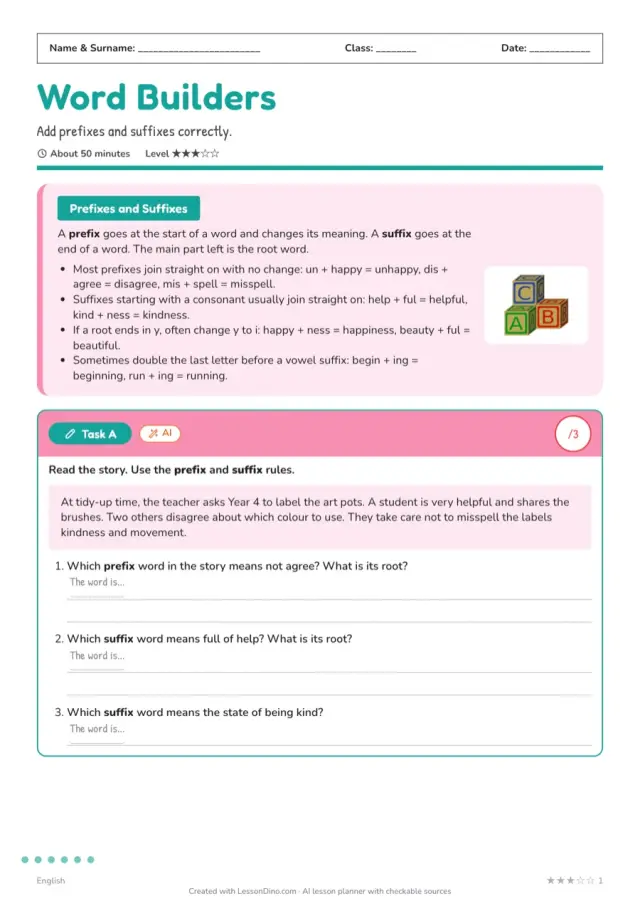
What Is Report?
Learn what makes a non-chronological report special.
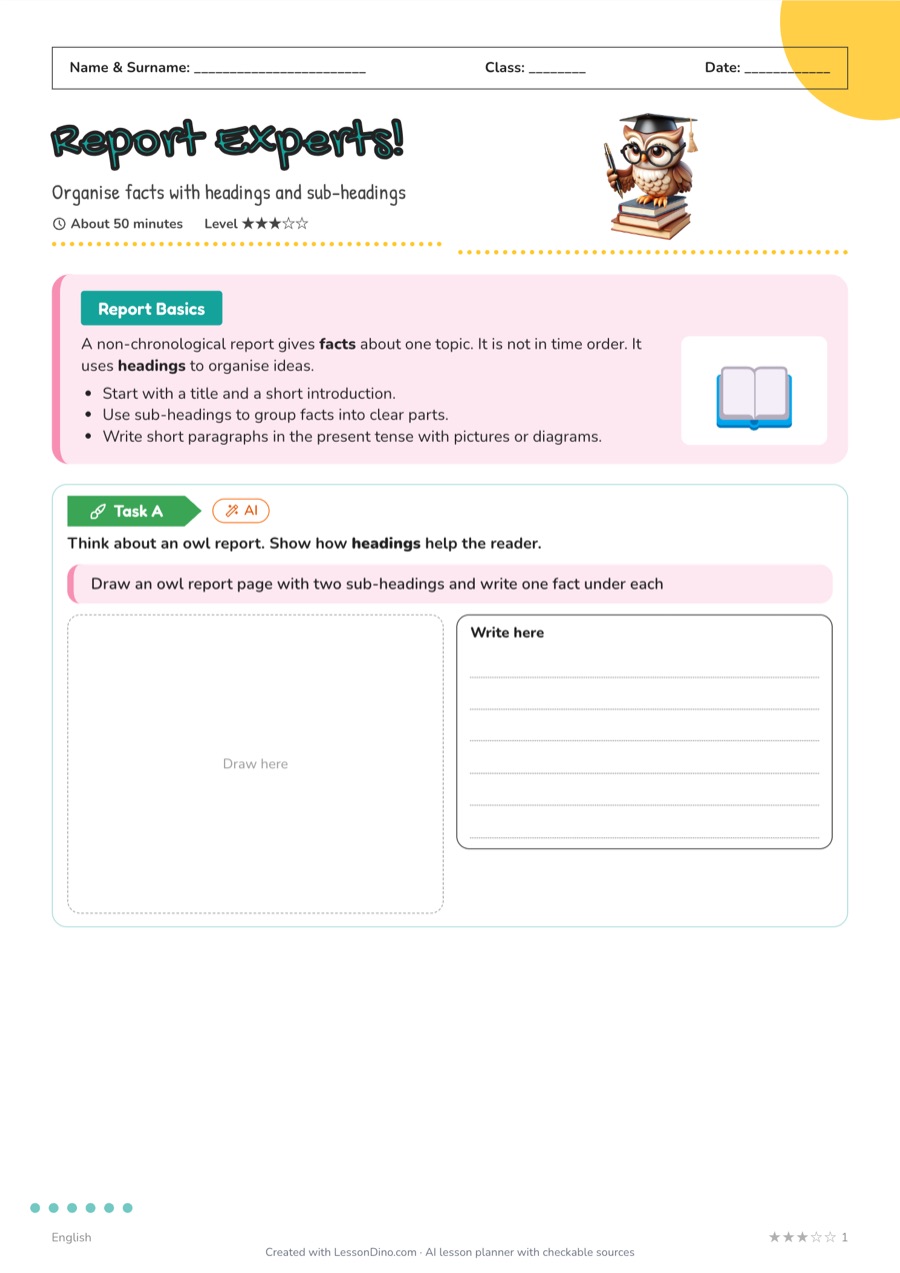
Report Basics
- A non-chronological report gives facts about one topic. It is not in time order. It uses headings to organise ideas.
- Start with a title and a short introduction.
- Use sub-headings to group facts into clear parts.
- Write short paragraphs in the present tense with pictures or diagrams.
Think about an owl report. Show how headings help the reader.
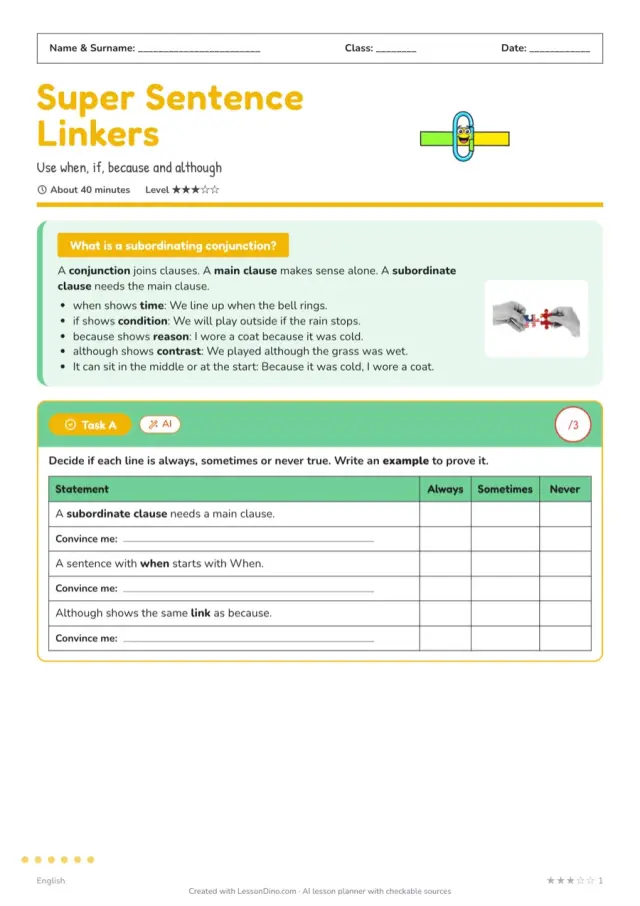
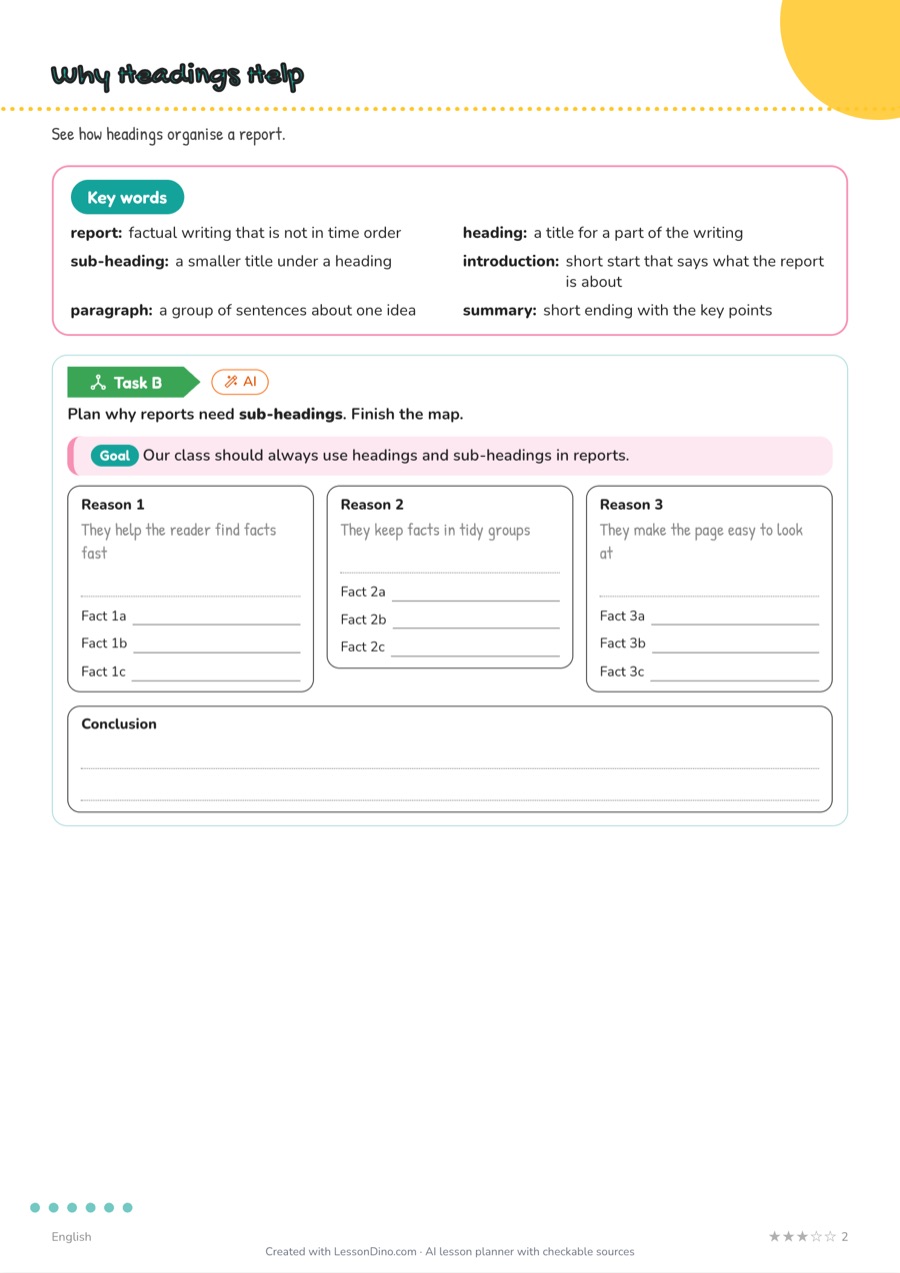
Why Headings Help
See how headings organise a report.
| Word | Meaning |
|---|---|
| report | factual writing that is not in time order |
| heading | a title for a part of the writing |
| sub-heading | a smaller title under a heading |
| introduction | short start that says what the report is about |
| paragraph | a group of sentences about one idea |
| summary | short ending with the key points |
Plan why reports need sub-headings. Finish the map.
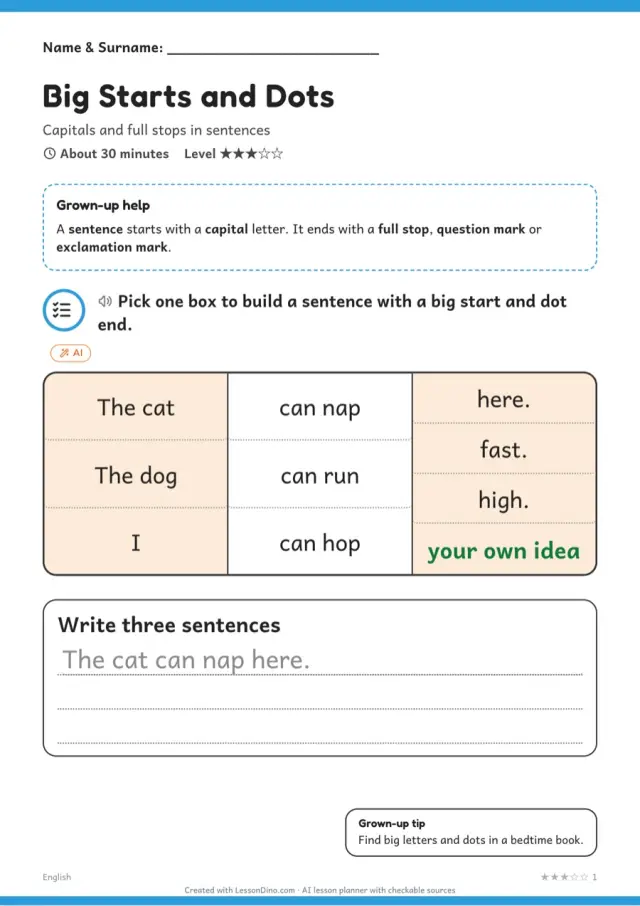
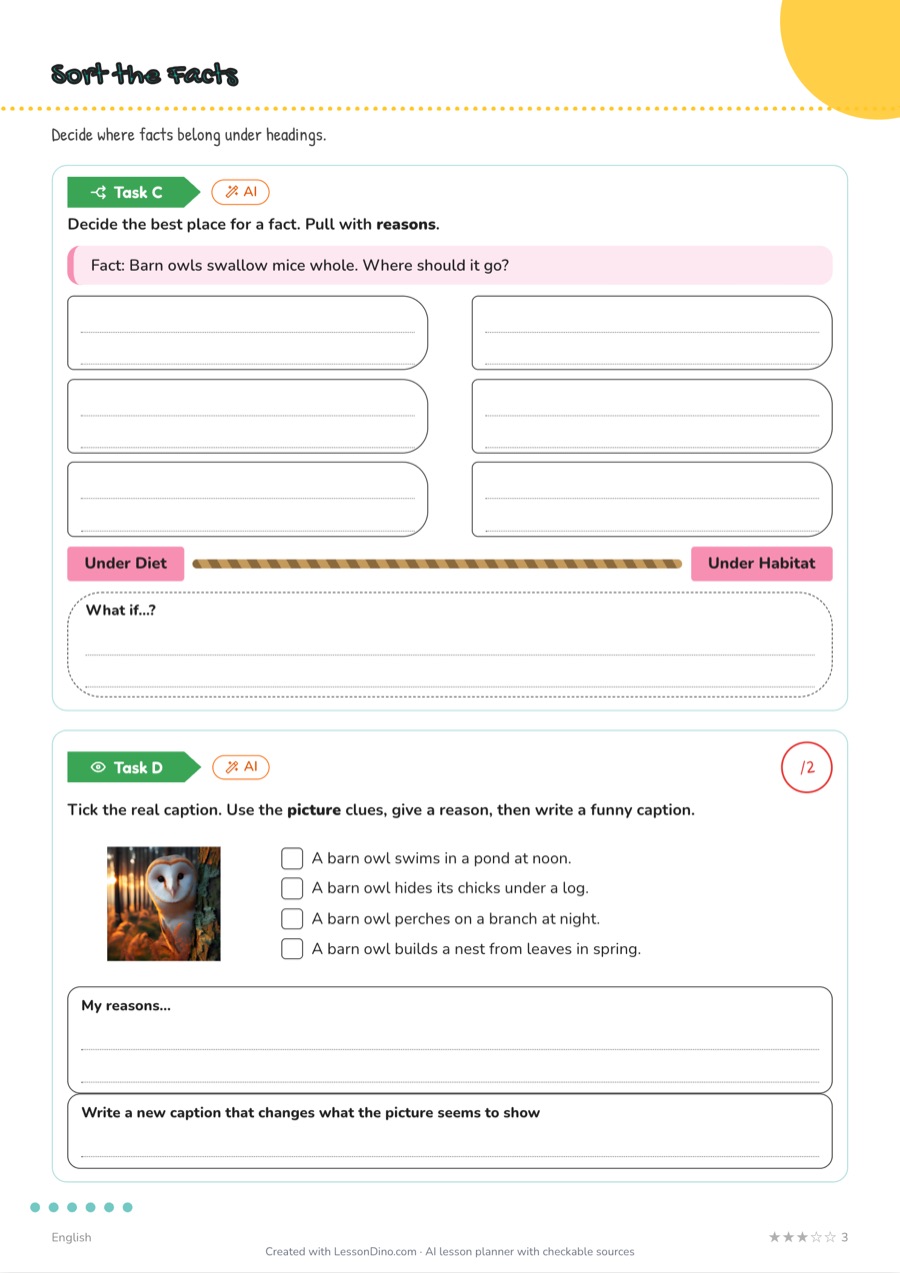
Sort the Facts
Decide where facts belong under headings.
Decide the best place for a fact. Pull with reasons.
Tick the real caption. Use the picture clues, give a reason, then write a funny caption.
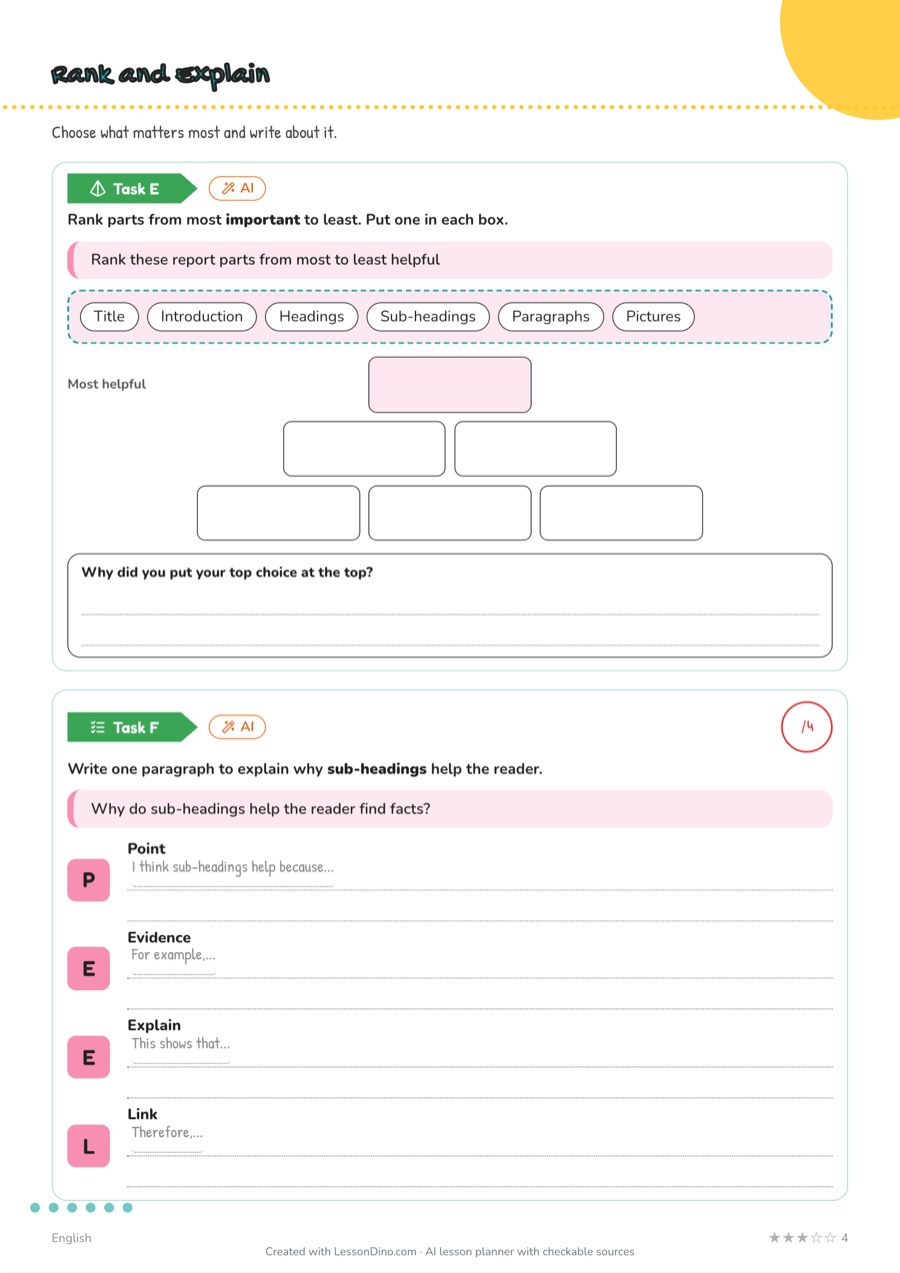
Rank and Explain
Choose what matters most and write about it.
Rank parts from most important to least. Put one in each box.
Write one paragraph to explain why sub-headings help the reader.
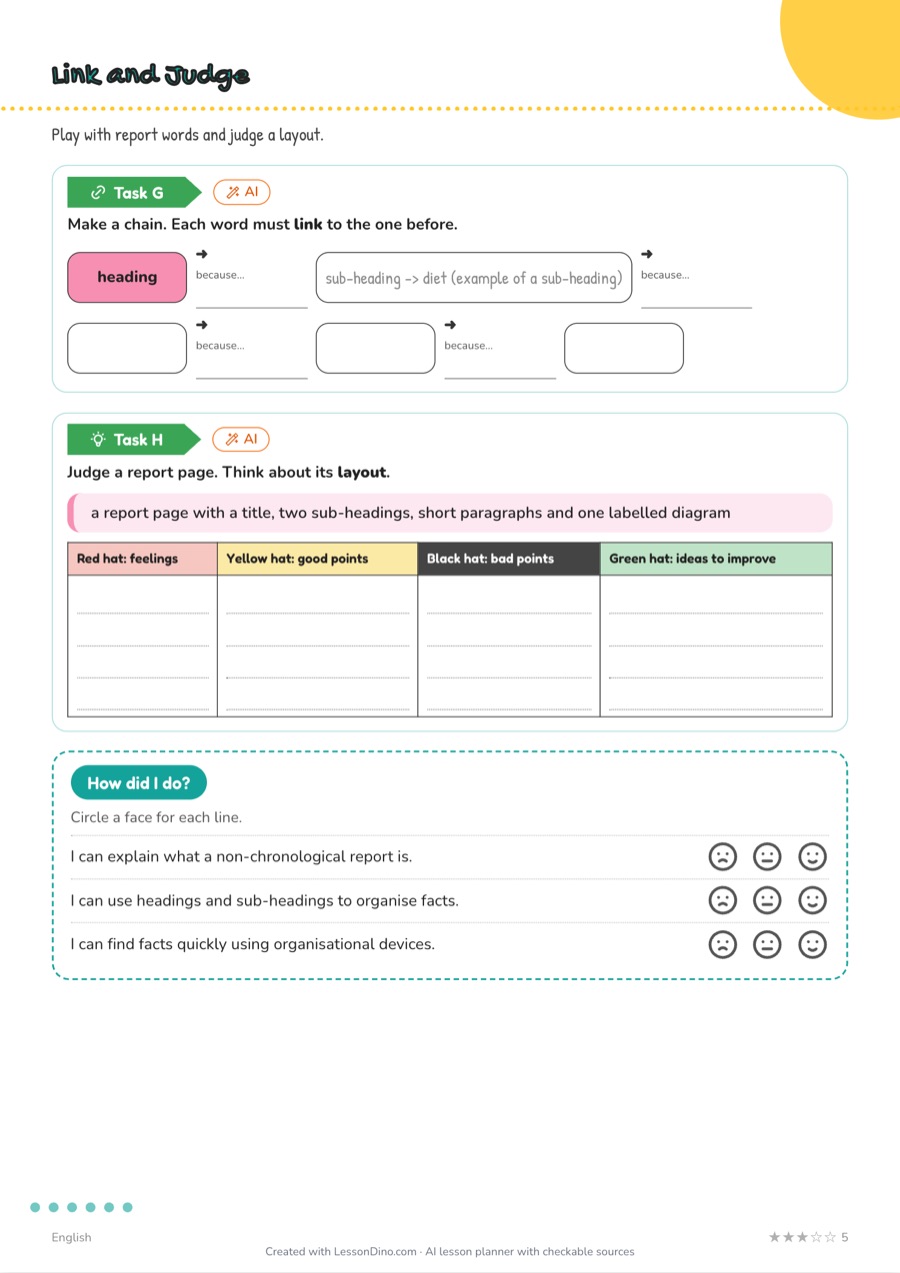
Link and Judge
Play with report words and judge a layout.
Make a chain. Each word must link to the one before.
Judge a report page. Think about its layout.
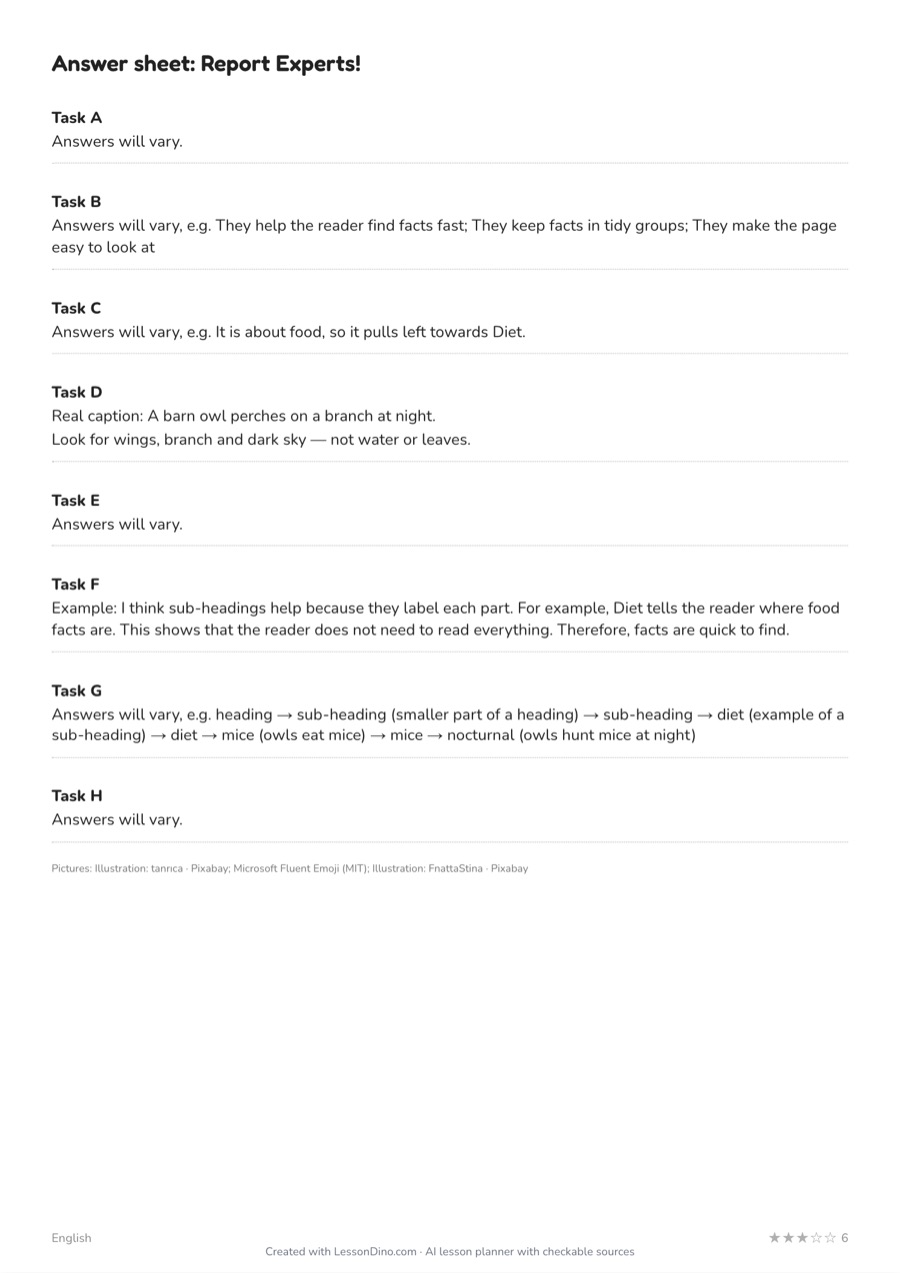
Answers
Show the answers
The answers are on the answer sheet, the last picture above.
Curriculum
in non-narrative material, using simple organisational devices [for example, headings and sub-headings]
Made with Lesson Dino's AI on 19 October 2026. AI can make mistakes, so check the answers and facts against the sources before you teach.