The worksheet
About this worksheet
Students learn skeletons and muscles give support, protection and movement. They make a poster to show the three jobs. This Year 3 Science worksheet gives students (ages 7–8) six pages of practice on skeletons and muscles, part of the animals, including humans unit. It goes with our free Skeletons and muscles lesson, which has the slides and a timed lesson plan.
What it covers
By the end, students should be able to:
- Students will name support, protection and movement as jobs of skeletons and muscles.
- Students will match skull, ribs and backbone to the parts they protect.
- Students will explain muscles pull bones at joints to bend and straighten.
How to use it
- Use it for practice after the teaching part of the lesson, once students have seen the worked examples on the slides.
- Support: Give the three word cards with picture clues and sentence starters to describe each job.
- Stretch: Ask students to add arrows showing how muscles pull on bones at a joint to make movement.
- The answer sheet is the last page, so you can print it on its own or let students check their own work.
Key vocabulary
- skeleton: frame of hard bones inside the body that holds it up
- muscle: soft body part that shortens to tug bones
- support: holding something up so it keeps its shape
- protection: keeping soft body parts safe from harm
- movement: changing place or position
- joint: bendy place where two bones meet
Mistakes to watch for
- Thinks skeleton is one big bone all the same shape. Handle cotton buds / point to poster: a skeleton is made up of lots of bones which are different shapes and sizes, over 200 bones.
- Thinks muscles push bones to straighten. Feel again: muscles can only pull, they cannot push; one pulls to bend, the other pulls the opposite way.
- Thinks only humans have skeletons and muscles. Recall fish, reptiles, birds and mammals move with muscles connected to skeleton; most animals have muscles to move and balance.
What's on the worksheet
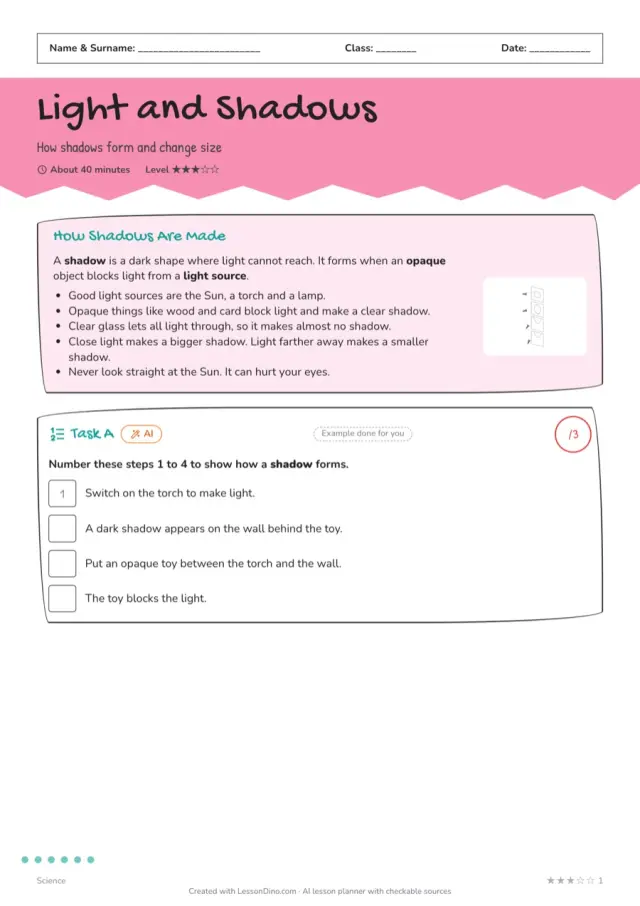
Bones Hold Us Up
Learn what skeletons and muscles do.
Skeletons and muscles
- Humans and many animals have a skeleton and muscles. The skeleton is made of over 200 bones joined together.
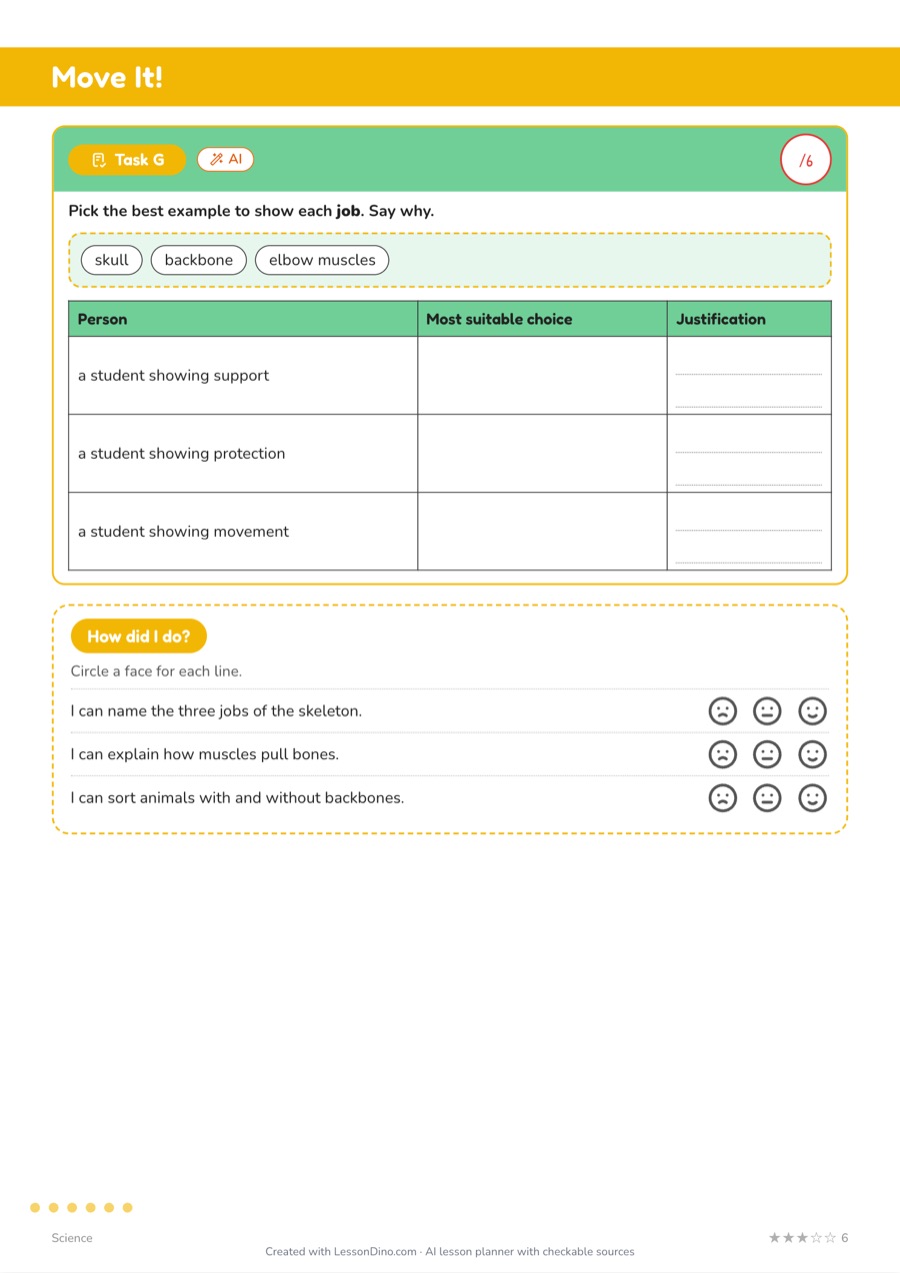
- Bones give support and hold the body up.
- Bones give protection. The skull guards the brain.
- Muscles and bones give movement at joints.
- Some animals have no backbone. Crabs have a hard skeleton outside.
Read each sentence. Tick true or false.
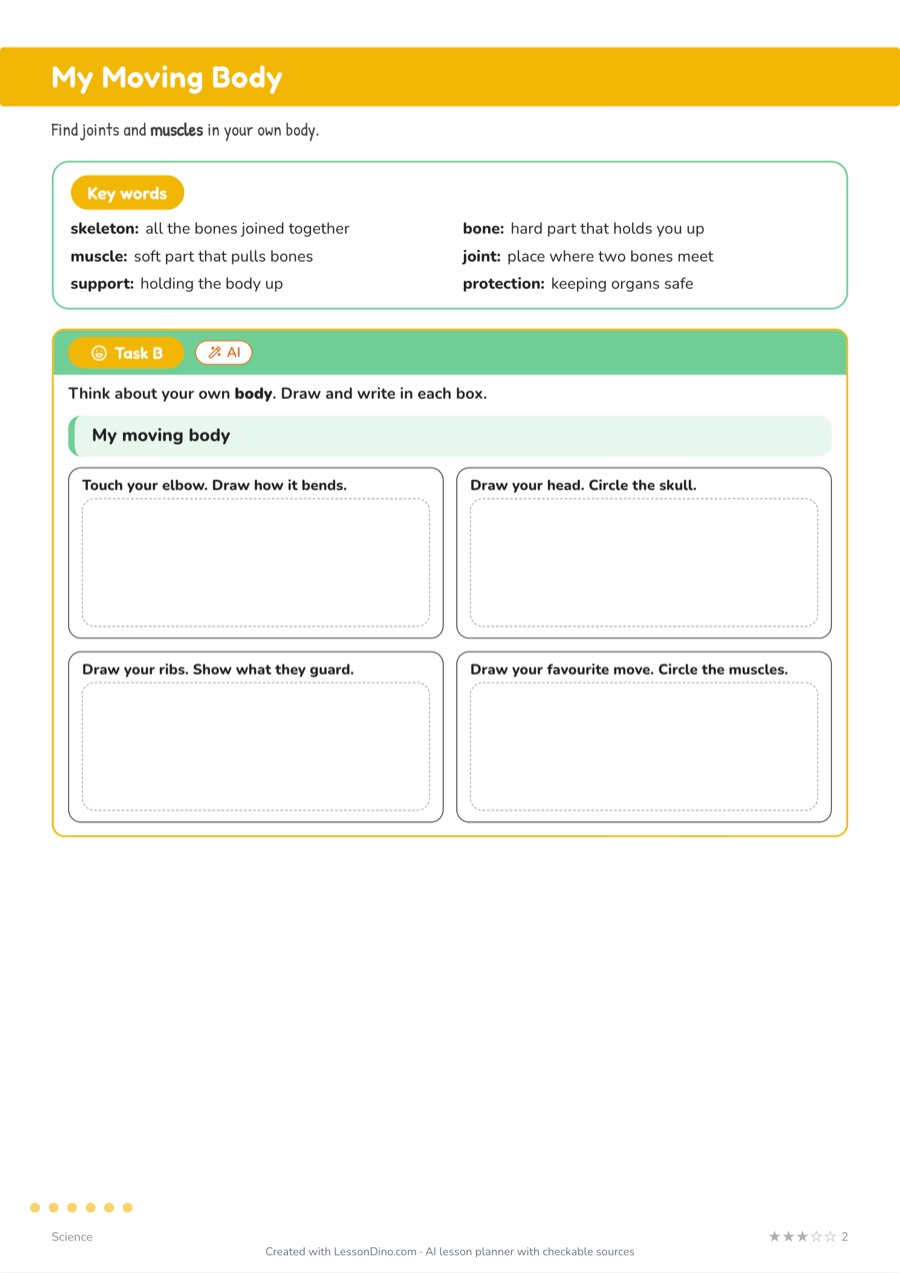
My Moving Body
Find joints and muscles in your own body.
| Word | Meaning |
|---|---|
| skeleton | all the bones joined together |
| bone | hard part that holds you up |
| muscle | soft part that pulls bones |
| joint | place where two bones meet |
| support | holding the body up |
| protection | keeping organs safe |
Think about your own body. Draw and write in each box.
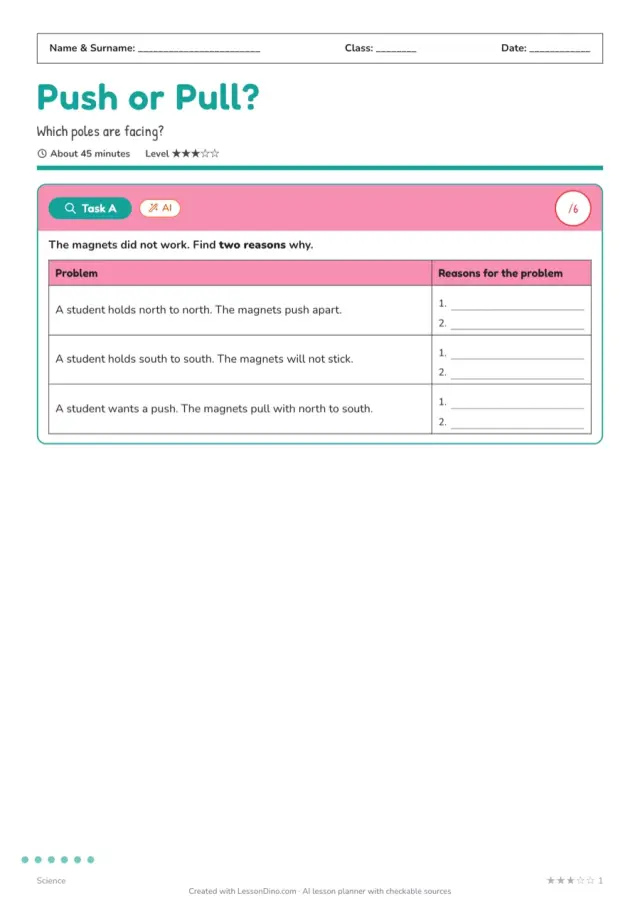
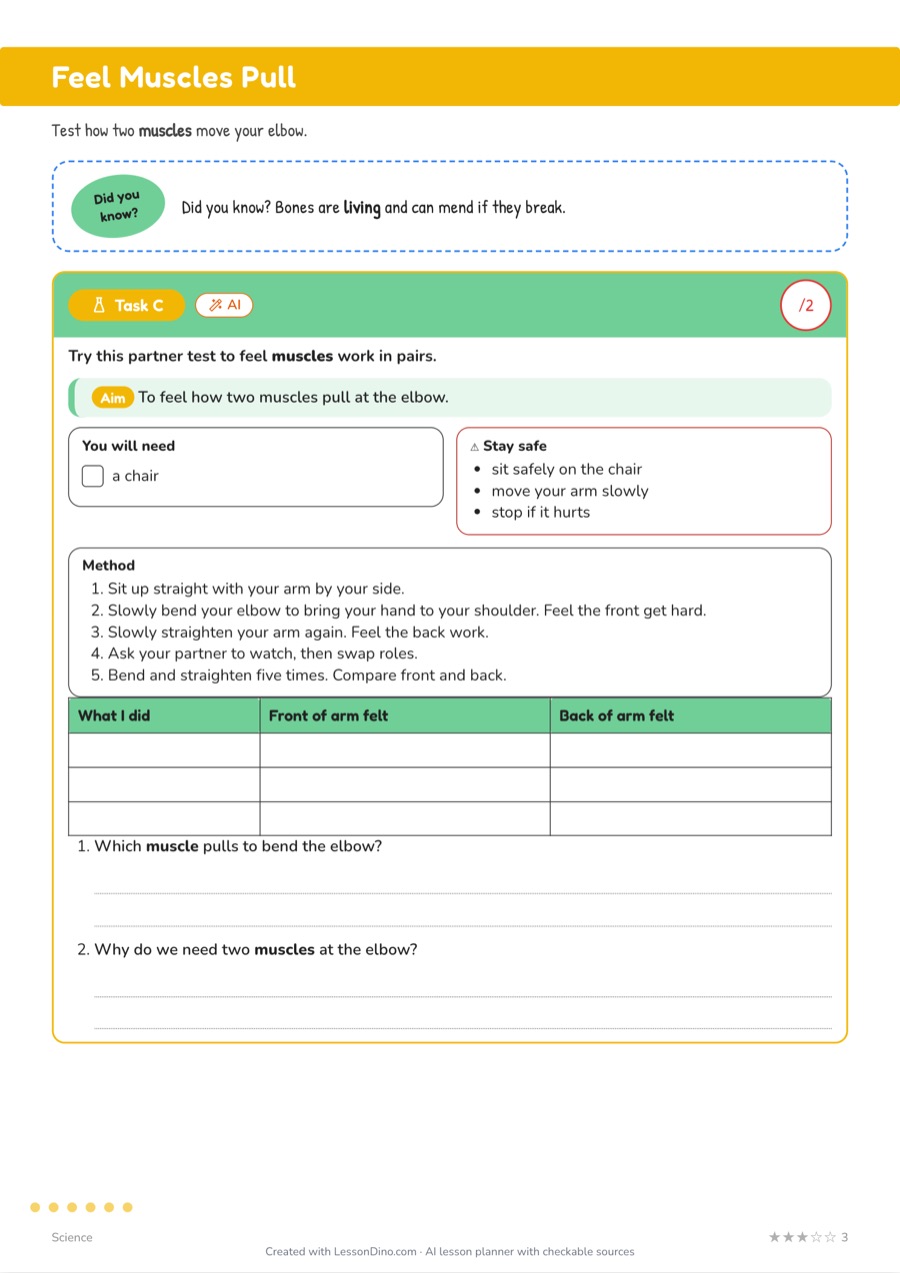
Feel Muscles Pull
Test how two muscles move your elbow.
- Did you know? Bones are living and can mend if they break.
Try this partner test to feel muscles work in pairs.
- Which muscle pulls to bend the elbow?
- Why do we need two muscles at the elbow?
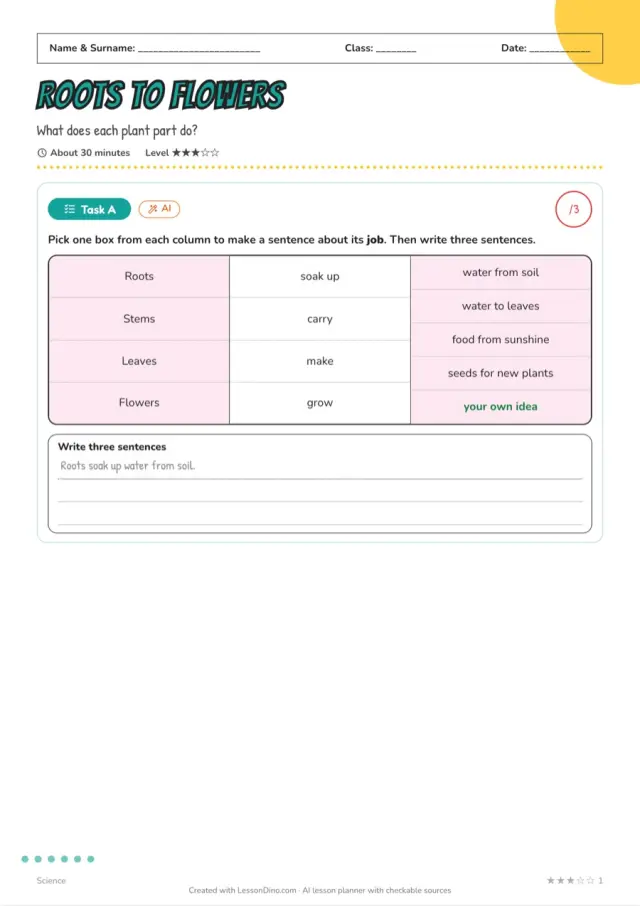
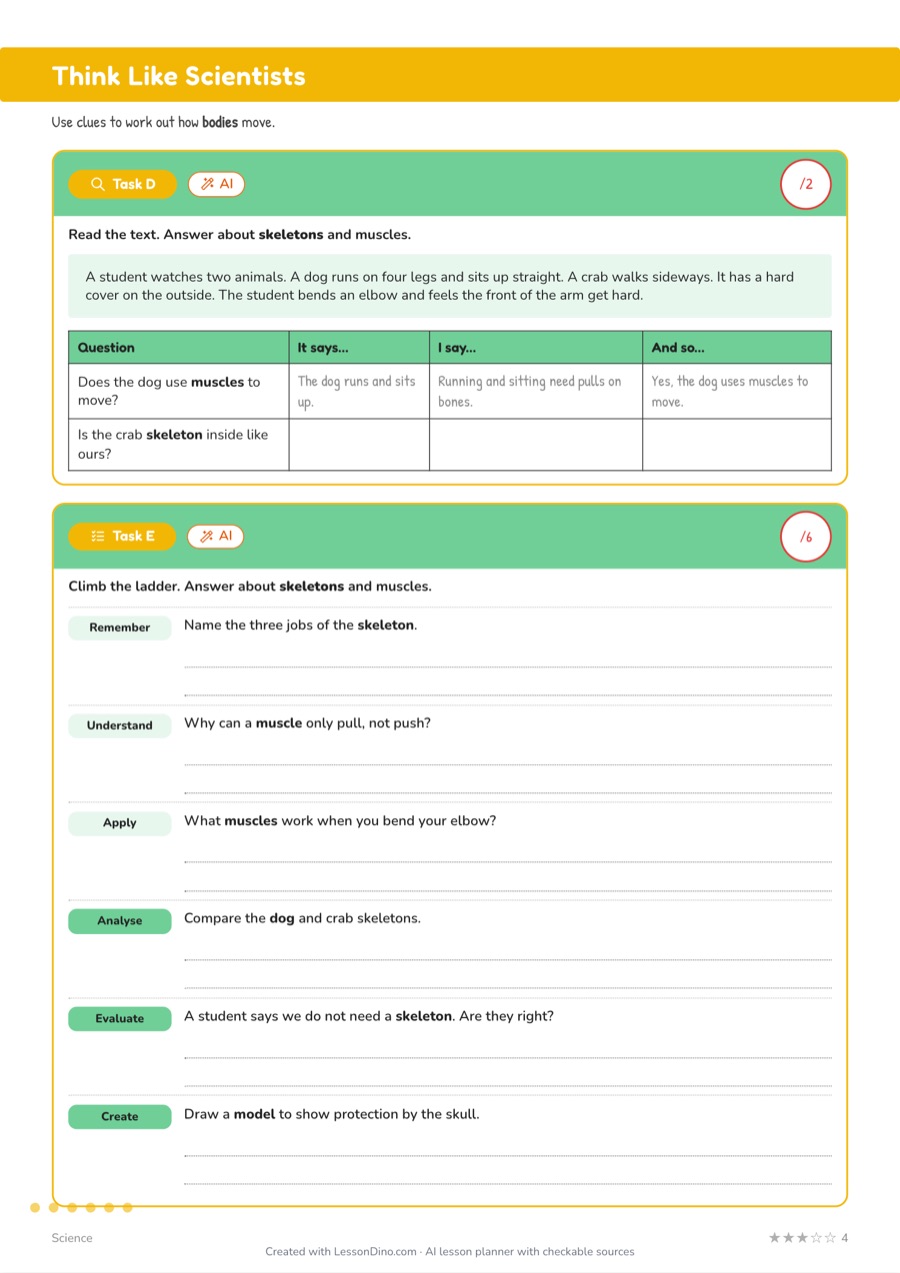
Think Like Scientists
Use clues to work out how bodies move.
Read the text. Answer about skeletons and muscles.
- A student watches two animals. A dog runs on four legs and sits up straight. A crab walks sideways. It has a hard cover on the outside. The student bends an elbow and feels the front of the arm get hard.
- Does the dog use muscles to move?
- Is the crab skeleton inside like ours?
Climb the ladder. Answer about skeletons and muscles.
- Name the three jobs of the skeleton.
- Why can a muscle only pull, not push?
- What muscles work when you bend your elbow?
- Compare the dog and crab skeletons.
- A student says we do not need a skeleton. Are they right?
- Draw a model to show protection by the skull.
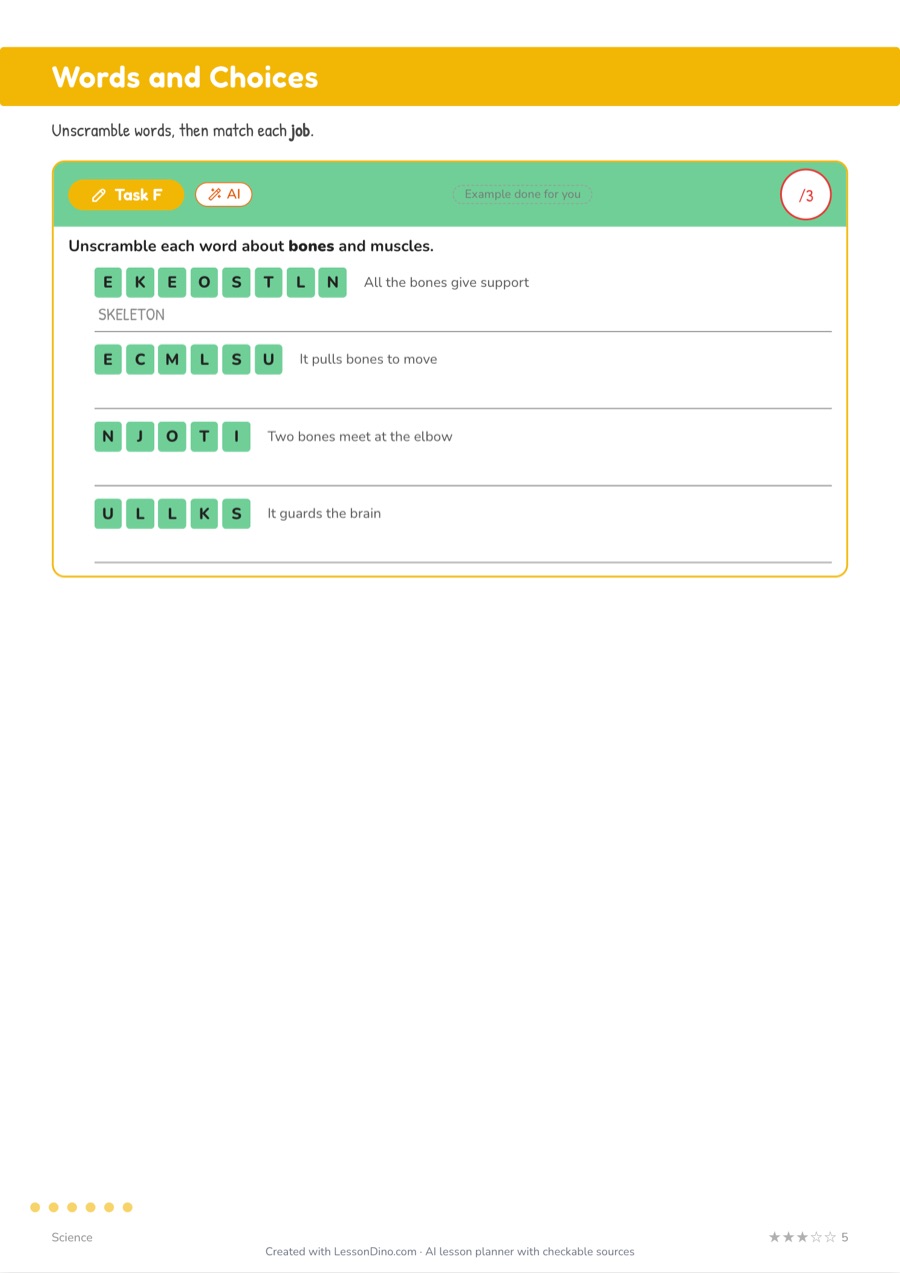
Words and Choices
Unscramble words, then match each job.
Unscramble each word about bones and muscles.
Page 6
Pick the best example to show each job. Say why.
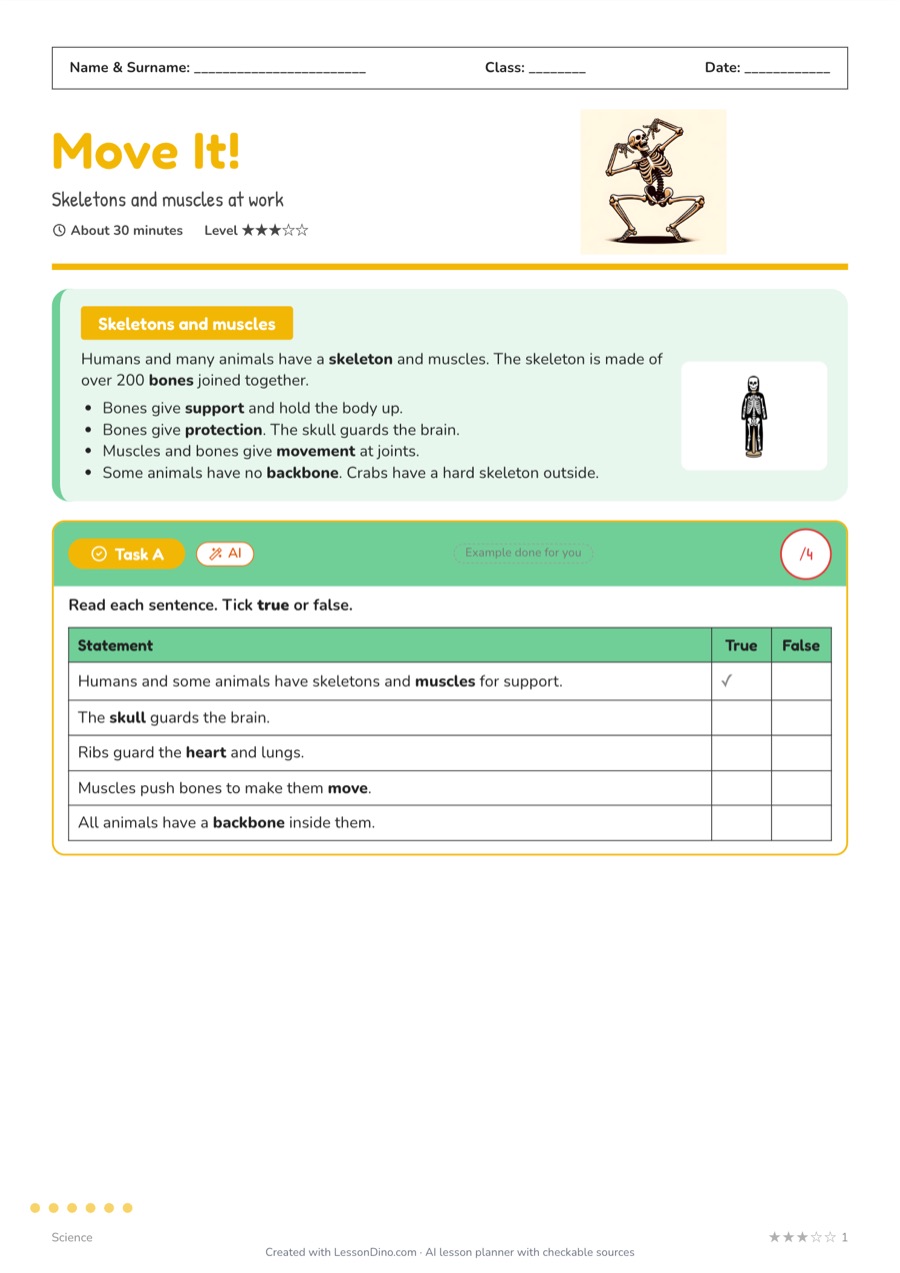
Answers
Show the answers
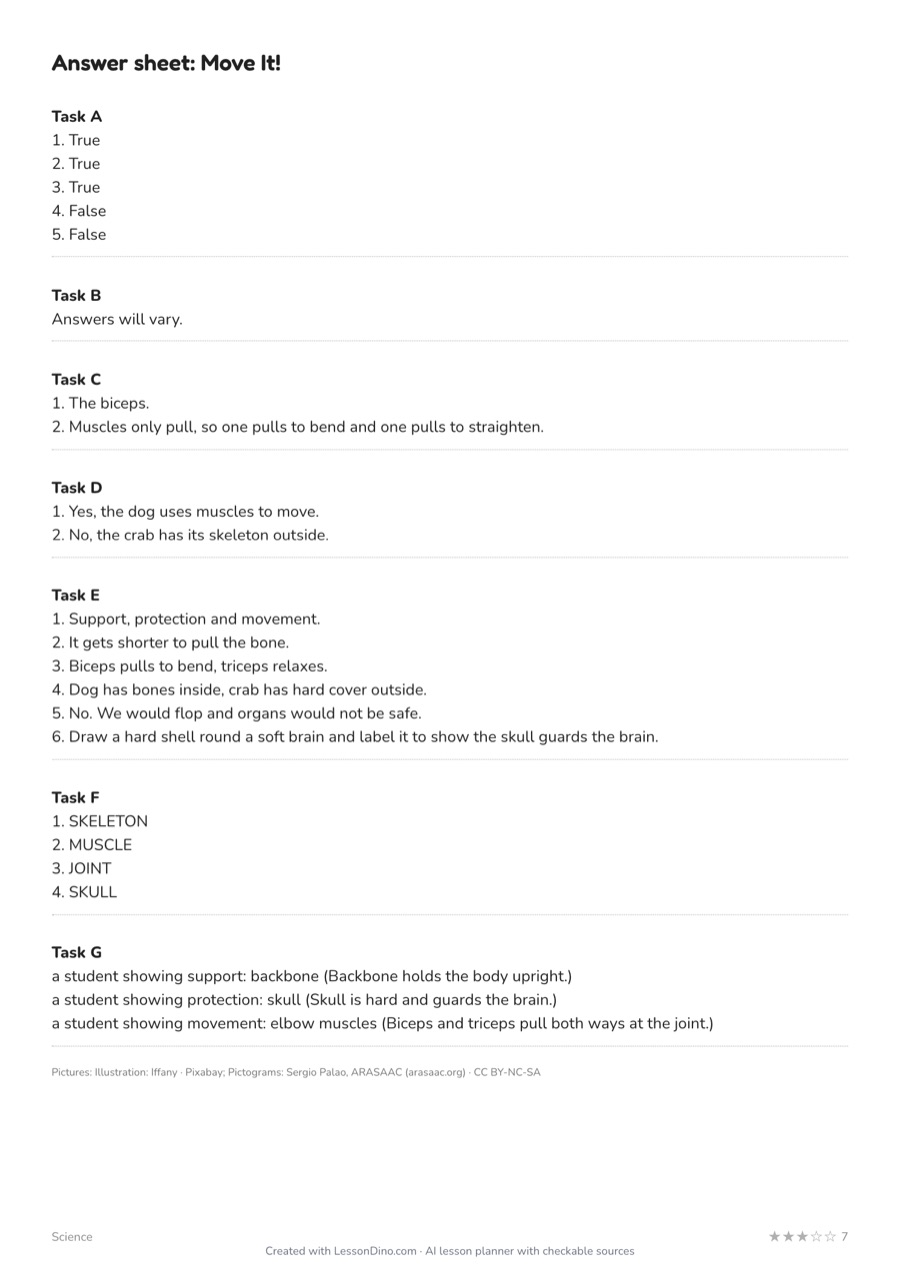
- Which muscle pulls to bend the elbow? The biceps.
- Why do we need two muscles at the elbow? Muscles only pull, so one pulls to bend and one pulls to straighten.
- Name the three jobs of the skeleton. Support, protection and movement.
- Why can a muscle only pull, not push? It gets shorter to pull the bone.
- What muscles work when you bend your elbow? Biceps pulls to bend, triceps relaxes.
- Compare the dog and crab skeletons. Dog has bones inside, crab has hard cover outside.
- A student says we do not need a skeleton. Are they right? No. We would flop and organs would not be safe.
- Draw a model to show protection by the skull. Draw a hard shell round a soft brain and label it to show the skull guards the brain.
The answer sheet is the last picture above.
Curriculum
identify that humans and some other animals have skeletons and muscles for support, protection and movement
Made with Lesson Dino's AI on 17 October 2026. AI can make mistakes, so check the answers and facts against the sources before you teach.