Slides
Lesson plan
Strong, Safe, Moving Skeletons and Muscles
Students learn skeletons and muscles give support, protection and movement. They make a poster to show the three jobs.
Objectives
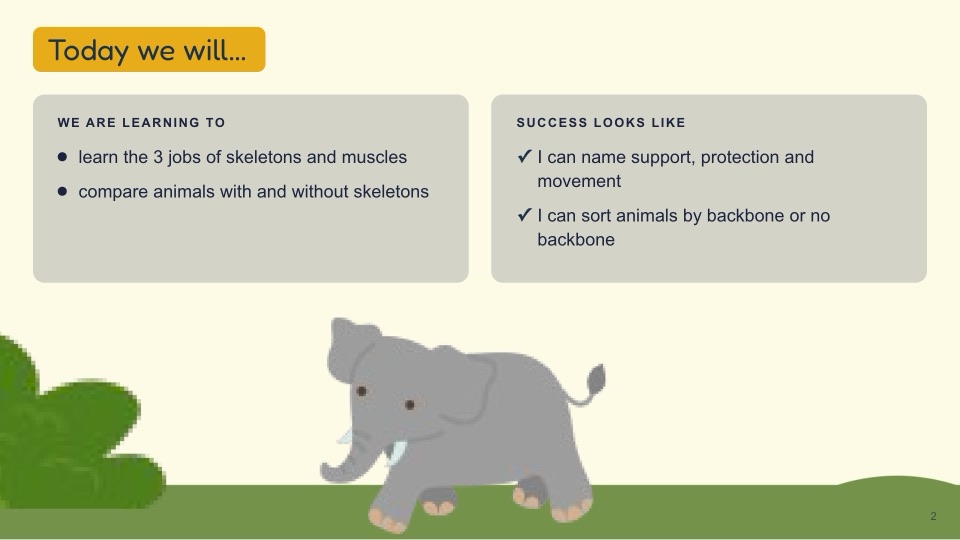
- Students will name support, protection and movement as jobs of skeletons and muscles.
- Students will match skull, ribs and backbone to the parts they protect.
- Students will explain muscles pull bones at joints to bend and straighten.
Success criteria
- I can name support, protection and movement as jobs of skeletons.
- I can say which bones guard brain, heart, lungs and spinal cord.
- I can show how two muscles pull to bend and straighten the elbow.
Key words
| Word | Meaning |
|---|---|
| skeleton | frame of hard bones inside the body that holds it up |
| muscle | soft body part that shortens to tug bones |
| support | holding something up so it keeps its shape |
| protection | keeping soft body parts safe from harm |
| movement | changing place or position |
| joint | bendy place where two bones meet |
Timed plan (60 minutes)
| Time | Stage | What happens |
|---|---|---|
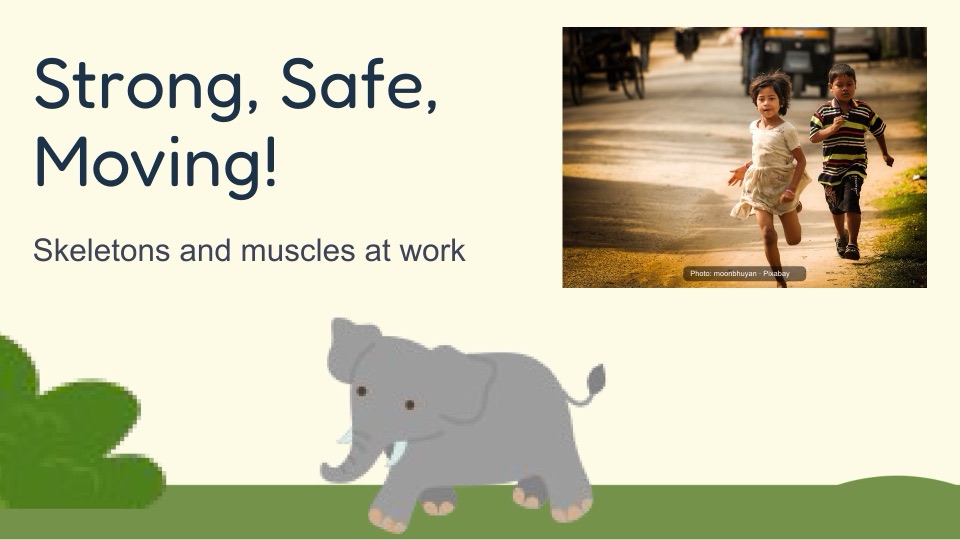
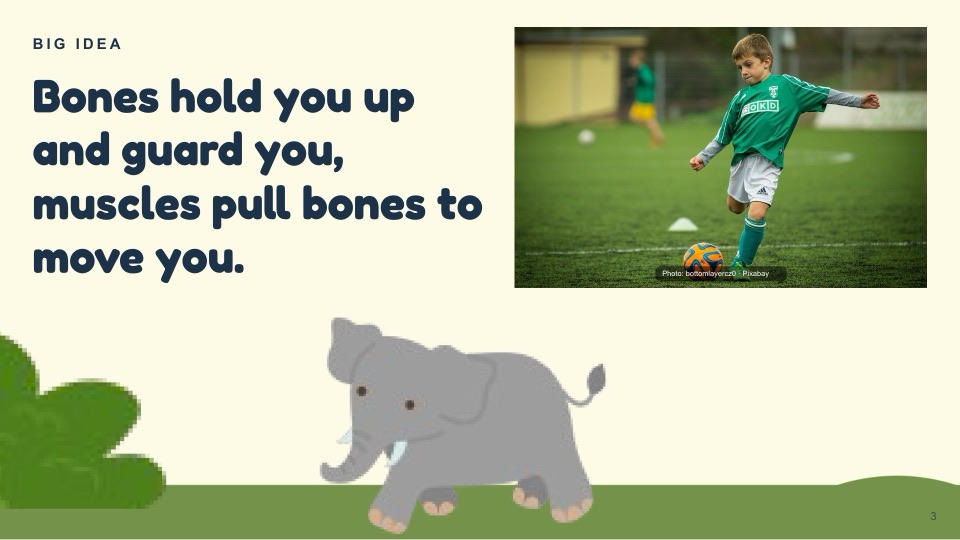
| 5 min | Starter | Hook interest in the three jobs and recall what holds us up and moves us. Show Slide 1 Strong, Safe, Moving! Skeletons and muscles at work and welcome the class. Show Slide 2 Today we will… and read objectives: learn the 3 jobs of skeletons and muscles. Say hook: If your skeleton wrote a job advert, what three jobs would it list? Ask pairs to guess. Take ideas and link to Slide 3 Big idea: Bones hold you up and guard you, muscles pull bones to move you. |
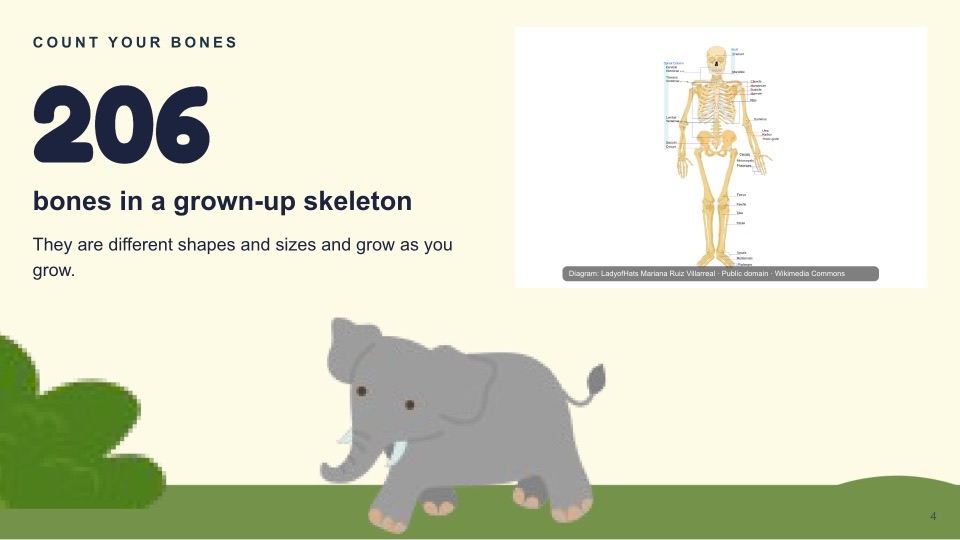
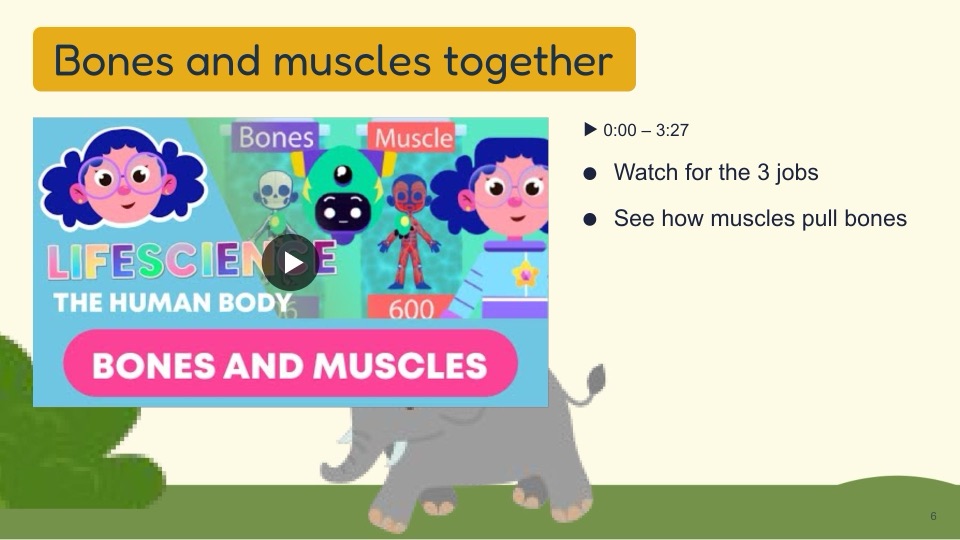
| 12 min | Skeletons Hold and Guard | Teach that skeletons give support and protect soft parts. Show Slide 3 Big idea and Slide 4 Count your bones: 206 bones in a grown-up skeleton. Explain they are different shapes and sizes and grow as you grow. Teach support: the skeleton supports the body, gives the body shape and supports its weight, and without a backbone we would not be able to stay upright. Teach protection: touch skull, ribs, backbone and say the skull guards the brain and the ribcage shields the heart and lungs, and the backbone is important to protect the spinal cord. Play Video clip 1 on Slide 6 (0:00–3:27) to see bones and muscles together and the 3 jobs, then recap skull, ribs, backbone. |
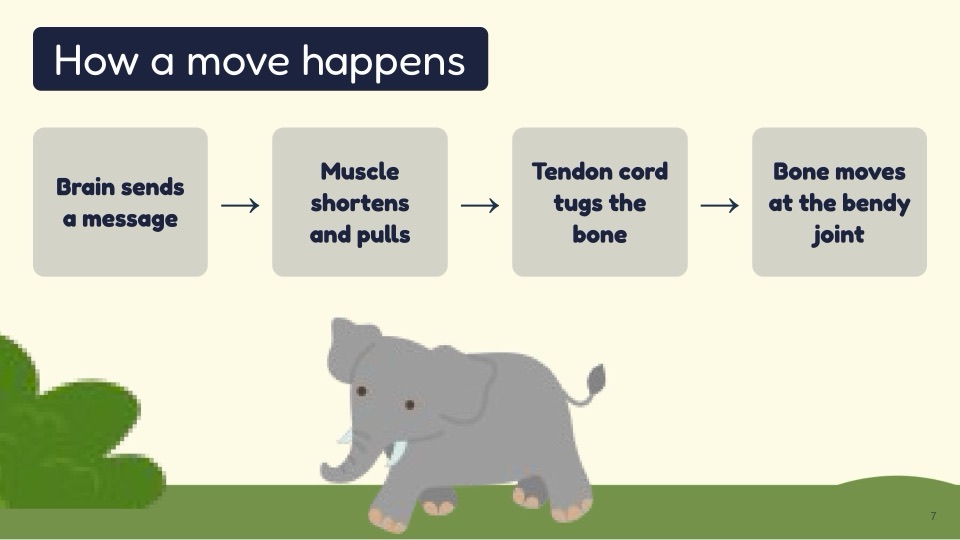
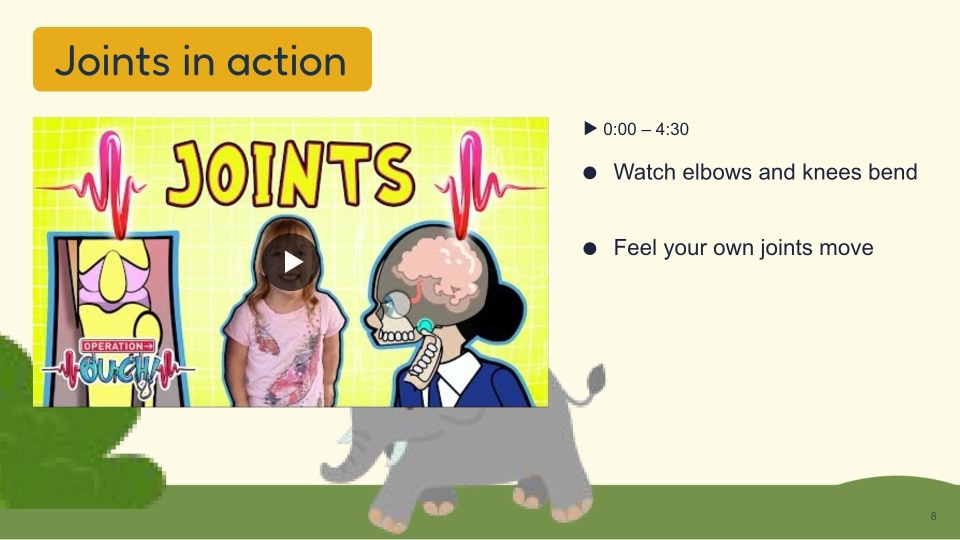
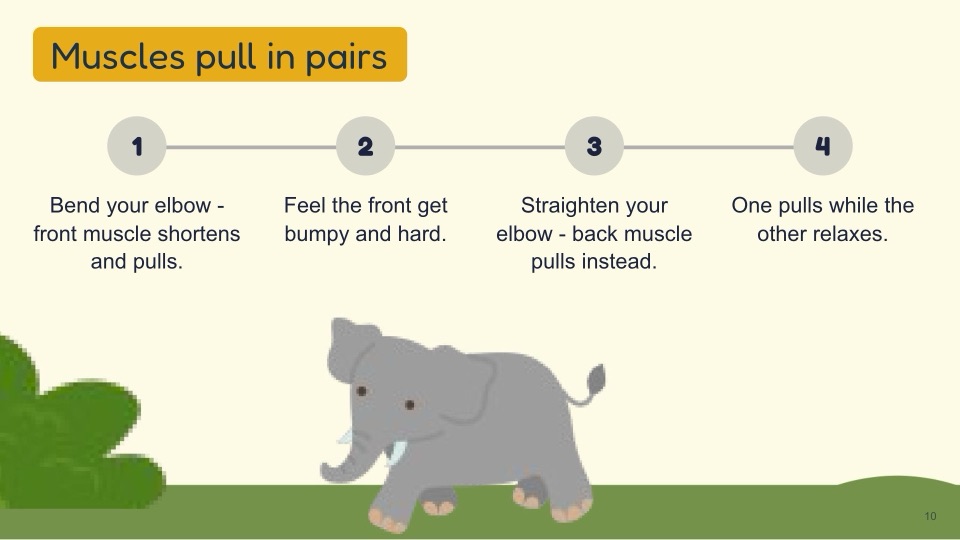
| 13 min | Muscles Pull at Joints | Teach that muscles pull bones at joints and work in pairs. Show Slide 7 How a move happens chain: Brain sends a message, Muscle shortens and pulls, Tendon cord tugs the bone, Bone moves at the bendy joint. Play Video clip 5 on Slide 8 (0:00–4:30) to watch elbows and knees bend, then students gently feel own elbow, knee and shoulder. Show Slide 10 Muscles pull in pairs steps and model: bend elbow, front gets bumpy and hard; straighten, back pulls instead. Teach that muscles can only pull, they cannot push, so joints are controlled by more than one muscle, the biceps bends the arm and the triceps straightens it. |
| 20 min | Three Jobs Poster | Apply learning by drawing and labelling support, protection and movement. Hand out large paper, felt tips and support, protection and movement word cards. Show model with three boxes. Model one box: draw backbone standing tall, write Backbone holds us up for support. Remind skeleton supports the body, protects organs and works with muscles to create movement. Send pairs to draw: skull guarding brain and ribs round heart and lungs for protection, tall body for support, bent elbow with two muscles for movement. Stop at 15 minutes for pairs to present: point to one drawing for each job and say which bones and muscles work. |
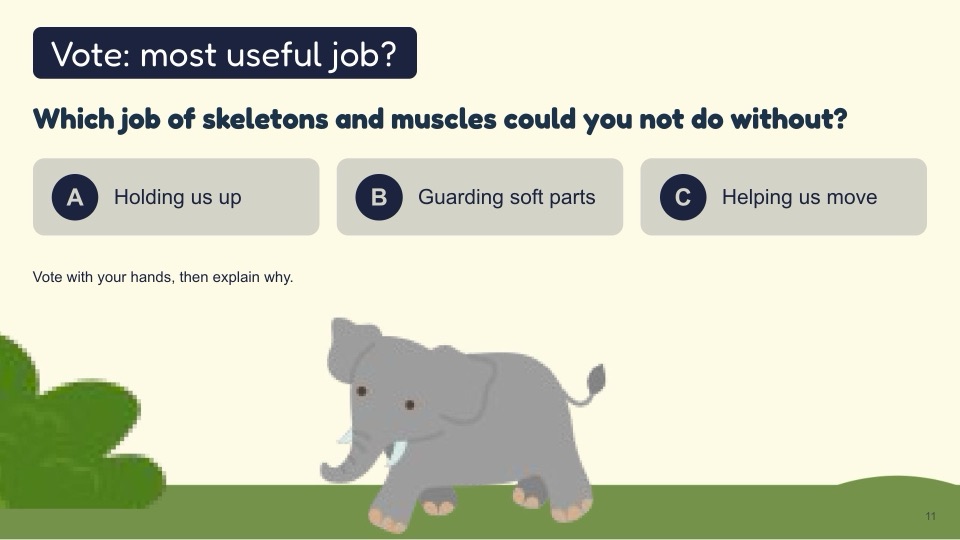
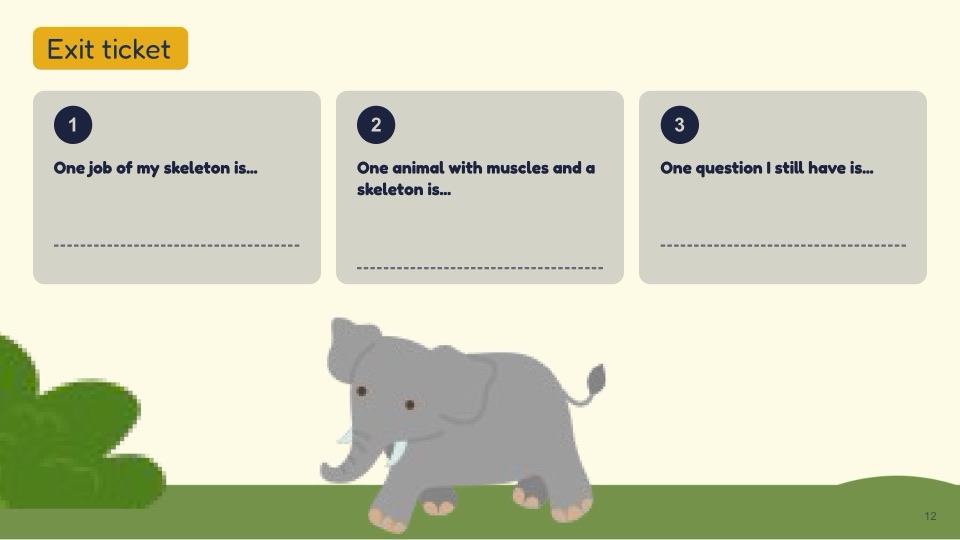
| 10 min | Vote and Exit | Return to objectives and check everyone can name jobs and examples. Show Slide 11 Vote: most useful job? Read: Which job of skeletons and muscles could you not do without? Holding us up, Guarding soft parts, Helping us move. Take vote with hands, ask two students to justify using skull, ribs or pull ideas. Show Slide 12 Exit ticket and hand out slips: One job of my skeleton is..., One animal with muscles and a skeleton is..., One question I still have is... Collect slips and link back: humans and most other animals have muscles throughout their bodies that help them move and balance. |
Common mistakes
- Thinks skeleton is one big bone all the same shape
How to spot it: Poster shows one bone or student says skeleton is one bone
Handle cotton buds / point to poster: a skeleton is made up of lots of bones which are different shapes and sizes, over 200 bones. - Thinks muscles push bones to straighten
How to spot it: Says triceps pushes arm straight
Feel again: muscles can only pull, they cannot push; one pulls to bend, the other pulls the opposite way. - Thinks only humans have skeletons and muscles
How to spot it: Sorts dog or fish as without bones
Recall fish, reptiles, birds and mammals move with muscles connected to skeleton; most animals have muscles to move and balance.
Support
- Give the three word cards with picture clues and sentence starters to describe each job.
- Pre-draw faint poster boxes for support, protection and movement so students only draw inside.
- Model each joint and muscle feel first so students copy one at a time.
Stretch
- Ask students to add arrows showing how muscles pull on bones at a joint to make movement.
- Ask students to explain why rigid skull bones that cannot move help protection.
- Ask students to explain what would happen to standing and balance without muscles to move bones.
Check questions
- One job of my skeleton is...?
Answer: support / holding us up, protection / guarding soft parts, or movement with muscles. - Which bones protect the heart and lungs?
Answer: Ribs / ribcage shields heart and lungs. - How do two muscles move your elbow?
Answer: One pulls to bend, the other pulls to straighten; muscles can only pull, never push.
Curriculum
identify that humans and some other animals have skeletons and muscles for support, protection and movement
Video clips
Clips on YouTube, from the start and end times we chose. Check each one before you show it.
-
bones and muscles together from 0:00 to 3:27
FuseSchool Kids: BONES & MUSCLES | The human body | Science | FuseSchool Kids
Covers both skeletons and muscles for support, protection and movement with simple vocabulary and pace perfect for 7-8-year-olds.
-
joints and skeleton in action from 0:00 to 4:30
Operation Ouch: Science for kids | Body Parts - Joints & Skeletal System | Experiments for kids | Operation Ouch
From a trusted children's broadcaster with practical demos at just the right level for 7-8-year-olds learning about movement.
Worksheet
Sources
- National curriculum in England: science programmes of study gov.uk
- Curriculum Map: Science Year 3 - camrose.harrow.sch.uk camrose.harrow.sch.uk
- The skeleton - Skeletal and muscular systems - 3rd level ... bbc.co.uk
- The Skeleton and Muscles (KS2 Science) | MindBlaze mindblaze.uk
- Skeletons and Muscles - Project GCSE projectgcse.co.uk
- muscle - Kids | Britannica Kids | Homework Help kids.britannica.com
- Muscles for movement KS2 | Y3 Science | Lesson Resources thenational.academy
- The skeletal system - Skeleton - Living organisms - KS3 ... bbc.co.uk
- Skeletons and Muscles Knowledge organiser(1) files.schudio.com
- Science for Kids: Bones and Human Skeleton - Ducksters ducksters.com
- KS2 Science: How do muscles and bones work? - BBC Teach bbc.co.uk
- Muscles and Skeletons - Steve Parker: 9780750236720 - AbeBooks abebooks.com
Picture credits
- Photo: moonbhuyan · Pixabay
- Photo: bottomlayercz0 · Pixabay
- Diagram: LadyofHats Mariana Ruiz Villarreal · Public domain · Wikimedia Commons
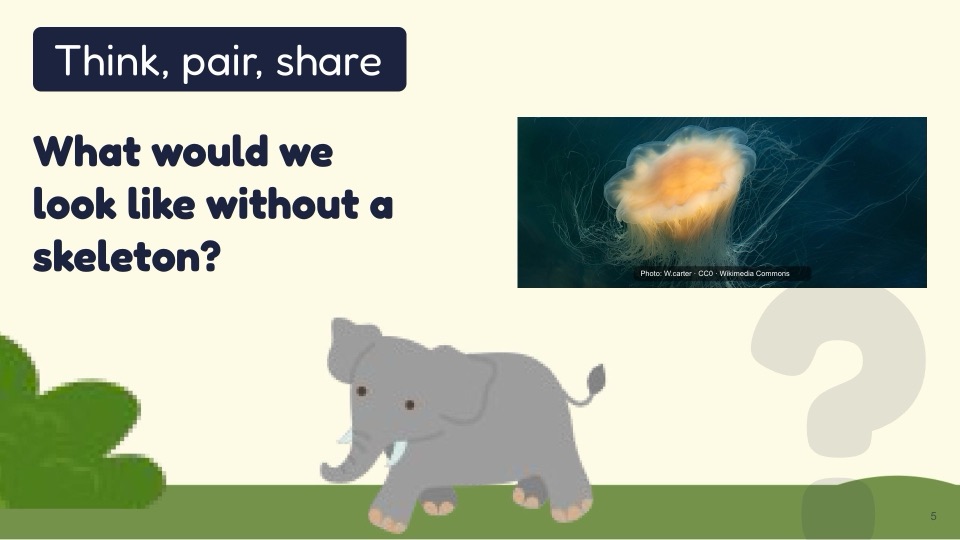
- Photo: W.carter · CC0 · Wikimedia Commons
- Illustration: Iffany · Pixabay
- Pictograms: Sergio Palao, ARASAAC (arasaac.org) · CC BY-NC-SA
Made with Lesson Dino's AI on 17 October 2026. AI can make mistakes, so check facts against the sources before you teach.