Slides
Lesson plan
How Big Is It Really? Shadows and Patterns
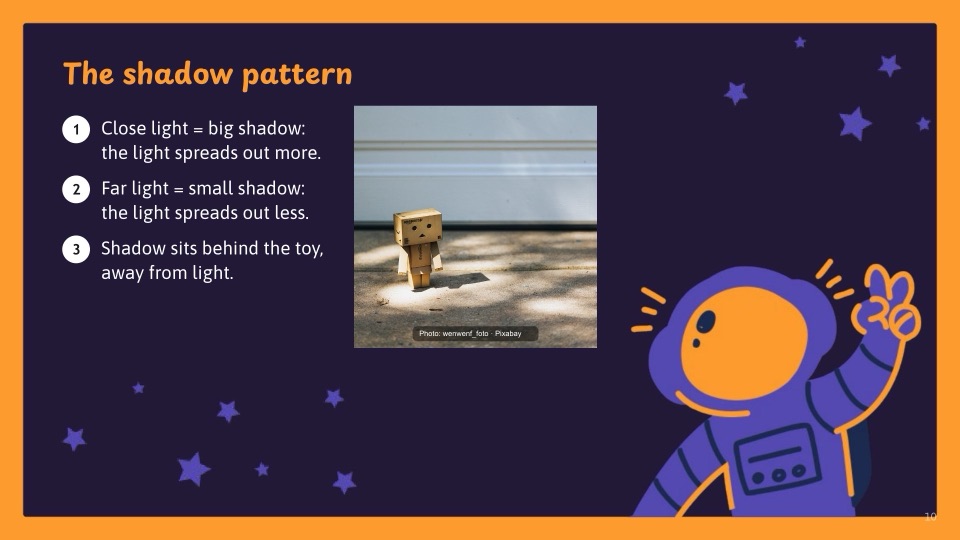
Pupils learn how opaque objects block light to make shadows. They measure toy shadows to prove close light makes big shadows.
Objectives
- Students will recognise how an opaque object blocks light to form a shadow.
- Students will measure shadows and describe the pattern as distance changes.
Success criteria
- I can explain how an opaque object makes a shadow.
- I can measure shadow height in centimetres accurately.
- I can describe the big-close and small-far shadow pattern.
Key words
| Word | Meaning |
|---|---|
| light source | something that makes its own light, like the Sun or a torch |
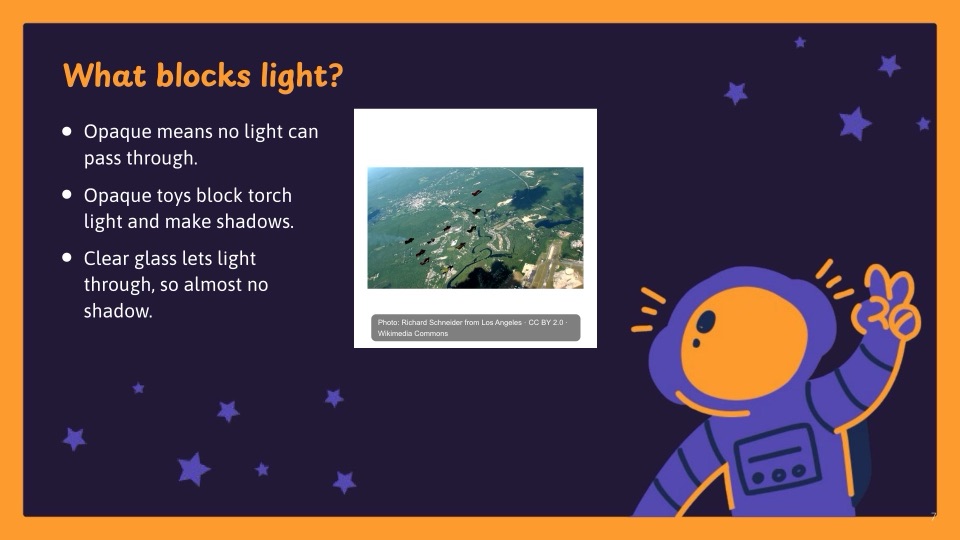
| opaque | material that lets no light pass through it |
| shadow | dark shape left where light is stopped by something blocking it |
| measure | use a ruler to find how tall or long something is in centimetres |
| pattern | something that happens again in the same way so you can predict it |
Timed plan (60 minutes)
| Time | Stage | What happens |
|---|---|---|
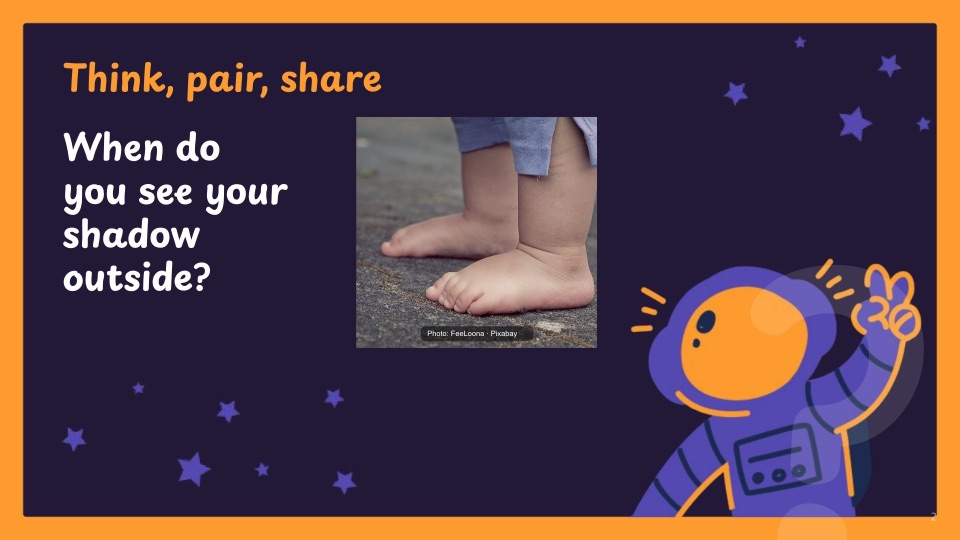
| 5 min | Starter | Recall seeing shadows outside and hook pupils with measuring to prove what makes shadows grow. Show Slide 1 title and say the hook question to the class. Show Slide 2 question and give 30 seconds think time. Take paired whisper, then ask two pairs to share when they see shadows. Link answers to today's measuring job and today's learning goals. |
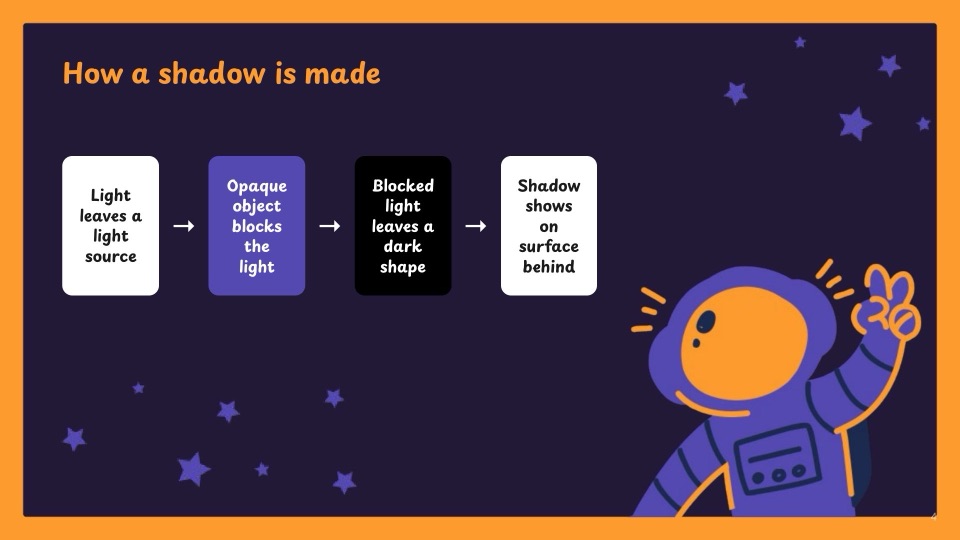
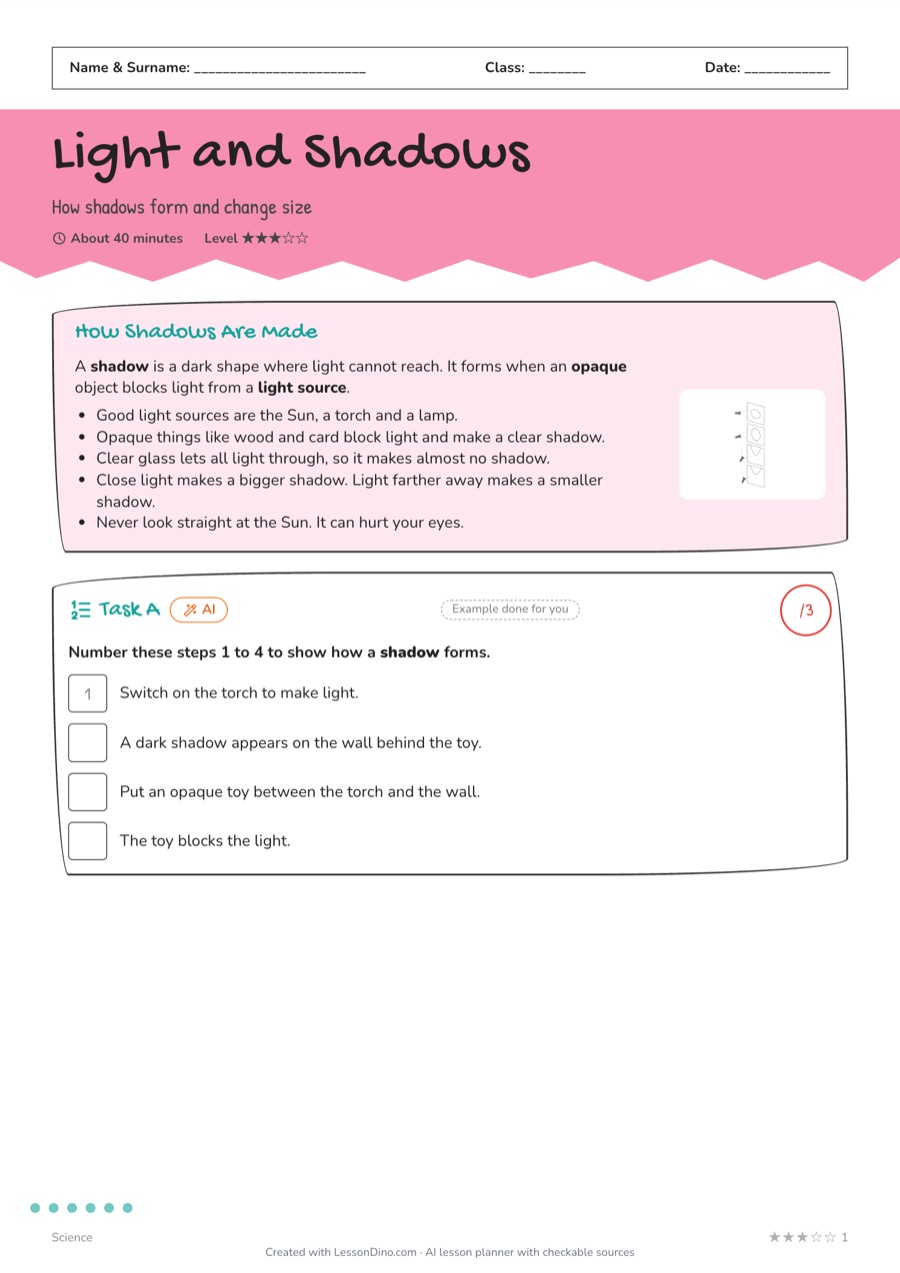
| 12 min | Teaching | Teach how an opaque object blocks light to make a shadow. Show Slide 4 chain and model torch on wall with hand blocking the beam. Play Video clip 1 and ask pupils to spot what blocks light and listen for opaque. Show Slide 7 points and test cardboard, clear plastic lid and tracing paper in the beam. Model Worksheet Task A ordering, then pupils number steps 1 to 4 on their own sheet. |
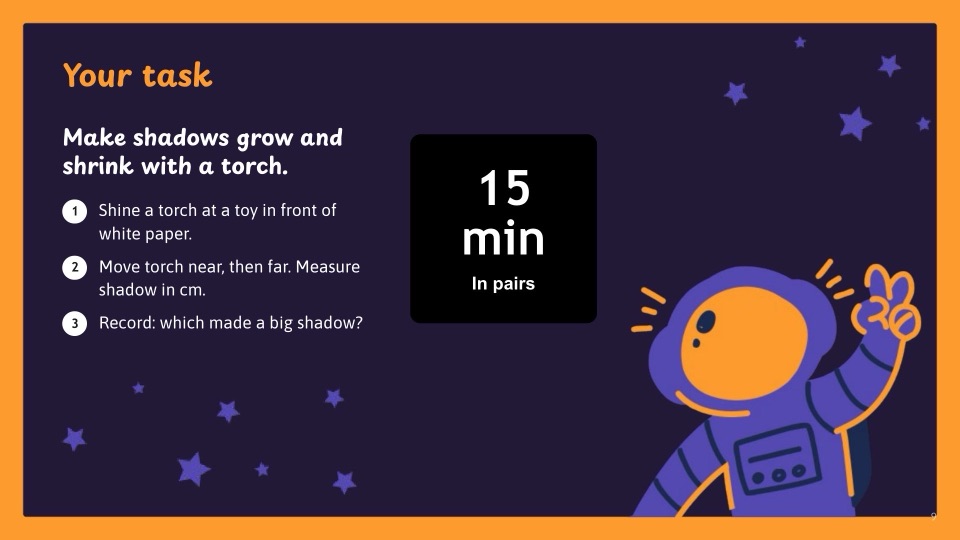
| 25 min | Main activity | Measure shadow size at different distances to find the close-big and far-small pattern. Show Slide 9 task and fix torch in place pointing at white paper. Model holding brick at 10 cm mark, measuring shadow height in centimetres and recording it. Send pairs to test 10 cm, 20 cm and 30 cm, keeping torch still and brick straight. Stop halfway to check tables, then prompt Worksheet Task C about torch moving closer. |
| 8 min | Pattern talk | Agree and say the pattern in how shadow size changes with distance. Collect three pairs of results on the board from near to far. Show Slide 10 bullets and read each pattern line together. Demo sliding toy near and far once more to match the numbers. Ask pupils to say the pattern sentence to a partner. |
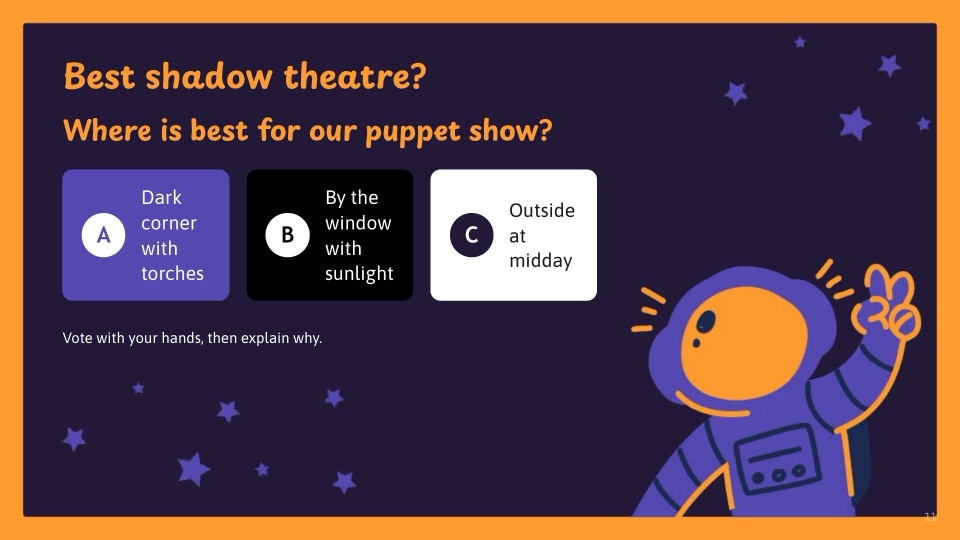
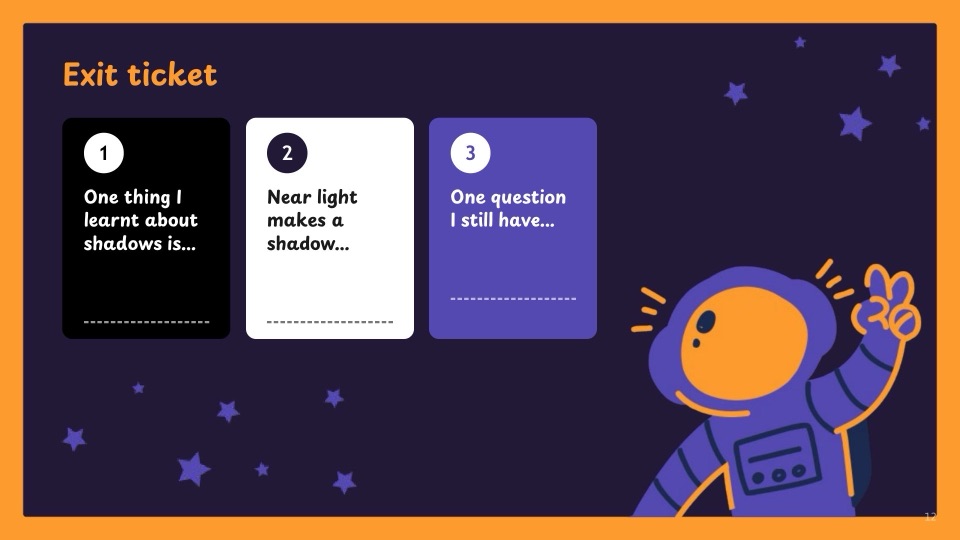
| 10 min | Plenary | Check both goals and reflect on how ideas about shadows changed. Show Slide 11 vote and take quick class vote on best shadow theatre place. Show Slide 12 exit lines and model one answer about near light. Give Worksheet Task E time to write I used to think... now I think... Collect two ideas and link back to opaque block and size pattern. |
Common mistakes
- Thinks clear plastic or glass makes a dark shadow.
How to spot it: Sorts transparent objects into shadow-maker pile.
Retest with torch: transparent lets light completely through, so almost no shadow. - Thinks shadow can move or stay on its own.
How to spot it: Says shadow follows or moves without object or light moving.
Freeze test: if both light and object stay still then shadow stays still too. - Thinks only object size sets shadow size.
How to spot it: Says big toy always means big shadow whatever the distance.
Compare same brick at 10 cm and 30 cm: further away gives smaller shadow.
Support
- Give pre-cut large shapes and sentence frame: The shadow formed because the ___ blocked the light.
- Use pre-marked 10 cm, 20 cm and 30 cm spots and a picture table with boxes for numbers.
Stretch
- Predict what two layers of tracing paper will do, then test and explain.
- Predict shadow size at 40 cm before measuring, then test it.
Check questions
- How is a shadow made?
Answer: Opaque object blocks light from a light source. - Toy at 10 cm makes a 14 cm shadow, at 30 cm makes a 6 cm shadow. What is the pattern?
Answer: Closer to light makes bigger shadow; further away makes smaller shadow. - Clear plastic in the torch beam: dark shadow or almost no shadow?
Answer: Almost no shadow because light passes through.
Curriculum
recognise that shadows are formed when the light from a light source is blocked by an opaque object; find patterns in the way that the size of shadows change
Video clips
Clips on YouTube, from the start and end times we chose. Check each one before you show it.
-
Light and Shadow for Grade 2 from 0:00 to 4:14
Periwinkle: Light and Shadow | Science For Kids | Grade 2 | Periwinkle
Directly teaches shadow formation with simple vocabulary and pace perfect for 7-8-year-olds in Year 3.
-
What Makes a Shadow? from 0:00 to 4:56
Kids Academy: What Makes a Shadow? | Light and Shadows for Kids
Clear explanation of light sources and shadows made for 7-8-year-olds with age-right examples.
Worksheet
Sources
- National curriculum in England: science programmes of study gov.uk
- Curriculum Map: Science Year 3 - camrose.harrow.sch.uk camrose.harrow.sch.uk
- Light and shadows - KS2 Science curriculum - BBC Bitesize bbc.co.uk
- Light and Shadows: Year 3 Science Project | Cornerstones cornerstoneseducation.co.uk
- Light and Shadow - School Learning Zone school-learningzone.co.uk
- Year 3 Science: Light - Lights and Shadows | Hamilton Brookes hamilton-trust.org.uk
- Light and Shadows (Year 6) | CGP+ Primary Online - CGP Plus cgpplus.co.uk
- Using Light and Shadow in Portrait Photography to Shape Emotion and ... bamfordphoto.co.uk
- Light and Colour Primary Resource - National Geographic Kids natgeokids.com
- Light - KS2 Science - BBC Bitesize bbc.co.uk
- The Science of Light and Shadows | Science in Pre-K scienceinprek.si.edu
- Shadow Facts for Kids kids.kiddle.co
- Light and shadows - Science Learning Hub sciencelearn.org.nz
- Light and Shadows Explained for Kids: Story, Facts & Activities | Storypie mystorypie.com
- Light and Shadows | Kindergarten Science for Kids kidsworldfun.com
- Learning Video: Light and Shadows - Kids Academy kidsacademy.mobi
- Helping Children Understand Light and Shadows | KS2 Science hands-oneducation.com
- Light and Shadows Flashcards - Class 3 Year 3 Science IGCSE (Cambridge) edurev.in
Picture credits
- Photo: MUSIC_AND_WALLPAPER · Pixabay
- Photo: FeeLoona · Pixabay
- Photo: Myriams-Fotos · Pixabay
- Photo: domitian · Pixabay
- Photo: Richard Schneider from Los Angeles · CC BY 2.0 · Wikimedia Commons
- Photo: wenwenf_foto · Pixabay
- Drawing: Shubjt · CC BY-SA 4.0 · Wikimedia Commons
- Pictograms: Sergio Palao, ARASAAC (arasaac.org) · CC BY-NC-SA
- Picture: unknown · CC0 · rawpixel via Openverse
Made with Lesson Dino's AI on 17 October 2026. AI can make mistakes, so check facts against the sources before you teach.