Slides
Lesson plan
Rock Detectives Sort and Group
Pupils compare rocks by colour, feel, shape and weight. They sort rocks into groups and explain their choices.
Objectives
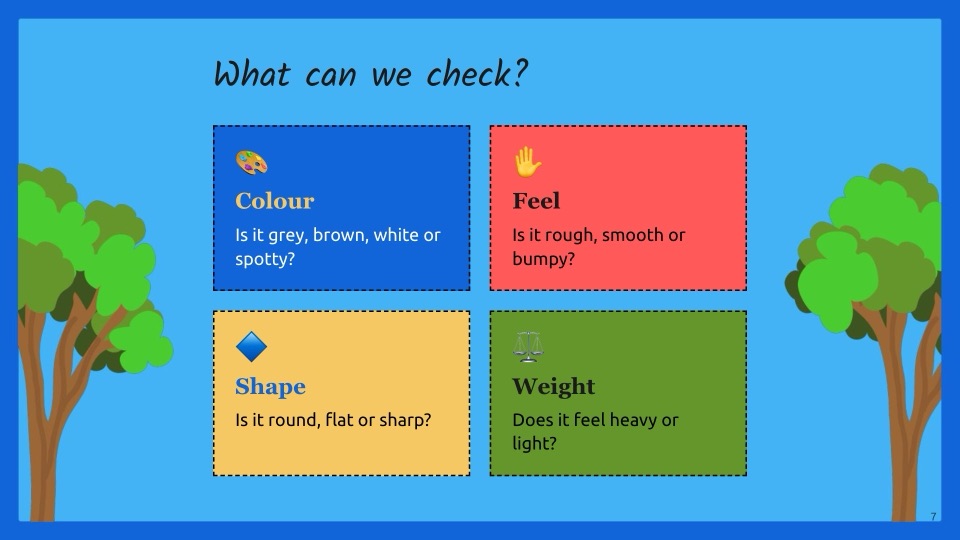
- Students will compare rocks by colour, texture, shape and weight.
- Students will group rocks with matching appearance and properties.
- Students will explain rock groups using features they observed.
Success criteria
- I can describe a rock’s colour, feel, shape and weight.
- I can sort rocks into groups that look and feel alike.
- I can explain why my rocks belong in the same group.
Key words
| Word | Meaning |
|---|---|
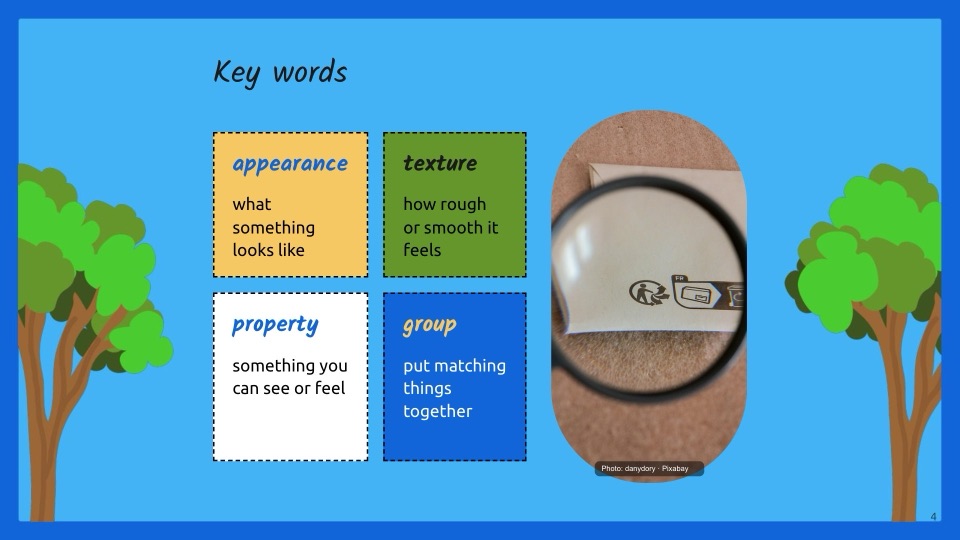
| appearance | what something looks like to your eyes |
| texture | how rough or smooth something feels when you touch |
| property | something you can see or feel about an object |
| group | things put together because they match |
Timed plan (60 minutes)
| Time | Stage | What happens |
|---|---|---|
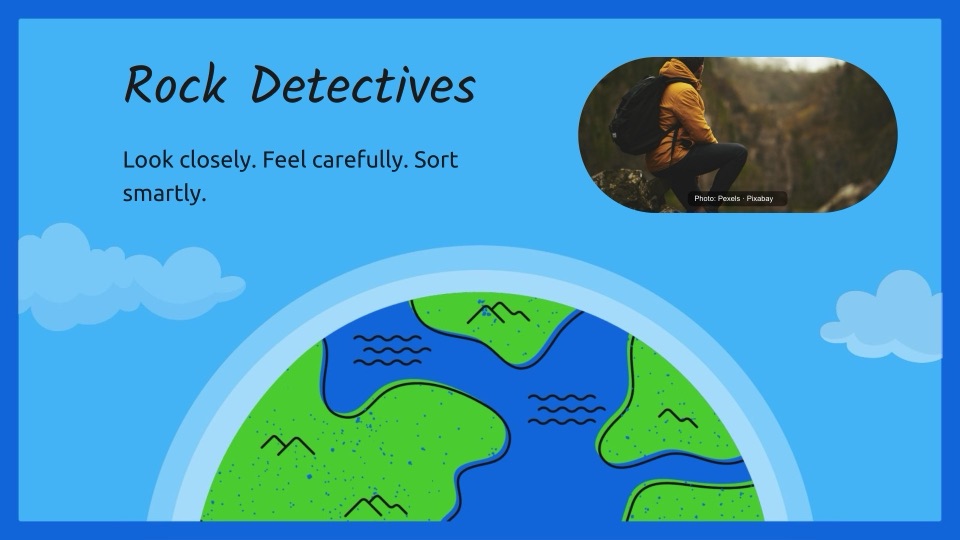
| 5 min | Starter | To hook pupils and surface ideas about rocks being different. Welcome class with Slide 1 and read the title line together. Say the hook: Detectives, I mixed up all the rock boxes. Your magnifiers can save the day. Ready to look super close? Show Slide 2 question and give 30 seconds think time. Ask pairs to share one quick answer with each other. |
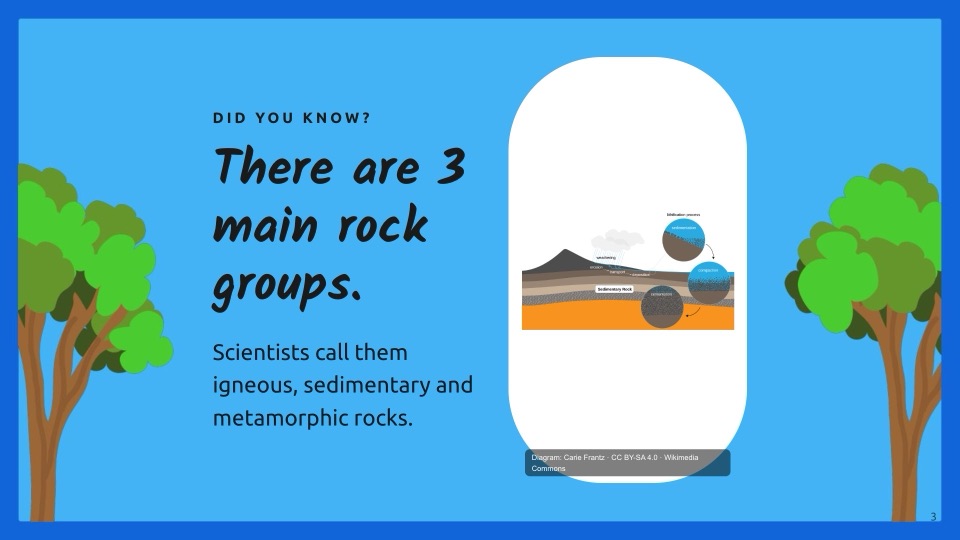
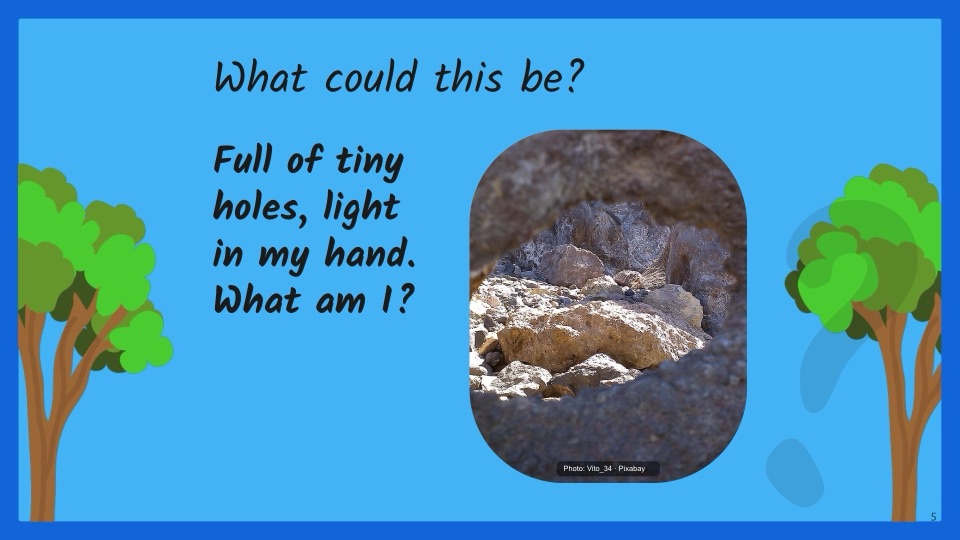
| 10 min | Teaching | To teach key words and model comparing rocks by observed features. Show Slide 3 and explain there are 3 main rock groups called igneous, sedimentary and metamorphic rocks. Teach Slide 4 key words by pointing to a rock for each property. Read Slide 5 mystery aloud and let pupils guess using clues. Model comparing two rocks by colour, feel, shape and weight. |
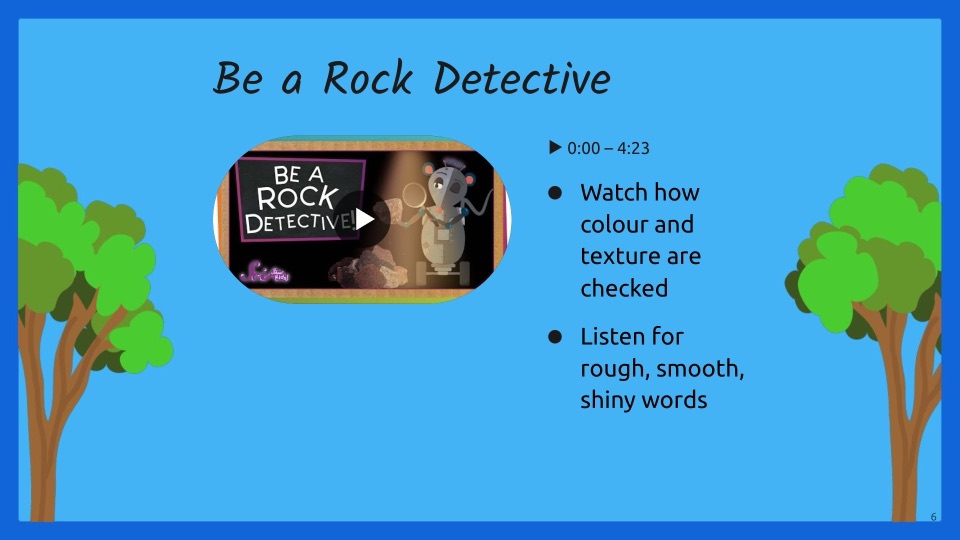
| 10 min | Guided practice | To practise checking colour and texture together before sorting alone. Play Slide 6 video and pause to repeat rough, smooth, shiny words. Show Slide 7 cards and model checking one rock for colour, feel, shape, weight. Ask class to call out the group name for the modelled rock. Set rules: look first, feel carefully, keep rocks on tray. |
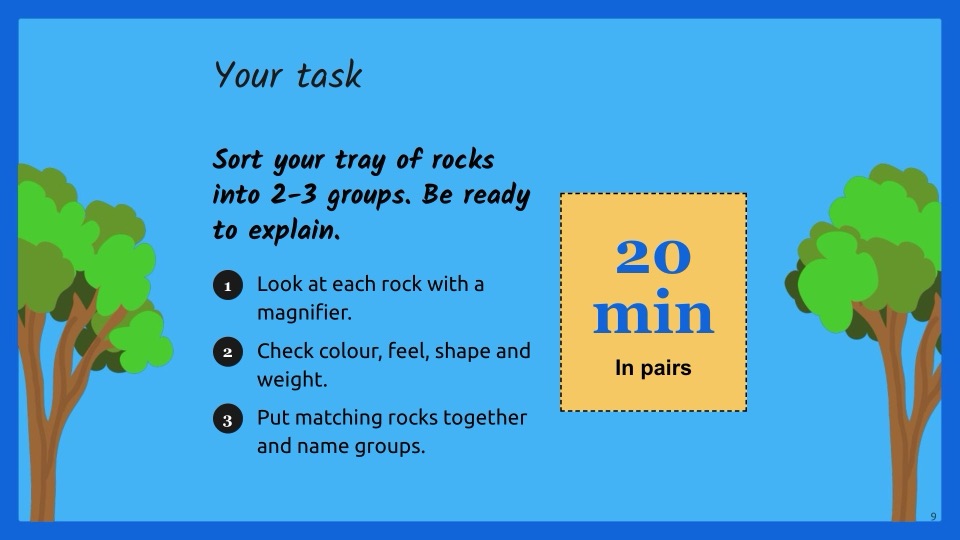
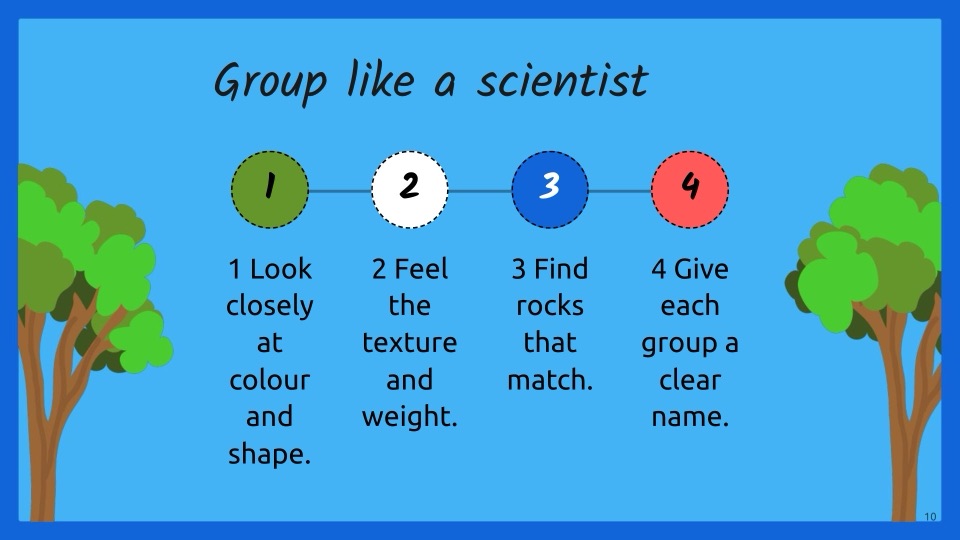
| 25 min | Main activity | To compare and group rocks closely in pairs using magnifiers. Show Slides 9-10 and explain steps: look, feel, find matches, name groups. Hand out trays, magnifying glasses and sorting mats for Magnifier Detectives. Remind pairs to use magnifying glass to explore examples of the rocks and sort by colour, spots, stripes, holes or shiny bits. Circulate, ask for group names and prompt splitting one group by a second feature. |
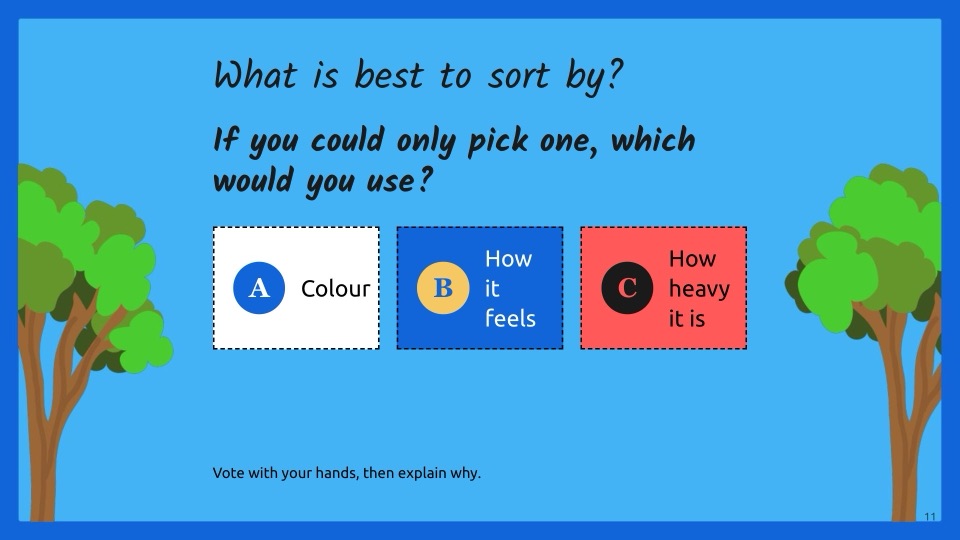
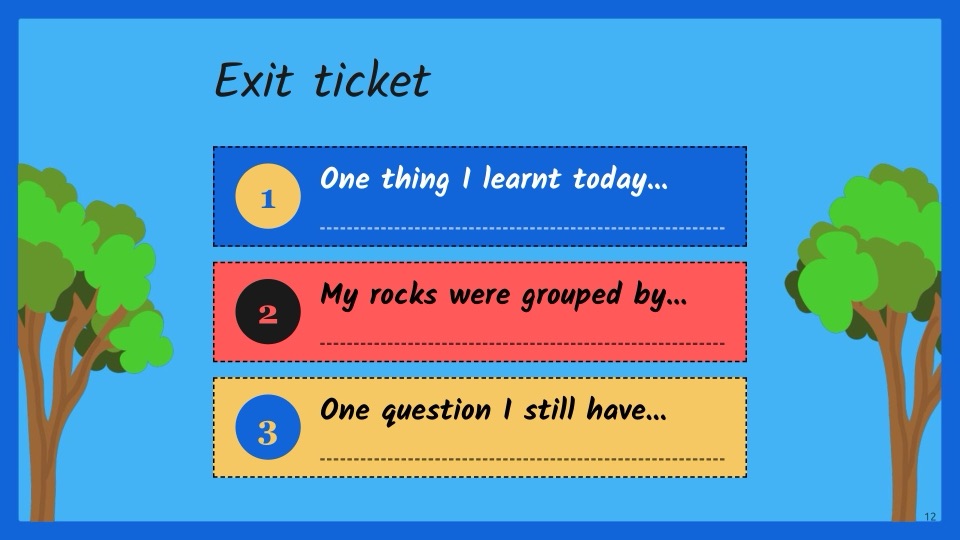
| 10 min | Plenary | To agree best sorting features and check learning against success criteria. Invite two pairs to show groups and explain feature used. Run Slide 11 vote for best single sorter: colour, feel or weight. Revisit success criteria and link to grouping by appearance and properties. Set Slide 12 exit ticket sentences for pupils to finish. |
Common mistakes
- Thinking size is the same as weight and putting all big rocks as heavy.
How to spot it: Pupil says big must be heavy without hefting both rocks.
Hold same-sized rocks, one in each hand, to compare heavy for its size, then check feel again. - Grouping only by favourite colour shade and ignoring spots, stripes or texture.
How to spot it: Groups have mixed smooth and rough rocks just because greyish.
Use magnifying glass to explore examples closely and re-sort by spots, holes or shiny bits. - Thinking there are only the three names igneous, sedimentary and metamorphic so appearance does not matter.
How to spot it: Pupil tries to guess the name instead of describing what they see.
Remind them to name groups by property first, e.g. rough darks, then link to scientist groups later.
Support
- Give a sorting mat with two choices, such as spotty or not spotty, to limit choices.
- Provide word bank and sentence starters for smooth, rough, heavy, light, bumpy and flat.
Stretch
- Ask students to split one large group into two smaller groups using a second feature.
- Ask students to explain out loud how they would justify a different grouping by another pair.
Check questions
- Name two properties you used to compare your rocks.
Answer: Colour and feel, e.g. grey and smooth, or spotty and rough. - My rocks were grouped by...
Answer: One clear rule, e.g. all rough and dark with spots together. - How do you know two rocks belong in the same group?
Answer: Because they match on the chosen appearance or feel feature.
Curriculum
compare and group together different kinds of rocks on the basis of their appearance and simple physical properties
Video clips
Clips on YouTube, from the start and end times we chose. Check each one before you show it.
-
Be a Rock Detective from 0:00 to 4:23
SciShow Kids: Be a Rock Detective!
Directly models comparing rocks by colour, texture and other looks and feels, with clear vocabulary and pace that suit 7-8-year-olds.
-
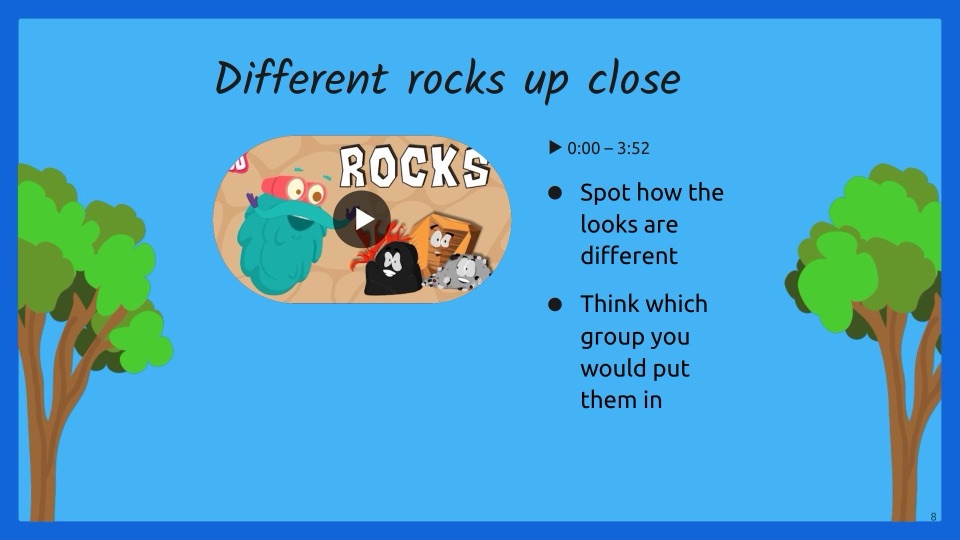
Types of rocks overview from 0:00 to 3:52
Peekaboo Kidz: Types Of Rocks | The Dr. Binocs Show | Learn Videos For Kids
Shows different kinds of rocks and how their appearance differs, with fun animation and simple language that suit 7-8-year-olds.
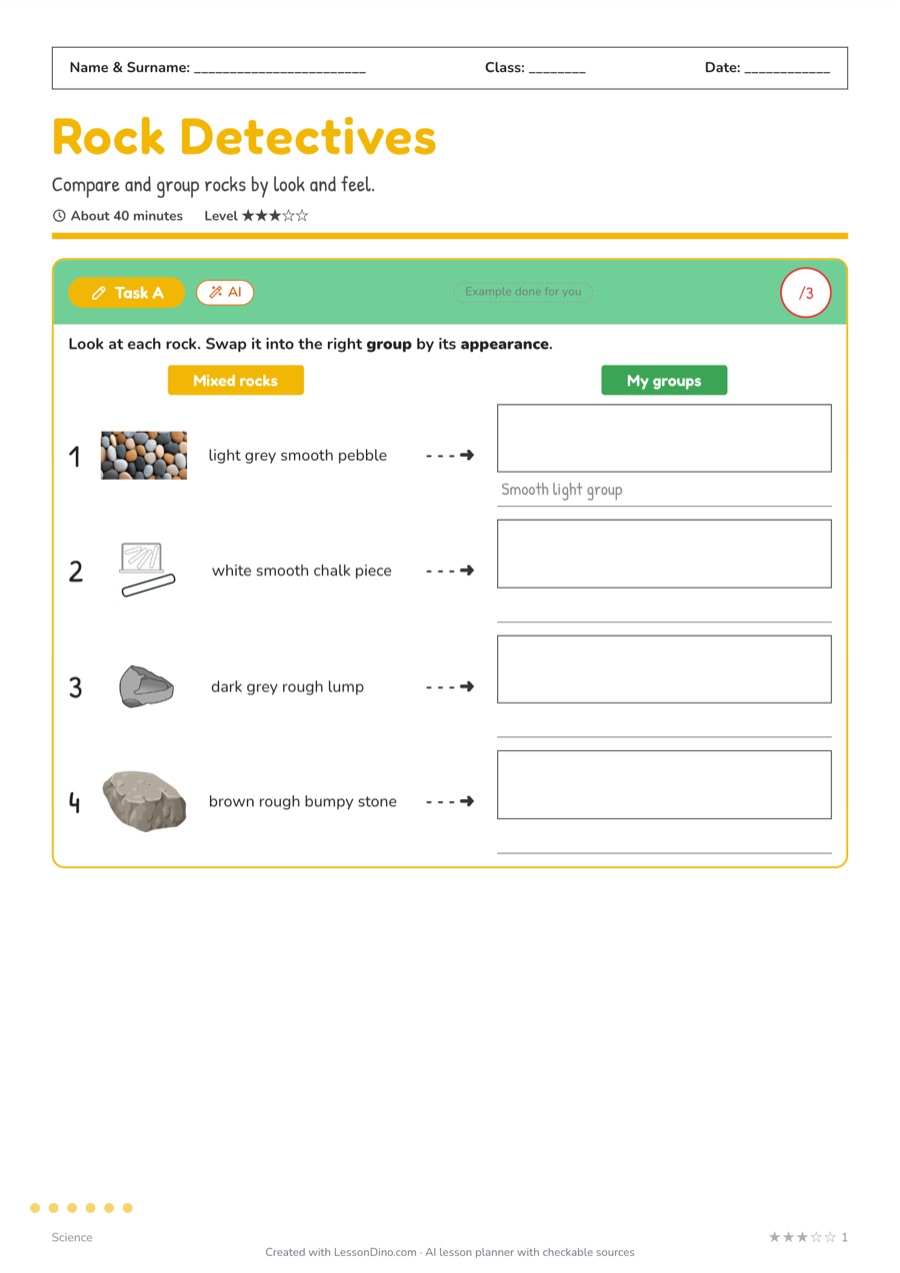
Worksheet
Sources
- St James C of E Junior School: Class 6 - using chocolate to explore different types of rocks stjamesjun.cumbria.sch.uk
- List of rock formations in the United Kingdom - Wikipedia en.wikipedia.org
- Common Rocks, United Kingdom location location.zone
- Eddystone Rocks, United Kingdom location location.zone
Picture credits
- Photo: Pexels · Pixabay
- Photo: 19771276 · Pixabay
- Diagram: Carie Frantz · CC BY-SA 4.0 · Wikimedia Commons
- Photo: danydory · Pixabay
- Photo: Vito_34 · Pixabay
- Illustration: Dreamdecko · Pixabay
- Pictograms: Sergio Palao, ARASAAC (arasaac.org) · CC BY-NC-SA
- Illustration: OpenClipart-Vectors · Pixabay
Made with Lesson Dino's AI on 17 October 2026. AI can make mistakes, so check facts against the sources before you teach.