Slides
Lesson plan
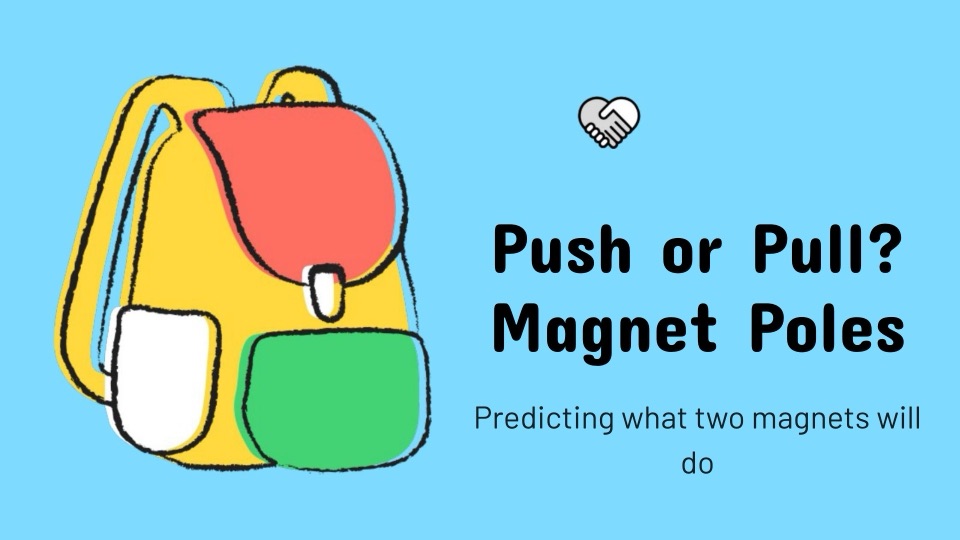
Push or Pull? Predicting Magnet Poles
Pupils learn the pole rule for attract and repel. They predict for each pole pair then test it with bar magnets.
Objectives
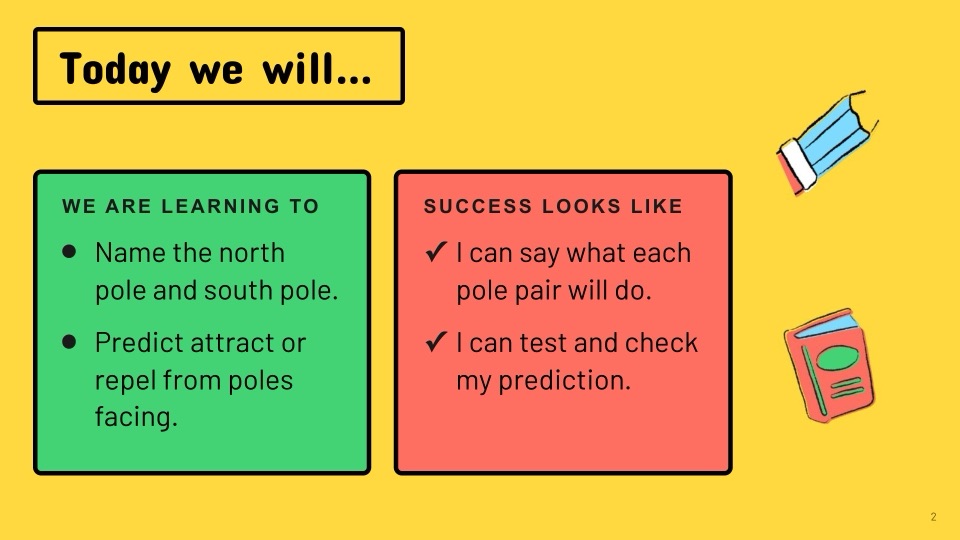
- Students will name the north pole and south pole on a bar magnet.
- Students will predict attract or repel from the poles facing each other.
- Students will test predictions by bringing poles close without touching.
Success criteria
- I can point to the north pole and the south pole.
- I can say attract for N–S and repel for same poles.
- I can check my prediction by testing the magnets.
Key words
| Word | Meaning |
|---|---|
| north pole | one marked end of a bar magnet |
| south pole | the other marked end of a bar magnet |
| attract | to pull together, like opposite ends snapping together |
| repel | to push apart, like same ends moving away |
| predict | to say what will happen before you try it |
Timed plan (60 minutes)
| Time | Stage | What happens |
|---|---|---|
| 10 min | Starter | To hook curiosity and recall north and south poles before predicting. Hold up two bar magnets with ends hidden, then show N facing N and let the top magnet jump away. Say the hook and show Slide 1, then share Slide 2 objectives in pupil language. Ask what the N and S ends are called and what pupils felt when the magnets pushed. Model saying the facing poles aloud: North facing north. |
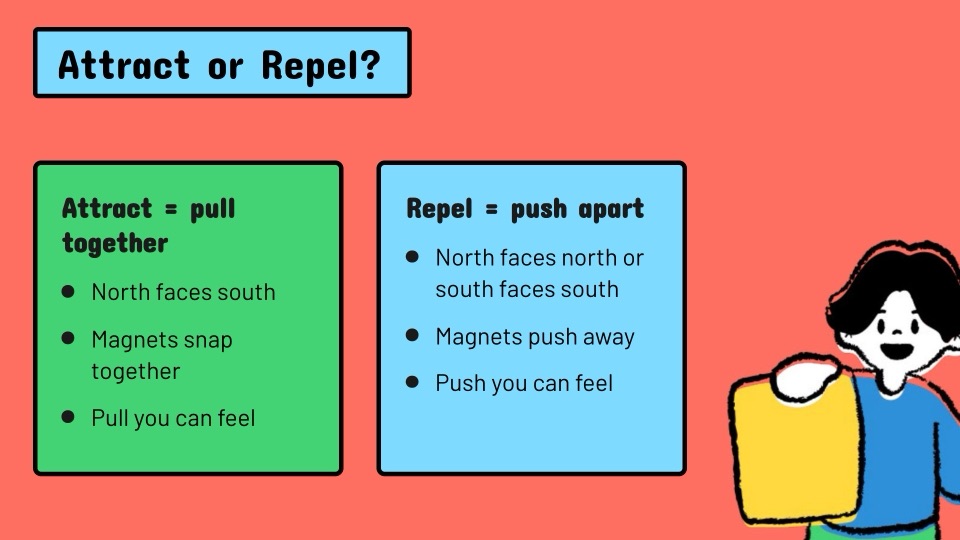
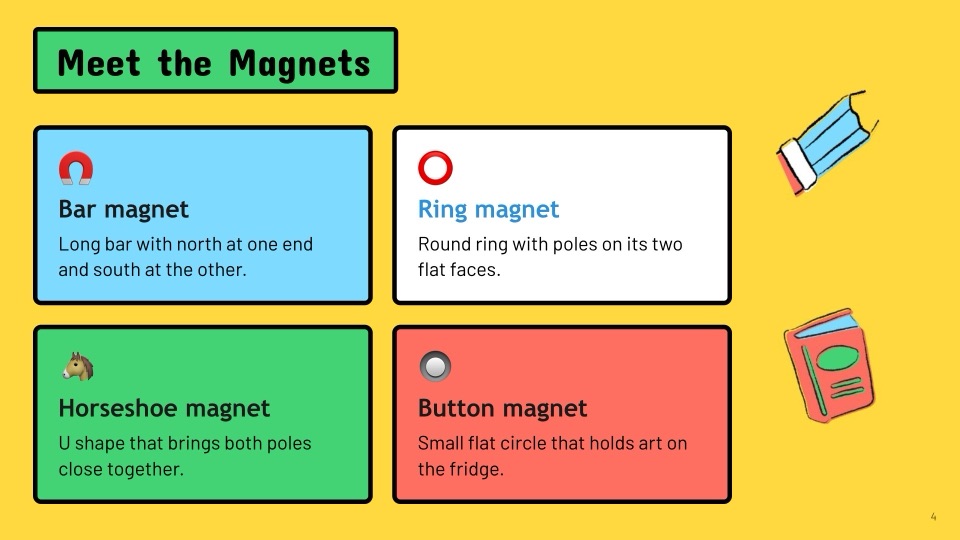
| 10 min | Teaching | To teach that opposite poles attract and same poles repel. Show Slide 3 and explain attract means pull together and repel means push apart. Show Slide 4 bar magnet and point to north at one end and south at the other. Model a full predict then test: say poles facing, say prediction, then slowly bring ends close. Repeat for a same-pole pair so pupils see and feel the push without touching. |
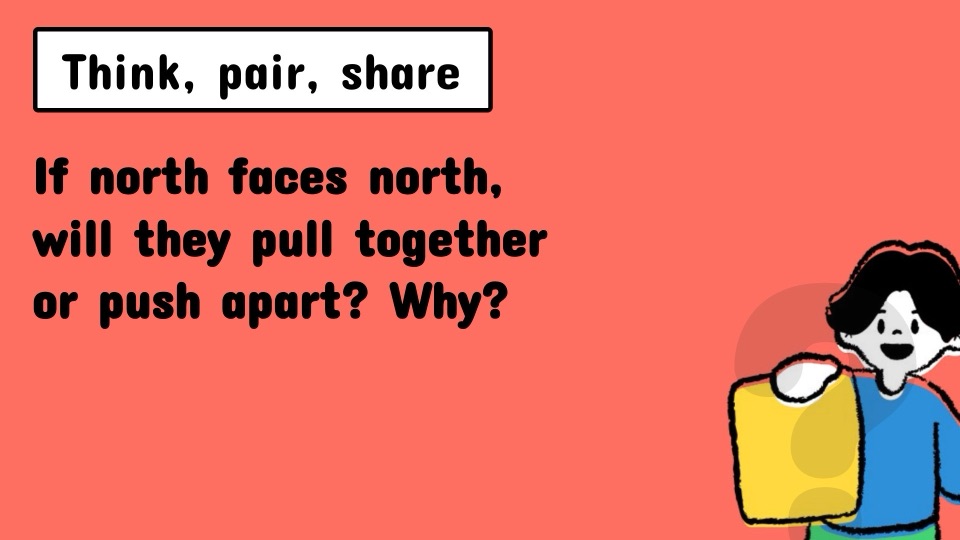
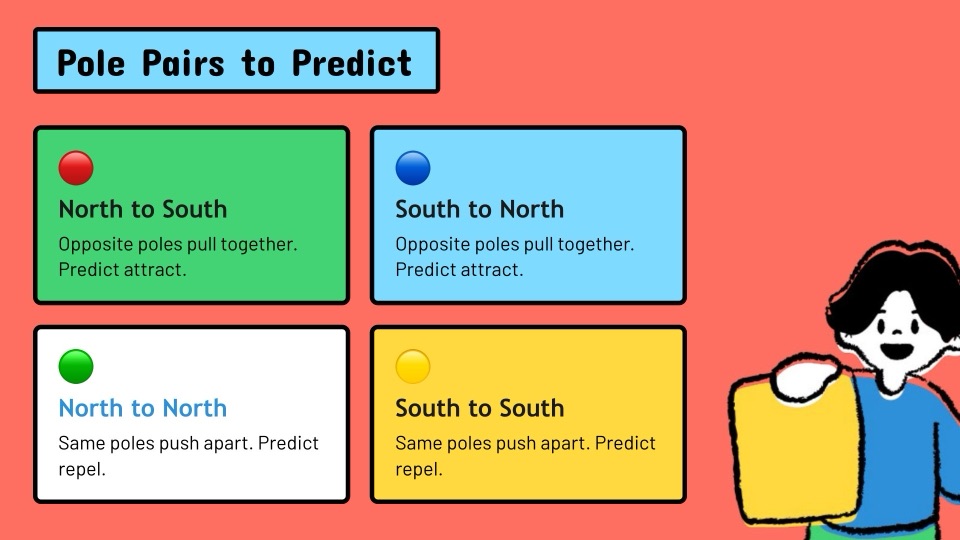
| 10 min | Guided practice | To practise saying predictions quickly from facing poles together. Show Slide 5 question and ask pairs to whisper the answer with a reason. Show Slide 7 pole-pair cards one at a time: North to South, South to North, North to North. Ask pupils to say the facing poles, then say predict attract or predict repel. Bring two real bar magnets together slowly to check each class prediction. |
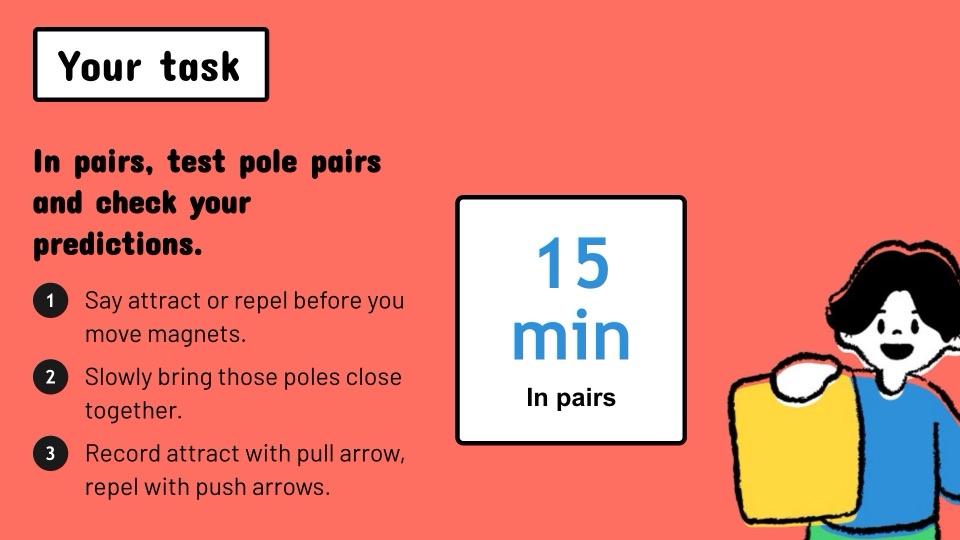
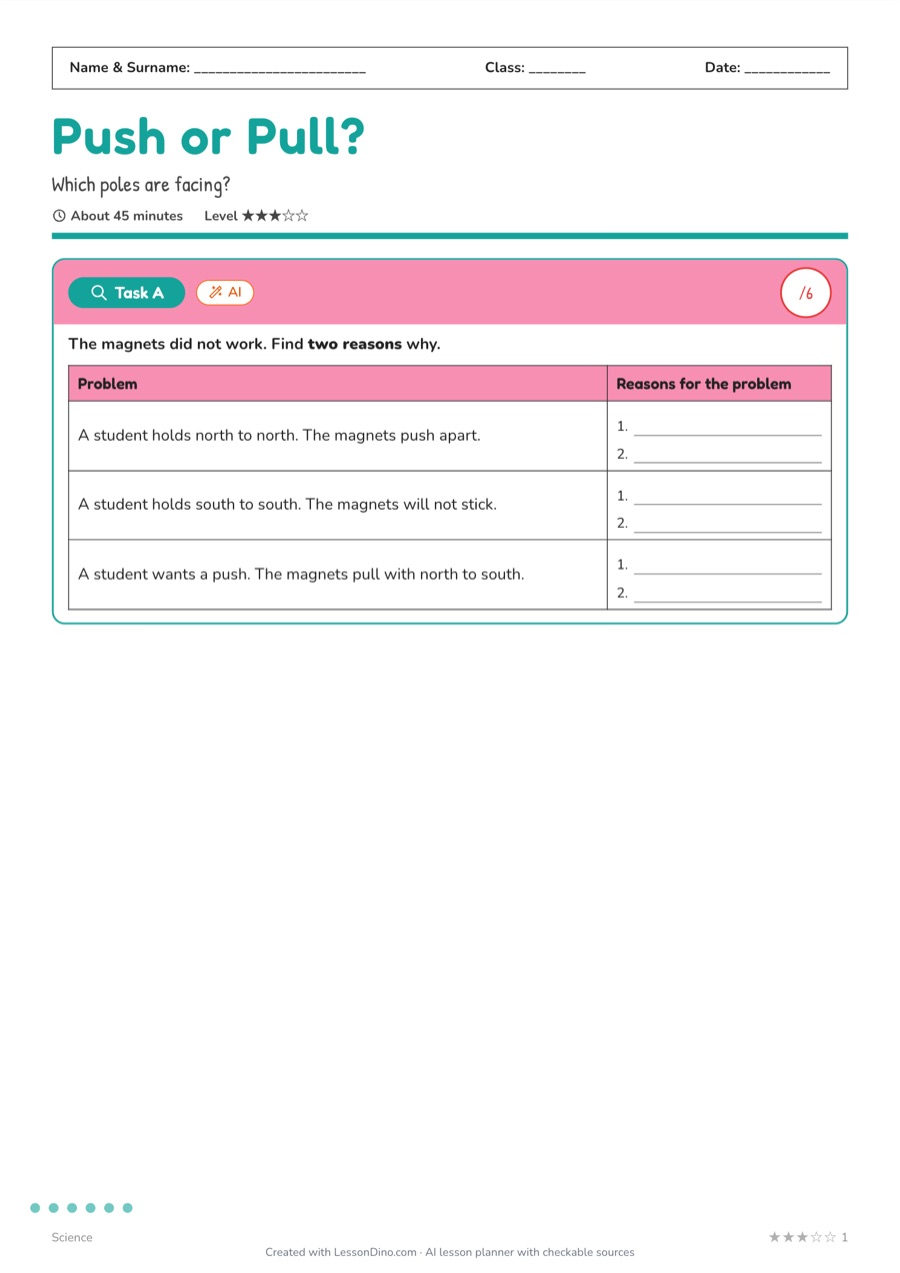
| 20 min | Main activity | To predict then test attract and repel for three pole pairs in pairs. Give out two bar magnets, prediction sheets and Worksheet Task C strips. Show Slide 9 and talk through the steps: say prediction, bring those poles slowly close, record with arrows. Remind pupils every magnet has a north pole at one end and a south pole at the other, and the force works without touching. Circulate, asking pairs to name facing poles before they move and to tick attract or repel after. |
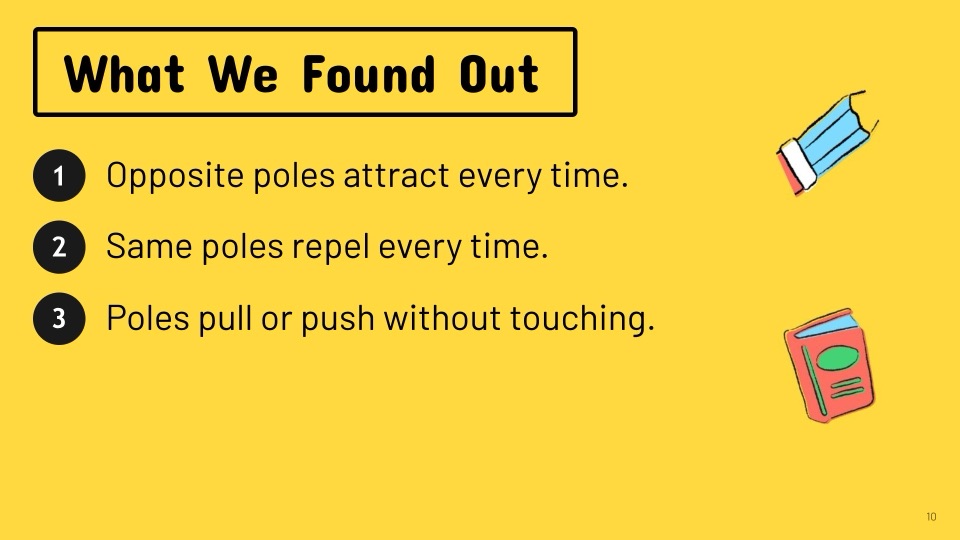
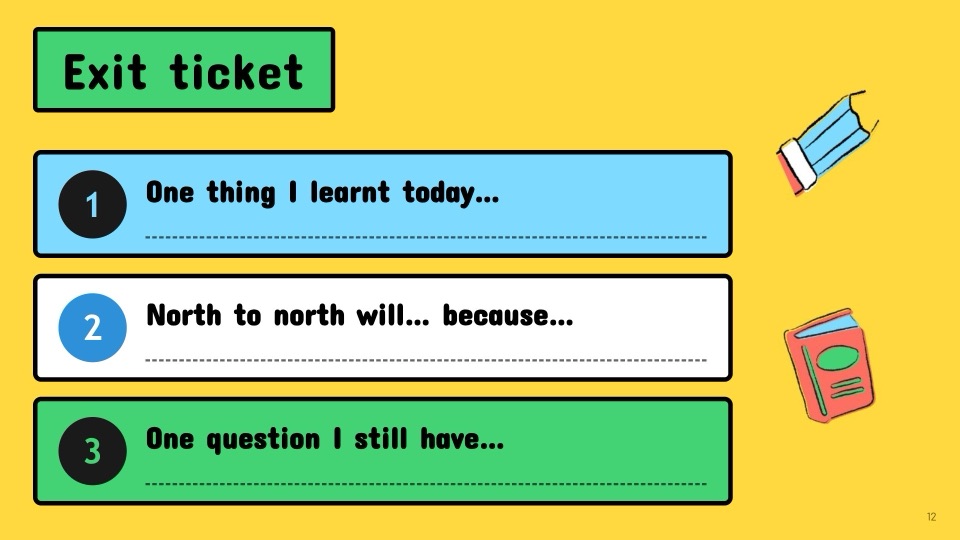
| 10 min | Plenary | To agree the pole rule and check every pupil can predict pole pairs. Invite two pairs to share their ticked results for N–S and N–N. Show Slide 10 and build the shared rule: opposite attract every time, same repel every time. Stress the pull or push can be felt with a small gap because magnetism works over a distance. Show Slide 12 exit ticket and ask pupils to write one sentence for North to north will… because… |
Common mistakes
- Thinking the same poles attract, predicting attract for North–North.
How to spot it: Pupil says attract when both facing poles are N or both are S.
Name both facing poles first, then use same means push apart and test slowly to feel the push. - Thinking magnets only work when touching.
How to spot it: Pupil pushes magnets together quickly and says nothing happened until they touched.
Hold a small gap and feel the pull or push, magnetism can act without direct contact. - Predicting without looking at which poles are facing.
How to spot it: Pupil shouts attract or repel without naming N or S.
Insist on saying North faces… then apply opposite attract, same repel.
Support
- Give a card showing N–S with arrows together and N–N with arrows apart to copy.
Stretch
- Ask students to predict what will happen if one magnet is turned round before testing.
Check questions
- North to north will… because…
Answer: repel, because the same poles push apart - North to south will… because…
Answer: attract, because opposite poles pull together - Do magnets have to touch to attract or repel?
Answer: No, they can pull or push without touching
Curriculum
predict whether 2 magnets will attract or repel each other, depending on which poles are facing
Video clips
Clips on YouTube, from the start and end times we chose. Check each one before you show it.
-
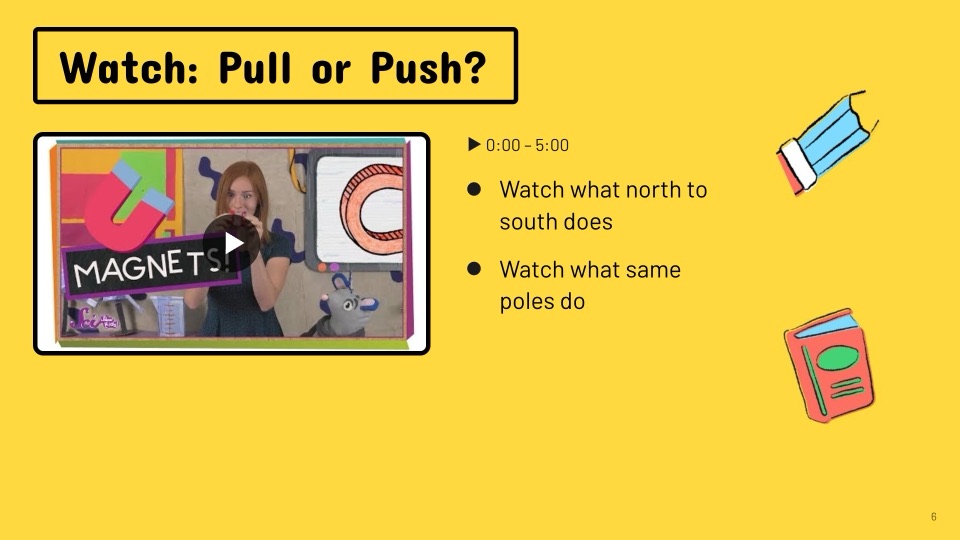
attract vs repel demo from 0:00 to 5:00
SciShow Kids: Fun with Magnets!
SciShow Kids pace and vocabulary are perfect for 7-8-year-olds and it shows north-south attract and same-pole repel very clearly.
-
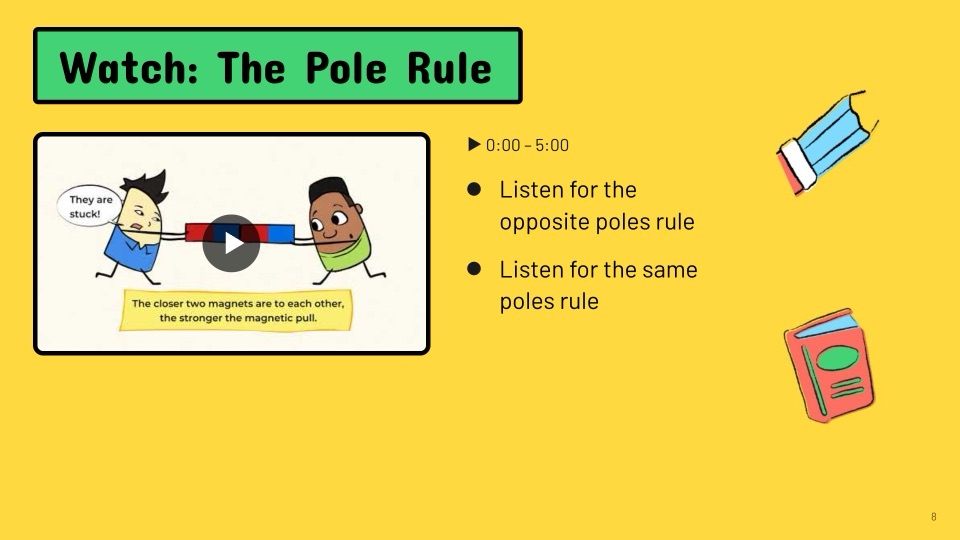
poles rule for 3rd grade from 0:00 to 5:00
MightyOwl: Magnets | MightyOwl Science | 3rd Grade
Made for 3rd grade, just right for Year 3 age 7-8, with a slow clear rule that opposite poles attract and like poles repel.
Worksheet
Sources
- National curriculum in England: science programmes of study gov.uk
- Curriculum Map: Science Year 3 - camrose.harrow.sch.uk camrose.harrow.sch.uk
- All products – Magnets Direct magnetsdirect.co.uk
- Magnets – KS2 Science curriculum - BBC Bitesize bbc.co.uk
- What is a magnet? - BBC Bitesize bbc.co.uk
- Fridge Photo Magnet | Personalised Magnets | Snapfish UK snapfish.co.uk
- What is a magnet? - BBC Bitesize bbc.co.uk
- Fun Magnet Facts for Kids - Science for Kids sciencekids.co.nz
- Magnet and Magnetism - Kids | Britannica Kids | Homework Help kids.britannica.com
- magnet and magnetism - Students | Britannica Kids | Homework Help kids.britannica.com
- Magnets for Kids: Fun Facts & Science Explained - The Edvocate theedadvocate.org
- The Science of Magnets for Kids! - cmosc.org cmosc.org
- What Is a Magnet for Kids: How Magnets Work - ScienceInsights scienceinsights.org
- How Do Magnets Work? Magnets, Magnetic Field, Compass, Domains smartclass4kids.com
- TIME for Kids | What Are Magnets? | G3-4 timeforkids.com
- Magnets and Electromagnetism Explained for Students academickids.com
- Britain Bets on Magnets, Not Mines: New £50 Million Critical Minerals Push Targets Supply Chain Security rareearthexchanges.com
- Permanent Suspension Magnets In United Kingdom, Permanent Suspension Magnets Manufacturers Suppliers United Kingdom kumarmagnetind.com
- A Kid-friendly Introduction to Magnets and Magnetism science.howstuffworks.com
- Magnet Facts for Kids: Poles, Compasses and Experiments kidzfeed.com
Picture credits
- Photo: ignartonosbg · Pixabay
- Illustration: Clker-Free-Vector-Images · Pixabay
- Pictograms: Sergio Palao, ARASAAC (arasaac.org) · CC BY-NC-SA
Made with Lesson Dino's AI on 17 October 2026. AI can make mistakes, so check facts against the sources before you teach.