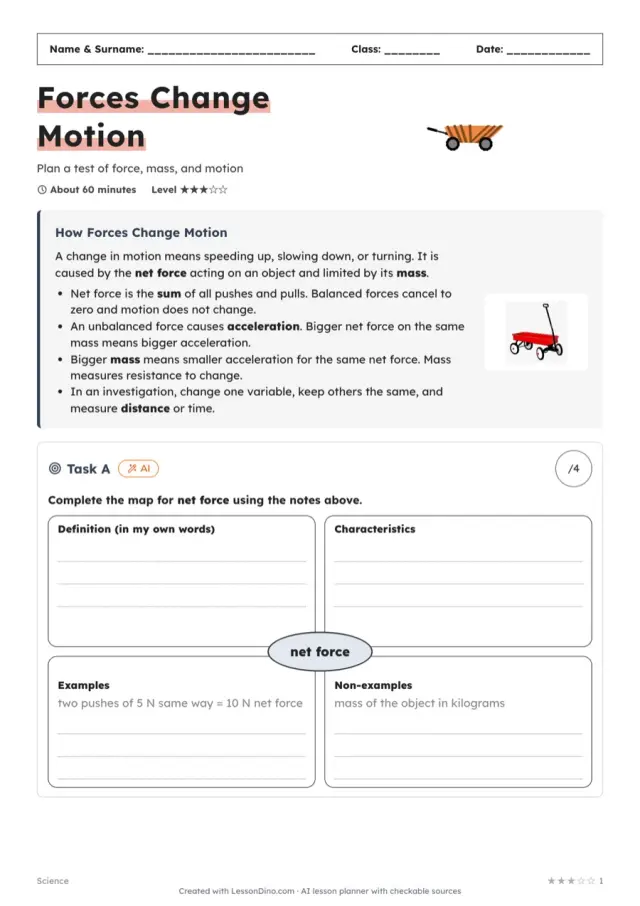
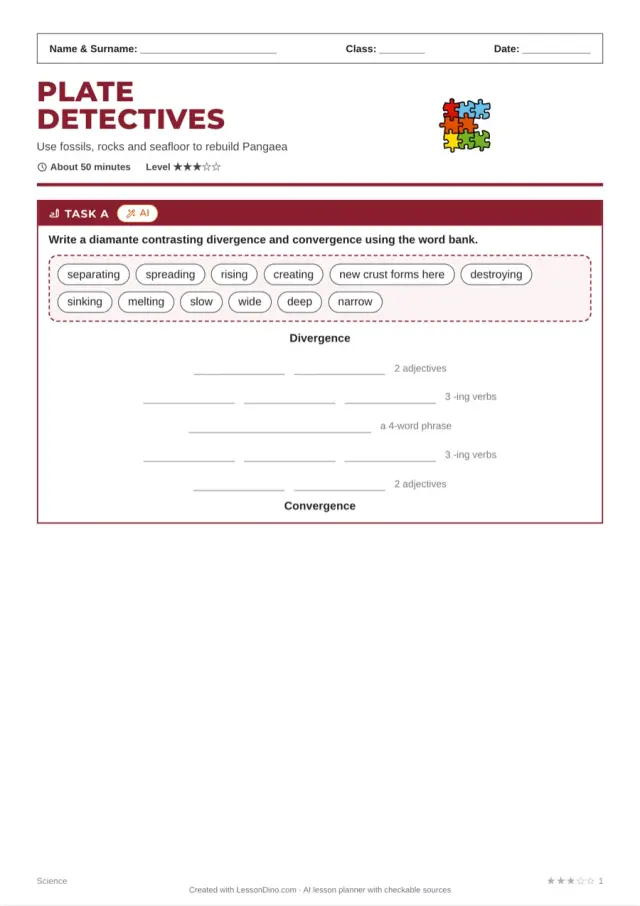
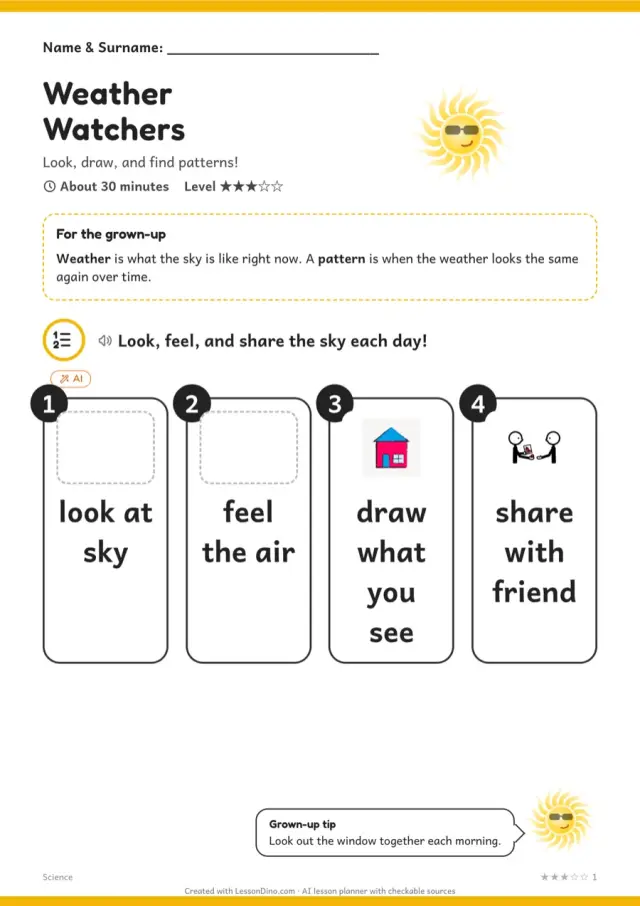
The worksheet
About this worksheet
Students learn that wave energy grows as amplitude squared. They draw waves and calculate relative energy as 1, 4, 9. This Grade 8 Science worksheet gives students (ages 13–14) three pages of practice on waves: amplitude and energy, part of the waves unit. It goes with our free Waves: amplitude and energy lesson, which has the slides and a timed lesson plan.
What it covers
By the end, students should be able to:
- Students will measure amplitude as height from rest to crest or trough.
- Students will use Energy proportional to amplitude squared to predict energy changes.
- Students will compare low- and high-energy waves using diagrams and math.
How to use it
- Main activity (20 minutes): Hand out graph paper and Worksheet Task C and model shading 1 by 1, 2 by 2, and 3 by 3 squares.
- Application (12 minutes): Assign Worksheet Task A: answer in full sentences using amplitude and energy in math and explanations.
- Plenary (8 minutes): Collect Worksheet Tasks A and C and preview that frequency will be modeled next time.
- Support: Use pre-drawn waves with a bold middle rest line and graph-paper squares for counting.
- Stretch: Calculate energy for amplitudes 5 and 10 and write why small height gains pack a big punch.
- The answer sheet is the last page, so you can print it on its own or let students check their own work.
Key vocabulary
- amplitude: farthest distance from the middle resting line to the top or bottom of a wave
- energy: what is carried by a wave that lets it push, move, or change things at the far end
- intensity: amount of power passing through each unit of surface area
- rest position: middle line where the medium sits when no wave is passing
Mistakes to watch for
- Thinking doubling amplitude doubles energy. Re-shade 2 by 2 squares to show 4 units and restate doubling quadruples because energy is amplitude squared.
- Measuring amplitude from crest to trough instead of rest line. Draw the middle rest line and measure rest to crest or trough only, the maximum displacement from rest.
- Thinking waves carry matter forward across the ocean. Show particles move mostly in place while the pattern moves forward; waves transport energy without transporting matter.
What's on the worksheet
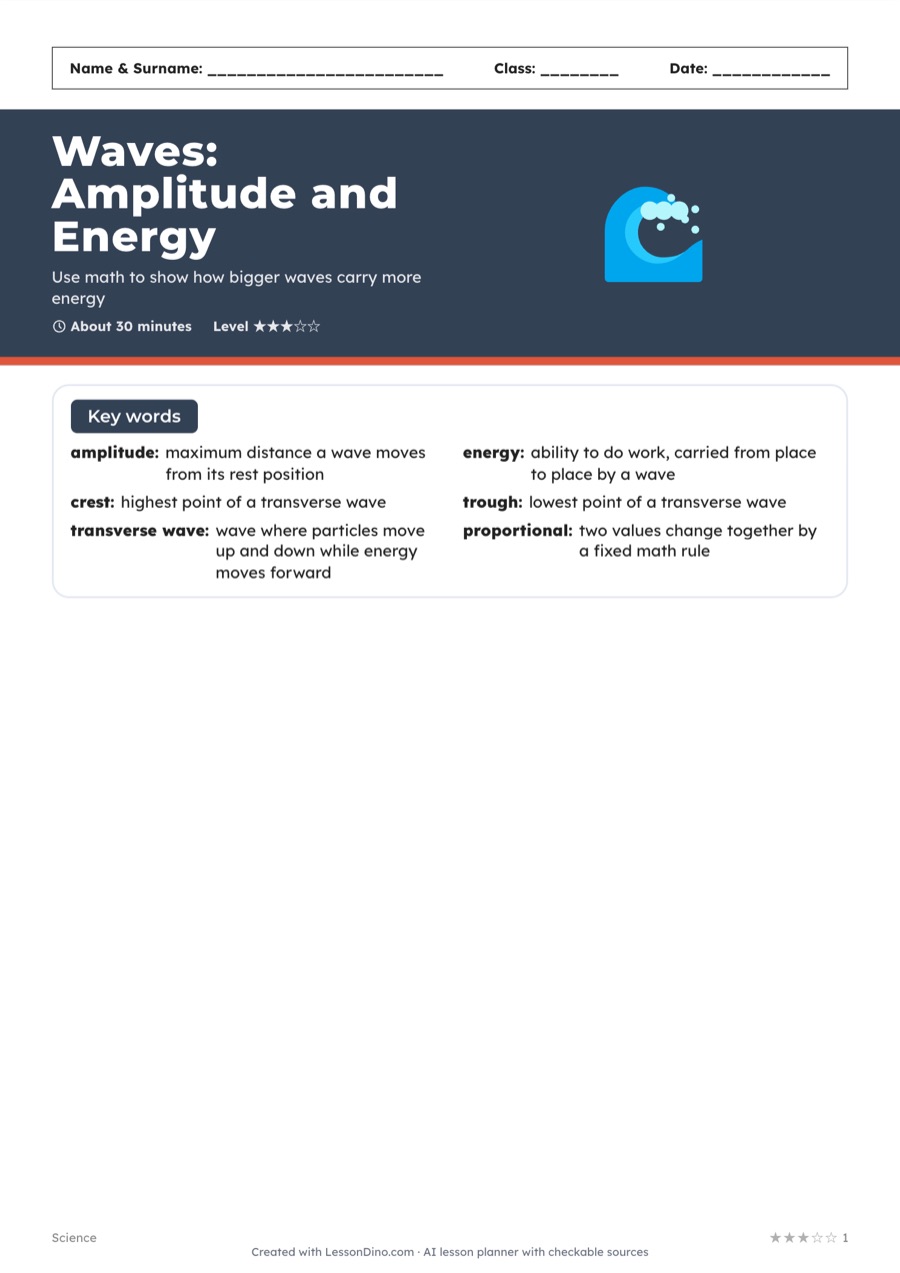
Big Waves, More Energy
Learn the link between amplitude and energy, then dig into an example.
| Word | Meaning |
|---|---|
| amplitude | maximum distance a wave moves from its rest position |
| energy | ability to do work, carried from place to place by a wave |
| crest | highest point of a transverse wave |
| trough | lowest point of a transverse wave |
| transverse wave | wave where particles move up and down while energy moves forward |
| proportional | two values change together by a fixed math rule |
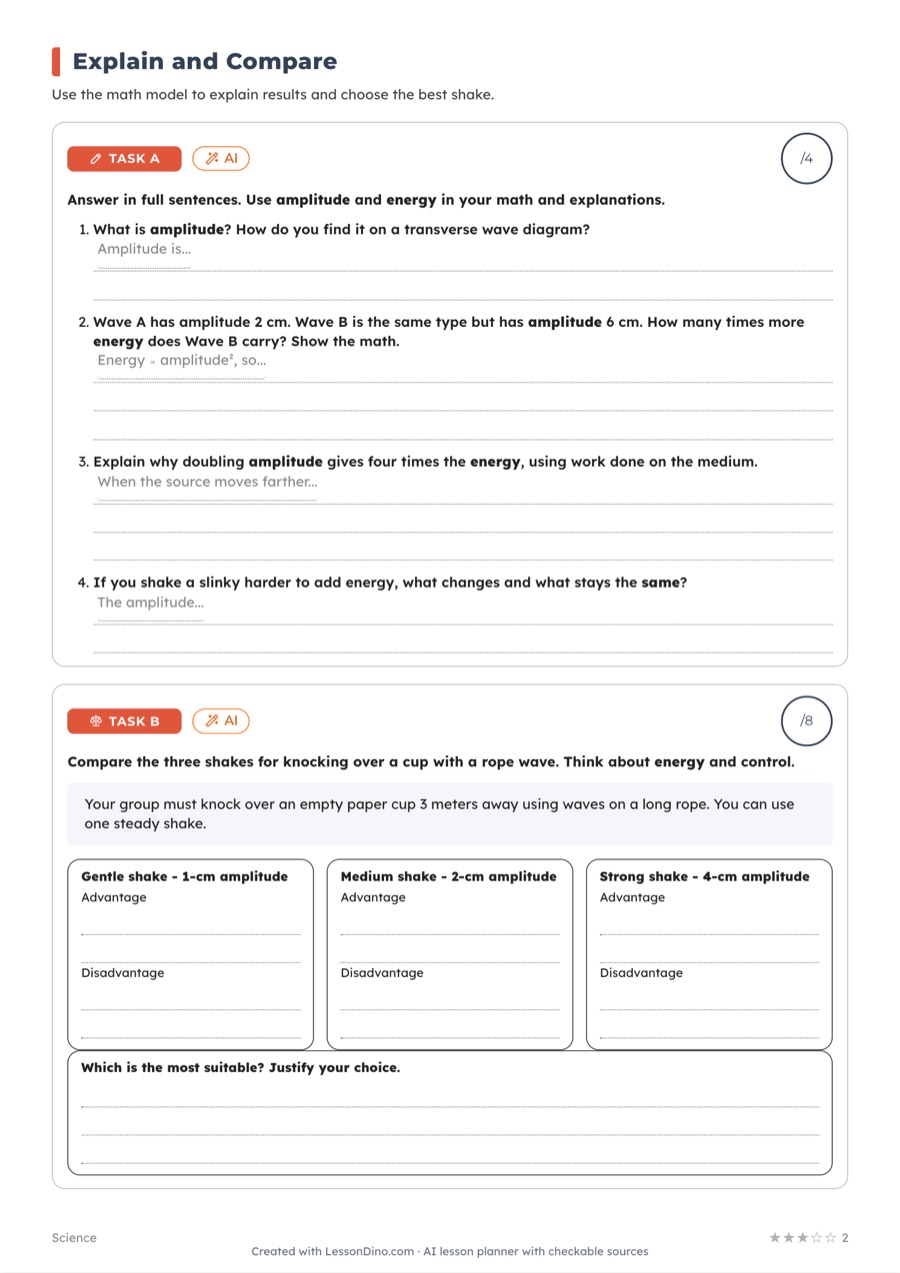
Explain and Compare
Use the math model to explain results and choose the best shake.
Answer in full sentences. Use amplitude and energy in your math and explanations.
- What is amplitude? How do you find it on a transverse wave diagram?
- Wave A has amplitude 2 cm. Wave B is the same type but has amplitude 6 cm. How many times more energy does Wave B carry? Show the math.
- Explain why doubling amplitude gives four times the energy, using work done on the medium.
- If you shake a slinky harder to add energy, what changes and what stays the same?
Compare the three shakes for knocking over a cup with a rope wave. Think about energy and control.
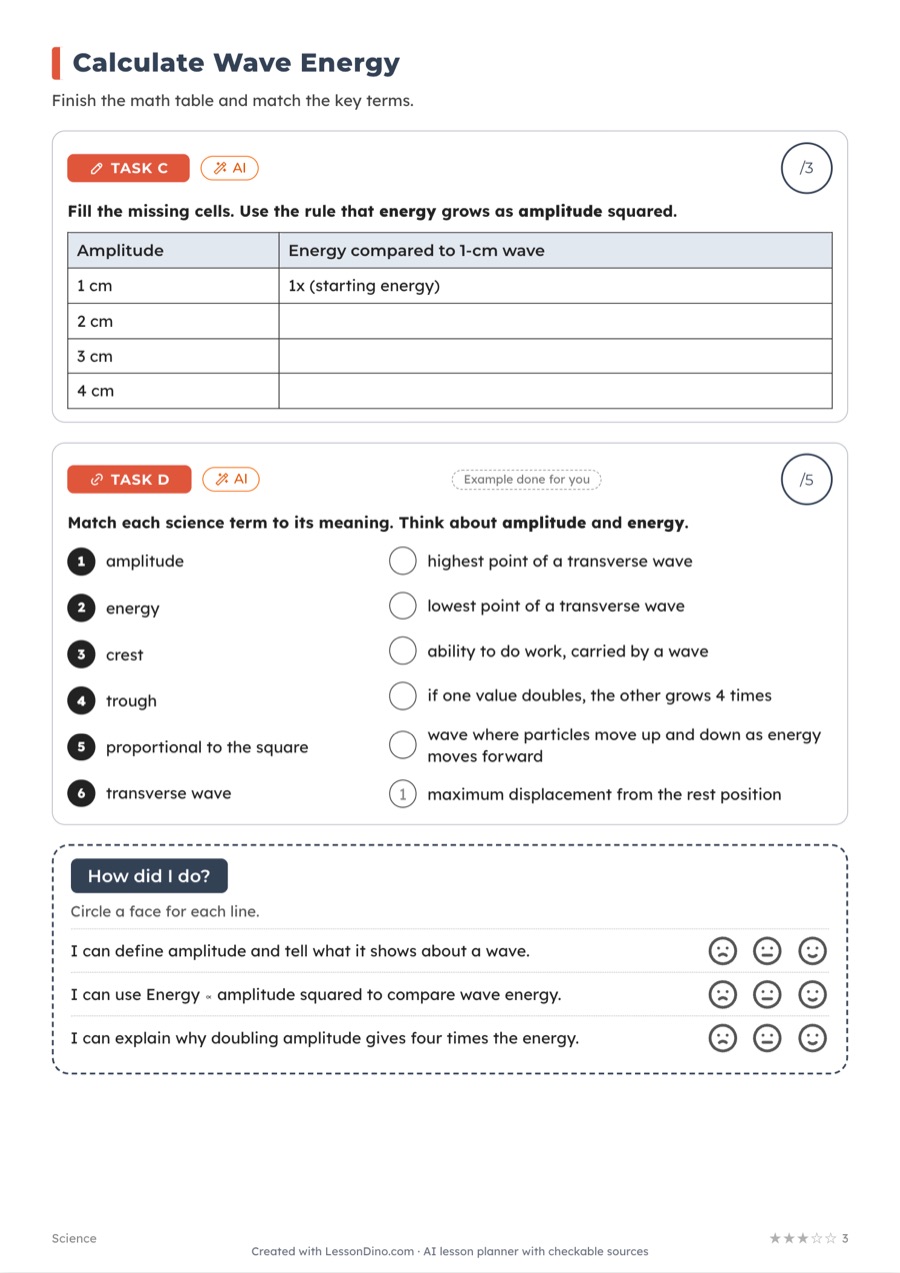
Calculate Wave Energy
Finish the math table and match the key terms.
Fill the missing cells. Use the rule that energy grows as amplitude squared.
Match each science term to its meaning. Think about amplitude and energy.
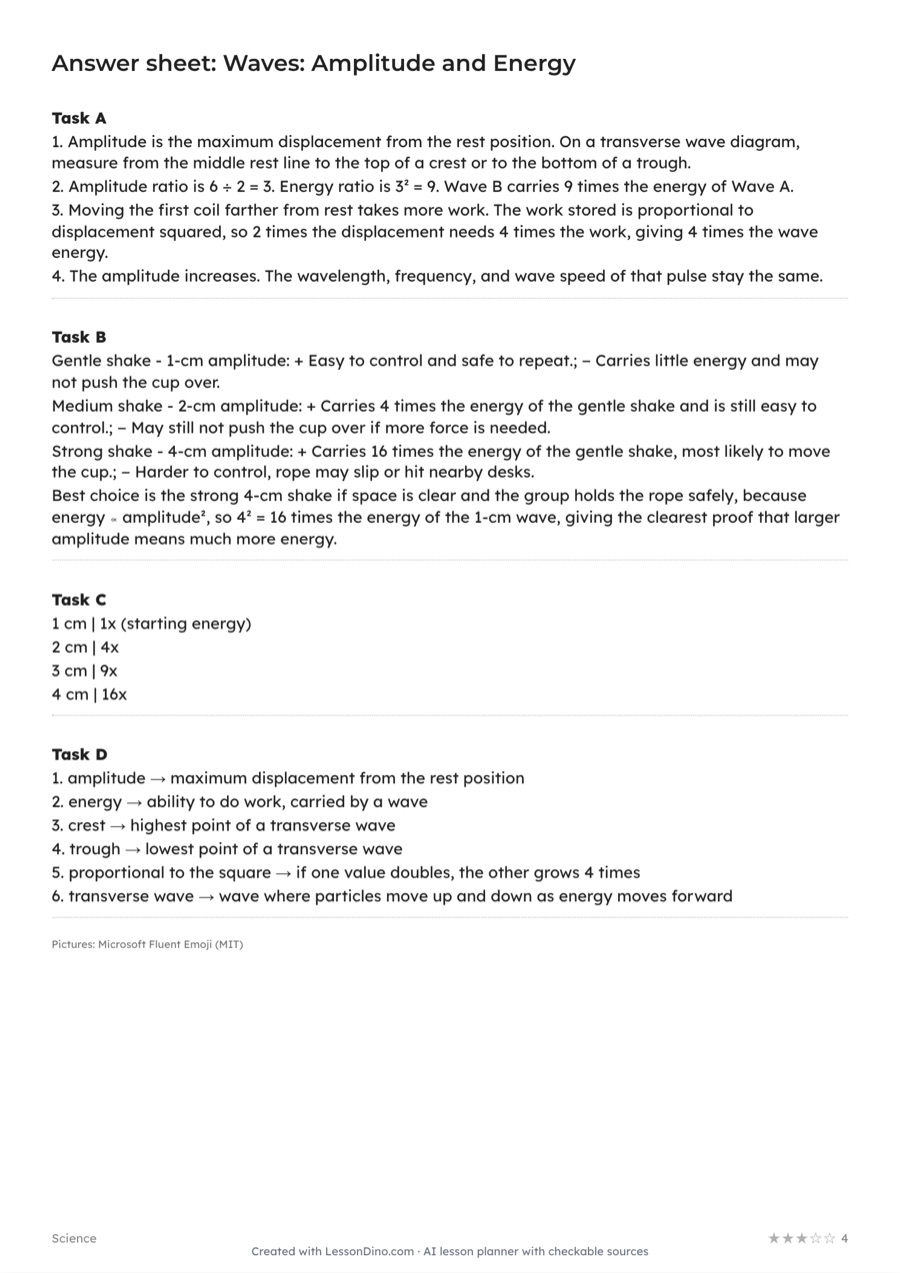
Answers
Show the answers
- What is amplitude? How do you find it on a transverse wave diagram? Amplitude is the maximum displacement from the rest position. On a transverse wave diagram, measure from the middle rest line to the top of a crest or to the bottom of a trough.
- Wave A has amplitude 2 cm. Wave B is the same type but has amplitude 6 cm. How many times more energy does Wave B carry? Show the math. Amplitude ratio is 6 ÷ 2 = 3. Energy ratio is 3² = 9. Wave B carries 9 times the energy of Wave A.
- Explain why doubling amplitude gives four times the energy, using work done on the medium. Moving the first coil farther from rest takes more work. The work stored is proportional to displacement squared, so 2 times the displacement needs 4 times the work, giving 4 times the wave energy.
- If you shake a slinky harder to add energy, what changes and what stays the same? The amplitude increases. The wavelength, frequency, and wave speed of that pulse stay the same.
The answer sheet is the last picture above.
Curriculum
Use mathematical representations to describe a simple model for waves that includes how the amplitude of a wave is related to the energy in a wave.
From Next Generation Science Standards (middle school), MS-PS4-1.
Made with Lesson Dino's AI on 16 October 2026. AI can make mistakes, so check the answers and facts against the sources before you teach.