Slides
Lesson plan
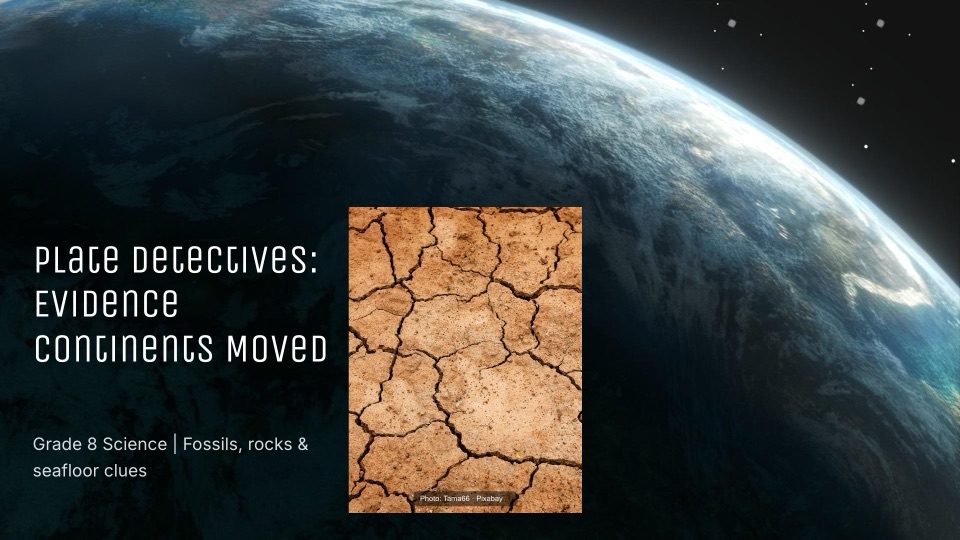
Plate Detectives: Putting Pangaea Back Together
Students analyze fossil, rock, shape, and seafloor clues for past plate motion. They rebuild Pangaea from paper clues and defend their reconstruction.
Objectives
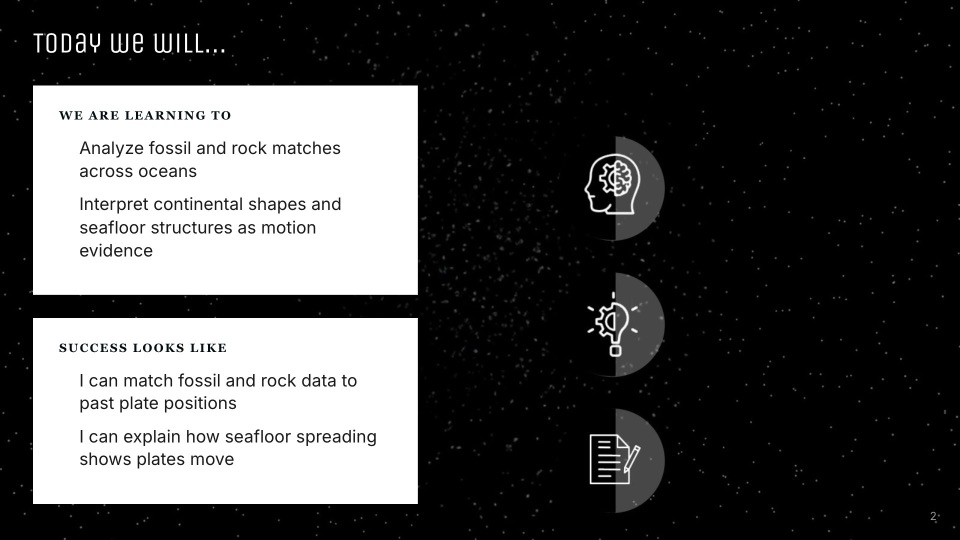
- Students will use fossil and rock matches to infer past continent positions.
- Students will use continental shape fits to support past plate motion claims.
- Students will explain how new seafloor forms at ridges and moves plates.
Success criteria
- I can match fossils and rocks across oceans to rejoin continents.
- I can describe how shape fit supports past plate movement.
- I can explain how seafloor data shows plates move apart.
Key words
| Word | Meaning |
|---|---|
| Pangaea | a very old giant landmass that later split into today's pieces |
| continental drift | slow movement of landmasses away from each other over time |
| fossil distribution | where the remains of ancient living things are found |
| seafloor spreading | making of fresh ocean floor at a ridge that then moves sideways |
| subduction zone | place where one sinking plate goes down under another plate |
Timed plan (60 minutes)
| Time | Stage | What happens |
|---|---|---|
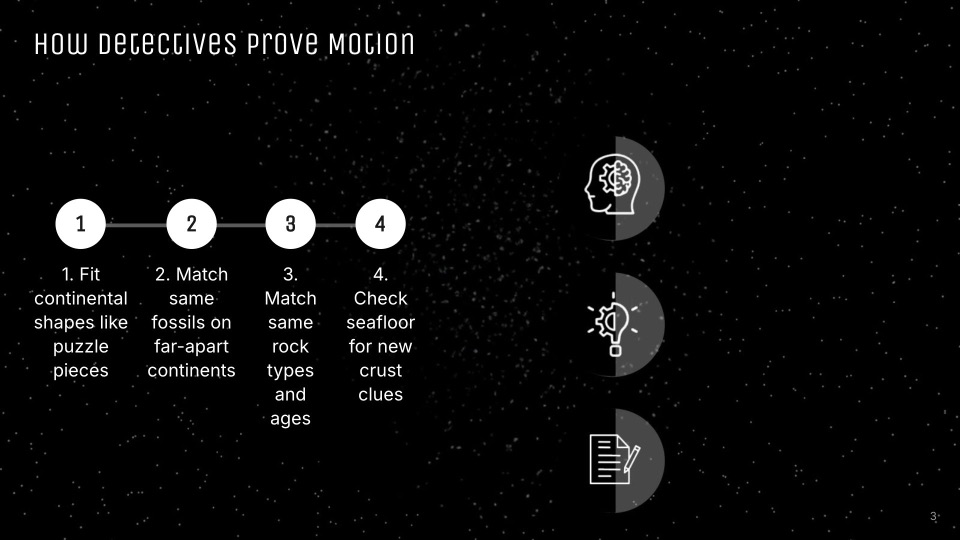
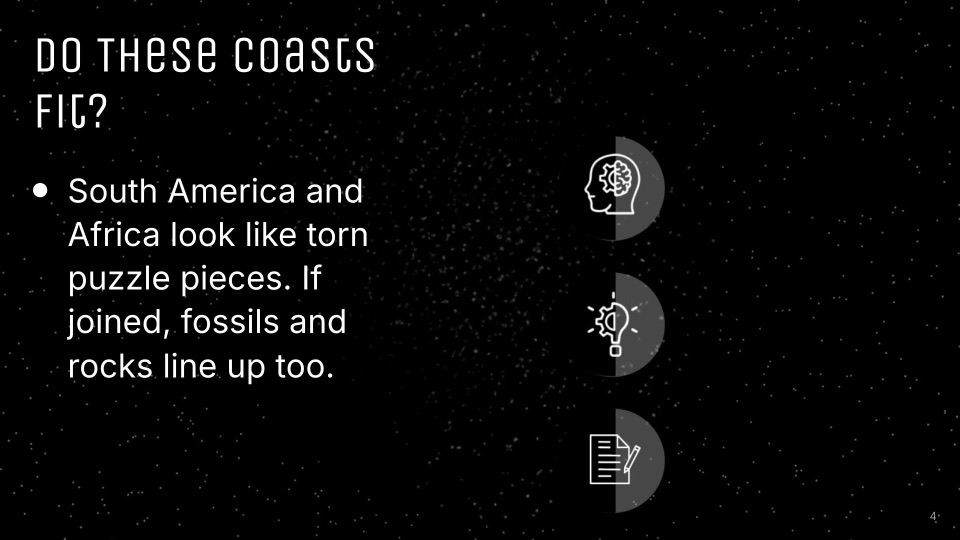
| 8 min | Starter | Hook interest in shape fit and set up the Pangaea detective task. Show Slides 1-2 and read the objectives for matching fossil and rock data. Say the hook and show Slide 4: South America and Africa look like torn puzzle pieces. Model a quick fit with two cutouts along the continental shelf edge. Ask what the fit suggests and what else would convince them besides shape. |
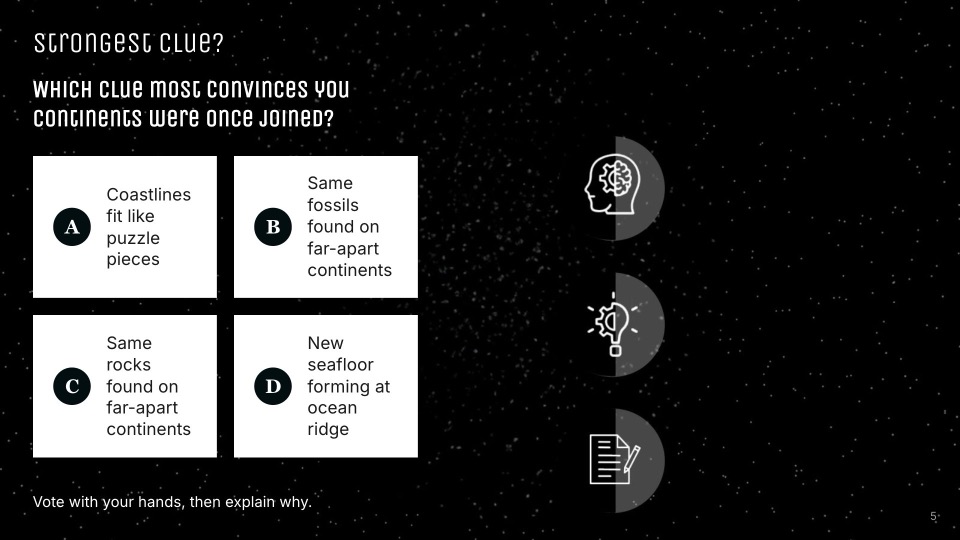
| 12 min | Fossil and rock clues | Teach that matching fossils and rocks prove past positions better than shape alone. Show Slide 5 vote on strongest clue and collect quick hands. Play Video clip 1 (0:00-4:36) on Slide 6 for fossil matches and rock matches. Explain that using shape is one type of evidence, same rock types is another, and same type and age fossils is yet another. Model claim with Brazil and West Africa matching rock formations and similar fossils. |
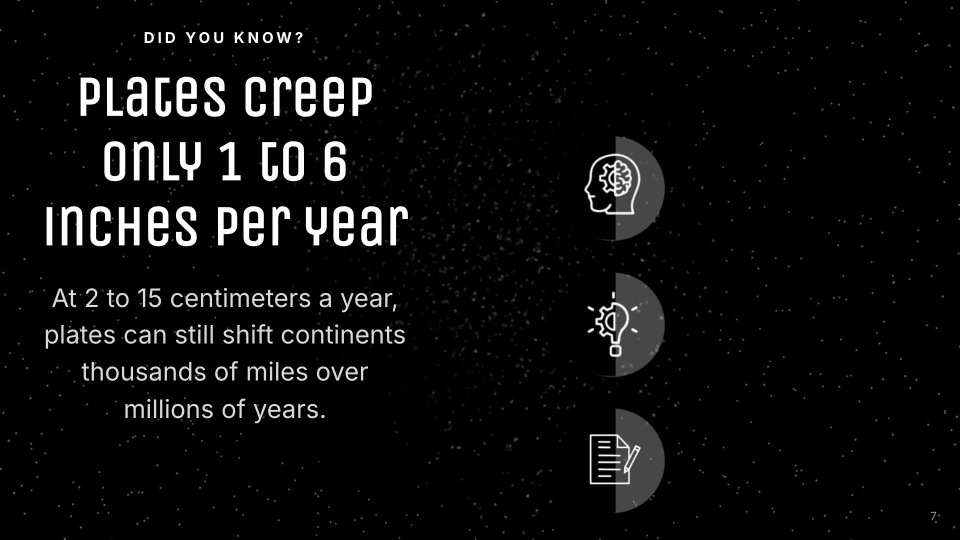
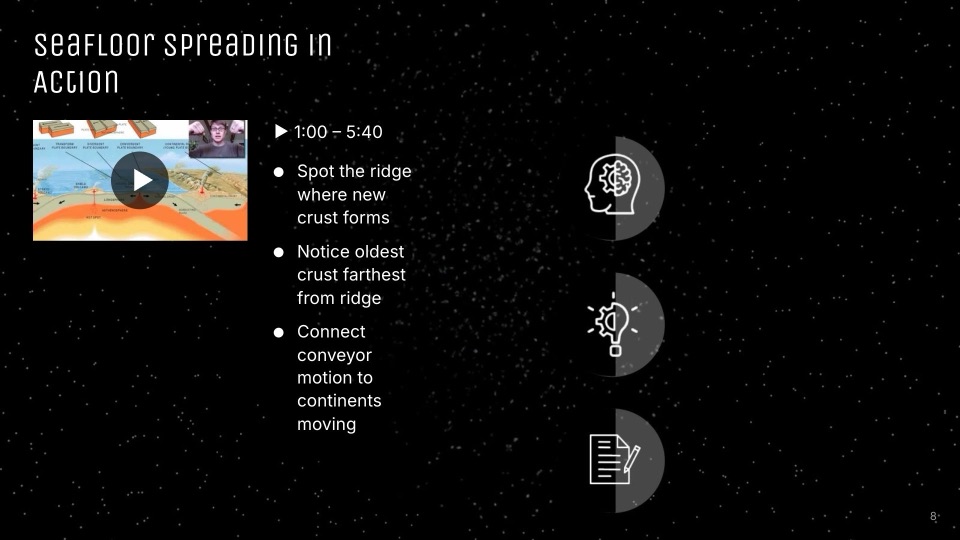
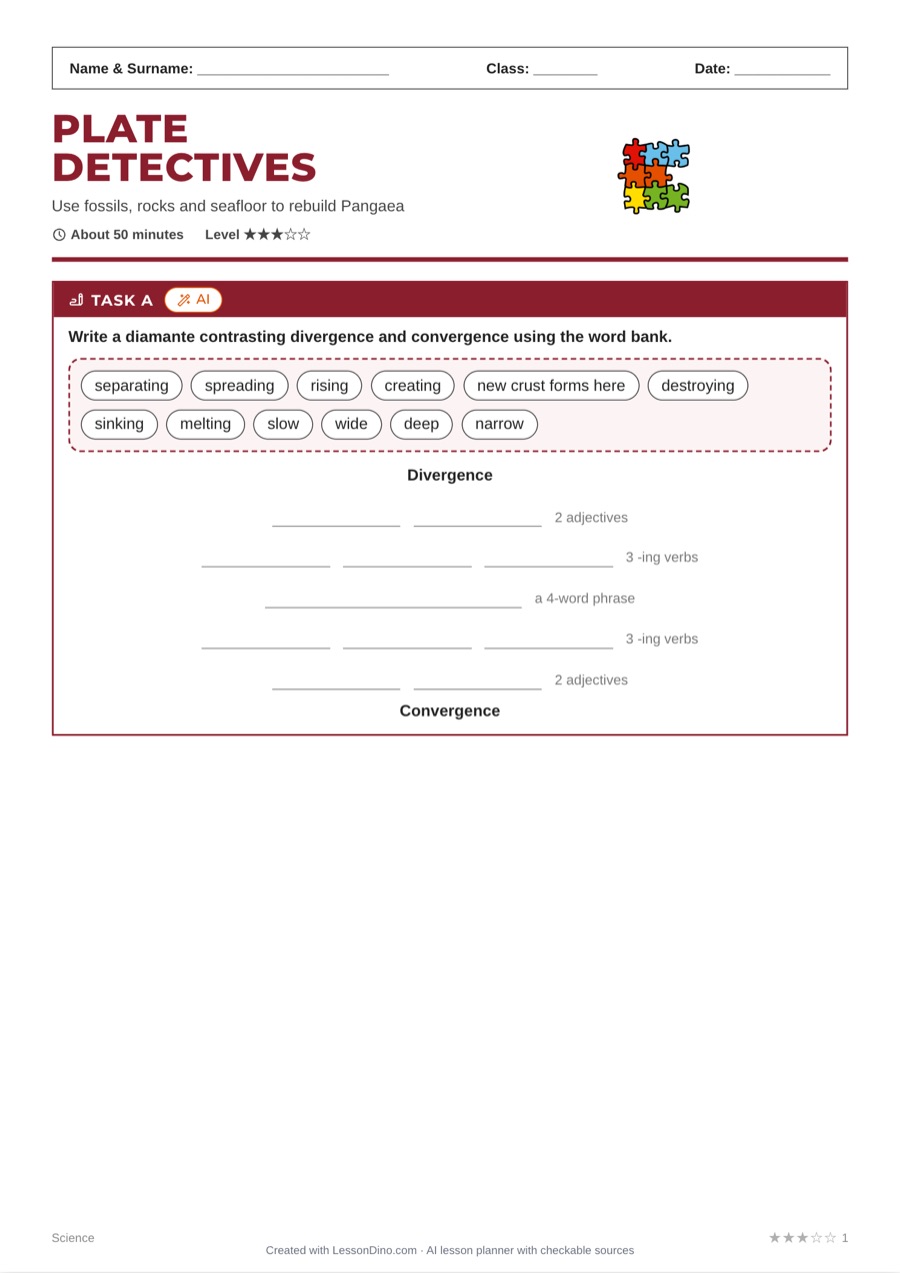
| 10 min | Seafloor proof | Show how new seafloor at ridges and old seafloor at trenches moves plates. Show Slide 7 and have students feel 2 cm and 15 cm on rulers for yearly rate. Play Video clip 6 (1:00-5:40) on Slide 8 to spot the ridge where new crust forms. Explain conveyor-belt motion where rock cools, makes new crust, and spreads away from the ridge. Contrast ridge creation with trench destruction where oceanic crust subducts and melts. |
| 20 min | Draw Pangaea From Clues | Reconstruct Pangaea from shape, fossil, rock, and seafloor clues in pairs. Show Slide 9 and hand out cutouts, clue sheet, crayons, glue, and Worksheet Task E. Model arranging two pieces using the key, then coloring matching fossil belts the same color. Circulate as pairs fit South America and Africa like puzzle pieces to make coherent patterns. Stop at 15 minutes for two pairs to defend reconstructions with two evidence pieces. |
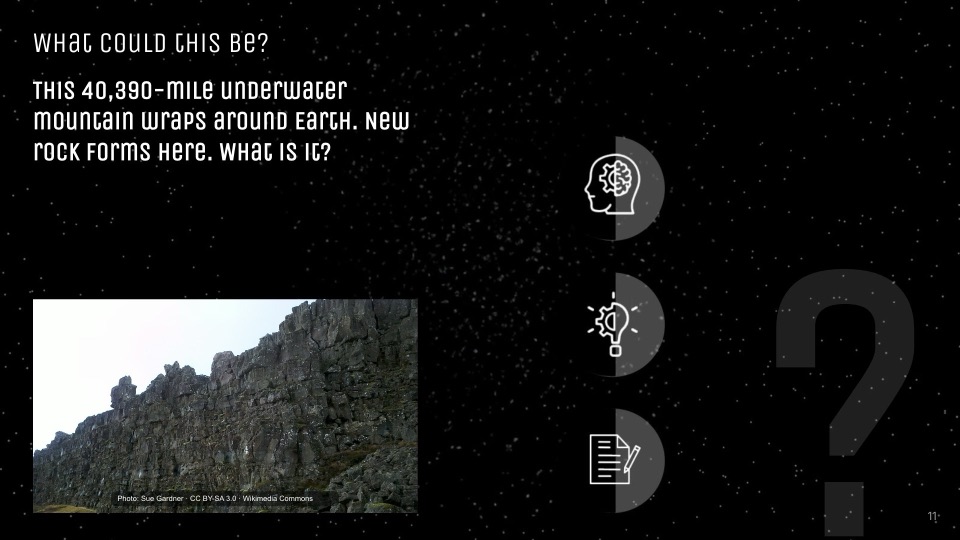
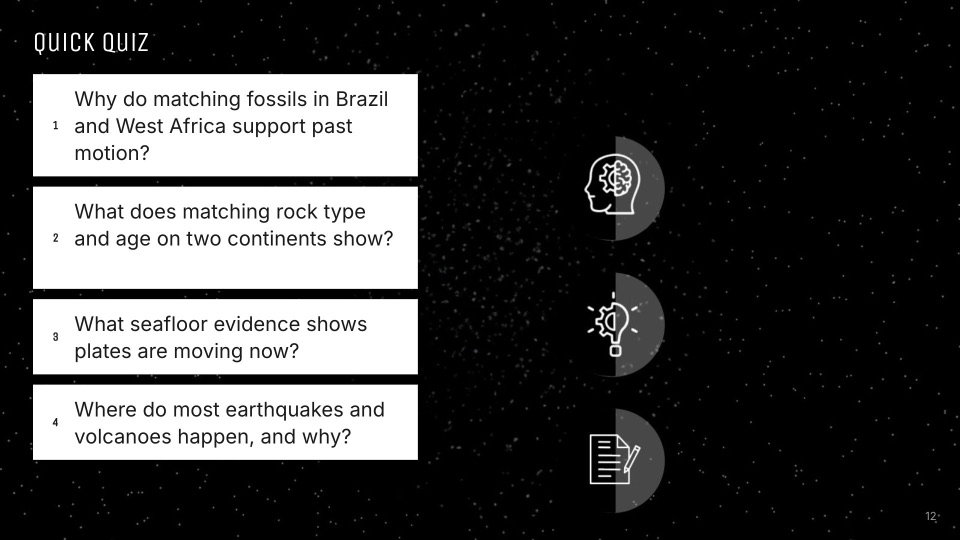
| 10 min | Plenary | Agree the big idea that moving plates carry continents and check learning. Show Slide 10 and state that continents are passengers on tops of much thicker plates. Show Slide 11 mystery and reveal the 40,390-mile ridge where new rock forms. Run Slide 12 quiz and Worksheet Task D ranking evidence strongest to weakest. Collect exit answers and preview how plates interact at boundaries. |
Common mistakes
- Thinking a good coastline fit alone proves continents moved.
How to spot it: Claim uses only shape with no fossils or rocks.
Require two clues: same rock types and same type and age fossils are added evidence. - Thinking the mantle is liquid water that continents plow through.
How to spot it: Drawing continents floating alone or pushing through mantle.
Show continents are passengers on tops of much thicker plates moving over softer mantle. - Thinking new and old ocean floor are the same age.
How to spot it: Labeling ridge rock as oldest or trench rock as newest.
Restate youngest forms at ridge and spreads in conveyor-belt motion, so ocean crust is relatively young.
Support
- Limit the puzzle to four continents and give one edge already matched as a starter.
- Color-code fossil card backs and pre-mark ridge center lines to continue patterns.
- Provide sentence starters and word banks for claims in every stage.
Stretch
- Have students draw arrows showing which way each piece moved to reach its present-day position.
- Have students calculate seafloor width after 1 million years at 2 to 15 centimeters per year.
- Have students propose another evidence type to search for to solve the puzzle.
Check questions
- Why do matching fossils in Brazil and West Africa support past motion?
Answer: Same species could not cross a wide ocean, so continents were joined. - Where does new oceanic crust form and what happens there?
Answer: At the mid-ocean ridge, magma rises and solidifies into basalt, forming new crust. - Why is continental shape alone not enough to prove past motion?
Answer: Need same rock types and same type and age fossils plus seafloor data.
Curriculum
Analyze and interpret data on the distribution of fossils and rocks, continental shapes, and seafloor structures to provide evidence of the past plate motions.
Video clips
Clips on YouTube, from the start and end times we chose. Check each one before you show it.
-
Middle school intro to evidence from 0:00 to 4:36
Khan Academy: Introduction to plate tectonics | Middle school Earth and space science | Khan Academy
Made for middle school with clear vocabulary and pace for ages 13-14 and directly covers fossils, rocks, and seafloor as evidence of past motion.
-
Evidence explained from 1:00 to 5:40
Bozeman Science: Plate Tectonics
Uses clear visuals and grade-appropriate vocabulary for ages 13-14 to connect fossils, rocks, and seafloor structures.
Worksheet
Sources
- Unit 1 avon.k12.ct.us
- Grade 8 Science Curriculum Pacing Guide gcsd.k12.nj.us
- Plate Tectonics—The Unifying Theory of Geology - U.S. National Park ... nps.gov
- Plate Tectonics | U.S. Geological Survey - USGS.gov usgs.gov
- Plate Tectonics - Introduction to Earth Science, Second Edition pressbooks.lib.vt.edu
- Plate Tectonics & Our National Parks - Geology (U.S. National Park Service) nps.gov
- Plate Tectonics - Introduction to Earth Science pressbooks.lib.vt.edu
- On plate tectonics and the geologic evolution of southwestern North America | U.S. Geological Survey usgs.gov
- Plate Tectonics guide for KS3 geography students - BBC bbc.co.uk
- Plate Tectonics - National Geographic Society education.nationalgeographic.org
- Lesson: Plate tectonics theory | Oak National Academy thenational.academy
- Lesson: Tectonic plates | Oak National Academy thenational.academy
- Plate Tectonics - Education education.nationalgeographic.org
- Plate tectonics - The Earth - GCSE Chemistry (Single Science) Revision ... bbc.co.uk
- Earth sciences - Plate Tectonics, Geology, Geophysics | Britannica britannica.com
- Plate tectonics | Definition, Theory, Facts, & Evidence | Britannica britannica.com
- Teaching Resources—Plate Tectonics - U.S. National Park Service nps.gov
- plate tectonics - Students | Britannica Kids | Homework Help kids.britannica.com
- Plate tectonics (video) | The geosphere | Khan Academy khanacademy.org
- Plate tectonics: Evidence of plate movement - Khan Academy khanacademy.org
- Fresh Ideas and Awesome Resources for Teaching Plate Tectonics sunrisescienceclassroom.com
- Plate tectonics activities: hands-on project ideas - Wild Earth Lab wildearthlab.com
- Plate Tectonics Classroom Activities and Lesson Plans geology.com
- Despite not having active plate tectonics, the eastern United States still experiences earthquakes. Why? The eastern United - SmartSolve.ai smartsolve.ai
- Plate Tectonics guide for KS3 geography students - BBC Bitesize | BBC Mirror bbcinsight.pages.dev
Picture credits
- Photo: Tama66 · Pixabay
- Photo: Sue Gardner · CC BY-SA 3.0 · Wikimedia Commons
- Pictograms: Sergio Palao, ARASAAC (arasaac.org) · CC BY-NC-SA
Made with Lesson Dino's AI on 17 October 2026. AI can make mistakes, so check facts against the sources before you teach.