The worksheet
About this worksheet
Students analyze fossil, rock, shape, and seafloor clues for past plate motion. They rebuild Pangaea from paper clues and defend their reconstruction. This Grade 8 Science worksheet gives students (ages 13–14) five pages of practice on plate tectonics, part of the earth's systems unit. It goes with our free Plate tectonics lesson, which has the slides and a timed lesson plan.
What it covers
By the end, students should be able to:
- Students will use fossil and rock matches to infer past continent positions.
- Students will use continental shape fits to support past plate motion claims.
- Students will explain how new seafloor forms at ridges and moves plates.
How to use it
- Draw Pangaea From Clues (20 minutes): Show Slide 9 and hand out cutouts, clue sheet, crayons, glue, and Worksheet Task E.
- Plenary (10 minutes): Run Slide 12 quiz and Worksheet Task D ranking evidence strongest to weakest.
- Support: Limit the puzzle to four continents and give one edge already matched as a starter.
- Stretch: Have students draw arrows showing which way each piece moved to reach its present-day position.
- The answer sheet is the last page, so you can print it on its own or let students check their own work.
Key vocabulary
- Pangaea: a very old giant landmass that later split into today's pieces
- continental drift: slow movement of landmasses away from each other over time
- fossil distribution: where the remains of ancient living things are found
- seafloor spreading: making of fresh ocean floor at a ridge that then moves sideways
- subduction zone: place where one sinking plate goes down under another plate
Mistakes to watch for
- Thinking a good coastline fit alone proves continents moved. Require two clues: same rock types and same type and age fossils are added evidence.
- Thinking the mantle is liquid water that continents plow through. Show continents are passengers on tops of much thicker plates moving over softer mantle.
- Thinking new and old ocean floor are the same age. Restate youngest forms at ridge and spreads in conveyor-belt motion, so ocean crust is relatively young.
What's on the worksheet
Pangaea Puzzle Pieces
Learn the clues that show continents once moved apart.
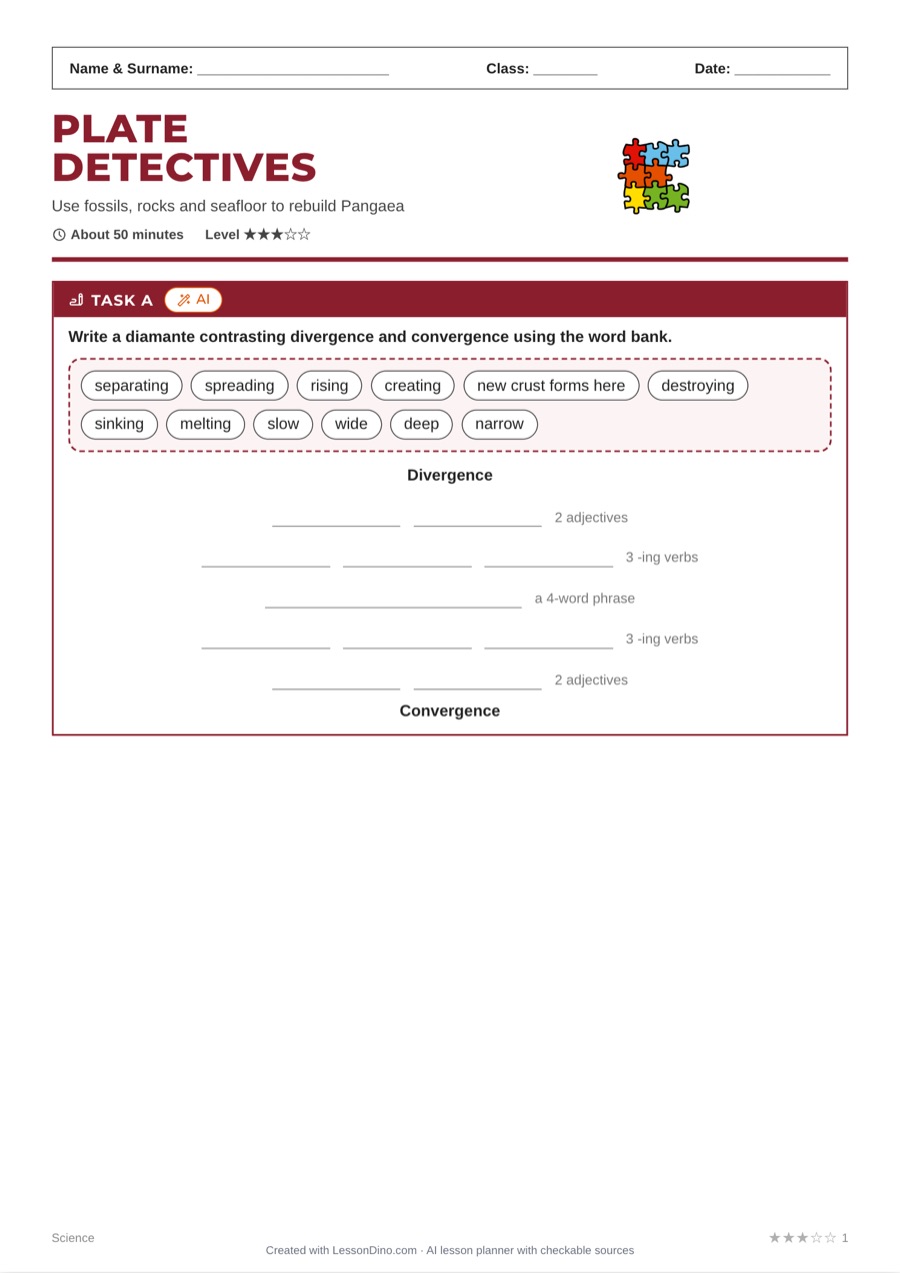
Write a diamante contrasting divergence and convergence using the word bank.
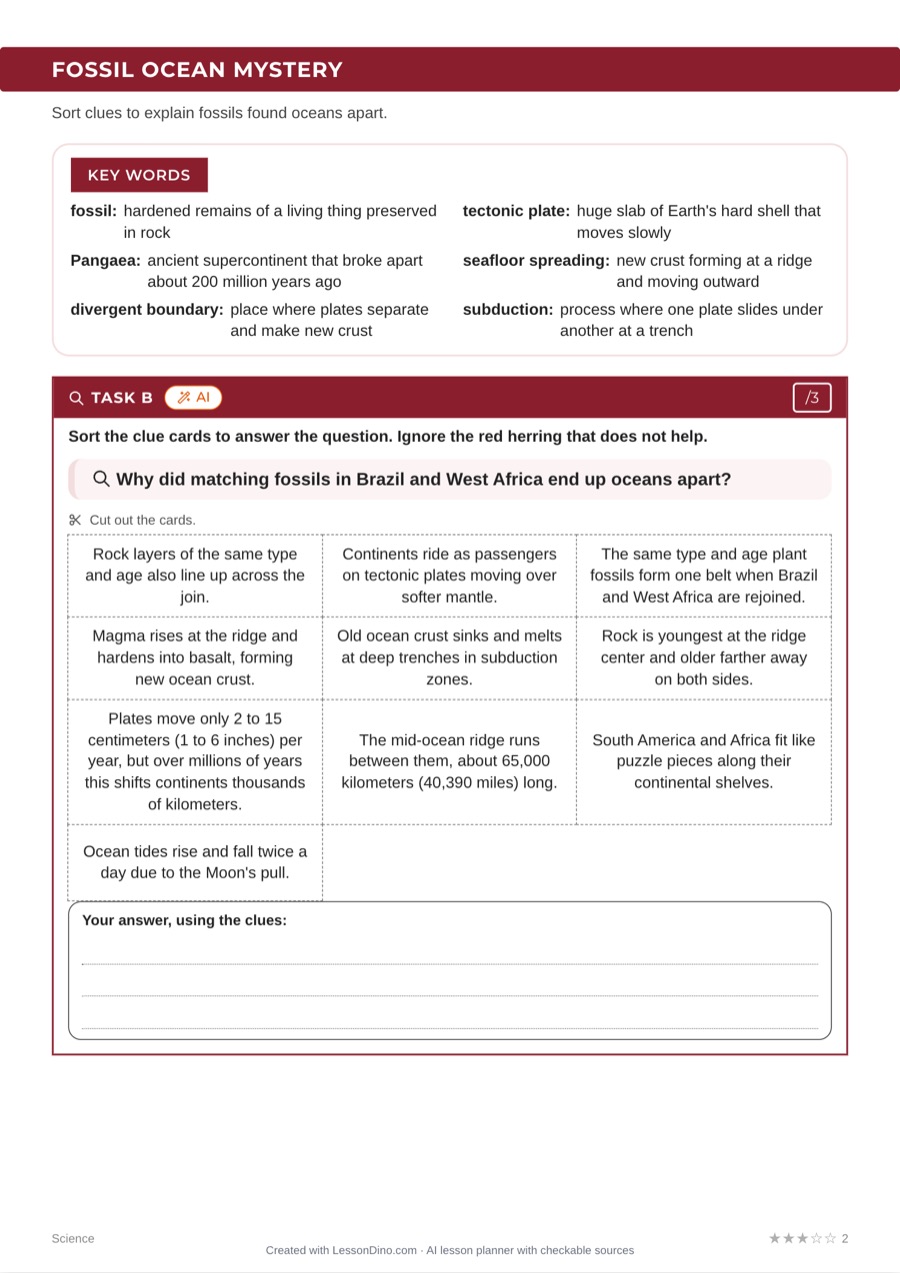
Fossil Ocean Mystery
Sort clues to explain fossils found oceans apart.
| Word | Meaning |
|---|---|
| fossil | hardened remains of a living thing preserved in rock |
| tectonic plate | huge slab of Earth's hard shell that moves slowly |
| Pangaea | ancient supercontinent that broke apart about 200 million years ago |
| seafloor spreading | new crust forming at a ridge and moving outward |
| divergent boundary | place where plates separate and make new crust |
| subduction | process where one plate slides under another at a trench |
Sort the clue cards to answer the question. Ignore the red herring that does not help.
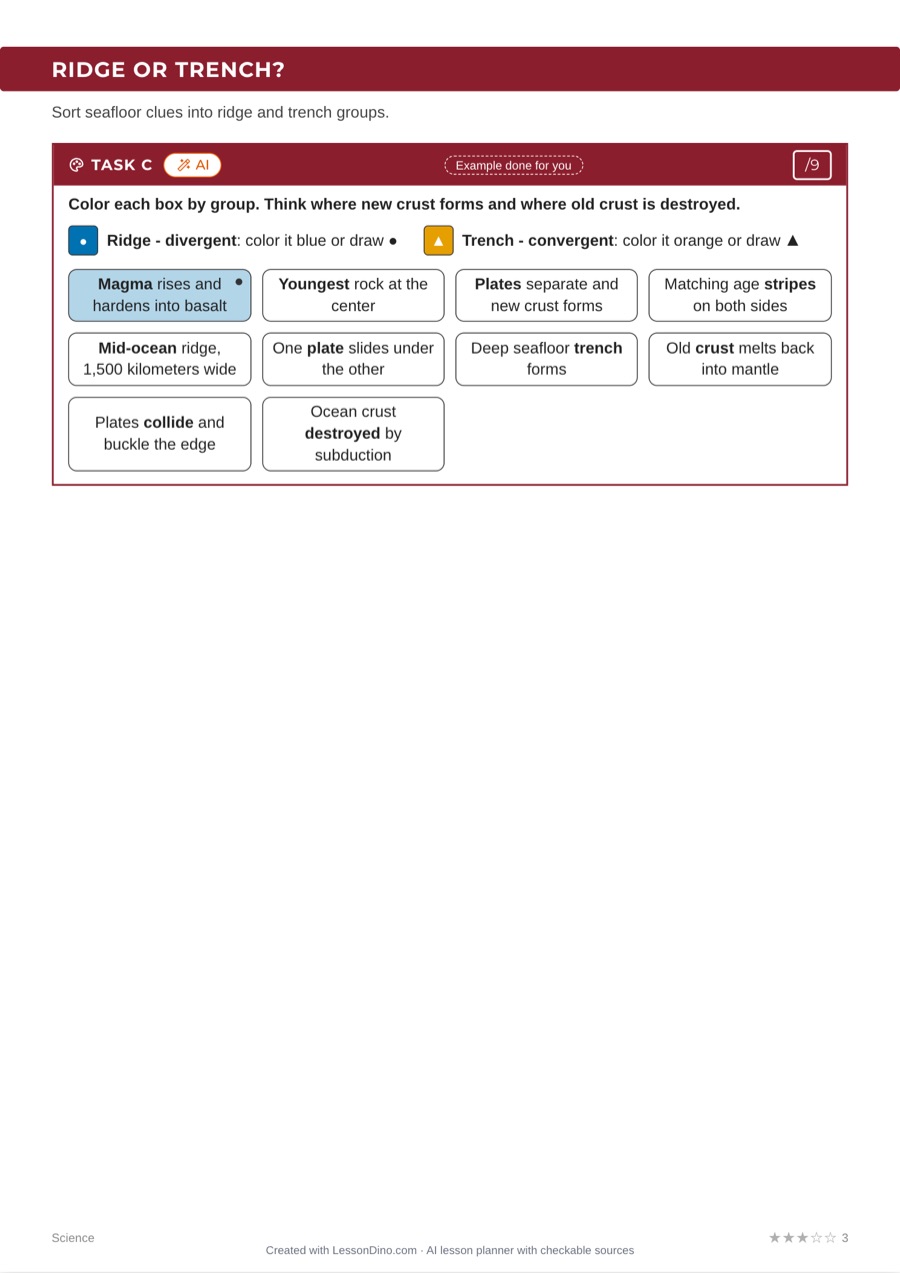
Ridge or Trench?
Sort seafloor clues into ridge and trench groups.
Color each box by group. Think where new crust forms and where old crust is destroyed.
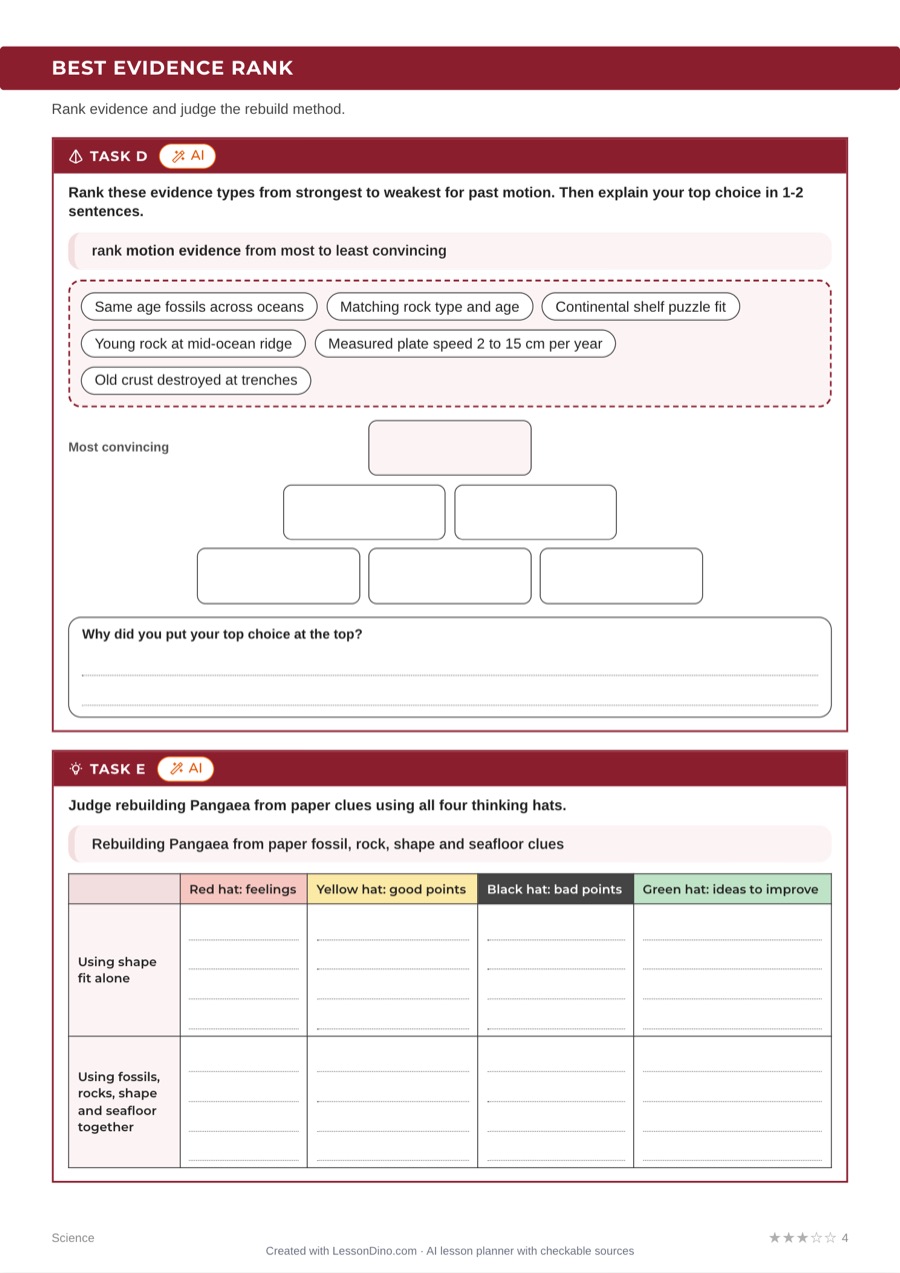
Best Evidence Rank
Rank evidence and judge the rebuild method.
Rank these evidence types from strongest to weakest for past motion. Then explain your top choice in 1-2 sentences.
Judge rebuilding Pangaea from paper clues using all four thinking hats.
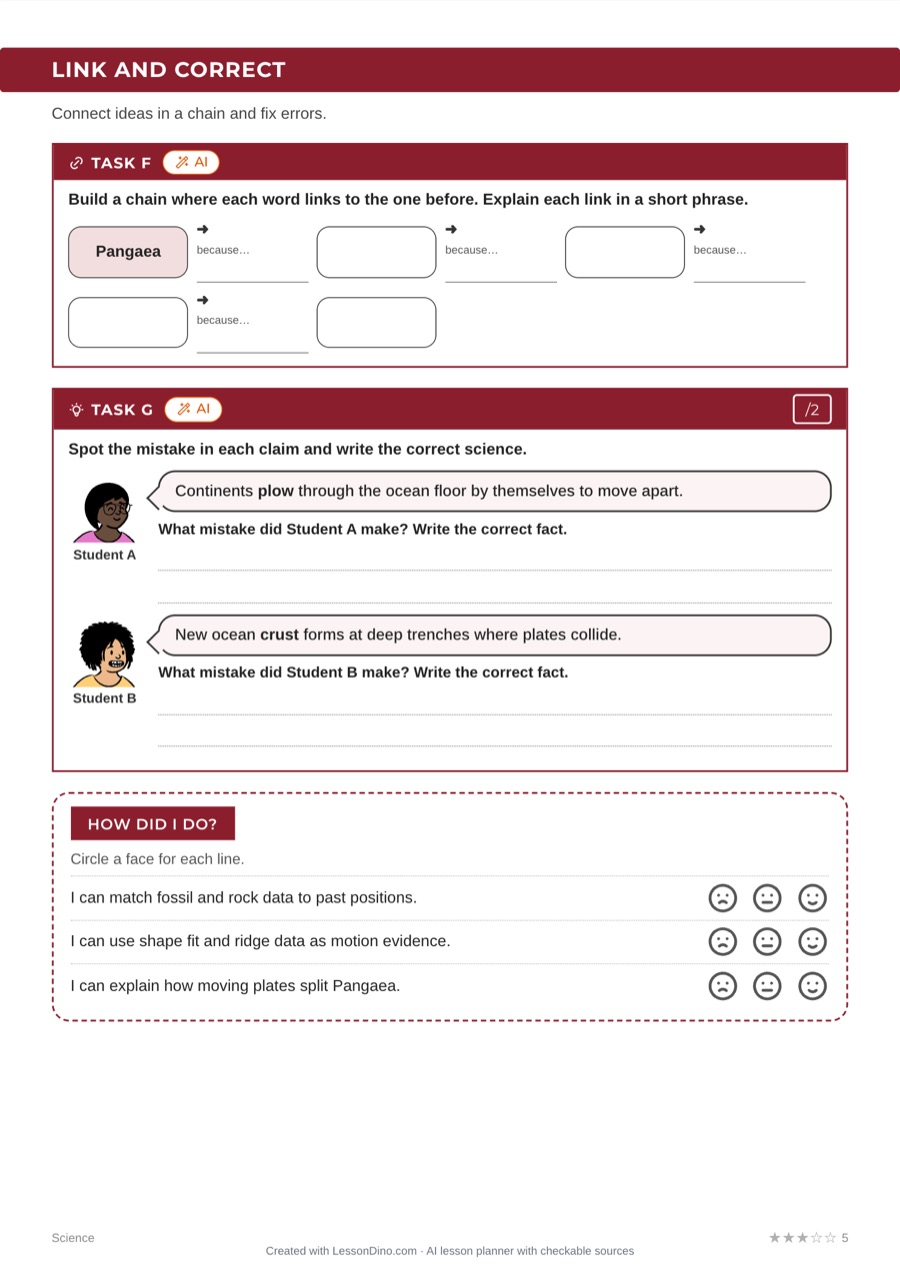
Link and Correct
Connect ideas in a chain and fix errors.
Build a chain where each word links to the one before. Explain each link in a short phrase.
Spot the mistake in each claim and write the correct science.
Answers
Show the answers
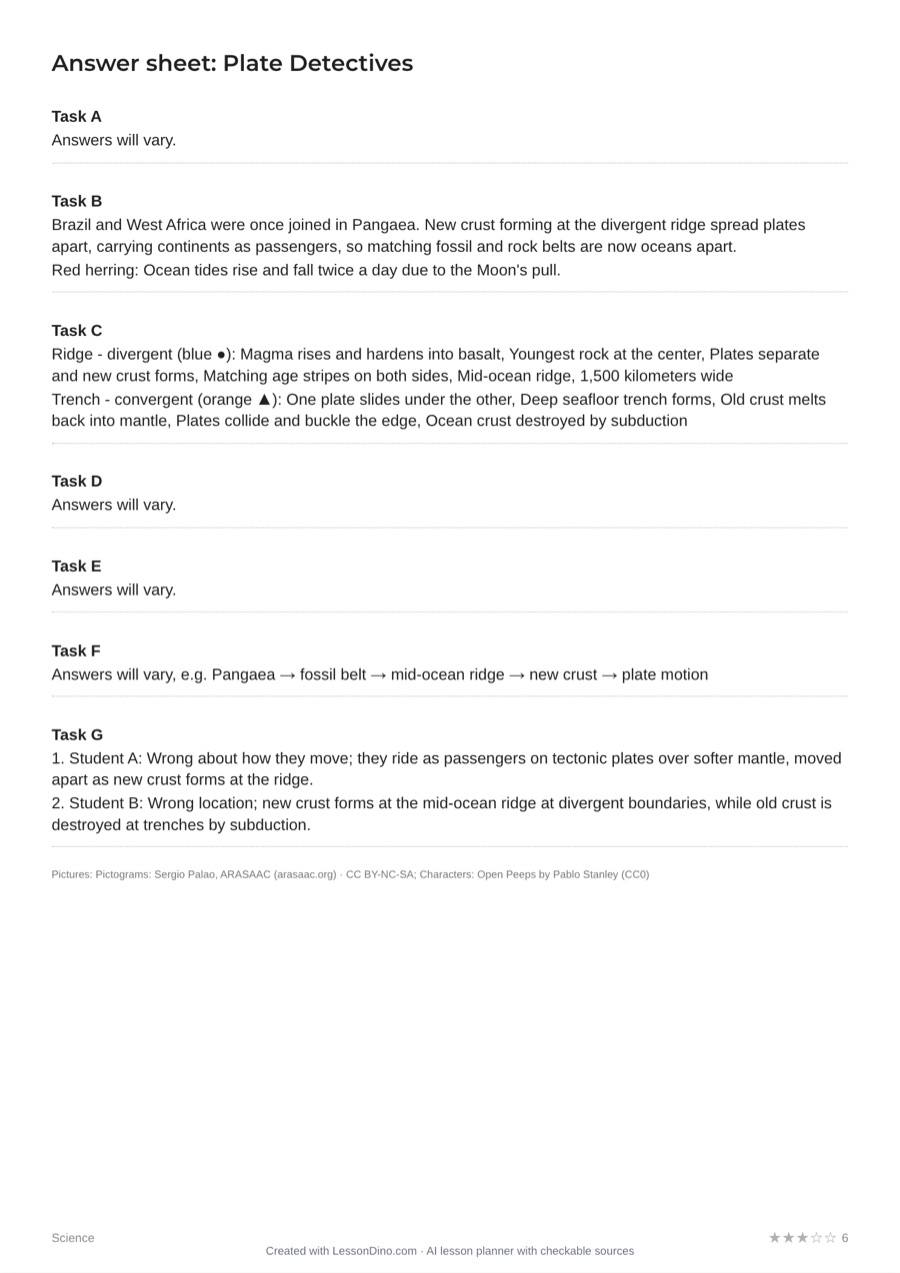
The answers are on the answer sheet, the last picture above.
Curriculum
Analyze and interpret data on the distribution of fossils and rocks, continental shapes, and seafloor structures to provide evidence of the past plate motions.
Made with Lesson Dino's AI on 17 October 2026. AI can make mistakes, so check the answers and facts against the sources before you teach.