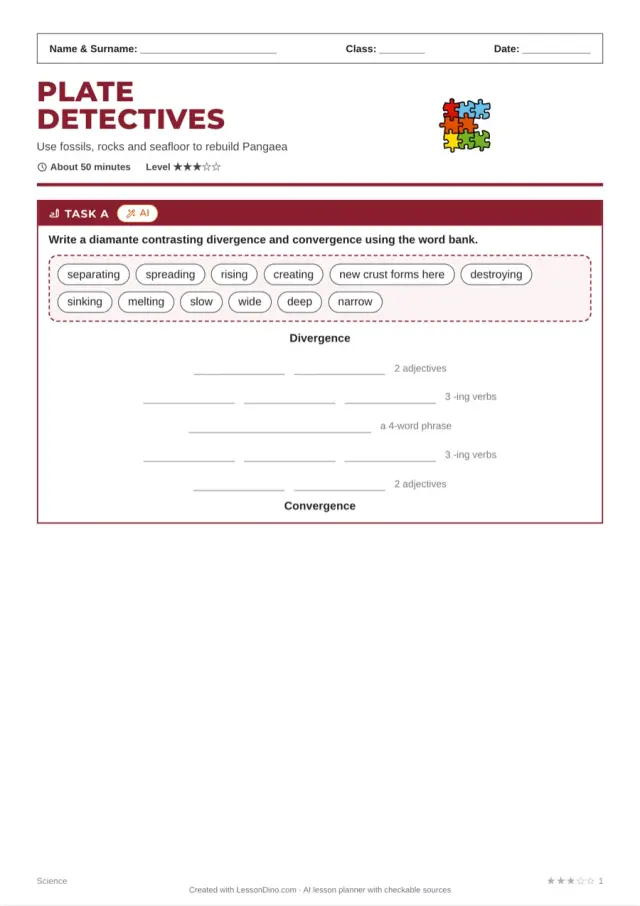
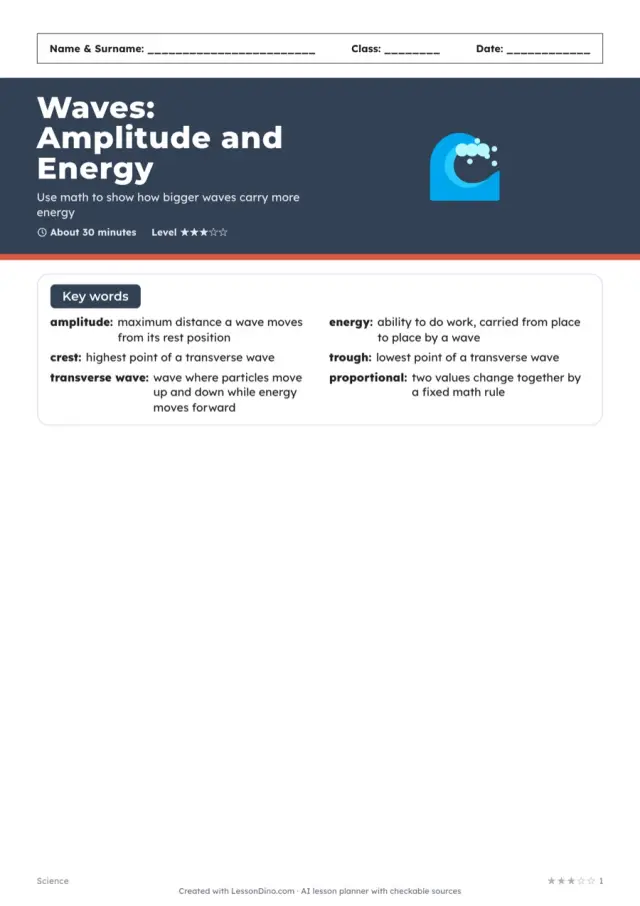
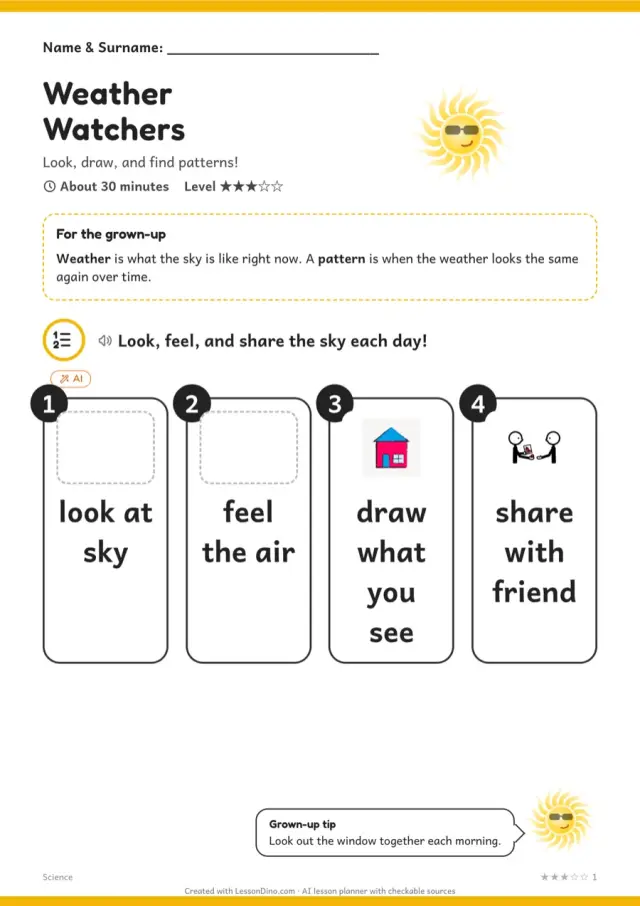
The worksheet
About this worksheet
Students learn that change in motion depends on net force and mass. They plan and run fair cart tests and use timed evidence. This Grade 8 Science worksheet gives students (ages 13–14) six pages of practice on newton's laws of motion, part of the forces and motion unit. It goes with our free Newton's laws of motion lesson, which has the slides and a timed lesson plan.
What it covers
By the end, students should be able to:
- Students will plan a fair test that changes net force and mass.
- Students will collect timed evidence showing how motion changes.
- Students will explain that acceleration depends on net force and mass.
How to use it
- Planning (10 minutes): Hand out Worksheet Tasks B and C and pre-made data table.
- Plenary (10 minutes): Show Slide 12 quiz and run Worksheet Task F for claim plus evidence.
- Support: Give pre-made data table with columns for pull, added mass, time, and observations so students focus on controlling variables.
- Stretch: Have students predict what doubling the pull should do to acceleration, then test it and explain using force equals mass times acceleration.
- The answer sheet is the last page, so you can print it on its own or let students check their own work.
Key vocabulary
- net force: sum of all pushes and pulls acting together
- mass: amount of matter in an object, measured in kilograms
- acceleration: how quickly speed or direction of movement changes
- friction: rubbing push or pull that opposes sliding and slows movement
Mistakes to watch for
- Thinking heavier objects always speed up more or fall faster with same push. Point to data and restate that acceleration depends on mass and force applied, so same force on larger mass gives smaller acceleration.
- Thinking balanced forces cause motion change. Draw equal opposite arrows summing to zero and show velocity stays constant unless acted on by an unbalanced force.
- Mixing up mass and force effects in F = ma. Use numbers: 4 N on 1 kg = 4 m/s2, on 2 kg = 2 m/s2, because force equals mass times acceleration.
What's on the worksheet
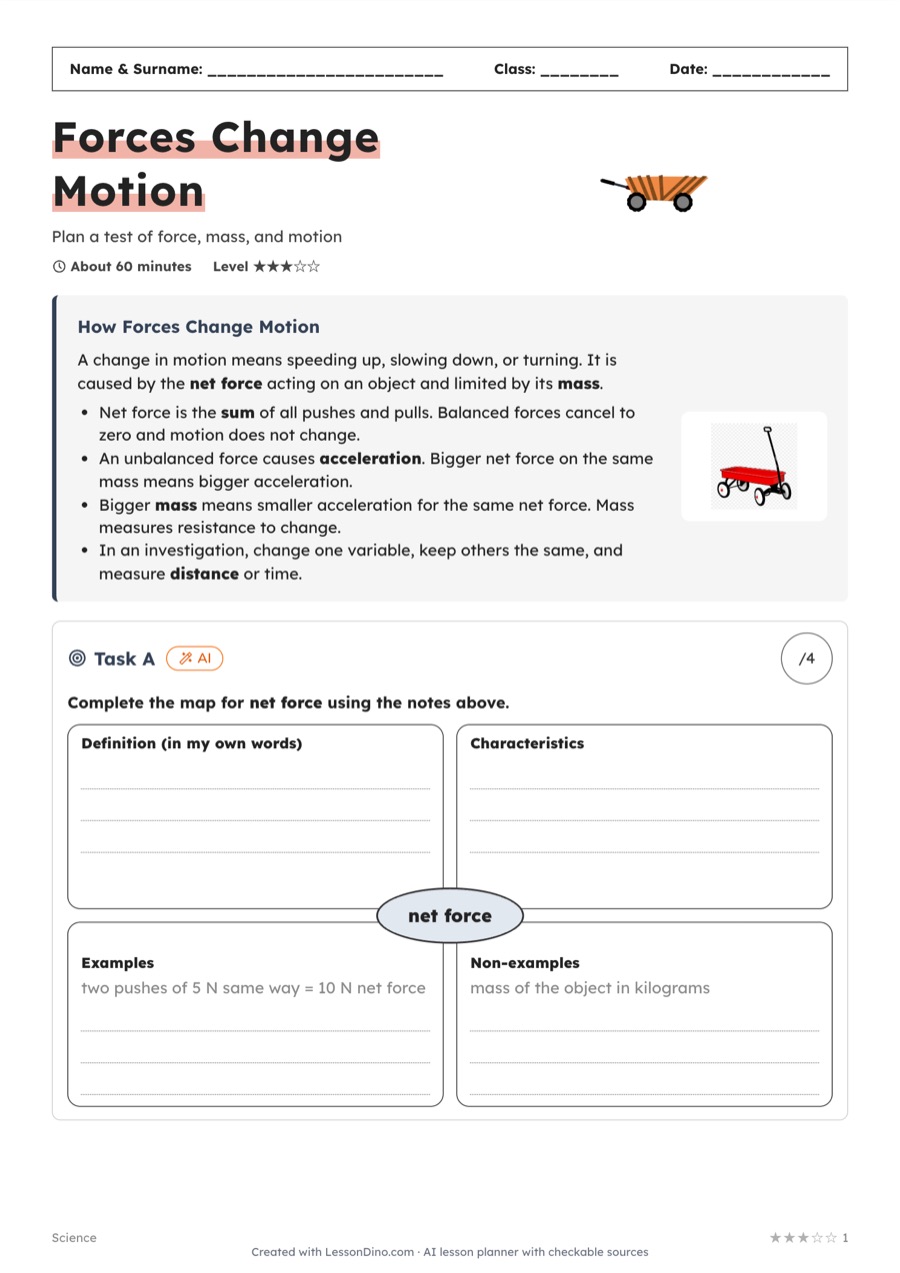
Forces and Motion
Review how the sum of forces and mass affect motion.
How Forces Change Motion
- A change in motion means speeding up, slowing down, or turning. It is caused by the net force acting on an object and limited by its mass.
- Net force is the sum of all pushes and pulls. Balanced forces cancel to zero and motion does not change.
- An unbalanced force causes acceleration. Bigger net force on the same mass means bigger acceleration.
- Bigger mass means smaller acceleration for the same net force. Mass measures resistance to change.
- In an investigation, change one variable, keep others the same, and measure distance or time.
Complete the map for net force using the notes above.
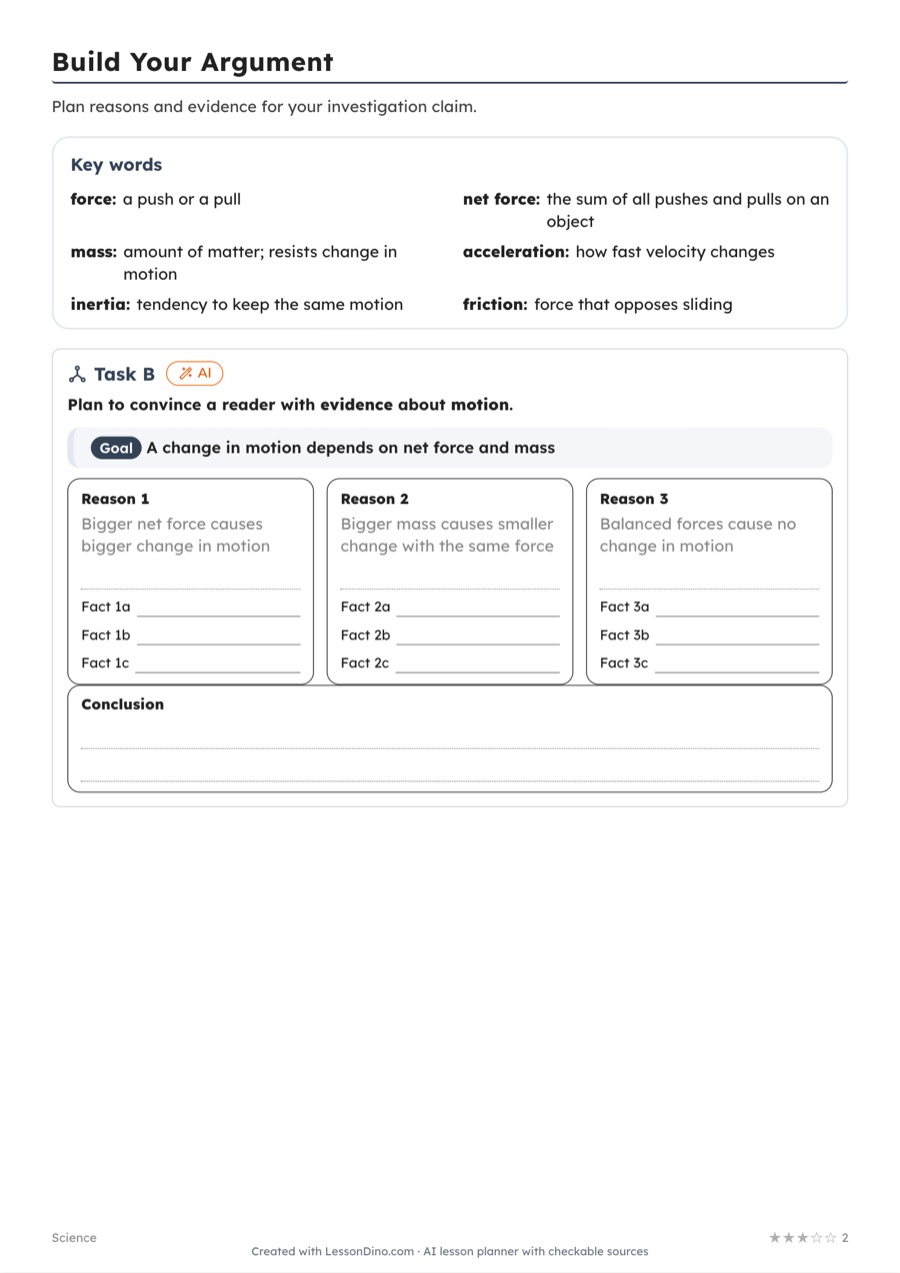
Build Your Argument
Plan reasons and evidence for your investigation claim.
| Word | Meaning |
|---|---|
| force | a push or a pull |
| net force | the sum of all pushes and pulls on an object |
| mass | amount of matter; resists change in motion |
| acceleration | how fast velocity changes |
| inertia | tendency to keep the same motion |
| friction | force that opposes sliding |
Plan to convince a reader with evidence about motion.
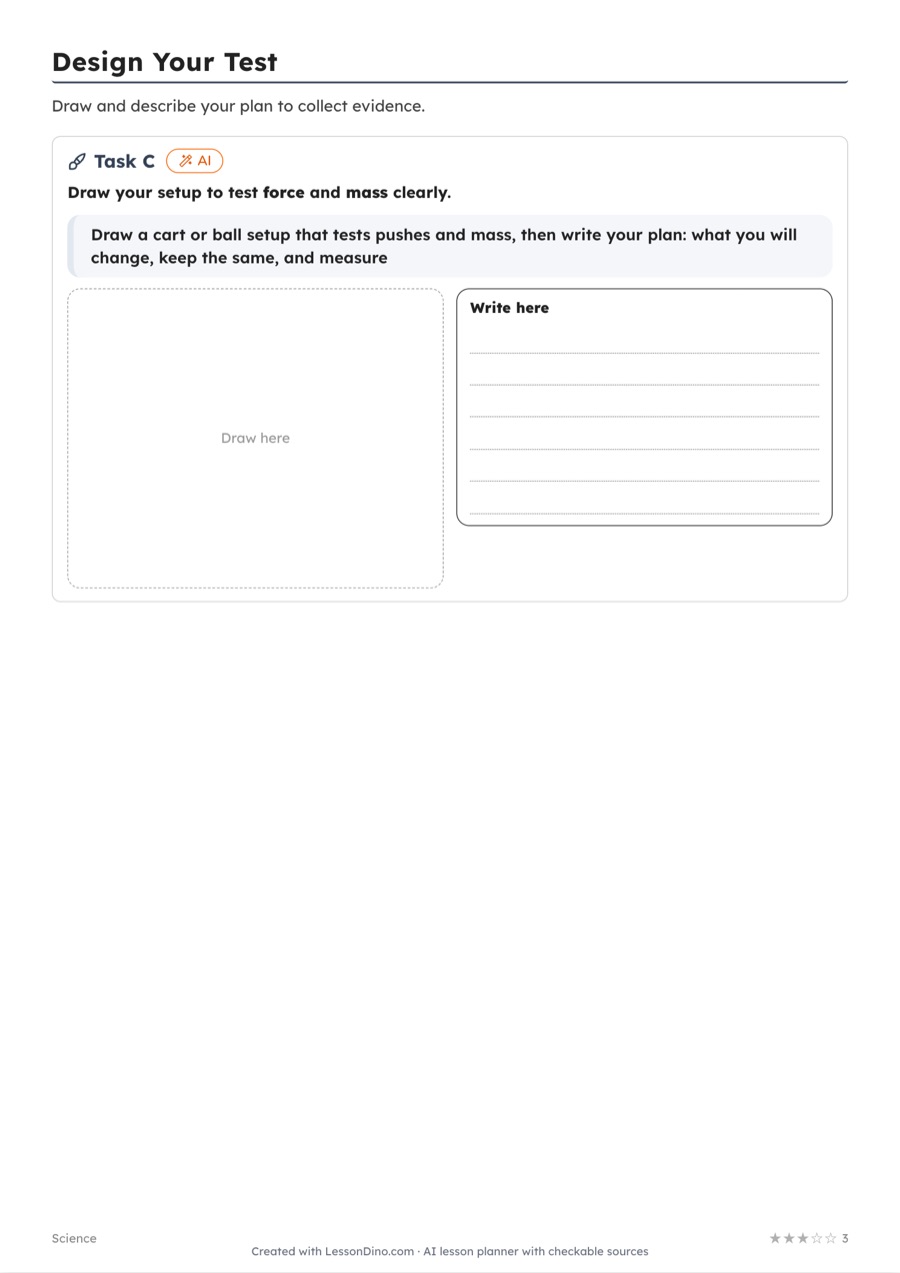
Design Your Test
Draw and describe your plan to collect evidence.
Draw your setup to test force and mass clearly.
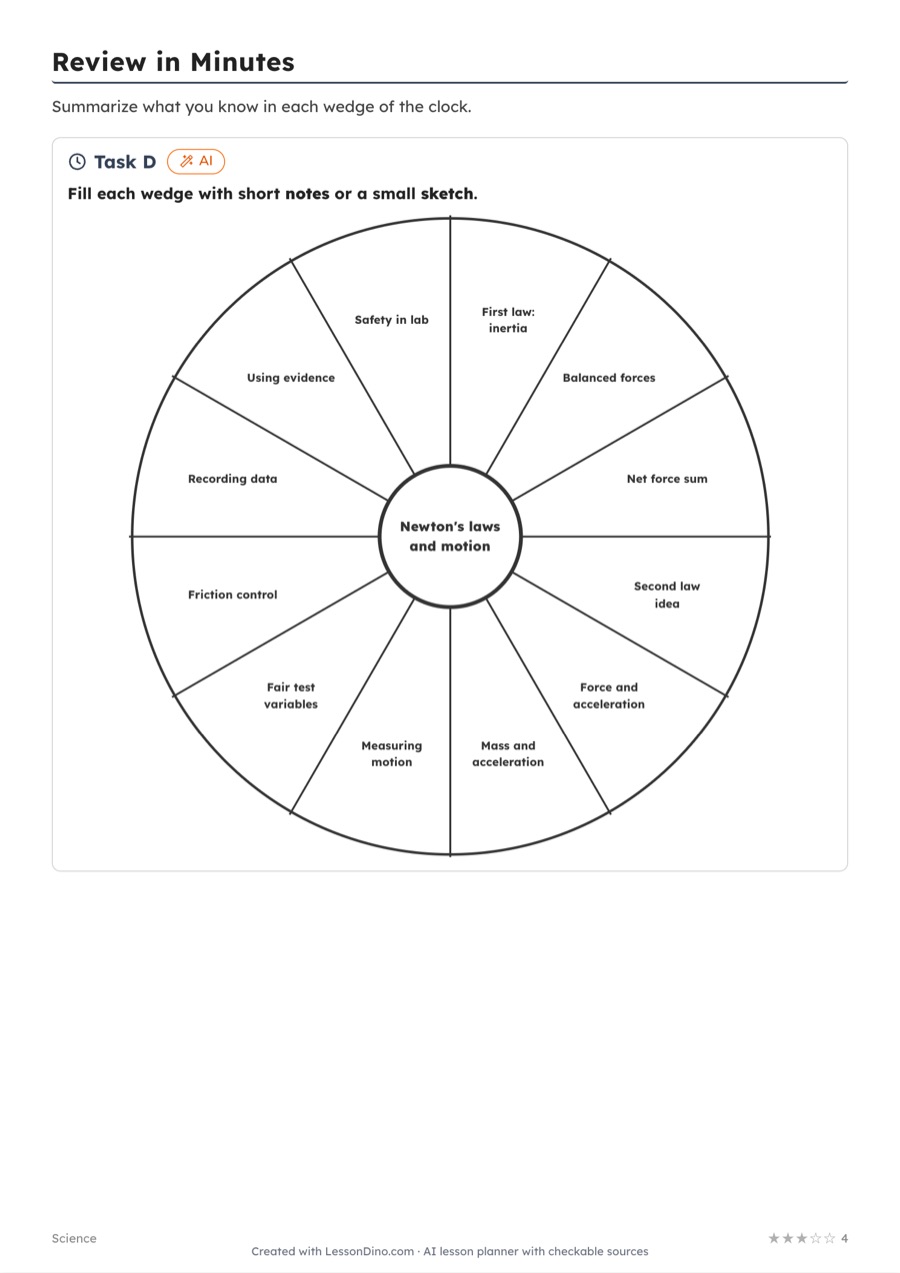
Review in Minutes
Summarize what you know in each wedge of the clock.
Fill each wedge with short notes or a small sketch.
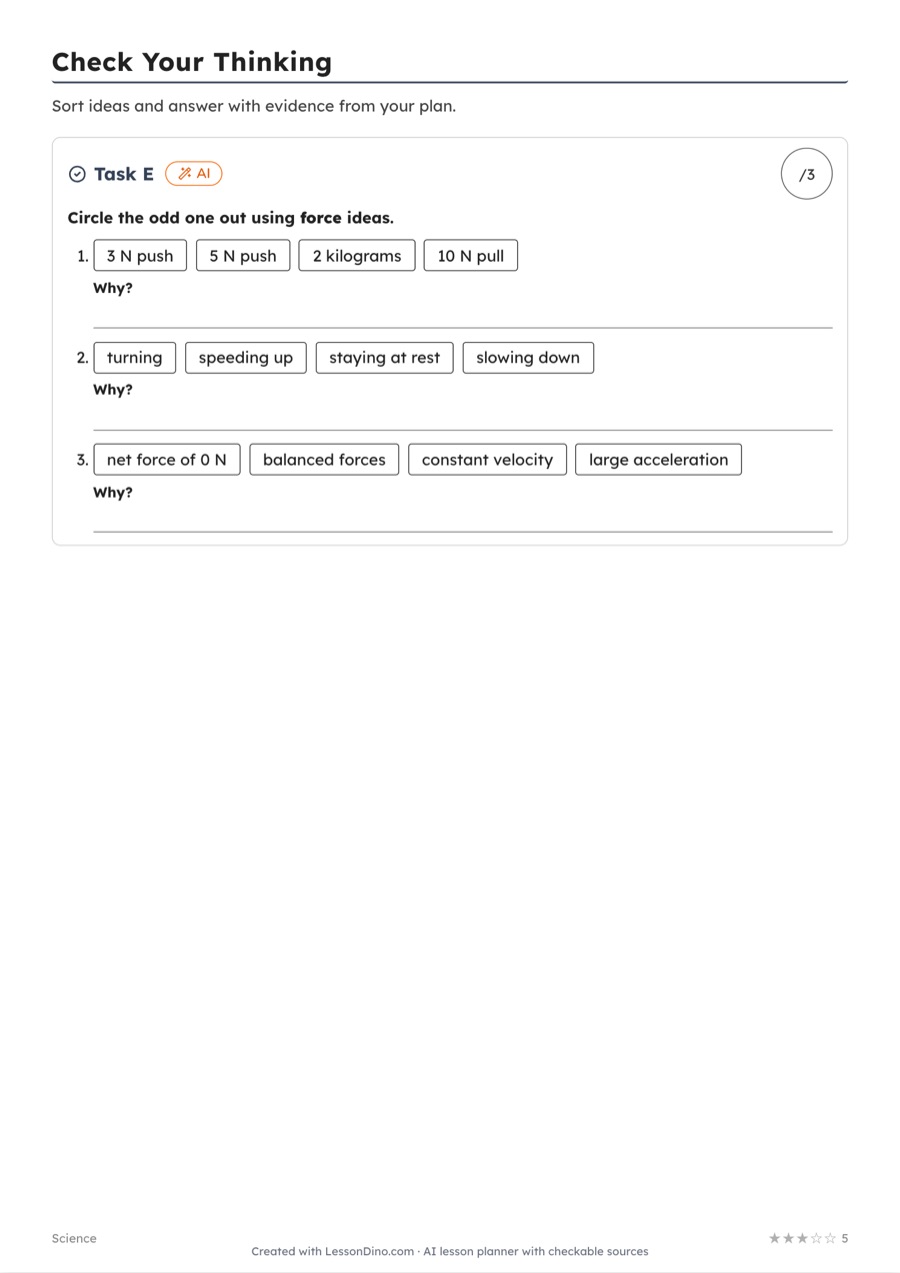
Check Your Thinking
Sort ideas and answer with evidence from your plan.
Circle the odd one out using force ideas.
Page 6
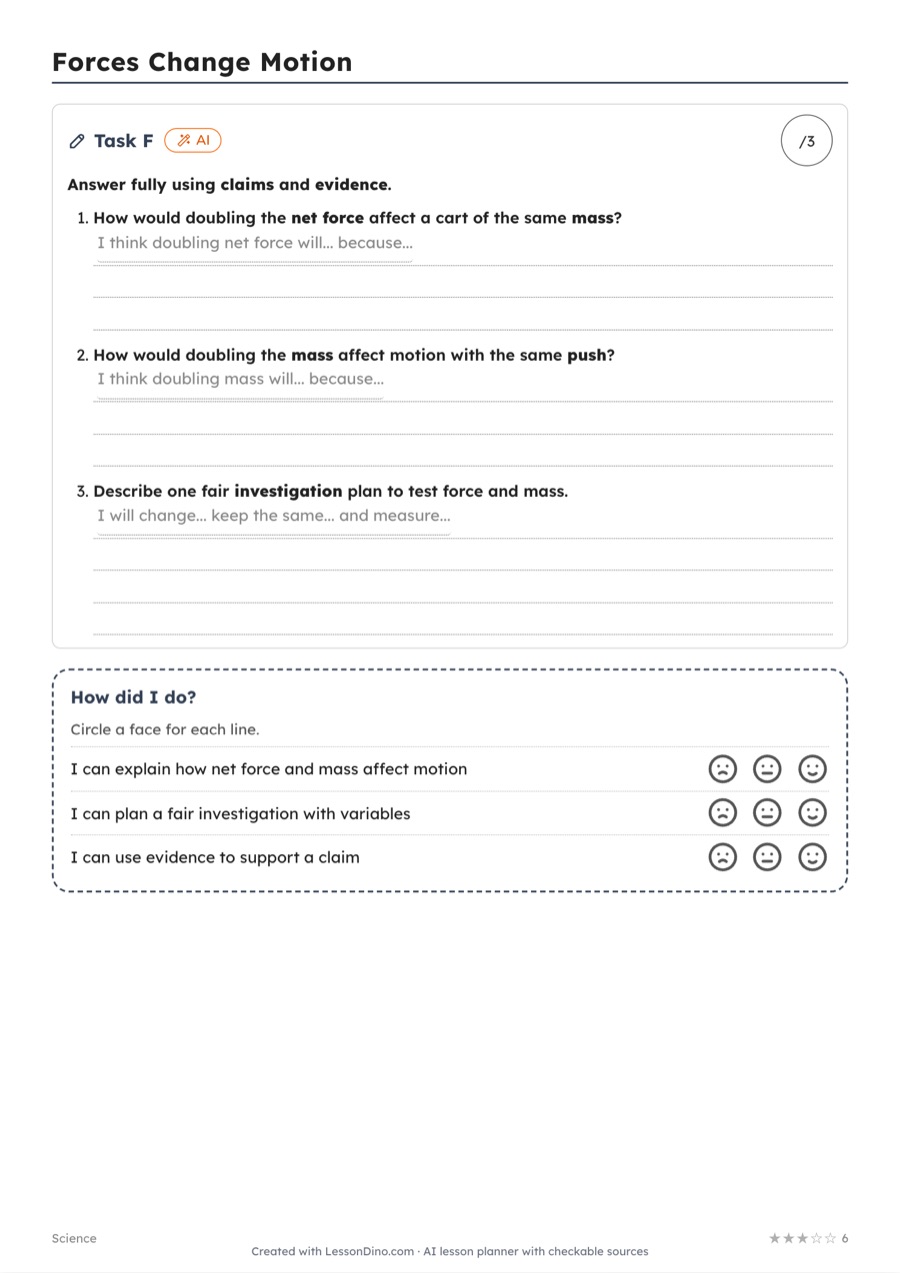
Answer fully using claims and evidence.
- How would doubling the net force affect a cart of the same mass?
- How would doubling the mass affect motion with the same push?
- Describe one fair investigation plan to test force and mass.
Answers
Show the answers
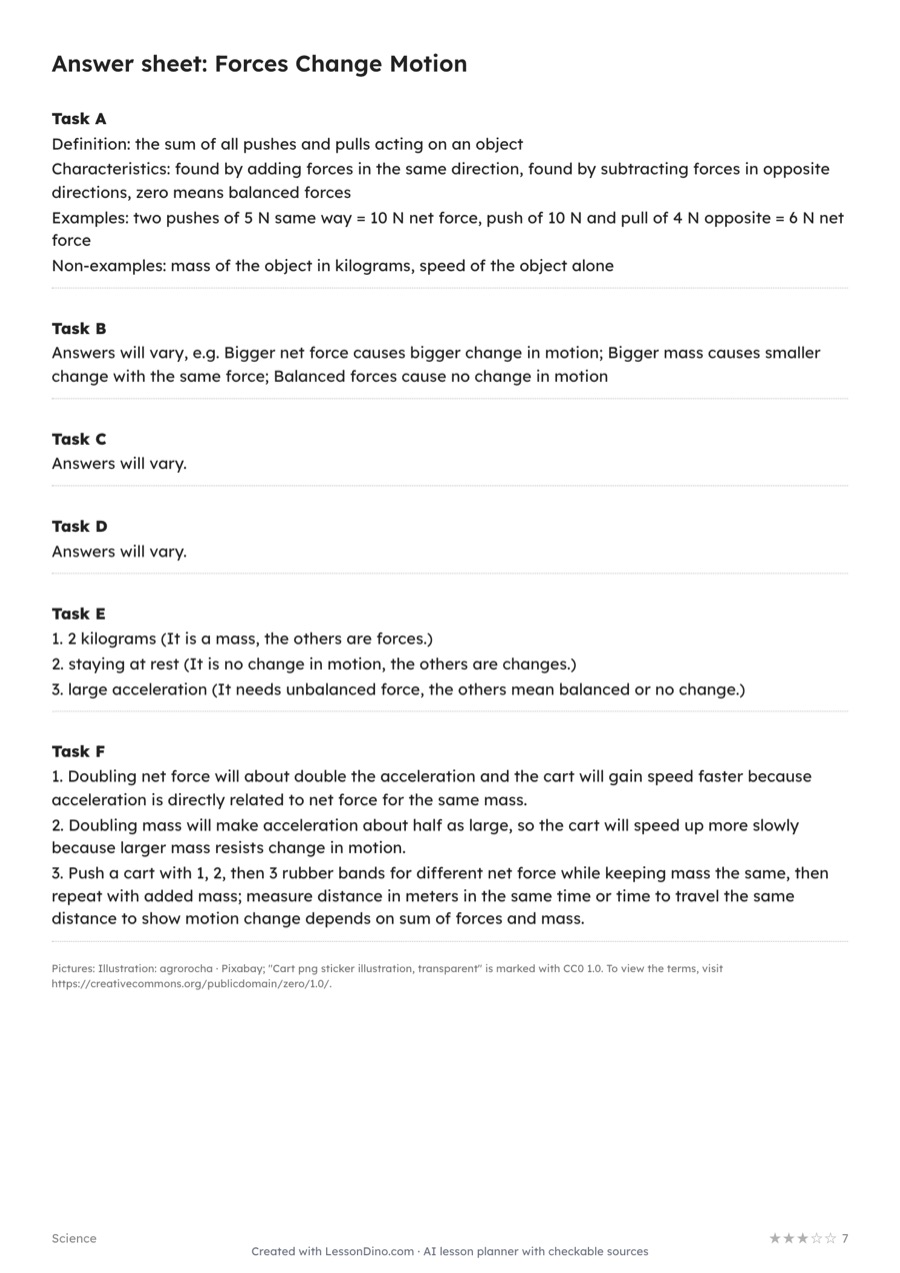
- How would doubling the net force affect a cart of the same mass? Doubling net force will about double the acceleration and the cart will gain speed faster because acceleration is directly related to net force for the same mass.
- How would doubling the mass affect motion with the same push? Doubling mass will make acceleration about half as large, so the cart will speed up more slowly because larger mass resists change in motion.
- Describe one fair investigation plan to test force and mass. Push a cart with 1, 2, then 3 rubber bands for different net force while keeping mass the same, then repeat with added mass; measure distance in meters in the same time or time to travel the same distance to show motion change depends on sum of forces and mass.
The answer sheet is the last picture above.
Curriculum
Plan an investigation to provide evidence that the change in an object's motion depends on the sum of the forces on the object and the mass of the object.
From Next Generation Science Standards (middle school), MS-PS2-2.
Made with Lesson Dino's AI on 16 October 2026. AI can make mistakes, so check the answers and facts against the sources before you teach.