Slides
Lesson plan
Bigger Wiggle, Much More Energy
Students learn that wave energy grows as amplitude squared. They draw waves and calculate relative energy as 1, 4, 9.
Objectives
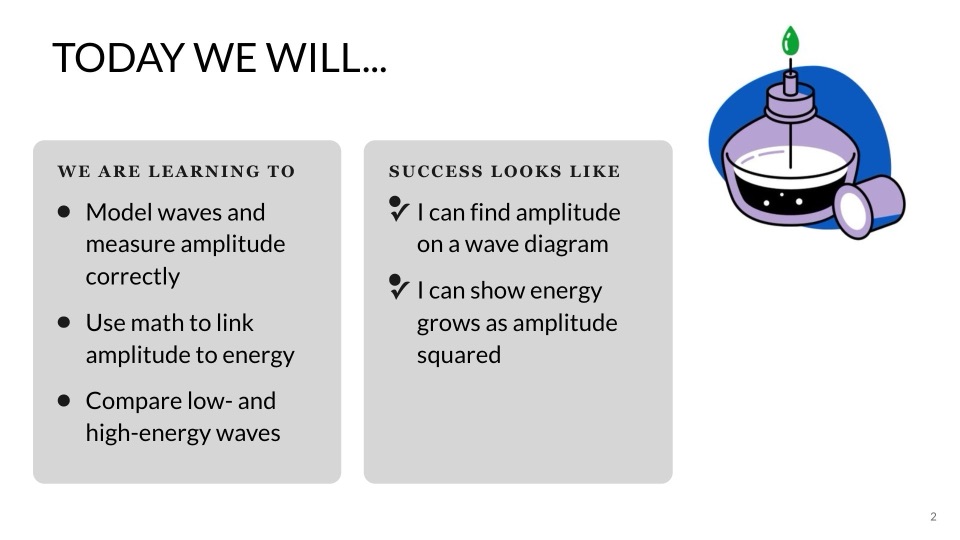
- Students will measure amplitude as height from rest to crest or trough.
- Students will use Energy proportional to amplitude squared to predict energy changes.
- Students will compare low- and high-energy waves using diagrams and math.
Success criteria
- I can find amplitude on a wave diagram from the middle line.
- I can calculate relative energy as amplitude squared: 1, 4, 9.
- I can explain why doubling amplitude gives four times the energy.
Key words
| Word | Meaning |
|---|---|
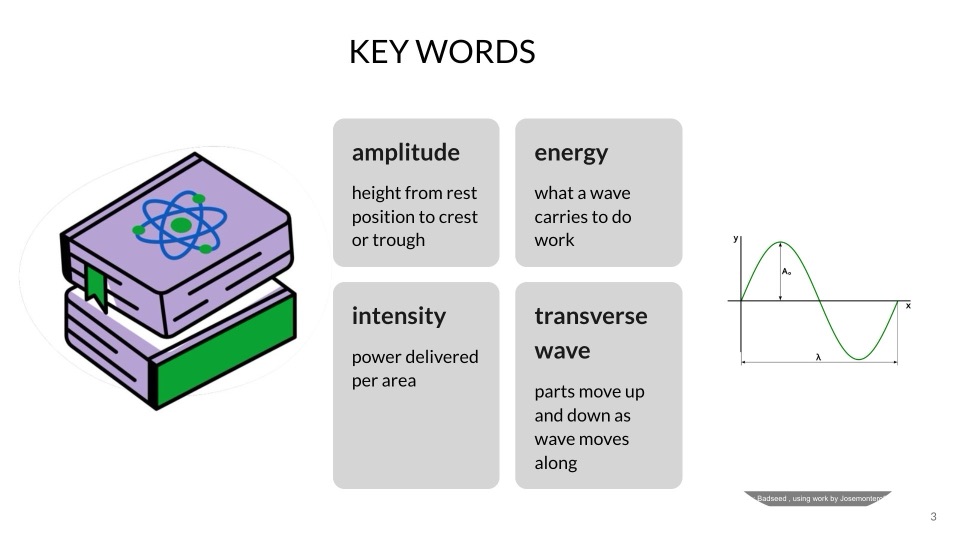
| amplitude | farthest distance from the middle resting line to the top or bottom of a wave |
| energy | what is carried by a wave that lets it push, move, or change things at the far end |
| intensity | amount of power passing through each unit of surface area |
| rest position | middle line where the medium sits when no wave is passing |
Timed plan (60 minutes)
| Time | Stage | What happens |
|---|---|---|
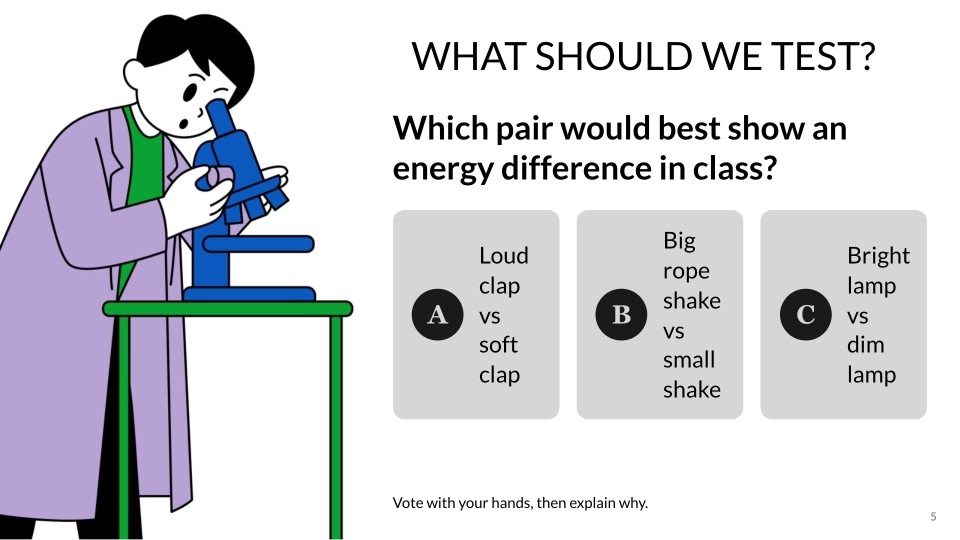
| 8 min | Starter | Surface ideas about waves and create a need to test how height links to energy. Show Slide 1 title and Slide 2 objectives and read the I can find amplitude goal. Ask the hook question and take predictions: doubling height doubles energy or more. Show Slide 5 vote: loud clap vs soft clap, big rope shake vs small shake, bright lamp vs dim lamp. Tally votes and link to a wave as an energy transport that moves energy without moving matter forward. |
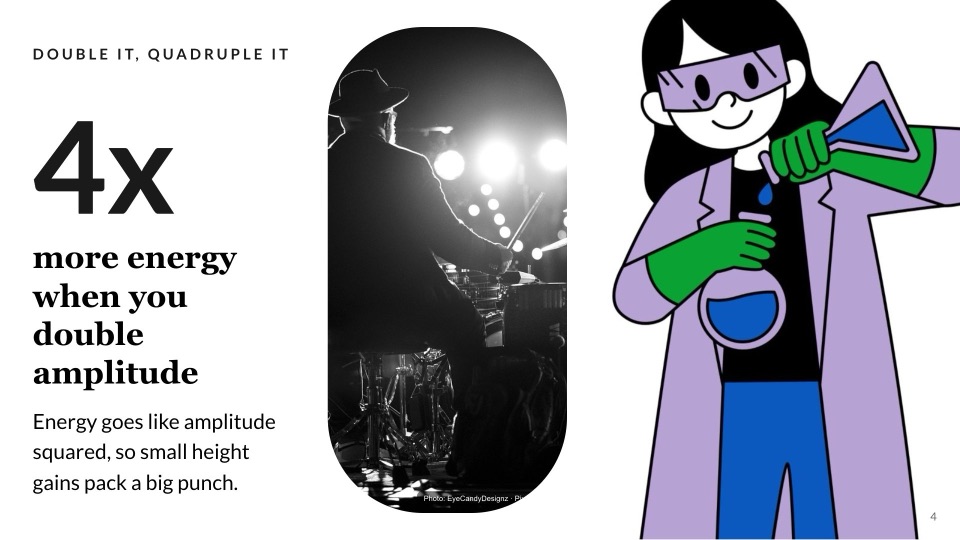
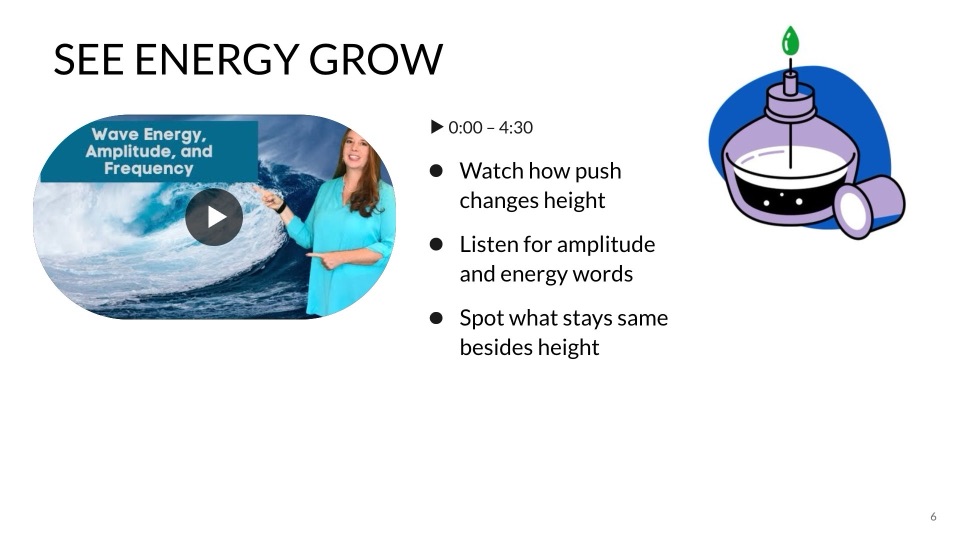
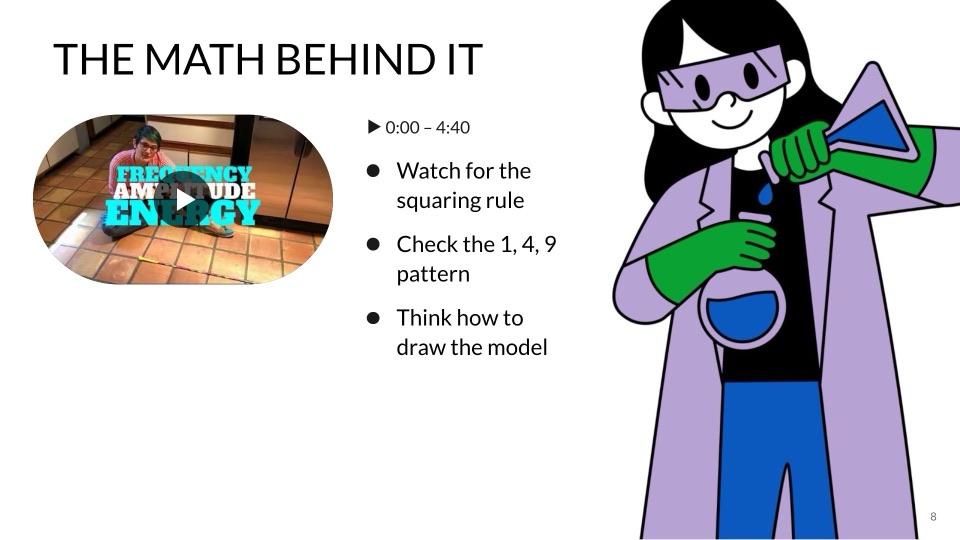
| 12 min | Teaching | Model how to measure amplitude and how energy depends on amplitude squared. Use Slide 3 to define amplitude as the maximum displacement from rest position and as distance from rest to crest or trough. Play Video clip 2 (0:00-0:47) to watch a small then large push make a small then large height. Show Slide 4 big number: energy is proportional to the square of amplitude, so doubling amplitude quadruples energy. Model the 1, 4, 9 pattern on the board with squares and Slide 6 prompts about what stays the same besides height. |
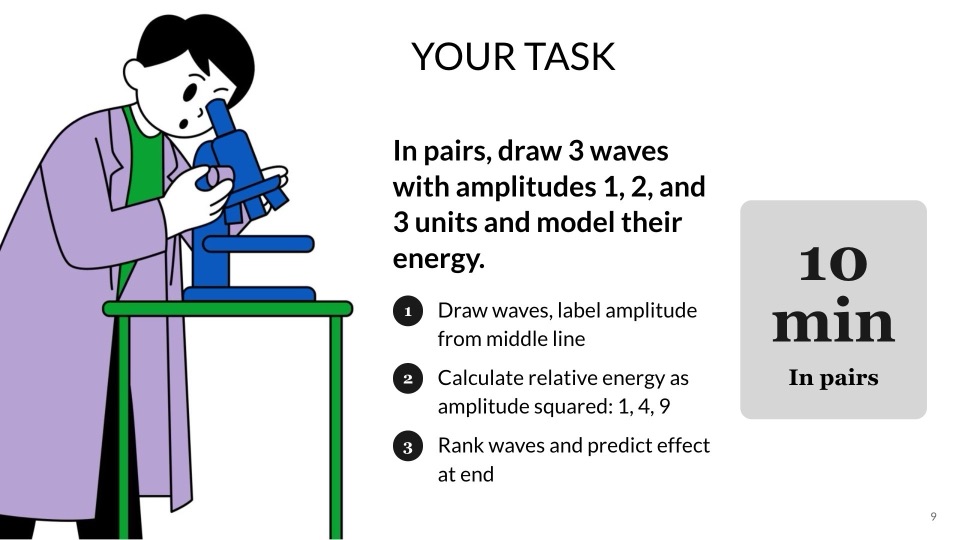
| 20 min | Main activity | Build and use the squared model to calculate relative wave energy from amplitude. Show Slide 9 task: draw 3 waves, label amplitude from the middle line, calculate energy as amplitude squared. Hand out graph paper and Worksheet Task C and model shading 1 by 1, 2 by 2, and 3 by 3 squares. Set pairs to complete amplitudes 1, 2, and 3 units to find energies 1, 4, and 9. Circulate, check tables, and prompt pairs to rank waves and predict effect at the far end. |
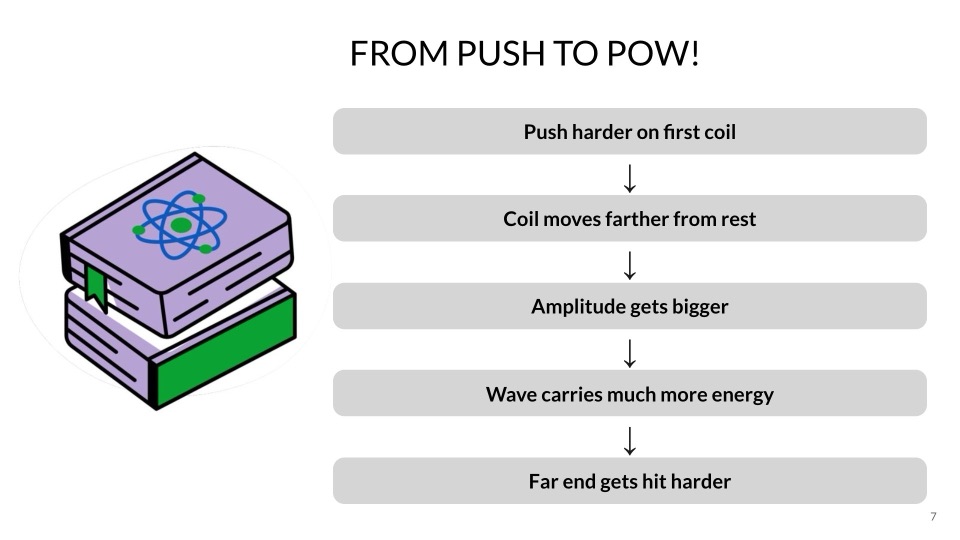
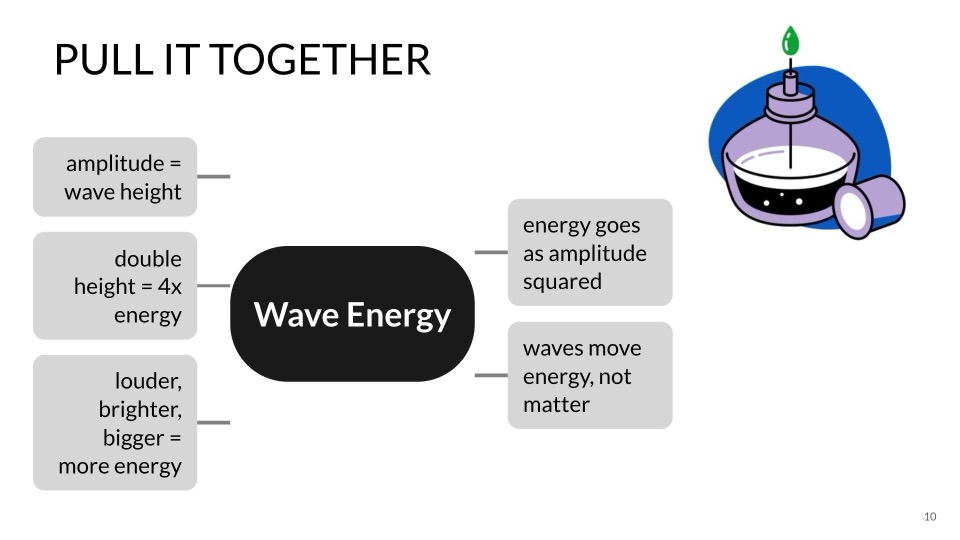
| 12 min | Application | Apply the amplitude-energy model to explain low- versus high-energy waves. Show Slide 7 chain: harder push on first coil gives farther motion from rest, bigger amplitude, much more energy. Assign Worksheet Task A: answer in full sentences using amplitude and energy in math and explanations. Remind students that waves move energy, not matter, and extra push changes amplitude, not speed. Use Slide 10 mindmap to connect louder, brighter, and bigger to larger amplitude and more energy. |
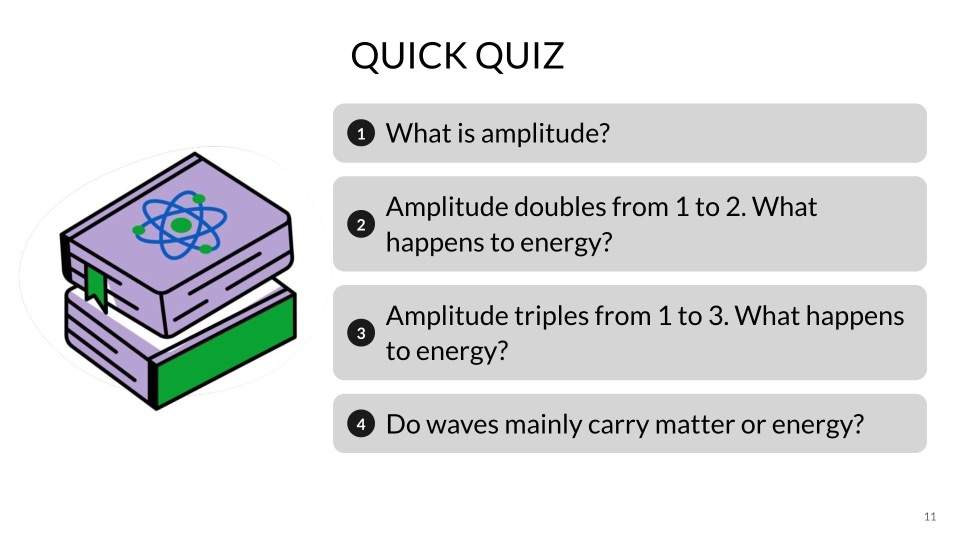
| 8 min | Plenary | Check that students can measure amplitude and use squaring to predict energy. Show Slide 11 quiz and cold-call answers for amplitude definition and doubling rule. Ask students to self-rate the success criteria with thumbs up or sideways. Collect Worksheet Tasks A and C and preview that frequency will be modeled next time. |
Common mistakes
- Thinking doubling amplitude doubles energy.
How to spot it: Student writes energy 2 when amplitude is 2.
Re-shade 2 by 2 squares to show 4 units and restate doubling quadruples because energy is amplitude squared. - Measuring amplitude from crest to trough instead of rest line.
How to spot it: Ruler spans full wave height on diagram.
Draw the middle rest line and measure rest to crest or trough only, the maximum displacement from rest. - Thinking waves carry matter forward across the ocean.
How to spot it: Student says water travels all the way to shore.
Show particles move mostly in place while the pattern moves forward; waves transport energy without transporting matter.
Support
- Use pre-drawn waves with a bold middle rest line and graph-paper squares for counting.
Stretch
- Calculate energy for amplitudes 5 and 10 and write why small height gains pack a big punch.
Check questions
- What is amplitude and how do you find it on a diagram?
Answer: Max displacement from rest position; measure from middle line to crest or trough. - Amplitude triples from 1 to 3. What happens to energy?
Answer: It becomes nine times bigger, from 1 to 9. - Wave A has amplitude 2 and Wave B has amplitude 4. How many times more energy does B carry? Show math.
Answer: Four times more: 4 squared is 16 and 2 squared is 4, and 16 divided by 4 is 4.
Curriculum
Use mathematical representations to describe a simple model for waves that includes how the amplitude of a wave is related to the energy in a wave.
From Next Generation Science Standards (middle school), MS-PS4-1.
Video clips
Clips on YouTube, from the start and end times we chose. Check each one before you show it.
-
Energy vs amplitude link from 0:00 to 4:30
adventures in ISTEM: The Relationship between the Energy of a wave and it's amplitude or frequency
Directly models how amplitude relates to energy with vocabulary and pace perfect for 13-14 in Grade 8.
-
Wave energy, frequency and amplitude from 0:00 to 4:40
Koralina McKenna: Wave Energy: Frequency & Amplitude
Explains the amplitude-energy relationship with simple math representations appropriate for 13-14.
Worksheet
Sources
- Unit 3 avon.k12.ct.us
- Grade 8 Science Curriculum Pacing Guide gcsd.k12.nj.us
- 16.4 Energy and Power of a Wave - University Physics Volume 1 pressbooks.online.ucf.edu
- 16.4 Energy and Power of a Wave - General Physics Using Calculus I pressbooks.online.ucf.edu
- Acoustics: the study of sound waves - Stanford University ccrma.stanford.edu
- Waves, Electromagnetic Radiation, and Sound - An Introduction to ... openbooks.lib.msu.edu
- Wave and Wave Properties | manoa.hawaii.edu/ExploringOurFluidEarth manoa.hawaii.edu
- Amplitude & Intensity of Sound Waves - BU cs.bu.edu
- Sound and noise - Sound waves, amplitude and frequency - 4th ... bbc.co.uk
- Waves KS3 | Y9 Science | Lesson Resources | Oak National Academy thenational.academy
- Sound Waves - BBC Bitesize bbc.co.uk
- Energy Transport and the Amplitude of a Wave physicsclassroom.com
- wave - Students | Britannica Kids | Homework Help kids.britannica.com
- What Does It Mean When a Wave’s Amplitude Increases? scienceinsights.org
- Features of waves links to energy transfer guide for KS3 ... bbc.co.uk
- Wave Intensity - lipa.physics.oregonstate.edu lipa.physics.oregonstate.edu
- Energy in Waves: Intensity - Introductory Physics for the Health and ... openbooks.lib.msu.edu
Picture credits
Made with Lesson Dino's AI on 16 October 2026. AI can make mistakes, so check facts against the sources before you teach.