Slides
Lesson plan
Push Harder or Load Heavier?
Students learn that change in motion depends on net force and mass. They plan and run fair cart tests and use timed evidence.
Objectives
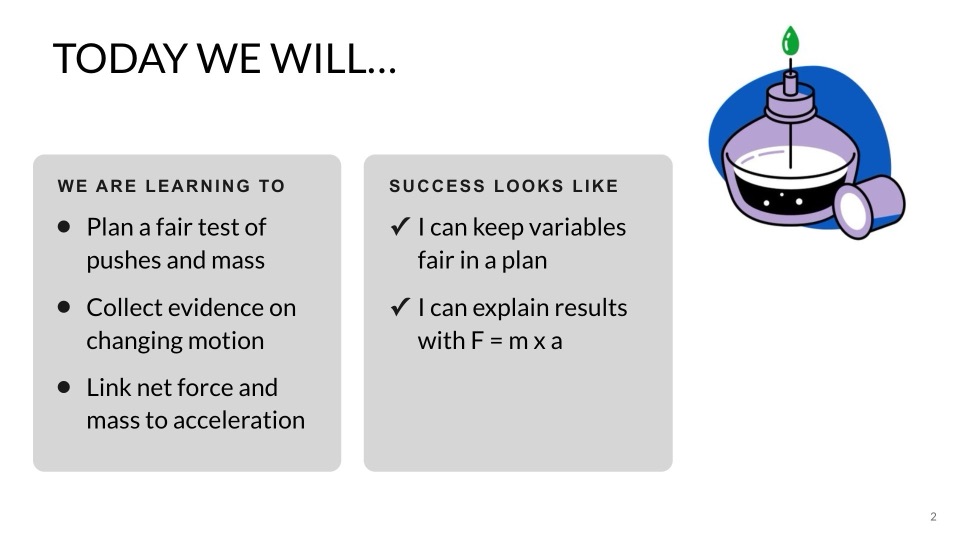
- Students will plan a fair test that changes net force and mass.
- Students will collect timed evidence showing how motion changes.
- Students will explain that acceleration depends on net force and mass.
Success criteria
- I can keep variables fair and change only force or mass.
- I can use timed results as evidence of changed motion.
- I can link net force and mass to size of acceleration.
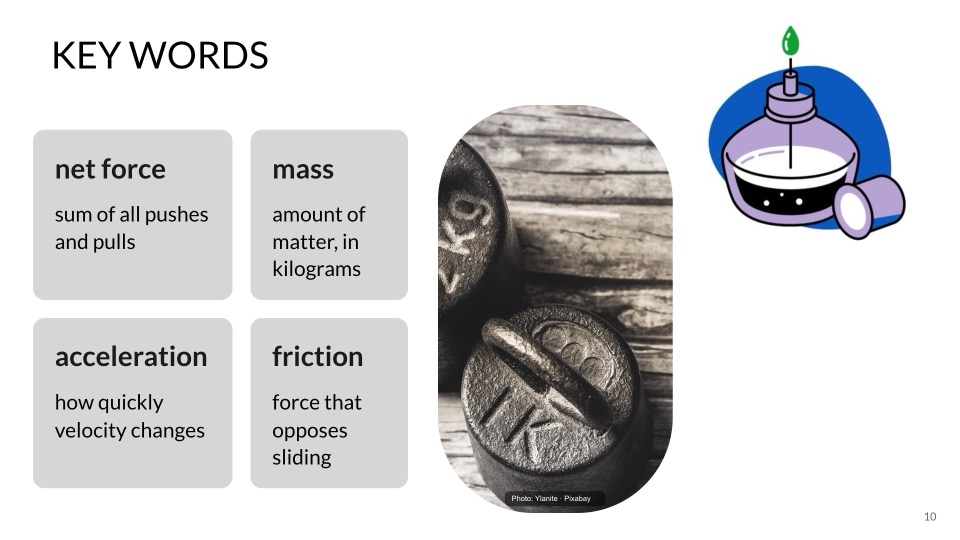
Key words
| Word | Meaning |
|---|---|
| net force | sum of all pushes and pulls acting together |
| mass | amount of matter in an object, measured in kilograms |
| acceleration | how quickly speed or direction of movement changes |
| friction | rubbing push or pull that opposes sliding and slows movement |
Timed plan (60 minutes)
| Time | Stage | What happens |
|---|---|---|
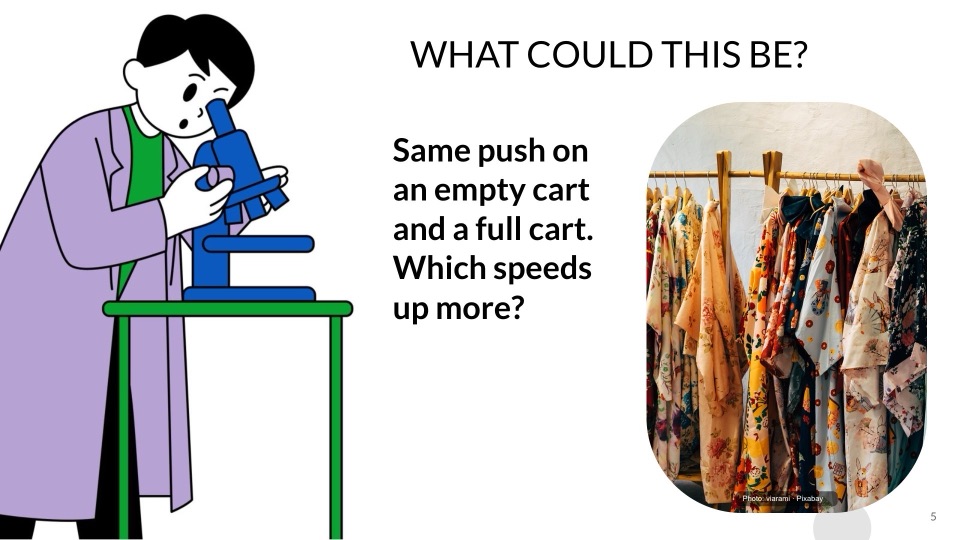
| 8 min | Starter | Connect prior push and pull ideas to the question of proving motion change. Show Slide 1 Push, Pull, and Speed Up and say the hook question. Show Slide 5 mystery: same push on an empty cart and a full cart. Take a vote on which speeds up more and ask for reasons. Link answers to learning goal: plan a fair test of force size and mass. |
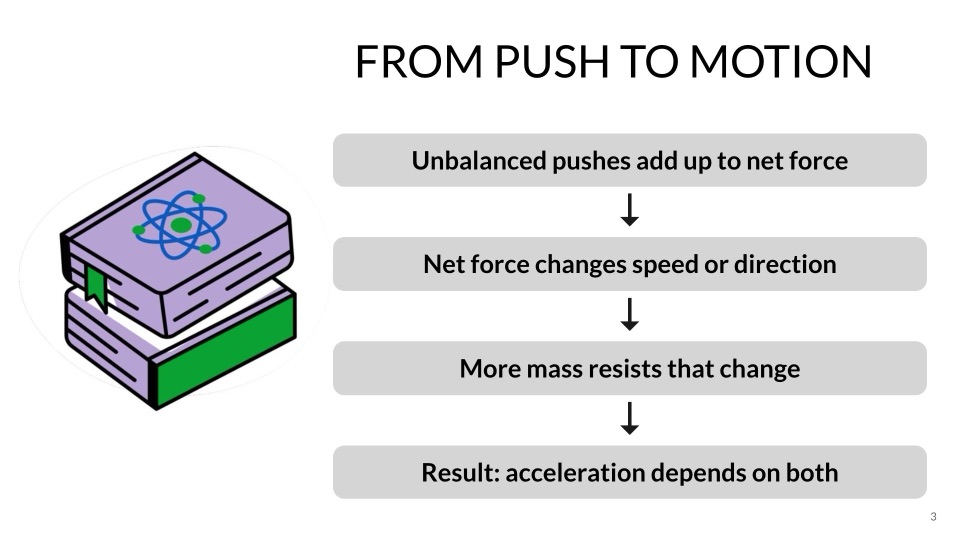
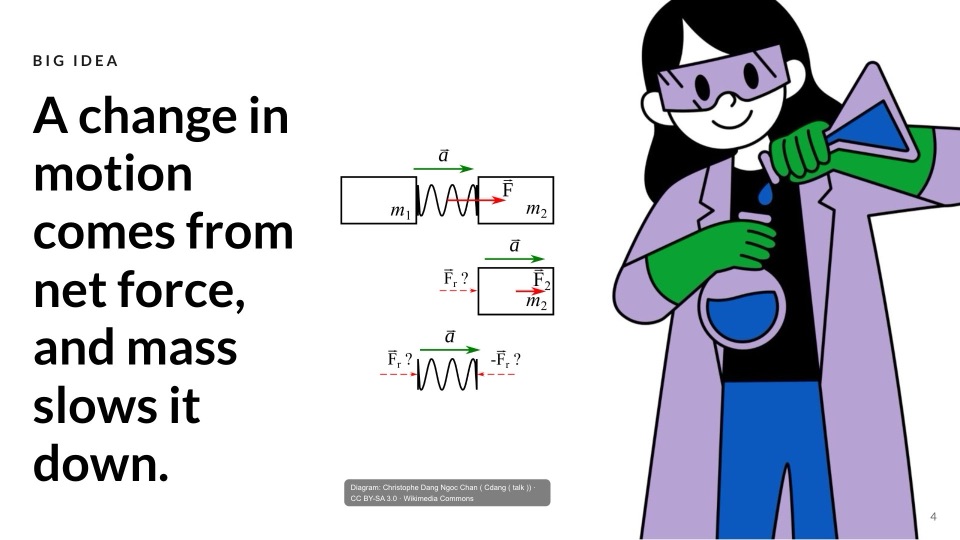
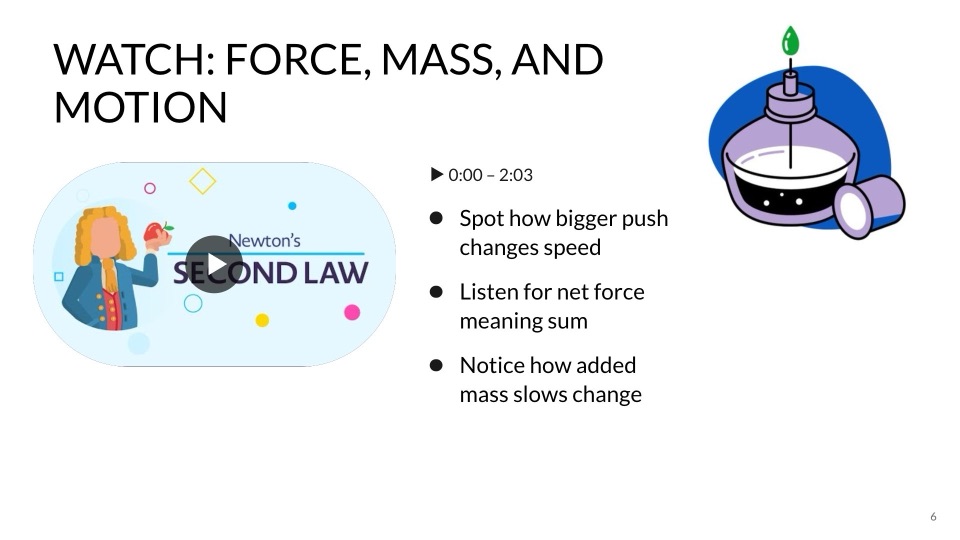
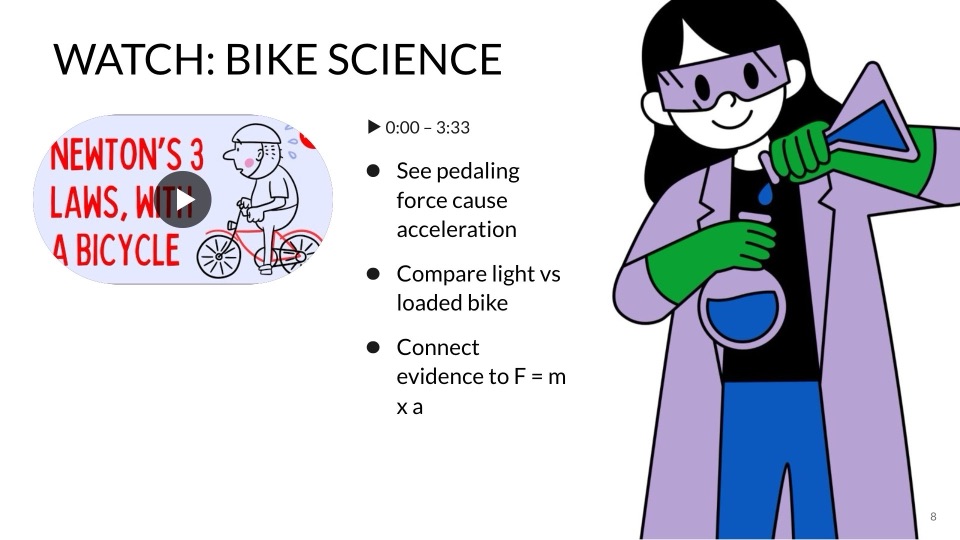
| 12 min | Teaching | Explain that net force changes motion and mass resists change. Show Slide 3 chain: unbalanced pushes add to net force, net force changes speed or direction, mass resists change. Show Slide 4 statement: change in motion comes from net force, and mass slows it down. Play Video clip 1 on Slide 6 and pause to name net force as the sum. Model F = ma calculation with 1-kg and 2-kg example. |
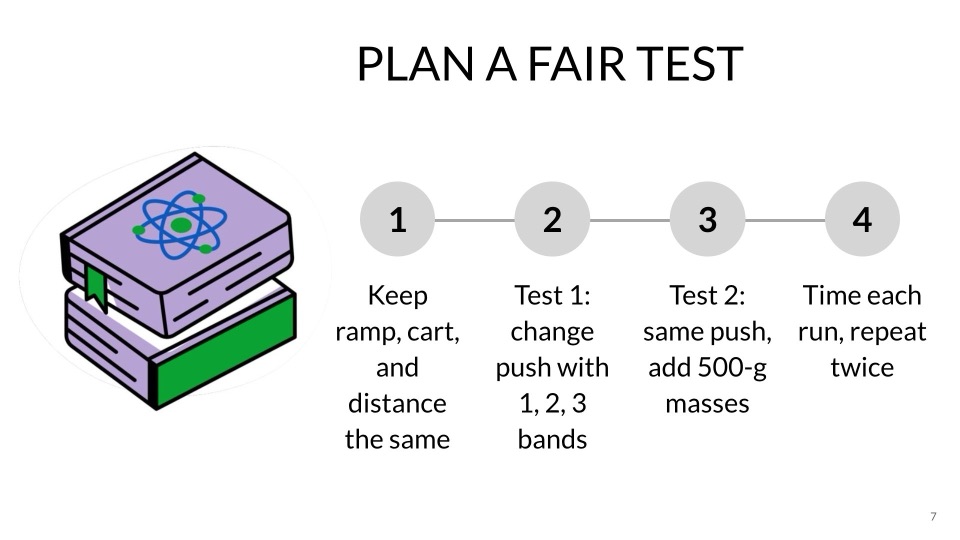
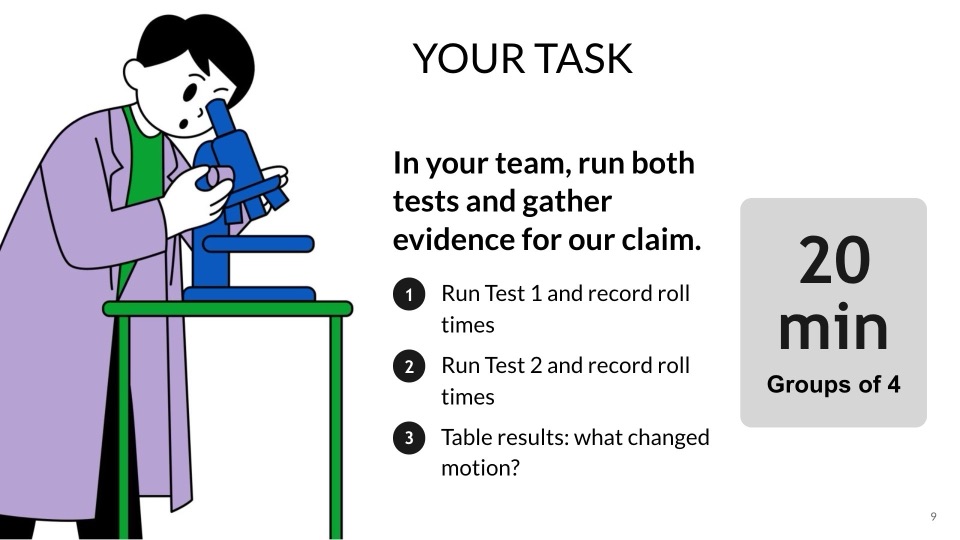
| 10 min | Planning | Plan a fair two-part test for force size and for mass. Show Slide 7 steps: keep ramp, cart, and distance same; Test 1 change pull with 1, 2, 3 bands; Test 2 same pull with added 500-g masses. Model how to read spring scale and time each run over 2 meters, repeat twice. Hand out Worksheet Tasks B and C and pre-made data table. Assign roles: puller, timer, recorder. |
| 20 min | Main activity | Collect timed evidence that motion change depends on force and mass. Show Slide 9 task and start timer for Test 1: three pulls, same mass, time to travel 2 meters. Circulate to check steady pulls, fair release, and two repeats. Switch groups to Test 2: same pull, three masses, time each run. Prompt claim writing: bigger net force means bigger change, bigger mass means smaller change. |
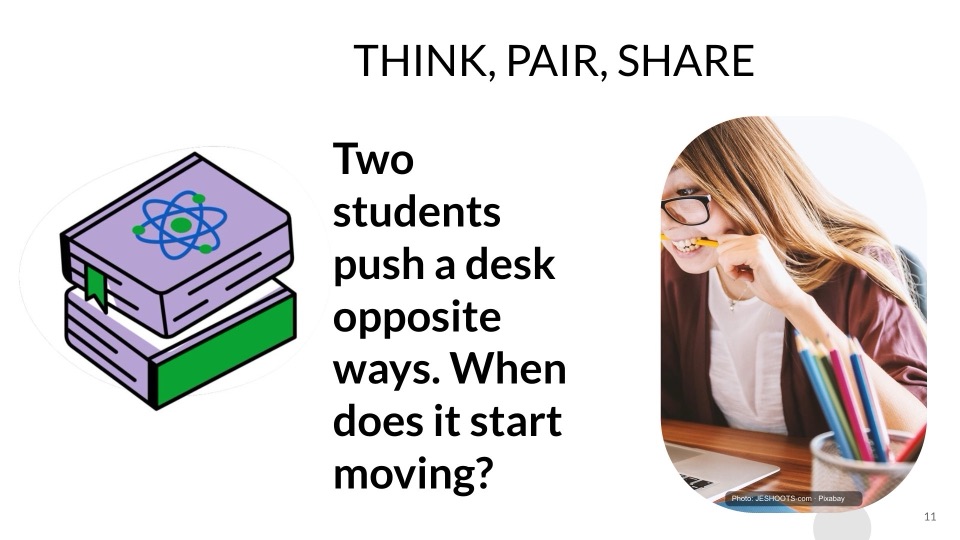
| 10 min | Plenary | Share claims and check that net force and mass explain acceleration. Show Slide 11 question: two students push a desk opposite ways, when does it move? Take 2 group claims and link to unbalanced force changing motion. Show Slide 12 quiz and run Worksheet Task F for claim plus evidence. Preview exit check and collect Task F. |
Common mistakes
- Thinking heavier objects always speed up more or fall faster with same push.
How to spot it: Claims that added mass gave larger acceleration despite longer times.
Point to data and restate that acceleration depends on mass and force applied, so same force on larger mass gives smaller acceleration. - Thinking balanced forces cause motion change.
How to spot it: Says desk moves when opposite pushes are equal.
Draw equal opposite arrows summing to zero and show velocity stays constant unless acted on by an unbalanced force. - Mixing up mass and force effects in F = ma.
How to spot it: Predicts doubling mass doubles acceleration.
Use numbers: 4 N on 1 kg = 4 m/s2, on 2 kg = 2 m/s2, because force equals mass times acceleration.
Support
- Give pre-made data table with columns for pull, added mass, time, and observations so students focus on controlling variables.
- Provide arrow cards and partly drawn setup to build force picture before drawing.
Stretch
- Have students predict what doubling the pull should do to acceleration, then test it and explain using force equals mass times acceleration.
- Ask what happens with three pulls at once and how friction changes the sum of forces.
Check questions
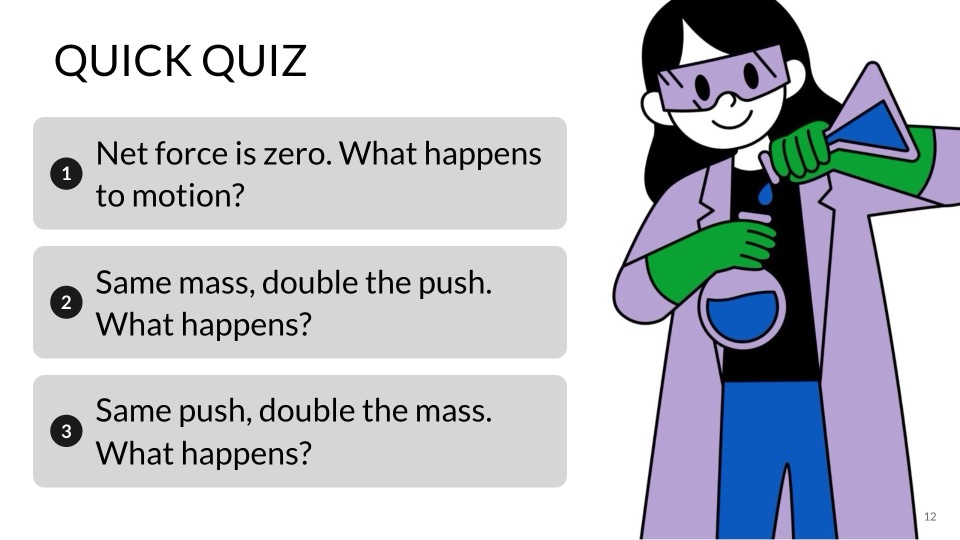
- Net force is zero. What happens to the motion?
Answer: No change - stays still or keeps same speed and direction. - Same mass, you double the net pull from 2 N to 4 N. What happens to acceleration?
Answer: Acceleration doubles. - Same 2 N pull, you double the mass. What happens to the change in motion?
Answer: Change is smaller; acceleration is half as large.
Curriculum
Plan an investigation to provide evidence that the change in an object's motion depends on the sum of the forces on the object and the mass of the object.
From Next Generation Science Standards (middle school), MS-PS2-2.
Video clips
Clips on YouTube, from the start and end times we chose. Check each one before you show it.
-
Force, Mass, and Acceleration from 0:00 to 2:03
LearnFree: Force, Mass, and Acceleration: Newton's Second Law
Directly models the lesson focus on net force, mass, and acceleration with clear language perfect for 13-14-year-olds.
-
Three Laws with a Bicycle from 0:00 to 3:33
TED-Ed: Newton's 3 Laws, with a bicycle - Joshua Manley
Uses an everyday bicycle example to explain the second law at the right vocabulary and pace for 13-14-year-olds.
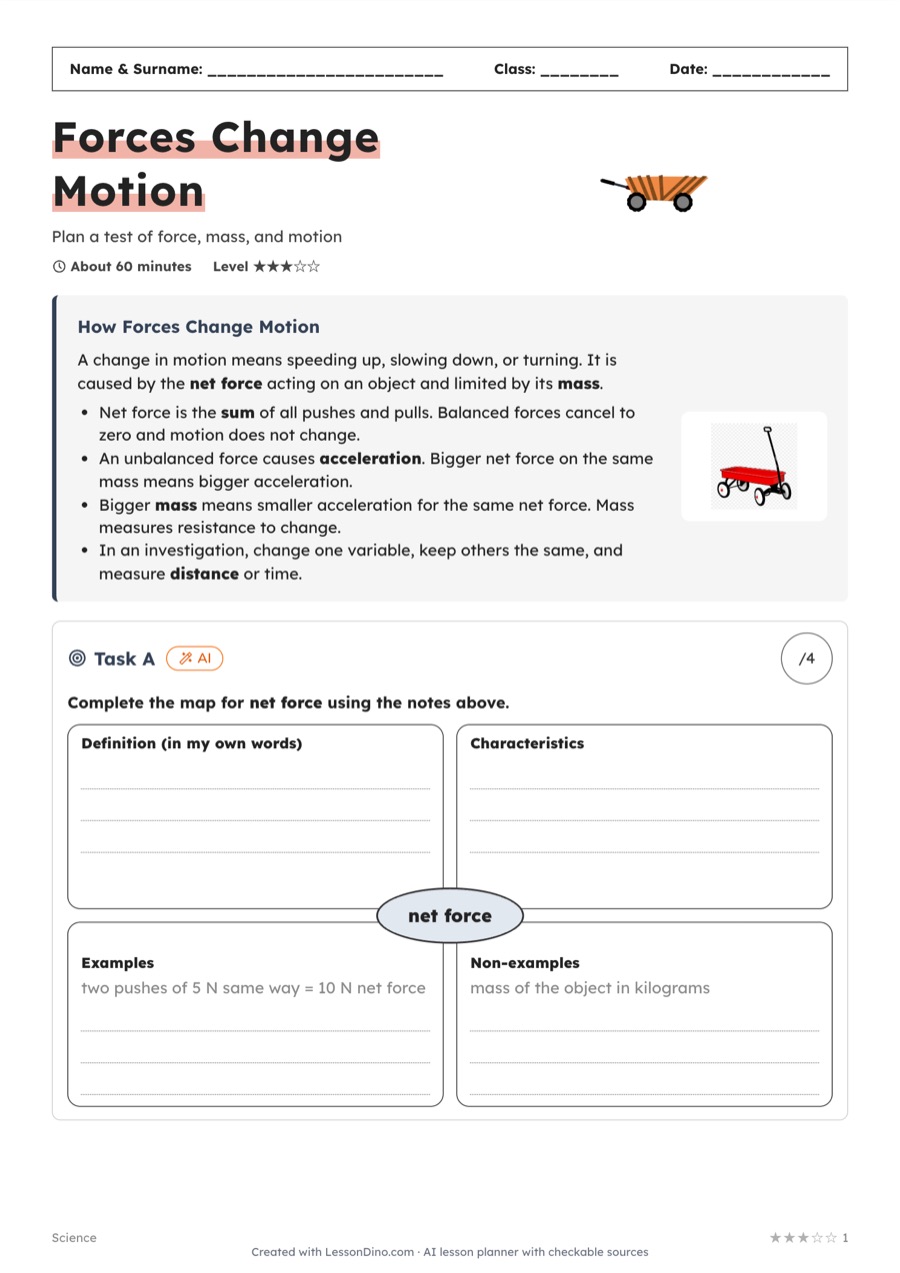
Worksheet
Sources
- Grade 8 Science Curriculum - Fairfax County Public Schools fcps.edu
- Read the Standards | Next Generation Science Standards nextgenscience.org
- Newton’s Laws of Motion | Glenn Research Center | NASA www1.grc.nasa.gov
- Newton's Laws of Motion - NASA grc.nasa.gov
- Newton’s Laws of Motion - pages.physics.ua.edu pages.physics.ua.edu
- Newton’s Laws of Motion - Worcester Polytechnic Institute users.wpi.edu
- Newton's laws - Revise: Forces, motion and energy - National ... bbc.co.uk
- Newton’s laws of motion | Definition, Examples, Applications ... britannica.com
- Forces and Newton's laws of motion | Khan Academy khanacademy.org
- Understanding Newton’s Laws of Motion | Explanations ... britannica.com
- Newton's laws of motion - Forces | Khan Academy en.khanacademy.org
- Newton's laws of motion en.wikipedia.org
- Newton's laws of motion Facts for Kids kids.kiddle.co
- Forces and Newton's Laws - Revise: Newton's Laws - BBC bbc.co.uk
- Force and Laws of motion | UP Science Grade 9 | Khan Academy en.khanacademy.org
- Newton’s Laws of Motion - Library For Kids libraryforkids.com
- Newton's Laws of Motion | Brilliant Math & Science Wiki brilliant.org
- Newton's Laws of Motion - 1. Force and Inertia phy6.org
- Newton's Laws - #InspiredBy | NASA/JPL Edu jpl.nasa.gov
- [physics/0110066] Newton's laws of motion in form of Riccati equ… arxiv.org
- Newton's Laws of Motion - ProofWiki proofwiki.org
- 5: Newton's Laws of Motion - Physics LibreTexts phys.libretexts.org
- Newton's Laws Study Guide | CK-12 Foundation ck12.org
- Forces and Newton's laws of motion | Physics archive | Khan ... khanacademy.org
- Maths in a minute: Newton's laws of motion | plus.maths.org plus.maths.org
Picture credits
Made with Lesson Dino's AI on 16 October 2026. AI can make mistakes, so check facts against the sources before you teach.