The worksheet
About this worksheet
Students learn to take apart claims and judge evidence. They diagnose sick arguments and cure them in teams. This Grade 8 ELA worksheet gives students (ages 13–14) six pages of practice on analyzing an argument, part of the reading informational text unit. It goes with our free Analyzing an argument lesson, which has the slides and a timed lesson plan.
What it covers
By the end, students should be able to:
- Students will delineate specific claims, reasoning, and evidence in a text.
- Students will evaluate reasoning for logic and evidence for relevance and sufficiency.
- Students will recognize and explain irrelevant evidence in an argument.
How to use it
- Guided practice (10 minutes): Hand out Worksheet Task C with Passage "Phones Out of Class?" paragraphs 2-4.
- Support: Give a chart with checkboxes: Does the evidence talk about the claim? Is there enough of it? Is the reasoning logical?
- Stretch: Groups write a discharge note predicting the best opposing argument and how their cured version survives it.
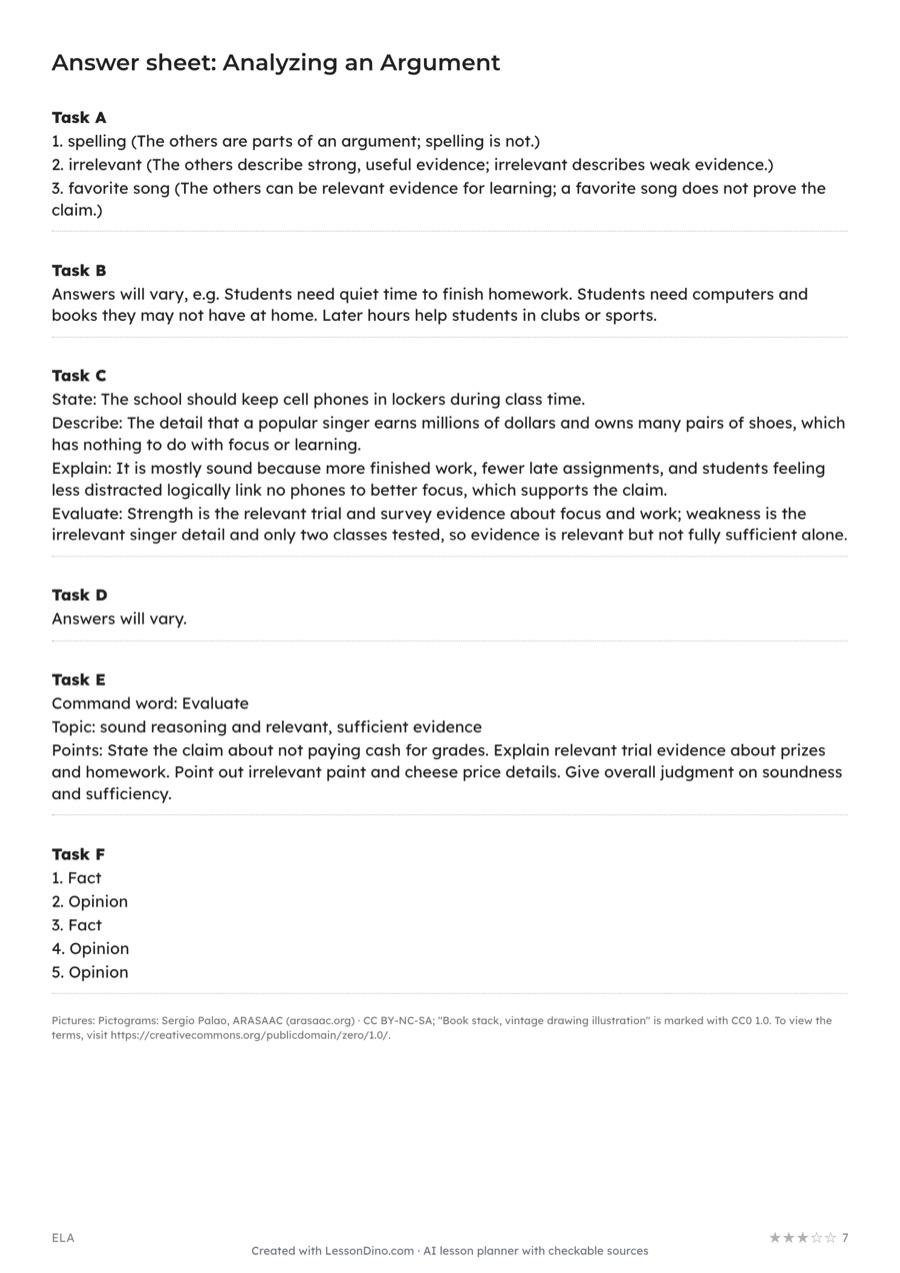
- The answer sheet is the last page, so you can print it on its own or let students check their own work.
Key vocabulary
- claim: a statement a writer tries to show is true
- reasoning: the clear link that shows why proof backs a point
- evidence: facts, examples, or quotes used as proof
- relevant: directly about the point and helping to prove it
- irrelevant: off the topic and not helping to prove the point
- sufficient: plenty enough proof to make the point believable
Mistakes to watch for
- Thinking any true statement counts as good evidence. Ask: does it prove this claim about learning or focus? If off-topic, set aside even if true.
- Confusing reasoning with evidence. Frame as: evidence is the proof; reasoning is why the proof should make us believe it.
- Thinking one relevant example is automatically enough. Ask: who, how many, how long? Show relevant but small proof needs more to be sufficient.
What's on the worksheet
Break Down Arguments
Learn what to look for in an argument.
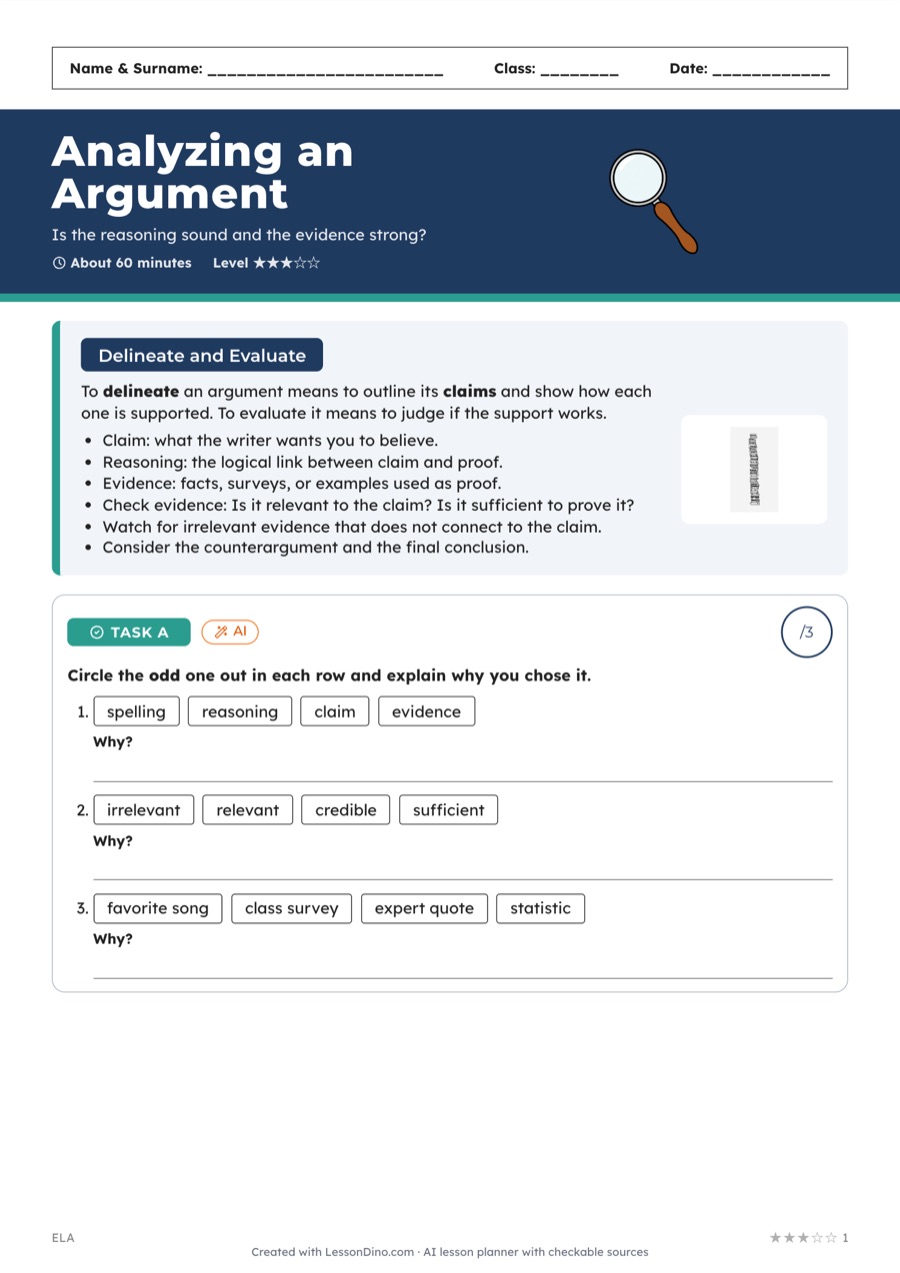
Delineate and Evaluate
- To delineate an argument means to outline its claims and show how each one is supported. To evaluate it means to judge if the support works.
- Claim: what the writer wants you to believe.
- Reasoning: the logical link between claim and proof.
- Evidence: facts, surveys, or examples used as proof.
- Check evidence: Is it relevant to the claim? Is it sufficient to prove it?
- Watch for irrelevant evidence that does not connect to the claim.
- Consider the counterargument and the final conclusion.
Circle the odd one out in each row and explain why you chose it.
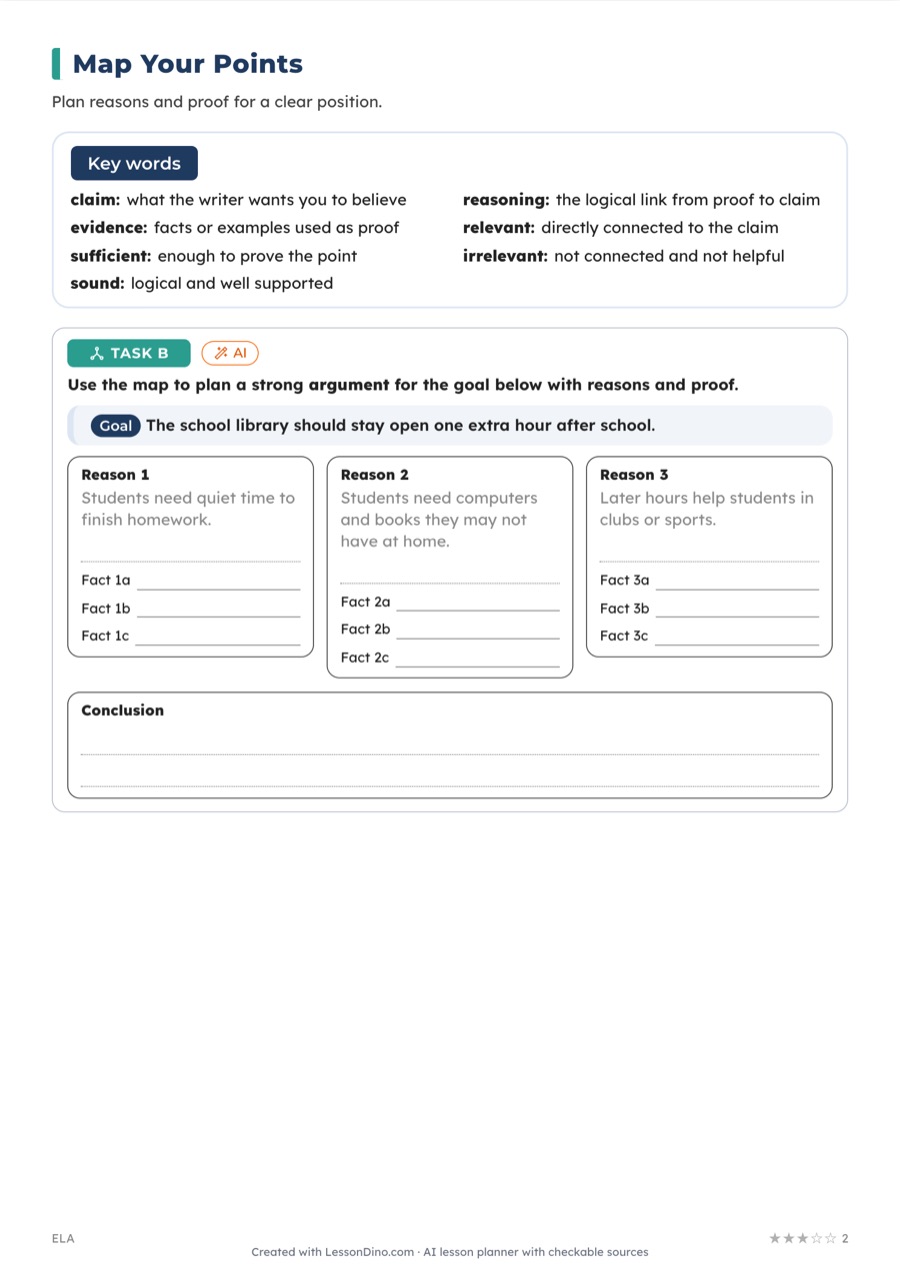
Map Your Points
Plan reasons and proof for a clear position.
| Word | Meaning |
|---|---|
| claim | what the writer wants you to believe |
| reasoning | the logical link from proof to claim |
| evidence | facts or examples used as proof |
| relevant | directly connected to the claim |
| sufficient | enough to prove the point |
| irrelevant | not connected and not helpful |
| sound | logical and well supported |
Use the map to plan a strong argument for the goal below with reasons and proof.
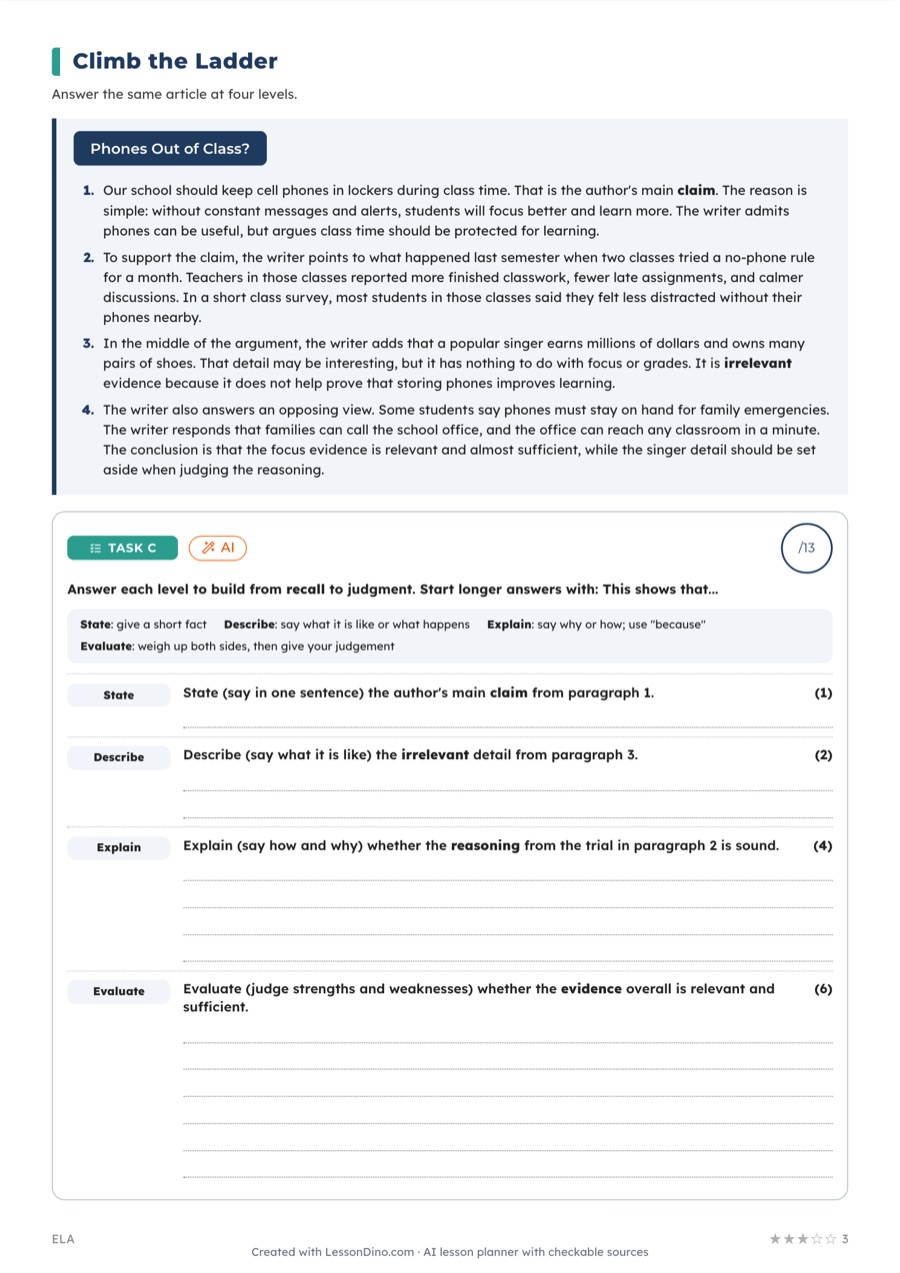
Climb the Ladder
Answer the same article at four levels.
Phones Out of Class?
Answer each level to build from recall to judgment. Start longer answers with: This shows that...
- State (say in one sentence) the author's main claim from paragraph 1.
- Describe (say what it is like) the irrelevant detail from paragraph 3.
- Explain (say how and why) whether the reasoning from the trial in paragraph 2 is sound.
- Evaluate (judge strengths and weaknesses) whether the evidence overall is relevant and sufficient.
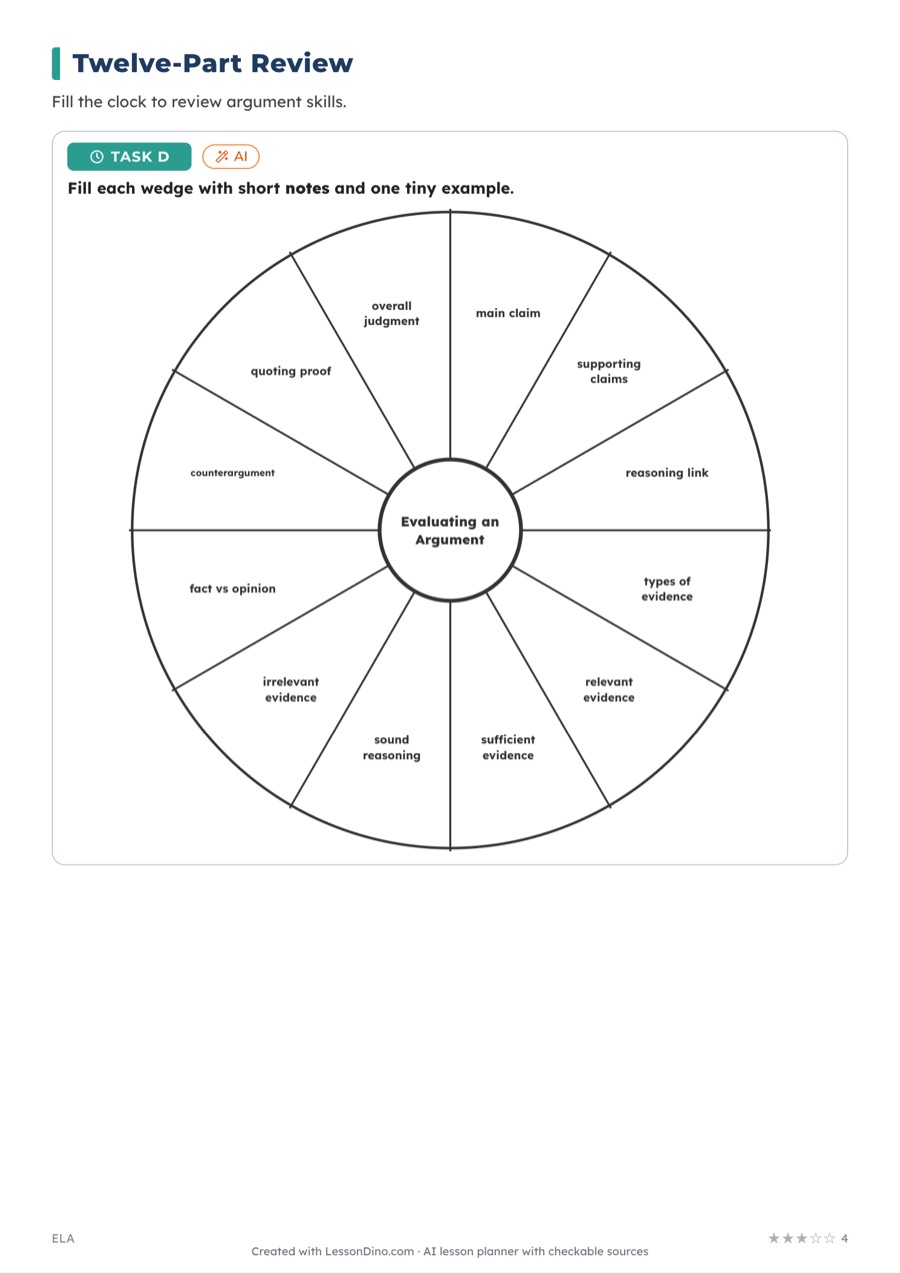
Twelve-Part Review
Fill the clock to review argument skills.
Fill each wedge with short notes and one tiny example.
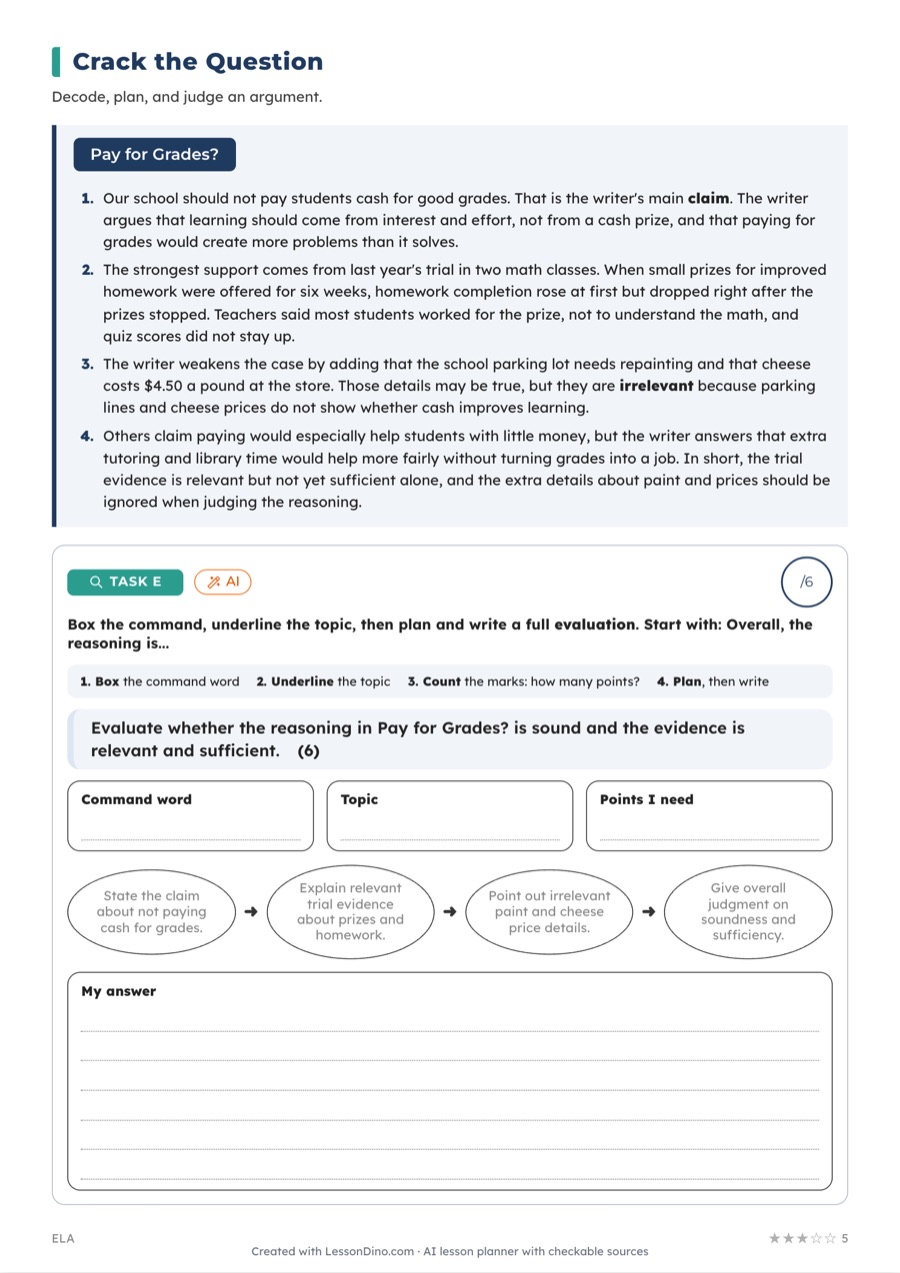
Crack the Question
Decode, plan, and judge an argument.
Pay for Grades?
Box the command, underline the topic, then plan and write a full evaluation. Start with: Overall, the reasoning is...
Page 6
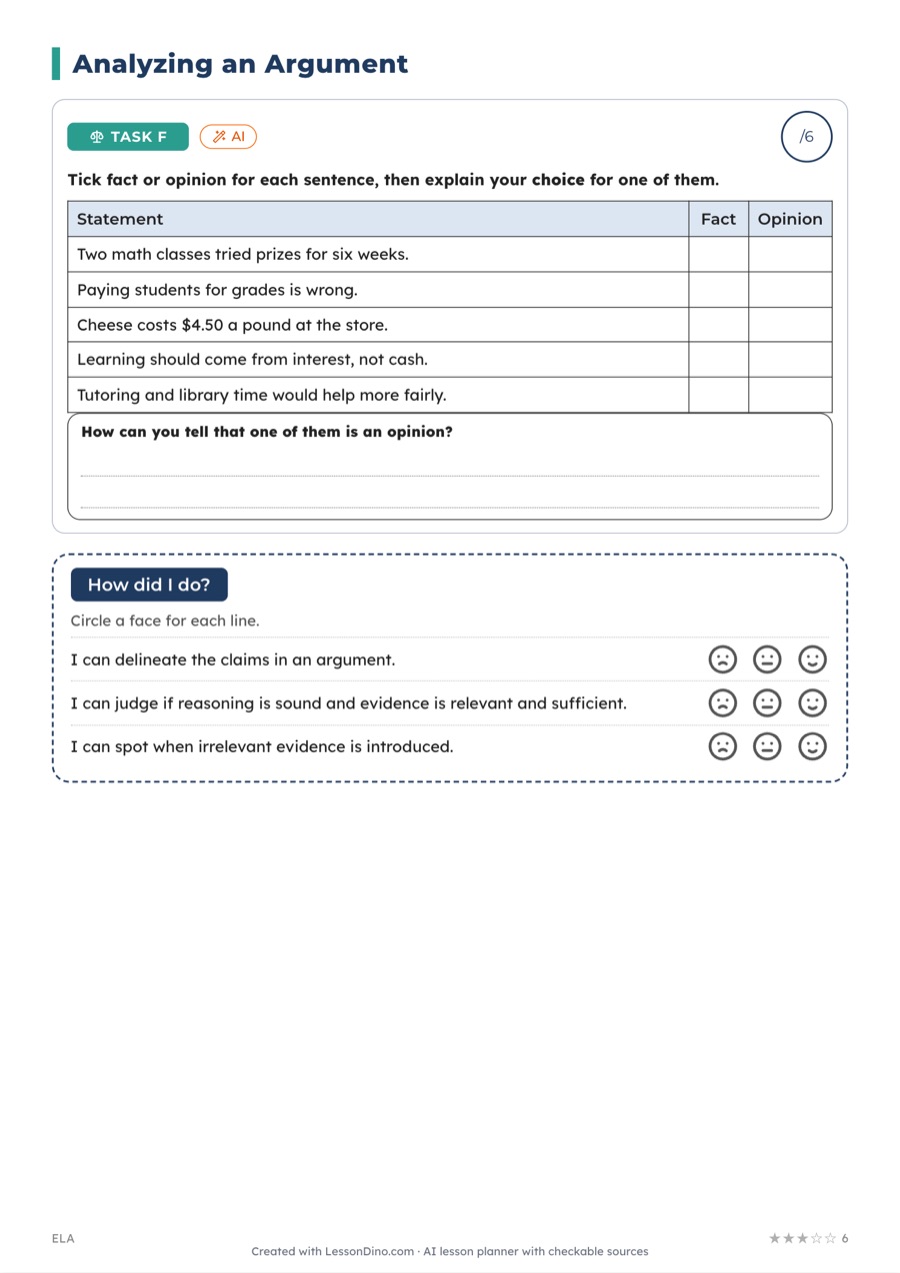
Tick fact or opinion for each sentence, then explain your choice for one of them.
Answers
Show the answers
- State (say in one sentence) the author's main claim from paragraph 1. The school should keep cell phones in lockers during class time.
- Describe (say what it is like) the irrelevant detail from paragraph 3. The detail that a popular singer earns millions of dollars and owns many pairs of shoes, which has nothing to do with focus or learning.
- Explain (say how and why) whether the reasoning from the trial in paragraph 2 is sound. It is mostly sound because more finished work, fewer late assignments, and students feeling less distracted logically link no phones to better focus, which supports the claim.
- Evaluate (judge strengths and weaknesses) whether the evidence overall is relevant and sufficient. Strength is the relevant trial and survey evidence about focus and work; weakness is the irrelevant singer detail and only two classes tested, so evidence is relevant but not fully sufficient alone.
The answer sheet is the last picture above.
Curriculum
Delineate and evaluate the argument and specific claims in a text, assessing whether the reasoning is sound and the evidence is relevant and sufficient; recognize when irrelevant evidence is introduced.
Made with Lesson Dino's AI on 17 October 2026. AI can make mistakes, so check the answers and facts against the sources before you teach.