Slides
Lesson plan
ER for Arguments: Sound, Relevant, Sufficient
Students learn to take apart claims and judge evidence. They diagnose sick arguments and cure them in teams.
Objectives
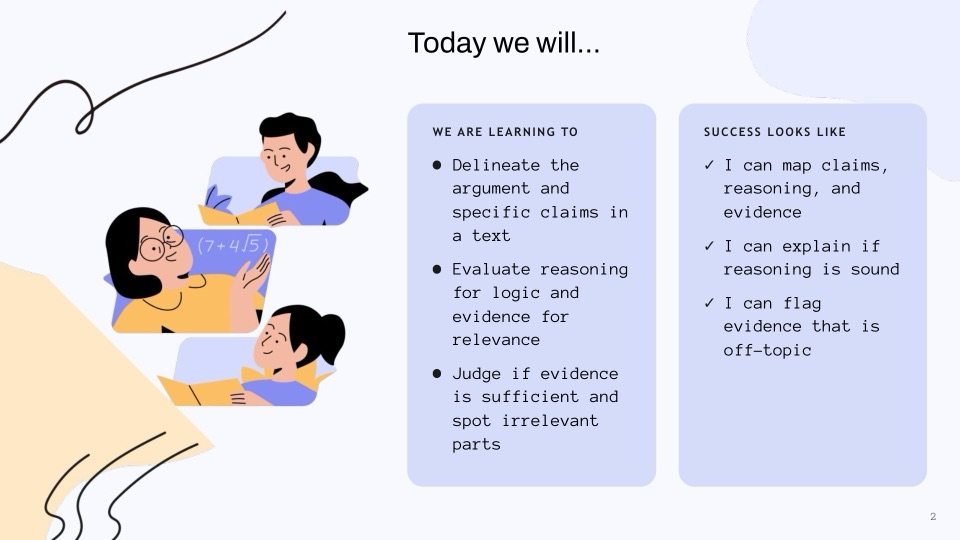
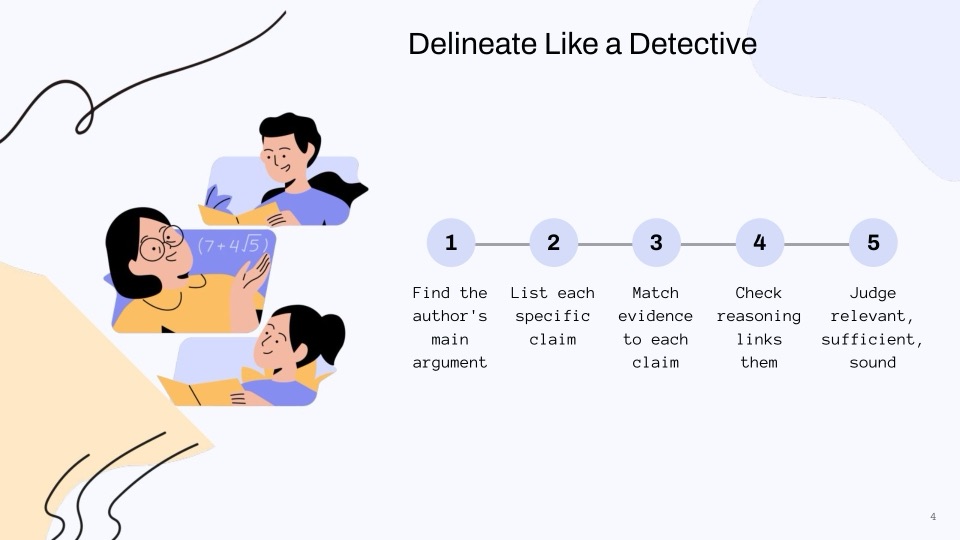
- Students will delineate specific claims, reasoning, and evidence in a text.
- Students will evaluate reasoning for logic and evidence for relevance and sufficiency.
- Students will recognize and explain irrelevant evidence in an argument.
Success criteria
- I can map each claim to the evidence meant to prove it.
- I can judge if reasoning is sound and evidence is enough.
- I can spot true details that do not prove the claim.
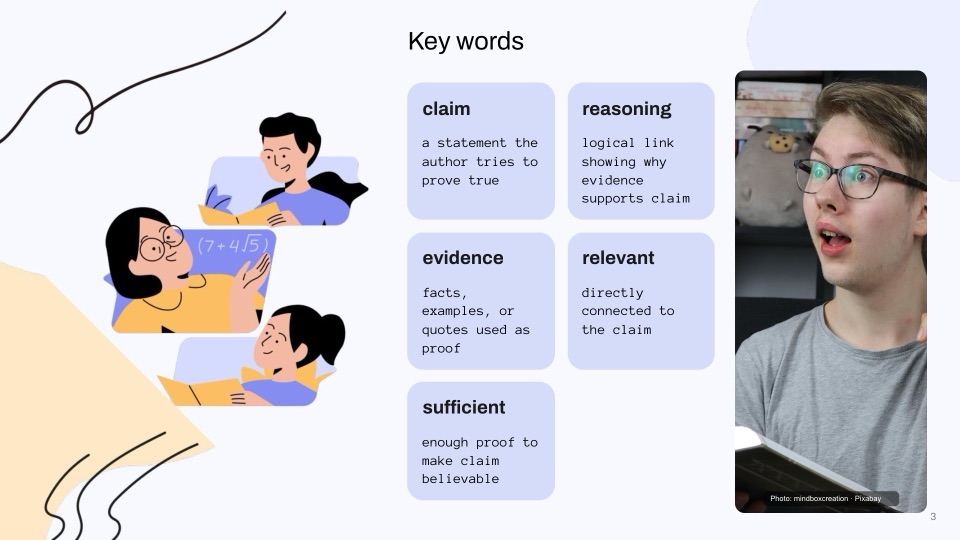
Key words
| Word | Meaning |
|---|---|
| claim | a statement a writer tries to show is true |
| reasoning | the clear link that shows why proof backs a point |
| evidence | facts, examples, or quotes used as proof |
| relevant | directly about the point and helping to prove it |
| irrelevant | off the topic and not helping to prove the point |
| sufficient | plenty enough proof to make the point believable |
Timed plan (60 minutes)
| Time | Stage | What happens |
|---|---|---|
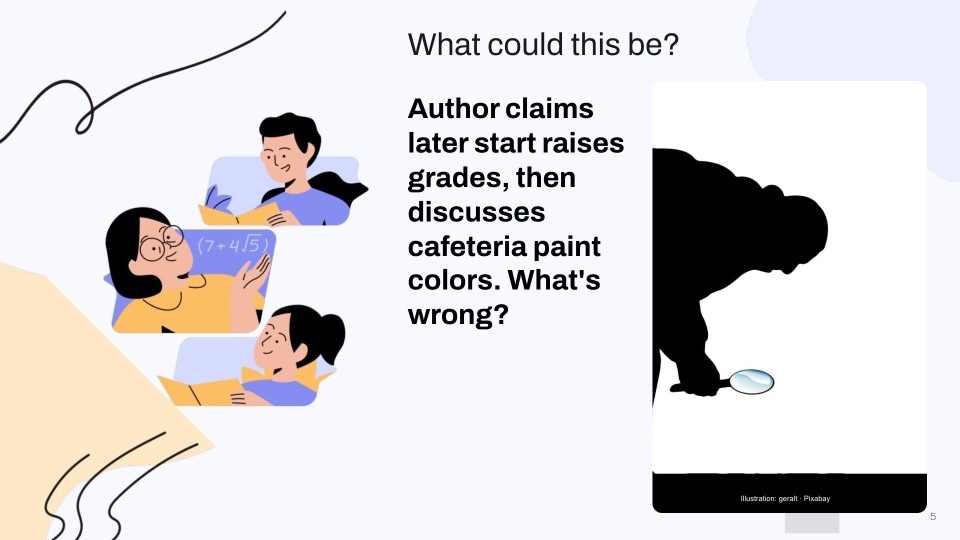
| 5 min | Starter | Hook students and recall claim and evidence before analysis. Welcome class with the ER hook and show Slide 1. Show Slide 5 mystery: author claims later start raises grades, then discusses cafeteria paint colors. Ask pairs to turn and talk for 30 seconds: what is wrong here? Cold-call to name the claim and why paint color does not help. |
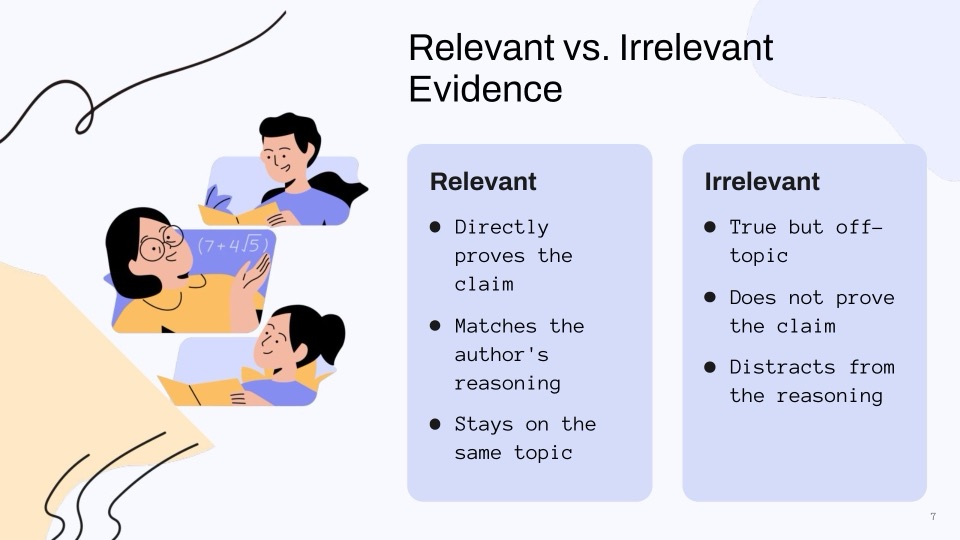
| 10 min | Teaching | Model how to delineate claims, reasoning, and evidence. Display Slide 3 key words and Slide 4 steps for delineating. Think aloud with Passage "Phones Out of Class?" paragraph 1: find main claim and reasoning. Match paragraph 2 evidence to the claim and draw arrows on board. Judge relevance and logic aloud using Slide 7 language. |
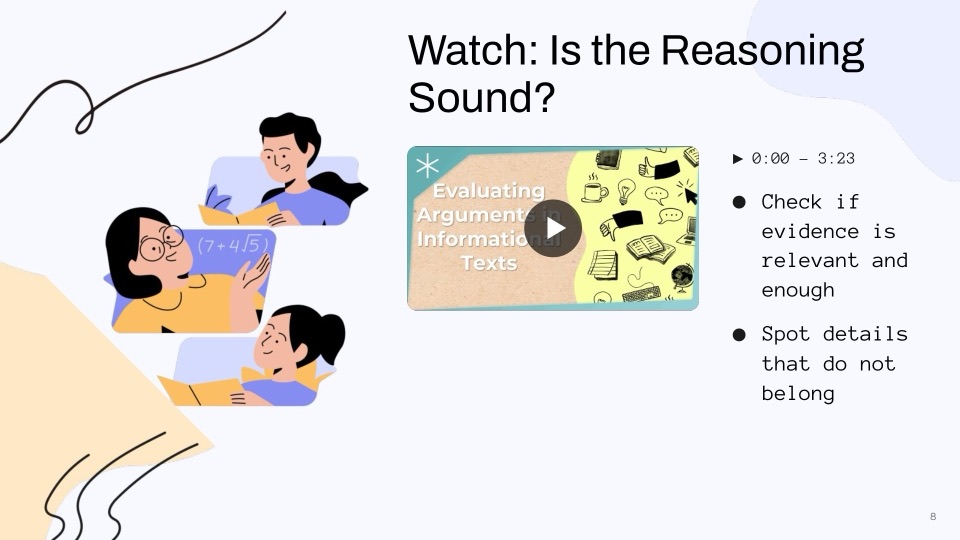
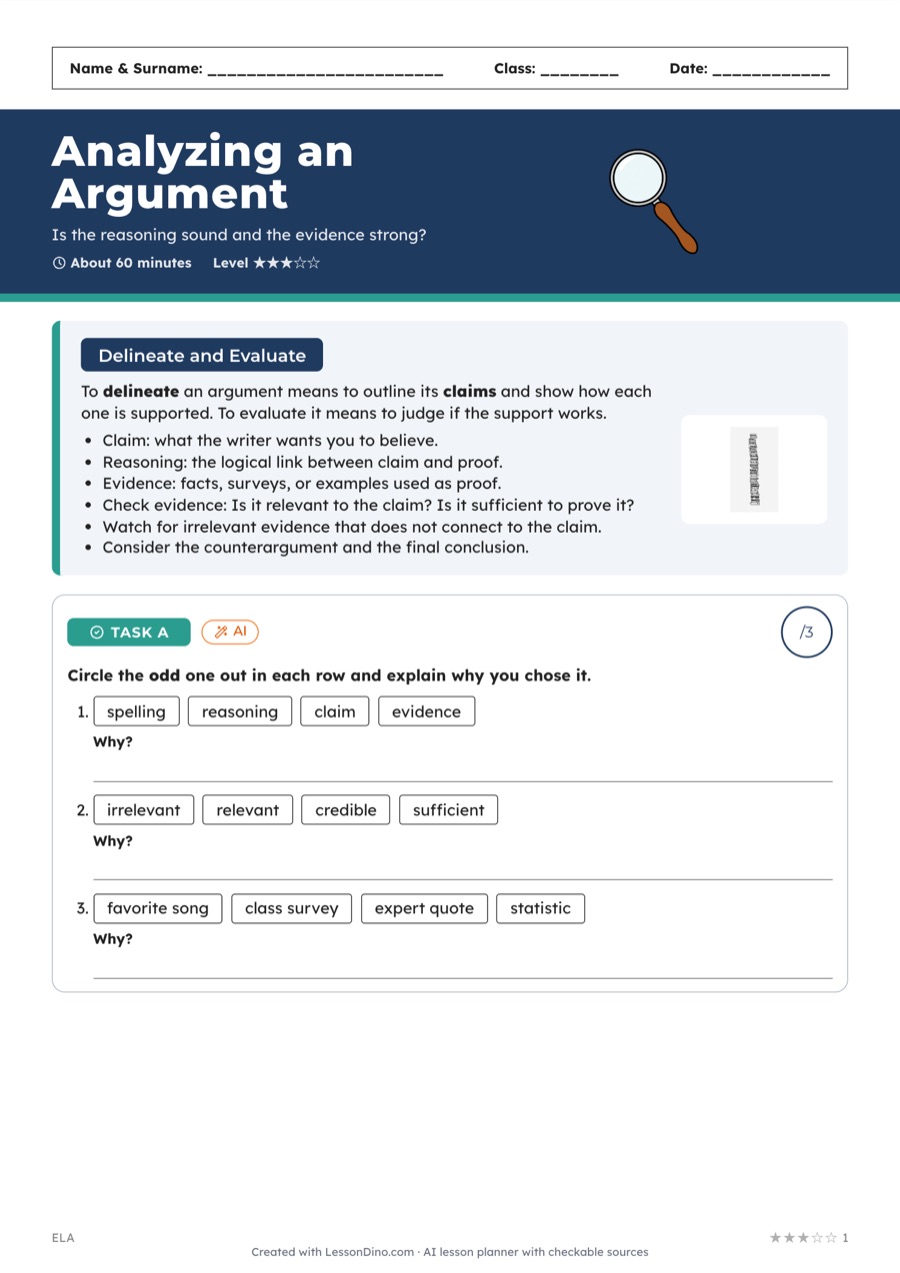
| 10 min | Guided practice | Practice judging relevance, sufficiency, and sound reasoning together. Hand out Worksheet Task C with Passage "Phones Out of Class?" paragraphs 2-4. Play Video clip 3 (0:00–3:23) on Slide 8 to model checking relevance and sufficiency. Guide pairs to label paragraph 3 singer detail as irrelevant and paragraph 2 survey as relevant. Lead class check: does paragraph 2 give enough to prove learning improved? |
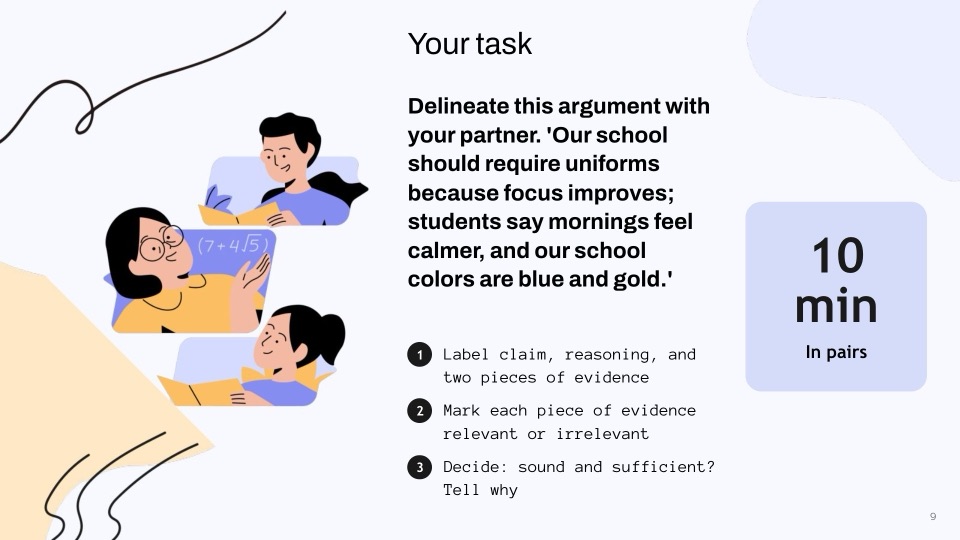
| 25 min | Main activity | Diagnose weak arguments and cure them with relevant, sufficient evidence. Give each group a patient chart and weak argument slip from Passage "Pay for Grades?" paragraphs 1-3. Direct groups to diagnose: unsound reasoning, irrelevant evidence, or relevant but not enough. Direct groups to choose two correct evidence bandages, remove irrelevant ones, and write how each supports the claim. Time groups and prompt discharge-note stretch, then select two groups to present cures. |
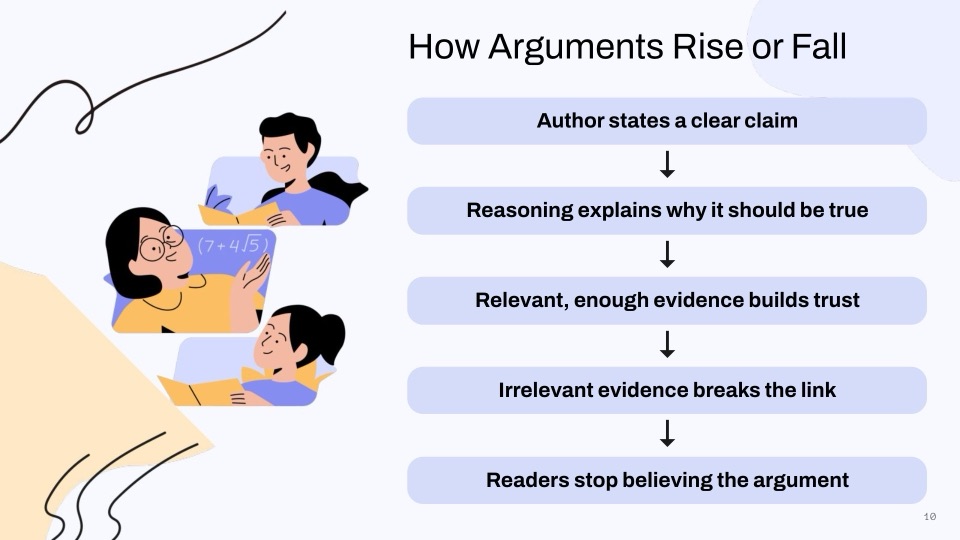
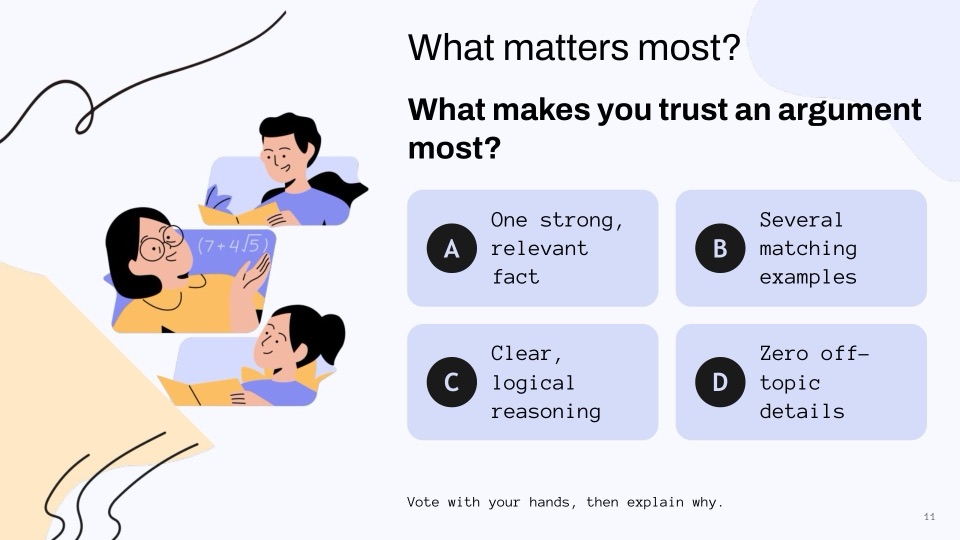
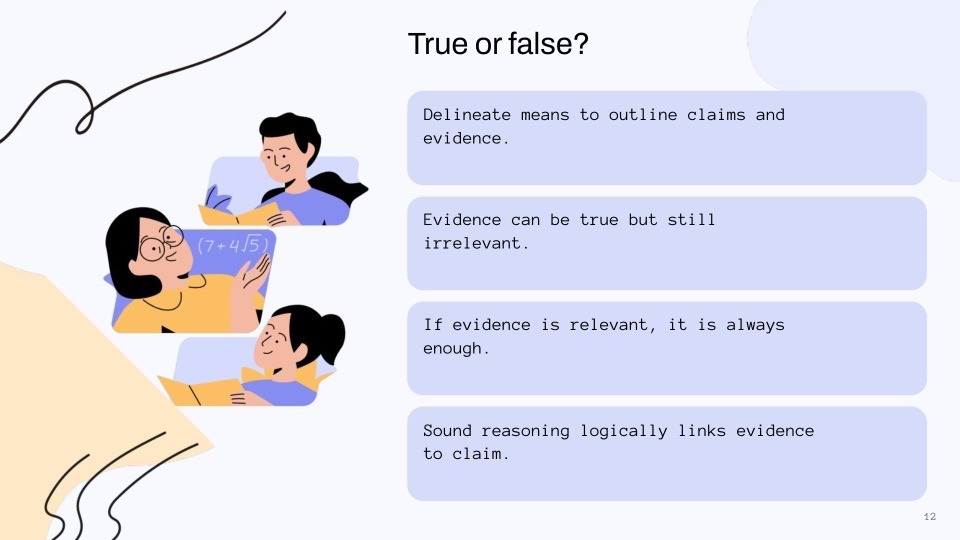
| 10 min | Plenary | Return to objectives and check delineation and evaluation. Display Slide 10 chain: clear claim, reasoning explains why, relevant enough evidence builds trust. Run Slide 12 true-or-false: delineate means outline; true can still be irrelevant; evidence must connect. Run Slide 11 vote: what makes you trust an argument most? Collect exit tickets and preview homework. |
Common mistakes
- Thinking any true statement counts as good evidence.
How to spot it: Students keep singer, paint, or cheese details as support.
Ask: does it prove this claim about learning or focus? If off-topic, set aside even if true. - Confusing reasoning with evidence.
How to spot it: Students label an example as the logical link.
Frame as: evidence is the proof; reasoning is why the proof should make us believe it. - Thinking one relevant example is automatically enough.
How to spot it: Students call two-class trial fully sufficient alone.
Ask: who, how many, how long? Show relevant but small proof needs more to be sufficient.
Support
- Give a chart with checkboxes: Does the evidence talk about the claim? Is there enough of it? Is the reasoning logical?
Stretch
- Groups write a discharge note predicting the best opposing argument and how their cured version survives it.
Check questions
- What does delineate mean when analyzing an argument?
Answer: To outline and map the main argument, specific claims, reasoning, and evidence. - Claim: cash for grades helps learning. Evidence: cheese costs $4.50 a pound. Relevant, irrelevant, or insufficient?
Answer: Irrelevant; true price does not prove anything about learning. - Why is one short trial relevant but not yet sufficient?
Answer: It matches the claim but is too small alone; more classes or longer data are needed.
Curriculum
Delineate and evaluate the argument and specific claims in a text, assessing whether the reasoning is sound and the evidence is relevant and sufficient; recognize when irrelevant evidence is introduced.
Video clips
Clips on YouTube, from the start and end times we chose. Check each one before you show it.
-
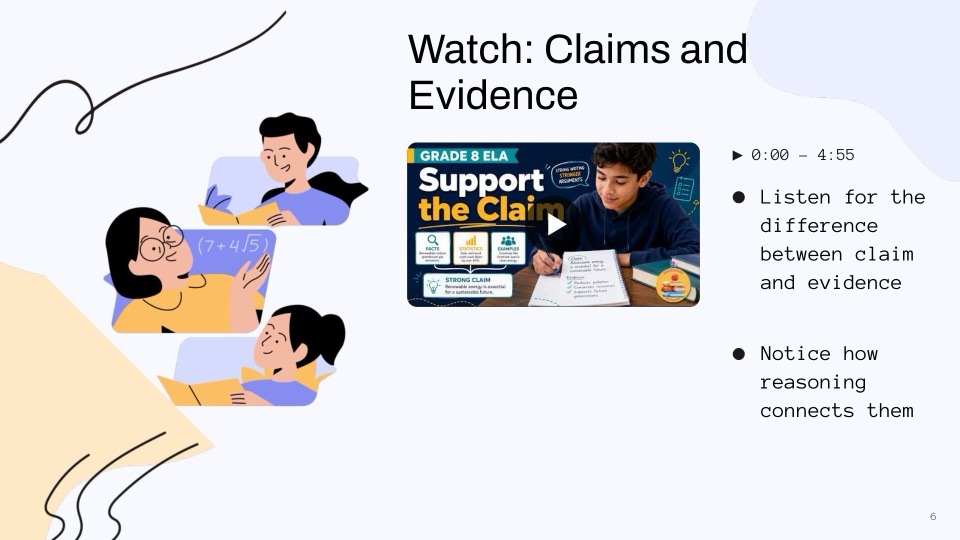
Analyzing Arguments and Evidence - Grade 8 from 0:00 to 4:55
HeroesMart Homeschool Academy: Analyzing Arguments and Evidence in 8th Grade ELA | Week 19 Day 2
Made explicitly for 8th-grade ELA so vocabulary and pace suit 13-14 and it directly covers claims and evidence.
-
Evaluating Arguments in Informational Texts from 0:00 to 3:23
Chorus Educational K-12 Content: Evaluating arguments in informational texts
Made as K-12 instructional content with clear middle-school language that suits 13-14 and matches evaluating reasoning.
Worksheet
Sources
- ELA Grade 8 - Chicago Public Schools cps.edu
- Grade 8 ELA Curriculum and Pacing Guide - ortn.edu ortn.edu
- Evaluating an argument’s reasoning and evidence | Guided ... khanacademy.org
- Evaluating arguments | Guided practice (article) | Khan Academy en.khanacademy.org
- How to build an argument for KS3 English students - BBC bbc.co.uk
- Ch. 9 How and Why to Study Arguments open.ocolearnok.org
Picture credits
- Photo: 14995841 · Pixabay
- Photo: mindboxcreation · Pixabay
- Illustration: geralt · Pixabay
- Picture: unknown · CC0 · rawpixel via Openverse
- Pictograms: Sergio Palao, ARASAAC (arasaac.org) · CC BY-NC-SA
Made with Lesson Dino's AI on 17 October 2026. AI can make mistakes, so check facts against the sources before you teach.