The worksheet
About this worksheet
Students learn how Sun energy and gravity move water in a loop. They build a shoebox model and label the main processes. This Grade 6 Science worksheet gives students (ages 11–12) five pages of practice on the water cycle, part of the earth's systems unit. It goes with our free The water cycle lesson, which has the slides and a timed lesson plan.
What it covers
By the end, students should be able to:
- Students will trace how Sun energy lifts water and gravity pulls it down.
- Students will build a shoebox model labeling evaporation, condensation, precipitation and runoff.
How to use it
- Use it for practice after the teaching part of the lesson, once students have seen the worked examples on the slides.
- Support: Give pre-cut shapes and a sample layout, plus labels to stick on instead of writing all terms from memory.
- Stretch: Have students add houses and farms and explain how human activities affect where water is stored, how it moves, and how clean it is.
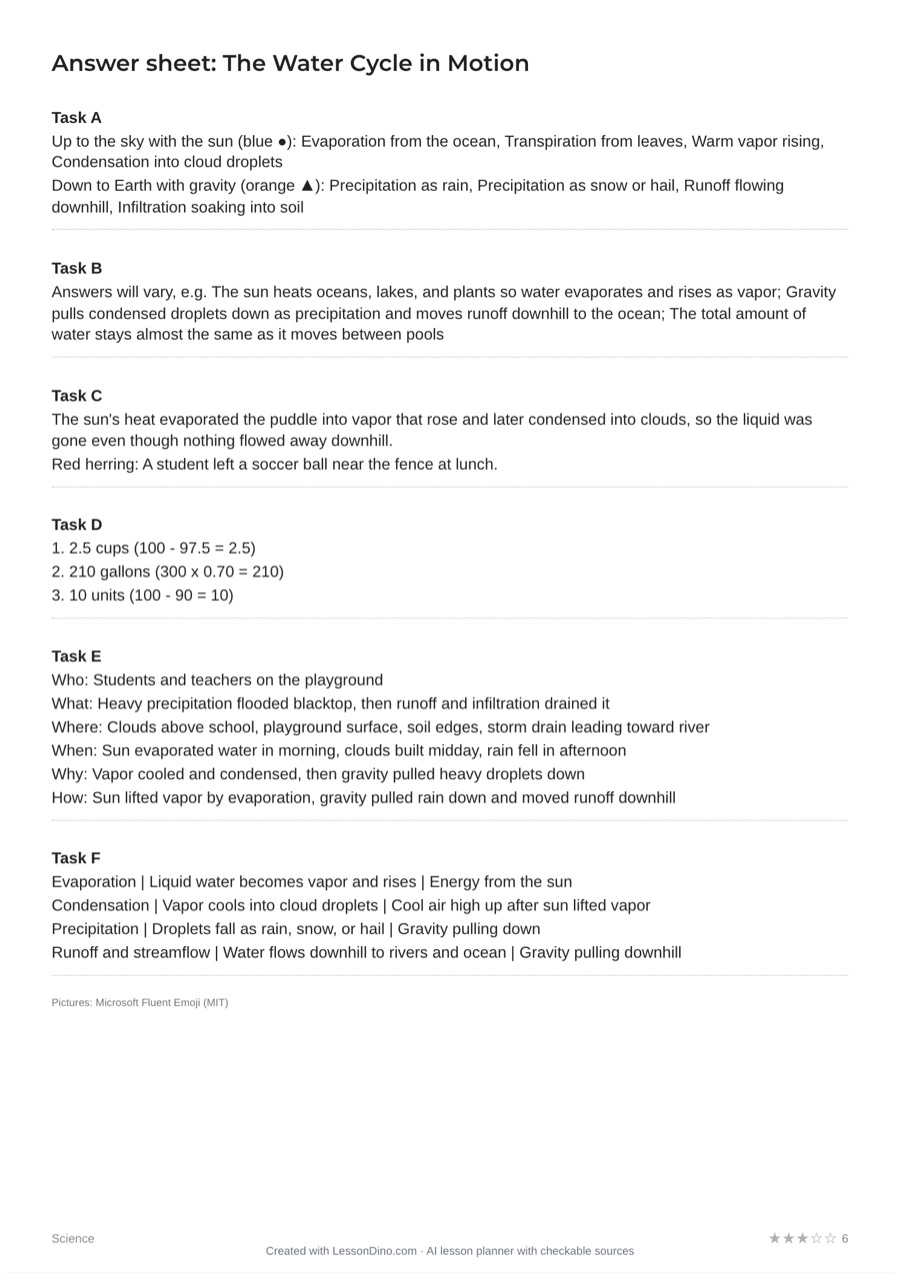
- The answer sheet is the last page, so you can print it on its own or let students check their own work.
Key vocabulary
- evaporation: liquid water changing into invisible gas that rises into air
- condensation: cooled gas changing back into tiny liquid drops that make clouds
- precipitation: water falling from clouds to the surface as rain, snow or hail
- runoff: rainwater flowing over land downhill toward streams and oceans
- gravity: invisible pull that brings falling water down toward the ground
Mistakes to watch for
- Thinking puddle water disappears and new water is made later. Remind that the total amount stays constant; it changed to invisible vapor by evaporation.
- Thinking clouds are vapor and rain comes without a driver. Model that vapor cools and condenses to liquid drops, then gravity pulls precipitation down.
- Mixing up runoff and infiltration. Act out: infiltration soaks into soil, runoff moves on the surface toward streams.
What's on the worksheet
Water on the Move
Learn the stages and what powers them.
Water Cycles Again and Again
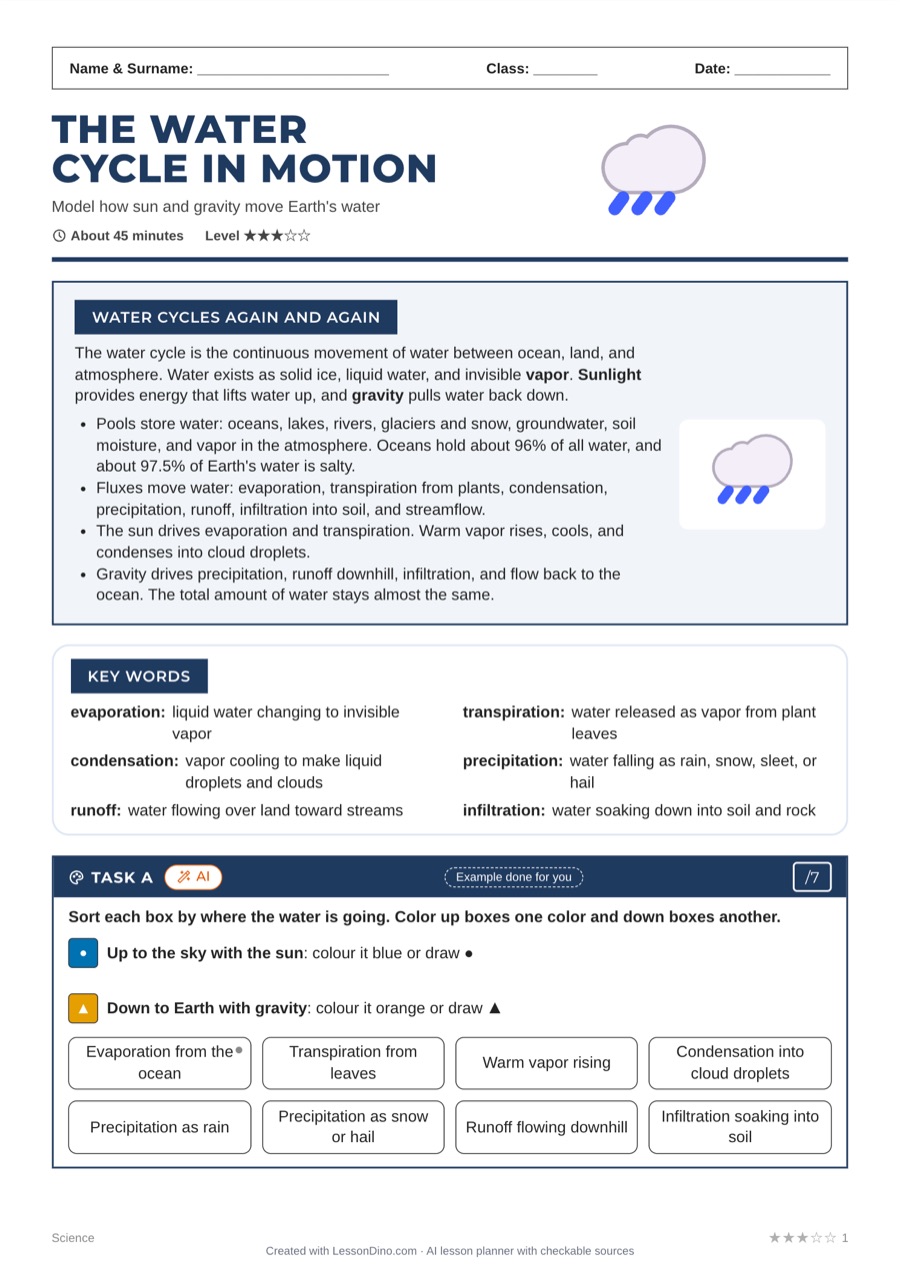
- The water cycle is the continuous movement of water between ocean, land, and atmosphere. Water exists as solid ice, liquid water, and invisible vapor. Sunlight provides energy that lifts water up, and gravity pulls water back down.
- Pools store water: oceans, lakes, rivers, glaciers and snow, groundwater, soil moisture, and vapor in the atmosphere. Oceans hold about 96% of all water, and about 97.5% of Earth's water is salty.
- Fluxes move water: evaporation, transpiration from plants, condensation, precipitation, runoff, infiltration into soil, and streamflow.
- The sun drives evaporation and transpiration. Warm vapor rises, cools, and condenses into cloud droplets.
- Gravity drives precipitation, runoff downhill, infiltration, and flow back to the ocean. The total amount of water stays almost the same.
| Word | Meaning |
|---|---|
| evaporation | liquid water changing to invisible vapor |
| transpiration | water released as vapor from plant leaves |
| condensation | vapor cooling to make liquid droplets and clouds |
| precipitation | water falling as rain, snow, sleet, or hail |
| runoff | water flowing over land toward streams |
| infiltration | water soaking down into soil and rock |
Sort each box by where the water is going. Color up boxes one color and down boxes another.
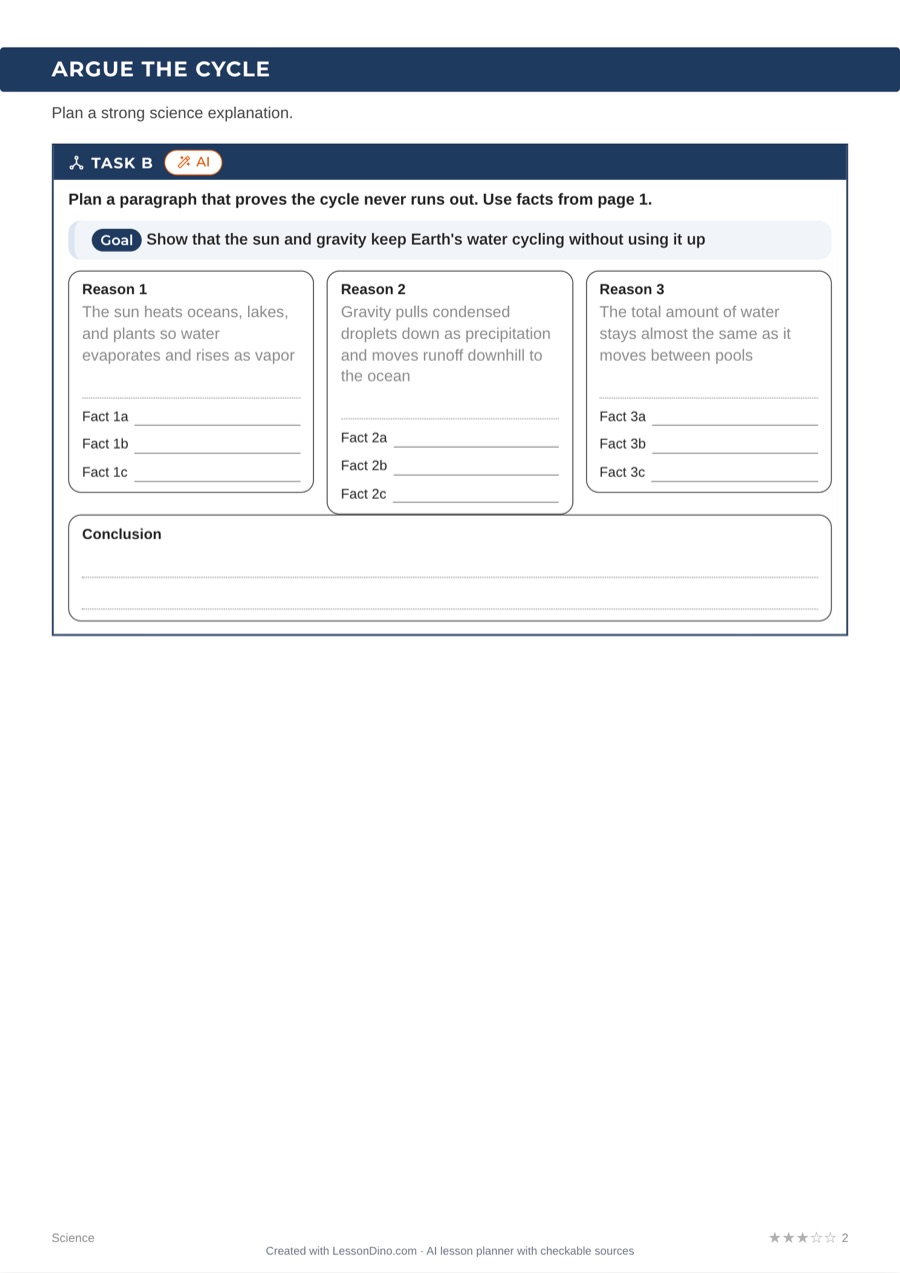
Argue the Cycle
Plan a strong science explanation.
Plan a paragraph that proves the cycle never runs out. Use facts from page 1.
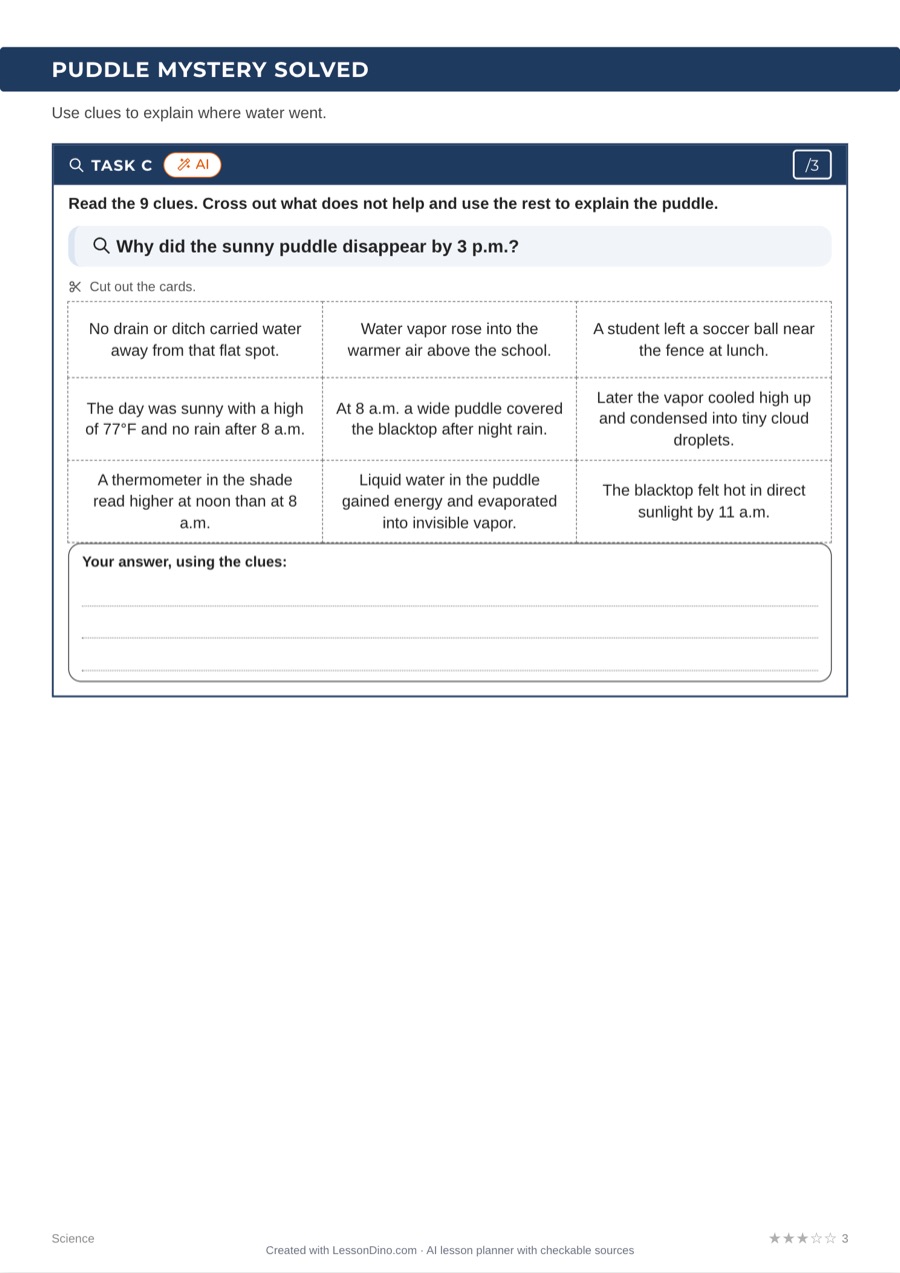
Puddle Mystery Solved
Use clues to explain where water went.
Read the 9 clues. Cross out what does not help and use the rest to explain the puddle.
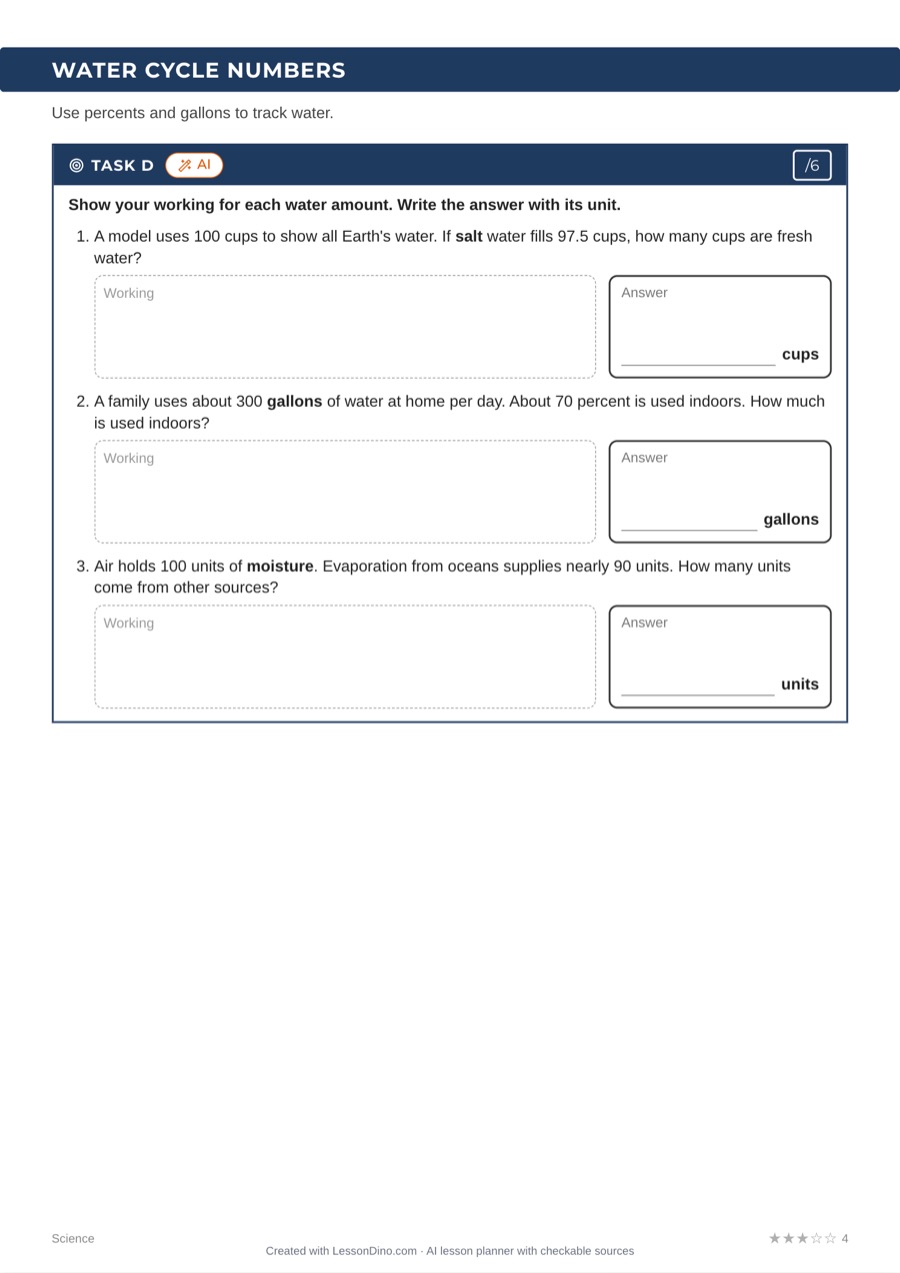
Water Cycle Numbers
Use percents and gallons to track water.
Show your working for each water amount. Write the answer with its unit.
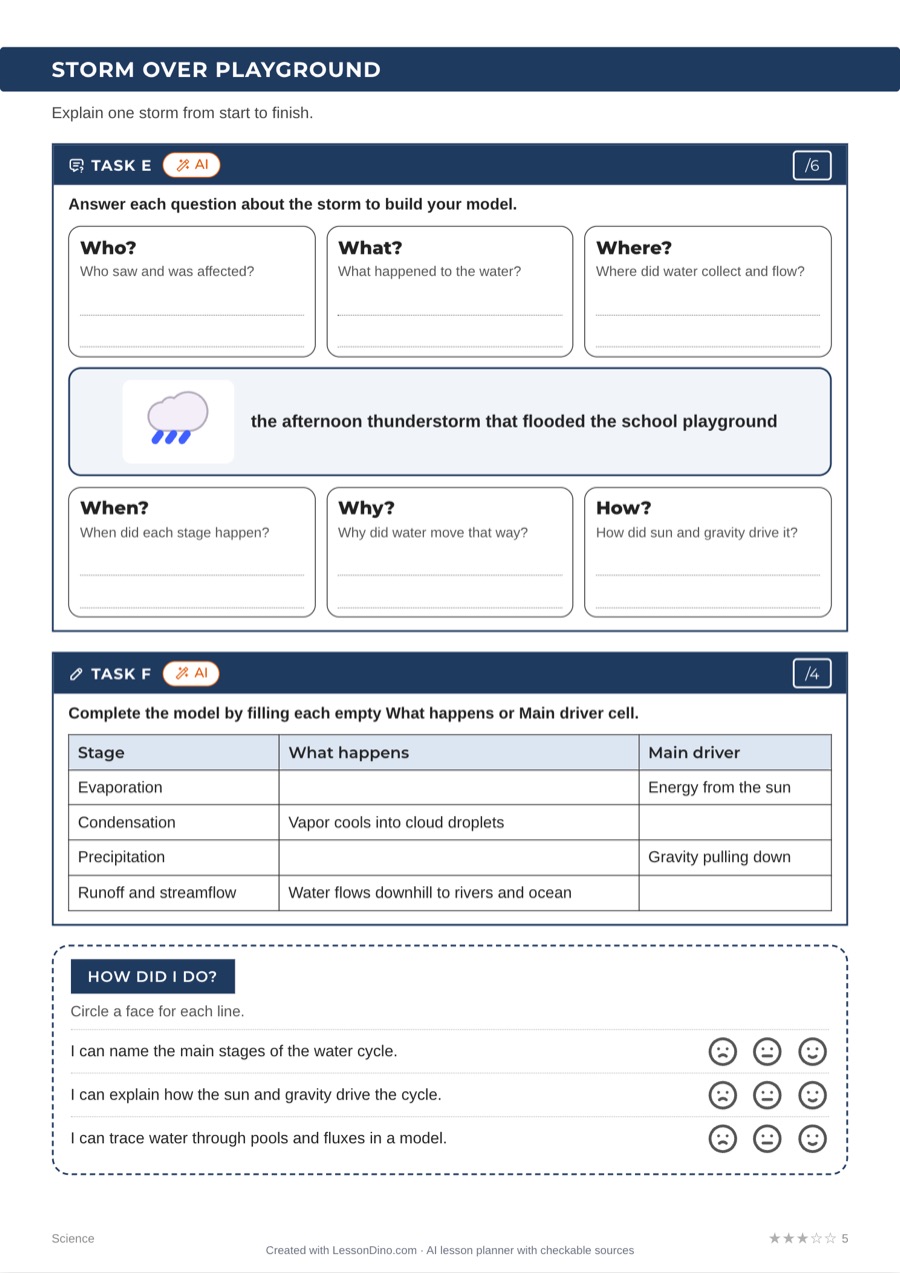
Storm Over Playground
Explain one storm from start to finish.
Answer each question about the storm to build your model.
Complete the model by filling each empty What happens or Main driver cell.
Answers
Show the answers
- A model uses 100 cups to show all Earth's water. If salt water fills 97.5 cups, how many cups are fresh water? 2.5 cups
- A family uses about 300 gallons of water at home per day. About 70 percent is used indoors. How much is used indoors? 210 gallons
- Air holds 100 units of moisture. Evaporation from oceans supplies nearly 90 units. How many units come from other sources? 10 units
The answer sheet is the last picture above.
Curriculum
Develop a model to describe the cycling of water through Earth's systems driven by energy from the sun and the force of gravity.
Made with Lesson Dino's AI on 16 October 2026. AI can make mistakes, so check the answers and facts against the sources before you teach.