Slides
Lesson plan
Shoebox Water Cycle Powered by Sun and Gravity
Students learn how Sun energy and gravity move water in a loop. They build a shoebox model and label the main processes.
Objectives
- Students will trace how Sun energy lifts water and gravity pulls it down.
- Students will build a shoebox model labeling evaporation, condensation, precipitation and runoff.
Success criteria
- I can explain how the Sun lifts water up and gravity pulls it down.
- I can label evaporation, condensation, precipitation and runoff on my model correctly.
Key words
| Word | Meaning |
|---|---|
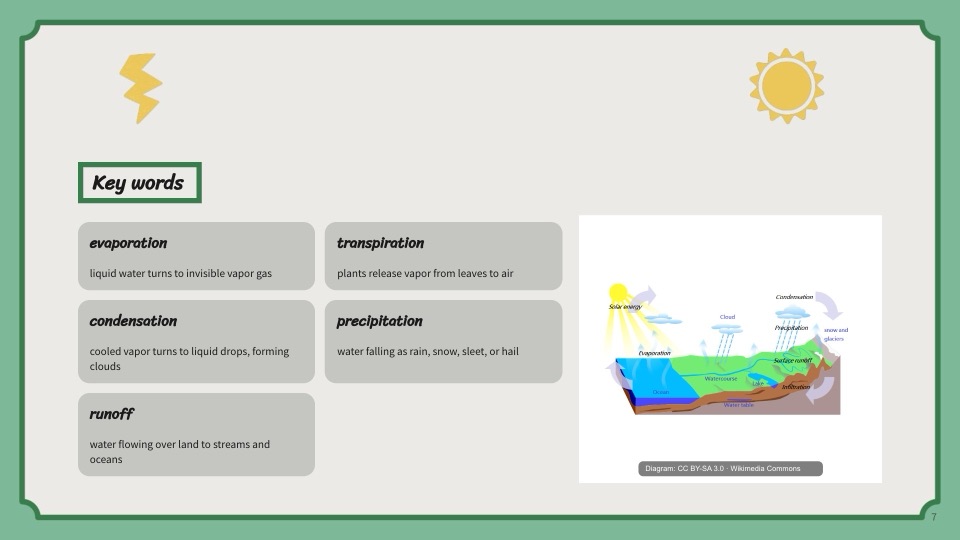
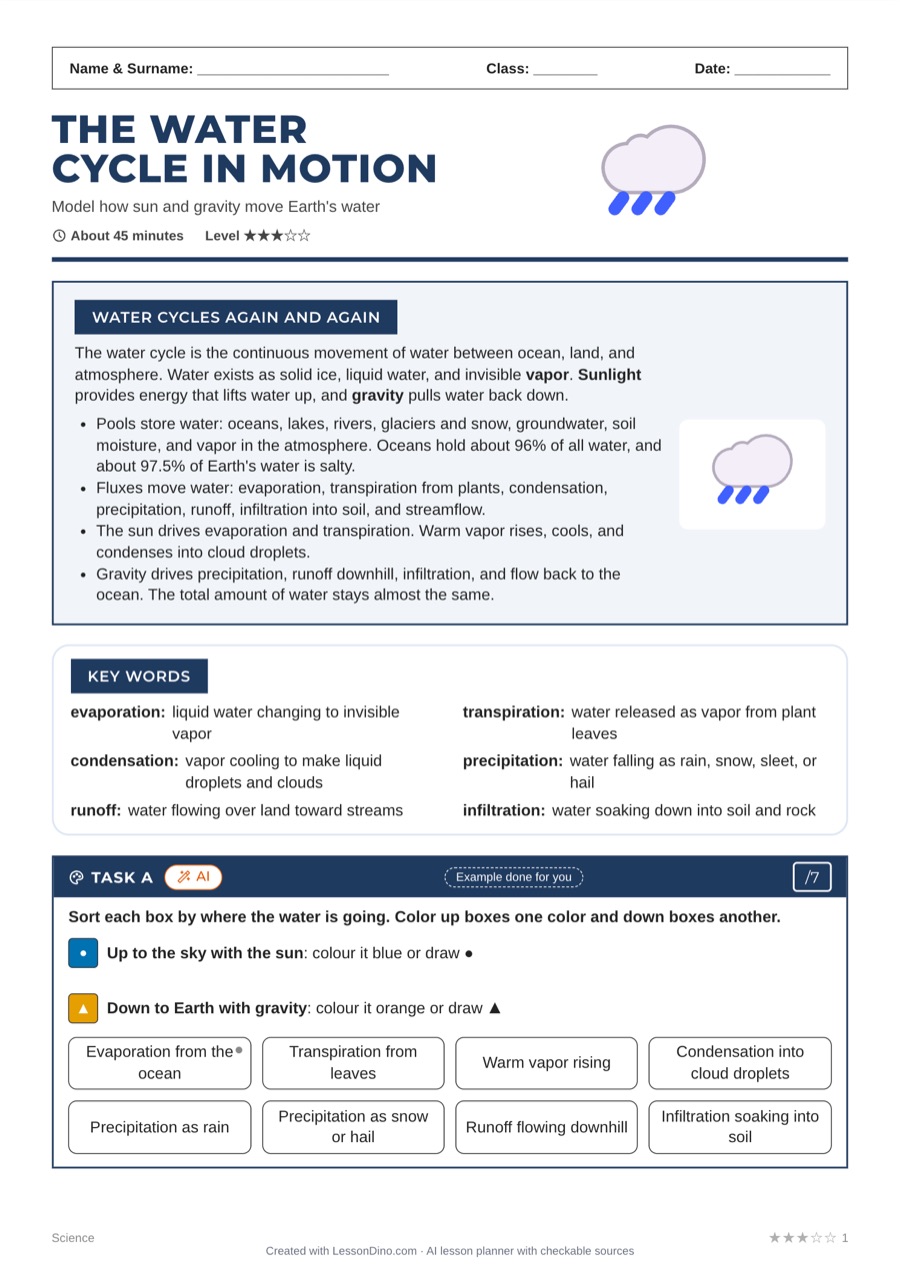
| evaporation | liquid water changing into invisible gas that rises into air |
| condensation | cooled gas changing back into tiny liquid drops that make clouds |
| precipitation | water falling from clouds to the surface as rain, snow or hail |
| runoff | rainwater flowing over land downhill toward streams and oceans |
| gravity | invisible pull that brings falling water down toward the ground |
Timed plan (60 minutes)
| Time | Stage | What happens |
|---|---|---|
| 7 min | Starter | Surface ideas about where water goes and introduce the model challenge. Welcome class and ask the hook: Can you build Earth’s water trip so small it fits in a shoebox but still shows what powers it? Show Slide 2 Where Next? and take a vote: A raindrop lands on school grass. What happens next? Show Slide 5 Think, pair, share: What lifts water up to clouds, and what pulls it back down? Collect 3 ideas and promise to test them with a model powered by the Sun and gravity. |
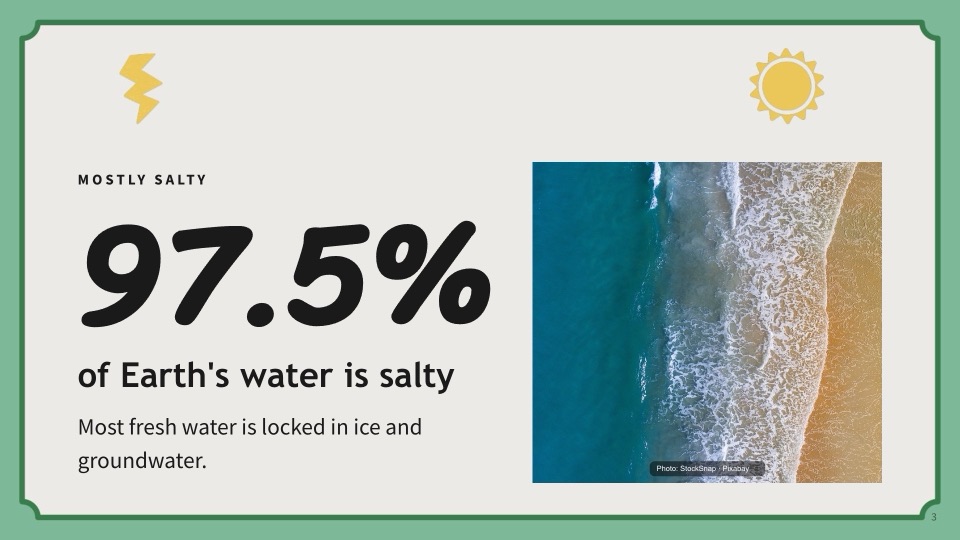
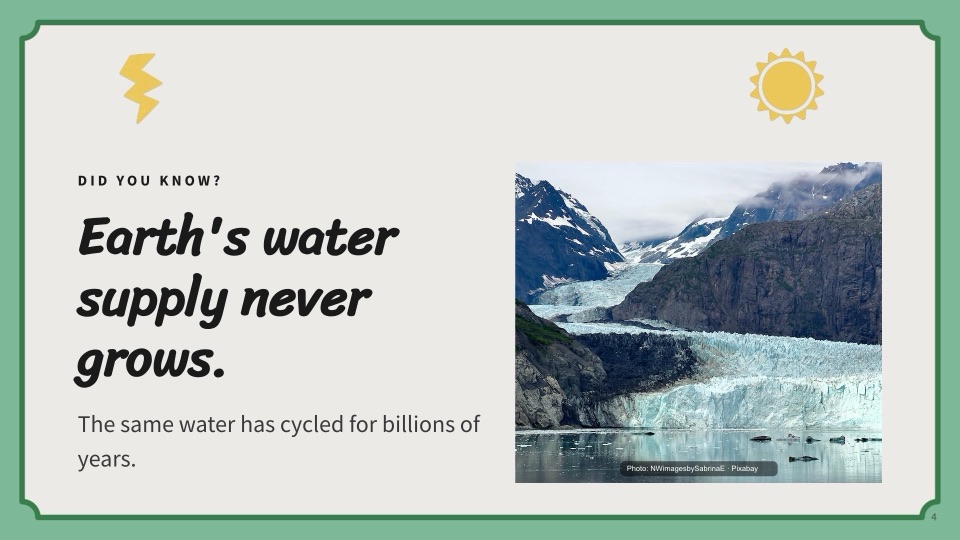
| 10 min | Teaching | Explain stores, state changes, and Sun and gravity drivers. Show Slide 3 and explain 97.5% of Earth's water is salty and oceans store 96% of all water. Show Slide 4 and explain the same water has cycled for billions of years and the total amount stays constant. Teach Slide 7 words with gestures: evaporation, transpiration, condensation, precipitation, runoff. Stress the system is powered by energy from the Sun as exchange between oceans, atmosphere, and land. |
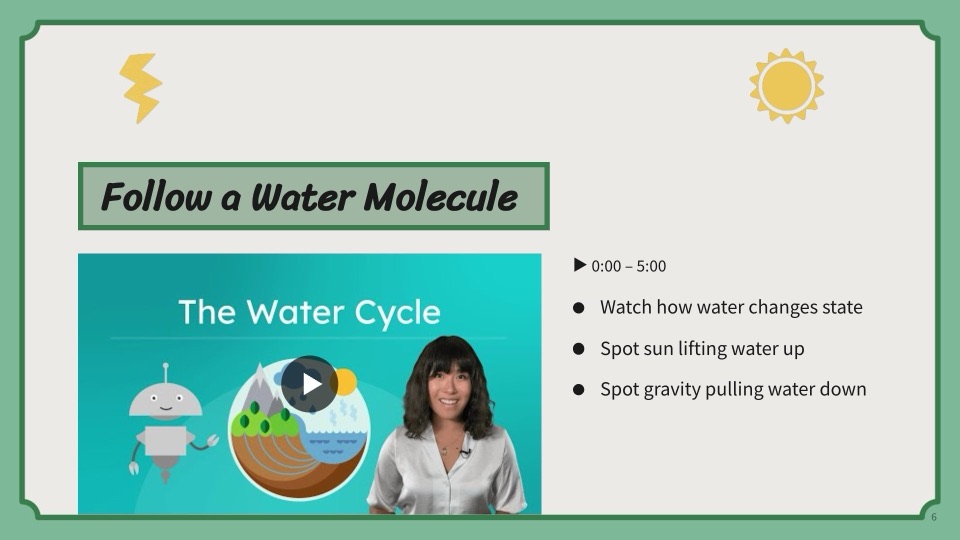
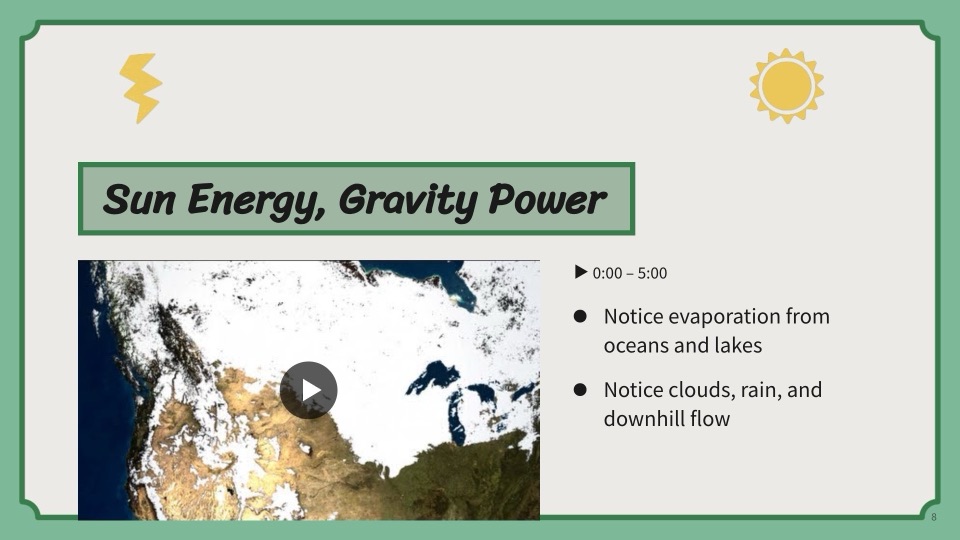
| 8 min | Watch and spot | See Sun lifting water and gravity pulling water in action. Show Slide 6 Follow a Water Molecule and play Video clip 1 (0:00–5:00). Pause twice to point out vapor rising after heating and clouds, rain and downhill flow. Narrate that evaporation from water bodies provides nearly 90% of atmospheric moisture. Ask students to call Sun when water rises and Gravity when water falls. |
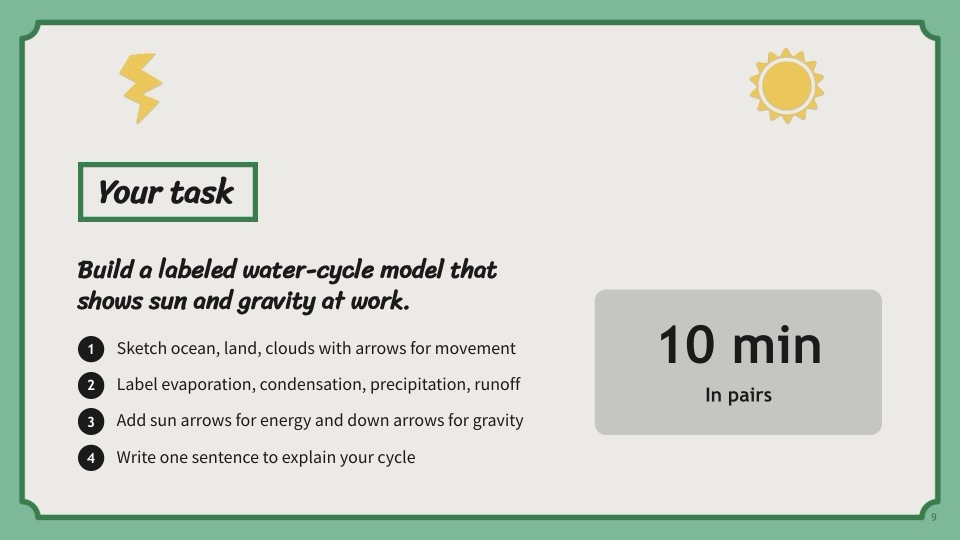
| 25 min | Main activity | Build and label a shoebox model driven by Sun and gravity. Show Slide 9 Your task and a finished example with ocean, land, cotton clouds, and arrows. Give out trays and remind teams to include one yellow Sun arrow for evaporation and brown down arrows for precipitation and runoff. Circulate to check labels for evaporation, transpiration, condensation, precipitation, and runoff, the most important processes. Stop at 20 minutes for 1-minute tours pointing to evaporation, condensation, precipitation, and runoff. |
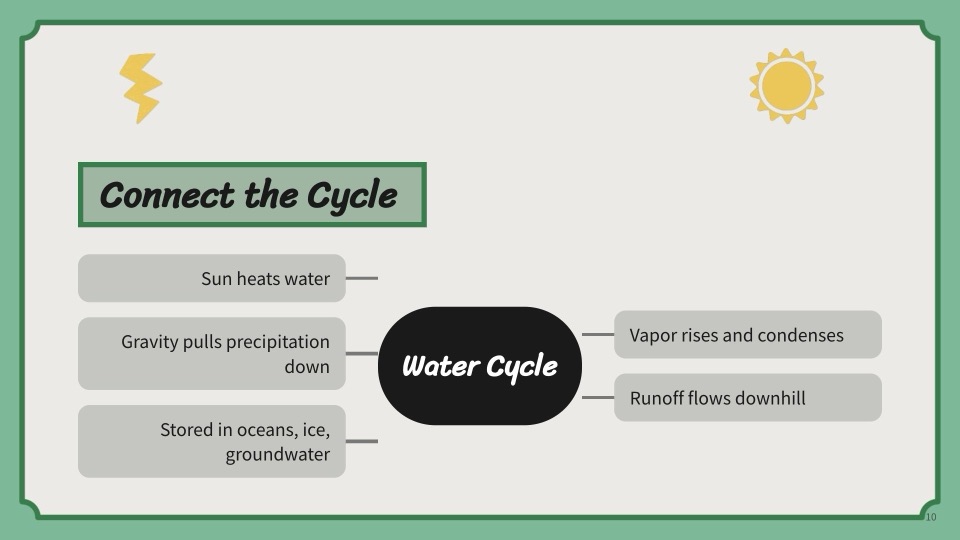
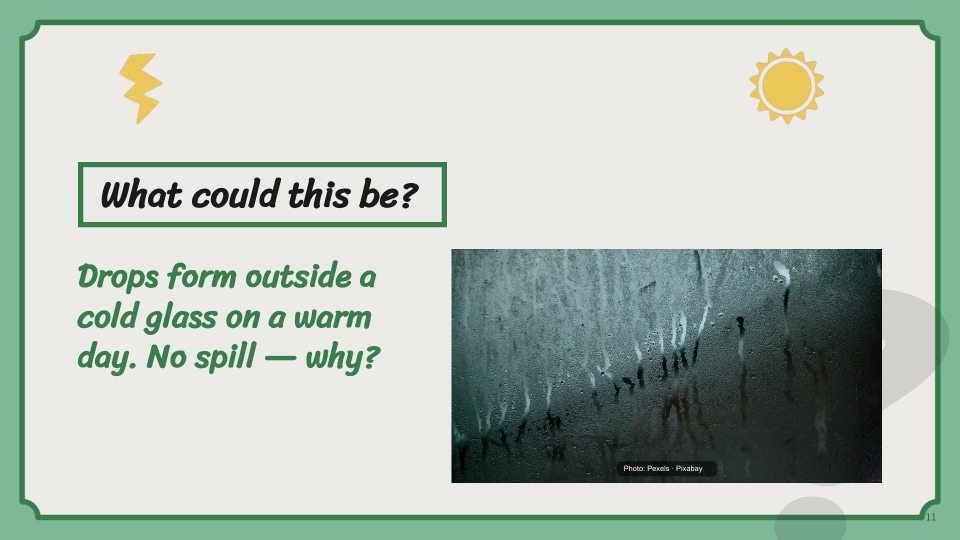
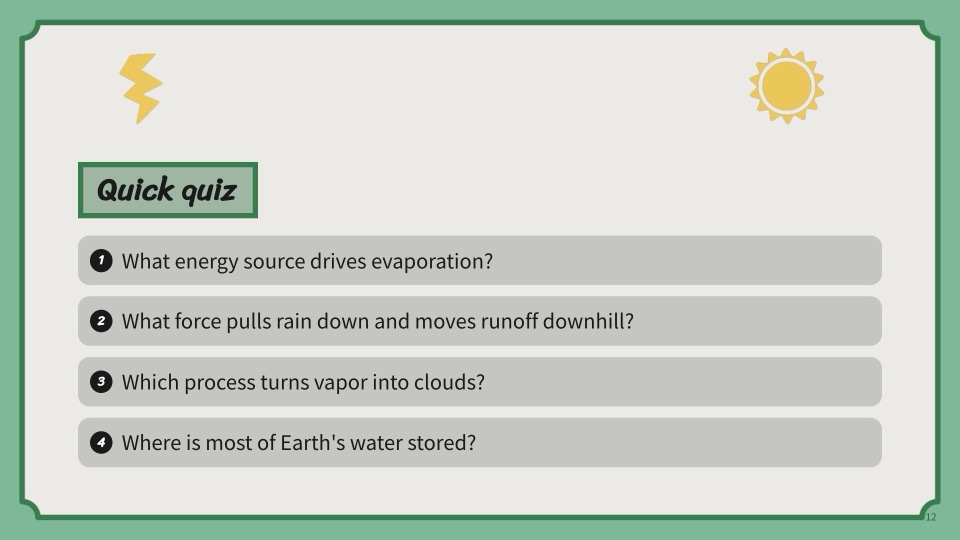
| 10 min | Plenary | Connect ideas and check Sun and gravity understanding. Show Slide 10 Connect the Cycle mindmap and have two teams link their model to each branch. Show Slide 11 mystery: explain drops on a cold glass as vapor cooling and condensing. Run Slide 12 Quick quiz orally for Sun and gravity drivers. Hand out exit tickets and preview next lesson on freshwater limits. |
Common mistakes
- Thinking puddle water disappears and new water is made later.
How to spot it: Exit says water is gone or used up.
Remind that the total amount stays constant; it changed to invisible vapor by evaporation. - Thinking clouds are vapor and rain comes without a driver.
How to spot it: Labels cloud as vapor or leaves out Sun and gravity arrows.
Model that vapor cools and condenses to liquid drops, then gravity pulls precipitation down. - Mixing up runoff and infiltration.
How to spot it: Labels soaking soil as runoff.
Act out: infiltration soaks into soil, runoff moves on the surface toward streams.
Support
- Give pre-cut shapes and a sample layout, plus labels to stick on instead of writing all terms from memory.
- Provide sentence starters, word bank, and Sun versus gravity color-coded arrows.
- Let students rehearse the 1-minute tour with a partner before sharing.
Stretch
- Have students add houses and farms and explain how human activities affect where water is stored, how it moves, and how clean it is.
- Have students compare shade versus sun evaporation and argue where condensation fits.
Check questions
- What energy source drives evaporation and what does it change?
Answer: Energy from the sun; liquid water to vapor gas. - What force pulls rain down and moves runoff downhill?
Answer: Gravity pulls precipitation to the surface and runoff toward streams. - Name the four labeled moves in your model in order.
Answer: Evaporation, condensation, precipitation, runoff.
Curriculum
Develop a model to describe the cycling of water through Earth's systems driven by energy from the sun and the force of gravity.
Video clips
Clips on YouTube, from the start and end times we chose. Check each one before you show it.
-
How water moves through Earth's systems from 0:00 to 5:00
Miacademy & MiaPrep Learning Channel: The Water Cycle - How Water Moves Through Earth's Systems
Title matches the lesson goal exactly and vocabulary and pace are perfect for ages 11-12 in Grade 6.
-
NASA Earth's water cycle from 0:00 to 5:00
NASA Goddard: NASA | Earth's Water Cycle
Authoritative NASA visuals clearly show sun-driven evaporation and gravity-driven movement at the right level for ages 11-12.
Worksheet
Sources
- Unit 3 avon.k12.ct.us
- Curriculum Map: Science 6 Course: GENERAL SCIENCE Sub-topic: General ... ltsd.k12.pa.us
- The water cycle - National Oceanic and Atmospheric Administration noaa.gov
- What Is the Water Cycle? - Science@NASA science.nasa.gov
- Water cycle | U.S. Geological Survey - USGS.gov usgs.gov
- The Water Cycle | Precipitation Education gpm.nasa.gov
- The Water Cycle - NASA Science science.nasa.gov
- Hydrology Education: The Water Cycle - National Weather Service weather.gov
- The water cycle - KS2 Science curriculum - BBC Bitesize bbc.co.uk
- What is the water cycle? - BBC Bitesize bbc.co.uk
- Lesson: The water cycle | Oak National Academy thenational.academy
- Water cycle | Definition, Steps, Diagram, & Facts | Britannica britannica.com
- Water - Wikipedia en.wikipedia.org
- Water - Simple English Wikipedia, the free encyclopedia simple.wikipedia.org
- The water cycle (video) | Ecology | Khan Academy khanacademy.org
- The Water Cycle - NASA Science earthobservatory.nasa.gov
- NASA SVS | Water Cycle Extremes: Droughts and Pluvials svs.gsfc.nasa.gov
- Properties of water - Wikipedia en.wikipedia.org
- [2312.14056v1] OH as a probe of the warm water cycle in planet-f… arxiv.org
- The Water Cycle | Coursera coursera.org
- Water Cycle - Process, Diagram, and its Various Stages geeksforgeeks.org
- Water | United Nations - الأمم المتحدة un.org
- How We Use Water | US EPA epa.gov
- Water Cycle Game - Science World scienceworld.ca
- Water supply and sanitation in the United States - Wikipedia en.wikipedia.org
Picture credits
Made with Lesson Dino's AI on 16 October 2026. AI can make mistakes, so check facts against the sources before you teach.