Slides
Lesson plan
Team of Teams: Evidence That Body Systems Interact
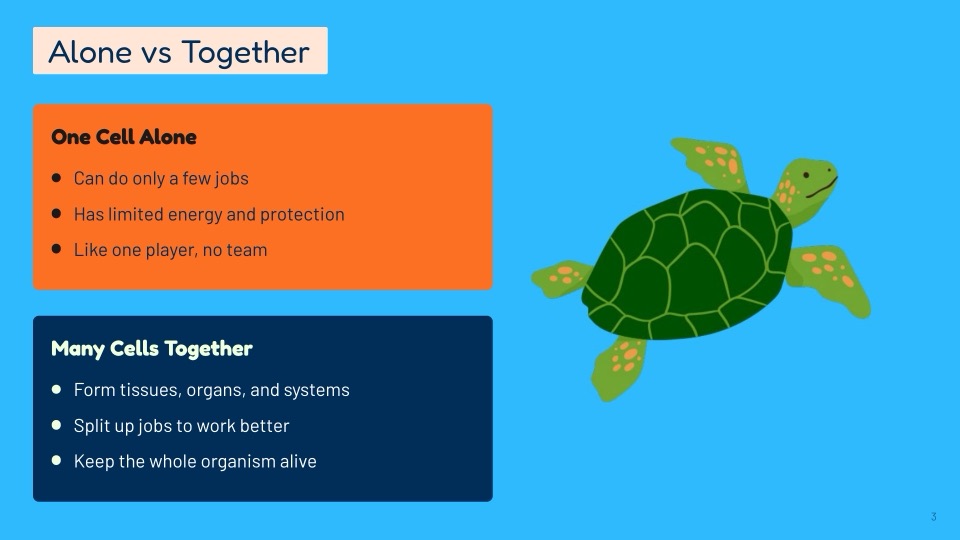
Students learn the body is interacting subsystems built from cell groups. They collect breath and pulse data and write a claim with evidence.
Objectives
- Students will order cells, tissues, organs and systems to show body organization.
- Students will use breath and pulse data to argue two systems interact.
- Students will explain that body is interacting subsystems made of cell groups.
Success criteria
- I can put cell, tissue, organ, and system in order.
- I can use body data as evidence that systems interact.
- I can write a claim that the body is interacting subsystems.
Key words
| Word | Meaning |
|---|---|
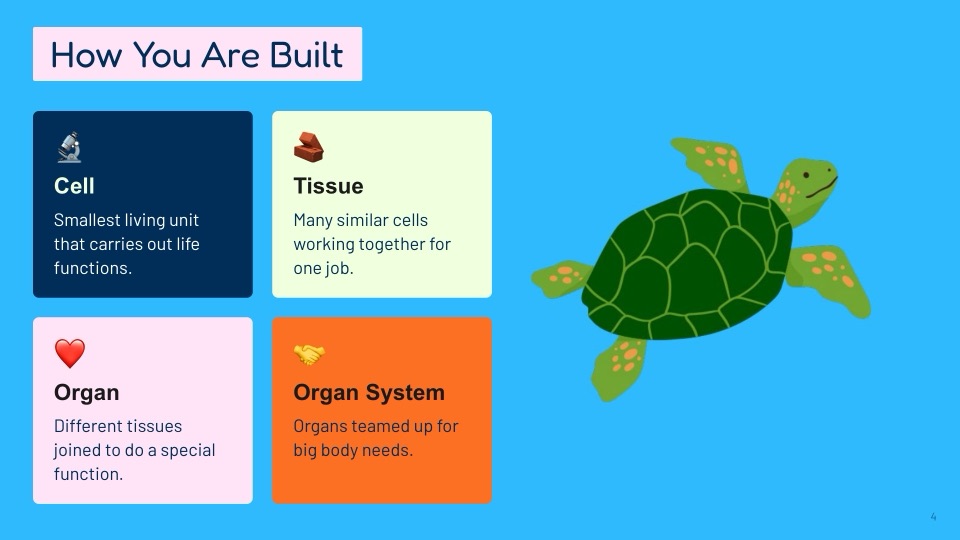
| cell | tiniest living building block that carries out life jobs |
| tissue | many similar tiny living blocks joined to do one job together |
| organ | body part made from two or more joined block-groups with a special job |
| system | team of body parts that work together to do a large life job |
Timed plan (60 minutes)
| Time | Stage | What happens |
|---|---|---|
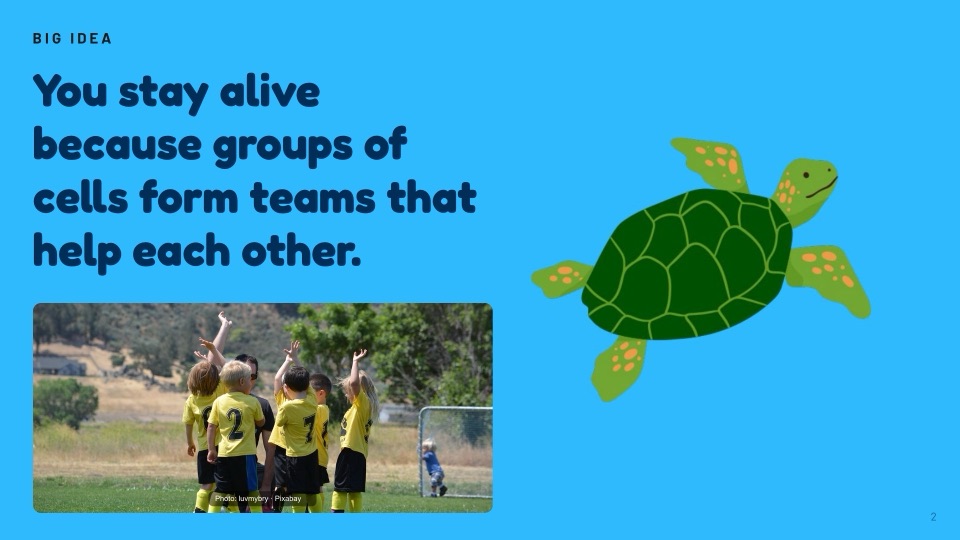
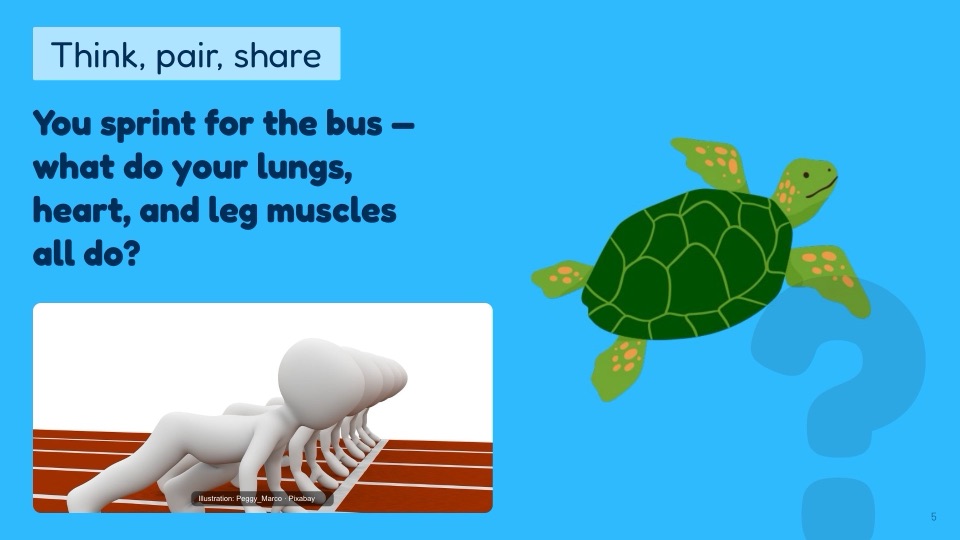
| 7 min | Starter | Hook interest in exercise and recall that lungs, heart, and muscles all respond. Show Slide 1: Your Body: A Team of Teams - How cells team up to keep you alive. Say the hook: Let's test what happens to your breathing and heartbeat when you move for one minute. Show Slide 5 question: You sprint for the bus — what do your lungs, heart, and leg muscles all do? Have partners tell each other in 60 seconds. Collect 3 quick ideas and link to Slide 2 statement: You stay alive because groups of cells form teams that help each other. |
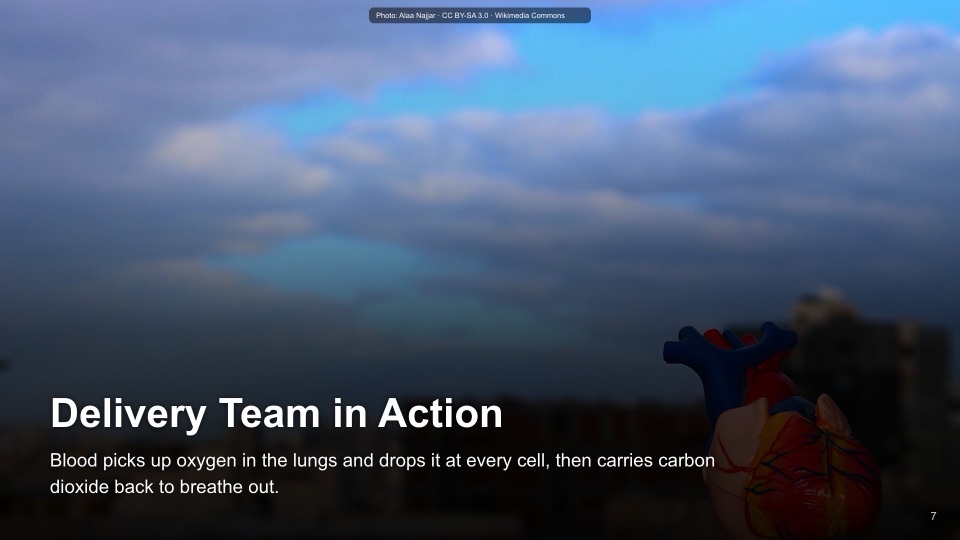
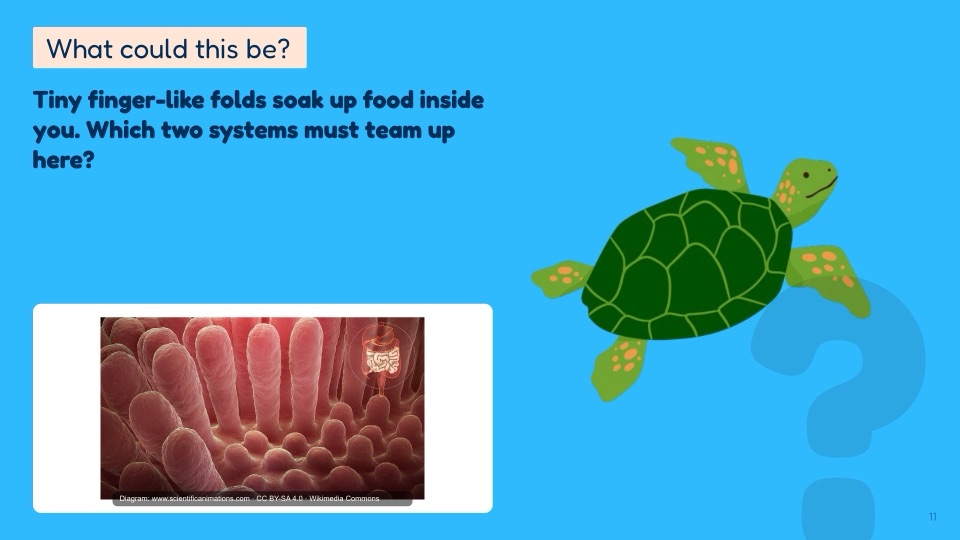
| 12 min | Teaching | Explain how cells build tissues, organs, and interacting systems. Show Slide 2 big idea and read it together. Show Slide 4 cards for Cell, Tissue and organ levels and explain that tissues are many similar cells together and an organ is several different tissues together so they can perform a special function. Model a ladder on the board: cells combine to form tissues, tissues combine to form organs, organs combine to form organ systems, and organ systems combine to form organisms. Show Slide 7 photo and explain: Blood picks up oxygen in the lungs and drops it at every cell, then carries carbon dioxide back to breathe out. |
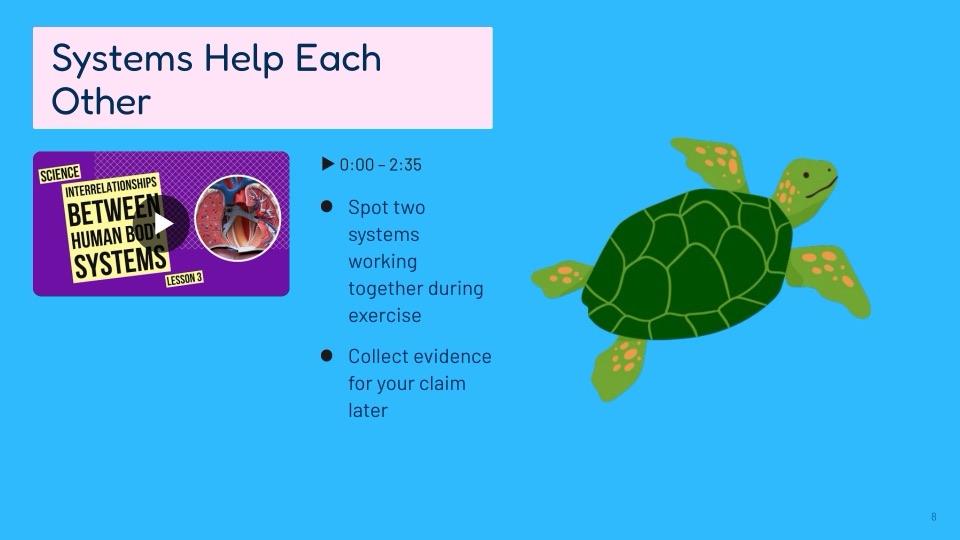
| 20 min | Main activity | Collect breath and pulse evidence that respiratory and circulatory systems interact. Remind safety: clear space, supportive shoes, walk not run, stop and sit and tell teacher if dizzy, short of breath, or sore. Model counting breaths for 30 seconds sitting and feeling pulse at the neck, then record in Before boxes. Show Slide 8 and play Video clip 1 How body systems interact (0:00–2:35). Tell students to spot two systems working together during exercise. Time 1 minute of marching in place, then time 30 seconds for After counts and recording. |
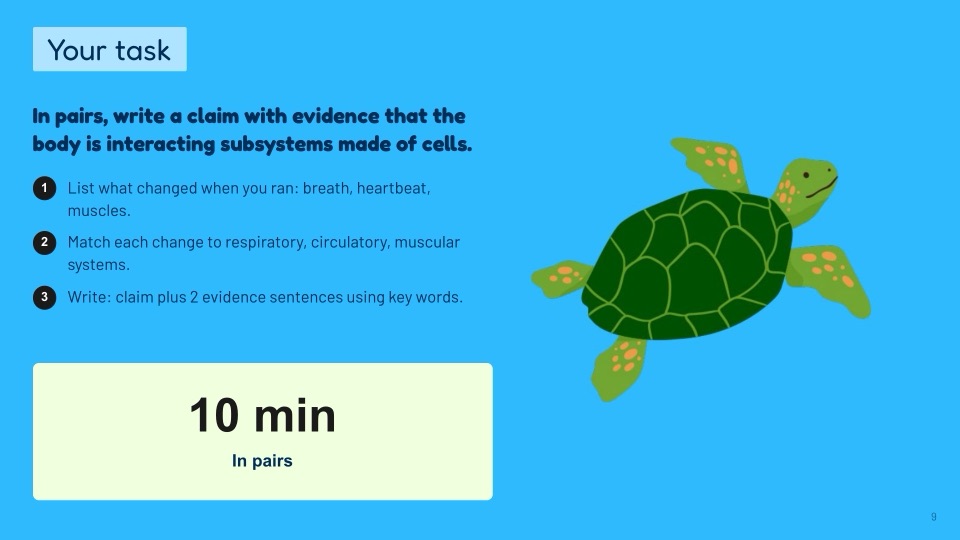
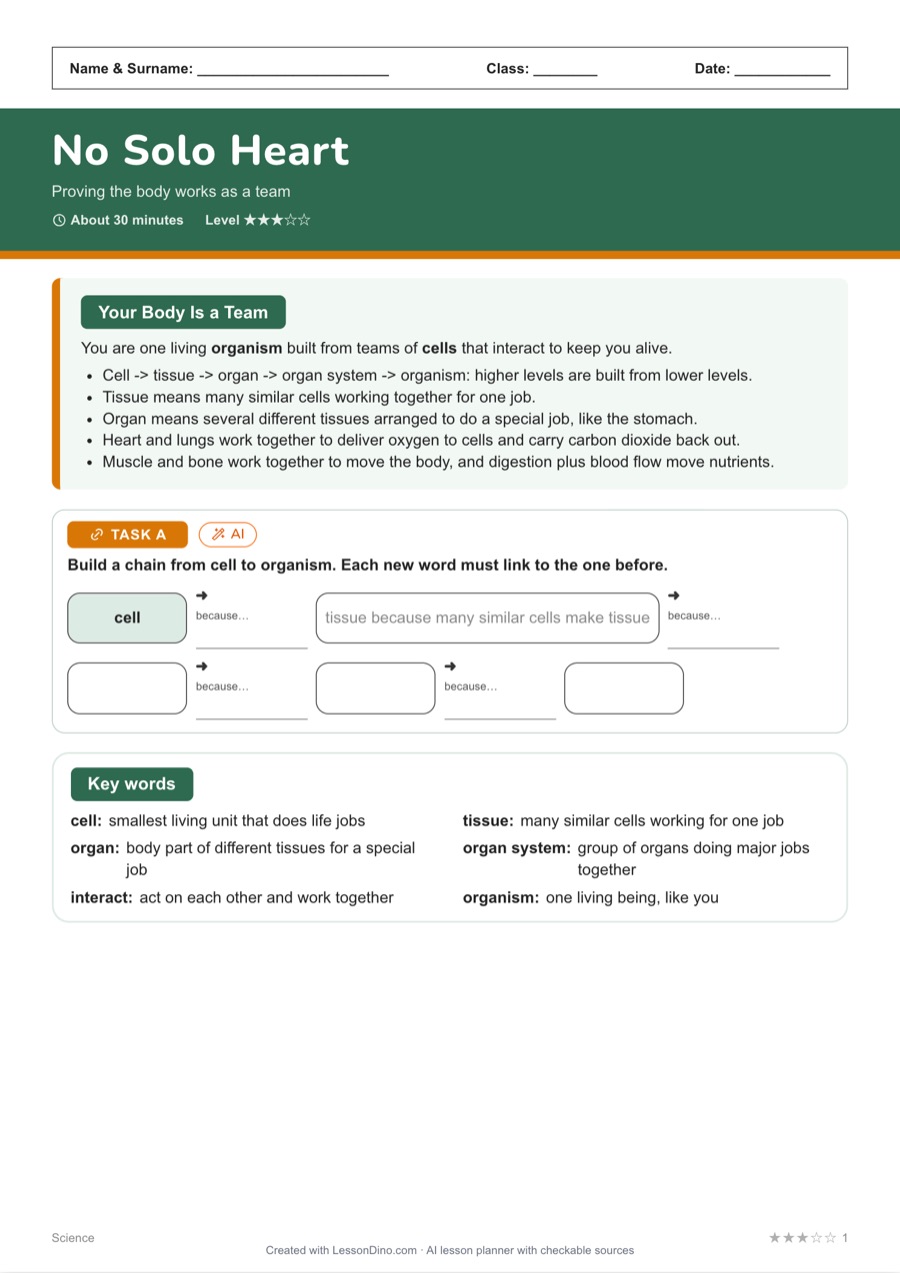
| 13 min | Argument writing | Write a claim with evidence that the body is interacting subsystems made of cells. Show Slide 9: In pairs, write a claim with evidence that the body is interacting subsystems made of cells. Model claim frame on board: I claim ___ because my evidence is ___ which shows ___. Hand out Worksheet Tasks D and E. Pairs read the sprint story, list what changed, and pick the claim with the best evidence of interaction. Circulate, prompt to link breath and pulse numbers to cell needs. |
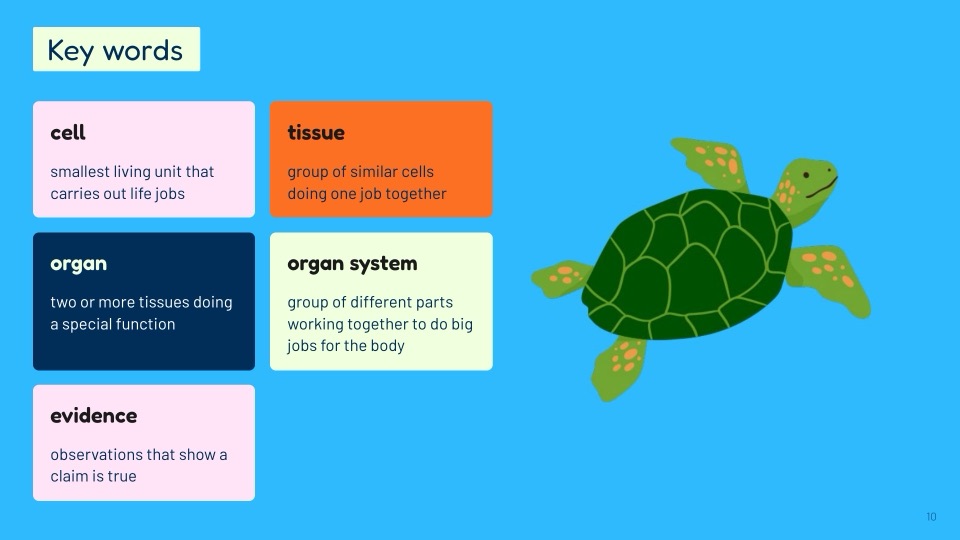
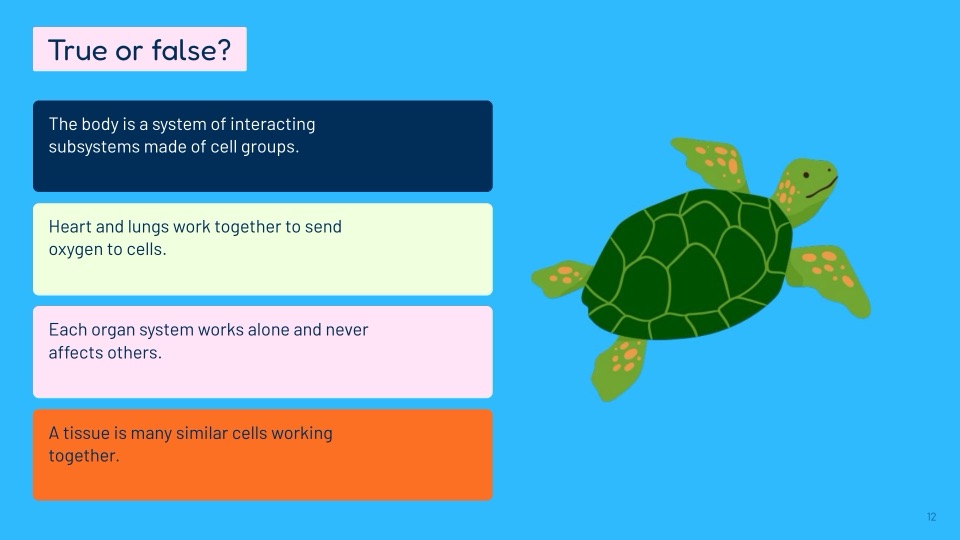
| 8 min | Plenary | Confirm that cells form interacting tissues, organs, and systems. Show Slide 10 key words and review cell, tissue, and organ meanings together. Show Slide 12 True or false statements and do Worksheet Task C tick true or false with evidence. Return to Slide 2 big idea and have two pairs read their claim with evidence aloud. Give exit ticket on paper. |
Common mistakes
- Thinks the heart or lungs work alone.
How to spot it: Claim mentions only one organ with no link.
Remind that heart and lungs work together to deliver oxygen and remove carbon dioxide and no part works in isolation. - Mixes up cell, tissue, organ, and system order.
How to spot it: Ladder places organ before tissue or system before organ.
Rebuild that higher levels are built from lower levels: cells to tissues to organs to organ systems, with tissues as similar cells together.
Support
- Starter strip with level names in order and picture matching with word bank
- 15-second counts doubled with boxed Before and After table
- Sentence frames for claim plus evidence with highlighted numbers
Stretch
- Explain why one organ can belong to more than one system in function
- Predict 3-minute rest recovery using oxygen delivery and defend order through three systems
Check questions
- Put in order: organ, cell, system, tissue.
Answer: cell, tissue, organ, system - Give one piece of evidence that respiratory and circulatory systems interact during exercise.
Answer: Breaths and pulse rose together to deliver oxygen and remove carbon dioxide - Use evidence to finish: The body is interacting subsystems because ___.
Answer: Groups of cells form tissues and organs and heart and lungs work together to keep cells supplied
Curriculum
Use argument supported by evidence for how the body is a system of interacting subsystems composed of groups of cells.
From Next Generation Science Standards (middle school), MS-LS1-3.
Video clips
Clips on YouTube, from the start and end times we chose. Check each one before you show it.
-
How body systems interact from 0:00 to 2:35
The Digital Classroom Experience: Interrelationships Between Human Body Systems | Science Lesson
Directly about interacting subsystems with clear middle-school vocabulary and pace that fits ages 11-12
-
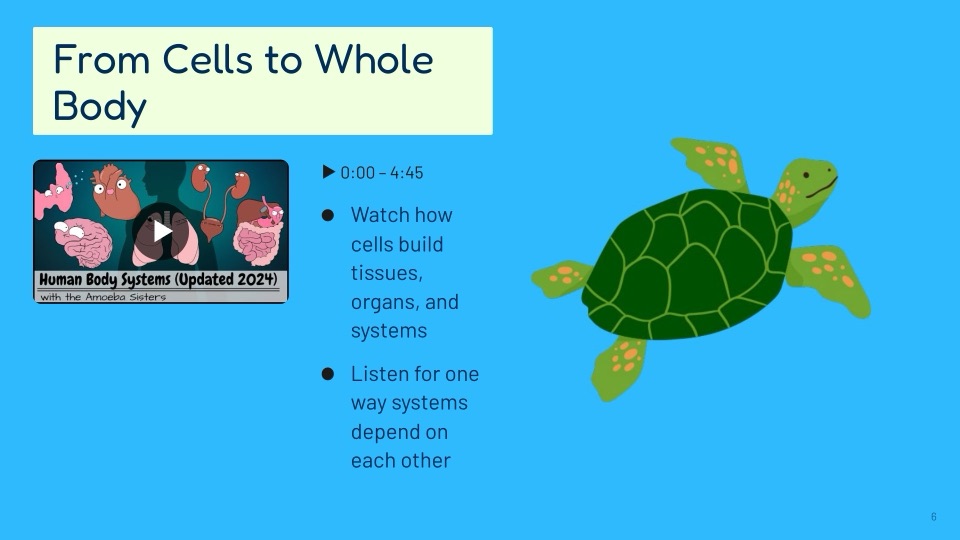
Body systems overview from 0:00 to 4:45
Amoeba Sisters: Human Body Systems Overview (Updated 2024)
Made for grades 6-8 with age-right humor and vocabulary for ages 11-12 and covers cells to systems to interactions
Worksheet
Sources
- 6th Grade Science Curriculum Home Page | SFUSD sfusd.edu
- Unit 5 avon.k12.ct.us
- Introduction to the Human Body - SEER Training training.seer.cancer.gov
- Structural Organization of the Human Body – Anatomy & Physiology pressbooks-dev.oer.hawaii.edu
- The 11 Organ Systems of the Human Body | Marian University marian.edu
- Human Anatomy Resources - BrainSTEM sites.clarkson.edu
- Body Functions & Life Process - SEER Training training.seer.cancer.gov
- Body Terminology – Medical Terminology for Healthcare Professions pressbooks.uwf.edu
- Introduction to human body systems | Health and medicine ... khanacademy.org
- Human body systems | Muscle, Skeletal, Respiratory ... britannica.com
- Human body | Organs, Systems, Structure, Diagram, & Facts ... britannica.com
- Science 101: Human Body - National Geographic Society education.nationalgeographic.org
- The Organization and Structure of the Human Body - Education education.nationalgeographic.org
- Human body en.wikipedia.org
- Human body systems | High school biology (DEPRECATED) | Khan Aca… khanacademy.org
- Biology for Kids: Human Body - Ducksters ducksters.com
- Human Body Systems Worksheets PDF (Free Printable) homeschoolof1.com
- Human body systems: Overview, anatomy, functions | Kenhub kenhub.com
- Human Body Systems - Science Lessons for Grade 6 Students kidsworldfun.com
- How To Teach Human Body Systems – 10 Activities chloecampbelleducation.com
- Human Body Systems Video For Kids | 3rd, 4th & 5th Grade generationgenius.com
- The Human Body in Space - NASA nasa.gov
- human body - Students | Britannica Kids | Homework Help kids.britannica.com
- Facts and Information About the Human Body - National Geographic nationalgeographic.com
- Human Body Systems Worksheets - Teaching Science with Lynda R ... teachingscience.us
Picture credits
Made with Lesson Dino's AI on 17 October 2026. AI can make mistakes, so check facts against the sources before you teach.