Slides
Lesson plan
Air Masses on the Move
Students learn how moving air masses and fronts change weather. They graph data to prove a cold front passed.
Objectives
- Students will describe air masses by temperature and humidity from source region.
- Students will compare two days of weather data to spot a front passing through.
- Students will explain weather change using data as evidence of air mass collision.
Success criteria
- I can name what warmth and dampness an air mass brings.
- I can read map signs and numbers to find a passing front.
- I can back my claim about weather with temperature and pressure data.
Key words
| Word | Meaning |
|---|---|
| air mass | a huge stretch of sky with almost the same warmth and dampness all through it |
| humidity | how much water as invisible gas is mixed in the sky |
| front | the line at the ground where two different stretches of sky meet |
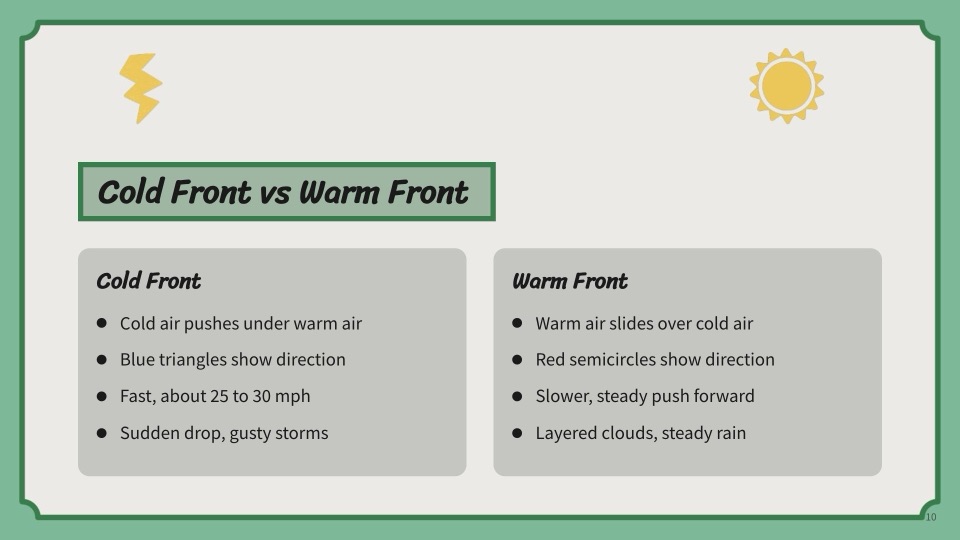
| cold front | a moving edge where cool dry air slides under warm damp air and takes its place |
| warm front | a moving edge where heated damp air slides up over cool dry air and takes its place |
Timed plan (60 minutes)
| Time | Stage | What happens |
|---|---|---|
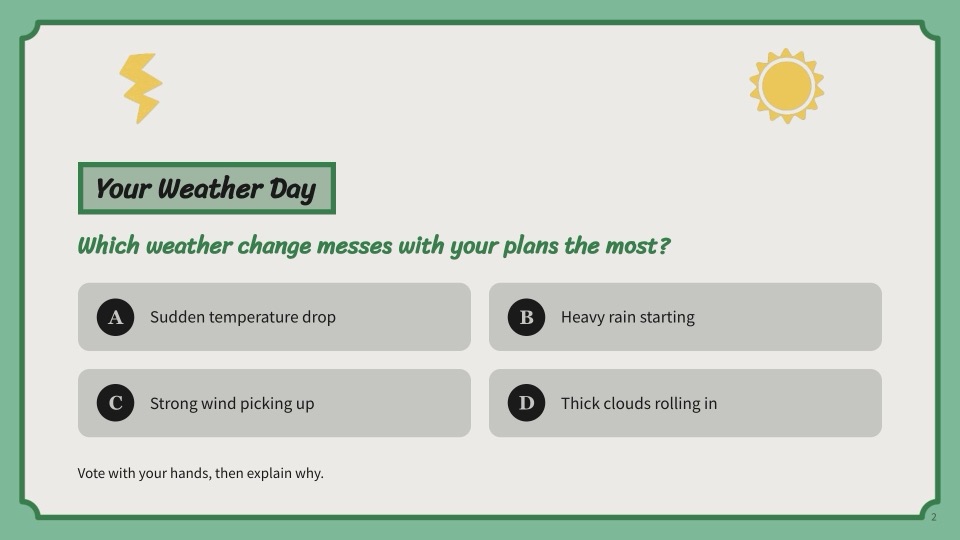
| 7 min | Starter | Hook interest in sudden weather shifts and link them to moving air. Show Slide 1 Air Masses on the Move and state the goal to explain changing weather with clues. Show Slide 2 Your Weather Day vote and take a show of hands for temperature drop, rain, wind, clouds. Say the mystery hook and preview the pencil-and-paper data task. Link votes to the idea that a huge body of moving air causes the shift. |
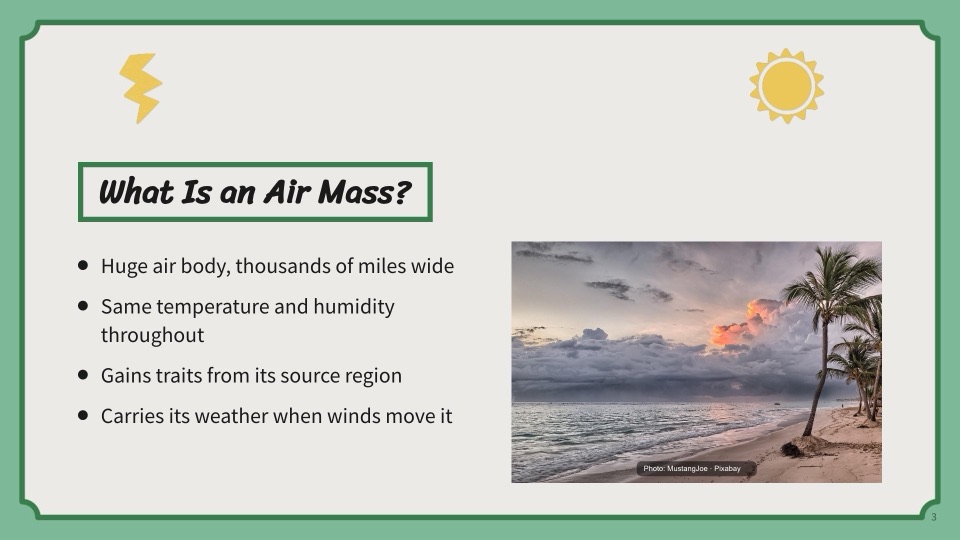
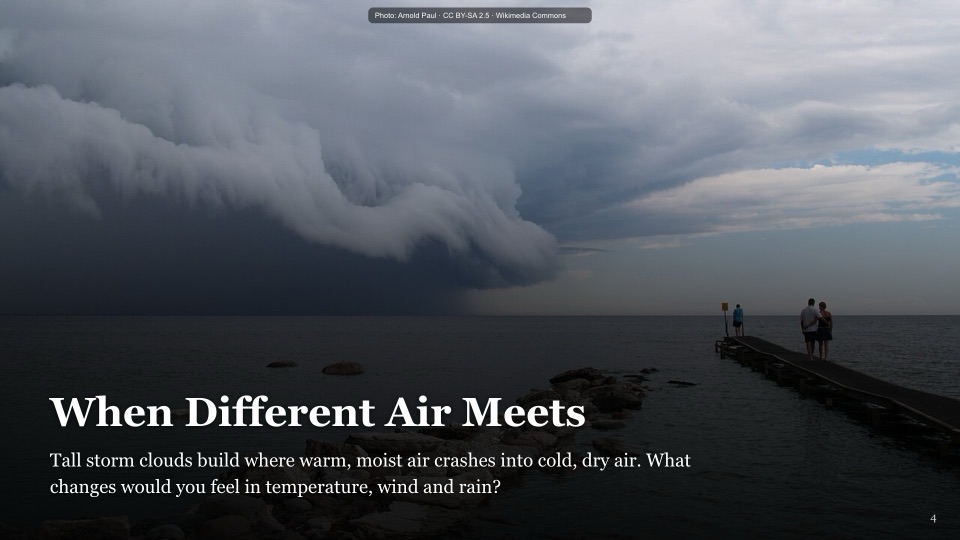
| 10 min | Teaching | Build the core idea that air gets temperature and humidity from its source region. Show Slide 3 What Is an Air Mass and define a large body with similar temperature and humidity throughout. Explain maritime forms over water and is humid, continental forms over land and is dry, and tropical is warm while polar is cold. Show Slide 4 storm photo and ask what temperature, wind and rain changes they would feel. Model naming: first part tells humidity, second part tells temperature. |
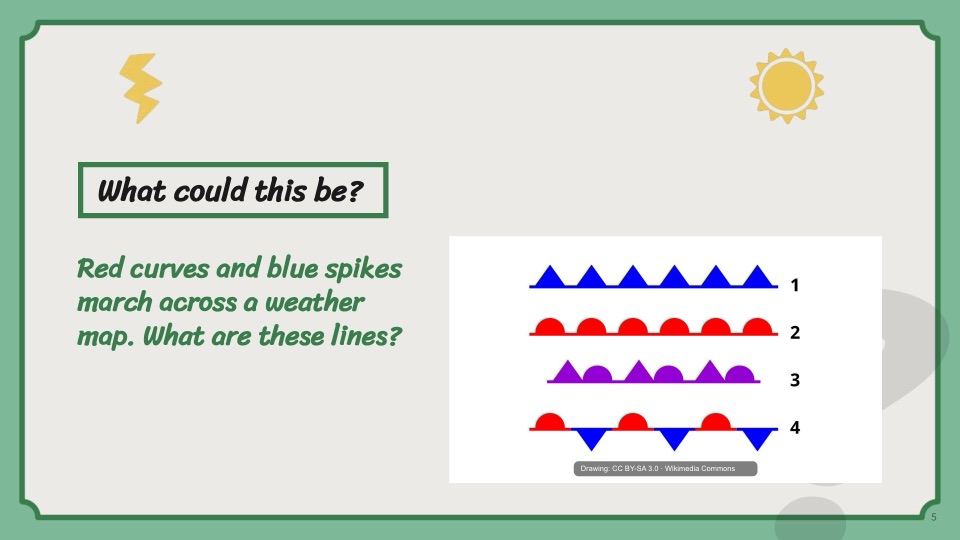
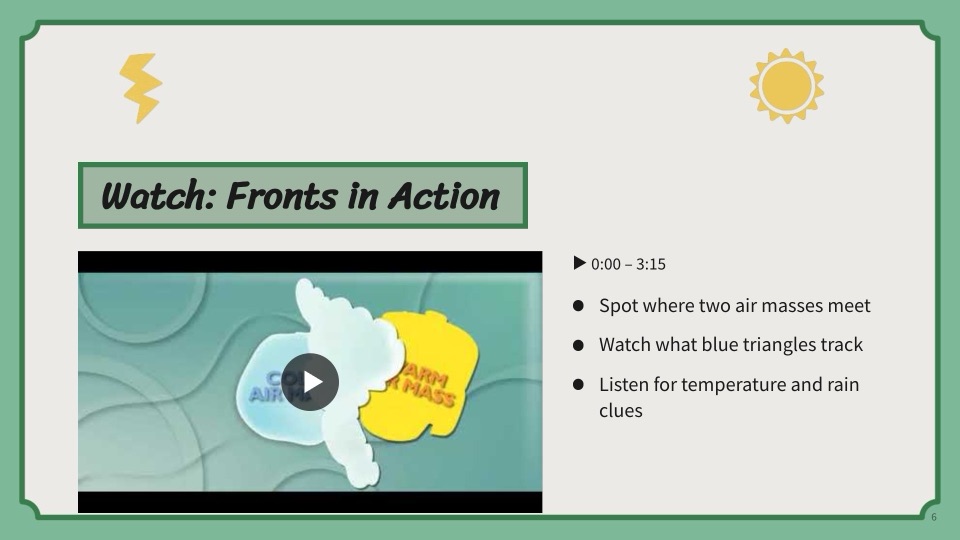
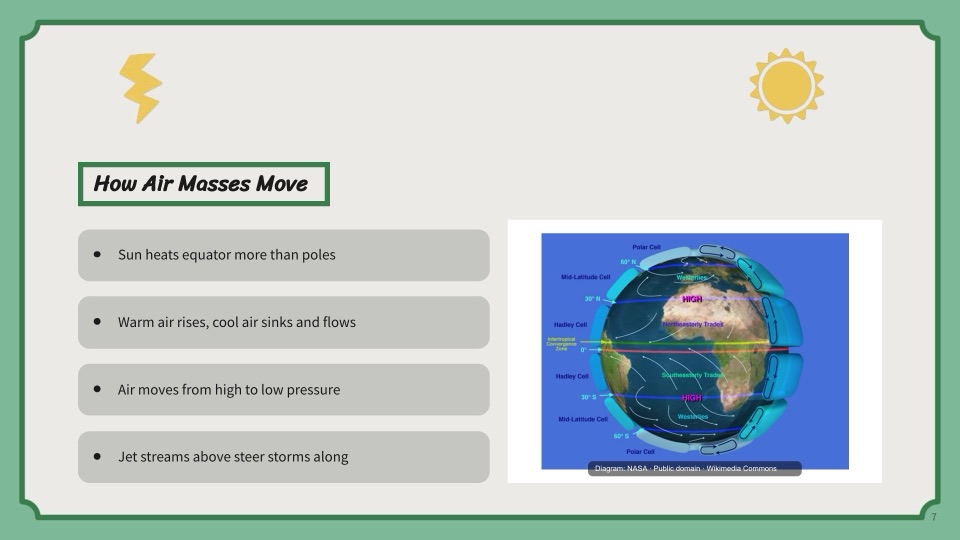
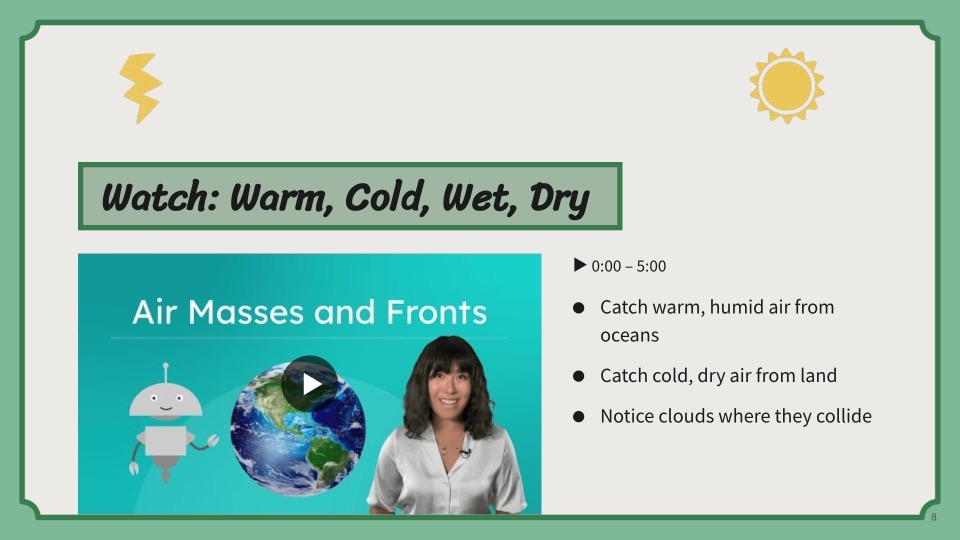
| 13 min | Teaching | Show how air masses meet at fronts and how those fronts move. Show Slide 5 mystery lines and reveal fronts as borders where two air masses meet. Play Video clip 1 (0:00-3:15) on Slide 6 and ask students to spot blue triangles and rain clues. Show Slide 7 How Air Masses Move: sun heats equator more, air moves high to low pressure, jet streams steer storms. Show Slide 10 Cold Front vs Warm Front and contrast blue triangles and red half-circles. |
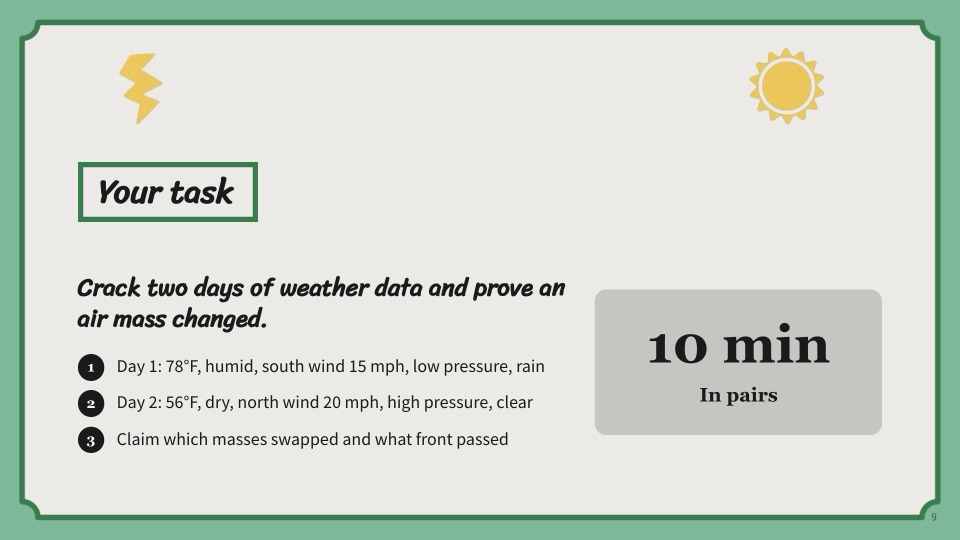
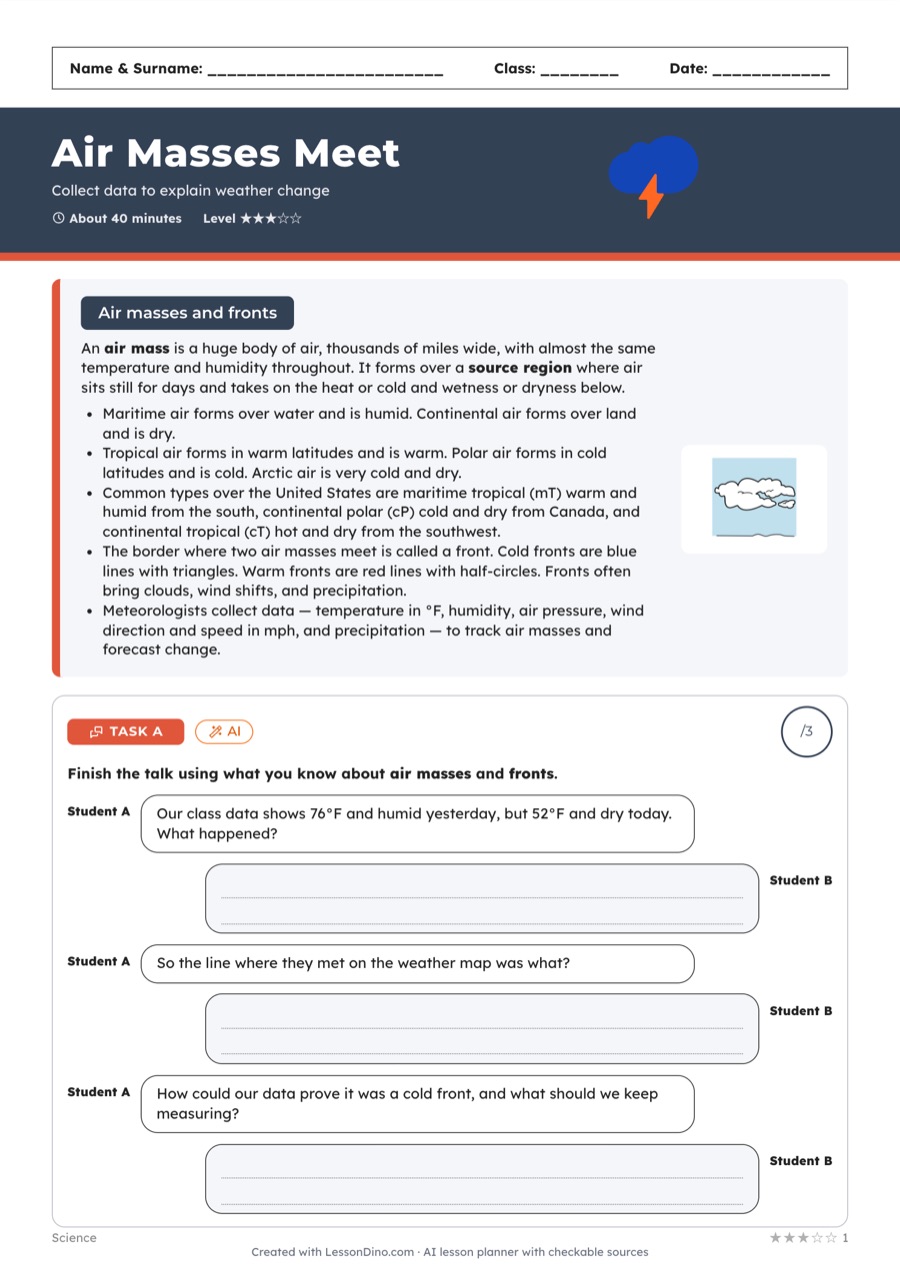
| 20 min | Main activity | Graph real numbers to prove an air mass swap caused the weather change. Show Slide 9 task: Day 1 78°F humid south wind 15 mph low pressure rain, Day 2 56°F dry north wind 20 mph high pressure clear. Hand out printed 3-day data tables in degrees Fahrenheit, pencils and rulers and Worksheet Task B. Model graphing temperature and pressure and writing a claim-evidence sentence. Set pairs to graph, find the swap day, and complete the storyboard. |
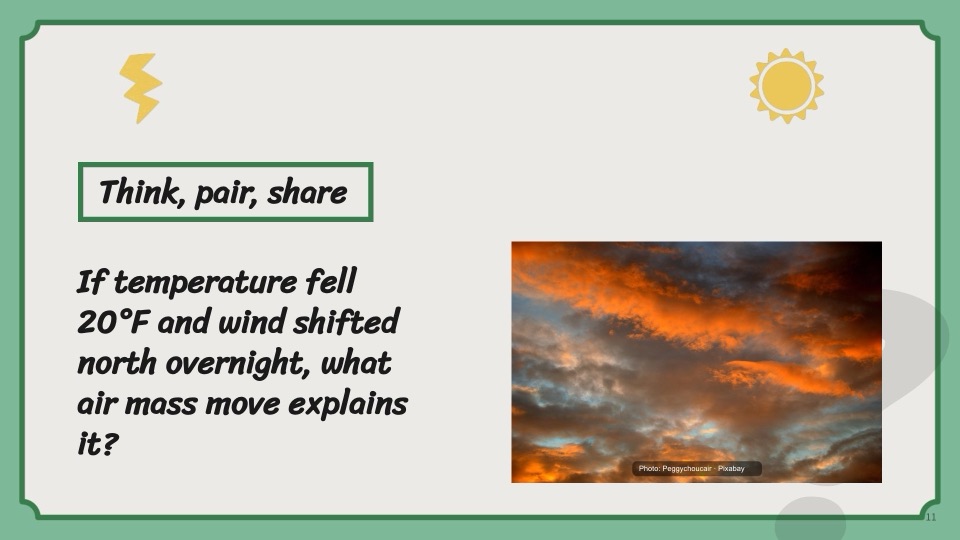
| 10 min | Plenary | Check that data evidence explains the front and fix common mix-ups. Show Slide 11 Think, pair, share and let pairs explain a 20°F overnight drop with north wind shift. Show Slide 12 True or false and vote on maritime over land, uniform traits, and source region ideas. Use Worksheet Task E to spot and fix two students mistakes about fronts. Summarize that uneven heating moves air and clashing masses can make storms. |
Common mistakes
- Mixing up maritime and continental
How to spot it: Labels warm humid ocean air as continental or dry land air as maritime
Restate maritime forms over water and is humid, continental forms over land and is dry. Use ocean vs land picture sort. - Swapping cold front and warm front symbols
How to spot it: Calls blue triangles warm front or says warm front is cold replacing warm
Cold fronts in blue occur where cold replaces warm; warm fronts in red occur where warm replaces cold. Practice with map symbols. - Using only temperature as proof
How to spot it: Claim has no pressure, wind or humidity numbers
Remind that wind direction, temperature, pressure, moisture and precipitation together show patterns. Add pressure rise and wind shift.
Support
- Pre-labeled graph axes, highlighted temperature and pressure columns, and picture data sheets with sunny-cloudy icons
- Word bank with cold, warm, front and sentence frames for claim-evidence writing
Stretch
- Add humidity and wind-shift evidence to strengthen the claim about a different air mass moving in
- Write and justify a Day 3 forecast from front direction and jet stream push
Check questions
- An air mass that forms over a tropical ocean is what type and what weather does it bring?
Answer: Maritime tropical, warm and humid. - Day 1 was 78°F humid south wind, Day 2 was 56°F dry north wind. What front passed and what is your evidence?
Answer: Cold front where cold replaces warm; temperature fell 22°F, pressure rose, wind shifted south to north. - True or false: When air masses with different temperature and humidity meet, it can create a severe storm.
Answer: True, clashing air masses can create a severe storm.
Curriculum
Collect data to provide evidence for how the motions and complex interactions of air masses result in changes in weather conditions.
From Next Generation Science Standards (middle school), MS-ESS2-5.
Video clips
Clips on YouTube, from the start and end times we chose. Check each one before you show it.
-
Air Masses and Fronts from 0:00 to 3:15
Study Jams Science & Math Videos: Scholastic - Study Jams - Air Masses and Fronts
Directly about air masses meeting at fronts to change weather and vocabulary and pace are perfect for 11-12.
-
How air masses affect weather from 0:00 to 5:00
Miacademy & MiaPrep Learning Channel: Air Masses and Fronts - How They Affect Weather Patterns
Explains air-mass types and frontal interactions clearly at the right level for 11-12.
Worksheet
Sources
- Unit 1 avon.k12.ct.us
- Curriculum Map: Science 6 Course: GENERAL SCIENCE Sub-topic: General ... ltsd.k12.pa.us
- Weather systems and patterns - National Oceanic and ... noaa.gov
- Air Masses - Center for Science Education scied.ucar.edu
- Air Masses and Fronts: The Movers and Shakers of Weather faa.gov
- Air Masses and Fronts | METEO 3: Weather Revealed ... courses.ems.psu.edu
- Air masses - Weather systems - National 4 Geography Revision - BBC bbc.co.uk
- What is an air mass? The characteristics of the five main UK ... bbc.co.uk
- Weather systems | 8th grade science (TX TEKS) | Khan Academy en.khanacademy.org
- Air Mass - National Geographic Society education.nationalgeographic.org
- North America - Air Masses, Climate, Weather | Britannica britannica.com
- Learn and try: Wind and air masses (article) | Khan Academy khanacademy.org
- Key points: Weather (article) | Weather | Khan Academy khanacademy.org
- Wind, air masses, and fronts (apply) (practice) | Khan Academy en.khanacademy.org
- weather - Students | Britannica Kids | Homework Help kids.britannica.com
- Air Masses & Weather Fronts Video For Kids | 6th, 7th & 8th Grade Science generationgenius.com
- Unit Plan 21 (Grade 6 Science): Air Masses & Weather Patterns teachmaverick.com
- Air Masses and Weather Fronts: Types & Characteristics cfinotebook.net
- Air Pressure, Air Masses & Weather Fronts Complete Unit teachingscience.us
Picture credits
- Photo: WikimediaImages · Pixabay
- Photo: MustangJoe · Pixabay
- Photo: Arnold Paul · CC BY-SA 2.5 · Wikimedia Commons
- Drawing: CC BY-SA 3.0 · Wikimedia Commons
- Diagram: NASA · Public domain · Wikimedia Commons
- Photo: Peggychoucair · Pixabay
- Pictograms: Sergio Palao, ARASAAC (arasaac.org) · CC BY-NC-SA
- Microsoft Fluent Emoji (MIT)
Made with Lesson Dino's AI on 17 October 2026. AI can make mistakes, so check facts against the sources before you teach.