The worksheet
About this worksheet
Students learn how metric and customary units compare in size. They fix shop labels by converting and ordering measurements. This Grade 4 Math worksheet gives students (ages 9–10) six pages of practice on unit conversion, part of the measurement and data unit. It goes with our free Unit conversion lesson, which has the slides and a timed lesson plan.
What it covers
By the end, students should be able to:
- Students will compare the relative sizes of length, weight, volume and time units.
- Students will convert measurements between larger and smaller units within one system.
- Students will choose sensible units and order measurements by true size.
How to use it
- Use it for practice after the teaching part of the lesson, once students have seen the worked examples on the slides.
- Support: Keep a helper table for kg to g and l to ml on desks for quick look-up.
- Stretch: Students write their own mix-up problem for another pair using pounds and ounces.
- The answer sheet is the last page, so you can print it on its own or let students check their own work.
Key vocabulary
- kilometer: a long distance unit for trips; 1 equals 1,000 meters
- centimeter: a small length unit for a pencil; 100 make a meter
- kilogram: a heavy weight unit for a backpack; 1 equals 1,000 grams
- ounce: a light weight unit for an apple; 16 make a pound
- milliliter: a tiny volume unit for a spoon; 1,000 make a liter
- minute: a time unit for recess; 60 make an hour
Mistakes to watch for
- Mixing up when to multiply or divide. Point to rule larger to smaller multiply; check that 1 meter = 100 centimeters so 2 m must be 200 cm.
- Using 100 or 10 for all conversions. Sort facts: 1 kg = 1,000 g and 1,000 milliliters is 1 liter, but 1 pound = 16 ounces.
- Thinking time works like metric by 100s. Chant that 1 hour = 60 minutes and there are 60 seconds in 1 minute, so 2 x 60 = 120.
What's on the worksheet
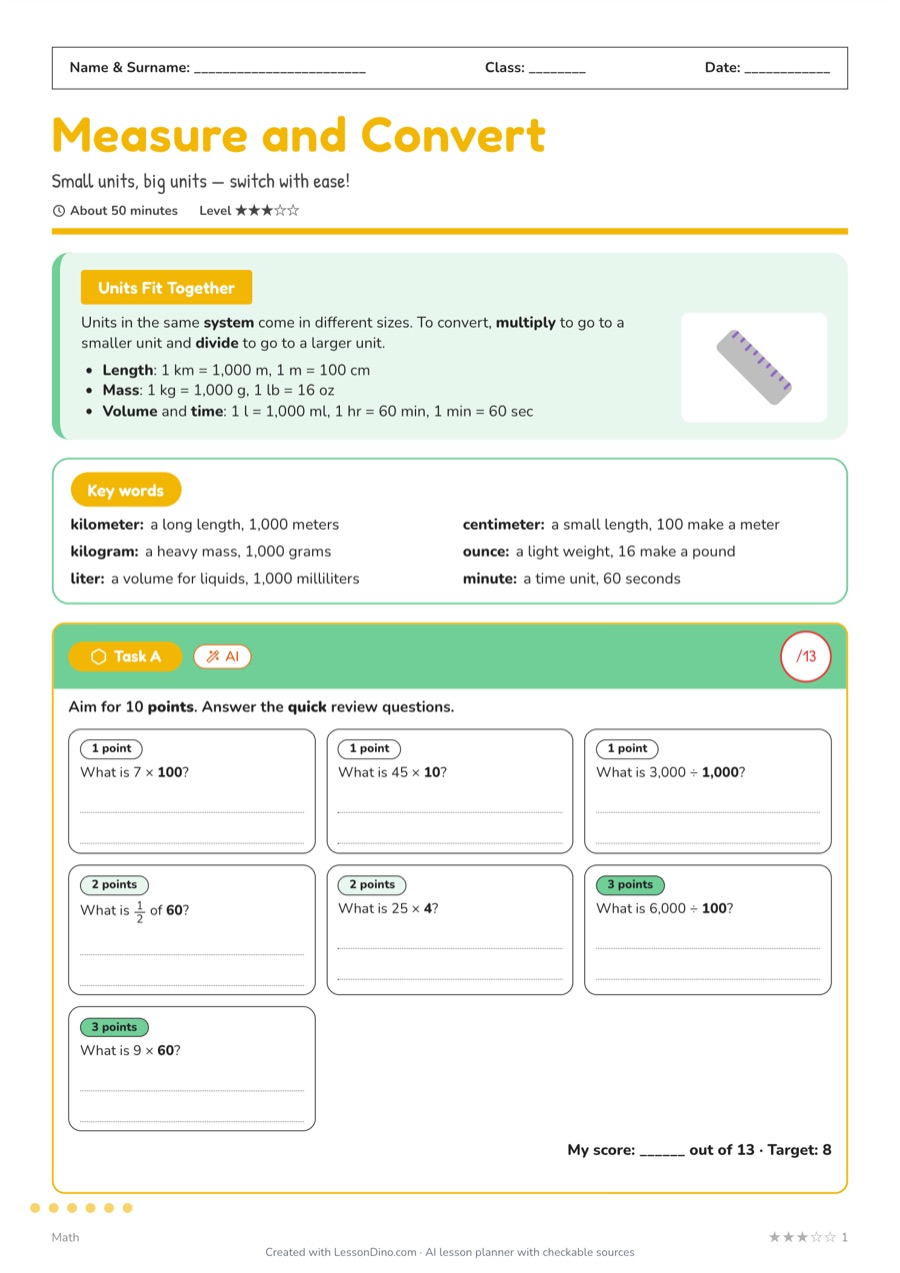
Size It Up!
Remember how units fit together.
Units Fit Together
- Units in the same system come in different sizes. To convert, multiply to go to a smaller unit and divide to go to a larger unit.
- Length: 1 km = 1,000 m, 1 m = 100 cm
- Mass: 1 kg = 1,000 g, 1 lb = 16 oz
- Volume and time: 1 l = 1,000 ml, 1 hr = 60 min, 1 min = 60 sec
| Word | Meaning |
|---|---|
| kilometer | a long length, 1,000 meters |
| centimeter | a small length, 100 make a meter |
| kilogram | a heavy mass, 1,000 grams |
| ounce | a light weight, 16 make a pound |
| liter | a volume for liquids, 1,000 milliliters |
| minute | a time unit, 60 seconds |
Aim for 10 points. Answer the quick review questions.
- What is 7 × 100?
- What is 45 × 10?
- What is 3,000 ÷ 1,000?
- What is 1/2 of 60?
- What is 25 × 4?
- What is 6,000 ÷ 100?
- What is 9 × 60?
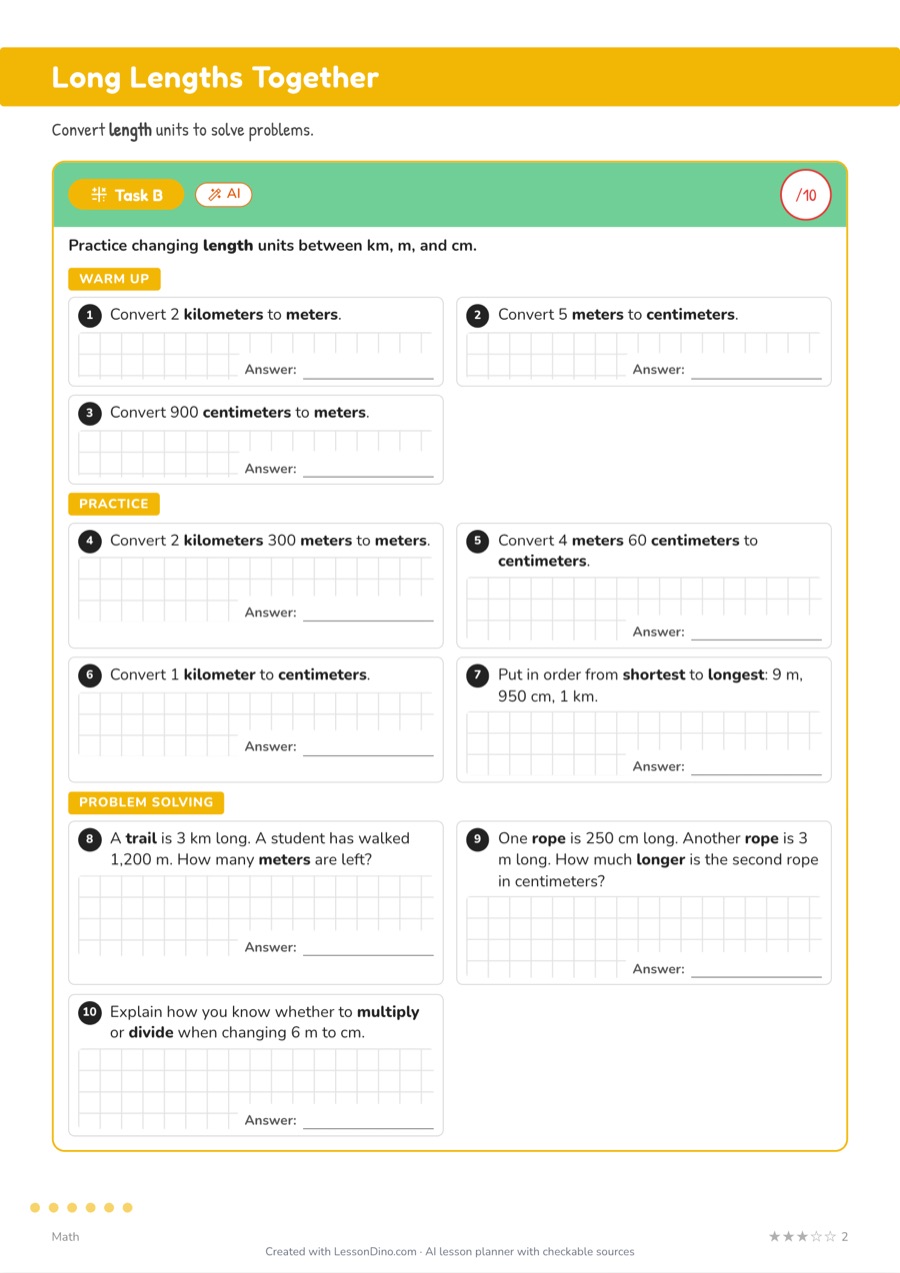
Long Lengths Together
Convert length units to solve problems.
Practice changing length units between km, m, and cm.
Warm up
- Convert 2 kilometers to meters.
- Convert 5 meters to centimeters.
- Convert 900 centimeters to meters.
Practice
- Convert 2 kilometers 300 meters to meters.
- Convert 4 meters 60 centimeters to centimeters.
- Convert 1 kilometer to centimeters.
- Put in order from shortest to longest: 9 m, 950 cm, 1 km.
Problem solving
- A trail is 3 km long. A student has walked 1,200 m. How many meters are left?
- One rope is 250 cm long. Another rope is 3 m long. How much longer is the second rope in centimeters?
- Explain how you know whether to multiply or divide when changing 6 m to cm.
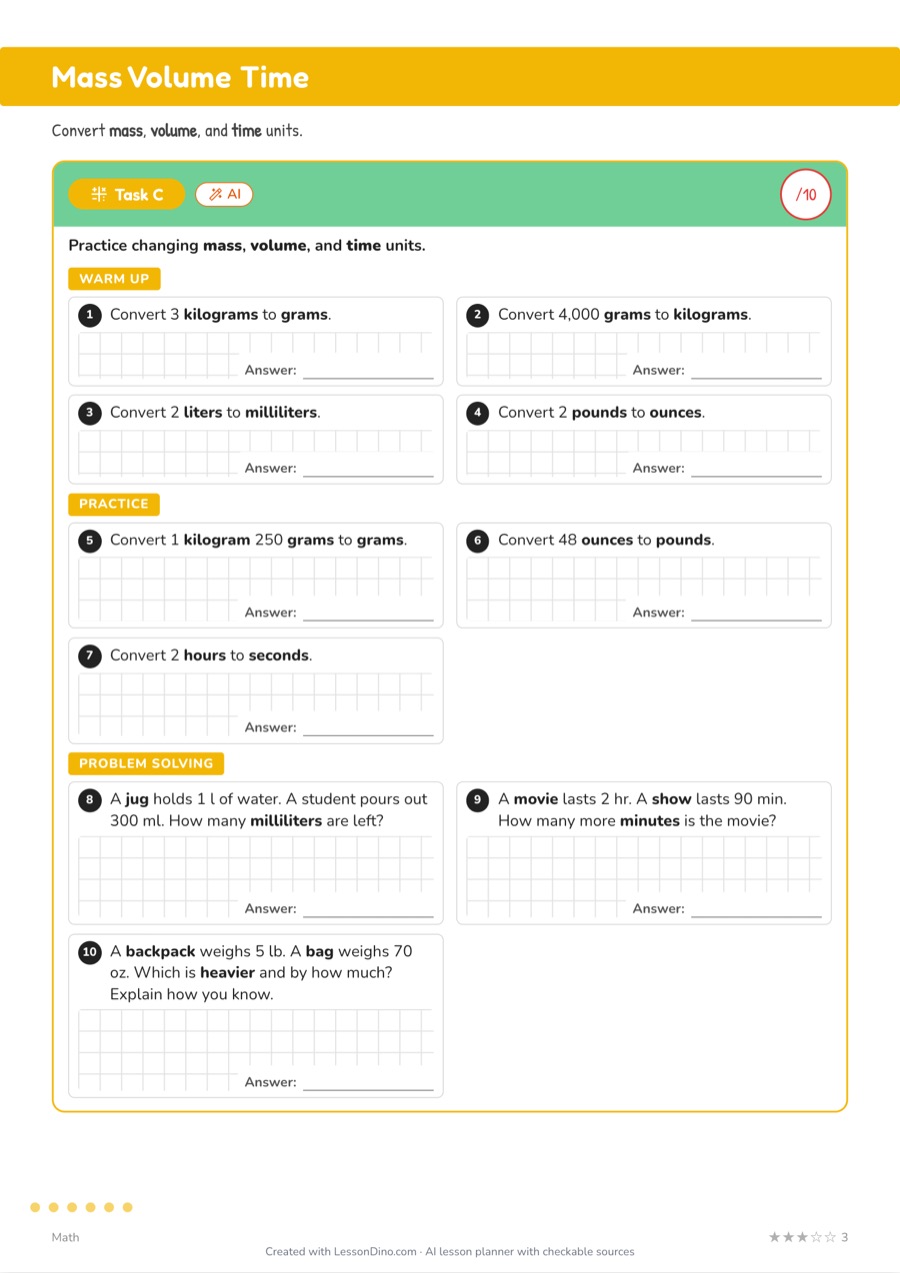
Mass Volume Time
Convert mass, volume, and time units.
Practice changing mass, volume, and time units.
Warm up
- Convert 3 kilograms to grams.
- Convert 4,000 grams to kilograms.
- Convert 2 liters to milliliters.
- Convert 2 pounds to ounces.
Practice
- Convert 1 kilogram 250 grams to grams.
- Convert 48 ounces to pounds.
- Convert 2 hours to seconds.
Problem solving
- A jug holds 1 l of water. A student pours out 300 ml. How many milliliters are left?
- A movie lasts 2 hr. A show lasts 90 min. How many more minutes is the movie?
- A backpack weighs 5 lb. A bag weighs 70 oz. Which is heavier and by how much? Explain how you know.
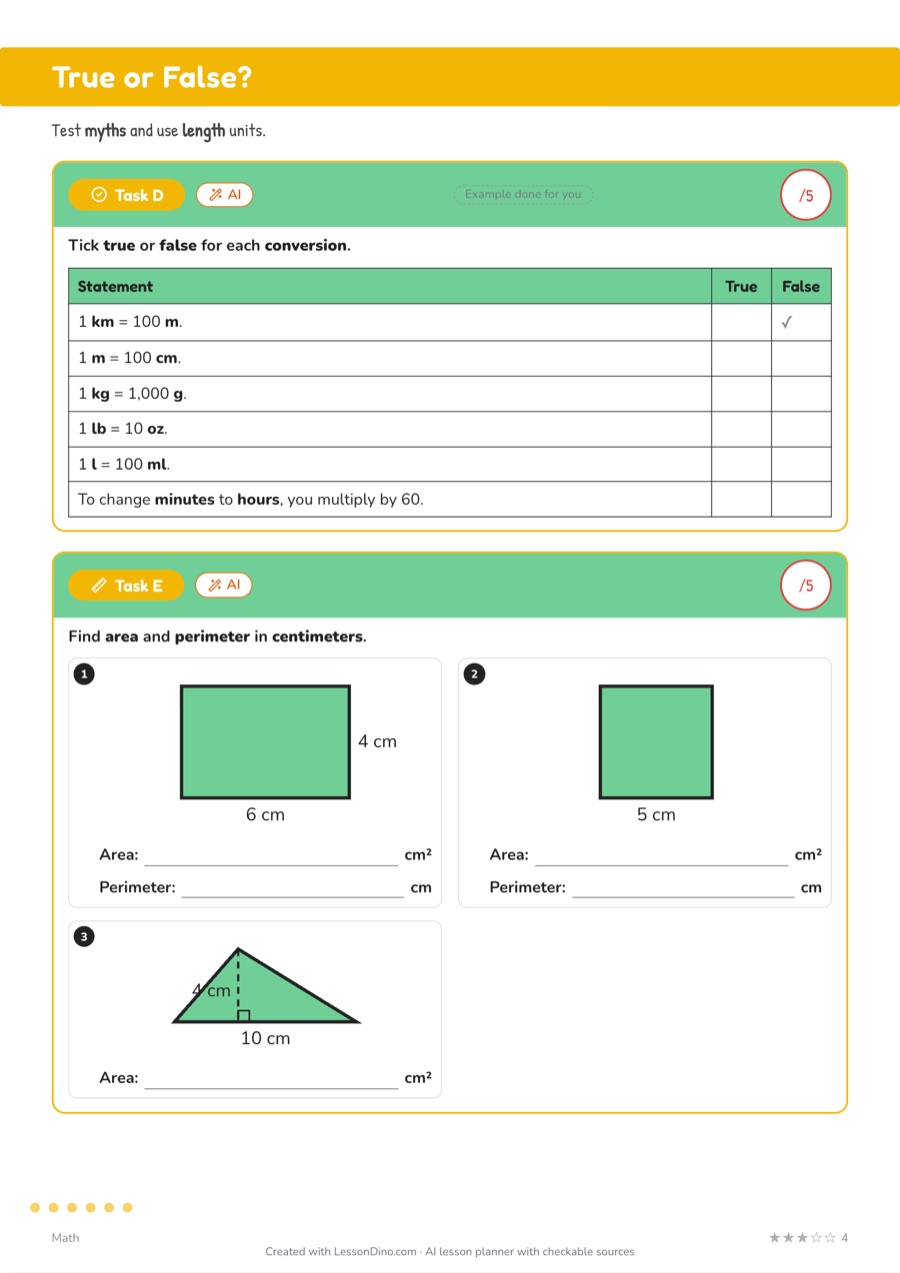
True or False?
Test myths and use length units.
Tick true or false for each conversion.
Find area and perimeter in centimeters.
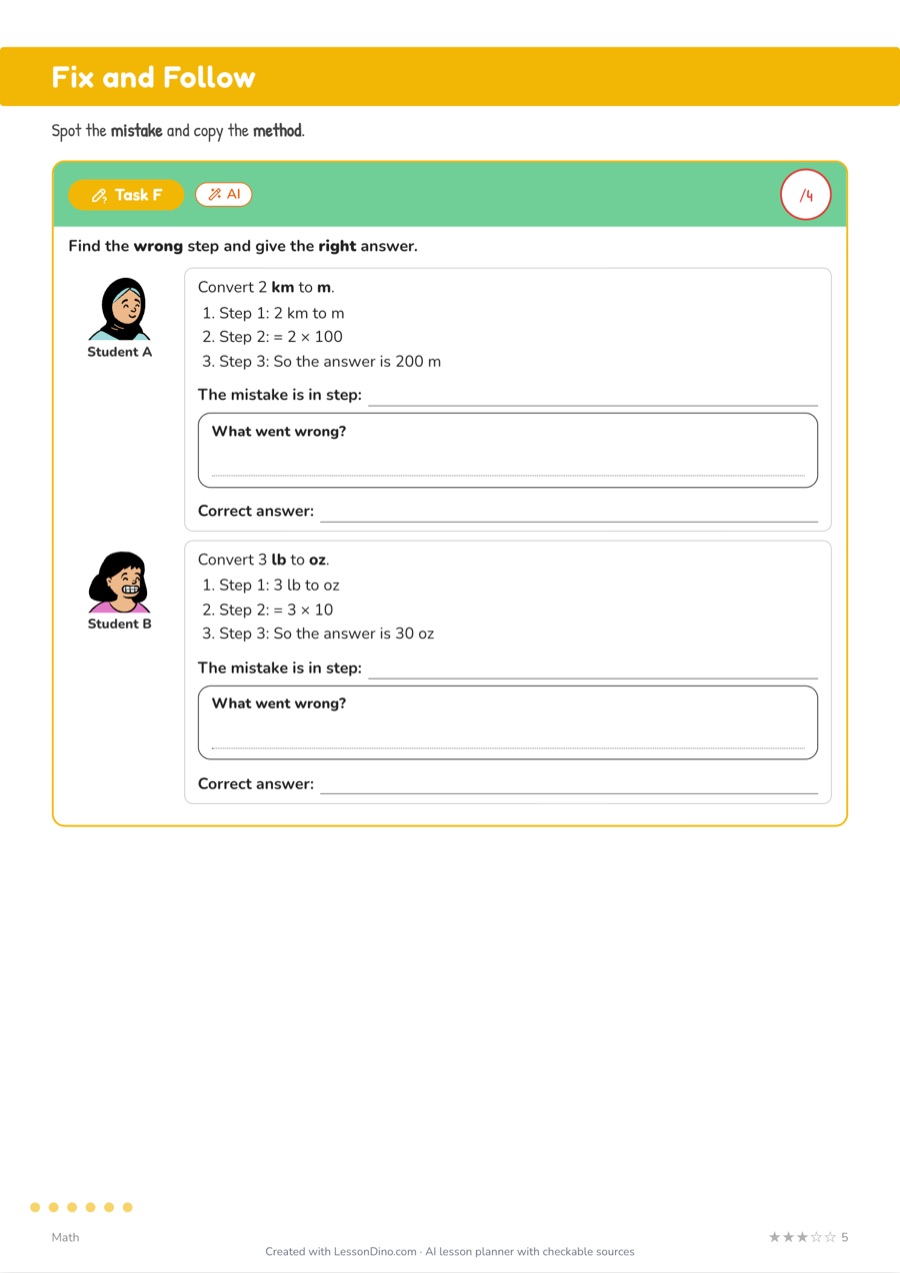
Fix and Follow
Spot the mistake and copy the method.
Find the wrong step and give the right answer.
Page 6
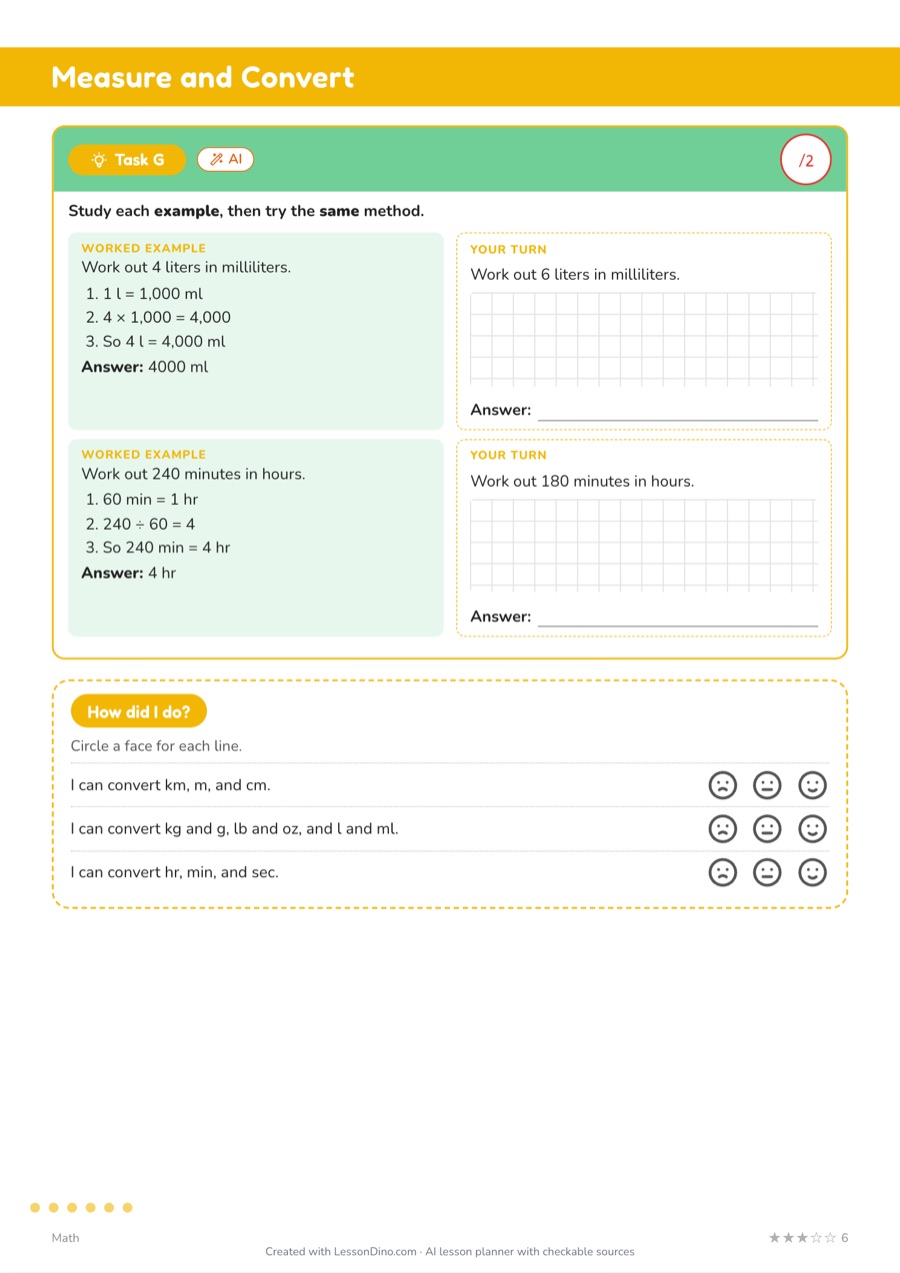
Study each example, then try the same method.
Answers
Show the answers
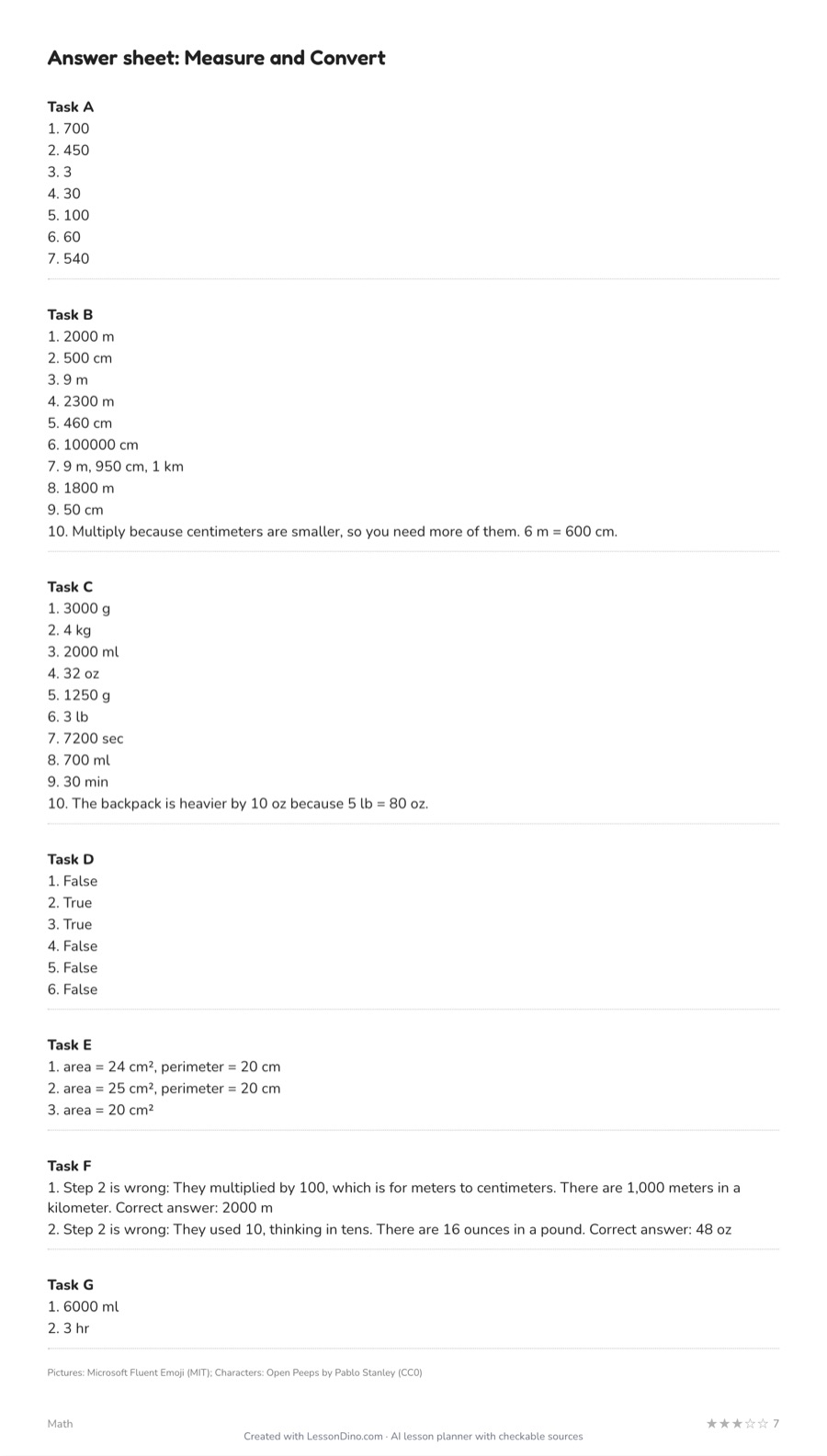
- What is 7 × 100? 700
- What is 45 × 10? 450
- What is 3,000 ÷ 1,000? 3
- What is 1/2 of 60? 30
- What is 25 × 4? 100
- What is 6,000 ÷ 100? 60
- What is 9 × 60? 540
- Convert 2 kilometers to meters. 2000 m
- Convert 5 meters to centimeters. 500 cm
- Convert 900 centimeters to meters. 9 m
- Convert 2 kilometers 300 meters to meters. 2300 m
- Convert 4 meters 60 centimeters to centimeters. 460 cm
- Convert 1 kilometer to centimeters. 100000 cm
- Put in order from shortest to longest: 9 m, 950 cm, 1 km. 9 m, 950 cm, 1 km
- A trail is 3 km long. A student has walked 1,200 m. How many meters are left? 1800 m
- One rope is 250 cm long. Another rope is 3 m long. How much longer is the second rope in centimeters? 50 cm
- Explain how you know whether to multiply or divide when changing 6 m to cm. Multiply because centimeters are smaller, so you need more of them. 6 m = 600 cm.
- Convert 3 kilograms to grams. 3000 g
- Convert 4,000 grams to kilograms. 4 kg
- Convert 2 liters to milliliters. 2000 ml
- Convert 2 pounds to ounces. 32 oz
- Convert 1 kilogram 250 grams to grams. 1250 g
- Convert 48 ounces to pounds. 3 lb
- Convert 2 hours to seconds. 7200 sec
- A jug holds 1 l of water. A student pours out 300 ml. How many milliliters are left? 700 ml
- A movie lasts 2 hr. A show lasts 90 min. How many more minutes is the movie? 30 min
- A backpack weighs 5 lb. A bag weighs 70 oz. Which is heavier and by how much? Explain how you know. The backpack is heavier by 10 oz because 5 lb = 80 oz.
The answer sheet is the last picture above.
Curriculum
Know relative sizes of measurement units within one system of units including km, m, cm; kg, g; lb, oz.; l, ml; hr, min, sec.
Made with Lesson Dino's AI on 16 October 2026. AI can make mistakes, so check the answers and facts against the sources before you teach.