Slides

Lesson plan
Which Fraction Wins? Comparing Unlike Fractions
Students learn to compare fractions with different numerators and denominators fairly. They build same-size models, use common denominators and 1/2, and write > , < , or =.
Objectives
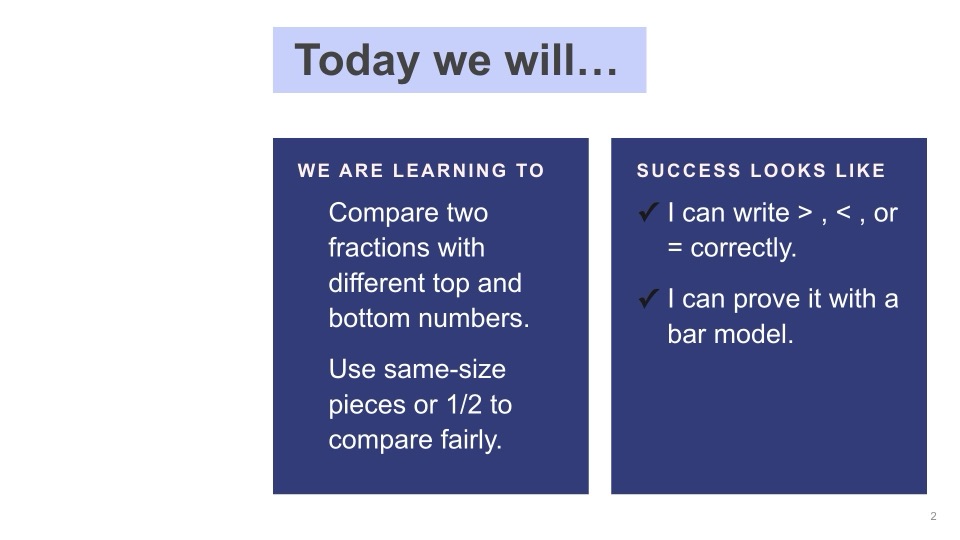
- Students will compare two unlike fractions using same-size visual models fairly.
- Students will use common denominators and the 1/2 benchmark to compare fractions.
- Students will record comparisons with >, <, = and justify with drawings.
Success criteria
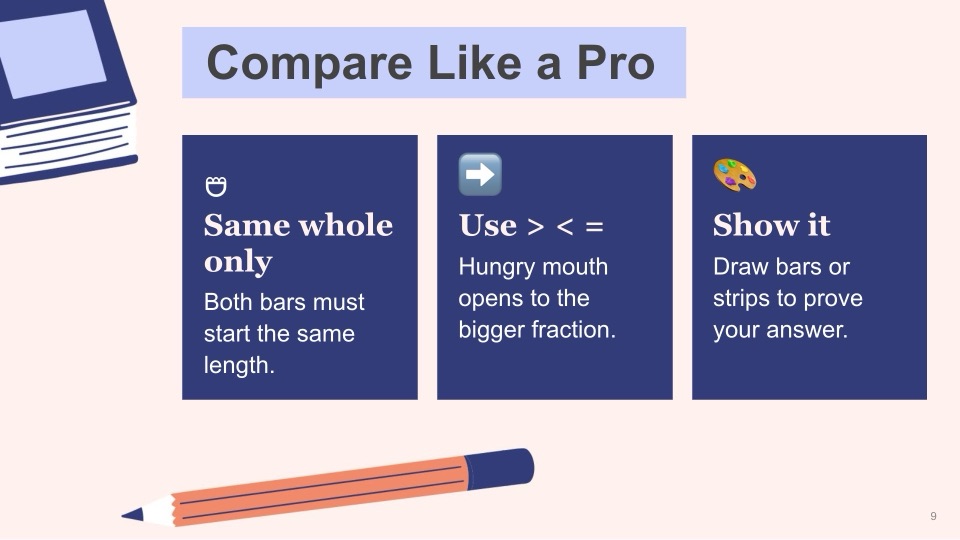
- I can compare fractions fairly only when wholes are the same size.
- I can rewrite fractions with same-size pieces or compare each to 1/2.
- I can write >, <, = correctly and explain with a model.
Key words
| Word | Meaning |
|---|---|
| numerator | top number that tells how many parts you have |
| denominator | bottom number that tells how many equal parts make one whole |
| same whole | two pizzas that are exactly equal in size so the comparison is fair |
| common denominator | same size parts used for both fractions so counts can be compared |
| benchmark | a familiar amount like one-half used to judge other fractions |
Timed plan (60 minutes)
| Time | Stage | What happens |
|---|---|---|
| 5 min | Starter | Activate same numerator and denominator ideas and hook students with the pizza comparison. Show Slides 1-2 and read the hook: Two friends ordered the same size pizza. One ate 2/3 and the other ate 3/4. Who ate more? Let's prove it with paper, not guessing! Show Slide 3 photo of two same-size candy bars cut different ways and ask for quick votes for 2/3 or 3/4. Remind class that talking about fraction size only makes sense when they refer to the same size whole. Ask partners to whisper why guessing is not enough and we need same-size proof. |
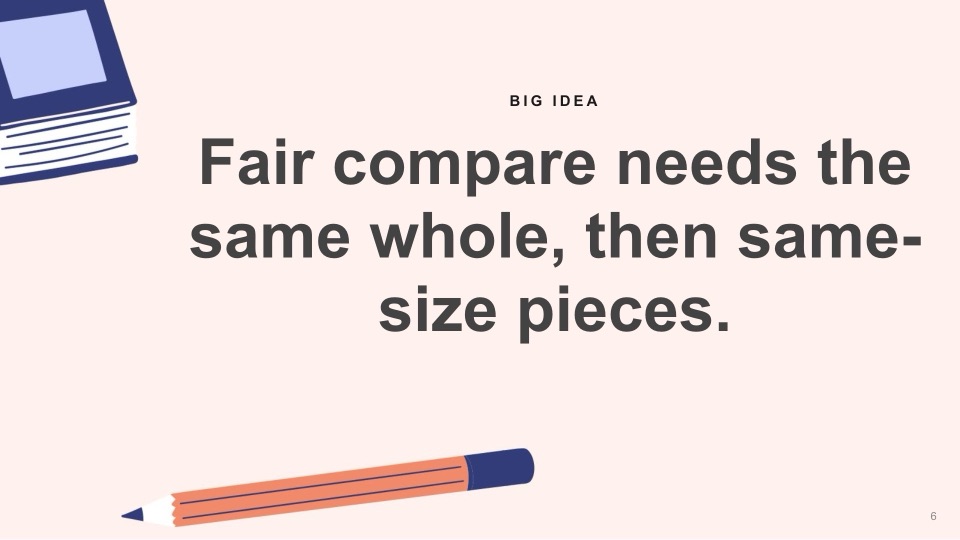
| 10 min | Teaching | Model fair comparison with same-size wholes and same-size pieces. Lay two same-size circles for 2/3 and 3/4 side by side and shade each amount. Recut or draw both as twelfths to make same-size pieces, showing 2/3 = 8/12 and 3/4 = 9/12. Think aloud that with the same denominator, the bigger numerator wins, so 8/12 < 9/12. Restate the big idea from Slide 6 and record 2/3 < 3/4 pointing to shaded parts to justify. |
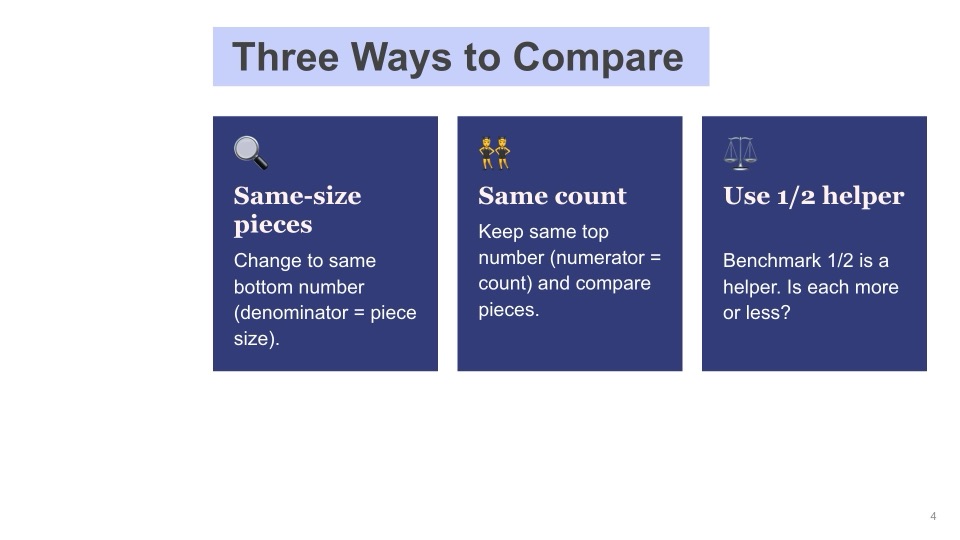
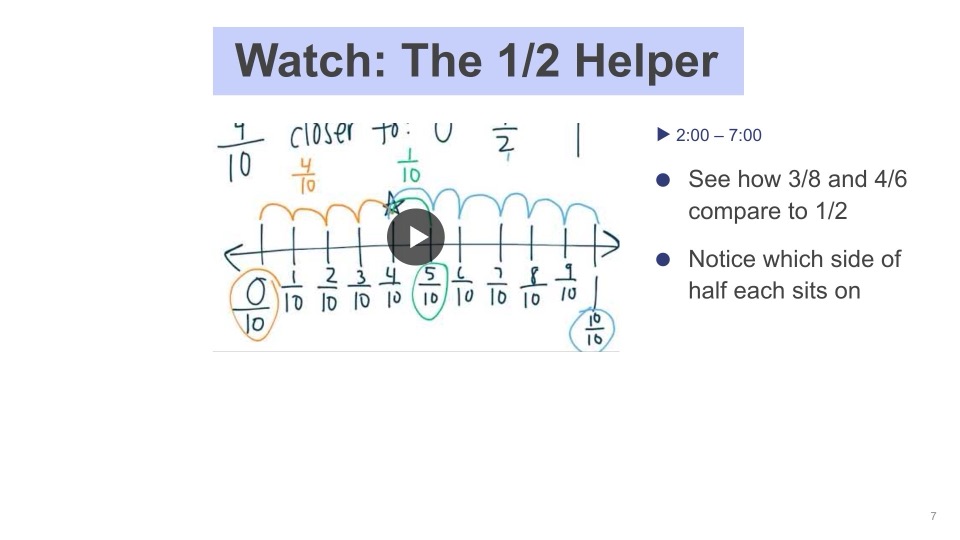
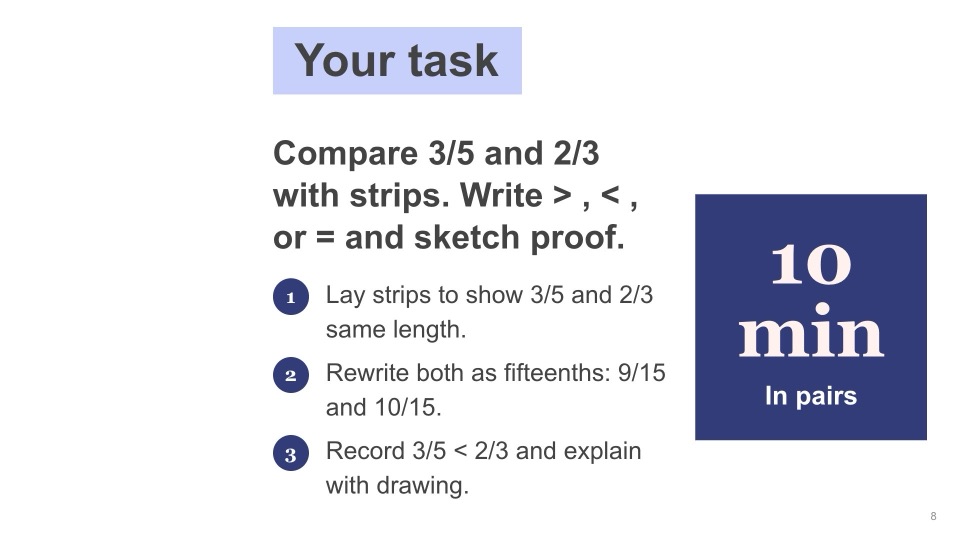
| 15 min | Guided practice | Practice the two helpers together: common denominator and comparing each to 1/2. Show Slide 4 cards for same bottom number and same count and same-size pieces idea. Model benchmark: half of 8 is 4, so 3/8 is less than half; half of 6 is 3, so 4/6 is more than half, so 3/8 < 4/6. Explain this is more and less than a benchmark such as one-half. Model common denominator: 3/5 = 9/15 and 2/3 = 10/15, so 3/5 < 2/3 because 9 < 10. Lead class to say the > or < sentence out loud for each pair with reason. |
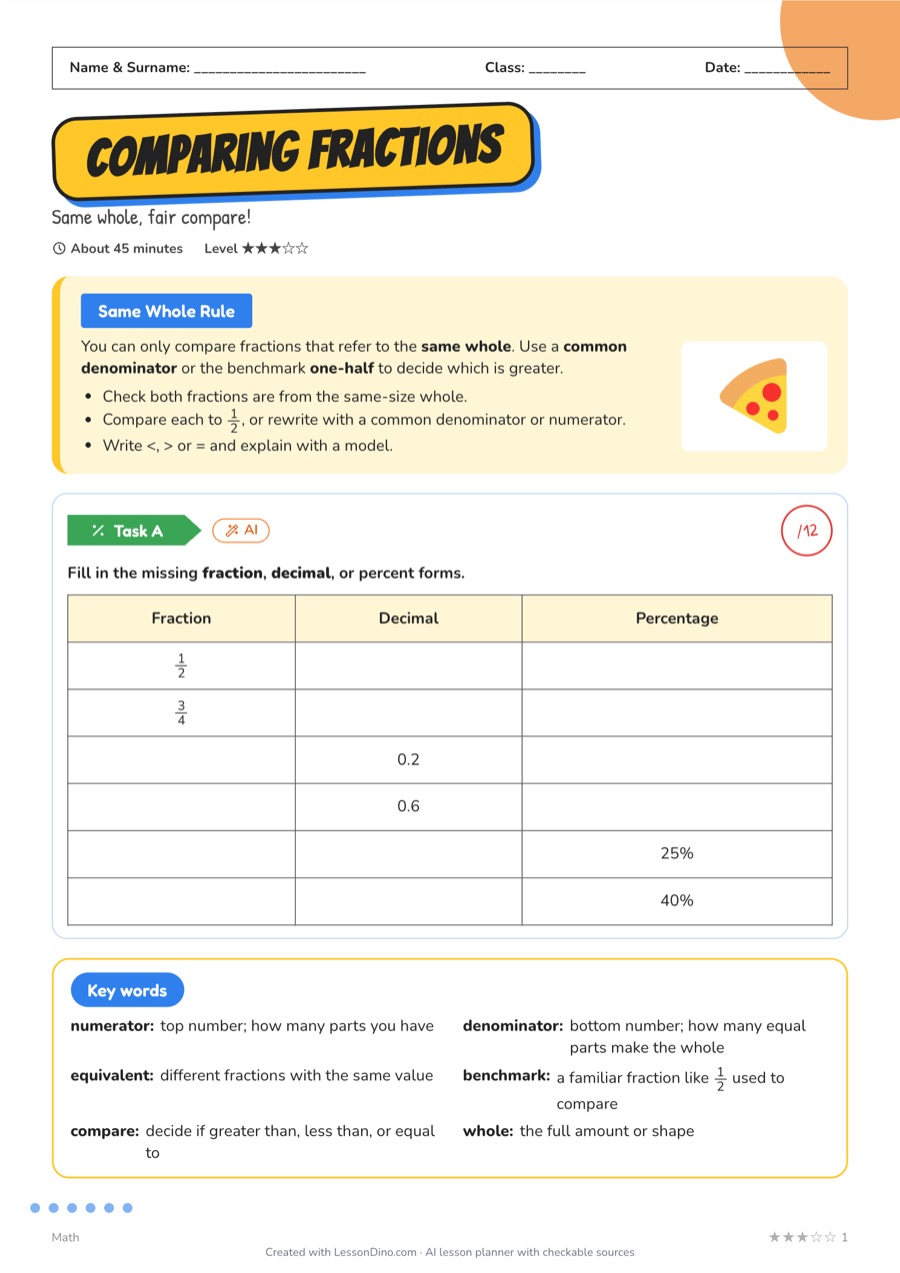
| 20 min | Main activity | Compare unlike fractions with same-size paper models and record with symbols. Hand out same-size circles and assign 2/3 vs 3/4. Remind pairs to lay same-size wholes side by side to see which shaded area is larger. Circulate as partners shade, glue, and write the comparison like 2/3 < 3/4 pointing to shaded parts to justify. Direct pairs to Worksheet Task B to compare next pairs from the same whole and show why with drawing and symbols. Stop class midway to highlight a strong justification and correct different-size wholes. |
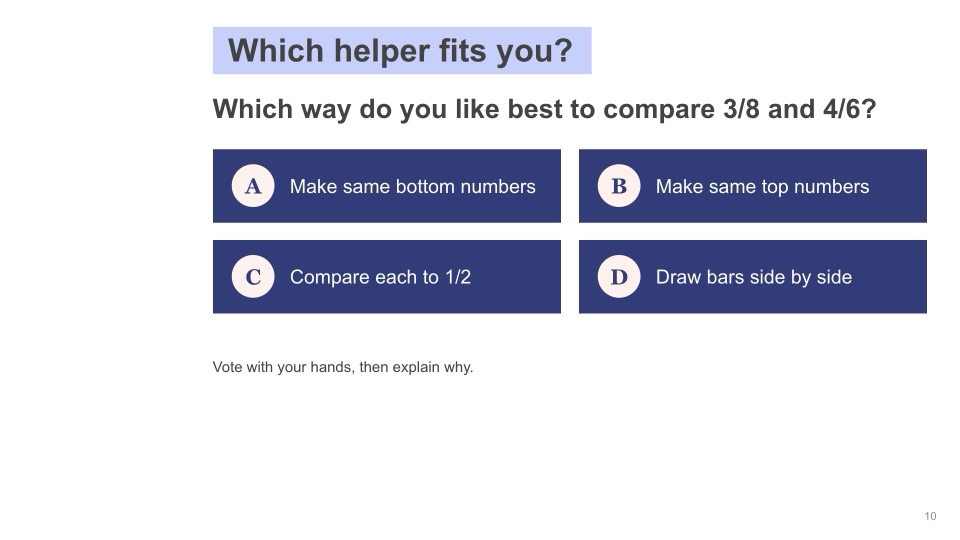
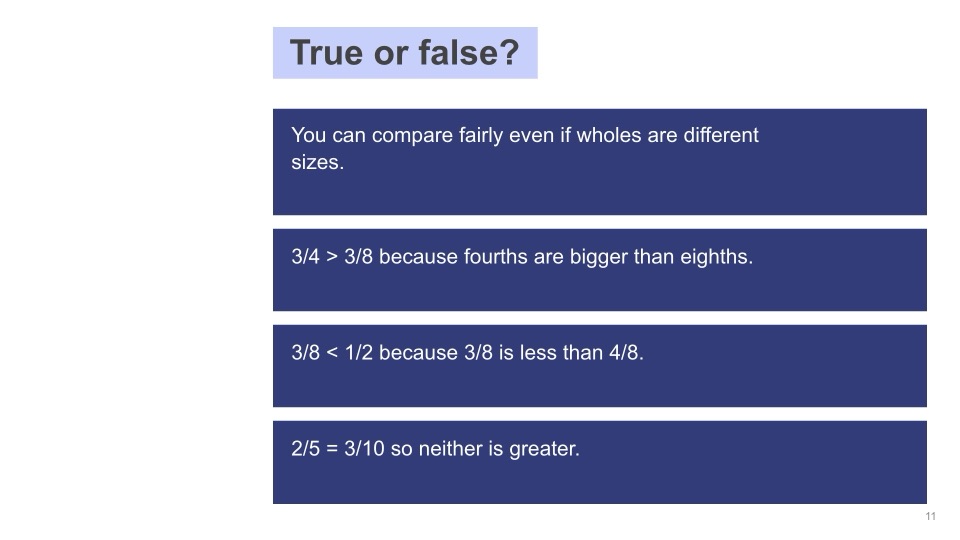
| 10 min | Plenary | Return to objectives, vote for favorite strategy, and fix same-whole misunderstanding. Run Slide 10 vote: which way do you like best to compare 3/8 and 4/6: same bottom numbers, same top numbers, compare each to 1/2, or draw bars side by side. Use Slide 11 true or false to stress wholes must match and 3/4 > 3/8 because fourths are bigger than eighths with same count. Model same numerator idea: with same numerator the smaller denominator wins because pieces are bigger, using same number of parts but parts of different sizes. Set exit ticket and preview homework. |
Common mistakes
- Thinks bigger denominator means bigger fraction, like 1/8 > 1/4.
How to spot it: Chooses 1/8 over 1/4 or says 8 is bigger so pieces are bigger.
Fold same-size strips for 1/2, 1/4, 1/8 to show larger denominator means smaller pieces. - Compares numerators with different-sized pieces, like 2/3 < 3/5 because 2 < 3.
How to spot it: Writes < or > without making common denominator or benchmark.
Rewrite first with same denominator, then with same denominator the bigger numerator wins. - Says 3/4 and 4/5 are equal because both are 1 piece away from whole.
How to spot it: Says both missing one so eaten parts equal.
Shade same-size circles and rewrite as 15/20 vs 16/20 to show 4/5 is bigger; missing larger piece means smaller fraction.
Support
- Start with 1/2 and 1/4 same-size pieces to see larger area wins before harder fractions.
- Use pre-drawn same-length bars and strips folded in half for 1/2 checks.
- Use only pairs where one denominator is a multiple of the other, like 2/5 = 4/10 > 3/10.
Stretch
- Order three same-size circles, like 1/2, 3/8, and 3/4, from least to greatest and explain.
- Add a second proof using a common denominator underneath the picture.
- Try 4/9 and 3/5 and test which common number of parts works for both.
Check questions
- Compare 2/3 and 3/4. Write <, > or = and give the twelfths proof.
Answer: 2/3 < 3/4 because 8/12 < 9/12. - Compare 3/8 and 4/6 using 1/2. Write <, > or = and explain.
Answer: 3/8 < 4/6 because 3/8 is less than 1/2 and 4/6 is more than 1/2. - True or false: You can compare fairly even if wholes are different sizes.
Answer: False. Wholes must match to compare fairly.
Curriculum
Compare two fractions with different numerators and different denominators, e.g., by creating common denominators or numerators, or by comparing to a benchmark fraction such as 1/2. Recognize that comparisons are valid only when the two fractions refer to the same whole. Record the results of comparisons with symbols >, =, or <, and justify the conclusions, e.g., by using a visual fraction model.
Video clips
Clips on YouTube, from the start and end times we chose. Check each one before you show it.
-
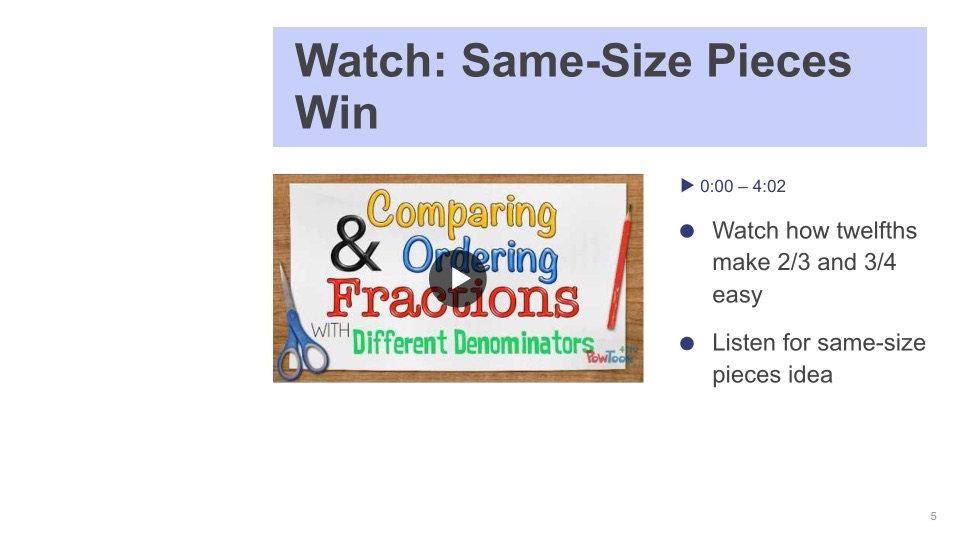
fraction strips unlike denominators from 0:00 to 4:02
Let's Do Math: Comparing and Ordering Fractions with Different Denominators (fraction strips)
Exactly matches this Grade 4 skill with visual models for 9-10-year-olds learning different denominators.
-
benchmark 1/2 comparison from 2:00 to 7:00
Ms. Kaitlyn Kendrick: Comparing Fractions to Benchmarks Of 0, 1/2, and 1
Teaches the 1/2 benchmark strategy at the right level for 9-10-year-olds in Grade 4.
Worksheet
Sources
- CA CSS Math - Content Standards (CA Dept of Education) cde.ca.gov
- Grade 4 Math Curriculum - Fairfax County Public Schools fcps.edu
- Comparing Fraction with Like and Unlike Denominators fcit.usf.edu
- s09 p3 mathnotes comparing fractions crdg.hawaii.edu
- Comparing Fractions: Step-by-Step Guide for Kids mathifykids.com
- Comparing Fractions – Methods, Definition With Examples brighterly.com
- Comparing fractions - Methods, Explanation, and Examples cuemath.com
- Comparing Fractions Worksheet - Math Salamanders math-salamanders.com
- Comparing Fractions - Free Activities & Learning Resources splashlearn.com
- Comparing & Ordering Fractions (Worksheets) superteacherworksheets.com
- Comparing Fractions - Ashleigh's Education Journey ashleigh-educationjourney.com
- Comparing Fractions: Visual Tools and Practical Strategies ... deled.institute
- The Most Effective Way to Teach Comparing Fractions to 4th ... teachinginroom5.com
- How to Compare Fractions? us.sofatutor.com
- Comparing Fractions Using Cross Multiplication – Maths Learn online sofatutor.co.uk
- Comparing Fractions For Kids | Greater Than, Less Than ... learnwithsitesforkids.com
- Comparing fractions - free lesson with a video - Homeschool Math homeschoolmath.net
- Comparing Fractions Resources - Education.com education.com
- Comparing Like Fractions Explained - Class 6 Maths with Example teachoo.com
Picture credits
- Photo: AlexanderStein · Pixabay
- Microsoft Fluent Emoji (MIT)
Made with Lesson Dino's AI on 16 October 2026. AI can make mistakes, so check facts against the sources before you teach.