The worksheet
About this worksheet
Students learn to compare fractions with different numerators and denominators fairly. They build same-size models, use common denominators and 1/2, and write > , < , or =. This Grade 4 Math worksheet gives students (ages 9–10) six pages of practice on comparing fractions, part of the number and operations—fractions unit. It goes with our free Comparing fractions lesson, which has the slides and a timed lesson plan.
What it covers
By the end, students should be able to:
- Students will compare two unlike fractions using same-size visual models fairly.
- Students will use common denominators and the 1/2 benchmark to compare fractions.
- Students will record comparisons with >, <, = and justify with drawings.
How to use it
- Main activity (20 minutes): Direct pairs to Worksheet Task B to compare next pairs from the same whole and show why with drawing and symbols.
- Support: Start with 1/2 and 1/4 same-size pieces to see larger area wins before harder fractions.
- Stretch: Order three same-size circles, like 1/2, 3/8, and 3/4, from least to greatest and explain.
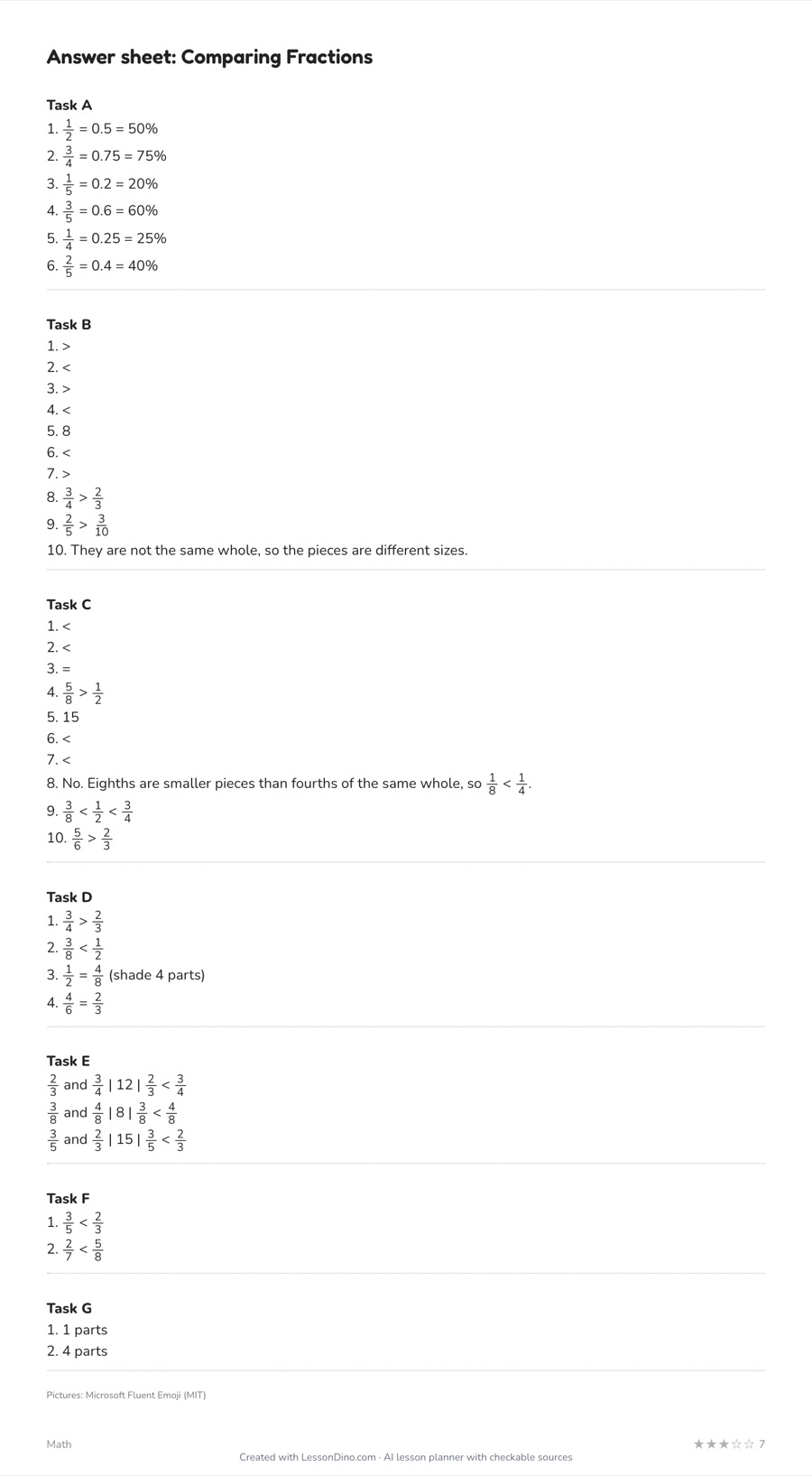
- The answer sheet is the last page, so you can print it on its own or let students check their own work.
Key vocabulary
- numerator: top number that tells how many parts you have
- denominator: bottom number that tells how many equal parts make one whole
- same whole: two pizzas that are exactly equal in size so the comparison is fair
- common denominator: same size parts used for both fractions so counts can be compared
- benchmark: a familiar amount like one-half used to judge other fractions
Mistakes to watch for
- Thinks bigger denominator means bigger fraction, like 1/8 > 1/4. Fold same-size strips for 1/2, 1/4, 1/8 to show larger denominator means smaller pieces.
- Compares numerators with different-sized pieces, like 2/3 < 3/5 because 2 < 3. Rewrite first with same denominator, then with same denominator the bigger numerator wins.
- Says 3/4 and 4/5 are equal because both are 1 piece away from whole. Shade same-size circles and rewrite as 15/20 vs 16/20 to show 4/5 is bigger; missing larger piece means smaller fraction.
What's on the worksheet
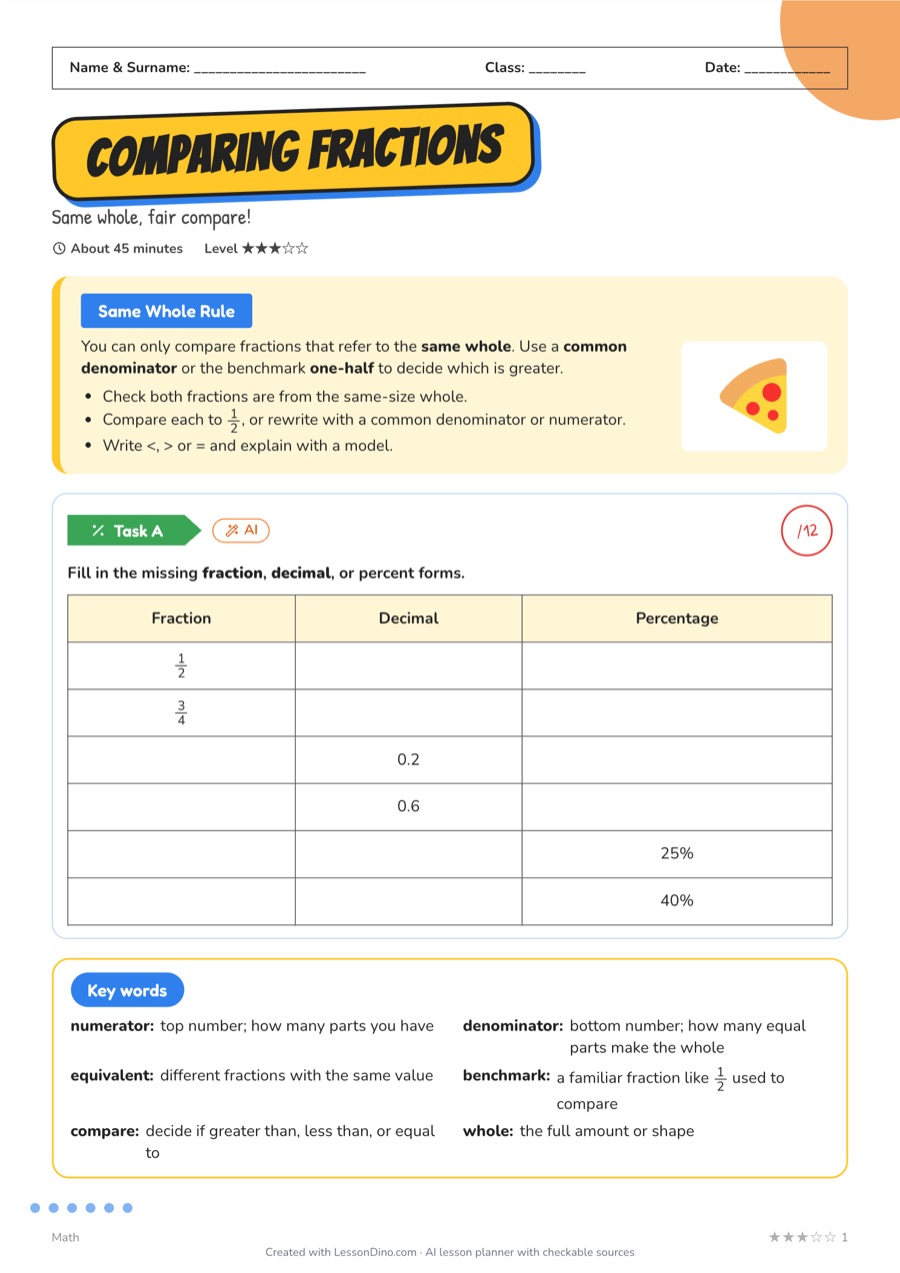
Fair Fraction Compare
Learn how to compare fractions from the same whole.
Same Whole Rule
- You can only compare fractions that refer to the same whole. Use a common denominator or the benchmark one-half to decide which is greater.
- Check both fractions are from the same-size whole.
- Compare each to 1/2, or rewrite with a common denominator or numerator.
- Write <, > or = and explain with a model.
Fill in the missing fraction, decimal, or percent forms.
| Word | Meaning |
|---|---|
| numerator | top number; how many parts you have |
| denominator | bottom number; how many equal parts make the whole |
| equivalent | different fractions with the same value |
| benchmark | a familiar fraction like 1/2 used to compare |
| compare | decide if greater than, less than, or equal to |
| whole | the full amount or shape |
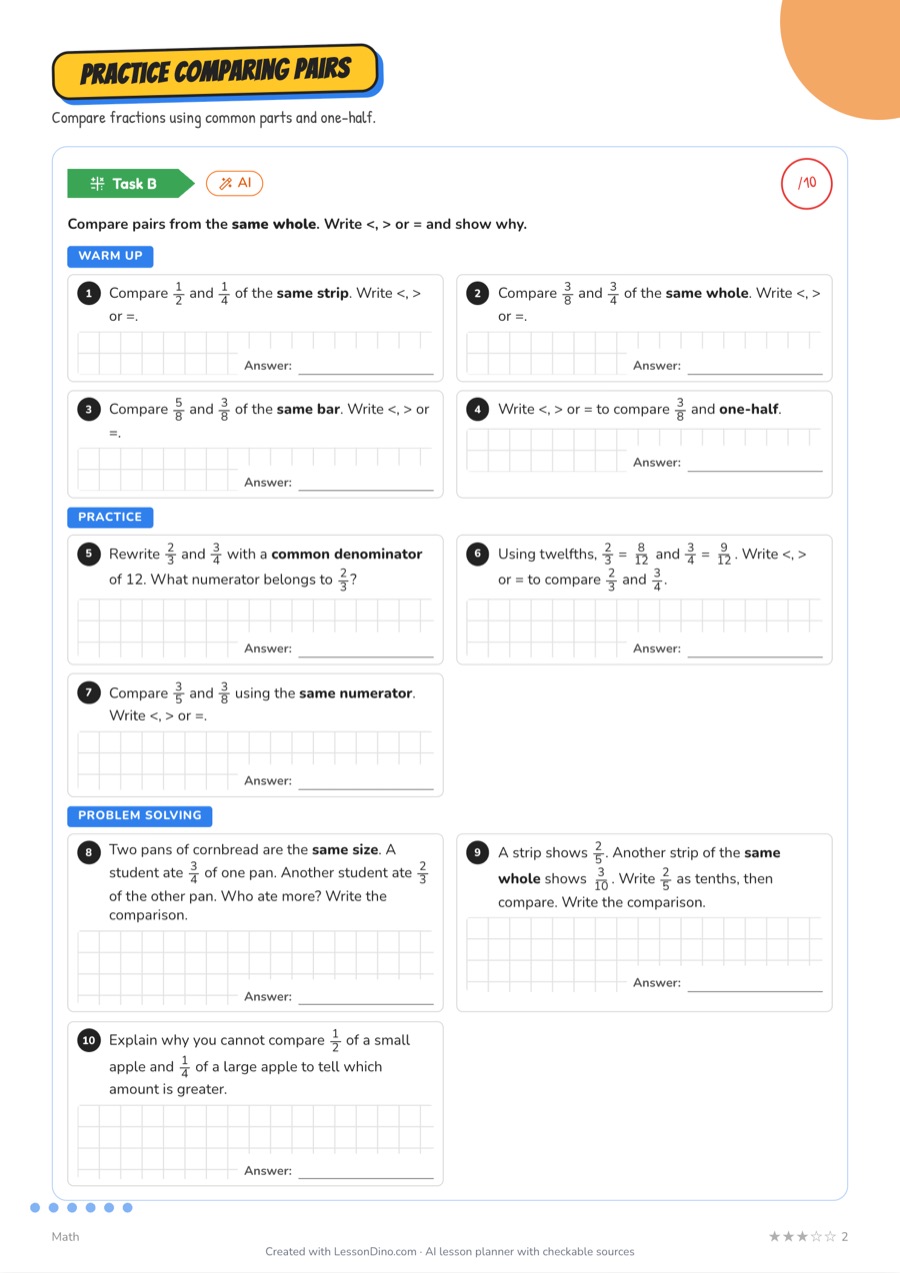
Practice Comparing Pairs
Compare fractions using common parts and one-half.
Compare pairs from the same whole. Write <, > or = and show why.
Warm up
- Compare 1/2 and 1/4 of the same strip. Write <, > or =.
- Compare 3/8 and 3/4 of the same whole. Write <, > or =.
- Compare 5/8 and 3/8 of the same bar. Write <, > or =.
- Write <, > or = to compare 3/8 and one-half.
Practice
- Rewrite 2/3 and 3/4 with a common denominator of 12. What numerator belongs to 2/3?
- Using twelfths, 2/3 = 8/12 and 3/4 = 9/12. Write <, > or = to compare 2/3 and 3/4.
- Compare 3/5 and 3/8 using the same numerator. Write <, > or =.
Problem solving
- Two pans of cornbread are the same size. A student ate 3/4 of one pan. Another student ate 2/3 of the other pan. Who ate more? Write the comparison.
- A strip shows 2/5. Another strip of the same whole shows 3/10. Write 2/5 as tenths, then compare. Write the comparison.
- Explain why you cannot compare 1/2 of a small apple and 1/4 of a large apple to tell which amount is greater.
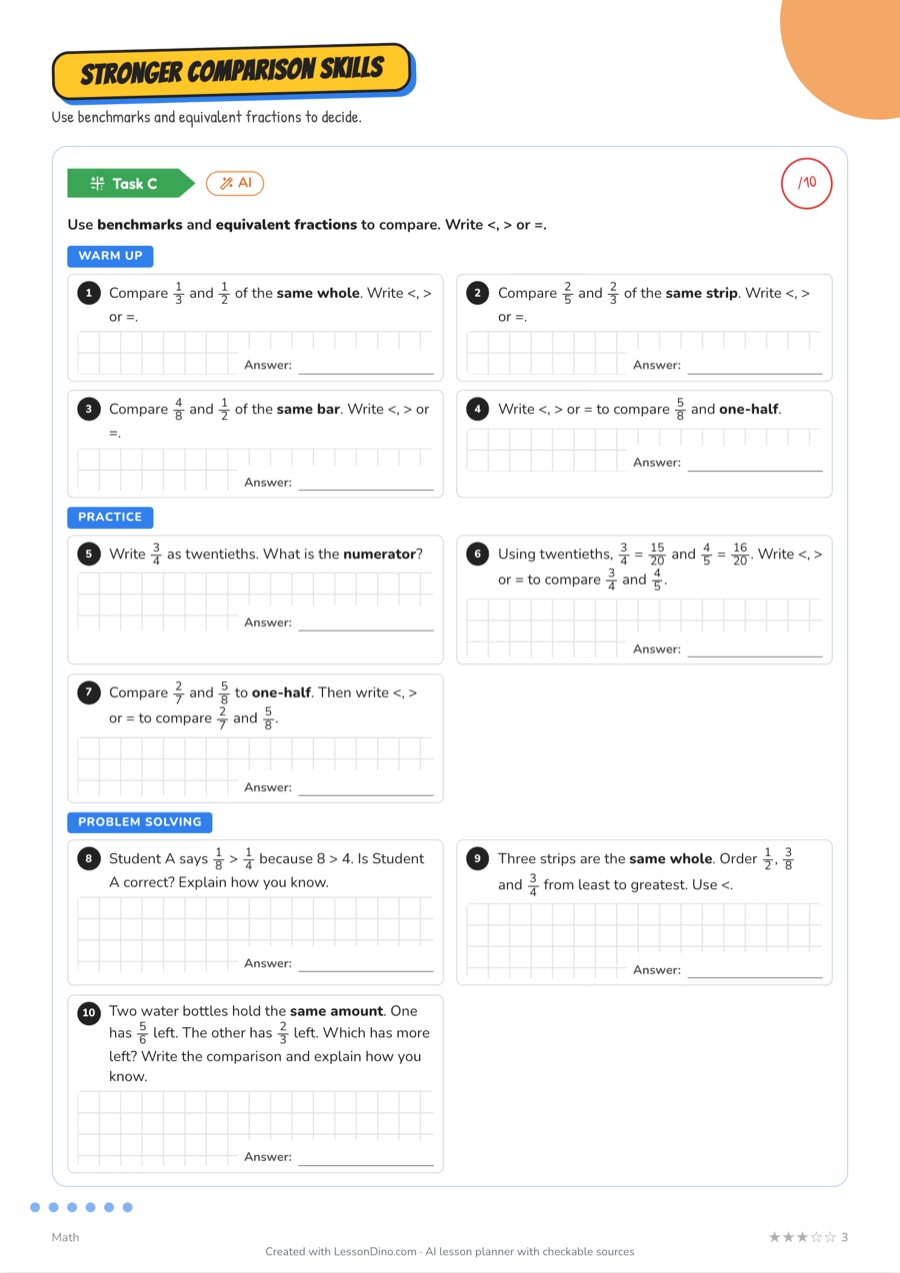
Stronger Comparison Skills
Use benchmarks and equivalent fractions to decide.
Use benchmarks and equivalent fractions to compare. Write <, > or =.
Warm up
- Compare 1/3 and 1/2 of the same whole. Write <, > or =.
- Compare 2/5 and 2/3 of the same strip. Write <, > or =.
- Compare 4/8 and 1/2 of the same bar. Write <, > or =.
- Write <, > or = to compare 5/8 and one-half.
Practice
- Write 3/4 as twentieths. What is the numerator?
- Using twentieths, 3/4 = 15/20 and 4/5 = 16/20. Write <, > or = to compare 3/4 and 4/5.
- Compare 2/7 and 5/8 to one-half. Then write <, > or = to compare 2/7 and 5/8.
Problem solving
- Student A says 1/8 > 1/4 because 8 > 4. Is Student A correct? Explain how you know.
- Three strips are the same whole. Order 1/2, 3/8 and 3/4 from least to greatest. Use <.
- Two water bottles hold the same amount. One has 5/6 left. The other has 2/3 left. Which has more left? Write the comparison and explain how you know.
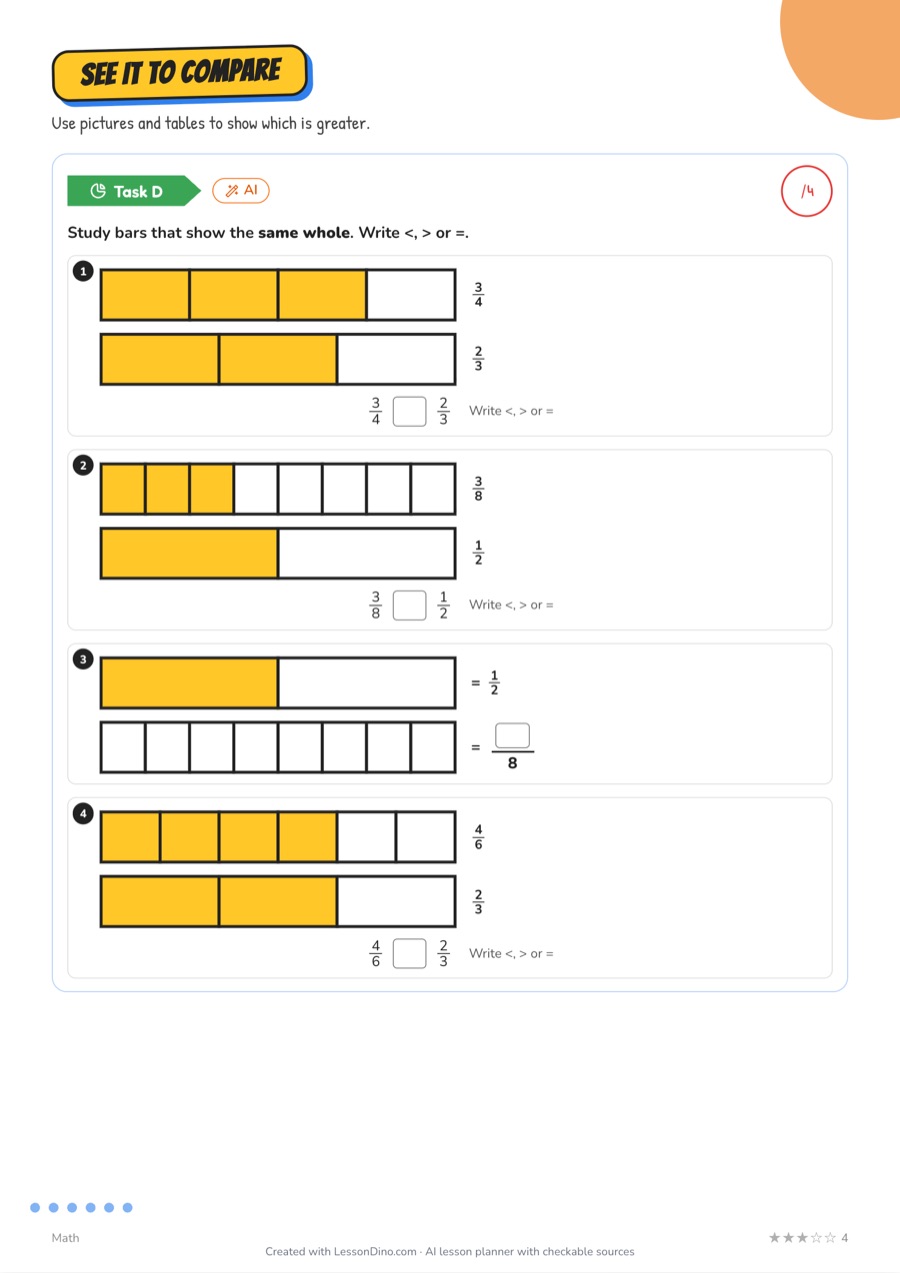
See It to Compare
Use pictures and tables to show which is greater.
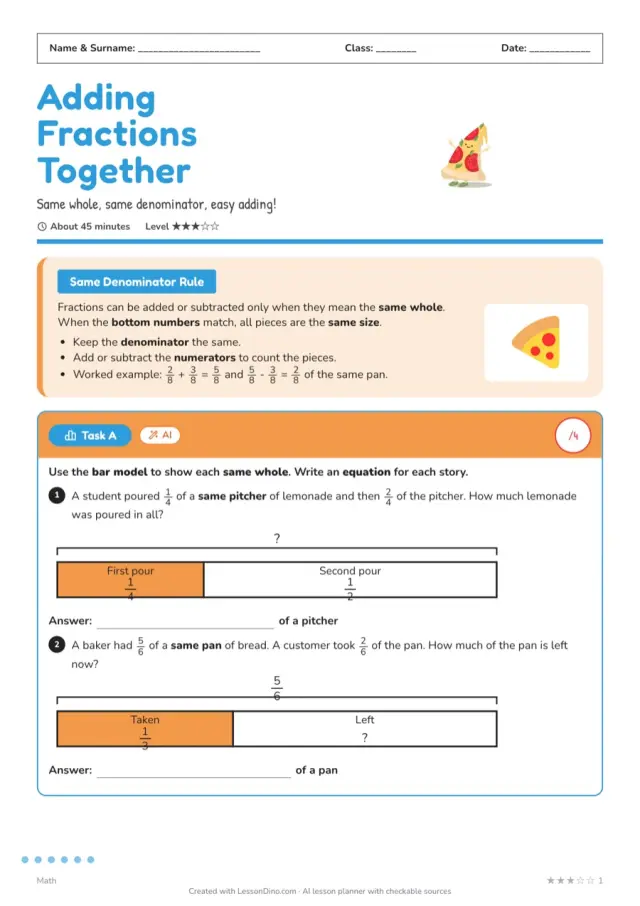
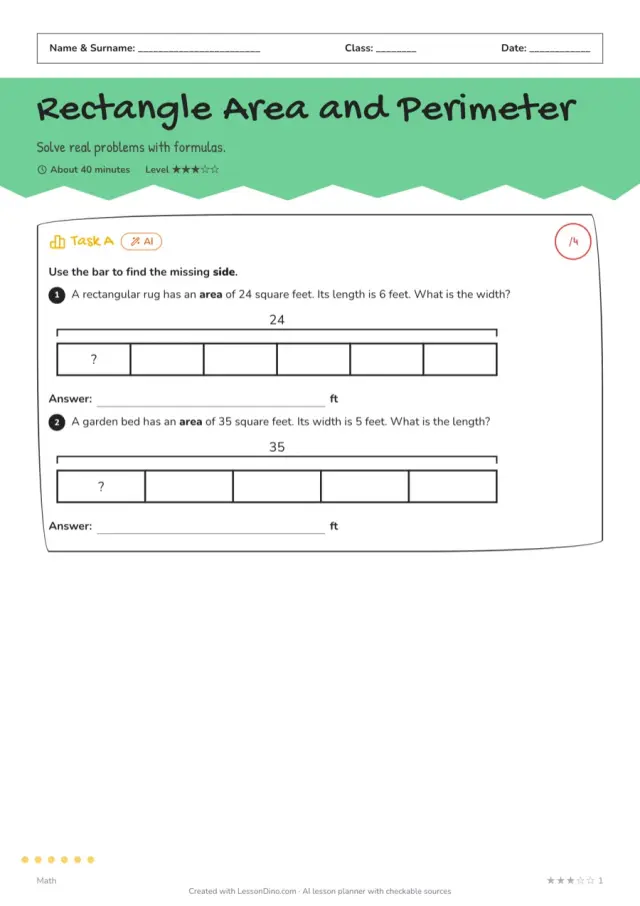
Study bars that show the same whole. Write <, > or =.
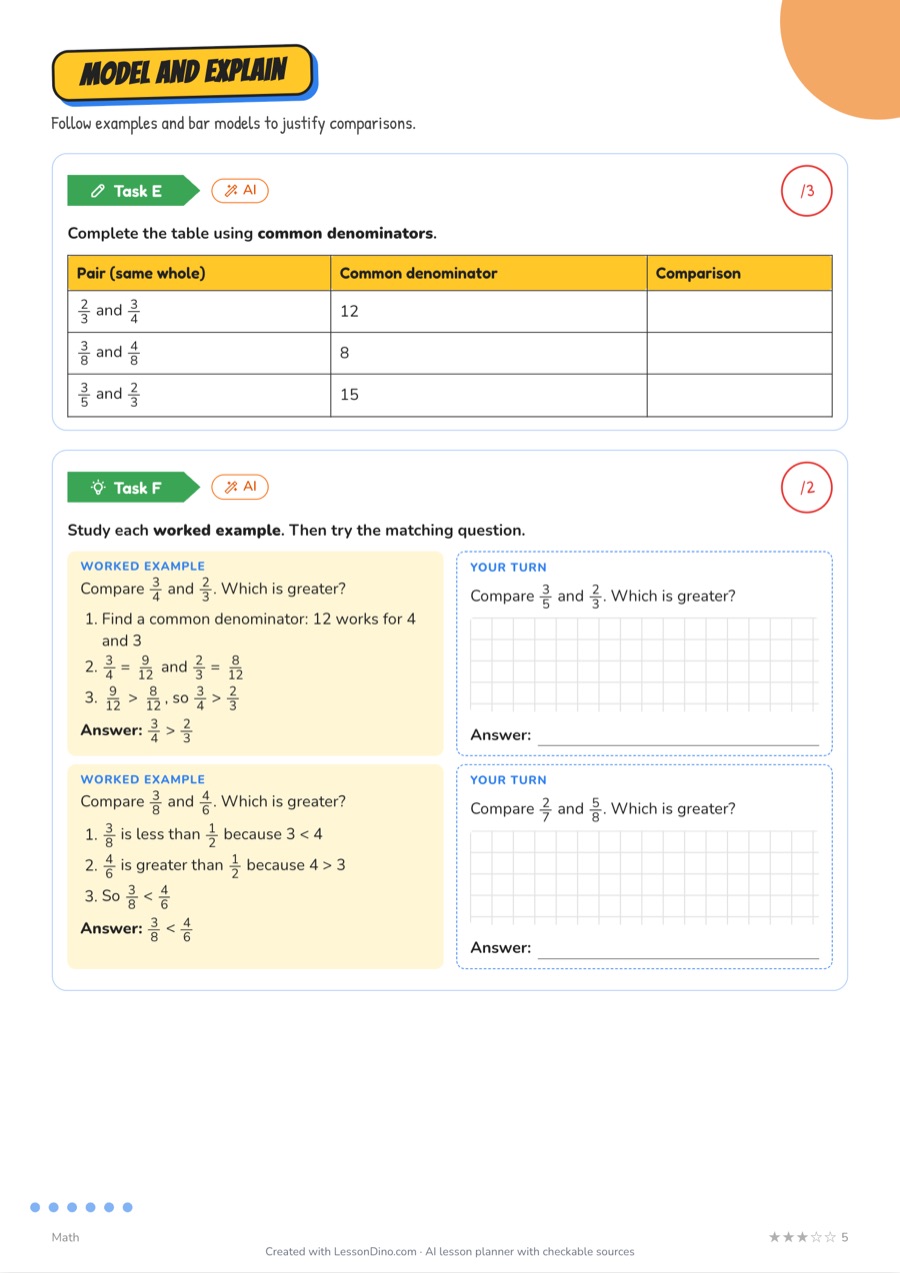
Model and Explain
Follow examples and bar models to justify comparisons.
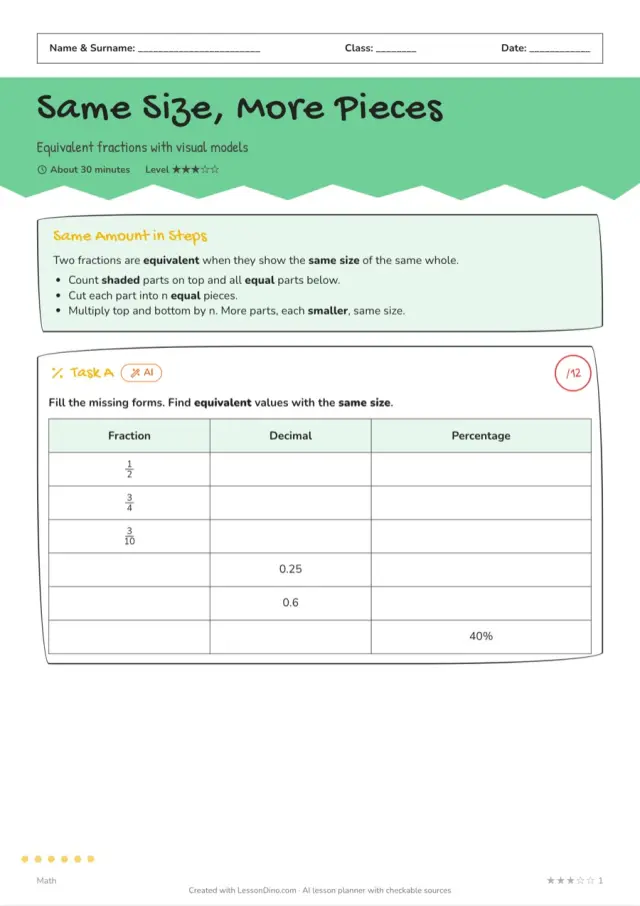
Complete the table using common denominators.
Study each worked example. Then try the matching question.
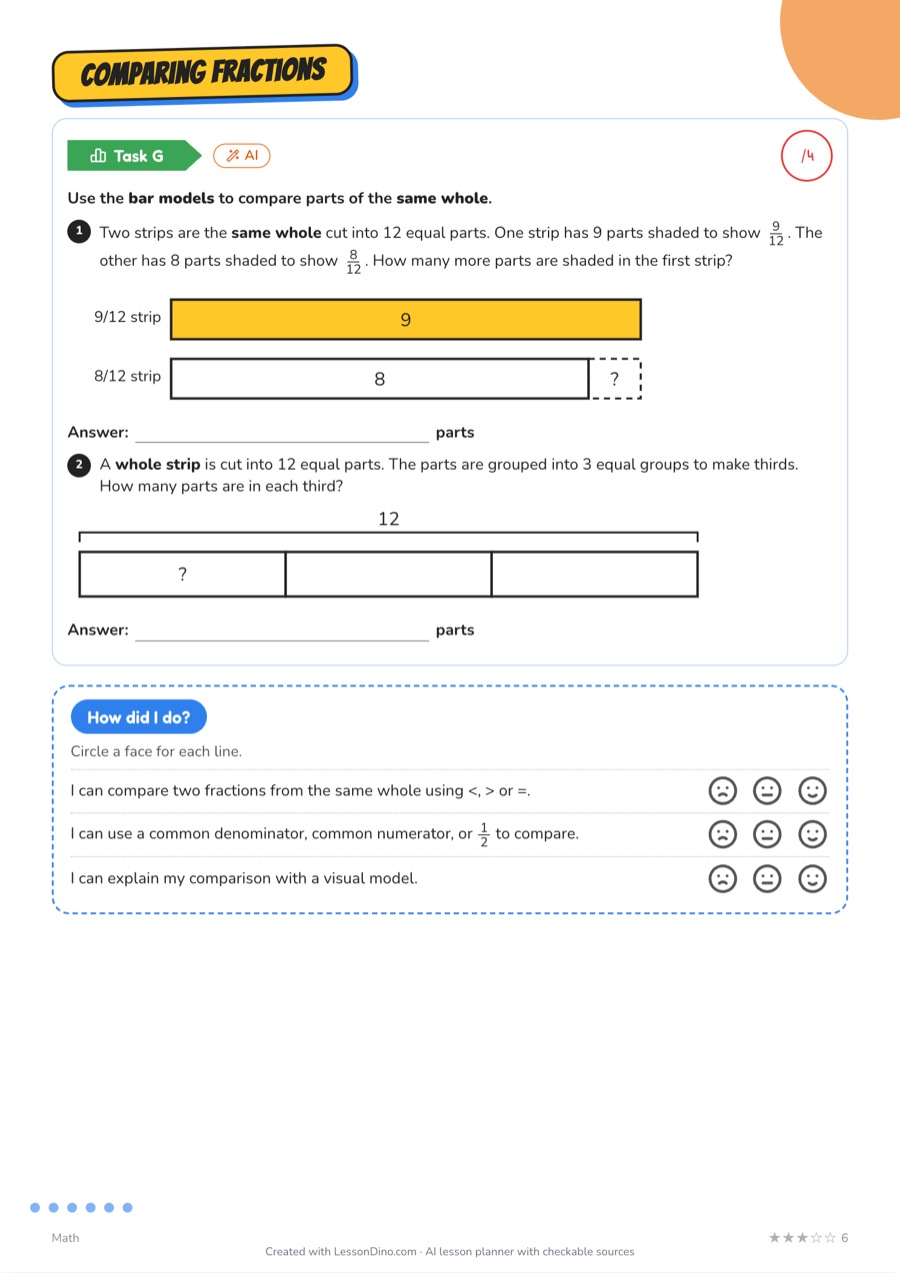
Page 6
Use the bar models to compare parts of the same whole.
Answers
Show the answers
- Compare 1/2 and 1/4 of the same strip. Write <, > or =. >
- Compare 3/8 and 3/4 of the same whole. Write <, > or =. <
- Compare 5/8 and 3/8 of the same bar. Write <, > or =. >
- Write <, > or = to compare 3/8 and one-half. <
- Rewrite 2/3 and 3/4 with a common denominator of 12. What numerator belongs to 2/3? 8
- Using twelfths, 2/3 = 8/12 and 3/4 = 9/12. Write <, > or = to compare 2/3 and 3/4. <
- Compare 3/5 and 3/8 using the same numerator. Write <, > or =. >
- Two pans of cornbread are the same size. A student ate 3/4 of one pan. Another student ate 2/3 of the other pan. Who ate more? Write the comparison. 3/4 > 2/3
- A strip shows 2/5. Another strip of the same whole shows 3/10. Write 2/5 as tenths, then compare. Write the comparison. 2/5 > 3/10
- Explain why you cannot compare 1/2 of a small apple and 1/4 of a large apple to tell which amount is greater. They are not the same whole, so the pieces are different sizes.
- Compare 1/3 and 1/2 of the same whole. Write <, > or =. <
- Compare 2/5 and 2/3 of the same strip. Write <, > or =. <
- Compare 4/8 and 1/2 of the same bar. Write <, > or =. =
- Write <, > or = to compare 5/8 and one-half. 5/8 > 1/2
- Write 3/4 as twentieths. What is the numerator? 15
- Using twentieths, 3/4 = 15/20 and 4/5 = 16/20. Write <, > or = to compare 3/4 and 4/5. <
- Compare 2/7 and 5/8 to one-half. Then write <, > or = to compare 2/7 and 5/8. <
- Student A says 1/8 > 1/4 because 8 > 4. Is Student A correct? Explain how you know. No. Eighths are smaller pieces than fourths of the same whole, so 1/8 < 1/4.
- Three strips are the same whole. Order 1/2, 3/8 and 3/4 from least to greatest. Use <. 3/8 < 1/2 < 3/4
- Two water bottles hold the same amount. One has 5/6 left. The other has 2/3 left. Which has more left? Write the comparison and explain how you know. 5/6 > 2/3
The answer sheet is the last picture above.
Curriculum
Compare two fractions with different numerators and different denominators, e.g., by creating common denominators or numerators, or by comparing to a benchmark fraction such as 1/2. Recognize that comparisons are valid only when the two fractions refer to the same whole. Record the results of comparisons with symbols >, =, or <, and justify the conclusions, e.g., by using a visual fraction model.
Made with Lesson Dino's AI on 16 October 2026. AI can make mistakes, so check the answers and facts against the sources before you teach.