The worksheet
About this worksheet
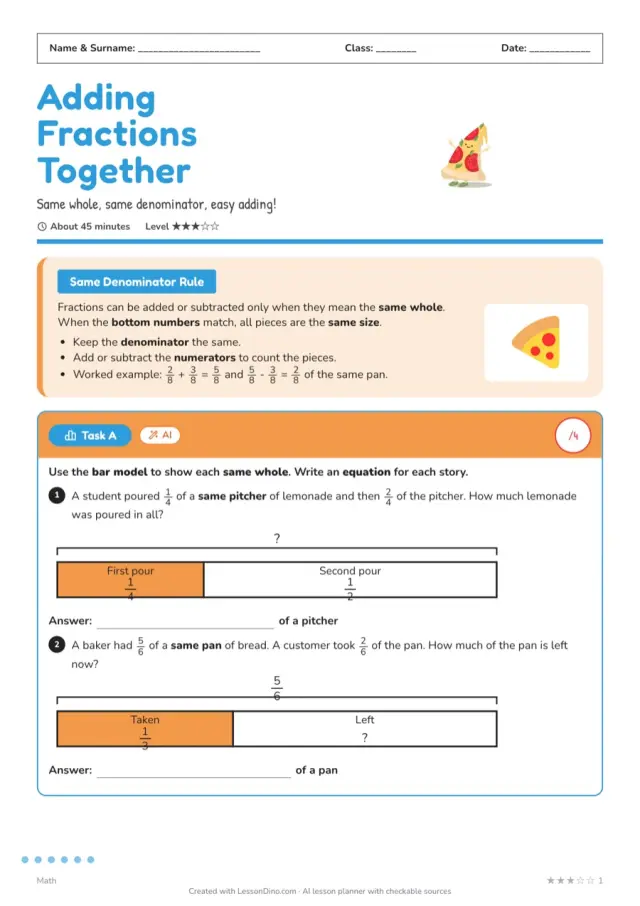
Students learn why multiplying top and bottom by the same number keeps the value. They draw models to prove and make equivalent fractions. This Grade 4 Math worksheet gives students (ages 9–10) seven pages of practice on equivalent fractions, part of the number and operations: fractions unit. It goes with our free Equivalent fractions lesson, which has the slides and a timed lesson plan.
What it covers
By the end, students should be able to:
- Students will draw visual models that prove two fractions are equal.
- Students will explain why a/b equals (n x a)/(n x b) using number and size of parts.
- Students will recognize and generate equivalent fractions by multiplying top and bottom.
How to use it
- Main activity (20 minutes): Hand out grid paper, colored pencils, rulers, and Worksheet Task C.
- Support: Provide outlines already split into thirds so students only add the second cut and count.
- Stretch: Have students draw a third version showing 6/9 and write the multiplication used.
- The answer sheet is the last page, so you can print it on its own or let students check their own work.
Key vocabulary
- equivalent: having the same value while looking different, like 1/2 = 2/4
- numerator: top number that counts shaded parts
- denominator: bottom number that counts all equal parts in the whole
- whole: the full shape or amount we start with
Mistakes to watch for
- Thinking 2/4 is bigger than 1/2 because 2 > 1 and 4 > 2. Overlay same-size bars to show same shaded size and stress more parts means smaller parts.
- Changing only the numerator or only the denominator. Recount both: each old part cut into n pieces, so both counts times n, which models (n x a)/(n x b).
- Adding the same number instead of multiplying, like 2/3 = 4/5. Show with drawing that adding breaks equal cuts; you only multiply or divide top and bottom by the same amount to keep the value.
What's on the worksheet
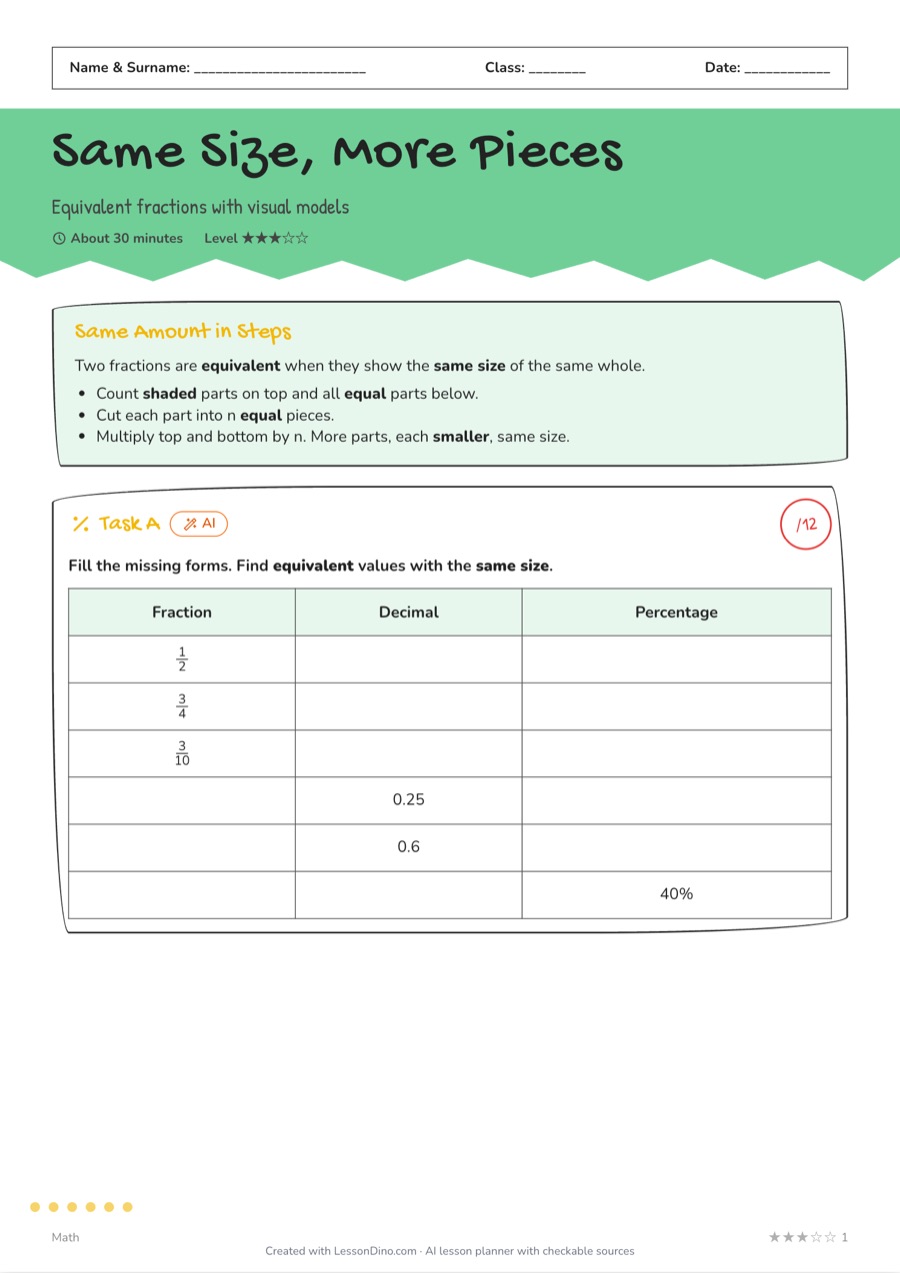
Same Size Pieces
See why more parts can show the same amount.
Same Amount in Steps
- Two fractions are equivalent when they show the same size of the same whole.
- Count shaded parts on top and all equal parts below.
- Cut each part into n equal pieces.
- Multiply top and bottom by n. More parts, each smaller, same size.
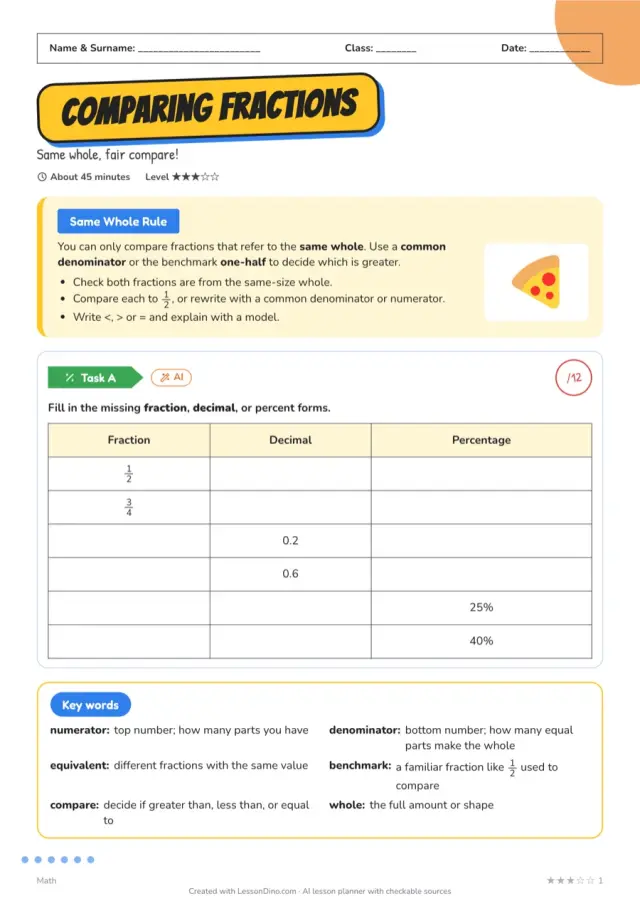
Fill the missing forms. Find equivalent values with the same size.
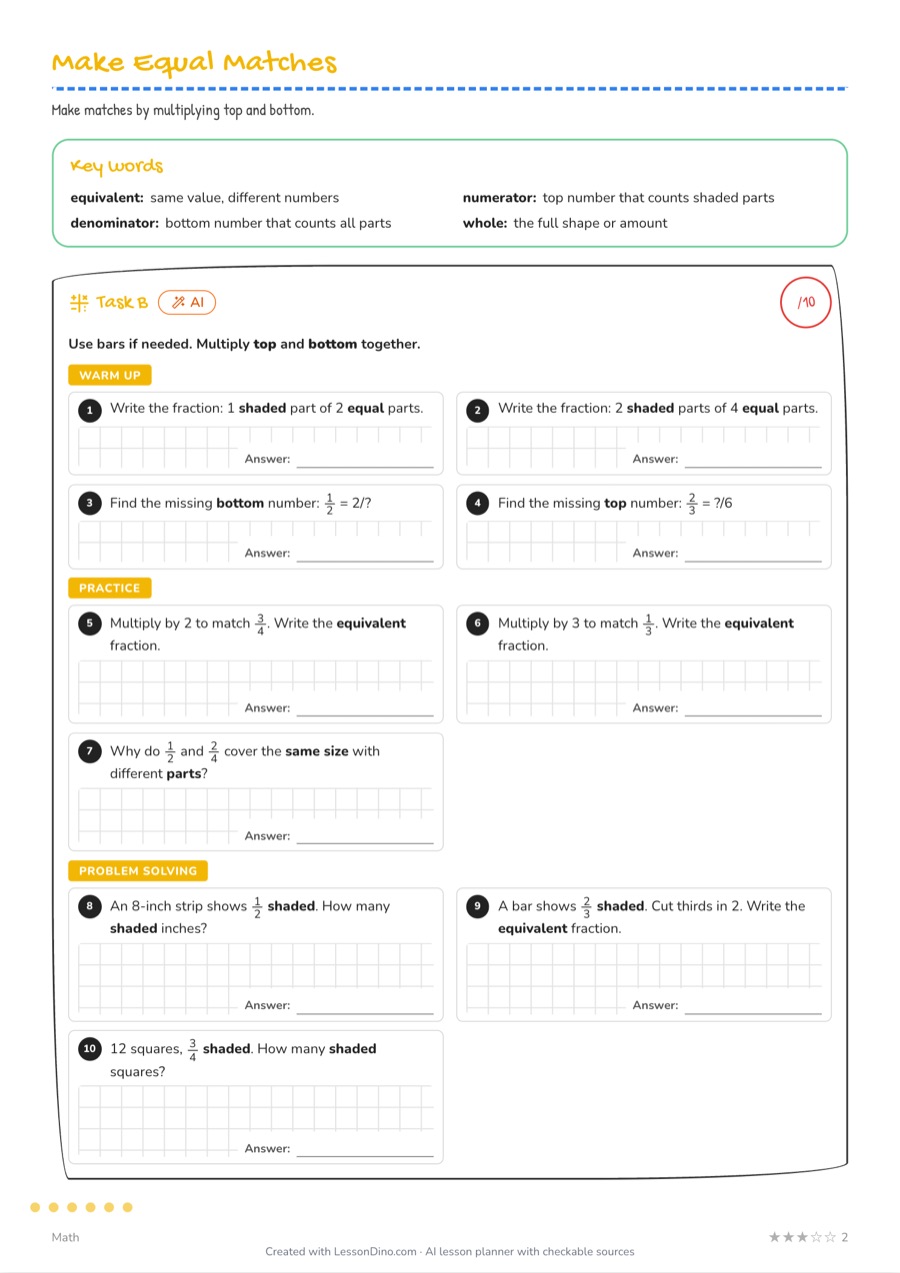
Make Equal Matches
Make matches by multiplying top and bottom.
| Word | Meaning |
|---|---|
| equivalent | same value, different numbers |
| numerator | top number that counts shaded parts |
| denominator | bottom number that counts all parts |
| whole | the full shape or amount |
Use bars if needed. Multiply top and bottom together.
Warm up
- Write the fraction: 1 shaded part of 2 equal parts.
- Write the fraction: 2 shaded parts of 4 equal parts.
- Find the missing bottom number: 1/2 = 2/?
- Find the missing top number: 2/3 = ?/6
Practice
- Multiply by 2 to match 3/4. Write the equivalent fraction.
- Multiply by 3 to match 1/3. Write the equivalent fraction.
- Why do 1/2 and 2/4 cover the same size with different parts?
Problem solving
- An 8-inch strip shows 1/2 shaded. How many shaded inches?
- A bar shows 2/3 shaded. Cut thirds in 2. Write the equivalent fraction.
- 12 squares, 3/4 shaded. How many shaded squares?
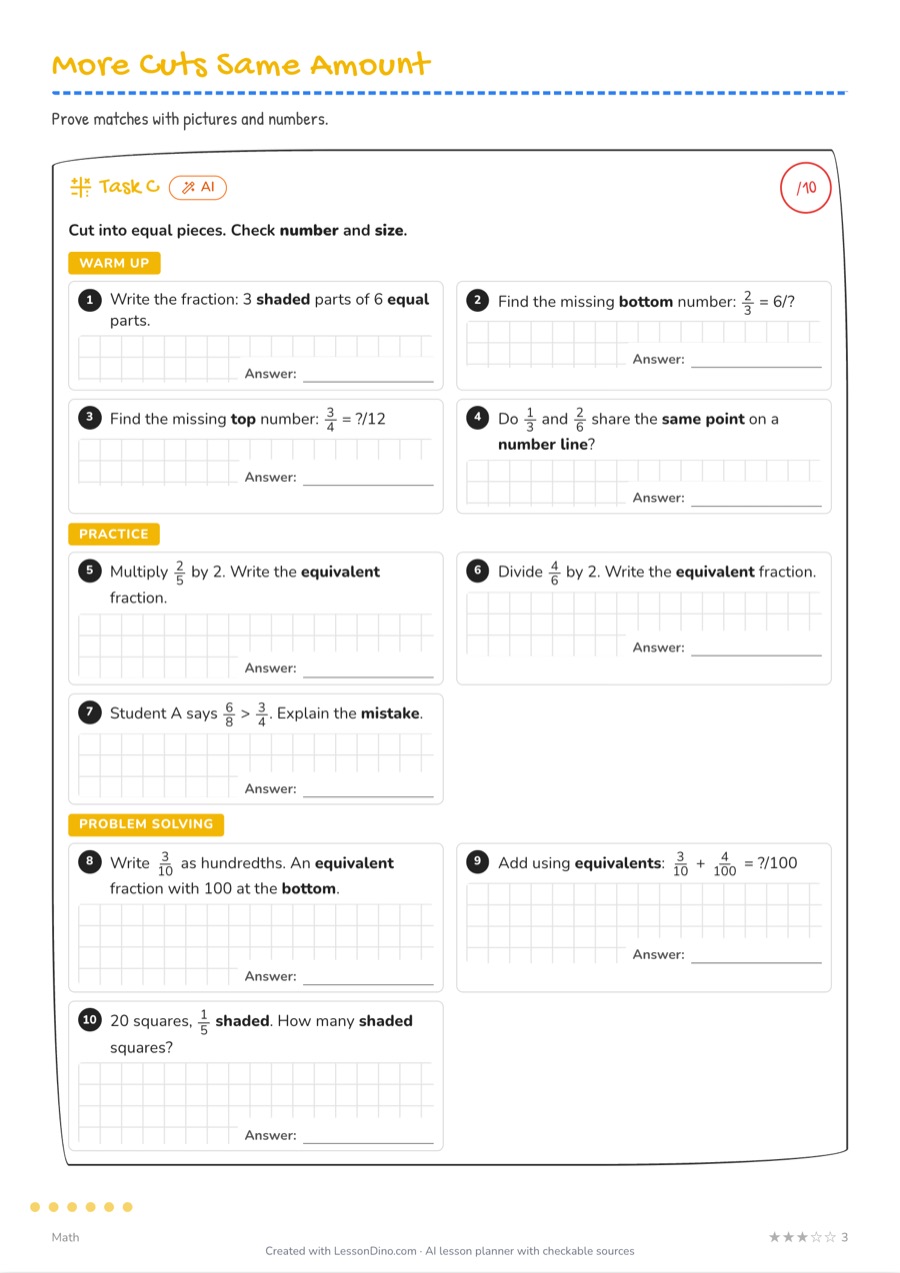
More Cuts Same Amount
Prove matches with pictures and numbers.
Cut into equal pieces. Check number and size.
Warm up
- Write the fraction: 3 shaded parts of 6 equal parts.
- Find the missing bottom number: 2/3 = 6/?
- Find the missing top number: 3/4 = ?/12
- Do 1/3 and 2/6 share the same point on a number line?
Practice
- Multiply 2/5 by 2. Write the equivalent fraction.
- Divide 4/6 by 2. Write the equivalent fraction.
- Student A says 6/8 > 3/4. Explain the mistake.
Problem solving
- Write 3/10 as hundredths. An equivalent fraction with 100 at the bottom.
- Add using equivalents: 3/10 + 4/100 = ?/100
- 20 squares, 1/5 shaded. How many shaded squares?
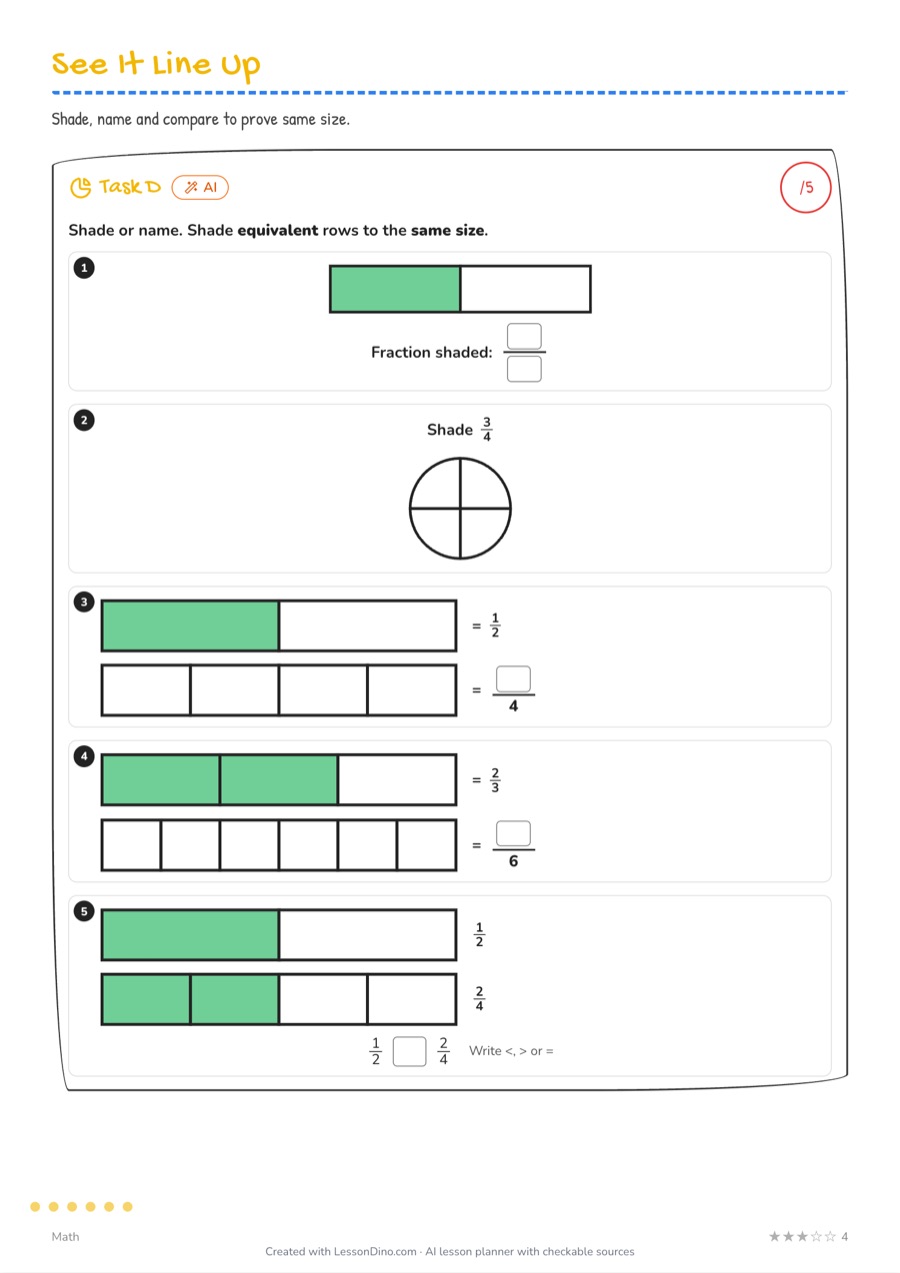
See It Line Up
Shade, name and compare to prove same size.
Shade or name. Shade equivalent rows to the same size.
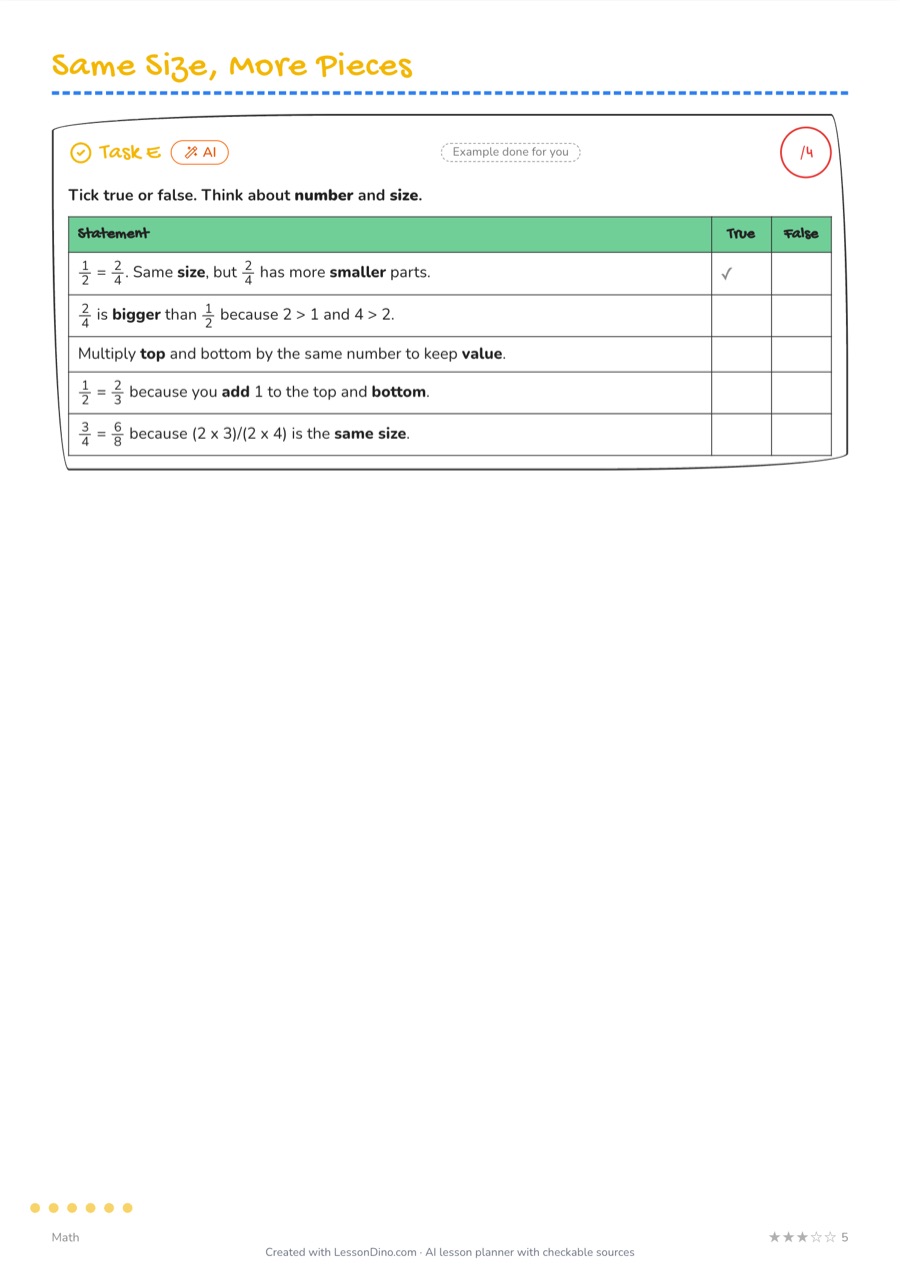
Page 5
Tick true or false. Think about number and size.
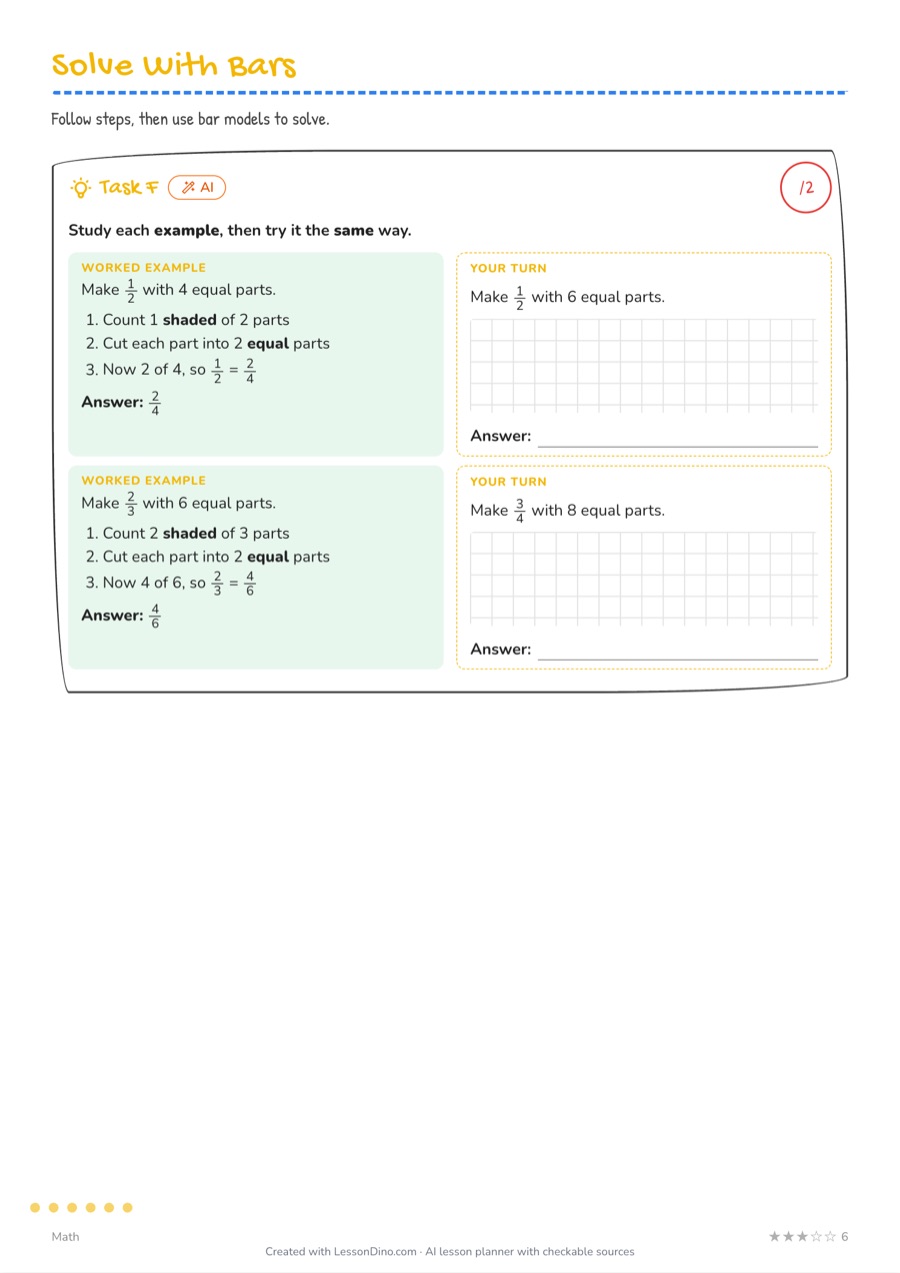
Solve With Bars
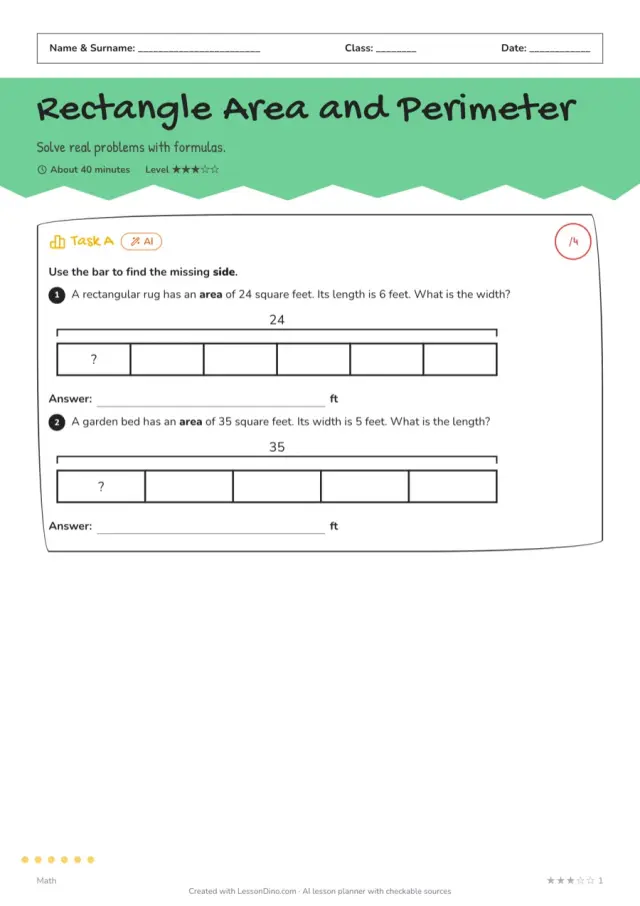
Follow steps, then use bar models to solve.
Study each example, then try it the same way.
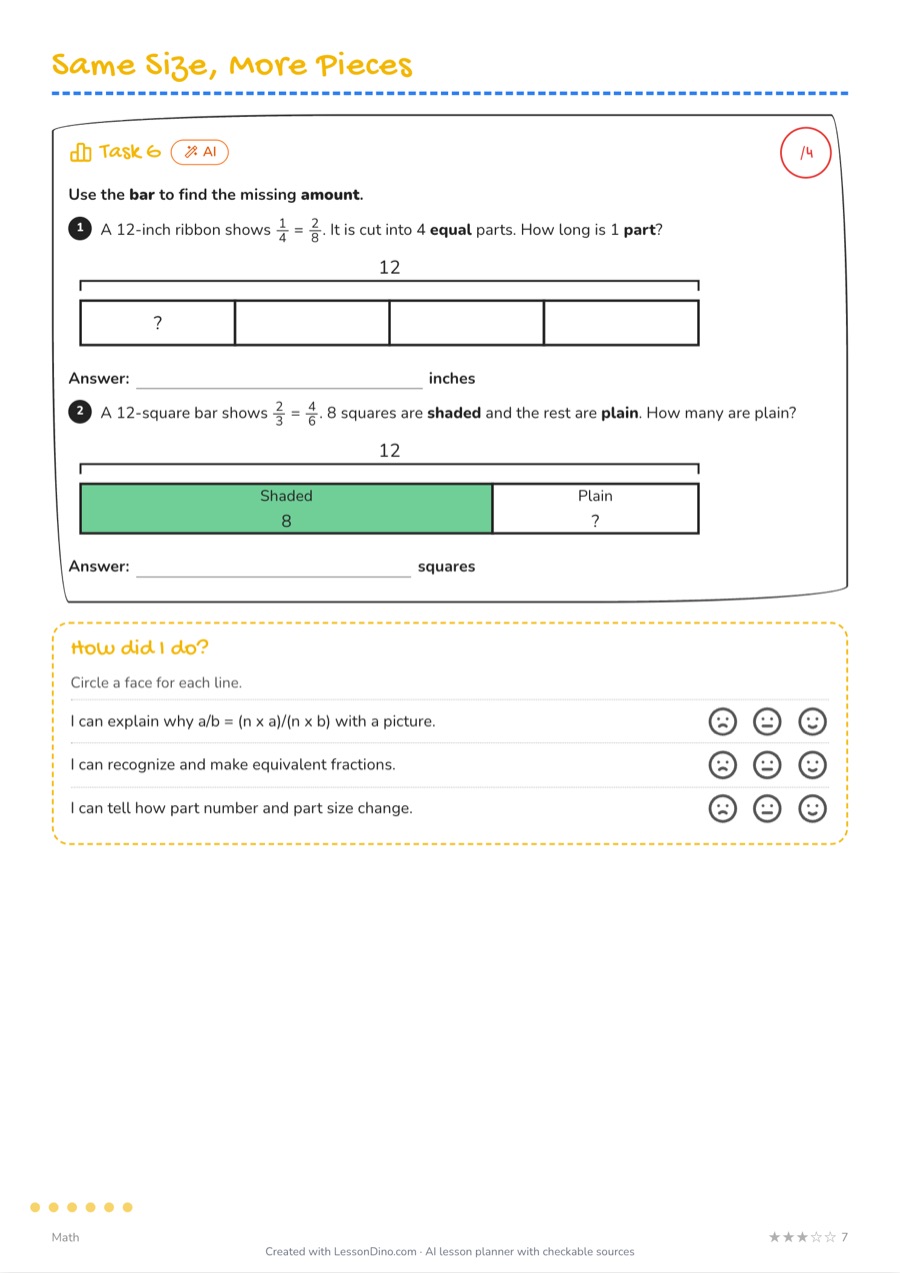
Page 7
Use the bar to find the missing amount.
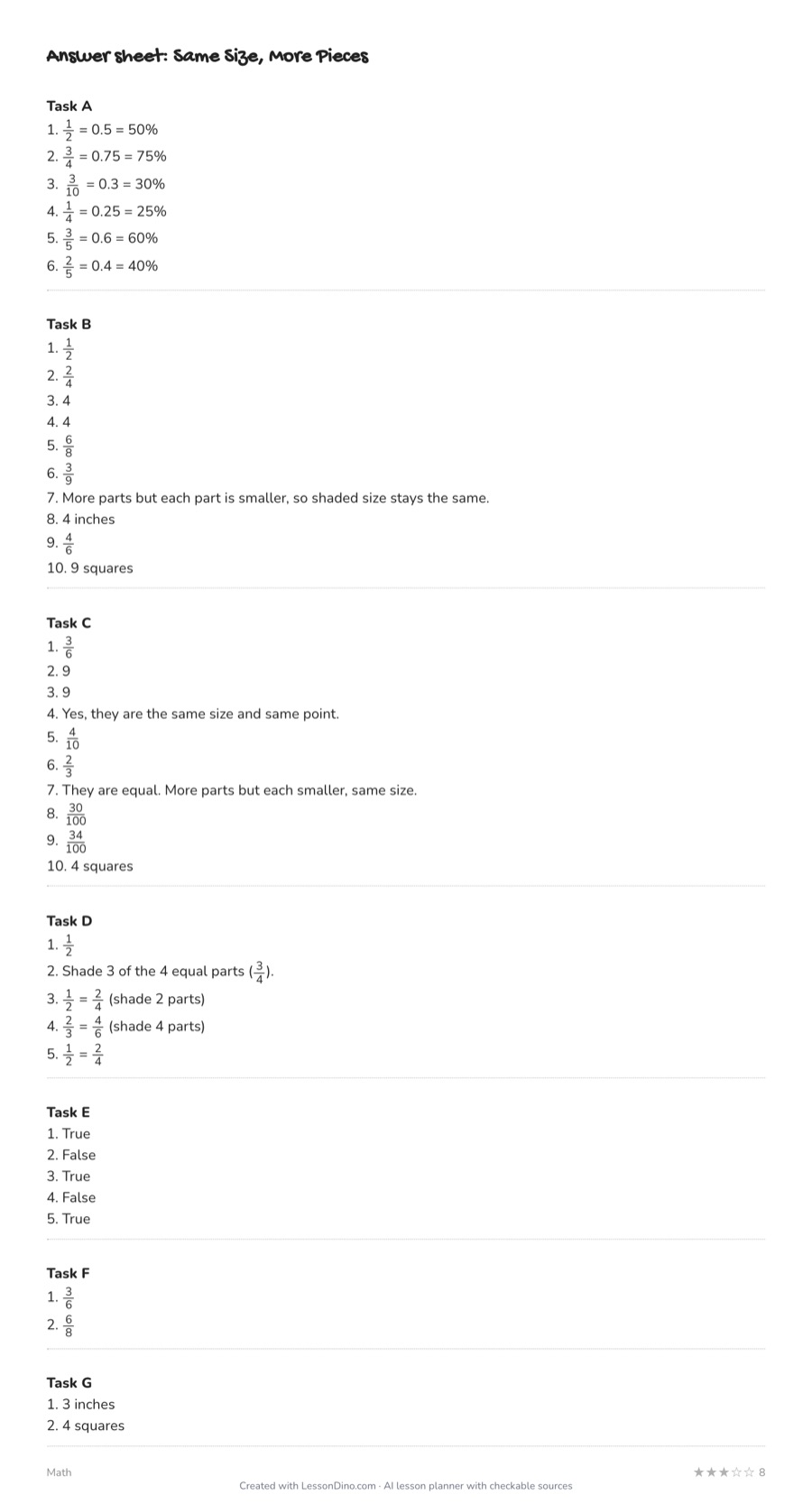
Answers
Show the answers
- Write the fraction: 1 shaded part of 2 equal parts. 1/2
- Write the fraction: 2 shaded parts of 4 equal parts. 2/4
- Find the missing bottom number: 1/2 = 2/? 4
- Find the missing top number: 2/3 = ?/6 4
- Multiply by 2 to match 3/4. Write the equivalent fraction. 6/8
- Multiply by 3 to match 1/3. Write the equivalent fraction. 3/9
- Why do 1/2 and 2/4 cover the same size with different parts? More parts but each part is smaller, so shaded size stays the same.
- An 8-inch strip shows 1/2 shaded. How many shaded inches? 4 inches
- A bar shows 2/3 shaded. Cut thirds in 2. Write the equivalent fraction. 4/6
- 12 squares, 3/4 shaded. How many shaded squares? 9 squares
- Write the fraction: 3 shaded parts of 6 equal parts. 3/6
- Find the missing bottom number: 2/3 = 6/? 9
- Find the missing top number: 3/4 = ?/12 9
- Do 1/3 and 2/6 share the same point on a number line? Yes, they are the same size and same point.
- Multiply 2/5 by 2. Write the equivalent fraction. 4/10
- Divide 4/6 by 2. Write the equivalent fraction. 2/3
- Student A says 6/8 > 3/4. Explain the mistake. They are equal. More parts but each smaller, same size.
- Write 3/10 as hundredths. An equivalent fraction with 100 at the bottom. 30/100
- Add using equivalents: 3/10 + 4/100 = ?/100 34/100
- 20 squares, 1/5 shaded. How many shaded squares? 4 squares
The answer sheet is the last picture above.
Curriculum
Explain why a fraction a/b is equivalent to a fraction (n × a)/(n × b) by using visual fraction models, with attention to how the number and size of the parts differ even though the two fractions themselves are the same size. Use this principle to recognize and generate equivalent fractions.
Made with Lesson Dino's AI on 17 October 2026. AI can make mistakes, so check the answers and facts against the sources before you teach.