The worksheet
About this worksheet
Students learn to add and subtract like-denominator fractions from the same whole. They build bar models with strips and write matching equations. This Grade 4 Math worksheet gives students (ages 9–10) six pages of practice on adding fractions, part of the number and operations—fractions unit. It goes with our free Adding fractions lesson, which has the slides and a timed lesson plan.
What it covers
By the end, students should be able to:
- Students will solve addition word problems with like denominators using a model and an equation.
- Students will solve subtraction word problems with like denominators using a model and an equation.
- Students will explain why fractions must refer to the same whole to add or subtract.
How to use it
- Plenary (10 minutes): Link answers back to objectives and collect Worksheet Task A.
- Support: Give strips already shaded for 3/8 and 2/8 so students only join and count them.
- Stretch: Give a total greater than 1 whole to model and rename, like 7/8 + 6/8.
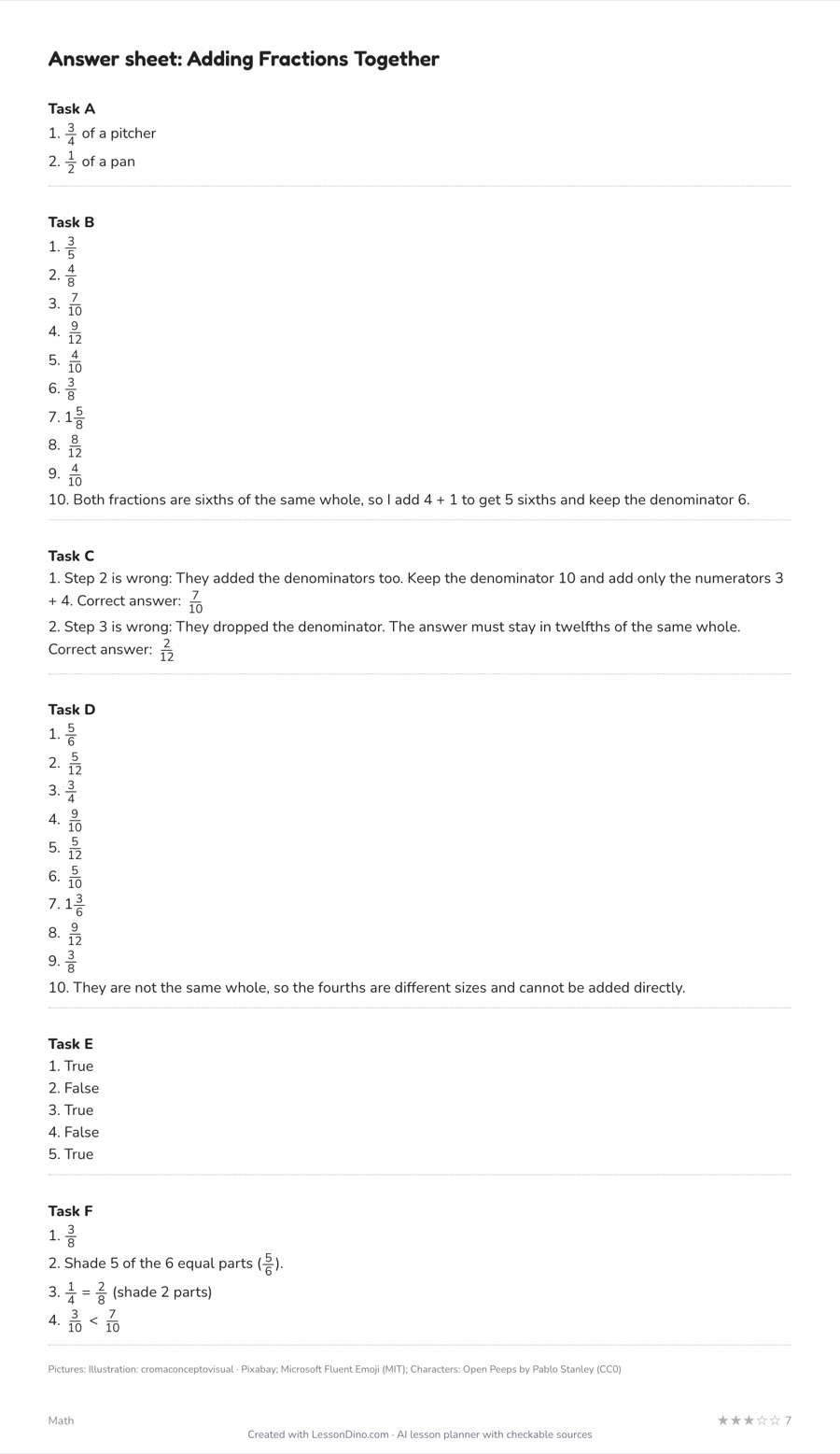
- The answer sheet is the last page, so you can print it on its own or let students check their own work.
Key vocabulary
- fraction: a part of one whole thing, like 3/8 of a pan
- numerator: top number; how many pieces we count
- denominator: bottom number; how big the pieces are
- same whole: one pan or ribbon that does not change size
- equation: numbers and an = sign that show the math work
Mistakes to watch for
- Adding or subtracting bottom numbers, e.g., 2/7 + 3/7 = 5/14. Remodel eighths or sevenths and count tops only, because same bottom means same size, so you only count tops. Adding fractions with the same denominator is like adding apples.
- Combining fractions from different-size wholes, e.g., two different pans. Place wholes side by side to show size gap. Remind that fractions represent parts of a whole, so both parts must come from one same-size whole.
- Writing the equation without a model check, wrong operation for the story. Underline take-away words vs joining words, then match to model: add shaded parts or cross out parts. Simply add or subtract to find the total number of slices when slices are all the same kind.
What's on the worksheet
Same Whole Adding
Learn the rule for adding and subtracting like fractions.
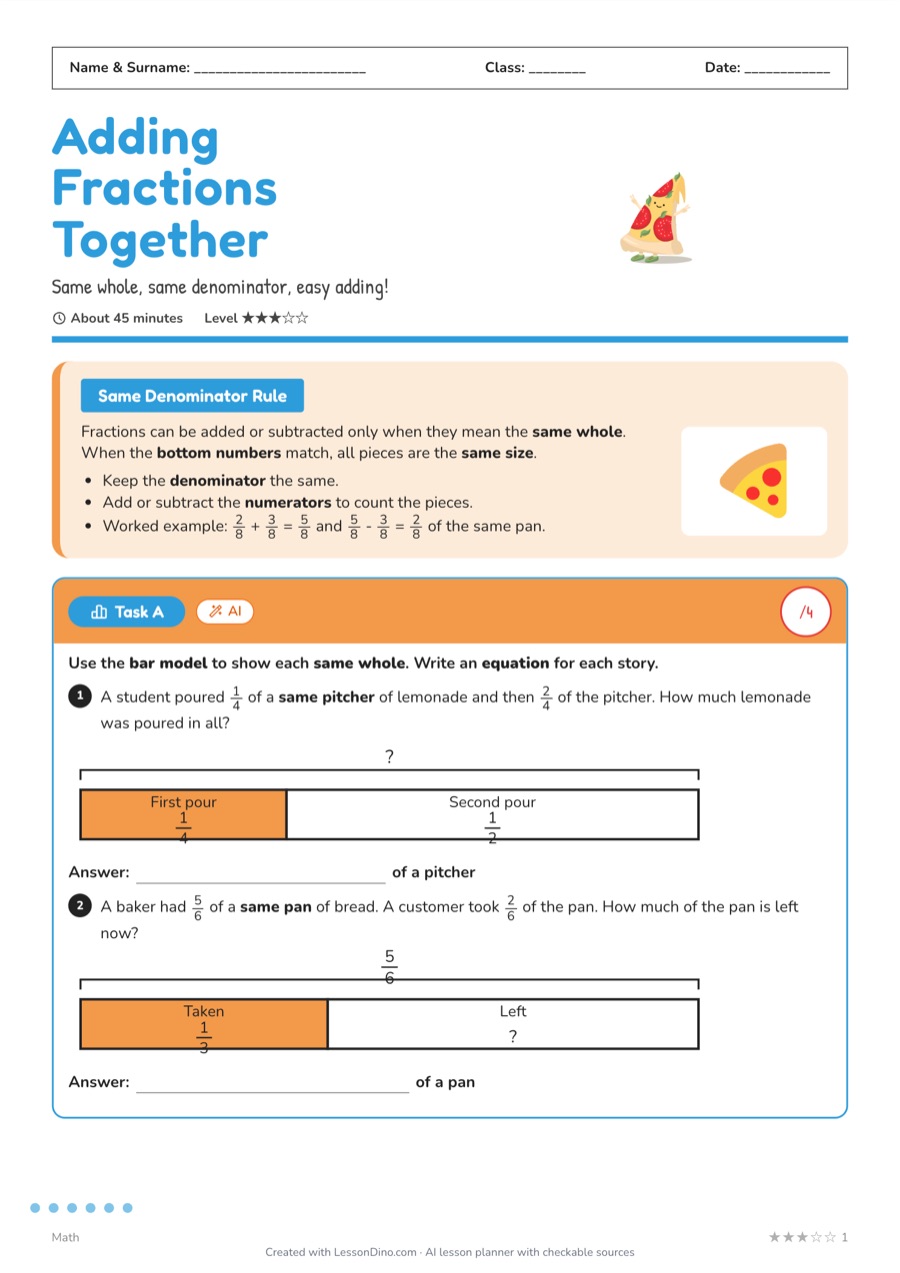
Same Denominator Rule
- Fractions can be added or subtracted only when they mean the same whole. When the bottom numbers match, all pieces are the same size.
- Keep the denominator the same.
- Add or subtract the numerators to count the pieces.
- Worked example: 2/8 + 3/8 = 5/8 and 5/8 - 3/8 = 2/8 of the same pan.
Use the bar model to show each same whole. Write an equation for each story.
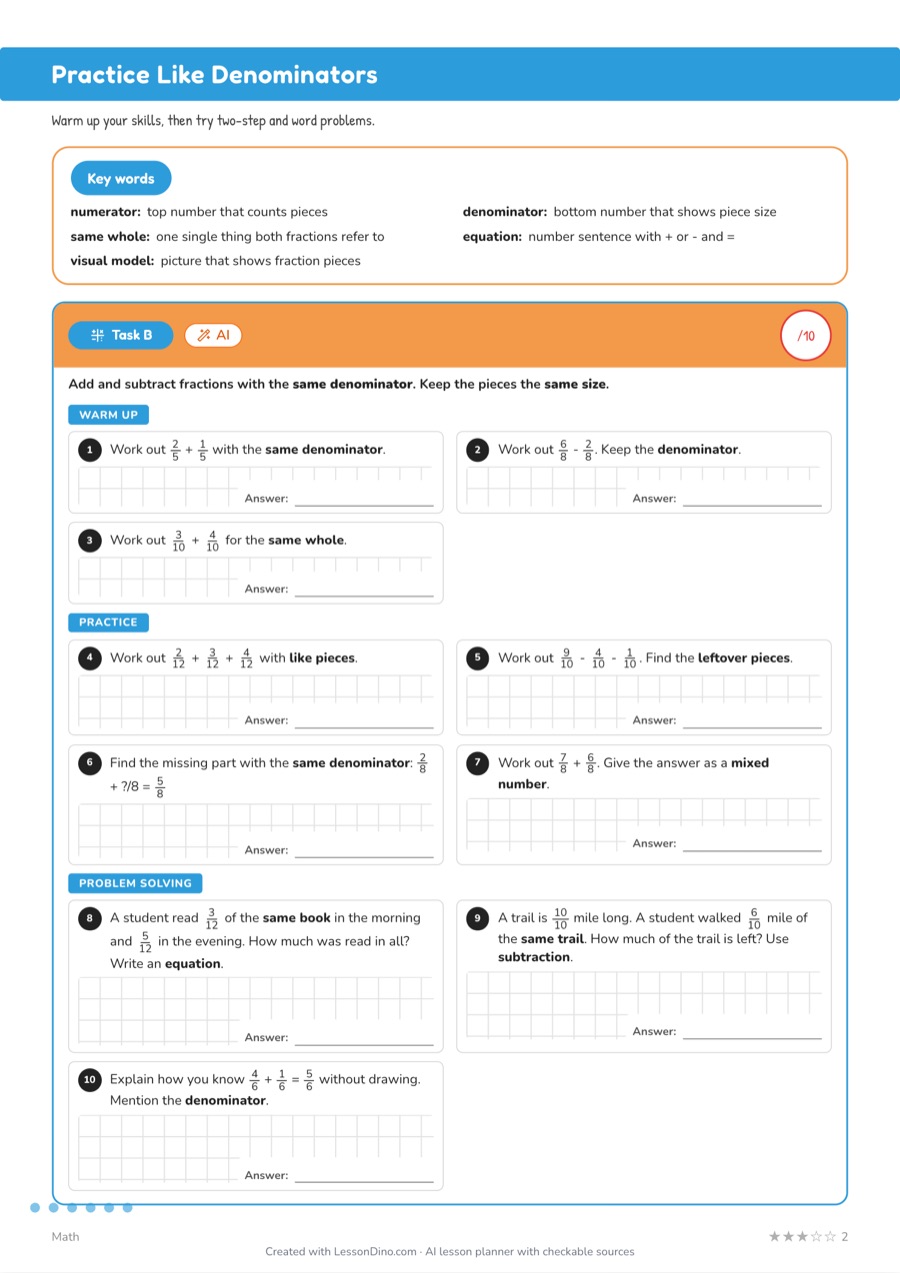
Practice Like Denominators
Warm up your skills, then try two-step and word problems.
| Word | Meaning |
|---|---|
| numerator | top number that counts pieces |
| denominator | bottom number that shows piece size |
| same whole | one single thing both fractions refer to |
| equation | number sentence with + or - and = |
| visual model | picture that shows fraction pieces |
Add and subtract fractions with the same denominator. Keep the pieces the same size.
Warm up
- Work out 2/5 + 1/5 with the same denominator.
- Work out 6/8 - 2/8. Keep the denominator.
- Work out 3/10 + 4/10 for the same whole.
Practice
- Work out 2/12 + 3/12 + 4/12 with like pieces.
- Work out 9/10 - 4/10 - 1/10. Find the leftover pieces.
- Find the missing part with the same denominator: 2/8 + ?/8 = 5/8
- Work out 7/8 + 6/8. Give the answer as a mixed number.
Problem solving
- A student read 3/12 of the same book in the morning and 5/12 in the evening. How much was read in all? Write an equation.
- A trail is 10/10 mile long. A student walked 6/10 mile of the same trail. How much of the trail is left? Use subtraction.
- Explain how you know 4/6 + 1/6 = 5/6 without drawing. Mention the denominator.
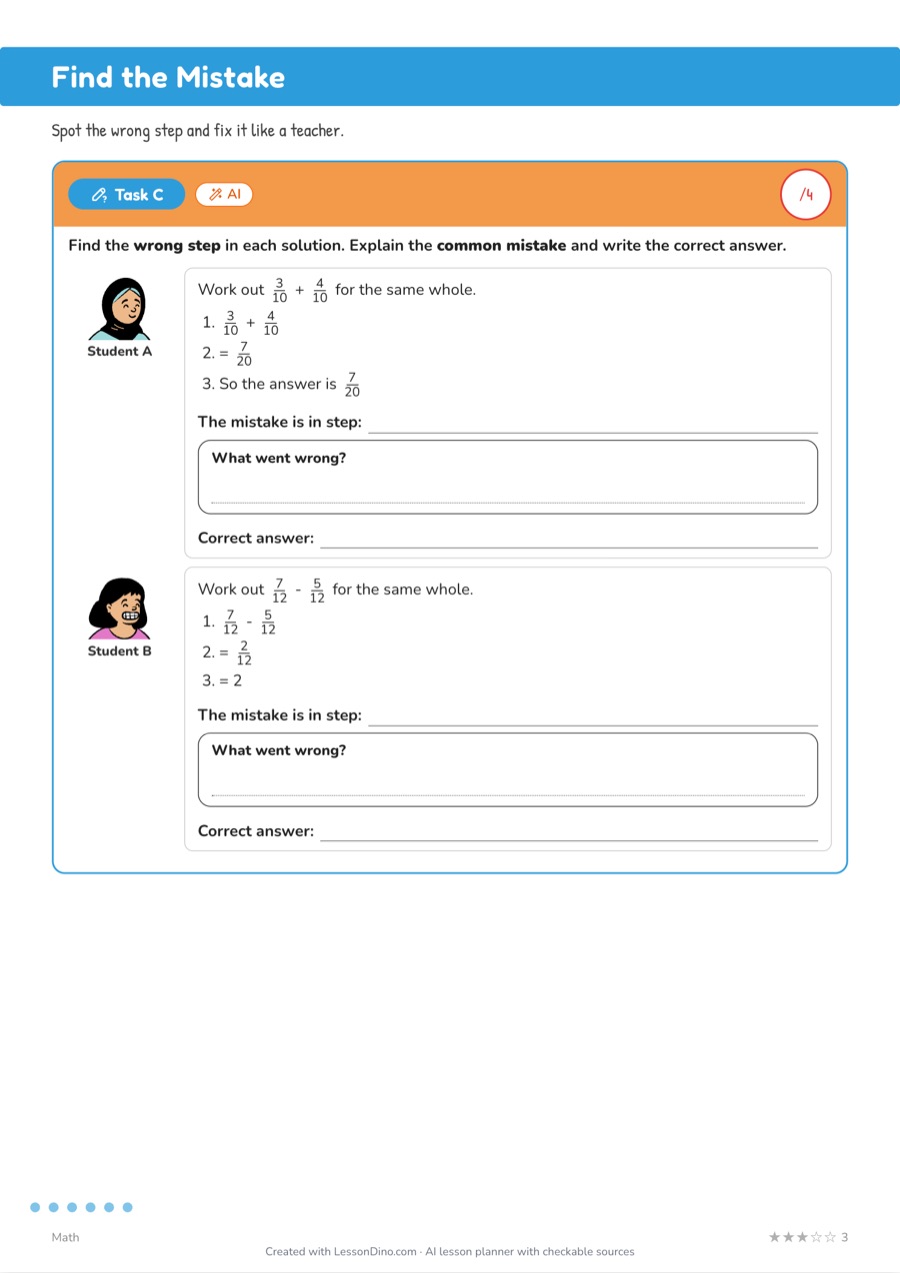
Find the Mistake
Spot the wrong step and fix it like a teacher.
Find the wrong step in each solution. Explain the common mistake and write the correct answer.
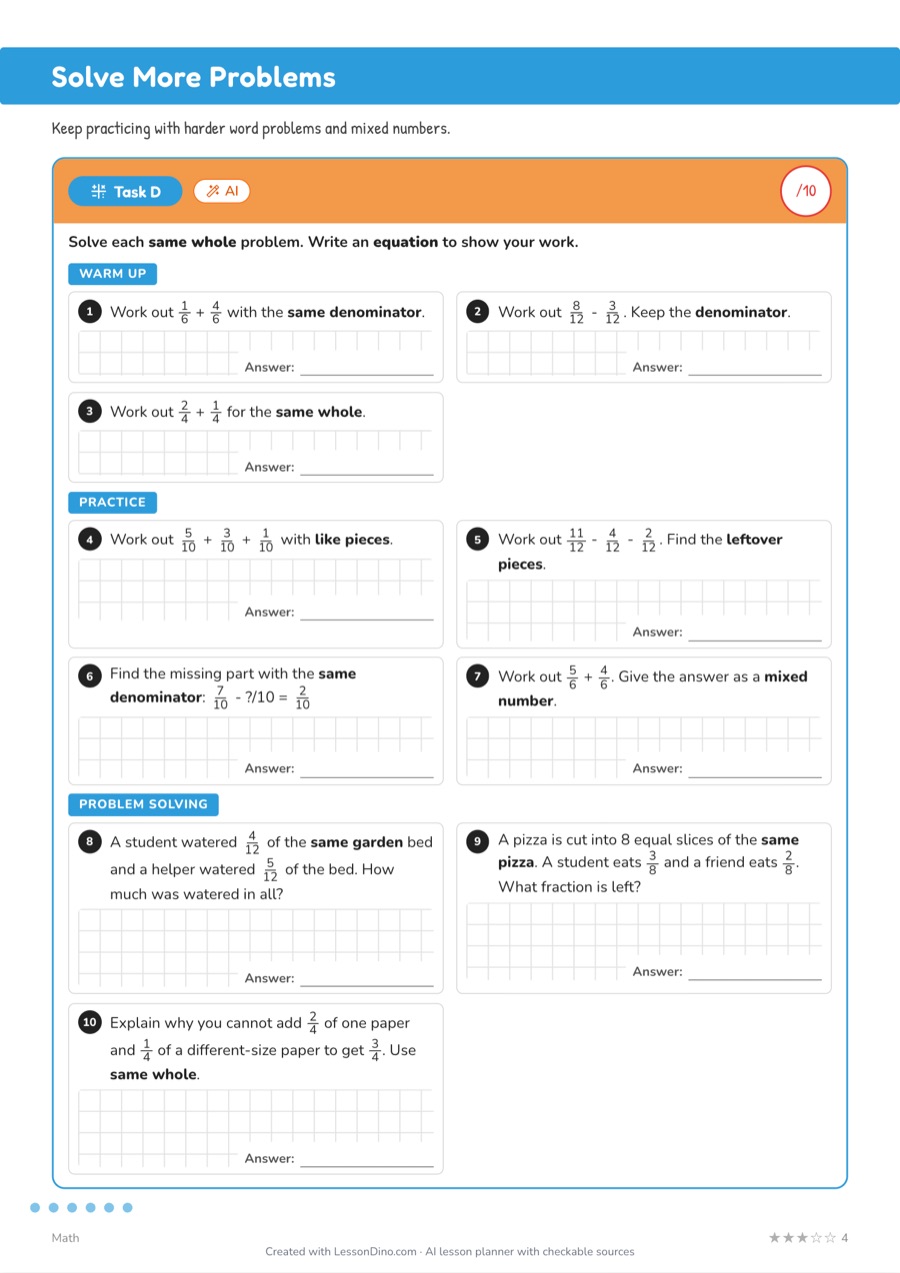
Solve More Problems
Keep practicing with harder word problems and mixed numbers.
Solve each same whole problem. Write an equation to show your work.
Warm up
- Work out 1/6 + 4/6 with the same denominator.
- Work out 8/12 - 3/12. Keep the denominator.
- Work out 2/4 + 1/4 for the same whole.
Practice
- Work out 5/10 + 3/10 + 1/10 with like pieces.
- Work out 11/12 - 4/12 - 2/12. Find the leftover pieces.
- Find the missing part with the same denominator: 7/10 - ?/10 = 2/10
- Work out 5/6 + 4/6. Give the answer as a mixed number.
Problem solving
- A student watered 4/12 of the same garden bed and a helper watered 5/12 of the bed. How much was watered in all?
- A pizza is cut into 8 equal slices of the same pizza. A student eats 3/8 and a friend eats 2/8. What fraction is left?
- Explain why you cannot add 2/4 of one paper and 1/4 of a different-size paper to get 3/4. Use same whole.
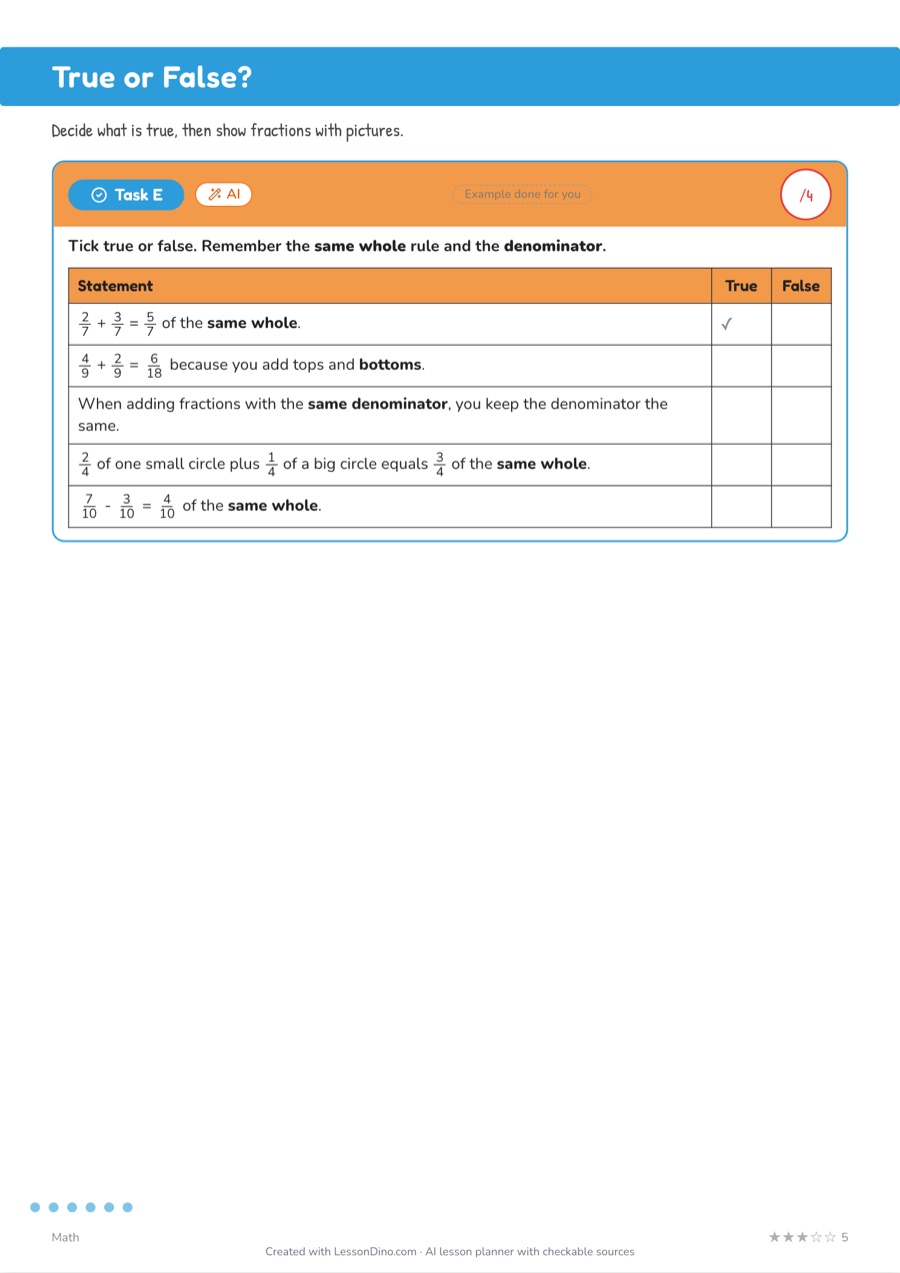
True or False?
Decide what is true, then show fractions with pictures.
Tick true or false. Remember the same whole rule and the denominator.
Page 6
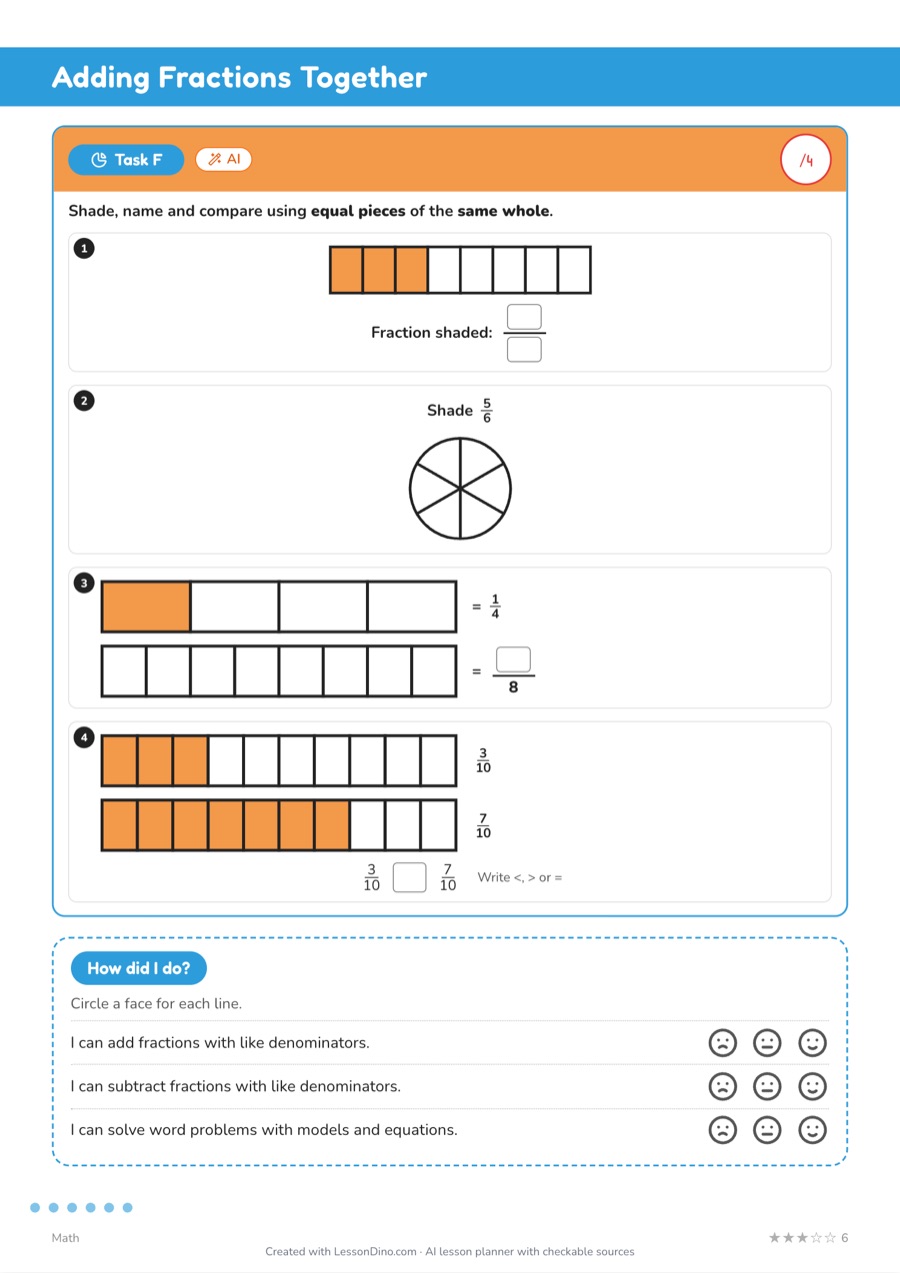
Shade, name and compare using equal pieces of the same whole.
Answers
Show the answers
- Work out 2/5 + 1/5 with the same denominator. 3/5
- Work out 6/8 - 2/8. Keep the denominator. 4/8
- Work out 3/10 + 4/10 for the same whole. 7/10
- Work out 2/12 + 3/12 + 4/12 with like pieces. 9/12
- Work out 9/10 - 4/10 - 1/10. Find the leftover pieces. 4/10
- Find the missing part with the same denominator: 2/8 + ?/8 = 5/8 3/8
- Work out 7/8 + 6/8. Give the answer as a mixed number. 1 5/8
- A student read 3/12 of the same book in the morning and 5/12 in the evening. How much was read in all? Write an equation. 8/12
- A trail is 10/10 mile long. A student walked 6/10 mile of the same trail. How much of the trail is left? Use subtraction. 4/10
- Explain how you know 4/6 + 1/6 = 5/6 without drawing. Mention the denominator. Both fractions are sixths of the same whole, so I add 4 + 1 to get 5 sixths and keep the denominator 6.
- Work out 1/6 + 4/6 with the same denominator. 5/6
- Work out 8/12 - 3/12. Keep the denominator. 5/12
- Work out 2/4 + 1/4 for the same whole. 3/4
- Work out 5/10 + 3/10 + 1/10 with like pieces. 9/10
- Work out 11/12 - 4/12 - 2/12. Find the leftover pieces. 5/12
- Find the missing part with the same denominator: 7/10 - ?/10 = 2/10 5/10
- Work out 5/6 + 4/6. Give the answer as a mixed number. 1 3/6
- A student watered 4/12 of the same garden bed and a helper watered 5/12 of the bed. How much was watered in all? 9/12
- A pizza is cut into 8 equal slices of the same pizza. A student eats 3/8 and a friend eats 2/8. What fraction is left? 3/8
- Explain why you cannot add 2/4 of one paper and 1/4 of a different-size paper to get 3/4. Use same whole. They are not the same whole, so the fourths are different sizes and cannot be added directly.
The answer sheet is the last picture above.
Curriculum
Solve word problems involving addition and subtraction of fractions referring to the same whole and having like denominators, e.g., by using visual fraction models and equations to represent the problem.
Made with Lesson Dino's AI on 17 October 2026. AI can make mistakes, so check the answers and facts against the sources before you teach.