Slides
Lesson plan
Same-Whole Fraction Stories
Students learn to add and subtract like-denominator fractions from the same whole. They build bar models with strips and write matching equations.
Objectives
- Students will solve addition word problems with like denominators using a model and an equation.
- Students will solve subtraction word problems with like denominators using a model and an equation.
- Students will explain why fractions must refer to the same whole to add or subtract.
Success criteria
- I can build a model for like-denominator addition and write the equation.
- I can build a model for like-denominator subtraction and write the equation.
- I can check that both fractions come from the same whole.
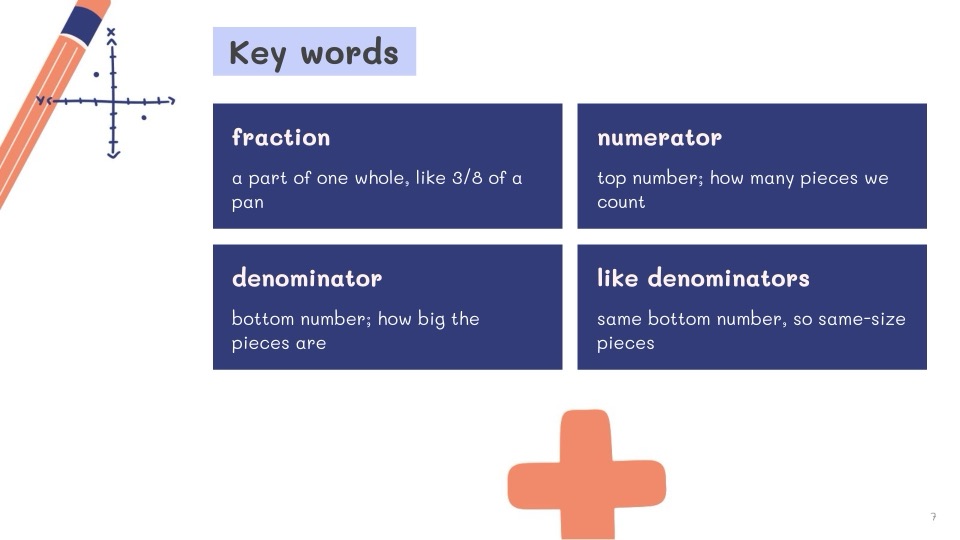
Key words
| Word | Meaning |
|---|---|
| fraction | a part of one whole thing, like 3/8 of a pan |
| numerator | top number; how many pieces we count |
| denominator | bottom number; how big the pieces are |
| same whole | one pan or ribbon that does not change size |
| equation | numbers and an = sign that show the math work |
Timed plan (60 minutes)
| Time | Stage | What happens |
|---|---|---|
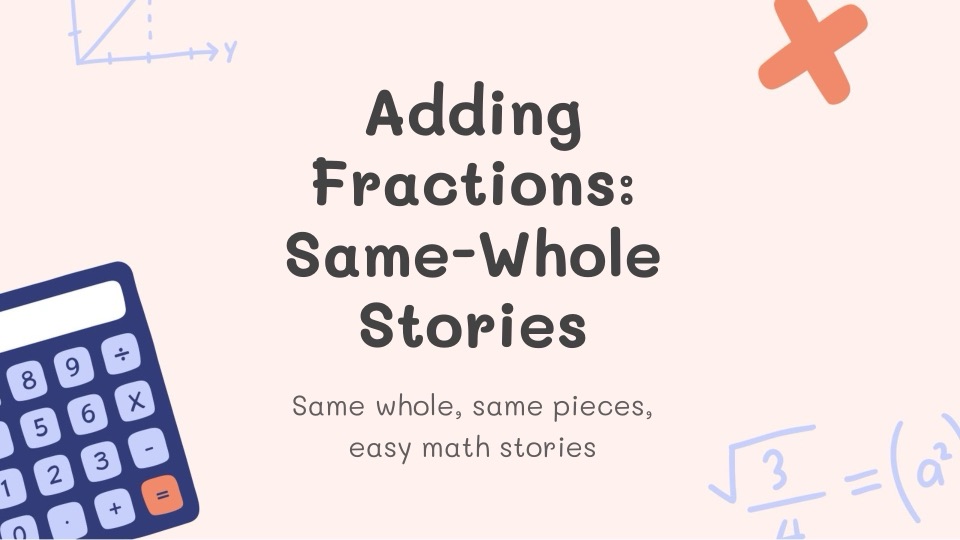
| 5 min | Starter | Hook students with the ribbon story and recall what fractions show. Display Slide 1: Adding Fractions: Same-Whole Stories. Say the hook: We have one long paper ribbon for our class project. If we use part in the morning and part in the afternoon, how can we figure out how much we used in all? Hold up one whole paper strip and two small eighth pieces to show morning and afternoon use. Ask pairs to whisper one idea for finding the total. |
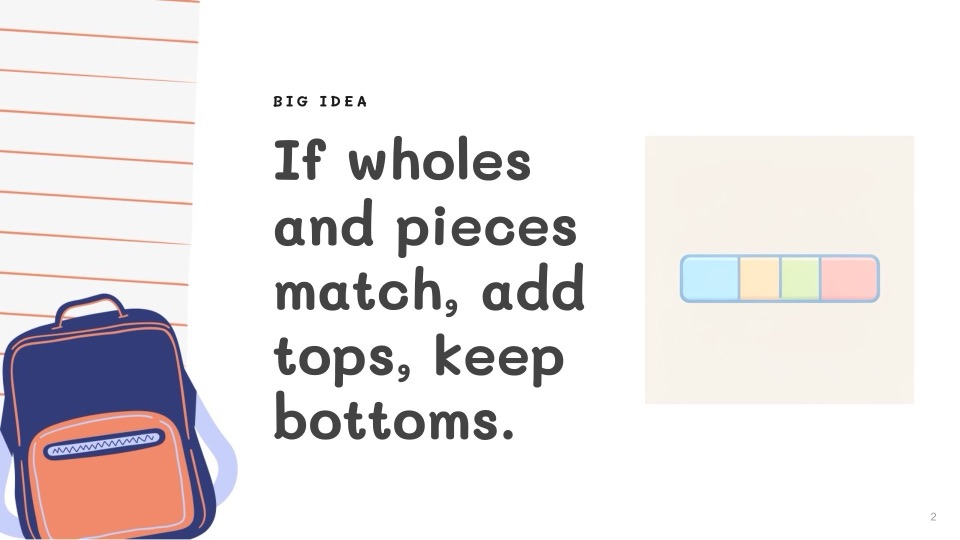
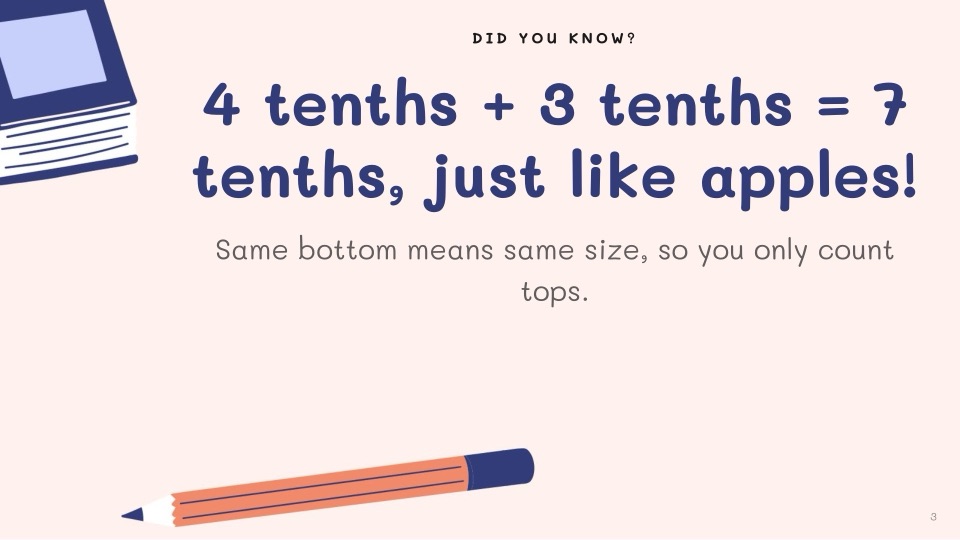
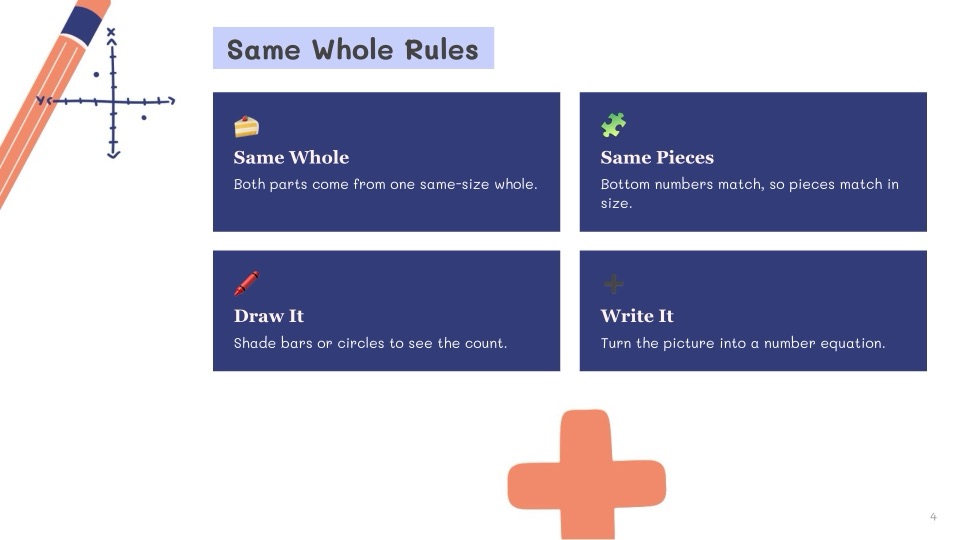
| 10 min | Teaching | Teach the same-whole and same-pieces rule for adding and subtracting. Display Slide 2 and read the big idea: If wholes and pieces match, add tops, keep bottoms. Display Slide 3 and read the fact: 4 tenths + 3 tenths = 7 tenths, just like apples! and Same bottom means same size, so you only count tops. Display Slide 4 Same Whole Rules cards and stress Both parts come from one same-size whole, because fractions represent parts of a whole. Model 2/7 + 3/7 = 5/7 with a bar divided in sevenths. |
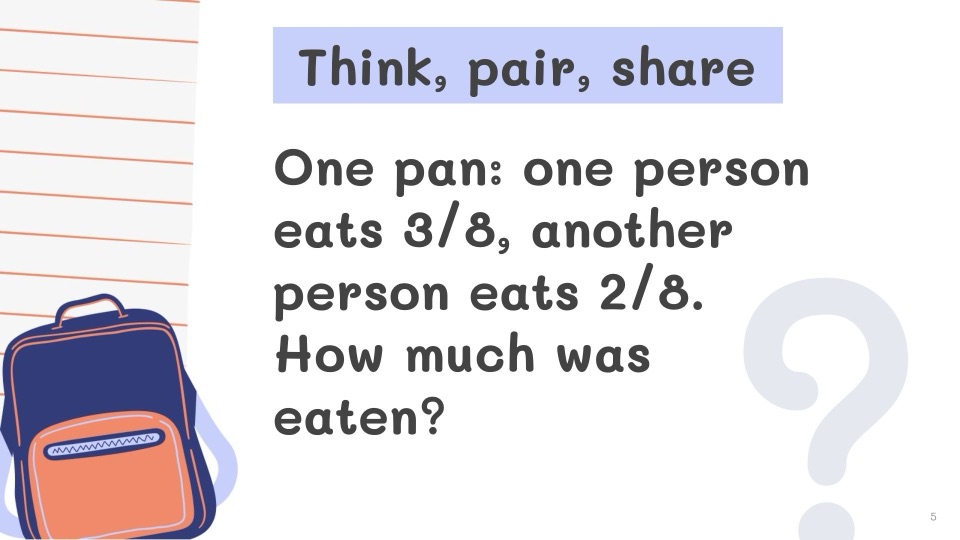
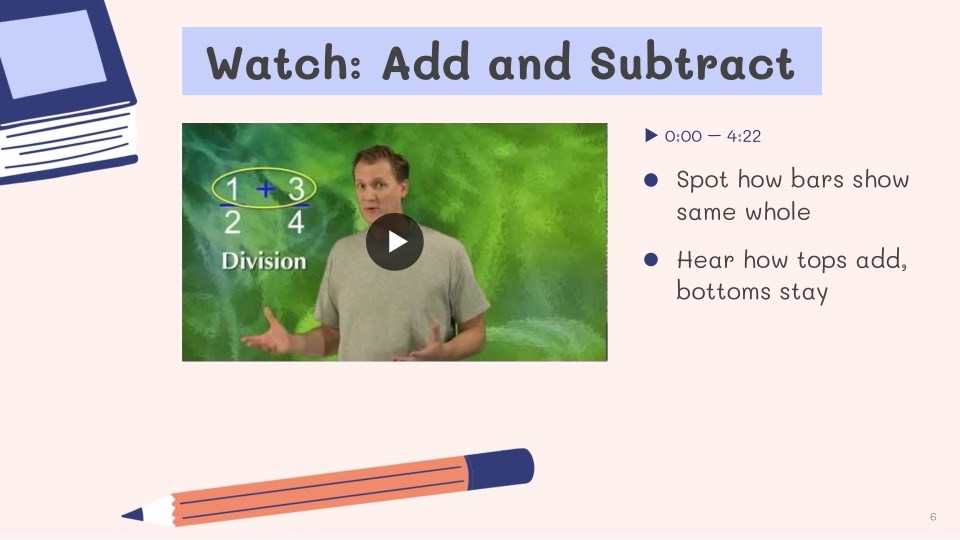
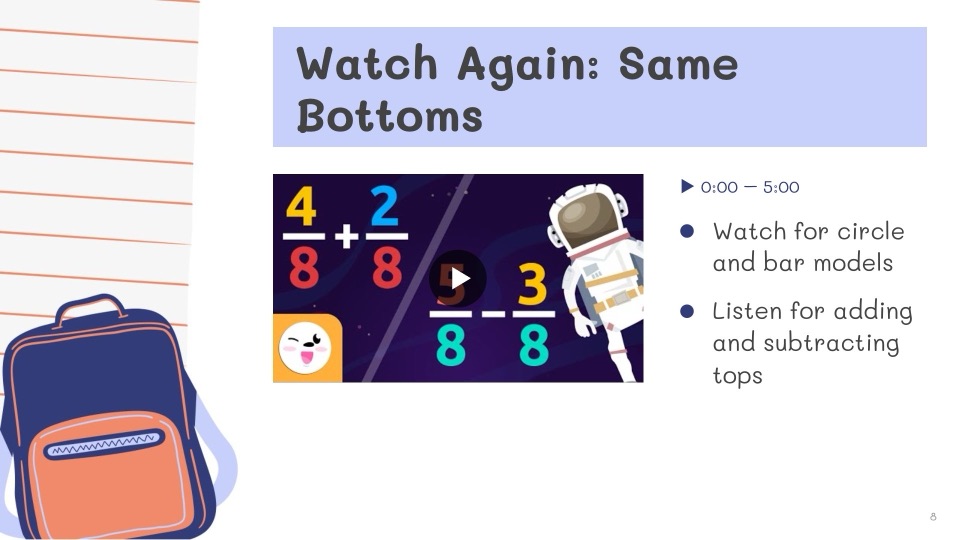
| 15 min | Modeling | Model how a word problem becomes a bar model and an equation. Display Slide 5 question: One pan: one person eats 3/8, another person eats 2/8. How much was eaten? Play Slide 6 Video clip 1 (0:00-4:22) and ask students to spot how bars show same whole and hear how tops add, bottoms stay. Build 3/8 + 2/8 with eighth strips on top of one whole strip, count 5 eighths, write 3/8 + 2/8 = 5/8. Fractions with the same denominator can be added directly by adding the numerators. Define key words on Slide 7, then preview Slide 8 for circles and bars adding and subtracting tops. |
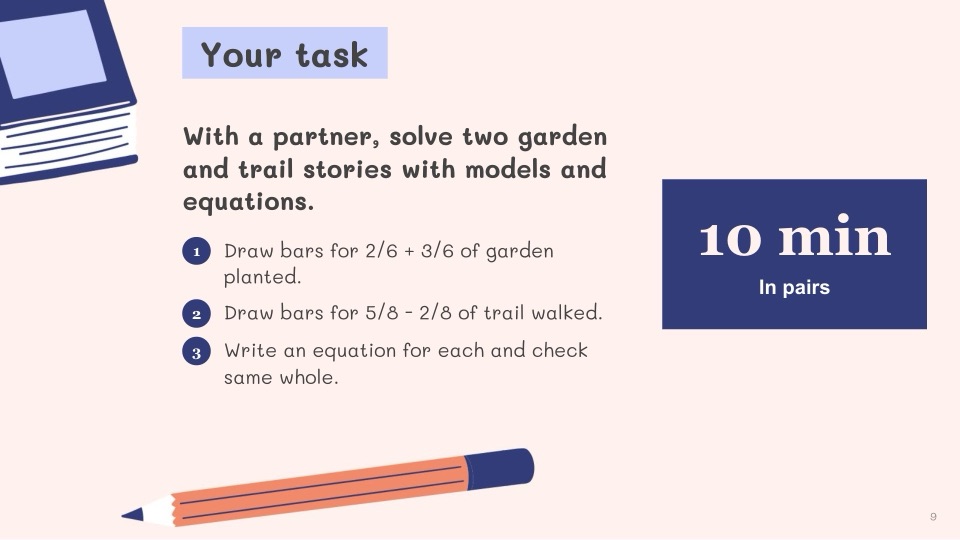
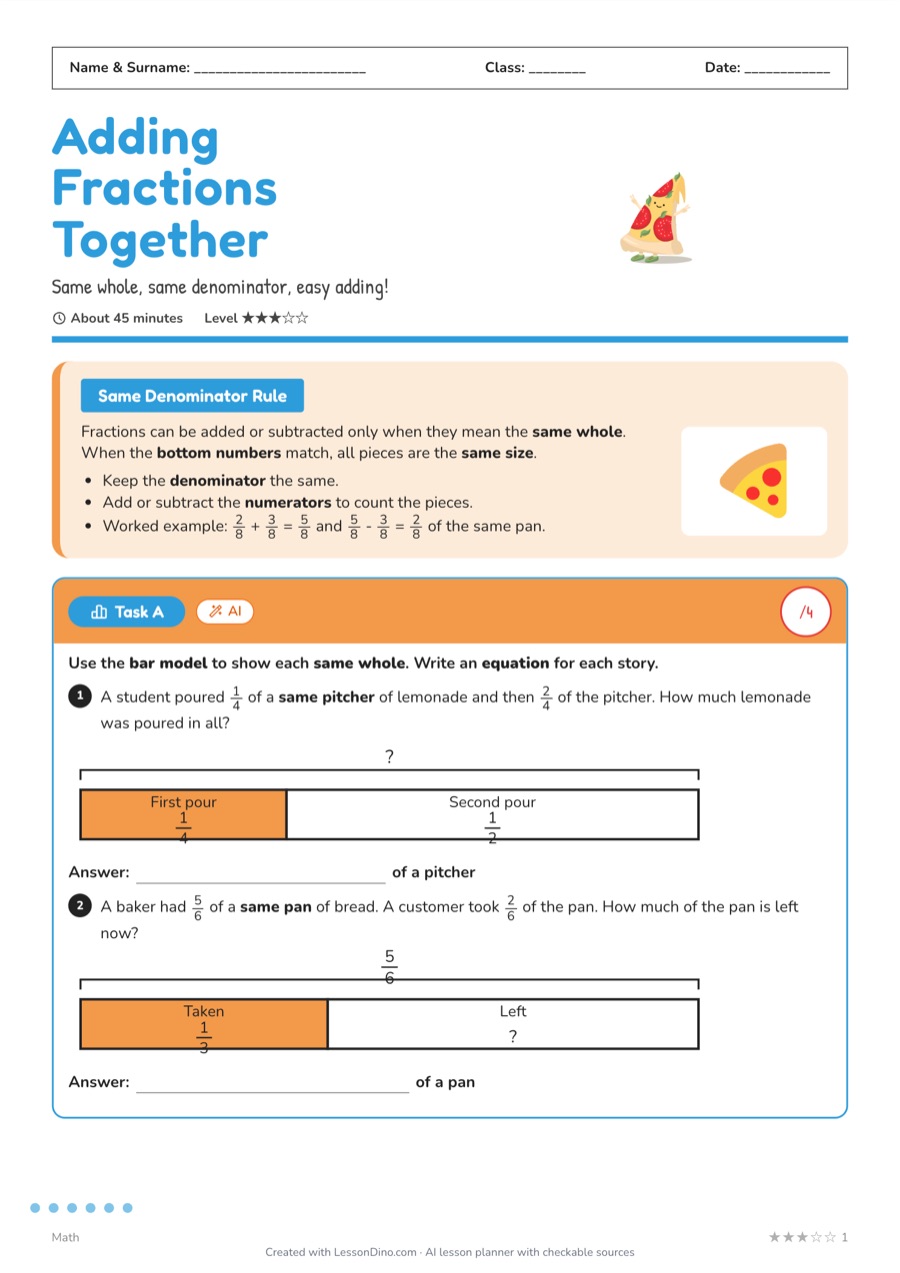
| 20 min | Main Activity | Solve like-denominator word problems by building strip models and writing equations. Hand out eighth strips, pencils, and word-problem sheet for the same ribbon and pan stories. Direct pairs to build 3/8 + 2/8 with strips on top of one whole strip, count eighths, then write the equation, then repeat with subtraction like 7/8 - 4/8. Display Slide 9 task and have pairs draw bars for 2/6 + 3/6 of garden planted and draw bars for 5/8 - 2/8 of trail walked, write an equation for each and check same whole. Circulate, ask for same-whole checks, and select pairs to hold up models. |
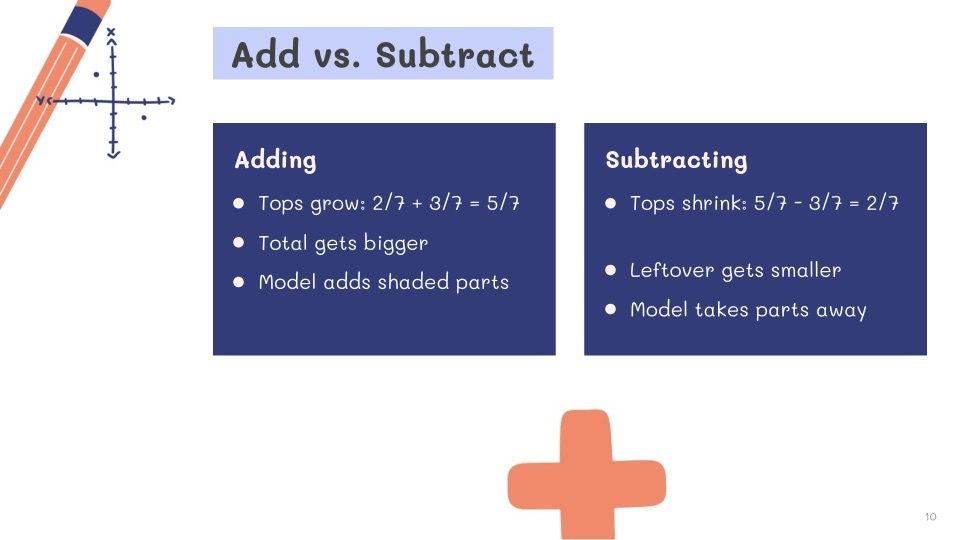
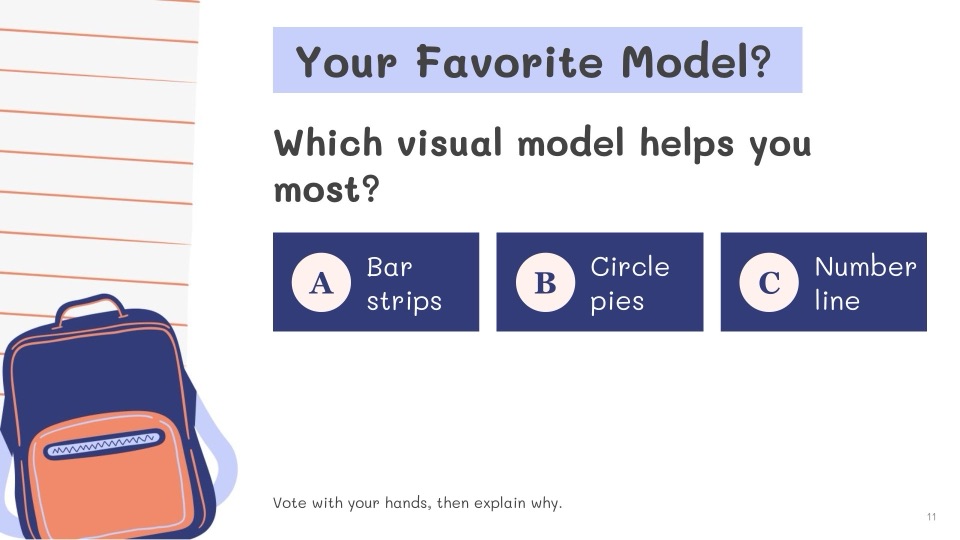
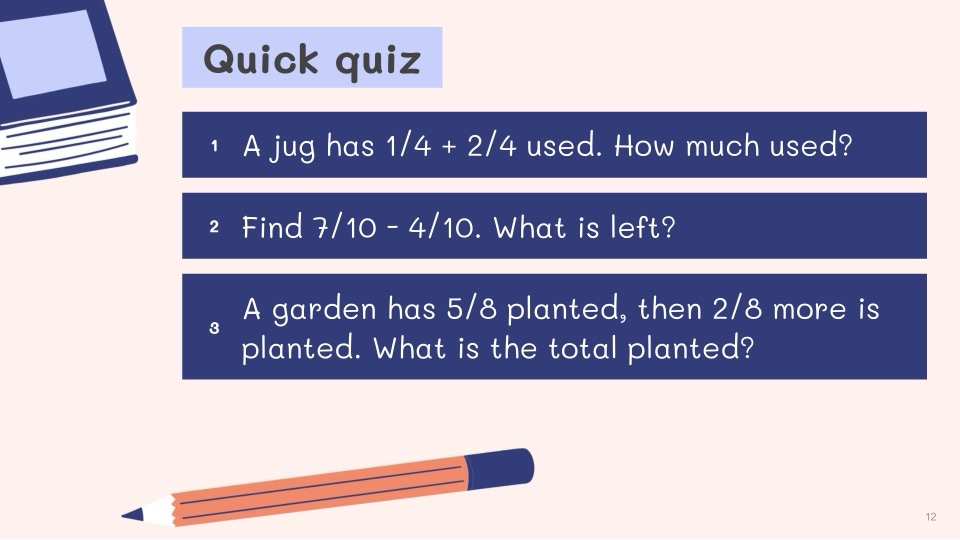
| 10 min | Plenary | Compare adding and subtracting and check who can solve same-whole problems. Display Slide 10 and compare Adding: Tops grow: 2/7 + 3/7 = 5/7 with Subtracting: Tops shrink: 5/7 - 3/7 = 2/7. Take a quick vote with Slide 11: Which visual model helps you most? Bar strips, circle pies, number line. Give Slide 12 Quick quiz: A jug has 1/4 + 2/4 used. How much used? Find 7/10 - 4/10. What is left? Link answers back to objectives and collect Worksheet Task A. |
Common mistakes
- Adding or subtracting bottom numbers, e.g., 2/7 + 3/7 = 5/14
How to spot it: Equation shows 14 or 12 on the bottom; model pieces no longer match
Remodel eighths or sevenths and count tops only, because same bottom means same size, so you only count tops. Adding fractions with the same denominator is like adding apples. - Combining fractions from different-size wholes, e.g., two different pans
How to spot it: Bars or circles are different lengths or sizes but student still adds tops
Place wholes side by side to show size gap. Remind that fractions represent parts of a whole, so both parts must come from one same-size whole. - Writing the equation without a model check, wrong operation for the story
How to spot it: Story says eaten then more eaten but equation subtracts, or vice versa
Underline take-away words vs joining words, then match to model: add shaded parts or cross out parts. Simply add or subtract to find the total number of slices when slices are all the same kind.
Support
- Give strips already shaded for 3/8 and 2/8 so students only join and count them.
- Provide a half-drawn bar model divided into sixths for students to finish shading.
- Post equation frames like __/8 + __/8 = __/8 and label the one whole.
Stretch
- Give a total greater than 1 whole to model and rename, like 7/8 + 6/8.
- Have students create a two-step story where a subtraction follows an addition, all in twelfths.
- Require one problem whose total is more than 1 whole and show it as a mixed number.
Check questions
- A jug has 1/4 + 2/4 used. How much of the jug is used?
Answer: 3/4 of the jug - Find 7/10 - 4/10. What is left?
Answer: 3/10 - Same garden: 2/6 planted in the morning and 3/6 in the afternoon. Write the equation and total.
Answer: 2/6 + 3/6 = 5/6 of the garden
Curriculum
Solve word problems involving addition and subtraction of fractions referring to the same whole and having like denominators, e.g., by using visual fraction models and equations to represent the problem.
Video clips
Clips on YouTube, from the start and end times we chose. Check each one before you show it.
-
Adding and Subtracting Fractions from 0:00 to 4:22
mathantics: Math Antics - Adding and Subtracting Fractions
Directly teaches addition and subtraction with like denominators using visual models and equations, perfect pace for ages 9-10.
-
Same-Denominator Add and Subtract from 0:00 to 5:00
Smile and Learn - English: Adding and Subtracting Fractions - Same Denominator - Math for Kids
Focused only on same-denominator addition and subtraction with clear kid-friendly visuals ideal for Grade 4 ages 9-10.
Worksheet
Sources
- Grade 4 Math Curriculum - Fairfax County Public Schools fcps.edu
- Grade 4 Math | SFUSD sfusd.edu
- Maths in a minute: Adding fractions (the easy way) | plus.maths.… plus.maths.org
- [2312.09021v1] Odd moments and adding fractions arxiv.org
- 4.4: Adding and Subtracting Fractions - Mathematics LibreTexts math.libretexts.org
- Lesson 1 Adding Fractions cdnend.americanhighschool.org
- Introduction to Fractions Adding Fractions mathmammoth.com
Picture credits
- AI illustration · Cloudflare
- Microsoft Fluent Emoji (MIT)
- Illustration: cromaconceptovisual · Pixabay
Made with Lesson Dino's AI on 17 October 2026. AI can make mistakes, so check facts against the sources before you teach.