The worksheet
About this worksheet
Students use rectangle area and perimeter formulas to solve real problems. They find a missing side by solving a multiplication or addition puzzle. This Grade 4 Math worksheet gives students (ages 9–10) six pages of practice on area and perimeter, part of the measurement and data unit. It goes with our free Area and perimeter lesson, which has the slides and a timed lesson plan.
What it covers
By the end, students should be able to:
- Students will use the rectangle area formula to solve real-world problems.
- Students will use the rectangle perimeter formula to solve real-world problems.
- Students will find a missing width or length from known area or perimeter.
How to use it
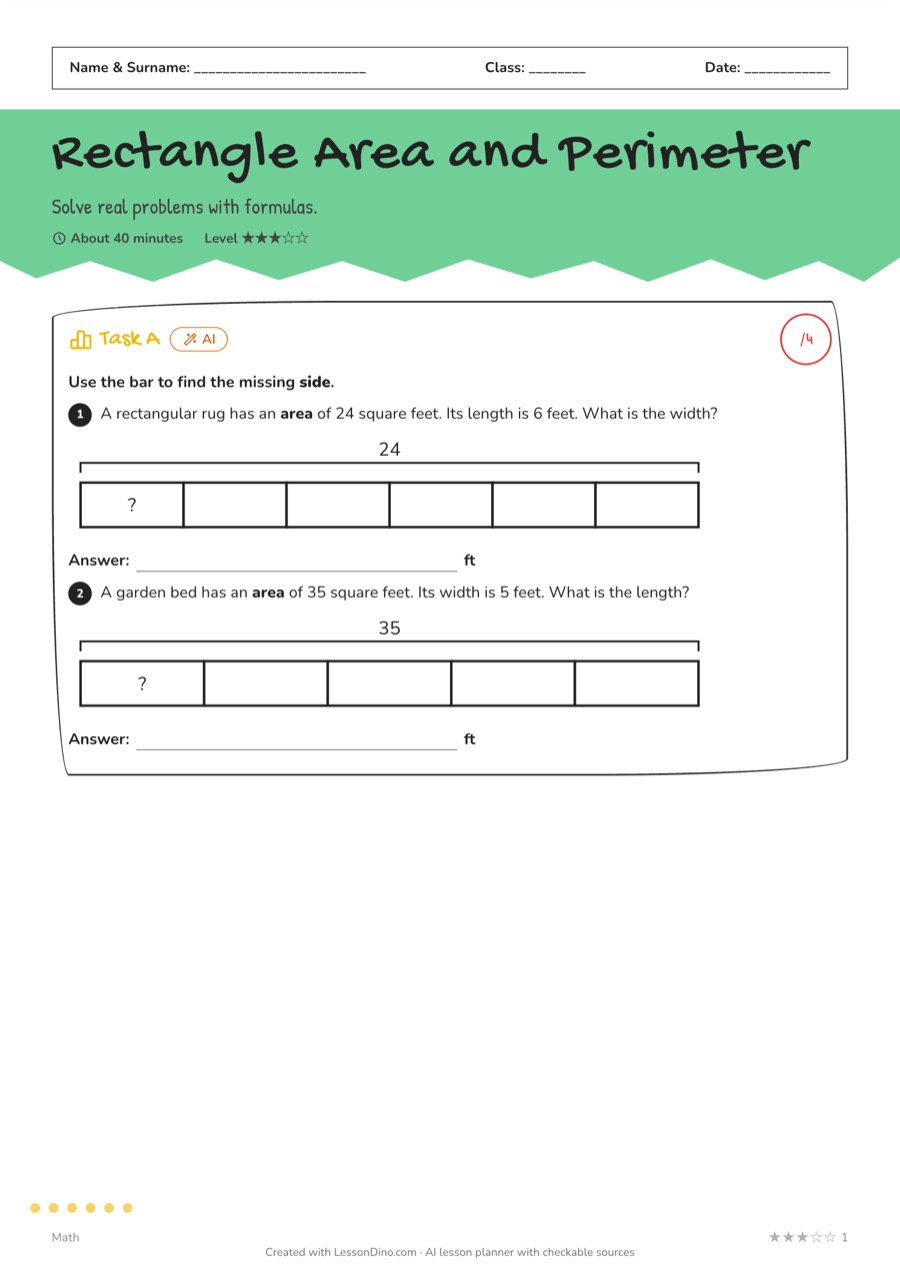
- Main activity (25 minutes): Give Worksheet Task A Use the bar to find the missing side and circulate to check equations and units.
- Support: Give a sheet with an 8-unit-long strip already shaded and let students add one row at a time and skip-count by 8s to reach 48.
- Stretch: Try a larger rug with an area of 96 square feet and a length of 12 feet and find the missing width the same way.
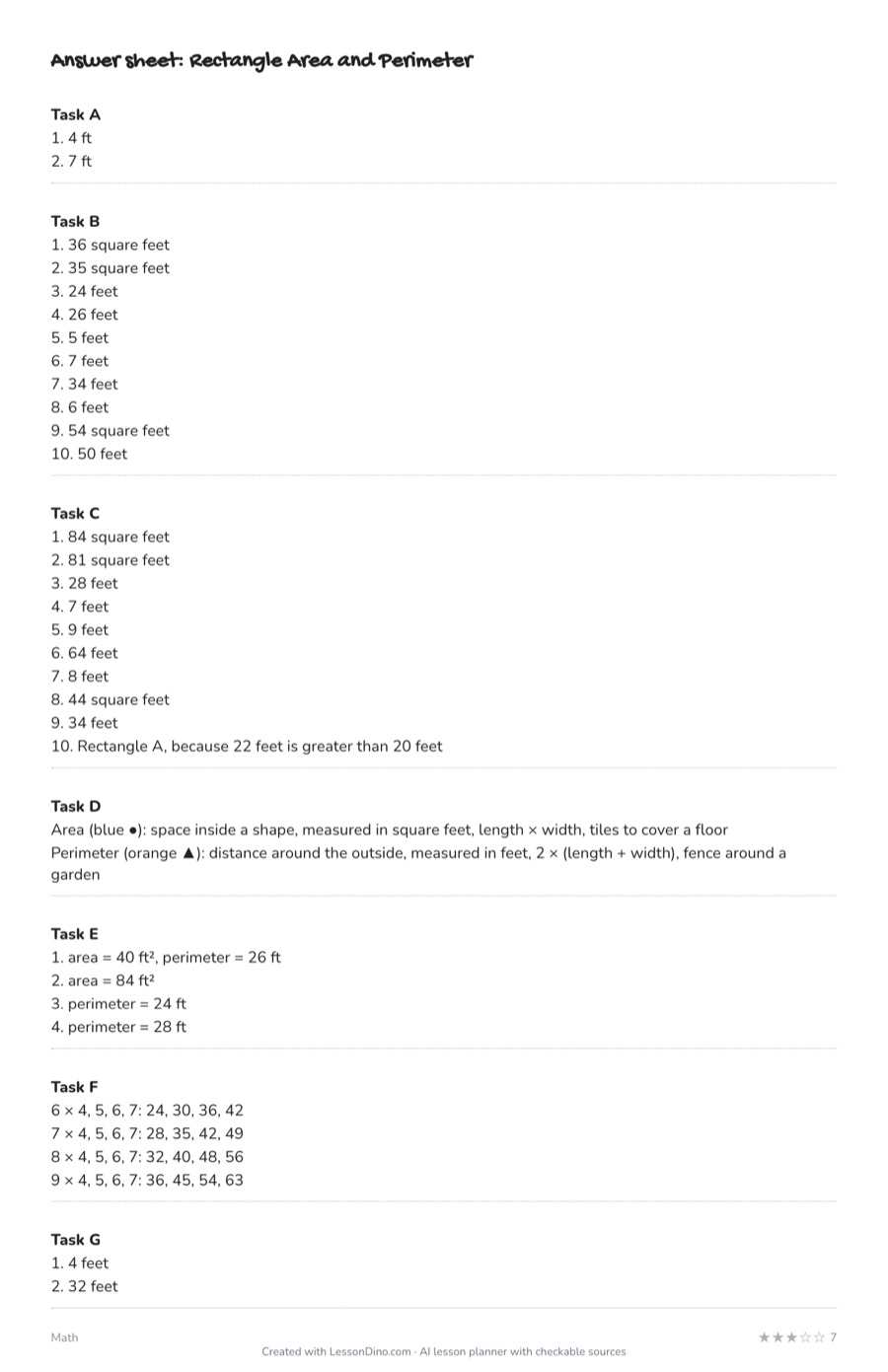
- The answer sheet is the last page, so you can print it on its own or let students check their own work.
Key vocabulary
- area: the space inside a flat shape, counted by how many 1 unit by 1 unit squares fit inside
- perimeter: the total distance around the outside edge of a shape
- length: the distance from one end to the other along the longer side of a rectangle
- width: the distance across a rectangle along the shorter side
- square feet: units for surface that count how many 1-foot by 1-foot tiles would cover it
Mistakes to watch for
- Mixing units, writing perimeter in square feet or area in feet. Sort jobs: paint or carpet to cover a surface needs square units, walking the edge needs linear units. Require both labels every time.
- Thinking same perimeter means same area. Calculate both with A = lw to show 20 vs 36, stressing different rectangles with the same perimeter can have different areas.
- Adding instead of multiplying for area, or multiplying sides for perimeter. Rebuild with tiles to count 48 squares inside, then contrast with adding sides for distance around.
What's on the worksheet
Fence and Floor
Learn what area and perimeter mean.
Use the bar to find the missing side.
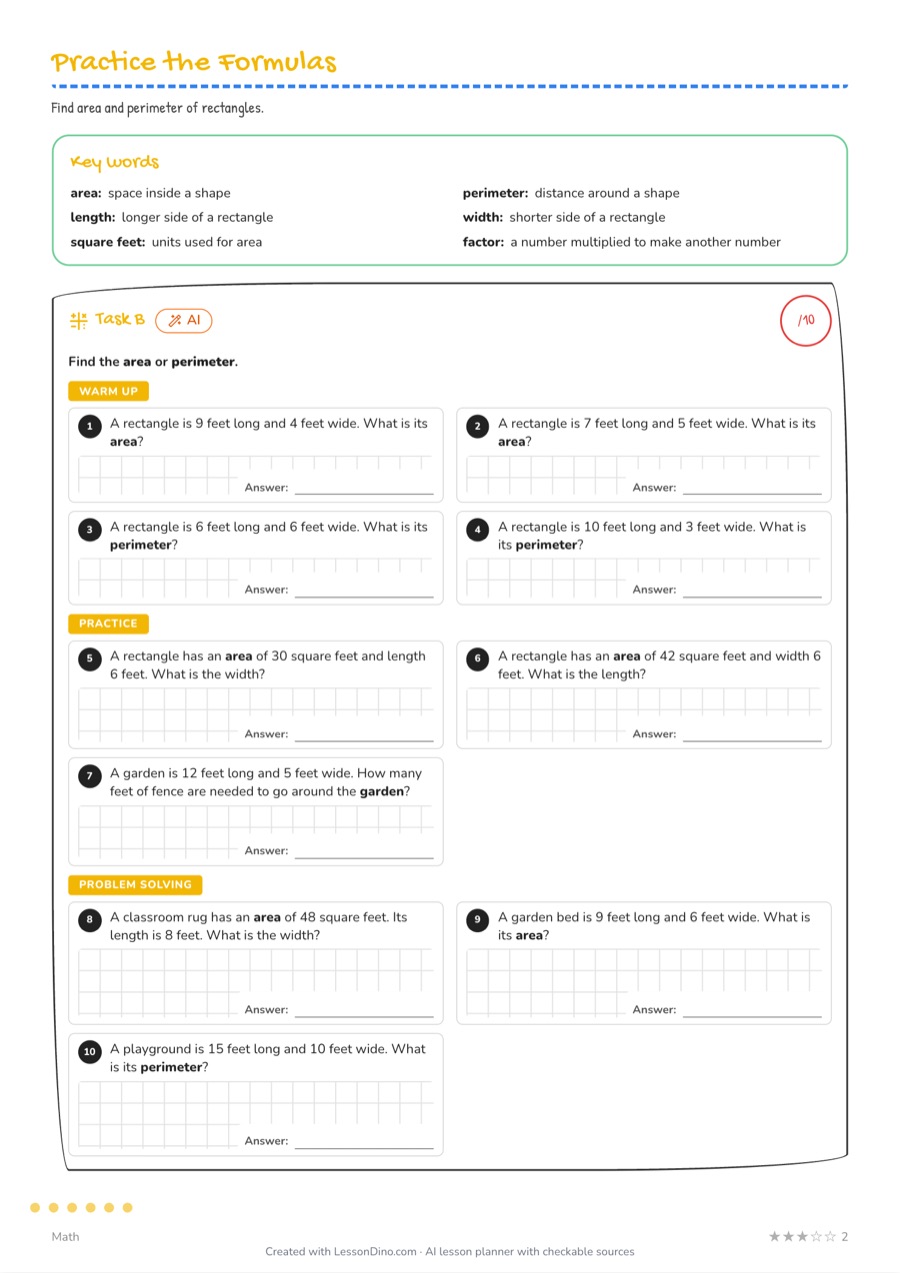
Practice the Formulas
Find area and perimeter of rectangles.
| Word | Meaning |
|---|---|
| area | space inside a shape |
| perimeter | distance around a shape |
| length | longer side of a rectangle |
| width | shorter side of a rectangle |
| square feet | units used for area |
| factor | a number multiplied to make another number |
Find the area or perimeter.
Warm up
- A rectangle is 9 feet long and 4 feet wide. What is its area?
- A rectangle is 7 feet long and 5 feet wide. What is its area?
- A rectangle is 6 feet long and 6 feet wide. What is its perimeter?
- A rectangle is 10 feet long and 3 feet wide. What is its perimeter?
Practice
- A rectangle has an area of 30 square feet and length 6 feet. What is the width?
- A rectangle has an area of 42 square feet and width 6 feet. What is the length?
- A garden is 12 feet long and 5 feet wide. How many feet of fence are needed to go around the garden?
Problem solving
- A classroom rug has an area of 48 square feet. Its length is 8 feet. What is the width?
- A garden bed is 9 feet long and 6 feet wide. What is its area?
- A playground is 15 feet long and 10 feet wide. What is its perimeter?
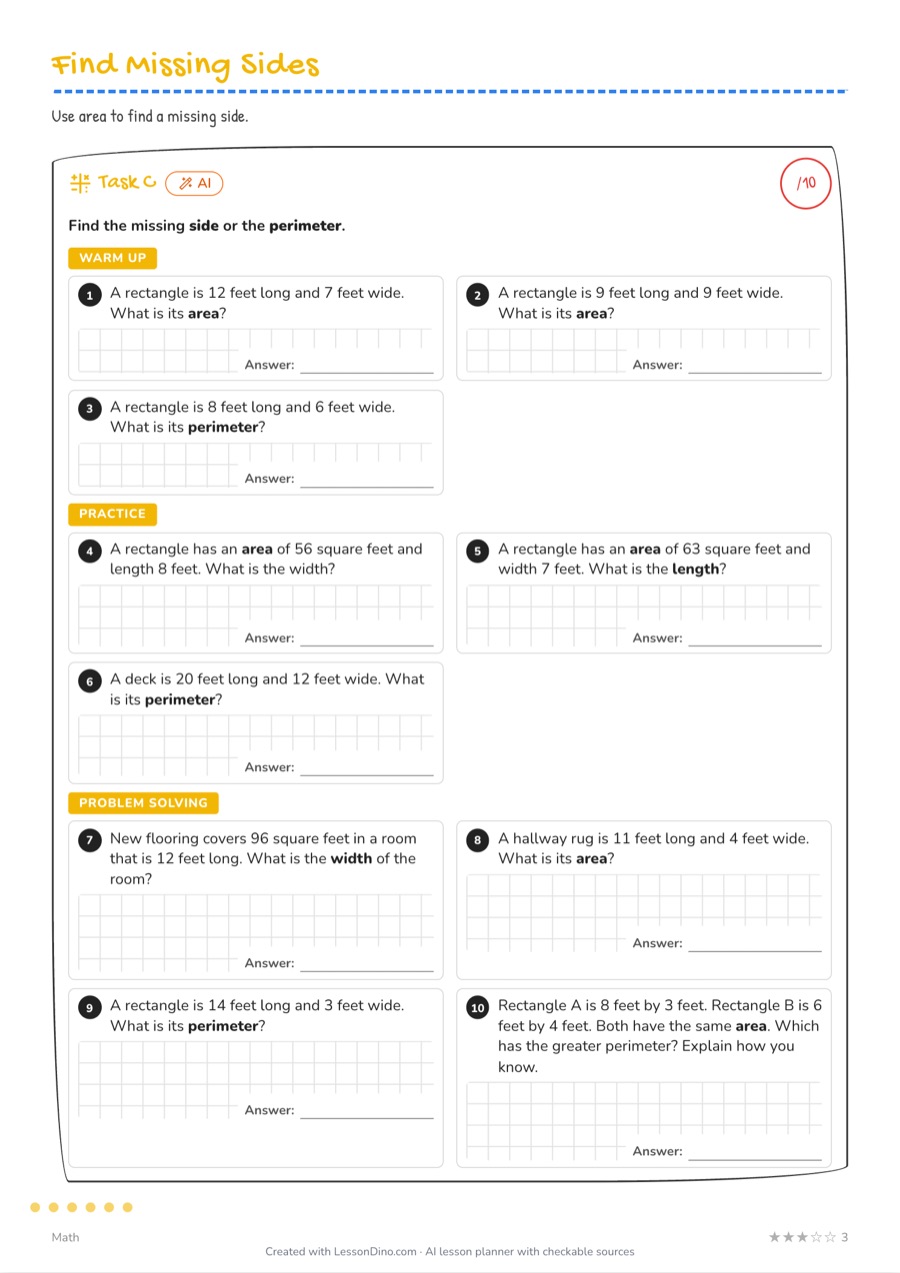
Find Missing Sides
Use area to find a missing side.
Find the missing side or the perimeter.
Warm up
- A rectangle is 12 feet long and 7 feet wide. What is its area?
- A rectangle is 9 feet long and 9 feet wide. What is its area?
- A rectangle is 8 feet long and 6 feet wide. What is its perimeter?
Practice
- A rectangle has an area of 56 square feet and length 8 feet. What is the width?
- A rectangle has an area of 63 square feet and width 7 feet. What is the length?
- A deck is 20 feet long and 12 feet wide. What is its perimeter?
Problem solving
- New flooring covers 96 square feet in a room that is 12 feet long. What is the width of the room?
- A hallway rug is 11 feet long and 4 feet wide. What is its area?
- A rectangle is 14 feet long and 3 feet wide. What is its perimeter?
- Rectangle A is 8 feet by 3 feet. Rectangle B is 6 feet by 4 feet. Both have the same area. Which has the greater perimeter? Explain how you know.
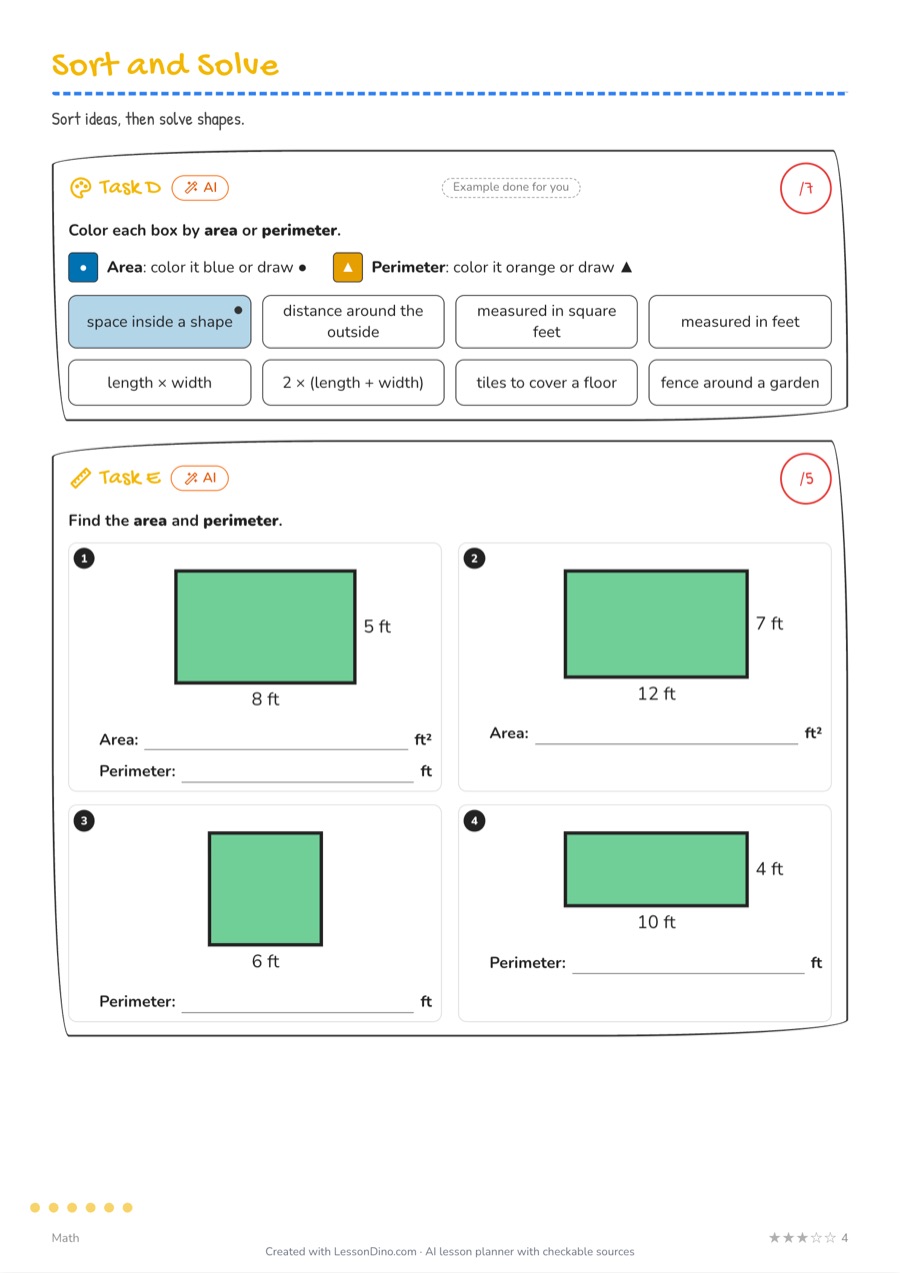
Sort and Solve
Sort ideas, then solve shapes.
Color each box by area or perimeter.
Find the area and perimeter.
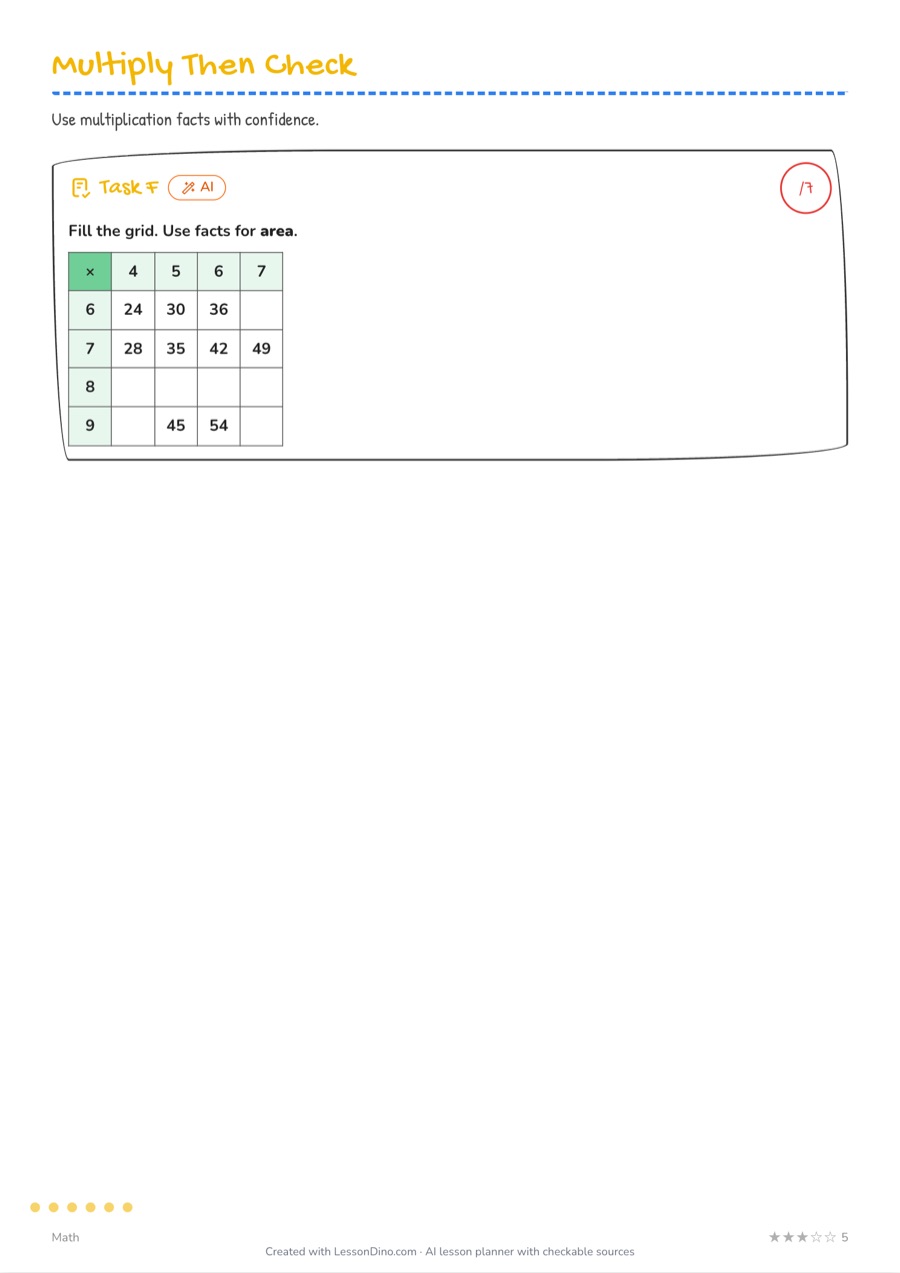
Multiply Then Check
Use multiplication facts with confidence.
Fill the grid. Use facts for area.
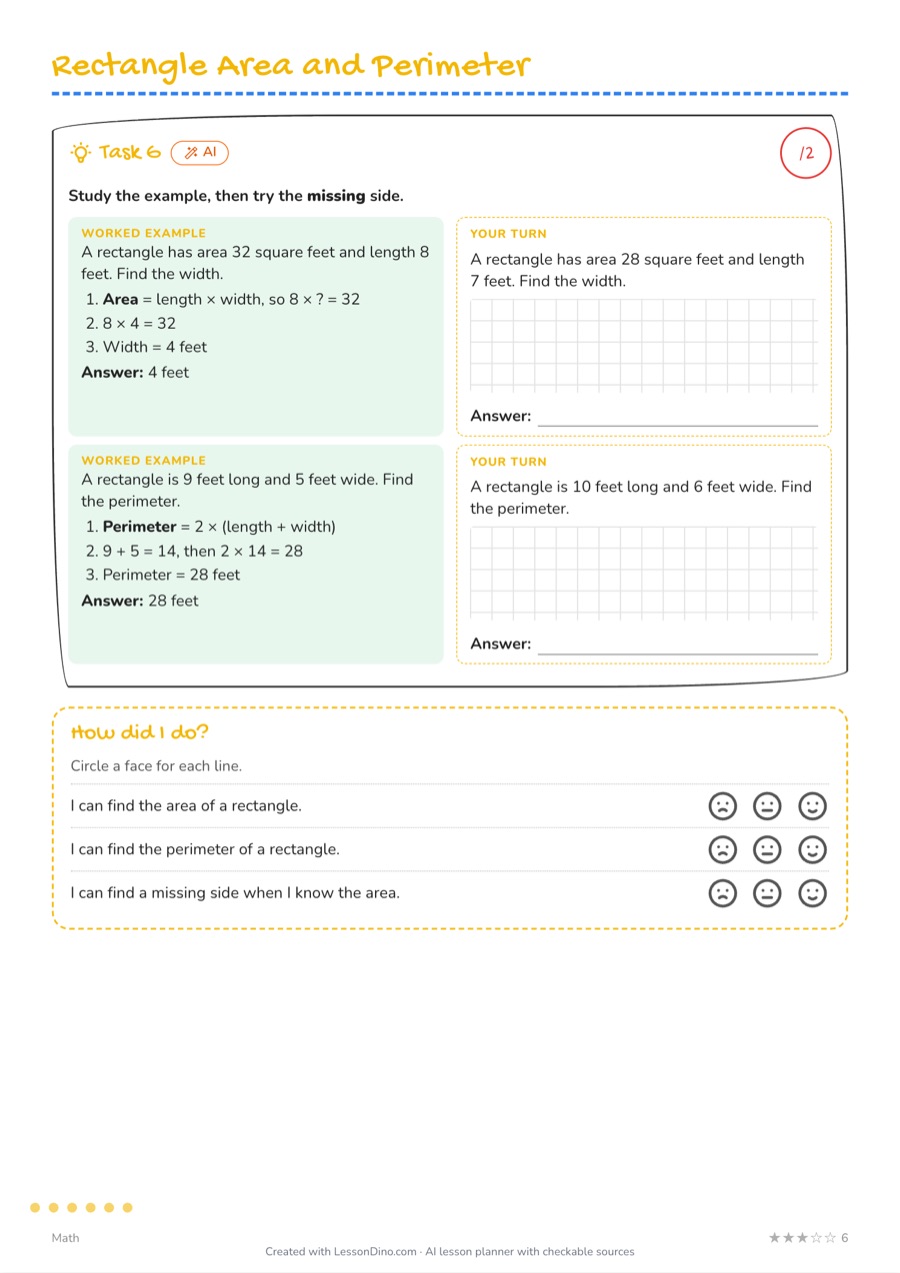
Page 6
Study the example, then try the missing side.
Answers
Show the answers
- A rectangle is 9 feet long and 4 feet wide. What is its area? 36 square feet
- A rectangle is 7 feet long and 5 feet wide. What is its area? 35 square feet
- A rectangle is 6 feet long and 6 feet wide. What is its perimeter? 24 feet
- A rectangle is 10 feet long and 3 feet wide. What is its perimeter? 26 feet
- A rectangle has an area of 30 square feet and length 6 feet. What is the width? 5 feet
- A rectangle has an area of 42 square feet and width 6 feet. What is the length? 7 feet
- A garden is 12 feet long and 5 feet wide. How many feet of fence are needed to go around the garden? 34 feet
- A classroom rug has an area of 48 square feet. Its length is 8 feet. What is the width? 6 feet
- A garden bed is 9 feet long and 6 feet wide. What is its area? 54 square feet
- A playground is 15 feet long and 10 feet wide. What is its perimeter? 50 feet
- A rectangle is 12 feet long and 7 feet wide. What is its area? 84 square feet
- A rectangle is 9 feet long and 9 feet wide. What is its area? 81 square feet
- A rectangle is 8 feet long and 6 feet wide. What is its perimeter? 28 feet
- A rectangle has an area of 56 square feet and length 8 feet. What is the width? 7 feet
- A rectangle has an area of 63 square feet and width 7 feet. What is the length? 9 feet
- A deck is 20 feet long and 12 feet wide. What is its perimeter? 64 feet
- New flooring covers 96 square feet in a room that is 12 feet long. What is the width of the room? 8 feet
- A hallway rug is 11 feet long and 4 feet wide. What is its area? 44 square feet
- A rectangle is 14 feet long and 3 feet wide. What is its perimeter? 34 feet
- Rectangle A is 8 feet by 3 feet. Rectangle B is 6 feet by 4 feet. Both have the same area. Which has the greater perimeter? Explain how you know. Rectangle A, because 22 feet is greater than 20 feet
The answer sheet is the last picture above.
Curriculum
Apply the area and perimeter formulas for rectangles in real world and mathematical problems. For example, find the width of a rectangular room given the area of the flooring and the length, by viewing the area formula as a multiplication equation with an unknown factor.
Made with Lesson Dino's AI on 17 October 2026. AI can make mistakes, so check the answers and facts against the sources before you teach.