Slides
Lesson plan
Same Size, Different Cuts
Students learn why multiplying top and bottom by the same number keeps the value. They draw models to prove and make equivalent fractions.
Objectives
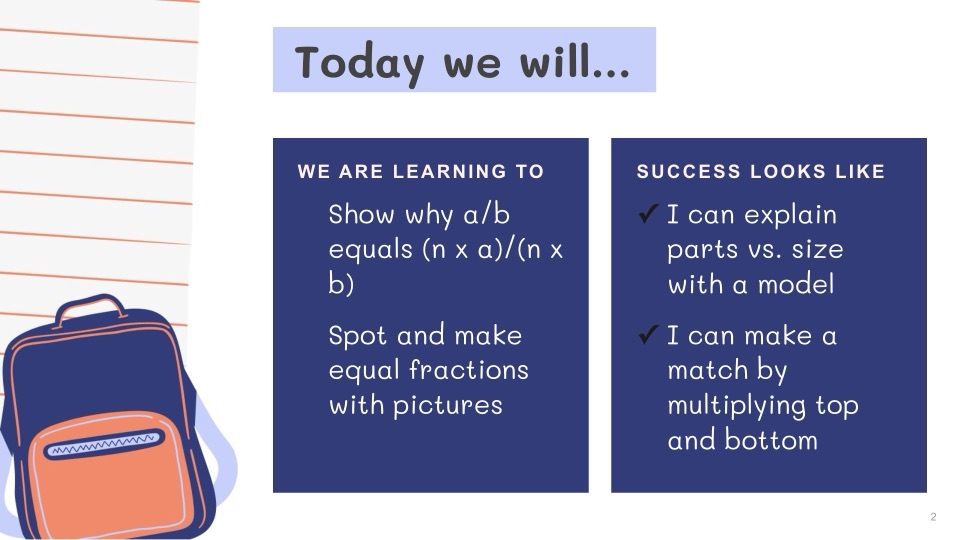
- Students will draw visual models that prove two fractions are equal.
- Students will explain why a/b equals (n x a)/(n x b) using number and size of parts.
- Students will recognize and generate equivalent fractions by multiplying top and bottom.
Success criteria
- I can explain how part number and size change but value stays the same.
- I can make a match by multiplying the top and bottom by the same number.
- I can spot and show equivalent fractions with a drawing.
Key words
| Word | Meaning |
|---|---|
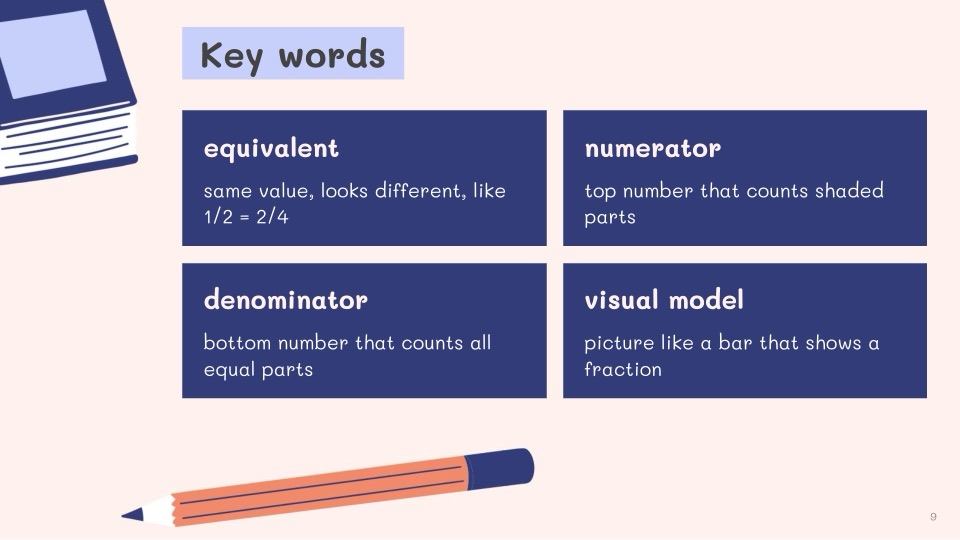
| equivalent | having the same value while looking different, like 1/2 = 2/4 |
| numerator | top number that counts shaded parts |
| denominator | bottom number that counts all equal parts in the whole |
| whole | the full shape or amount we start with |
Timed plan (60 minutes)
| Time | Stage | What happens |
|---|---|---|
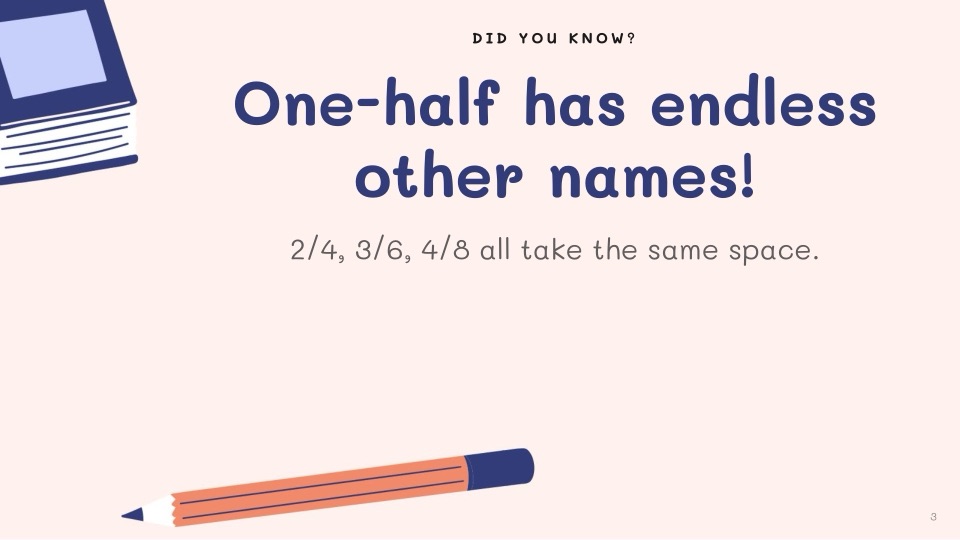
| 5 min | Starter | Activate ideas about halves and hook students into proving 2/3 equals 4/6. Show Slide 1 title and read the hook in an excited voice. Show Slide 3 and point out 2/4, 3/6, 4/8 all take the same space as 1/2. Ask partners to whisper why more pieces might still be the same amount. State today students will draw models that prove two fractions are equal. |
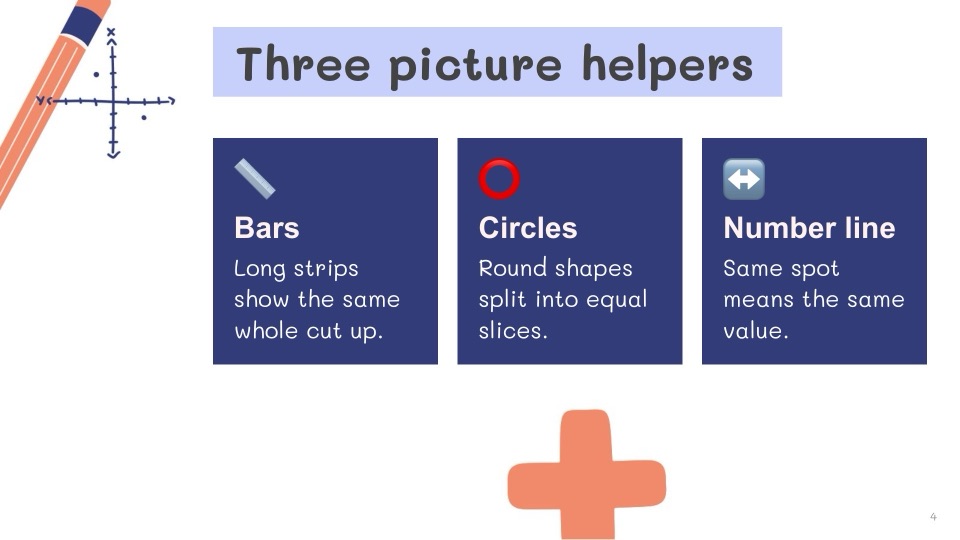
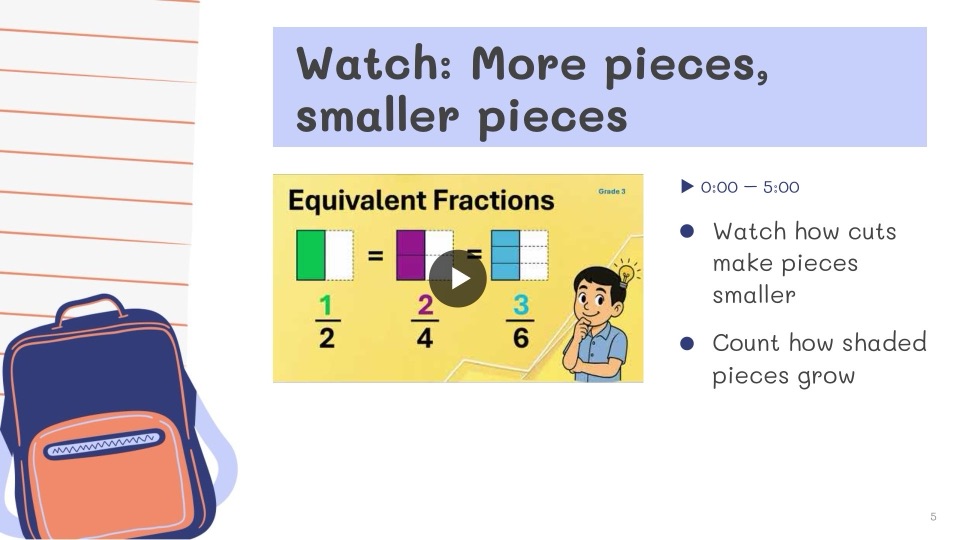
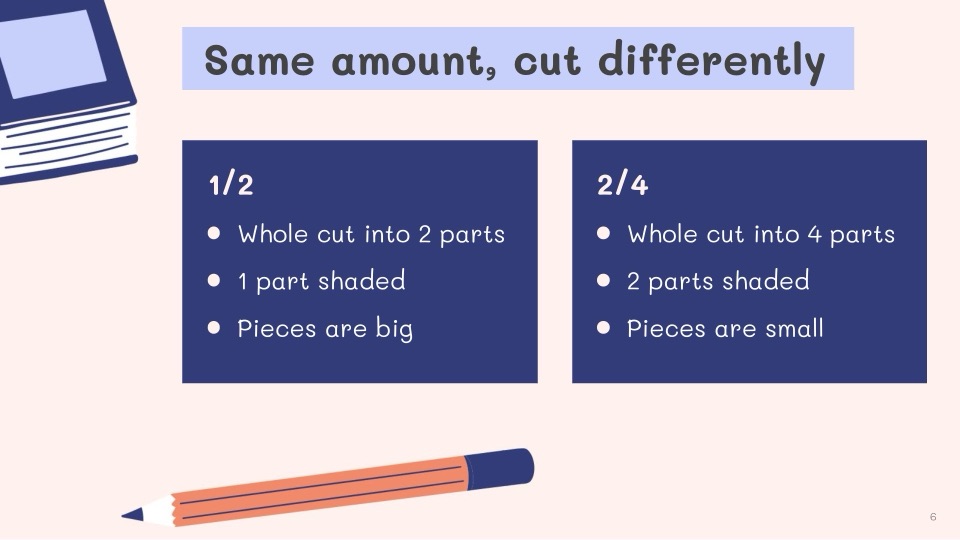
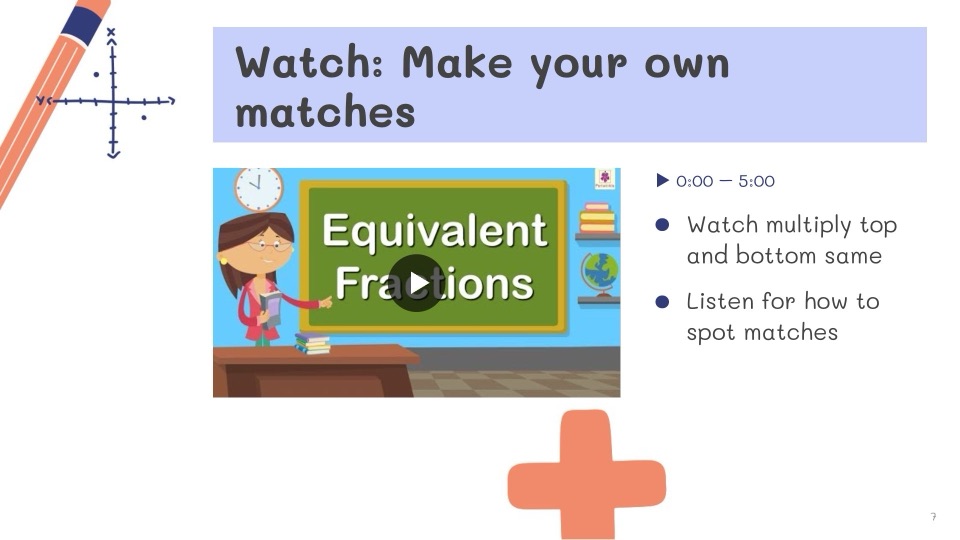
| 13 min | Teaching | Model why 1/2 equals 2/4 using bars and attention to number and size of parts. Show Slide 4 helpers and name strips, circles, and number line for comparing. Play Video clip 1 and tell students to count how shaded pieces grow as cuts grow. Show Slide 6 compare of 1/2 and 2/4 and draw the second cut live. Think aloud about big vs small pieces and write 1/2 = 2/4. |
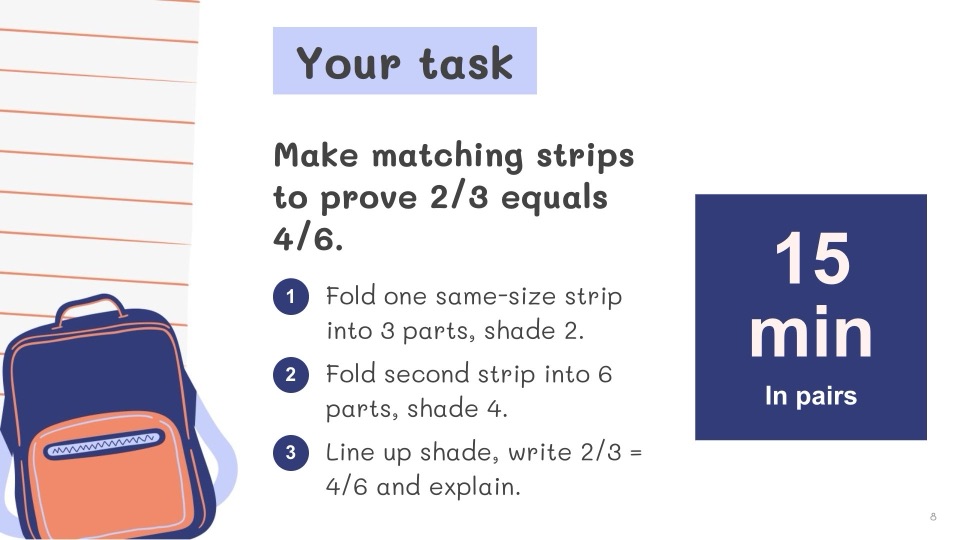
| 12 min | Guided practice | Prove together why 2/3 equals 4/6 and link the drawing to multiplication. Display Slide 8 task to prove 2/3 equals 4/6 with same-size wholes. Draw a same-size rectangle, split into 3, shade 2 to show 2/3. Add a second cut in each third and count to 6 total and 4 shaded. Show Slide 9 words and label numerator, denominator, and equivalent. |
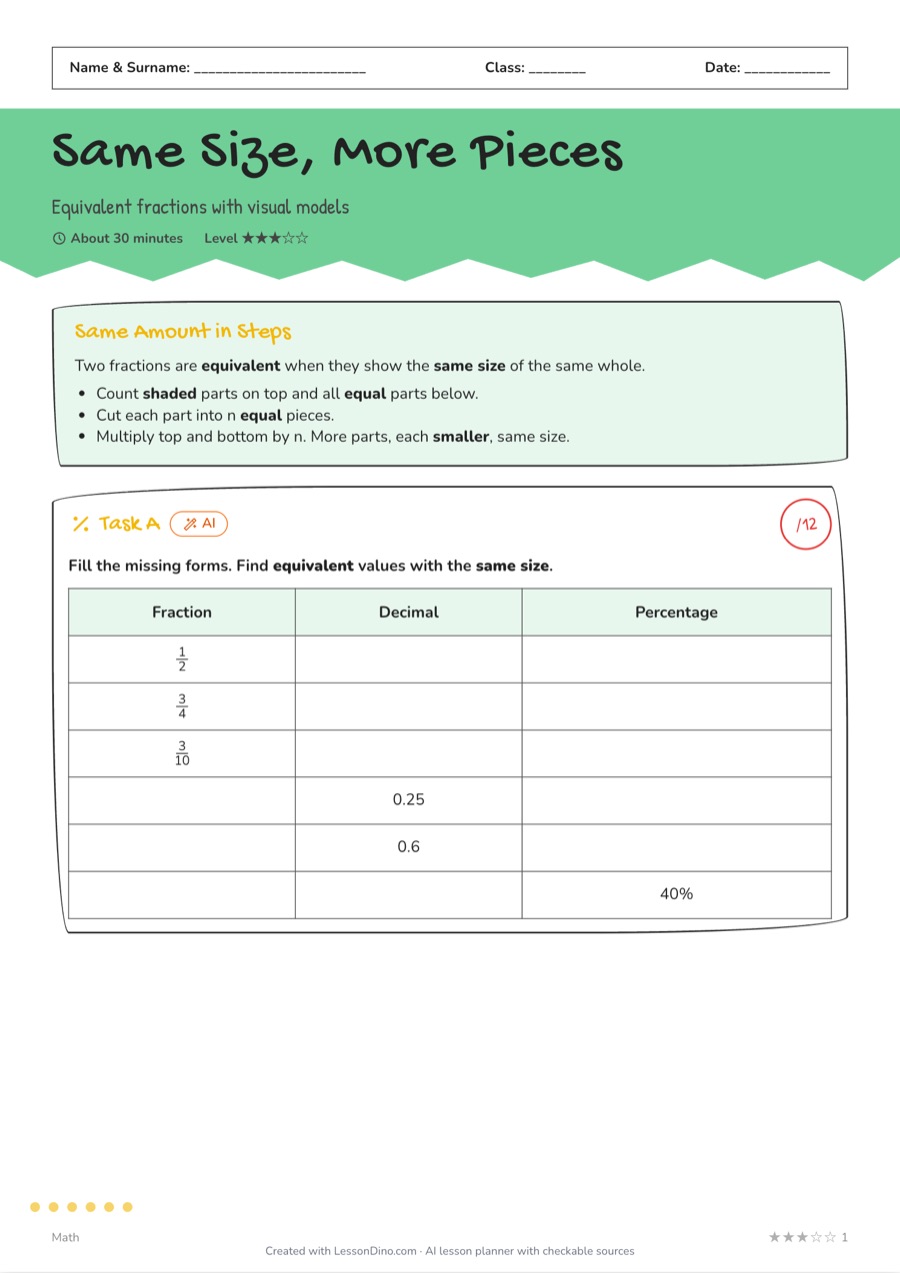
| 20 min | Main activity | Have pairs draw and label models that prove equivalent fractions. Hand out grid paper, colored pencils, rulers, and Worksheet Task C. Direct pairs to draw 2/3, then double-cut to 4/6 with = between. Circulate, ask about number and size, and prompt the multiplication label. Stop halfway for two pairs to show same-size shading. |
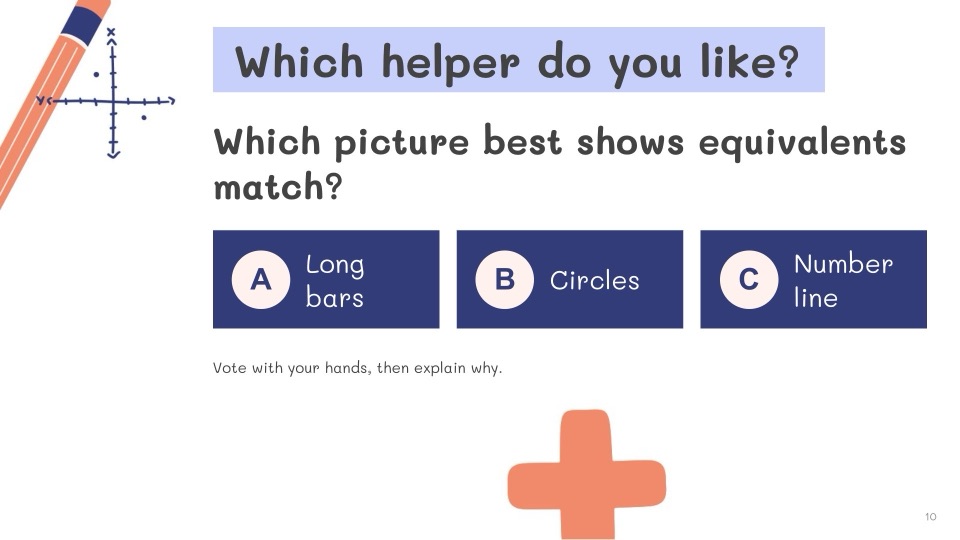
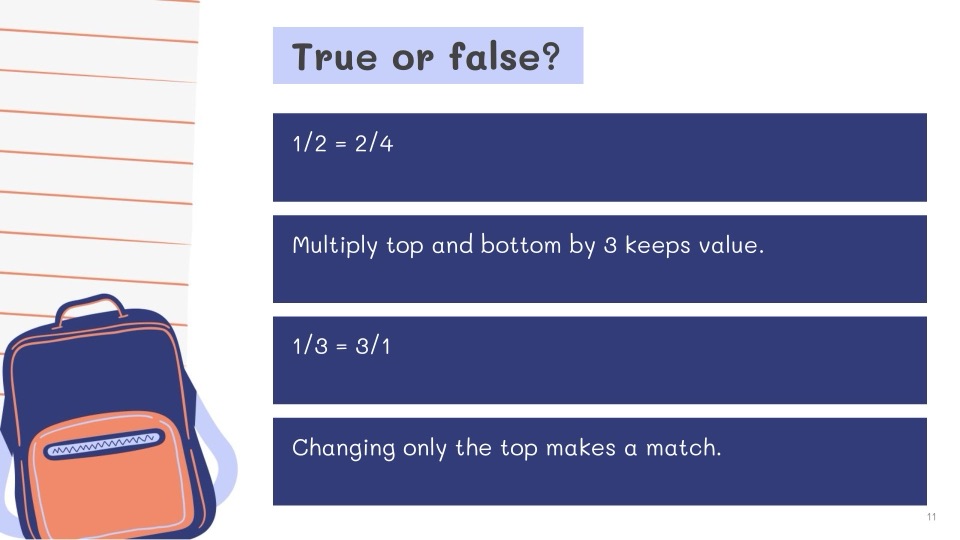
| 10 min | Plenary | Check understanding of parts vs size and the multiply rule for generating matches. Run Slide 10 vote on which helper best shows matches and take quick reasons. Show Slide 11 true-false and have students justify with part number and size. Give exit ticket on whiteboards and collect answers. Restate the rule and preview generating more matches tomorrow. |
Common mistakes
- Thinking 2/4 is bigger than 1/2 because 2 > 1 and 4 > 2.
How to spot it: Student says larger top or bottom means larger value.
Overlay same-size bars to show same shaded size and stress more parts means smaller parts. - Changing only the numerator or only the denominator.
How to spot it: Student writes 2/3 = 4/3 or 2/5 after cutting.
Recount both: each old part cut into n pieces, so both counts times n, which models (n x a)/(n x b). - Adding the same number instead of multiplying, like 2/3 = 4/5.
How to spot it: Student adds 2 to top and bottom.
Show with drawing that adding breaks equal cuts; you only multiply or divide top and bottom by the same amount to keep the value.
Support
- Provide outlines already split into thirds so students only add the second cut and count.
- Limit first models to halves, fourths, and eighths and model lining up right edges.
Stretch
- Have students draw a third version showing 6/9 and write the multiplication used.
- Have students make a set for 3/4 using eighths and twelfths and explain the pattern.
Check questions
- Draw or explain why 1/2 = 2/4 using number and size of parts.
Answer: Same whole, 2 parts to 4 parts, pieces smaller, same shaded size. - Fill the missing number: 2/3 = 8/12. What did you multiply by?
Answer: 4; (4 x 2)/(4 x 3) = 8/12. - True or false: 3/4 = 6/8 because top and bottom were both multiplied by 2.
Answer: True.
Curriculum
Explain why a fraction a/b is equivalent to a fraction (n × a)/(n × b) by using visual fraction models, with attention to how the number and size of the parts differ even though the two fractions themselves are the same size. Use this principle to recognize and generate equivalent fractions.
Video clips
Clips on YouTube, from the start and end times we chose. Check each one before you show it.
-
Why different fractions equal same size from 0:00 to 5:00
Maths With Kids: Equivalent Fractions Decoded | Why Different Fractions Equal the Same Thing
Directly explains why a/b equals (n x a)/(n x b) with visual models showing more parts but smaller size, in language perfect for ages 9-10.
-
Grade 4 equivalents from 0:00 to 5:00
Periwinkle: Equivalent Fractions | Mathematics Grade 4 | Periwinkle
Labeled for Grade 4 and teaches recognizing and generating equivalents, a perfect match for ages 9-10.
Worksheet
Sources
- Number & Operations—Fractions | Common Core State Standards ... thecorestandards.org
- CA CSS Math - Content Standards (CA Dept of Education) cde.ca.gov
- Equivalent fractions - Math Help - LibGuides at Tulsa ... guides.library.tulsacc.edu
- Equivalent Fractions - Ximera ximera.osu.edu
- Equivalent fractions - Copy of DIY Maths - LibGuides at ... libguides.cccua.edu
- 19 Equivalent Fractions Worksheets for Practice | Endolab ... endolab.ucdavis.edu
- Equivalents Fractions - Department of Mathematics at UTSA mathresearch.utsa.edu
- Equivalent Fractions When do two fractions represent the same csun.edu
- Equivalent fractions - KS2 Maths resources for Year 4 - BBC bbc.co.uk
- How to find equivalent fractions - BBC Bitesize bbc.co.uk
- Kids Math: Equivalent Fractions - Ducksters ducksters.com
- Kids Math: Introduction to Fractions - Ducksters ducksters.com
- Use the language of equivalent fractions correctly thenational.academy
- Flexi answers - How can you tell if a fraction is equivalent? | CK-12 Foundation ck12.org
- Equivalent Fractions For Kids | Fractions With The Same Value learnwithsitesforkids.com
- Equivalent Fractions Explained | Definition, Examples & Quiz ... workybooks.com
- The Significance of Understanding Equivalent Fractions beyondtraditionalmath.com
- How to Find Equivalent Fractions: Easy Methods and Tricks wikihow.com
- Equivalent Fractions - Math: Basic Tutorials - The Learning ... tlp-lpa.ca
- Equivalent Fractions mathsisfun.com
- Equivalent Fractions: Developing a Pathway of Students ... - ed files.eric.ed.gov
- equivalent fractions - calcsolver calcsolver.us
Made with Lesson Dino's AI on 17 October 2026. AI can make mistakes, so check facts against the sources before you teach.